Expression is the moment a cloned gene stops being an abstract sequence in a vector and becomes a working biological product. Once the recombinant DNA workflow has delivered a verified construct, the cell must be given the right genetic signals, the right physical environment and the right nutrients to transcribe that gene, translate the messenger RNA and fold the resulting polypeptide into a functional protein. This lesson examines that transition in detail, moving from the molecular logic of heterologous expression through the engineering of stirred-tank bioreactors and into the quantitative reasoning that governs large-scale production. The aim is practical fluency: understanding why a protein that expresses beautifully in a flask can fail in a thousand-litre vessel, and what an engineer does about it.
Large-scale production is not an afterthought appended to laboratory cloning; it is a distinct discipline with its own vocabulary, constraints and economics. A recombinant protein destined for therapeutic use may be required in kilogram quantities under strict regulatory scrutiny, while an industrial enzyme may need to be produced at costs measured in dollars per litre of fermentation broth. The bioreactor is the vessel in which raw materials are biologically converted into specific products, individual enzymes and other valuable molecules using microbial, plant, animal or human cells. It provides optimal conditions for achieving the desired product by controlling temperature, pH, substrate, salts, vitamins and oxygen, and it is the meeting point of biology and chemical engineering.
This lesson builds directly on the preceding work on isolation, cutting, ligation and PCR amplification, and it prepares the ground for downstream processing, quality control and product formulation. Here the focus stays inside the vessel: how expression is induced, how culture modes differ, how mixing and aeration deliver oxygen, how foaming and heat are managed, and how a process validated at bench scale is translated to industrial scale without losing yield or product quality. Each section pairs the underlying principle with the practical failure modes that experienced bioprocess scientists encounter routinely.
On This Page
- Expression of Cloned Genes in Heterologous Hosts
- From Laboratory Cultures to Industrial Bioreactors
- Controlling the Bioprocess Environment
- Quantitative Reasoning in Continuous Culture
- Alternative Bioreactor Designs and Scale-Up Engineering
- Scale-Up Constraints and Process Economics
- Expression, Bioreactors and Large-Scale Production
Expression of Cloned Genes in Heterologous Hosts
When a piece of foreign DNA is inserted into a cloning vector and transferred into a bacterial, plant or animal cell, the alien DNA gets multiplied. In almost all recombinant technologies, however, multiplication is only a means to an end: the ultimate aim is to produce a desirable protein. The recombinant DNA must therefore be expressed, and the foreign gene must be placed under conditions that allow transcription and translation to proceed efficiently. Expression in a host that is not the gene's natural owner is termed heterologous expression, and any protein encoding gene expressed in a heterologous host is called a recombinant protein. The technical details involved are considerable, and they begin with the construct itself.
Genetic Elements That Govern Expression
Productive expression requires more than a coding sequence. The gene must be positioned downstream of a promoter that the host RNA polymerase recognises, and that promoter should ideally be inducible so that biomass can be accumulated before the metabolic burden of protein synthesis is imposed. Ribosome binding sites, codon usage, messenger RNA secondary structure and the presence or absence of sequences that destabilise transcripts all influence yield. In E. coli, the lac, tac and T7 promoter systems are widely used because they can be switched on with isopropyl β-D-1-thiogalactopyranoside or by temperature shift, giving the operator deliberate control over the timing of induction.
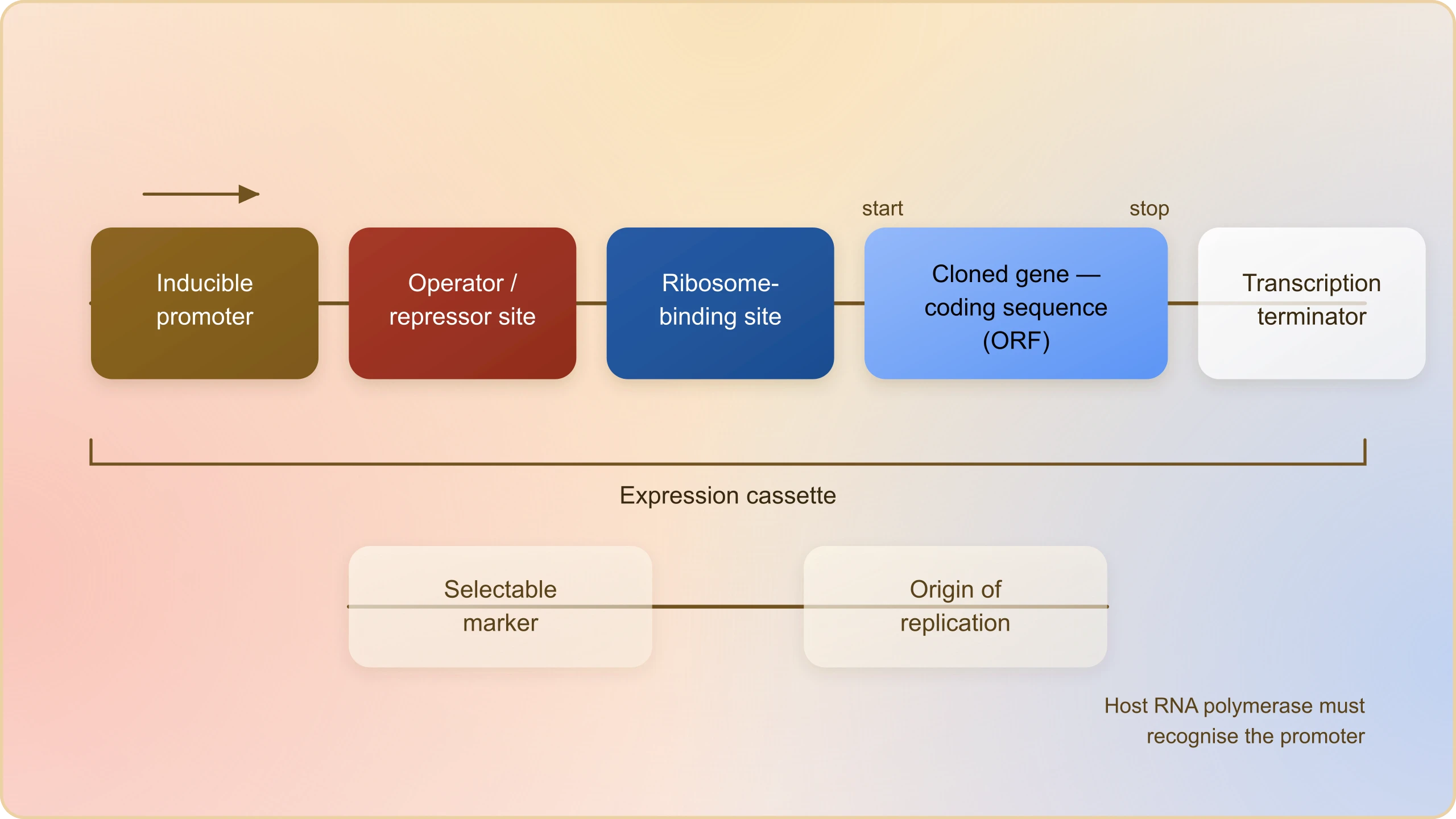
Induction timing is itself a design decision. Inducing too early diverts resources away from growth and can reduce final volumetric productivity; inducing too late leaves insufficient time for accumulation. A common laboratory heuristic is to grow the culture to mid-exponential phase, typically an optical density at 600 nm of 0.5 to 0.8, before adding inducer, then harvest several hours later. Beyond timing, the choice of host determines whether post-translational modifications such as glycosylation, disulfide bond formation and proteolytic processing will occur at all, which is why the host is selected with the target protein's final structure in mind rather than convenience alone.
Choosing Among Expression Hosts
Each expression platform carries a distinct balance of speed, cost, yield and biological fidelity. E. coli grows rapidly on inexpensive media and can accumulate recombinant protein to a large fraction of total cellular protein, but it cannot glycosylate proteins and often deposits complex eukaryotic proteins as insoluble inclusion bodies. Yeasts such as Pichia pastoris and Saccharomyces cerevisiae offer eukaryotic folding machinery and secretory expression at moderate cost. Insect cells infected with baculovirus, mammalian cell lines such as CHO and HEK293, and transgenic plants extend the range further, each trading higher cost and slower growth for greater authenticity of the final product.

The consequences of a poor host choice are rarely subtle. A therapeutic glycoprotein produced in bacteria will lack the carbohydrate structures on which its serum half-life and receptor interactions depend, while a simple industrial enzyme that needs no modification may be produced far more cheaply in a microbial system. Host selection therefore sits at the intersection of molecular biology and process economics, and it is normally fixed early in development because changing hosts later invalidates almost every upstream and downstream parameter that has been optimised around the original choice.
We Also Published
From Laboratory Cultures to Industrial Bioreactors
The cells harbouring cloned genes of interest may be grown on a small scale in the laboratory, and those cultures can be used for extracting the desired protein and purifying it by different separation techniques. Small volume cultures, however, cannot yield appreciable quantities of products. To produce in large quantities, the development of bioreactors was required, vessels in which large volumes of culture, typically 100 to 1000 litres and often far more in industry, can be processed. A bioreactor can be thought of as a vessel in which raw materials are biologically converted into specific products, individual enzymes and other molecules using microbial, plant, animal or human cells.
The engineering brief for such a vessel is deceptively simple: provide optimum growth conditions of temperature, pH, substrate, salts, vitamins and oxygen, and do so uniformly throughout a large liquid volume. Uniformity is the hard part. A bench flask is small enough that diffusion and gentle shaking keep gradients modest, whereas an industrial tank several metres tall develops spatial gradients in dissolved oxygen, pH and nutrient concentration that can be substantial. The bioreactor's control systems exist precisely to suppress those gradients and to hold the culture in its physiologically most active state for as long as possible.
Anatomy of the Stirred-Tank Bioreactor
The most commonly used bioreactors are of the stirring type. A stirred-tank reactor is usually cylindrical, or has a curved base to facilitate mixing of the reactor contents, and the stirrer promotes even mixing and oxygen availability throughout the vessel. Alternatively, air can be bubbled through the reactor. A typical unit carries an agitator system, an oxygen delivery system, a foam control system, a temperature control system and a pH control system, together with sampling ports so that small volumes of the culture can be withdrawn periodically for analysis without compromising sterility.
The sparged variant introduces sterile air as bubbles through a sparger at the base, which greatly increases the interfacial area available for oxygen transfer and is essential for high-density aerobic cultures. Impellers, usually Rushton turbines or pitched-blade designs, disperse those bubbles and prevent them from channelling straight to the headspace. Baffles break up the swirling vortex that a bare impeller would create. Every one of these components is a deliberate answer to a physical problem, and the arrangement of the tank reflects decades of accumulated fermentation engineering practice.
Culture Modes: Batch, Fed-Batch and Continuous
Cells can be multiplied in a continuous culture system wherein the used medium is drained out from one side while fresh medium is added from the other, maintaining the cells in their physiologically most active log or exponential phase. This culturing method produces a larger biomass, leading to higher yields of the desired protein. In a simple batch culture, by contrast, nutrients are supplied once at the start and the culture passes through lag, exponential, stationary and decline phases, with product formation often ceasing as growth slows. Fed-batch culture occupies the middle ground and dominates industrial practice.
In fed-batch operation, a concentrated nutrient feed is added gradually so that the growth rate is controlled rather than left to the organism's appetite. This matters because excess glucose in E. coli triggers overflow metabolism, producing acetate that inhibits growth and reduces recombinant protein yield, while in yeast it causes catabolite repression and ethanol accumulation. By limiting the feed, the operator avoids substrate inhibition and catabolite repression simultaneously, extending the exponential phase and raising final biomass and product titre. Continuous culture, though elegant for steady-state studies, is rarely used for regulated production because of the risk of genetic instability and contamination over long run times.
Controlling the Bioprocess Environment
A bioreactor is only as good as its instrumentation and control loops. Dissolved oxygen, pH, temperature, foaming and nutrient feed are the five parameters that most directly determine whether a culture thrives or collapses, and each requires a sensor, a controller and an actuator working in concert. The dissolved oxygen probe typically reads a value expressed as a percentage of air saturation, and the controller manipulates agitation speed, airflow rate or the oxygen fraction in the inlet gas to hold the setpoint. Because oxygen is sparingly soluble in water, the supply side is almost always the binding constraint in high-density aerobic culture.
pH control follows a similar logic, with setpoints usually held near 7.0 for bacteria and near 7.2 for mammalian cells, corrected by automatic addition of acid or base. Temperature is maintained by a water jacket or internal coil, and the controller must anticipate the metabolic heat that a dense culture generates. Foaming arises from the surfactants and proteins that accumulate in broth, and it is managed with mechanical foam breakers or by dosing antifoam agents such as silicone emulsions or polypropylene glycol. Each control loop interacts with the others, which is why tuning a bioreactor is a systems problem rather than a checklist.
Agitation, Aeration and Oxygen Transfer
Oxygen transfer is quantified by the volumetric mass transfer coefficient, ##k_La##, which has units of reciprocal time and expresses how quickly oxygen moves from the gas phase into the liquid. The oxygen uptake rate of the culture must not exceed the transfer capacity, or dissolved oxygen falls and metabolism shifts toward less efficient pathways. The balance can be written as a simple differential equation for dissolved oxygen concentration ##C_L##:
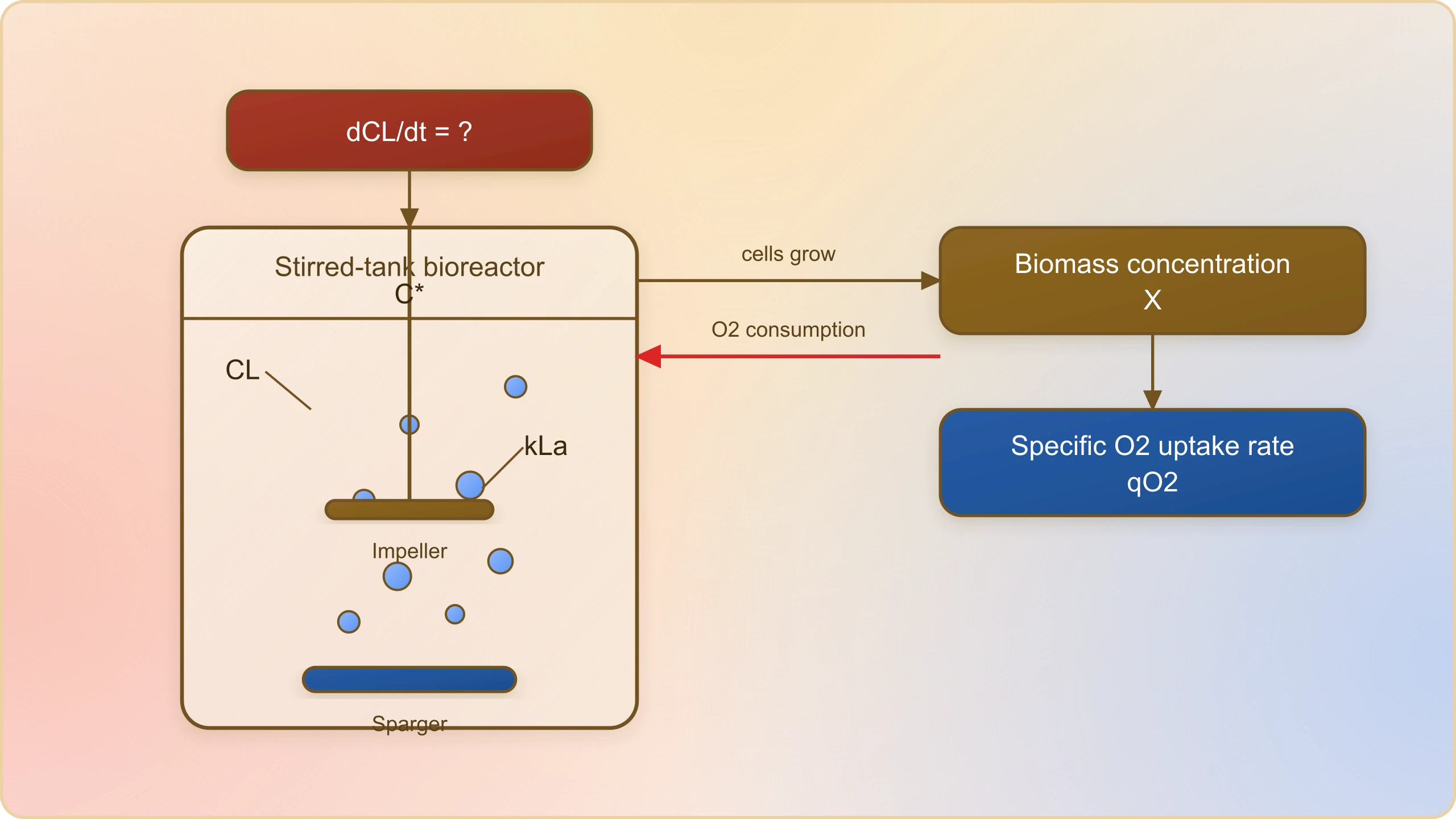
Here ##C^{*}## is the saturation concentration of oxygen in the broth, ##q_{O_2}## is the specific oxygen uptake rate and ##X## is the biomass concentration. At steady state the derivative is zero, so the maximum sustainable biomass is set by the ratio of transfer capacity to specific demand. Increasing agitation raises ##k_La## but also raises shear stress, which damages fragile mammalian cells and can fragment fungal mycelia. Sparging raises the driving force but promotes foaming. The engineer's task is to find the operating window where oxygen supply is adequate and shear remains tolerable.
Foaming, Antifoam and Heat Removal
Foam is more than a nuisance. It coats probes, reduces working volume, blocks exhaust filters and can cause contamination when it overflows into the headspace. Antifoam agents lower surface tension and collapse the foam, but they are added sparingly because excess antifoam reduces ##k_La## by suppressing bubble breakup and can complicate downstream purification. Mechanical foam control, using a rotating breaker in the headspace, avoids the chemical burden but adds mechanical complexity. A well-run process usually combines both approaches, dosing antifoam on demand from a foam-sensing probe rather than continuously.
Heat removal is the quiet constraint that often limits scale. Microbial cultures generate metabolic heat roughly in proportion to oxygen consumption, and the surface area available for cooling grows more slowly than the volume as a tank is enlarged. A vessel that cools comfortably at 100 litres may require an external heat exchanger or a chilled water loop at 10,000 litres. This geometric reality, in which volume scales with the cube of the linear dimension while surface area scales with the square, is the single most important reason that scale-up is not simply a matter of building a bigger tank.
Quantitative Reasoning in Continuous Culture
Continuous culture rewards quantitative treatment because it reaches a genuine steady state. In a chemostat, fresh medium enters at volumetric flow rate ##F## and broth leaves at the same rate, so the working volume ##V## stays constant. The dilution rate is defined as the flow per unit volume, and it sets the specific growth rate of the culture at steady state. This relationship is the foundation of steady-state bioprocess analysis and gives the operator direct control over growth rate through a pump setting, which is a remarkable degree of authority over a living system.
At steady state the specific growth rate ##\mu## equals the dilution rate ##D##, provided the substrate concentration is sufficient to support that rate. If the dilution rate is pushed above the maximum specific growth rate ##\mu_{max}##, the cells are washed out faster than they can divide and the culture collapses. This washout threshold is a hard operational boundary, and it explains why chemostats are run well below ##\mu_{max}## when long-term stability matters. The Monod relationship links growth rate to the residual substrate concentration ##S## through the half-saturation constant ##K_s##.
A Worked Biomass Yield Calculation
Consider a chemostat with a working volume of 10 litres fed at 2 litres per hour, giving a dilution rate of 0.2 per hour. Suppose the feed contains 20 grams per litre of glucose, the biomass yield coefficient ##Y_{X/S}## is 0.5 grams of cells per gram of substrate, and the residual substrate at steady state is negligible. The biomass concentration is then the product of yield and substrate consumed, giving 10 grams per litre, and the volumetric productivity is the product of biomass concentration and dilution rate, or 2 grams per litre per hour. Over a day the vessel produces roughly 480 grams of cells.


The same arithmetic extends to product titre. If the specific product formation rate is 0.05 grams of product per gram of cells per hour, the volumetric product productivity is 10 grams per litre multiplied by 0.05 per hour, giving 0.5 grams per litre per hour. These simple balances let an engineer predict whether a proposed process can meet demand before any steel is cut. They also reveal the levers available: raise biomass, raise specific productivity, or raise dilution rate, each with its own biological and physical limits.
Interpreting the Numbers Critically
Textbook calculations assume ideal mixing and neglect maintenance energy, which real cells expend on functions unrelated to growth. A maintenance coefficient reduces the apparent yield at low growth rates, so a chemostat run at a very low dilution rate delivers less biomass than the simple model predicts. Plasmid loss and segregational instability add a further complication, because cells that have discarded the recombinant plasmid often outgrow their productive siblings. A production process must therefore include selection pressure, such as an antibiotic marker in small-scale work or a auxotrophy-based system at scale, to keep the productive population dominant.
Product titre also depends on whether the protein is secreted or retained intracellularly. Secretion simplifies downstream processing but imposes a transport burden on the cell and exposes the product to proteases in the broth. Intracellular accumulation gives higher volumetric titre but demands cell disruption before purification. These considerations belong partly to the next lesson on downstream processing, yet they must be anticipated here, because the choice of culture mode and expression strategy determines what the purification team will eventually receive.
Alternative Bioreactor Designs and Scale-Up Engineering
Stirred tanks dominate because they are versatile and well understood, but they are not the only option. Airlift bioreactors use a draft tube and rising gas bubbles to circulate the broth, providing mixing and aeration without an impeller, which reduces shear and suits fragile cells. Packed-bed reactors immobilise cells or enzymes on a solid support and pass medium through the bed, giving high volumetric productivity for secreted products. Fluidised-bed reactors keep the support particles suspended by an upward flow, avoiding the clogging that plagues packed beds. Each design is a different answer to the same question of how to contact cells, nutrients and oxygen efficiently.
Disposable single-use bioreactors have reshaped the landscape over the past two decades. A sterile plastic bag with an internal mixing element, held in a rigid support, replaces a stainless-steel vessel for a single campaign. This eliminates cleaning and sterilisation validation between batches, shortens changeover time and lowers capital cost, which is attractive for clinical manufacturing and for facilities producing multiple products in small volumes. The trade-offs are limited mechanical strength, restricted operating pressure, extractables and leachables from the plastic film, and a practical upper size limit that keeps single-use technology mostly in mammalian cell culture rather than large microbial fermentation.
The Physics of Scale-Up
Scale-up is the translation of a process from a validated small vessel to a larger one without loss of performance. The difficulty is that no single parameter can be held constant across scales. If the engineer holds impeller tip speed constant, mixing time lengthens and oxygen transfer may fall short; if oxygen transfer is held constant by increasing power input, shear rises and heat generation grows. Mixing time in a large tank can be tens of seconds compared with a second or two in a laboratory vessel, so a pulse of feed or base added at the top may not be dispersed before local pH or substrate extremes damage the culture.
Oxygen transfer capacity, expressed through ##k_La##, is usually the first parameter chosen for matching, because oxygen demand scales with volume while supply depends on interfacial area and power density. Heat removal is the second, and it frequently becomes limiting before oxygen does. Shear stress is the third, and it matters most for mammalian and insect cells, which lack a cell wall and can be damaged by turbulent eddies smaller than the cell itself. A successful scale-up strategy identifies which of these constraints binds first and designs the large vessel around it, accepting compromises elsewhere.
Common Mistakes and Troubleshooting
Several failure patterns recur so often that they are worth naming. Foaming that overwhelms the headspace usually signals excess protein accumulation or an unbalanced feed, and the reflex of adding more antifoam can worsen oxygen transfer. A sudden fall in dissolved oxygen despite maximum agitation often indicates an oxygen demand that has outgrown the sparger's capacity, requiring oxygen enrichment of the inlet gas rather than more stirring. pH drift that resists correction may point to a failing probe or to metabolic acid production from an unintended carbon source. Each symptom has a physical explanation, and diagnosis proceeds by isolating the control loop responsible.
Plasmid instability deserves particular attention because it is invisible until productivity collapses. Cells that lose the recombinant plasmid grow faster than their productive neighbours, so a long fed-batch run can end with a population dominated by non-producers. Antibiotic selection is impractical at industrial scale because of cost and environmental release, so stable systems use auxotrophic complementation or integration of the gene into the chromosome. Temperature-inducible systems and tightly controlled promoters also help by delaying the metabolic burden until the biomass has been accumulated, which is the central logic of two-stage production.
Scale-Up Constraints and Process Economics
The transition from a 2-litre flask to a 2000-litre tank exposes every assumption embedded in the small-scale process. Mixing time, oxygen transfer, heat removal and shear stress all change with geometry, and they do not change in proportion. A process that is oxygen-limited at bench scale may become heat-limited at pilot scale and shear-limited at production scale, so the binding constraint migrates as the vessel grows. Experienced engineers therefore characterise the process across at least two scales before committing to a production design, using pilot vessels of 100 to 1000 litres as the bridge between laboratory and plant.
Computational fluid dynamics has become a standard tool for predicting flow patterns, dead zones and local shear in large vessels before they are built. It cannot replace empirical measurement, but it narrows the design space and identifies configurations likely to fail. Tracer studies, in which a pulse of inert marker is injected and its dispersion measured at the outlet, give the mixing time directly and reveal whether the vessel behaves as a well-mixed system or as a network of poorly connected regions. These measurements feed back into impeller selection, baffle placement and sparger design.
Economic and Regulatory Dimensions
Process economics shape technical choices as much as biology does. Capital cost, consumable cost, labour, utilities and the fraction of product lost in purification all enter the calculation, and a process that maximises titre may not minimise cost per kilogram of purified product. A very high-titre fermentation that produces a large amount of contaminating protein can be more expensive overall than a moderate-titre process that is easier to purify. This is why upstream and downstream teams negotiate over expression strategy, secretion versus intracellular accumulation, and the choice of host, rather than working in isolation.
Regulatory expectations add a further layer. A manufacturing process must be validated to produce a consistent product, and changes to the process after approval require formal comparability studies. This creates a strong incentive to fix the process design early and to understand it thoroughly, because a change of bioreactor scale or culture mode late in development is expensive and slow. Quality by design principles encourage the identification of critical process parameters and their acceptable ranges, so that the operator knows which variables genuinely affect product quality and which can be adjusted freely without regulatory consequence.
Preparing for Downstream Processing
The choices made inside the bioreactor determine what the downstream team receives. A secreted product arrives in a large volume of relatively dilute broth that must be concentrated and clarified, while an intracellular product arrives in a smaller volume of cells that must be disrupted. High cell density increases the burden on centrifugation and filtration, and antifoam or media components can interfere with chromatography. The fermentation endpoint, whether at a fixed time or triggered by a drop in growth rate, also affects the ratio of product to contaminants, because proteases released from lysed cells degrade the product if harvest is delayed.
Understanding these connections is the mark of a process scientist rather than a technician. The bioreactor is not an isolated unit operation but the first stage of an integrated manufacturing train, and decisions taken there propagate through every subsequent step. The next lesson takes up that train in detail, covering cell disruption, separation, chromatography, formulation and the quality control that demonstrates the product meets specification. The present lesson has established the upstream half of that story: how a cloned gene is expressed, how the culture environment is controlled, and how the process is scaled without losing the biology that made it work.
Expression, Bioreactors and Large-Scale Production
Bringing the lesson together, the path from a cloned gene to an industrial product runs through four connected decisions. First, the gene must be placed under a promoter the chosen host recognises and induced at a time that balances growth against protein synthesis. Second, the host must be selected for the post-translational modifications the product requires, accepting the associated cost and growth rate. Third, the culture mode must be chosen to avoid substrate inhibition and catabolite repression, which in practice means fed-batch for most recombinant proteins. Fourth, the vessel must be designed and controlled so that oxygen, pH, temperature and foam remain within limits at every point in the broth.
Each of these decisions constrains the others. A mammalian host demands gentler agitation and more expensive media, which pushes the process toward single-use bioreactors and perfusion culture. A bacterial host permits vigorous sparging and high oxygen transfer, which makes large stainless-steel tanks economical but risks inclusion body formation. A secreted product simplifies purification but dilutes the broth and exposes the protein to proteases. The process scientist holds all of these considerations simultaneously, and the mark of competence is the ability to explain why a particular combination was chosen rather than merely to describe what was done.
The quantitative tools introduced here, from the dilution rate relationship to the oxygen balance and the yield calculation, are deliberately simple. They are not intended to replace detailed kinetic modelling but to build intuition about which variables matter and how they interact. An engineer who can estimate biomass productivity from a feed rate, or predict washout from a growth rate, is far better equipped to diagnose a failing run than one who relies on intuition alone. These estimates also frame conversations with downstream colleagues, because they indicate how much material will arrive and in what form.
Looking ahead, the next lesson follows the product out of the bioreactor and into purification, quality control and formulation. The harvest step, the choice of chromatography resins, the validation of clearance for viruses and impurities, and the formulation of a stable final product all depend on decisions made upstream. A fermentation that produces a correctly folded, soluble protein at high titre makes downstream processing straightforward; one that produces aggregated protein in a dilute broth makes it a struggle. The upstream process is therefore the foundation on which the entire manufacturing train rests, and it deserves the careful, quantitative attention this lesson has given it.
From our network :
- EV 2.0: The Solid-State Battery Breakthrough and Global Factory ExpansionDiscover the impact of the Solid-State Battery Breakthrough on the EV market. Learn about CATL and BYD stock growth, global factory expansion in Europe, and the future of EV 2.0 technology.
- Trump Political Strategy How Geopolitical Stunts Serve As Media Diversions
- Analyzing Trump Deportation Numbers Insights Into The 2026 Immigration Crackdown
- Do You Need a New Router or Is Your Internet Plan the Problem?A practical comparison of the signs that point to router limits versus signs your broadband speed or provider is the bottleneck, so you can decide what to replace before spending money.
- AI-Powered 'Precision Diagnostic' Replaces Standard GRE Score ReportsDiscover the new GRE Precision Diagnostic. Learn how AI-powered behavioral analytics and time-to-solve tracking are replacing standard GRE score reports to empower students.
- 98% of Global MBA Programs Now Prefer GRE Over GMAT Focus EditionExplore why 98% of global MBA programs now prefer the GRE over GMAT Focus. Learn about the shorter GRE format, verbal logic importance, and strategic versatility for students.
- How to Print Cheaply: Cutting the Cost per PageA practical, measured guide to lowering what each printed page costs — duplex and draft modes, third-party ink, yield mathematics, and knowing when a new printer beats refills.
- 10 Physics Numerical Problems with Solutions for IIT JEEPrepare for IIT JEE with 10 physics numerical problems, complete with detailed solutions and conceptual explanations. Ideal for mastering kinematics, thermodynamics, electromagnetism, and optics.
- Where to Put Your Wireless Router for Better CoverageA practical, physics-grounded guide to router placement: why the centre of the home beats the corner, how walls and metal sap signal, and how to run a simple survey that proves the improvement.