Every ecosystem on Earth functions simultaneously as a factory, a filter, a climate regulator, and a cultural inheritance. The air we breathe has been conditioned by forests and phytoplankton; the water we drink has passed through soils, wetlands, and microbial communities that strip away contaminants; the crops we harvest depend on pollinators, nutrient cycles, and rainfall patterns shaped by vegetation thousands of kilometres away. These are not charitable gifts from nature but the measurable outputs of ecological processes—productivity, decomposition, energy flow, and nutrient cycling—operating at scales from a handful of soil to an entire biome. When ecologists speak of ecosystem services, they are naming the point at which ecology becomes economics, public health, and governance.
This lesson examines that intersection with the precision the subject demands. It begins with the fourfold classification formalised by the Millennium Ecosystem Assessment in 2005—provisioning, regulating, supporting, and cultural services—and then tests that framework against real cases: pollination in agricultural landscapes, water purification in forested catchments, carbon sequestration in peatlands, and the recreational and spiritual values attached to landscapes. From there, the discussion turns to valuation, including the landmark global estimate published by Costanza and colleagues in 1997, and to the less comfortable concept of ecosystem disservices, where ecological processes impose costs rather than benefits on human populations.
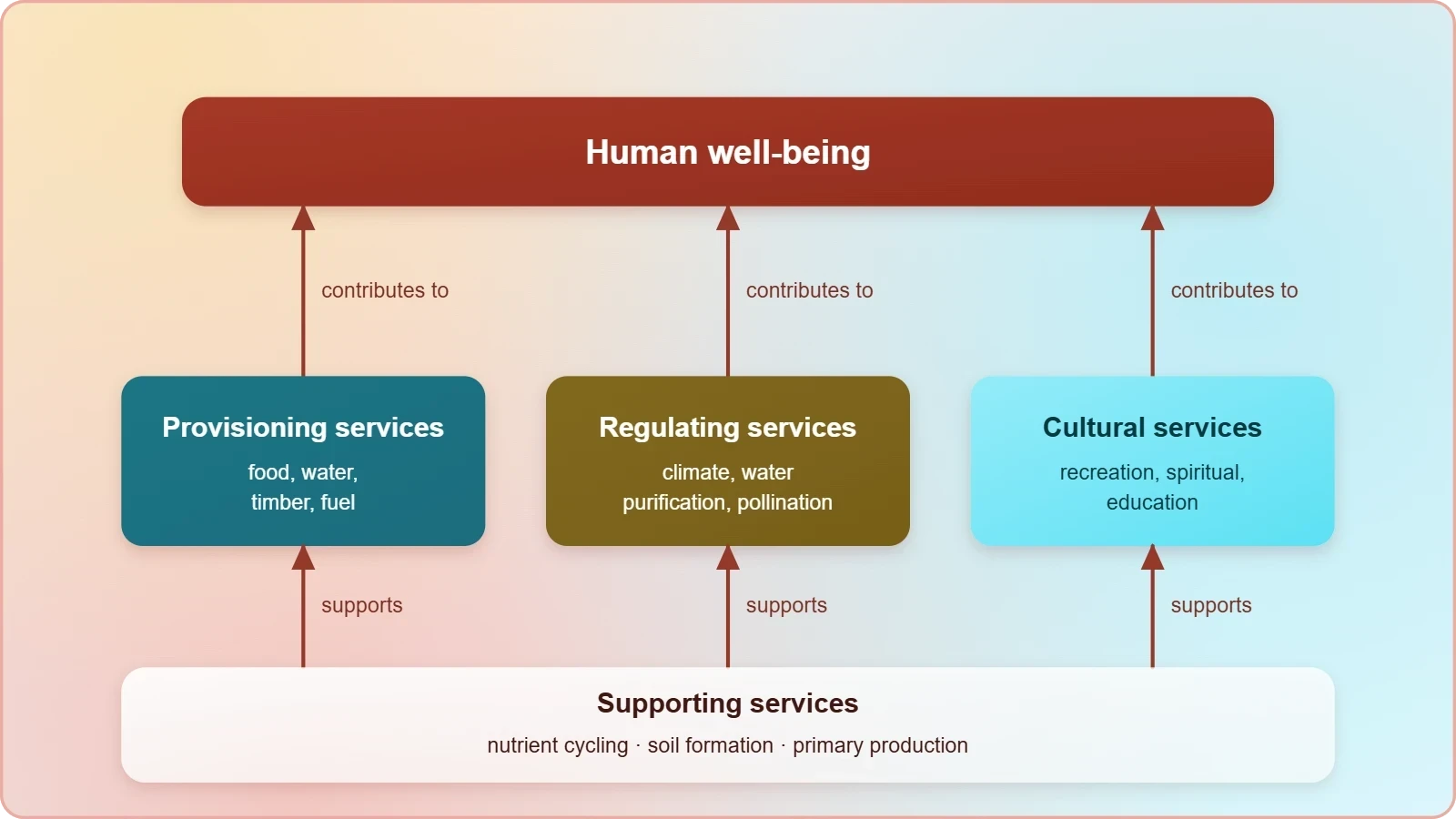
Because this lesson follows directly from nutrient cycling, it assumes fluency with gaseous and sedimentary cycles and uses that foundation to explain how services are generated and how they fail. It also prepares the ground for the quantitative ecology that follows, where measurement, sampling, and modelling of ecosystem processes take centre stage. The central argument is straightforward: human well-being is not an externality of the biosphere but a direct function of it, and the degradation of ecosystems is therefore a measurable withdrawal from a shared account.
On This Page
- The Millennium Ecosystem Assessment and the Architecture of Services
- Provisioning and Regulating Services in Practice
- Valuing Ecosystem Services: Methods and Controversies
- Keystone Species and the Stability of Service Delivery
- Land-Use Change and the Erosion of Service Capacity
- Human Well-Being, Equity, and the Governance of Dependence
The Millennium Ecosystem Assessment and the Architecture of Services
The Millennium Ecosystem Assessment, commissioned by the United Nations and published in 2005, remains the most influential attempt to systematise the relationship between ecosystems and human welfare. Drawing on the work of more than 1,300 scientists across 95 countries, it concluded that approximately 60 percent of the ecosystem services it examined were being degraded or used unsustainably. The assessment reframed conservation from a question of protecting nature for its own sake to a question of maintaining the biological infrastructure on which food security, health, and economic activity depend. Its four-category framework—provisioning, regulating, supporting, and cultural—has since become the standard vocabulary of environmental policy, ecological economics, and sustainable development planning worldwide.
Defining the Four Service Categories
Provisioning services are the tangible products harvested from ecosystems: food, fresh water, timber, fibre, fuelwood, and genetic resources. Regulating services are the benefits obtained from the control of ecological processes, including climate regulation through carbon storage, flood attenuation by wetlands, water purification by soils and vegetation, disease regulation, and pollination. Supporting services underpin all the others and include soil formation, nutrient cycling, primary production, and oxygen generation. Cultural services encompass the non-material benefits—recreation, aesthetic value, spiritual significance, education, and sense of place—that ecosystems provide to human societies and that resist easy monetisation.
The categories are analytically useful but not watertight, and students should recognise the overlaps. Pollination is classified as a regulating service, yet it directly provisions roughly three-quarters of the world's leading food crops. Nutrient cycling is a supporting service, but when it fails, the result is a provisioning failure measured in lost yield. The framework's strength lies in forcing explicit recognition of services that markets ignore; its weakness lies in the temptation to treat the four boxes as independent when ecological reality is a single, tightly coupled system in which supporting processes generate regulating outcomes that enable provisioning flows.
Supporting Services as the Ecological Foundation
Supporting services deserve particular attention because they are the ecological machinery described in earlier lessons. Primary productivity—the capture of solar energy by producers, divided into gross and net primary productivity—is the ultimate source of all provisioning services. Decomposition, operating through fragmentation, leaching, and catabolism, returns nutrients to circulation and maintains soil fertility. Nutrient cycling, whether gaseous like carbon or sedimentary like phosphorus, determines the long-term capacity of an ecosystem to sustain production. These processes have no direct market price, which is precisely why they are so easily degraded: their value becomes visible only when they collapse and the dependent services fail.
Provisioning and Regulating Services in Practice
Abstract categories acquire meaning only when attached to concrete ecological processes, and the most instructive cases sit at the boundary between provisioning and regulating services. Pollination is the clearest example. Roughly 75 percent of leading global food crops benefit from animal pollination to some degree, and the annual market value of the crops dependent on pollinators has been estimated in the hundreds of billions of dollars. The service is delivered by wild insects, managed honeybee colonies, and in some regions by birds and bats, all of which depend on habitat that supports nesting sites, forage, and refuge from pesticides. When those habitats disappear, the provisioning service fails, and the failure is invisible until harvest yields drop.
Pollination, Water Purification, and Carbon Sequestration
Water purification illustrates the same coupling. Forested catchments and wetlands filter sediment, absorb excess nitrogen and phosphorus, and break down pathogens, delivering water that requires less treatment before human consumption. The city of New York famously avoided building a filtration plant costing several billion dollars by investing roughly one to one and a half billion dollars in protecting and restoring the Catskill-Delaware watershed, a decision that converted a regulating service into a hard financial saving. Carbon sequestration operates on a longer timescale: forests, peatlands, and ocean plankton absorb atmospheric carbon dioxide, moderating climate change, with peatlands storing more carbon per hectare than any other terrestrial ecosystem despite covering only about three percent of land area.
These examples share a structural feature worth emphasising. The service is produced by a functioning ecological community, not by a single species, and it is therefore vulnerable to the loss of any critical component. Pollination requires not just bees but the flowering plants that sustain them through the season; water purification requires not just trees but the soil biota that process nutrients; carbon sequestration requires not just vegetation but the decomposer communities that determine whether carbon is stored or respired. This is why the supporting services discussed earlier cannot be treated as optional background—they are the production line on which the visible services depend.
Cultural Services and the Non-Material Dimension
Cultural services resist the accounting logic applied to provisioning and regulating services, yet they are no less real. Recreation, tourism, aesthetic enjoyment, spiritual practice, and educational use all depend on intact ecosystems, and their economic footprint is substantial: nature-based tourism constitutes a significant share of the global travel economy, and property values near green space and clean water consistently exceed those in degraded surroundings. Cultural services also carry equity implications, because access to green space and clean environments is unevenly distributed across income groups and geographies. Attempts to price these services often founder on the difficulty of assigning monetary values to experiences that are, by their nature, not traded in markets.
Valuing Ecosystem Services: Methods and Controversies
Assigning monetary values to ecosystem services is an exercise in translation, and like all translation it loses something in transit. The most cited attempt is the 1997 paper by Robert Costanza and colleagues, published in Nature, which estimated the total annual value of the world's ecosystem services at approximately 33 trillion US dollars—a figure larger than global gross national product at the time. The estimate was derived by aggregating published valuations across biomes and service types, and it provoked both admiration for its ambition and criticism for its methodological heterogeneity. Its lasting contribution was not the number itself but the demonstration that ecosystem services could be compared, however imperfectly, with conventional economic activity.
Revealed Preference, Stated Preference, and Replacement Cost
Valuation methods fall into several families. Revealed preference approaches infer value from observable behaviour, such as the travel costs people incur to visit a national park or the price premium commanded by properties near clean water. Stated preference methods, including contingent valuation and choice experiments, ask people directly what they would pay for a specified environmental change. Replacement cost and avoided cost methods estimate the expense of substituting a technological alternative—a water treatment plant in place of a forested catchment, or hand pollination in place of wild insects. Each method carries assumptions that can be challenged, and results vary widely with framing, income levels, and cultural context.
The deeper controversy concerns commensurability. Critics argue that reducing a coral reef or a sacred grove to a single monetary figure strips away values that are not substitutable and may license their destruction wherever the price seems acceptable. Defenders respond that in a world where development decisions are routinely made in monetary terms, refusing to value nature is equivalent to valuing it at zero. The practical resolution adopted by many governments and multilateral institutions is to use valuation as one input among several, alongside ecological thresholds and equity considerations, rather than as a decisive verdict. Payment for ecosystem services schemes, carbon markets, and biodiversity offsets all rest on this uneasy compromise.
Ecosystem Disservices and the Cost Side of the Ledger
Ecosystems do not only confer benefits. The concept of ecosystem disservices captures the harms that ecological processes impose on human welfare: crop damage by pests and pathogens, allergic reactions to pollen, disease transmission by mosquitoes and ticks, flooding exacerbated by beaver activity or vegetation blockage, and the nuisance and infrastructure damage caused by invasive species. Recognising disservices prevents a sentimental view of nature in which all ecological processes are assumed beneficial. It also clarifies why some communities resist conservation measures that impose local costs—such as restrictions on land use to protect wildlife—while benefits accrue to distant populations.
The disservice concept has practical implications for management. A wetland that purifies water downstream may also harbour disease vectors; a forest that sequesters carbon may provide habitat for crop-raiding animals. Effective policy weighs benefits and costs together, and where possible designs interventions that capture the former while mitigating the latter. This is not a counsel of cynicism but of realism: the ecosystems that generate services are the same systems that generate hazards, and human dependence on them is therefore a relationship of negotiated risk rather than passive receipt. The distribution of both benefits and harms across social groups is a question of environmental justice as much as ecology.
Keystone Species and the Stability of Service Delivery
Not all species contribute equally to the delivery of ecosystem services, and the concept of the keystone species captures this asymmetry. A keystone species exerts an influence on community structure disproportionate to its abundance; remove it and the ecosystem reorganises, often abruptly. Sea otters, by preying on sea urchins, protect kelp forests that shelter fish nurseries and sequester carbon. Elephants, by dispersing seeds and maintaining savanna structure, sustain habitats used by countless other species. Fig trees, which fruit asynchronously, provide a year-round food source for frugivores in tropical forests. In each case, the loss of one species propagates through the community and degrades services that human populations depend upon.
Functional Groups and Redundancy
The relationship between biodiversity and service delivery is mediated by functional redundancy. Where several species perform similar ecological roles—several pollinators visiting the same crop, several decomposers processing the same litter—the loss of one may be compensated by others, and the service persists. This redundancy provides insurance, but it is not unlimited. When disturbance removes species faster than others can expand their activity, or when the lost species performed a unique function, the service collapses. The practical lesson is that species richness matters not as a collection of curiosities but as the portfolio that keeps ecological processes running under changing conditions.
Keystone species also complicate the valuation framework discussed earlier. Their value is not captured by the market price of any single product they yield, because their contribution is structural: they maintain the conditions under which many services are produced. Protecting a keystone species therefore protects an entire service portfolio, which is why conservation strategies increasingly focus on identifying and safeguarding these pivotal organisms rather than maximising the protection of charismatic but ecologically peripheral species. The same logic applies to functional groups, whose collective contribution to pollination, decomposition, or pest control often exceeds the sum of their individual contributions.
Pollinators as a Service-Critical Functional Group
Pollinators illustrate the keystone logic at the level of a functional group rather than a single species. Wild bee communities, hoverflies, butterflies, moths, and in tropical regions bats and birds together deliver pollination, and the diversity of the group provides resilience against the loss of any one member. Agricultural intensification, pesticide use, and habitat fragmentation have reduced both the abundance and the diversity of pollinators across many regions, and the resulting service deficit has been documented in crop yield declines. Managed honeybee colonies can partially substitute, but they are themselves vulnerable to disease, and their use cannot replace the full functional repertoire of wild communities.
Land-Use Change and the Erosion of Service Capacity
Land-use change is the single largest driver of ecosystem service loss globally, and its effects are best understood as a reallocation rather than a simple destruction. Converting forest to cropland typically increases provisioning services—food and fibre—while reducing regulating and supporting services such as carbon storage, water purification, and soil retention. The trade-off is not inherently irrational; societies need food. The problem arises when the loss of regulating services is unpriced and therefore invisible in the decision, so that the conversion appears more profitable than it actually is once the downstream costs of flooding, water treatment, and lost pollination are counted.
Trade-Offs, Synergies, and Landscape Configuration
The spatial arrangement of land uses matters as much as their extent. A landscape with fragmented forest patches delivers fewer regulating services than one with contiguous forest, because edge effects degrade the interior and because species requiring large territories disappear. Riparian buffers—strips of vegetation along waterways—can maintain water purification and bank stability even within an agricultural matrix, demonstrating that careful configuration can capture synergies between provisioning and regulating services. Agroforestry, which integrates trees with crops, similarly seeks to combine production with carbon storage, soil fertility, and biodiversity habitat rather than treating them as mutually exclusive.

Quantifying these trade-offs requires the measurement tools that the next lesson develops. Simple indicators can be derived from the processes already discussed: net primary productivity as a proxy for the provisioning potential of a landscape, soil organic carbon as an indicator of supporting service integrity, and indices of habitat connectivity as predictors of regulating service delivery. More sophisticated approaches use spatial models to map service flows from production areas to beneficiary populations, revealing that the people who benefit from a service are often not the people who bear the cost of maintaining it—a mismatch that lies at the heart of many environmental conflicts.
Threats, Feedbacks, and the Risk of Abrupt Change
The threats to ecosystem services are cumulative and interacting: habitat conversion, climate change, pollution, overexploitation, and invasive species reinforce one another. The most dangerous feature of this interaction is the potential for abrupt, non-linear change. A lake may absorb nutrient loading for years and then flip suddenly into a turbid, anoxic state; a forest may degrade gradually and then cross a threshold beyond which it cannot regenerate. Such regime shifts are difficult to reverse and disproportionately costly, which argues for precautionary management that keeps ecosystems well away from thresholds rather than optimising for maximum short-term yield.
Human dependence on ecosystem services is therefore not a static fact but a dynamic vulnerability. As populations grow and consumption patterns intensify, the demand for provisioning services rises while the regulating and supporting services that sustain them are degraded. The resulting squeeze is the central environmental challenge of the century, and it cannot be resolved by technological substitution alone, because no technology replaces the full suite of processes performed by intact ecosystems. Understanding the structure and function of ecosystems—the subject of this course—is thus a precondition for managing that vulnerability rather than discovering it through crisis.
Human Well-Being, Equity, and the Governance of Dependence
The link between ecosystem services and human well-being is direct and measurable, particularly for the poorest populations. Rural households in low-income countries often depend on wild-harvested food, fuelwood, medicinal plants, and clean water for a substantial share of their subsistence, and they are the first to suffer when those services degrade. The Millennium Ecosystem Assessment explicitly connected service degradation to poverty, hunger, and disease, arguing that the burden falls disproportionately on those with the fewest substitutes available. This distributional dimension transforms ecosystem management from a technical question into a question of justice.
Payments, Property Rights, and Collective Action
Governance responses have proliferated. Payments for ecosystem services schemes compensate landowners for maintaining practices that generate benefits downstream, such as forest conservation in a watershed. Carbon markets create tradable credits for sequestration. Biodiversity offsets allow developers to compensate for residual impacts. Each mechanism depends on secure property rights, credible monitoring, and equitable benefit-sharing, and each can fail when those conditions are absent. Schemes that reward large landowners while excluding customary users, or that measure only carbon while ignoring co-benefits for water and biodiversity, can undermine the very services they claim to protect.
Collective action at the scale of the service is essential because ecosystem services cross property boundaries. A watershed is not contained within a single farm, and the atmosphere is not contained within a single nation. Effective governance therefore requires institutions that match the scale of the ecological process, from local water user associations to international climate agreements. The principle of subsidiarity—deciding at the lowest level capable of effective action—offers a useful guide, but it must be complemented by mechanisms for coordinating across levels, since local decisions can generate regional and global consequences that local institutions have no incentive to consider.
From Measurement to Policy: Preparing for Quantitative Analysis
The arguments in this lesson rest on claims that can be tested, and testing them requires measurement. How much carbon does a hectare of restored forest actually store? What is the marginal effect of an additional pollinator species on crop yield? How does water treatment cost vary with upstream land cover? These are empirical questions, and answering them demands the sampling design, productivity estimation, and modelling techniques that the next lesson develops. The conceptual framework of ecosystem services is powerful precisely because it is falsifiable: it predicts that service degradation will produce measurable welfare losses, and it invites the quantitative scrutiny that follows.
Students should leave this lesson with a clear sense of the stakes. Ecosystems are not merely objects of study but the operating system of human civilisation, and the services they provide are neither infinite nor free. Recognising that dependence, measuring it honestly, and governing it equitably are the tasks that connect ecology to economics, public health, and policy. The final lessons of this course supply the analytical tools; this one supplies the reason to use them.
Also Read
- No links available.
From our network :
- Analyzing Trump Deportation Numbers Insights Into The 2026 Immigration Crackdown
- AI-Powered 'Precision Diagnostic' Replaces Standard GRE Score ReportsDiscover the new GRE Precision Diagnostic. Learn how AI-powered behavioral analytics and time-to-solve tracking are replacing standard GRE score reports to empower students.
- How to Print Cheaply: Cutting the Cost per PageA practical, measured guide to lowering what each printed page costs — duplex and draft modes, third-party ink, yield mathematics, and knowing when a new printer beats refills.
- EV 2.0: The Solid-State Battery Breakthrough and Global Factory ExpansionDiscover the impact of the Solid-State Battery Breakthrough on the EV market. Learn about CATL and BYD stock growth, global factory expansion in Europe, and the future of EV 2.0 technology.
- Where to Put Your Wireless Router for Better CoverageA practical, physics-grounded guide to router placement: why the centre of the home beats the corner, how walls and metal sap signal, and how to run a simple survey that proves the improvement.
- 10 Physics Numerical Problems with Solutions for IIT JEEPrepare for IIT JEE with 10 physics numerical problems, complete with detailed solutions and conceptual explanations. Ideal for mastering kinematics, thermodynamics, electromagnetism, and optics.
- Trump Political Strategy How Geopolitical Stunts Serve As Media Diversions
- 98% of Global MBA Programs Now Prefer GRE Over GMAT Focus EditionExplore why 98% of global MBA programs now prefer the GRE over GMAT Focus. Learn about the shorter GRE format, verbal logic importance, and strategic versatility for students.
- Do You Need a New Router or Is Your Internet Plan the Problem?A practical comparison of the signs that point to router limits versus signs your broadband speed or provider is the bottleneck, so you can decide what to replace before spending money.
RESOURCES
- Resources will be updated soon.