Every organism that respires leaves behind a measurable signature, and in the study of plants that signature is captured by a single, elegant ratio. When oxygen is drawn in and carbon dioxide is released, the two volumes do not always move in lockstep; the precise relationship between them reveals what fuel the cell is burning at that moment. This ratio, the respiratory quotient, transforms a simple observation of gas exchange into a diagnostic tool, allowing us to infer whether a tissue is oxidising carbohydrate, fat or protein. It is the final piece of the respiratory puzzle, drawing together glycolysis, fermentation, the Krebs cycle and the amphibolic pathway into one quantitative expression.
This closing lesson of the course defines the respiratory quotient precisely as the ratio of the volume of carbon dioxide evolved to the volume of oxygen consumed during respiration. From that definition we derive the characteristic values that accompany each class of respiratory substrate: a quotient of exactly one for carbohydrates, a value below one for fats, and approximately 0.9 for proteins. Each figure is not memorised but calculated from balanced chemical equations, so the arithmetic behind tripalmitin and glucose becomes transparent rather than mysterious. By the end, you will see why a single number can tell a physiologist so much about the metabolic state of a living tissue.
The respiratory quotient also carries an important caution. In living organisms, respiratory substrates are rarely pure; fats, proteins and carbohydrates are oxidised together, so the measured quotient is a blended value reflecting a mixture of fuels. Understanding the pure-substrate benchmarks therefore becomes the foundation for interpreting real, mixed respiration. This lesson builds directly on the amphibolic pathway, where intermediates flow between breakdown and synthesis, and it prepares you to read the respiratory balance sheet with a critical eye. Mastery of the quotient completes the chapter and equips you to reason about energy metabolism from first principles.
On This Page
Defining the Respiratory Quotient
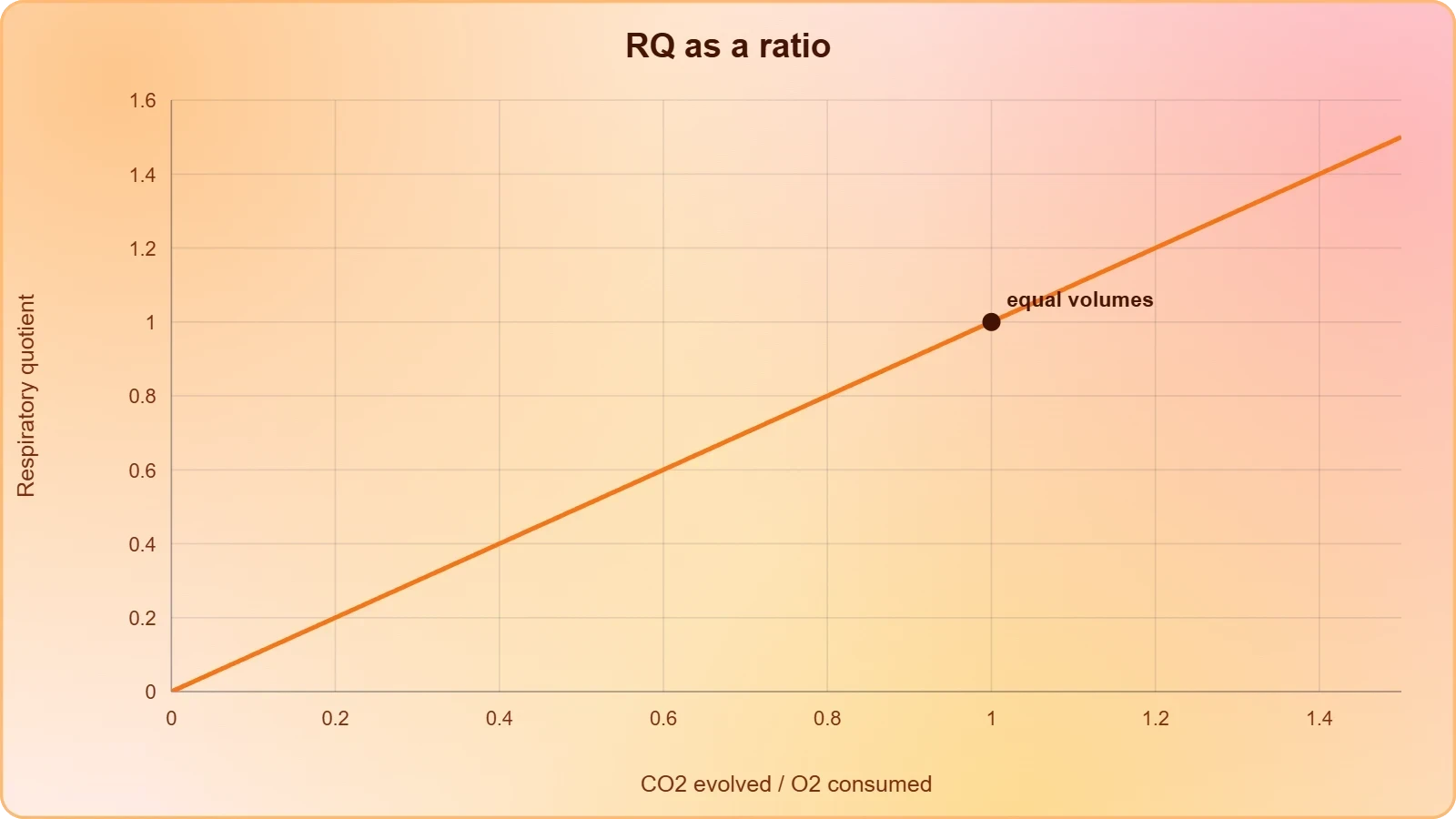
The respiratory quotient, often abbreviated RQ, is defined as the ratio of the volume of carbon dioxide evolved to the volume of oxygen consumed during respiration. It is also known as the respiratory ratio. This definition applies specifically to aerobic respiration, where oxygen is consumed and carbon dioxide is released. Because gases are measured under the same conditions of temperature and pressure, their volumes are directly proportional to the number of moles involved, which is why the quotient can be computed directly from a balanced equation. The ratio is dimensionless, a pure number that characterises the substrate being oxidised.
The formal definition and its notation
The relationship is expressed compactly as a fraction. In words, the respiratory quotient equals the volume of carbon dioxide evolved divided by the volume of oxygen consumed. Written as a formula, this becomes a clean mathematical statement that we can apply to any substrate once its combustion equation is known. The notation is deliberately simple so that the same expression serves for glucose, for a fatty acid, or for a protein. The value of the quotient is not fixed; it depends entirely upon the type of respiratory substrate used during respiration, which is the central insight of this lesson.
Why the ratio is meaningful
The quotient is meaningful because the oxidation of an organic substrate consumes oxygen in proportion to the carbon and hydrogen it contains, while releasing carbon dioxide in proportion to its carbon content. A substrate rich in oxygen, such as a carbohydrate, already carries much of the oxygen needed for its own combustion, so it demands relatively little external oxygen and releases carbon dioxide in equal measure. A substrate poor in oxygen, such as a fat, must draw heavily on atmospheric oxygen, so the denominator of the ratio grows and the quotient falls below one. The number therefore encodes the elemental composition of the fuel.
This is why the respiratory quotient functions as a metabolic fingerprint. By measuring the gases exchanged by a tissue, a physiologist can infer the dominant substrate being respired without ever isolating the molecules involved. The quotient sits at the end of the respiratory chain of ideas, translating the biochemistry of glycolysis, the Krebs cycle and oxidative phosphorylation into a single observable quantity. It is a bridge between the molecular events inside the mitochondrion and the macroscopic exchange of gases at the surface of the plant.
Carbohydrates and a Quotient of One
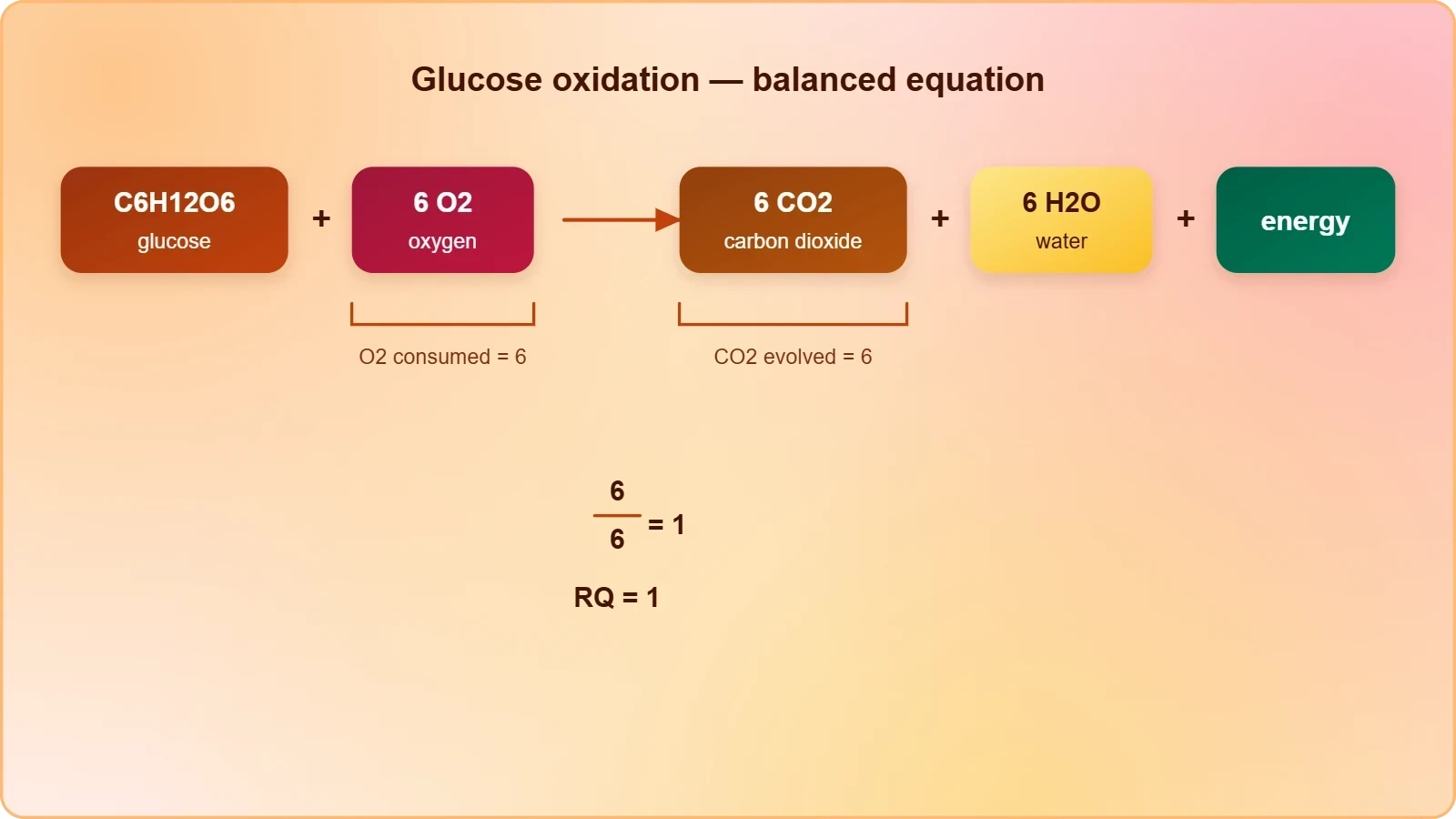
When carbohydrates are used as substrate and are completely oxidised, the respiratory quotient equals one. This is because equal amounts of carbon dioxide and oxygen are evolved and consumed respectively. The simplest and most familiar example is glucose, the favoured substrate for respiration. Its complete oxidation can be written as a balanced equation in which six molecules of carbon dioxide are released for every six molecules of oxygen consumed. Dividing the volume of carbon dioxide by the volume of oxygen therefore yields six divided by six, which is exactly one. The result is a clean, whole-number benchmark against which all other substrates are judged.
The glucose equation worked through
The oxidation of glucose is represented by the equation in which one molecule of glucose combines with six molecules of oxygen to produce six molecules of carbon dioxide, six molecules of water and energy. Reading the coefficients directly gives the quotient: six volumes of carbon dioxide over six volumes of oxygen. The arithmetic is trivial, yet it carries deep significance, because it shows that a carbohydrate is already so rich in oxygen that its combustion is gas-neutral in volume terms. Every molecule of oxygen the cell imports is matched by a molecule of carbon dioxide it exports.
Interpreting a quotient of one
A measured quotient of one is a strong signal that carbohydrate is the dominant fuel. In a germinating seed rich in starch, or in a leaf respiring stored sugars, the gases exchanged approach this one-to-one relationship. The value is not merely a textbook curiosity; it is a practical indicator used to characterise the metabolic state of plant tissues. When the quotient sits at unity, the physiologist can reasonably conclude that the carbon skeletons being oxidised are carbohydrates, and that the respiratory machinery is running on the most oxygen-rich of the major substrates.
It is worth emphasising that the quotient of one applies to complete oxidation. If carbohydrate is only partially broken down, or if intermediates are diverted into synthesis through the amphibolic pathway, the observed ratio can drift. This is why the pure-substrate values are best understood as reference points rather than rigid laws. They describe the ideal case of a single substrate fully oxidised, and they become the yardstick against which the more complex, mixed respiration of a living cell is measured and interpreted.
Fats and a Quotient Below One
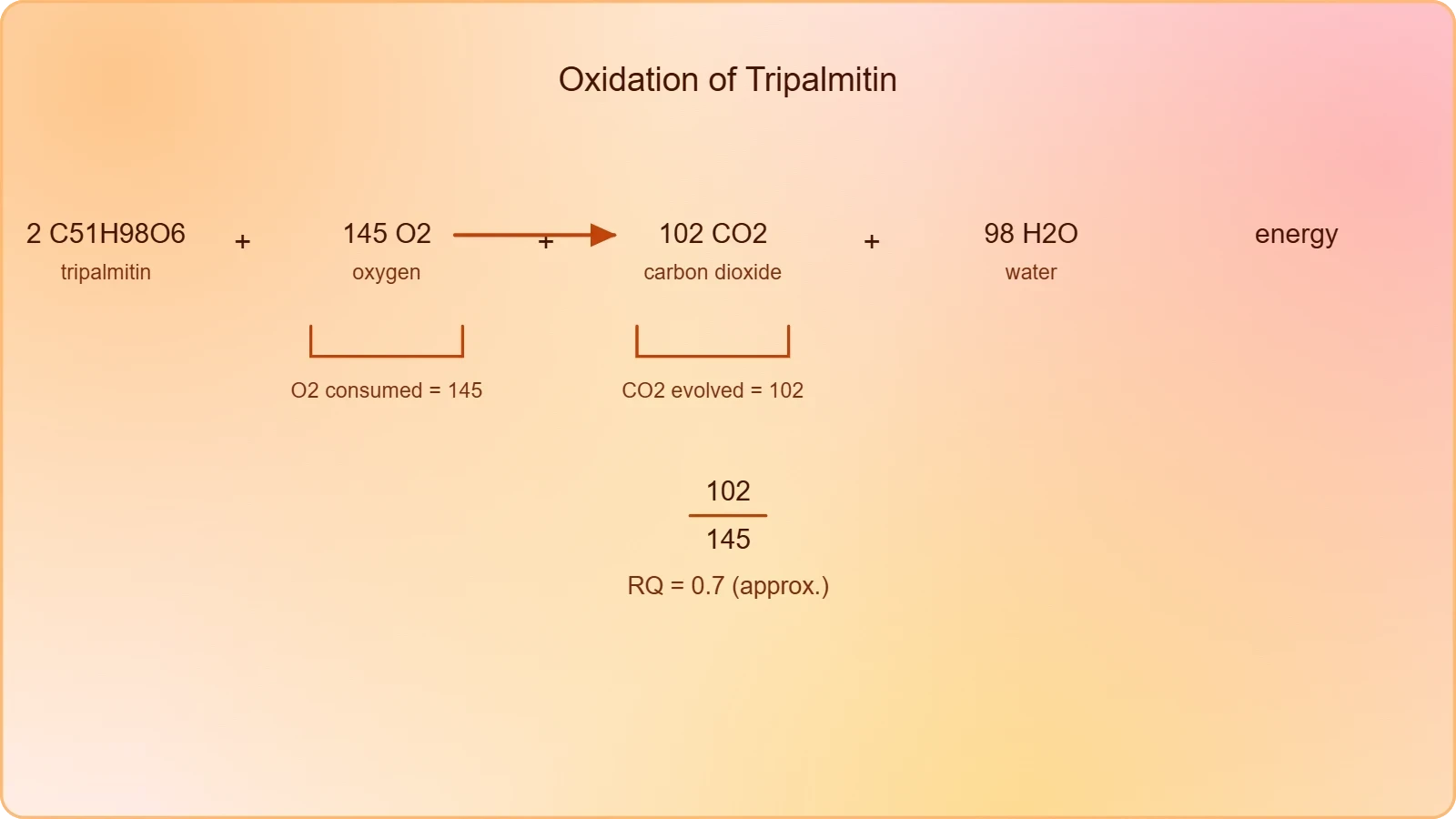
When fats are used in respiration, the respiratory quotient is less than one. The reason lies in the elemental composition of fats, which are far poorer in oxygen and far richer in carbon and hydrogen than carbohydrates. To oxidise such a molecule completely, the cell must import a large quantity of atmospheric oxygen, while the carbon dioxide released is comparatively modest. The denominator of the ratio therefore exceeds the numerator, and the quotient falls below unity. The classic calculation uses tripalmitin, a fatty acid substrate, whose complete oxidation yields a quotient of approximately 0.7.
The tripalmitin calculation
The balanced equation for tripalmitin shows that two molecules of the fat react with one hundred and forty-five molecules of oxygen to produce one hundred and two molecules of carbon dioxide, ninety-eight molecules of water and energy. Dividing the carbon dioxide coefficient by the oxygen coefficient gives one hundred and two over one hundred and forty-five, which evaluates to approximately 0.7. This figure is the benchmark for fat respiration. The arithmetic demonstrates concretely why oxygen-poor substrates demand more oxygen and release proportionally less carbon dioxide, driving the quotient downward.
Reading a low quotient in practice
A quotient near 0.7 signals that fat is the predominant fuel. This is metabolically significant because fats are densely packed with energy and are mobilised when carbohydrate reserves run low, for instance in certain storage tissues or during prolonged respiration. The low quotient reflects the heavy oxygen demand of fat oxidation, a demand that the plant must meet through its diffusive gas exchange. Recognising this value allows the physiologist to distinguish a fat-burning tissue from a carbohydrate-burning one purely from the gases it exchanges, without any chemical analysis of the tissue itself.
The contrast with carbohydrate is instructive. Where glucose returns a quotient of one, tripalmitin returns roughly 0.7, and the gap between them is a direct measure of how much oxygen each substrate already contains. This is the practical power of the respiratory quotient: it converts an abstract difference in molecular structure into a number that can be measured at the surface of a leaf or a germinating seed. The lower the quotient, the more oxygen-hungry the substrate, and the more the tissue depends on a steady supply of air.
Proteins and a Quotient Near 0.9
When proteins are respiratory substrates, the respiratory quotient is about 0.9. This value sits between the carbohydrate benchmark of one and the fat benchmark of roughly 0.7, reflecting the intermediate elemental composition of proteins. Proteins contain less oxygen than carbohydrates but more than fats, so their oxidation demands a moderate excess of oxygen over the carbon dioxide released. The quotient of approximately 0.9 is therefore a characteristic signature of protein respiration, distinct from both the carbohydrate and the fat values. It completes the trio of pure-substrate benchmarks that anchor the entire topic.
Why proteins fall between the extremes
The position of proteins between carbohydrates and fats is not accidental. Their carbon-to-oxygen ratio lies between the two extremes, so the volume of oxygen required to oxidise them fully is greater than that for carbohydrate but less than that for fat. The carbon dioxide released, meanwhile, tracks the carbon content of the molecule. The net effect is a quotient slightly below unity, near 0.9. This intermediate value illustrates a general principle: the respiratory quotient rises as the substrate becomes richer in oxygen and falls as the substrate becomes poorer in oxygen.
Placing the three benchmarks together
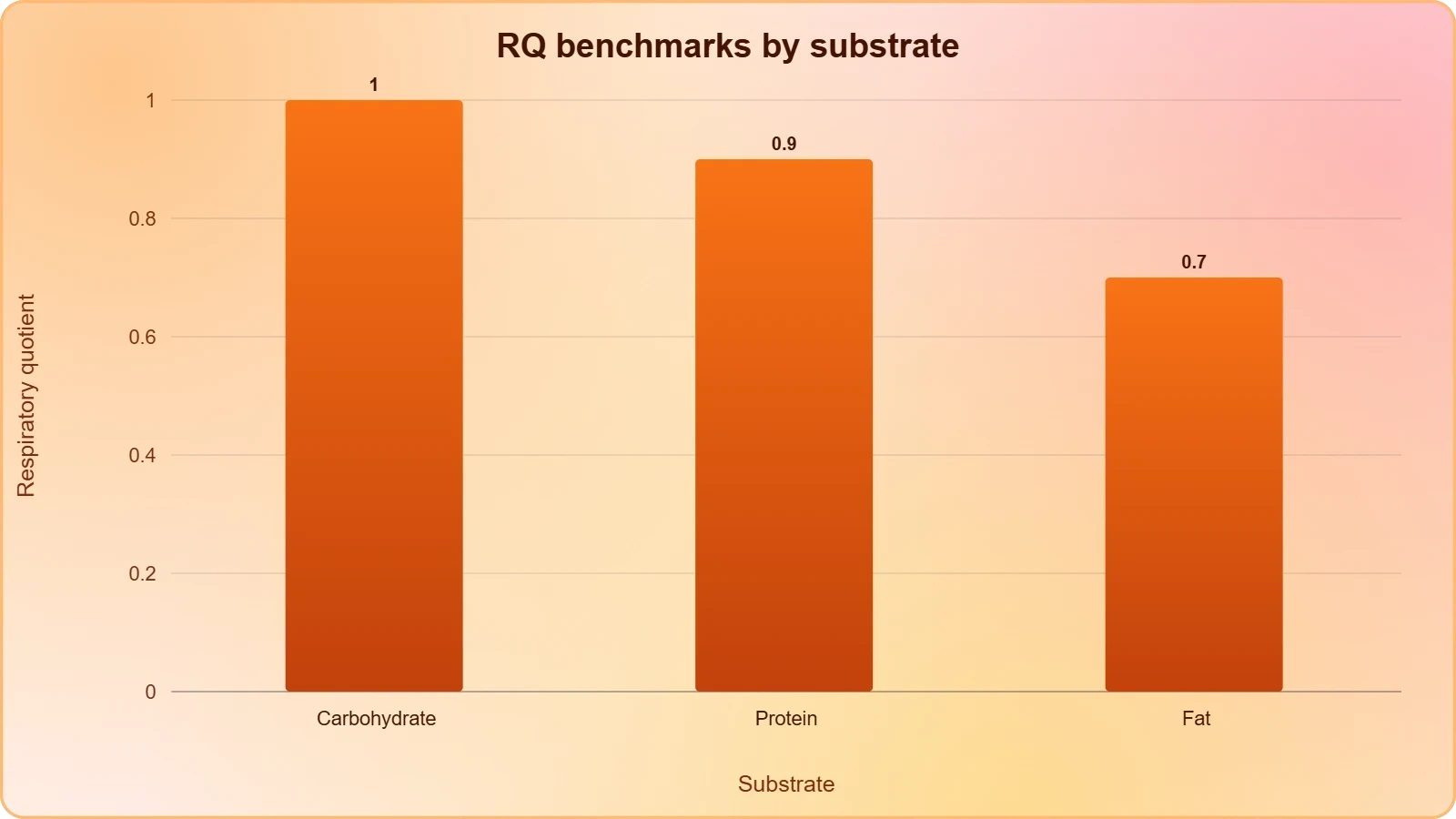
With the three values established, a clear hierarchy emerges. Carbohydrates give a quotient of one, proteins about 0.9, and fats about 0.7. Each figure is derived from the balanced oxidation equation of a representative substrate, and together they form a reference scale. A measured quotient close to one points to carbohydrate, a value near 0.9 suggests protein, and a value near 0.7 indicates fat. The scale is the practical heart of the lesson, allowing the composition of respiration to be inferred from gas exchange alone.
Mixed Substrates in the Living Organism
What is important to recognise is that in living organisms, respiratory substrates are often more than one; pure proteins or fats are never used as respiratory substrates. This single observation reframes everything that precedes it. The neat values of one, 0.9 and 0.7 describe ideal, single-substrate cases, but a real plant cell oxidises a mixture of carbohydrates, fats and proteins simultaneously. The measured respiratory quotient is therefore a weighted blend of the individual quotients, reflecting the proportions in which each substrate is being consumed at that moment. The pure values become reference points for interpreting a mixed reality.
Why pure substrates are an idealisation
No living tissue runs exclusively on a single pure fuel. Even a starch-rich seed draws on proteins and lipids as it germinates, and a respiring leaf oxidises a blend of sugars and organic acids. The amphibolic pathway, explored in the previous lesson, further complicates the picture, because intermediates are constantly withdrawn for synthesis and replenished from breakdown. The respiratory quotient of a living organism is thus a dynamic, composite quantity. The pure-substrate benchmarks remain indispensable, but they must be applied with the understanding that they describe limiting cases rather than the ordinary condition of a cell.
Interpreting a measured quotient
When a physiologist measures a quotient between the benchmarks, the value indicates the balance of fuels in use. A quotient near one suggests carbohydrate dominance, a drift toward 0.7 suggests increasing reliance on fat, and an intermediate value implies a mixture. The interpretation is probabilistic rather than absolute, because different mixtures can produce the same ratio. Nevertheless, the quotient remains a powerful, non-invasive probe of metabolic state. It allows the observer to reason about which substrates a tissue is oxidising, and in what rough proportion, from the simple measurement of gases exchanged.
Going Further and Closing the Course
The respiratory quotient is also called the respiratory ratio, a synonym worth remembering when reading older texts. Beyond the core material, a little background deepens the picture. Tripalmitin, the fat used in the worked calculation, is a triglyceride made of glycerol combined with three palmitic acid molecules; its long hydrocarbon chains are what make it so oxygen-poor and its quotient so low. This structural detail explains, at the molecular level, why fats demand so much atmospheric oxygen. Such background enriches understanding without altering the definitions, numbers or order of ideas established in the lesson.
Consolidating the chapter
This lesson closes a course that began with why organisms need energy and how plants exchange gases, then moved through glycolysis, fermentation, aerobic respiration, the electron transport system and oxidative phosphorylation, before reaching the respiratory balance sheet, the amphibolic pathway and now the respiratory quotient. Each stage built on the last, and the quotient is the natural culmination, because it converts the entire biochemistry of respiration into a single measurable number. The three benchmarks of one, 0.9 and 0.7 now stand as the practical summary of everything the chapter has established about substrates and energy release.
Final takeaways
The essential message is compact. The respiratory quotient is the ratio of the volume of carbon dioxide evolved to the volume of oxygen consumed. Carbohydrates give one, fats give less than one, and proteins give about 0.9. In living organisms, substrates are mixed, so measured values are blends. With these facts secure, the learner can interpret gas exchange as a window into metabolism, connecting the molecular events of the mitochondrion to the observable behaviour of the whole plant. The course ends here, but the reasoning it has built continues to serve wherever respiration is studied.
Also Read
- No links available.
From our network :
- 10 Physics Numerical Problems with Solutions for IIT JEEPrepare for IIT JEE with 10 physics numerical problems, complete with detailed solutions and conceptual explanations. Ideal for mastering kinematics, thermodynamics, electromagnetism, and optics.
- Vite 6/7 'Cold Start' Regression in Massive Module GraphsIn-depth analysis of Vite 6/7 cold start regressions in massive module graphs. Learn about barrel file issues, pre-bundling optimizations, and how to improve Vite dev server performance.
- Mastering DB2 12.1 Instance Design: A Technical Deep Dive into Modern Database ArchitectureComprehensive guide to DB2 12.1 Instance Design. Explore architectural components, HADR setup, buffer pool tuning, and security policies for IBM DB2 12.1. Includes 10 functional SQL and Shell samples.
- Trump Political Strategy How Geopolitical Stunts Serve As Media Diversions
- AI-Powered 'Precision Diagnostic' Replaces Standard GRE Score ReportsDiscover the new GRE Precision Diagnostic. Learn how AI-powered behavioral analytics and time-to-solve tracking are replacing standard GRE score reports to empower students.
- Analyzing Trump Deportation Numbers Insights Into The 2026 Immigration Crackdown
- 98% of Global MBA Programs Now Prefer GRE Over GMAT Focus EditionExplore why 98% of global MBA programs now prefer the GRE over GMAT Focus. Learn about the shorter GRE format, verbal logic importance, and strategic versatility for students.
- EV 2.0: The Solid-State Battery Breakthrough and Global Factory ExpansionDiscover the impact of the Solid-State Battery Breakthrough on the EV market. Learn about CATL and BYD stock growth, global factory expansion in Europe, and the future of EV 2.0 technology.
- Mastering DB2 LUW v12 Tables: A Comprehensive Technical GuideComprehensive guide on DB2 LUW v12 tables. Explore CREATE TABLE syntax, BLU Acceleration, range partitioning, data types, and security features for IBM DB2 LUW v12.
RESOURCES
- Importance of the leaf respiratory quotient - PMCpmc.ncbi.nlm.nih.govApr 21, 2025 ... Rates of leaf respiratory CO2‐release (R CO2) are important for terrestrial biosphere models that estimate carbon exchange between plants ...
- Respiratory Quotient - an overview | ScienceDirect Topicssciencedirect.comRespiratory quotient is defined as the ratio of moles of carbon dioxide evolved to moles of oxygen absorbed in plant cells, typically equal to…
- Importance of the leaf respiratory quotient - PubMedpubmed.ncbi.nlm.nih.govRates of leaf respiratory CO 2 -release (R CO2 ) are important for terrestrial biosphere models that estimate carbon exchange between plants and the ...
- respiration in plants chapter 12 - NCERTncert.nic.in12.7 Respiratory. Quotient. Reprint 2026-27. Page 2. 154. BIOLOGY directly (herbivores) or indirectly (carnivores). Saprophytes like fungi are dependent on dead ...
- Genomic basis for stimulated respiration by plants growing under ...pubmed.ncbi.nlm.nih.govMar 3, 2009 ... Photosynthetic and respiratory exchanges of CO(2) by plants with the ... Greater respiratory quotient and leaf carbohydrate content at ...
- Genomic basis for stimulated respiration by plants growing ... - PNASpnas.orgMar 3, 2009 ... Greater respiratory quotient and leaf carbohydrate content at elevated [CO2] indicate that stimulated respiration was supported by the ...
- The Apparent Respiratory Quotient of Soils and Tree Stems and the ...agupubs.onlinelibrary.wiley.comFeb 21, 2022 ... The CO2/O2 fluxes ratio (apparent respiration quotient [ARQ]) measured in soils and plants contains valuable information about the ...
- Respiratory Quotient (RQ) may be - SILAPATHAR COLLEGEsilapatharcollege.edu.in(1) Respiratory Quotient of Carbohydrates. Carbohydrates are principle respiratory substrates in plants and the commone among them are starch, inulin ...
- Physiology, Respiratory Quotient - StatPearls - NCBI Bookshelf - NIHncbi.nlm.nih.govIt is a dimensionless number used in calculating the basal metabolic rate when estimated from carbon dioxide production to oxygen absorption. Oxygen uptake is…
- Emerging topics in stable isotope ecology: are there isotope effects ...nph.onlinelibrary.wiley.comJul 5, 2005 ... ... (RQ = 1) vs highly reduced compounds such as lipids (RQ < 1). Plant respiratory pathways provide energy for…
- Respiratory Quotient of Plant Substrates | PDF | Cellular Respirationscribd.comThe Respiratory Quotient. or. RQ value. The Respiratory Quotient or RQ value is a measure of the ratio of carbon dioxide produced and oxygen
- Impacts of larval host plant species on dispersal traits and free-flight ...nature.comMay 16, 2022 ... syriaca shown only. b Body mass normalized adult flight metabolic rate and c resting metabolic rate, and (d) respiratory quotient…
- are there isotope effects in plant respiration? - Pataki - 2005 - New ...nph.onlinelibrary.wiley.comJul 5, 2005 ... ... respiratory quotient (RQ): the ratio of carbon dioxide evolved to oxygen consumed in respiration. RQ values are known to…
- The respiration of barley plants II—Carbohydrate concentration, and ...royalsocietypublishing.org... respiratory quotient of starving leaves. Consequently, in later experiments, it was possible to compare the results of direct sugar analysis with ...
- Respiratory Quotient (RQ): Definition, Formula, Values, Applicationsmicrobenotes.comJan 12, 2026 ... RQ is applied in the study of the respiration of seeds, roots, fruits, and other tissues in plants. It assists…