Every discussion of aerobic respiration eventually arrives at a number that students carry with them long after the chapter is finished: 38 ATP molecules per molecule of glucose. That figure is the centrepiece of the respiratory balance sheet, an accounting exercise that traces the energy currency produced as glucose is oxidised through glycolysis, the TCA cycle and the electron transport system. Yet the balance sheet is as much a lesson in scientific honesty as it is in bioenergetics, because the number it produces rests on a set of assumptions that a living cell quietly violates every second of its existence.
This lesson, the thirteenth in a fifteen-part course on respiration in plants, builds directly on the chemiosmotic mechanism examined previously, where proton flow through ATP synthase was coupled to ATP production. Here the focus shifts from how ATP is made to how much is made, and under what conditions the tally can legitimately be claimed. The assumptions behind the calculation are stated plainly, their limitations are examined without evasion, and the comparison between fermentation and aerobic respiration is drawn into sharp relief. The result is a clearer appreciation of why the living system's efficiency in extracting and storing energy deserves admiration rather than mere memorisation.
By the end of the lesson, learners should be able to list the four assumptions underpinning the net ATP calculation, explain why each is not really valid in a living system, state the net gain of 38 ATP molecules during aerobic respiration of one glucose molecule, and contrast fermentation with aerobic respiration on three specific grounds. The material also prepares the ground for the next lesson on the amphibolic pathway, where the respiratory route is shown to serve synthesis as well as breakdown.
On This Page
The Logic of the Respiratory Balance Sheet
The respiratory balance sheet is an attempt to answer a deceptively simple question: for every molecule of glucose oxidised, how many molecules of ATP are gained? Answering it requires following the carbon skeleton through glycolysis, the TCA cycle and the electron transport system, counting the ATP and the reduced coenzymes produced at each stage, and converting NADH and FADH₂ into their ATP equivalents through oxidative phosphorylation. The exercise is possible, and it is instructive, but it can remain only a theoretical exercise, because the calculation depends on conditions that a living cell does not actually satisfy.
What makes the balance sheet valuable is not the precision of its final figure but the discipline it imposes on the learner. To count ATP, one must know where it is made, which reactions reduce NAD⁺ and FAD, and how those reduced coenzymes are reoxidised in the electron transport system. The balance sheet therefore functions as a revision of the entire pathway compressed into a single ledger. It also exposes the gap between a tidy textbook model and the crowded, simultaneous chemistry of a real cell, a gap that the following sections examine in detail.
The Four Assumptions Stated Plainly
The calculation of net ATP gain can be made only on certain assumptions, and the material lists them explicitly. First, there is a sequential, orderly pathway functioning, with one substrate forming the next and with glycolysis, the TCA cycle and the ETS pathway following one after another. Second, the NADH synthesised in glycolysis is transferred into the mitochondria and undergoes oxidative phosphorylation. Third, none of the intermediates in the pathway are utilised to synthesise any other compound. Fourth, only glucose is being respired, with no other alternative substrates entering the pathway at any of the intermediary stages.
Each assumption is a simplification that makes arithmetic possible. The first treats the pathway as a conveyor belt rather than a network. The second assumes efficient shuttling of cytosolic reducing power into the mitochondrial matrix. The third ignores the biosynthetic withdrawals that the amphibolic pathway will later reveal. The fourth isolates glucose as the sole fuel. Together they define an idealised cell that no biologist would claim to have observed, yet they allow a definite number to be derived and defended.
Why the Assumptions Fail in a Living System
These assumptions are not really valid in a living system. All pathways work simultaneously and do not take place one after another; substrates enter the pathways and are withdrawn from them as and when necessary; ATP is utilised as and when needed; and enzymatic rates are controlled by multiple means. The cell is not a sequence of finished reactions but a shifting equilibrium of competing demands, in which the product of one moment is the substrate or the inhibitor of the next.
The consequences for the balance sheet are immediate. If intermediates are withdrawn for synthesis, fewer carbons complete the cycle and fewer ATP molecules are realised. If alternative substrates enter at intermediate stages, the ledger no longer describes glucose oxidation alone. If ATP is consumed as fast as it is made, the notion of a stored net gain becomes abstract. The figure of 38 ATP therefore describes a potential under specified conditions, not a guaranteed yield in every cell at every moment.
Why the Exercise Still Matters
Despite these caveats, the exercise is useful, and the material is explicit about why: it allows us to appreciate the beauty and efficiency of the living system in extracting and storing energy. A calculation that isolates one fuel and one pathway reveals the scale of the energy transaction, and the comparison with fermentation shows how much more a cell gains when oxygen is available as the terminal electron acceptor.
The balance sheet also teaches a habit of mind that extends well beyond this chapter. Scientific models are judged not by whether their assumptions are literally true but by whether the idealisation illuminates the system it describes. Recognising where the model departs from reality is part of understanding the model, not a reason to discard it. The respiratory balance sheet, honestly presented, is both a calculation and a lesson in the limits of calculation.
Counting ATP Through the Pathway
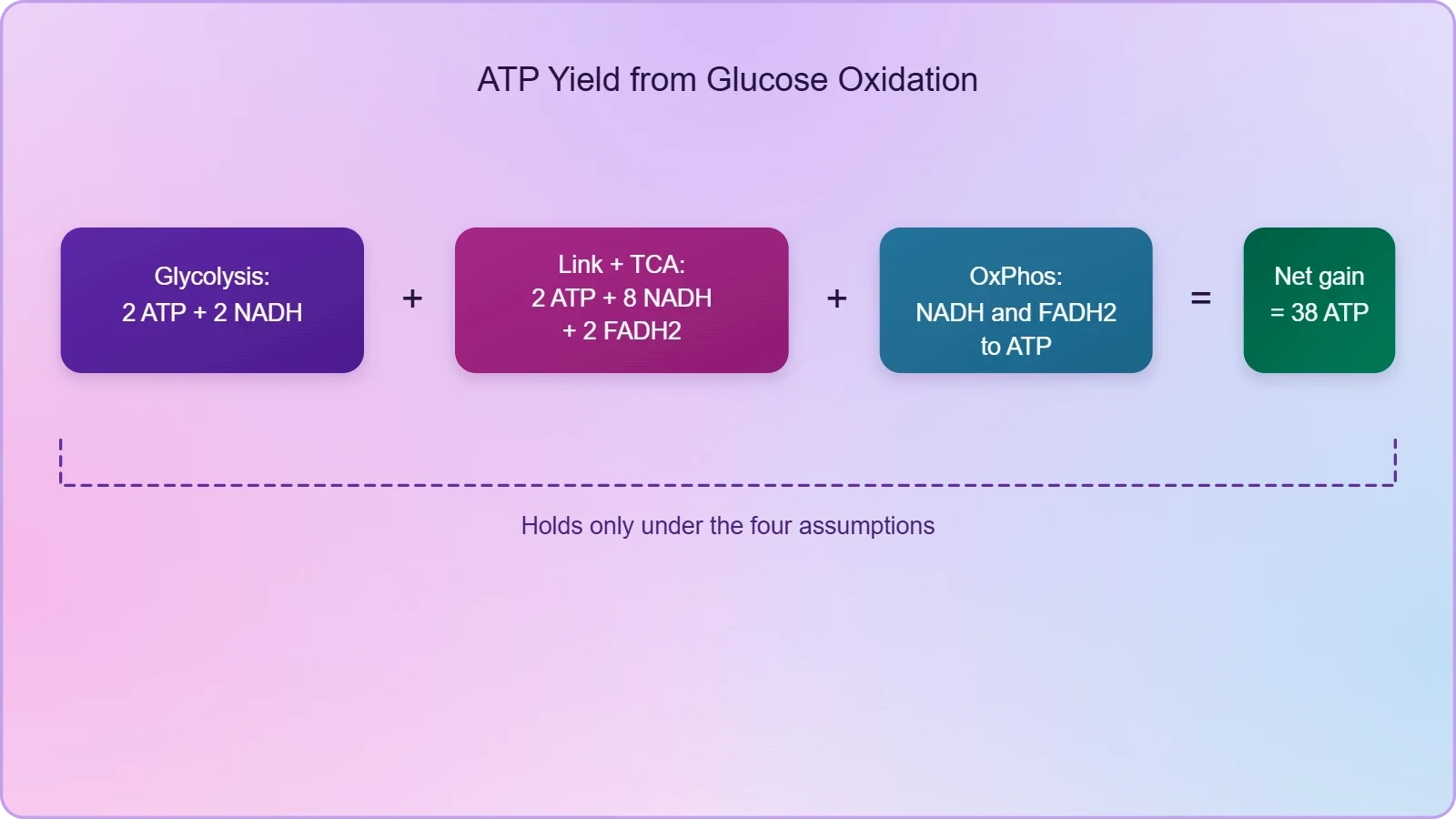
To see where the figure of 38 comes from, it helps to walk the ledger stage by stage, using the conventions established in earlier lessons. Glycolysis yields a small direct gain of ATP together with NADH; the link reaction and the TCA cycle yield more reduced coenzymes and a little direct ATP; the electron transport system converts the reduced coenzymes into ATP through oxidative phosphorylation. The balance sheet simply sums these contributions under the four assumptions already stated.
The arithmetic is deliberately kept simple in the textbook treatment. Each NADH is credited with a fixed ATP equivalent and each FADH₂ with a smaller one, reflecting their points of entry into the electron transport chain. The total is then presented as the net gain for the oxidation of one glucose molecule. What matters for this lesson is not memorising every intermediate sum but understanding that the total is assembled from parts, and that each part depends on the assumptions holding.

Glycolysis and the Cytosolic Contribution
Glycolysis takes place in the cytosol and delivers a modest direct return, together with NADH that must be accounted for. Under the assumptions, the NADH synthesised in glycolysis is transferred into the mitochondria and undergoes oxidative phosphorylation, so its reducing power is credited in full. This transfer is the second of the four assumptions, and it is the one most sensitive to the conditions inside a real cell.
The cytosolic contribution is small in absolute terms but significant in principle. It shows that energy extraction begins before the mitochondrion is involved at all, and it explains why fermentation, which stops at this stage, can still claim a net gain of two ATP molecules per glucose. The contrast between that modest figure and the full aerobic total is the heart of the comparison drawn later in the lesson.
The TCA Cycle and the Reduced Coenzymes
The TCA cycle, following the link reaction, completes the oxidation of the carbon skeleton and generates the bulk of the reduced coenzymes that will drive ATP synthesis. Each turn of the cycle produces NADH and FADH₂, and these carry electrons to the electron transport system. The direct ATP yield of the cycle itself is small; its real importance for the balance sheet lies in the reducing power it hands to the inner membrane.
Because the cycle is also the point at which intermediates can be withdrawn for synthesis, it is where the third assumption is most visibly strained. A cell that needs to build fatty acids or amino acids will divert intermediates away from complete oxidation, and the ATP total falls accordingly. The cycle is therefore both an energy-generating engine and a supply depot, a duality that the amphibolic pathway lesson will develop further.
Oxidative Phosphorylation and the Final Tally
The electron transport system and oxidative phosphorylation convert the reduced coenzymes into ATP. As established in the previous lesson, the F₁ headpiece of ATP synthase contains the catalytic site for synthesis of ATP from ADP and inorganic phosphate, while F₀ forms the channel through which protons cross the inner membrane. For each ATP produced, four protons pass through F₀ from the intermembrane space to the matrix, down the electrochemical proton gradient.
Summing the contributions under the stated assumptions gives the textbook result. There can be a net gain of 38 ATP molecules during aerobic respiration of one molecule of glucose. The figure is a landmark of the chapter, and it is worth stating precisely: it is a net gain, it refers to aerobic respiration, and it is calculated per molecule of glucose. Every qualifier in that sentence carries weight.
Fermentation and Aerobic Respiration Compared
The balance sheet becomes far more meaningful when set beside fermentation, the anaerobic route that stops at pyruvic acid. The material draws the comparison on three specific grounds, and each deserves attention because each isolates a different dimension of the difference. Fermentation accounts for only a partial breakdown of glucose, whereas in aerobic respiration glucose is completely degraded to CO₂ and H₂O. The contrast is one of completeness before it is one of quantity.
The second ground is quantitative. In fermentation there is a net gain of only two molecules of ATP for each molecule of glucose degraded to pyruvic acid, whereas many more molecules of ATP are generated under aerobic conditions. The third concerns the pace of coenzyme recycling: NADH is oxidised to NAD⁺ rather slowly in fermentation, but the reaction is very vigorous in aerobic respiration. Together these three contrasts explain why oxygen availability transforms the energy economy of a cell.

Partial Breakdown Versus Complete Oxidation
Fermentation leaves the carbon skeleton largely intact, stopping at pyruvic acid or its derivatives, so much of the chemical energy remains locked in the products. Aerobic respiration drives the oxidation to completion, releasing CO₂ and forming H₂O as the terminal products. The difference in completeness is the structural reason for the difference in yield, and it is worth stating before any numbers are compared.
Complete oxidation also requires the electron transport system to function as the final acceptor route, which is why oxygen matters. Without it, the reduced coenzymes cannot be reoxidised vigorously, and the pathway cannot continue past the fermentation stage. The completeness of aerobic breakdown and the availability of oxygen are therefore two sides of the same biochemical coin.
The Pace of NADH Reoxidation
The third contrast is kinetic rather than thermodynamic. In fermentation, NADH is oxidised to NAD⁺ rather slowly, which constrains how quickly glycolysis can keep running. In aerobic respiration the reaction is very vigorous, because the electron transport system provides an efficient route for reoxidation. The pace of this recycling sets the tempo for the entire pathway.
This point is often underappreciated by learners who focus only on the ATP totals. A cell does not merely need a large theoretical yield; it needs a steady supply of oxidised coenzyme to keep flux moving. The vigour of aerobic reoxidation is what allows the higher yield to be realised in practice, and it explains why oxygen deprivation is felt so quickly in energy-hungry tissues.
Reading the Balance Sheet Critically
A balance sheet is only as trustworthy as its entries, and the entries here are conditional. The figure of 38 ATP is a net gain calculated for aerobic respiration of one molecule of glucose, and it holds only while the four assumptions hold. When a cell withdraws intermediates for synthesis, when alternative substrates enter the pathway, or when ATP is consumed as fast as it is produced, the realised yield departs from the theoretical one. The number is a benchmark, not a measurement.
Reading the balance sheet critically also means resisting two opposite errors. The first is to treat 38 as a fixed property of glucose, as though every molecule oxidised must yield exactly that many ATP. The second is to dismiss the calculation as meaningless because its assumptions are false. The material steers between these errors by presenting the assumptions openly and then explaining why the exercise remains useful despite them.
What the Number Does and Does Not Claim
The number claims that, under a specified set of idealisations, the oxidation of one glucose molecule can yield a net gain of 38 ATP. It does not claim that every cell achieves this yield at every moment, nor that the yield is independent of the cell's biosynthetic demands. The qualifiers matter: net gain, aerobic respiration, one molecule of glucose. Remove any of them and the statement changes meaning.
This precision is what distinguishes a scientific statement from a slogan. Learners who can reproduce the number but not its conditions have memorised a fact without understanding it. Learners who can state the conditions, explain why they fail, and still defend the usefulness of the calculation have understood the balance sheet as the material intends it to be understood.
Preparing for the Amphibolic Pathway
The third assumption, that no intermediate is utilised to synthesise any other compound, is the hinge on which the next lesson turns. Once that assumption is relaxed, the respiratory pathway reveals itself as a route for synthesis as well as breakdown. Fatty acids are broken down to acetyl CoA before entering the pathway, but when the organism needs to synthesise fatty acids, acetyl CoA is withdrawn from the pathway for that purpose.
The same logic applies to proteins, where respiratory intermediates form the link between breakdown and synthesis. Because the respiratory pathway is involved in both anabolism and catabolism, it is better considered an amphibolic pathway rather than a catabolic one. The balance sheet lesson thus ends by opening a door: the very withdrawals that spoil the arithmetic are the ones that make the pathway amphibolic.
Going Further
The figure of 38 ATP per glucose is a textbook calculation based on the assumptions listed in the material, and it is worth being explicit about that status. It is not a measured value obtained from a living tissue; it is the output of a model. Presenting it as a model, rather than as a fact about glucose, helps learners understand why different textbooks sometimes quote slightly different totals depending on which shuttle or which ATP equivalent they adopt.
In living cells, pathways run simultaneously rather than one after another, and this simultaneity is the deepest reason the assumptions fail. Glycolysis, the TCA cycle and the electron transport system operate at the same time, sharing intermediates and competing for coenzymes. Recognising this turns the balance sheet from a list of numbers into a portrait of a cell in motion, where energy extraction and biosynthesis are interleaved rather than sequential.
A Short Programming Illustration
A simple script can make the conditional nature of the calculation concrete. The function below sums the contributions under the assumptions and then shows how the total falls when a fraction of intermediates is withdrawn for synthesis. It is a teaching aid, not a simulation of a cell, but it demonstrates why the realised yield is a variable rather than a constant.

def respiratory_balance_sheet(glycolysis_atp, tca_atp, etc_atp, withdrawal_fraction=0.0):
    """Theoretical net ATP for one glucose under the stated assumptions."""
    theoretical = glycolysis_atp + tca_atp + etc_atp
    realised = theoretical * (1 - withdrawal_fraction)
    return theoretical, realised

theoretical, realised = respiratory_balance_sheet(8, 6, 24, withdrawal_fraction=0.15)
print(f"Theoretical net gain: {theoretical} ATP")
print(f"Realised with withdrawals: {realised:.1f} ATP")
Checking the Arithmetic
The balance sheet can also be expressed as a compact sum, which is useful for revision. The equation below states the relationship in the form used throughout the lesson, with the total set to the textbook figure of 38 ATP molecules per molecule of glucose under the stated assumptions.
Also Read
- No links available.
From our network :
- 10 Physics Numerical Problems with Solutions for IIT JEEPrepare for IIT JEE with 10 physics numerical problems, complete with detailed solutions and conceptual explanations. Ideal for mastering kinematics, thermodynamics, electromagnetism, and optics.
- AI-Powered 'Precision Diagnostic' Replaces Standard GRE Score ReportsDiscover the new GRE Precision Diagnostic. Learn how AI-powered behavioral analytics and time-to-solve tracking are replacing standard GRE score reports to empower students.
- EV 2.0: The Solid-State Battery Breakthrough and Global Factory ExpansionDiscover the impact of the Solid-State Battery Breakthrough on the EV market. Learn about CATL and BYD stock growth, global factory expansion in Europe, and the future of EV 2.0 technology.
- Mastering DB2 12.1 Instance Design: A Technical Deep Dive into Modern Database ArchitectureComprehensive guide to DB2 12.1 Instance Design. Explore architectural components, HADR setup, buffer pool tuning, and security policies for IBM DB2 12.1. Includes 10 functional SQL and Shell samples.
- 98% of Global MBA Programs Now Prefer GRE Over GMAT Focus EditionExplore why 98% of global MBA programs now prefer the GRE over GMAT Focus. Learn about the shorter GRE format, verbal logic importance, and strategic versatility for students.
- Trump Political Strategy How Geopolitical Stunts Serve As Media Diversions
- Vite 6/7 'Cold Start' Regression in Massive Module GraphsIn-depth analysis of Vite 6/7 cold start regressions in massive module graphs. Learn about barrel file issues, pre-bundling optimizations, and how to improve Vite dev server performance.
- Mastering DB2 LUW v12 Tables: A Comprehensive Technical GuideComprehensive guide on DB2 LUW v12 tables. Explore CREATE TABLE syntax, BLU Acceleration, range partitioning, data types, and security features for IBM DB2 LUW v12.
- Analyzing Trump Deportation Numbers Insights Into The 2026 Immigration Crackdown
RESOURCES
- ATP yield of plant respiration: potential, actual and unknown - PMCpmc.ncbi.nlm.nih.govA numerical balance sheet model combining respiratory carbon metabolism and ... ATP yield of aerobic respiration will be in order. In that case, the ...
- ATP yield of plant respiration: potential, actual and unknown - PubMedpubmed.ncbi.nlm.nih.govOct 4, 2023 ... ... respiratory ATP yield and identify important unknowns. Method: A numerical balance sheet model combining respiratory carbon metabolism and ...
- Respiratory Balance Sheet - GeeksforGeeksgeeksforgeeks.orgJun 22, 2026 ... ATP Balance Sheet of Aerobic Respiration. atp_balance_sheet_of_aerobic_respiration. Thus, Complete oxidation of one molecule of glucose yields ...
- Physiology, Adenosine Triphosphate - StatPearls - NCBI Bookshelfncbi.nlm.nih.govFeb 13, 2023 ... ATP can be produced by cellular respiration, beta-oxidation, ketosis ... The molecular machinery of Keilin's respiratory chain. Biochem ...
- The Electron Transport Chain | CK-12 Foundationflexbooks.ck12.orgNov 1, 2026 ... The Respiratory Balance Sheet: ATP Yield in Electron Transport Chain (ETC). To appreciate the efficiency of aerobic respiration, biologists ...
- respiration in plants chapter 12 - NCERTncert.nic.in12.5 THE RESPIRATORY BALANCE SHEET. It is possible to make calculations of ... Hence, there can be a net gain of 38 ATP molecules…
- ATP yield of plant respiration: potential, actual and unknownacademic.oup.com... cellular mechanisms with inferences ... respiratory ATP yield and identify important unknowns. Method. A numerical balance sheet model combining respiratory ...
- Respiration | PPTX - Slideshareslideshare.net... Respiration • Efficiency of respiration = 2 X 8.9/52 X 100 = Important Questions on Respiration 1. Give a balance sheet of ATP…
- Glucose Oxidation Respiratory Balance Sheet I Research Tweetresearchtweet.comGlucose Oxidation Respiratory balance sheet is a mathematical calculation of net ATP produced by cellular respiration which includes Glycolysis, Krebs ....
- Respiratory balance sheet and amphibolic pathway - GNEETgneet.comQ6) Out of 36 ATP molecules produced per glucose molecule during respiration … [CBSE 1991]. 1. 2 are produced outside glycolysis and 34 during…
- Mitochondrial dysfunction: mechanisms and advances in therapynature.comMay 15, 2024 ... ... ATP production ability and reduces ROS production of damaged mitochondria. ... aerobic respiration and enhances radiosensitivity. Theranostics 9 ...
- The process of aerobic respiration - Student Academic Successmonash.eduFor every one glucose molecule split, glycolysis has a net yield of two ATP molecules produced, and two NADH molecules. ... The final yield…
- Plant Respiration Project for Class XI | PDF - Scribdscribd.comThe Respiratory Balance Sheet: Objective: Calculate the overall energy production in. aerobic respiration, showing ATP yield per glucose molecule. 5.
- Adaptive respiratory bypass restores oxidative metabolism in NADH ...biorxiv.orgOct 1, 2026 ... This bias towards the EMP pathway over the Entner-Doudoroff (ED) pathway often results in higher ATP yield when aerobic oxidative ...
- Mitochondrial disease: mechanisms, signalling, and therapeutic ...sciencedirect.com... ATP production and cellular energy failure. Despite a shared bioenergetic ... aerobic respiration of mitochondrial DNA-Depleted motor Neuron NSC-34. J ...