On This Page
Fundamentals of Direct Substitution
Direct substitution serves as the first step in limit evaluation. This method assumes the function behaves predictably at the target point. If a function is continuous, the limit equals the function value.
Calculus students use this approach to simplify their initial analysis. It eliminates the need for complex graphing or table creation. Most elementary functions allow for this straightforward calculation without extra steps.
The process relies on the property of continuity within real numbers. When ##f(x)## is continuous at ##c##, the limit is simply ##f(c)##. This identity forms the core of basic limit laws.
Accuracy in arithmetic is vital during this phase of calculation. Small errors in substitution lead to incorrect limit values. Always double-check the signs and exponents when replacing variables.
Understanding the domain of the function is equally important here. You must ensure the target value exists within the defined set. Substitution fails if the point lies outside the function's domain.
Defining the Substitution Process
The substitution process starts by identifying the limit notation. You look for the value ##c## that ##x## approaches. This value becomes the input for your algebraic expression.
Next, you replace every instance of ##x## with the number ##c##. This transforms a limit problem into a standard arithmetic problem. The notation ##\lim_{x \to c}## is then dropped from the equation.
Simplify the resulting expression using standard order of operations. Calculate powers first, followed by multiplication and addition. This sequence ensures you reach the correct numerical output.
Consider the function ##f(x) = 2x + 3## as ##x## approaches ##4##. You replace ##x## with ##4## to get ##2(4) + 3##. The final result is ##11##, which is the limit.
This method works because the function's path is unbroken. The output value at the point matches the trend of nearby points. This consistency is the hallmark of continuous algebraic functions.
When to Use Direct Substitution
Use direct substitution when the function is a polynomial. Polynomials are continuous everywhere, making them perfect candidates for this method. They never contain gaps, jumps, or vertical asymptotes.
Apply this technique to rational functions at non-zero denominator points. If the bottom of the fraction is safe, substitution is valid. It provides the most efficient path to a solution.
Check for radical functions with positive radicands during your evaluation. As long as the root is defined, substitution remains a reliable tool. This applies to both square and cube roots.
Avoid this method if the function is piecewise at a break. Points where the formula changes require more careful left and right analysis. Direct substitution might overlook a jump in the graph.
Recognize that substitution is your "Plan A" for every limit. Try it first to see if it yields a real number. If it does, you have likely found the correct limit.
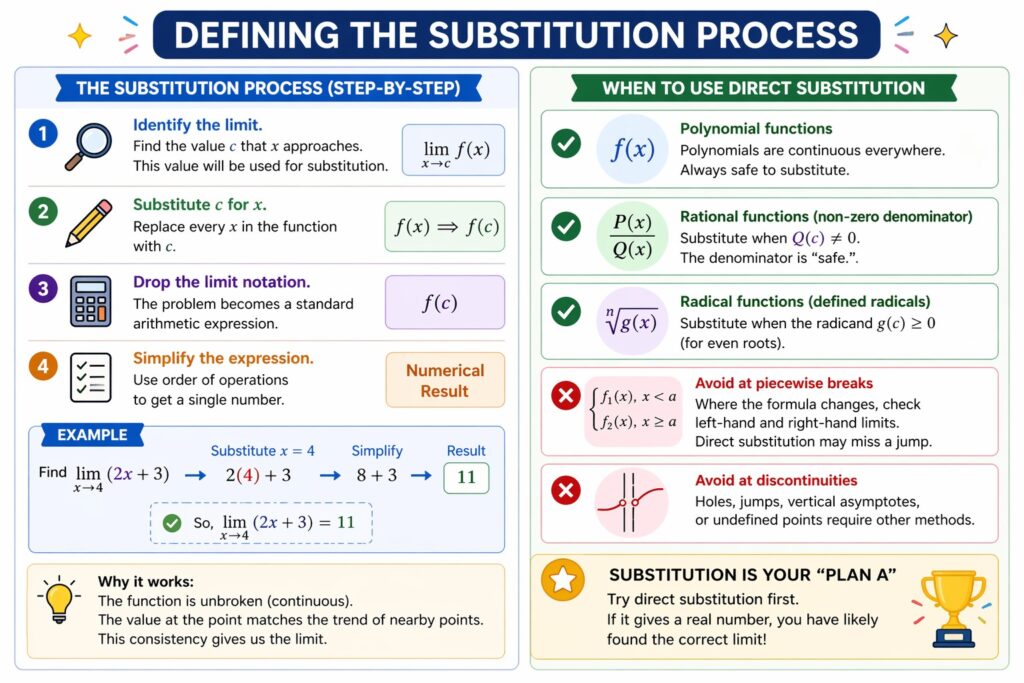
It also shows the main cases where substitution is valid and where it can fail.
Handling Simple Algebraic Expressions
Simple algebraic expressions include basic arithmetic operations and variables. These expressions follow predictable patterns when evaluating limits. Direct substitution handles these structures without requiring advanced factoring or rationalization.
Evaluating these expressions requires a firm grasp of algebraic rules. You must manage coefficients and constants while maintaining the limit's integrity. The goal is to reach a single numerical value.
Most textbook problems begin with these simple algebraic forms. They build the student's intuition for how functions behave near specific points. This practice reinforces the connection between algebra and calculus.
When handling multiple terms, apply the substitution to each term. The sum of the limits equals the limit of the sum. This property allows for a modular approach to solving problems.
Keep track of negative numbers during the substitution phase. Squaring a negative value results in a positive outcome. These fundamental rules prevent common pitfalls in limit calculation.
Evaluating Polynomial Functions
Polynomial functions consist of variables raised to non-negative integer powers. They are the easiest functions to evaluate using direct substitution. No matter the degree, the limit is always the function value.
To evaluate ##\lim_{x \to c} P(x)##, calculate ##P(c)## directly. This applies to linear, quadratic, and higher-degree polynomial expressions. The result is always a defined real number.
Problem 1: Evaluate the limit of the polynomial.
Limit: lim (x -> 2) of (3x^2 - 5x + 2)
Step 1: Substitute 2 for x.
Calculation: 3(2)^2 - 5(2) + 2
Result: 3(4) - 10 + 2 = 12 - 10 + 2 = 4
The example above shows how substitution simplifies the limit. By plugging in ##2##, the expression becomes a simple arithmetic string. The final value ##4## represents the limit.

Polynomials do not have holes or vertical asymptotes to consider. Their graphs are smooth curves that exist for all real ##x##. This makes them the most "substitution-friendly" functions in calculus.
Consistency is key when working with large polynomial expressions. Handle each power of ##x## carefully to avoid exponentiation errors. High-degree polynomials require focused attention during the arithmetic stage.
Working with Rational Functions
Rational functions are ratios of two polynomial expressions. Direct substitution works if the denominator is not zero at the limit point. This condition is crucial for a valid calculation.
Check the denominator first before performing any math. If plugging in the value results in a non-zero number, proceed. If it results in zero, you must use other methods.
Problem 2: Evaluate the limit of the rational function.
Limit: lim (x -> 4) of (x + 2) / (x - 1)
Step 1: Substitute 4 for x in the numerator and denominator.
Calculation: (4 + 2) / (4 - 1) = 6 / 3
Result: 2
As seen in the problem, the denominator ##4 - 1## equals ##3##. Since ##3## is not zero, the substitution is successful. The limit of the function is exactly ##2##.
Rational functions often appear in introductory calculus exams. They test your ability to recognize when substitution is appropriate. Always verify the status of the denominator before finalizing your answer.
If the denominator is non-zero, the function is continuous at that point. This allows you to treat the rational expression like a polynomial. The division is simply the last step in your process.
Identifying Non-Problematic Points
Non-problematic points are values where the function is well-defined. At these points, the function does not experience division by zero. There are no square roots of negative numbers involved either.
Identifying these points saves time during mathematical exams. It tells you immediately that direct substitution will provide the answer. You can skip more complex algebraic manipulations entirely.
A point is non-problematic if it lies within the function's domain. Domain checks are therefore a prerequisite for limit evaluation. Understanding where a function "lives" is a vital skill.
Most points on a standard graph are non-problematic for basic functions. Issues only arise at specific boundaries or excluded values. Focus your attention on these potential "trouble spots" first.
When you find a non-problematic point, the limit evaluation is trivial. It becomes a matter of basic arithmetic rather than conceptual struggle. This efficiency is the goal of mastering substitution basics.
Recognizing Continuous Intervals
Continuous intervals are stretches of the x-axis where the graph is unbroken. Within these intervals, every point is non-problematic for limits. Direct substitution is the standard tool for these regions.
Polynomials are continuous over the interval
This means every real number is a non-problematic point. You can always plug in any value for a polynomial.
Rational functions are continuous everywhere except where the denominator is zero. To find these intervals, solve for the roots of the denominator. Every other point allows for direct substitution.
Radical functions with even roots are continuous where the radicand is non-negative. For ##\sqrt{x}##, the interval of continuity is
Substitution works for any positive value of ##x##.
Recognizing these intervals helps you predict the behavior of limits. If the target value ##c## is inside a continuous interval, expect success. You can proceed with substitution with total confidence.
Avoiding Division by Zero
Division by zero is the most common reason substitution fails. It creates an undefined value that does not represent a limit. You must identify these points to avoid "illegal" math.
If ##\lim_{x \to c} \dfrac{f(x)}{g(x)}## results in ##g(c) = 0##, stop. You cannot simply plug in the value and get a number. This indicates a vertical asymptote or a hole.
Check the denominator specifically before doing any other work. A quick mental check of ##g(c)## saves significant effort. It determines if the point is problematic or safe.
When the denominator is zero but the numerator is not, the limit is undefined. It usually approaches infinity or negative infinity at that point. Direct substitution alone cannot describe this behavior fully.
Safety in calculus comes from respecting the rules of division. Never provide a numerical answer if the denominator vanishes. This situation requires a different set of analytical tools.
Transitioning to Advanced Limit Techniques
Direct substitution is powerful but has clear limitations. Many interesting calculus problems involve points where substitution fails. These are often the most important points on a graph.
When substitution results in an undefined form, you must pivot. This transition marks the move from basic to intermediate calculus. You begin to look for hidden patterns in the algebra.
Learning when substitution fails is as important as learning when it works. It signals that a more sophisticated approach is necessary. This awareness prevents you from making fundamental errors.
Advanced techniques often involve simplifying the expression first. You might factor a polynomial or rationalize a square root. After simplification, you often return to direct substitution.
This section prepares you for the challenges of indeterminate forms. It bridges the gap between simple arithmetic and true calculus. Mastery of the basics ensures you are ready for this step.
Spotting Indeterminate Forms
An indeterminate form occurs when substitution yields
This result does not mean the limit does not exist. It means the current form of the expression is unhelpful.
The form
is a "keep going" signal in mathematics. It suggests that there is a common factor to cancel. The limit exists, but it is currently hidden from view.
Problem 3: Identify an indeterminate form.
Limit: lim (x -> 1) of (x^2 - 1) / (x - 1)
Step 1: Substitute 1 for x.
Calculation: (1^2 - 1) / (1 - 1) = 0 / 0
Result: Indeterminate form. Substitution fails here.
In the example, the result is
, which is indeterminate. You cannot say the limit is zero or undefined yet. Further algebraic work is required to find the value.
Spotting these forms early prevents you from giving incorrect answers. Many students mistakenly write "0" or "undefined" for these problems. Recognizing the indeterminate status is the first step to a solution.
Always test for
by performing a quick substitution. If you see it, prepare to use factoring or other methods. This is the boundary where direct substitution basics end.
Preparing for Algebraic Manipulation
Algebraic manipulation is the cure for indeterminate forms. It changes the look of the function without changing its value. The goal is to create a "substitution-ready" expression.
Factoring is the most common manipulation technique used. By breaking down polynomials, you can often cancel problematic terms. This removal of the "zero-maker" allows substitution to work.
Rationalization is another key method for handling square roots. It moves the radical to a different part of the fraction. This often resolves the division by zero issue effectively.
Expanding terms can also reveal hidden cancellations in the limit. Multiplying out binomials might simplify the numerator or denominator. This clarity is essential for reaching the final numerical limit.
Once you manipulate the expression, you apply direct substitution again. The new expression will have a non-problematic point at ##c##. This cycle of manipulation and substitution is central to calculus.
RESOURCES
- No results found.
0 Comments