On This Page
Fundamental Concepts of the Fractional Part Function
Mathematical Definition and Formalism
The fractional part function is formally defined for any real number ##x## as the difference between the number and its floor. The floor function, ##\lfloor x \rfloor##, represents the greatest integer less than or equal to ##x##.
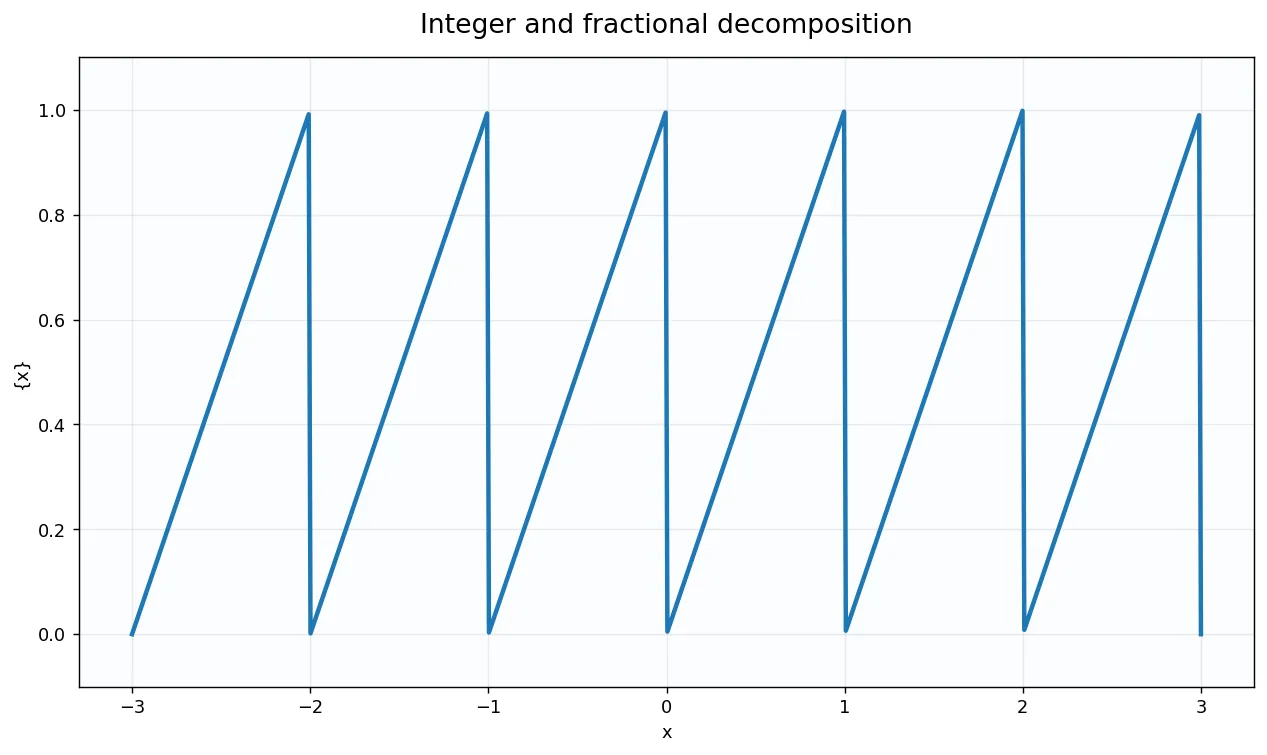
This relationship is expressed through the standard equation
. This definition ensures that every real number can be uniquely decomposed into an integer part and a fractional part.
The notation ##\{x\}## is universally accepted in mathematical literature to represent this operation. It is important to distinguish this from set notation, which uses similar curly braces in different contexts.
Algebraically, the function isolates the values that exist between consecutive integers on the number line. It effectively "resets" the value of the number at every integer boundary encountered during progression.
By defining it this way, mathematicians ensure that the result is always non-negative. This consistency is crucial for maintaining the function's utility across various branches of advanced calculus and number theory.
Domain and Range Analysis
The domain of the fractional part function consists of the set of all real numbers, denoted as ##\mathbb{R}##. It accepts any input, whether rational, irrational, positive, negative, or zero.
The range of the function is strictly confined to the half-open interval
. This means the output can be exactly zero but must always be strictly less than one.
When the input ##x## is an integer, the floor of ##x## is equal to ##x## itself. Consequently, the fractional part ##\{x\}## evaluates to zero, marking the lower bound of the range.
As ##x## increases toward the next integer, the fractional part increases linearly. However, it never reaches the value of one, as the floor function increments exactly at that integer point.
This range constraint is a defining characteristic that distinguishes it from simple decimal truncation. It ensures that the function remains bounded regardless of the magnitude of the input value.
Graphical Representation and Behavior
The Sawtooth Wave Pattern
When plotted on a Cartesian coordinate system, the fractional part function produces a distinctive sawtooth wave. This pattern consists of a series of parallel line segments with a constant slope.
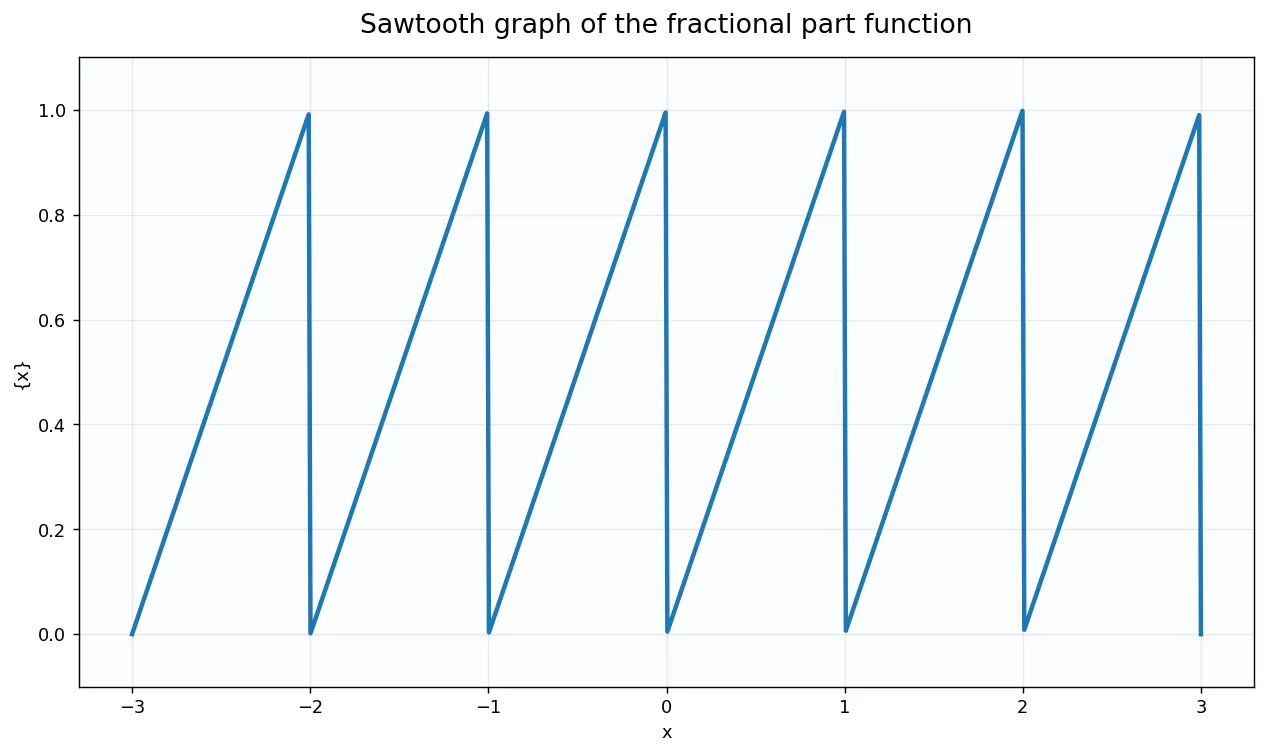
Each segment begins at an integer point ##(n, 0)## and rises at a forty-five-degree angle. The segment continues until it approaches the coordinates of the next integer, ##(n+1, 1)##.
At the exact point where ##x## reaches an integer, the graph experiences a jump discontinuity. The value drops instantaneously from the limit of one back down to the baseline of zero.
The slope of each linear segment is exactly one, as the derivative of ##x - \lfloor x \rfloor## is one. This assumes we are looking at the intervals between the integer jump points.
This visual representation highlights the repetitive and predictable nature of the function. It is a classic example of a piecewise linear function used to model periodic phenomena in physics.
Continuity and Discontinuity Points
The fractional part function is continuous on all intervals of the form ##(n, n+1)##, where ##n## is an integer. Within these bounds, the function behaves as a simple linear transformation.
However, the function is not continuous across the entire real number line. Discontinuities occur at every integer value of ##x##, where the function "breaks" and restarts its cycle.
Specifically, these are classified as jump discontinuities because the left-hand and right-hand limits differ. As ##x## approaches an integer from the left, the limit is one, but the value is zero.
From a calculus perspective, this means the function is not differentiable at any integer point. The derivative exists and equals one everywhere else, creating a series of parallel tangent lines.
Understanding these points of discontinuity is essential when integrating or differentiating expressions involving ##\{x\}##. Engineers must account for these jumps when using the function in signal processing or digital logic.
We Also Published
Algebraic Properties and Identities
Relationship with the Floor Function
The most significant identity involving this function is the decomposition of a real number. Any number ##x## can be written as the sum of its integer and fractional parts.
This identity is written as
. This formula allows for the easy conversion between the total value and its constituent components in algebraic proofs.
Because the floor function always returns an integer, the fractional part is essentially the remainder. It represents the "leftover" value after the largest possible integer has been subtracted from the original.
This relationship is also used to define the ceiling function in terms of the fractional part. For non-integers, the ceiling can be expressed using the floor and fractional components.
In many mathematical contexts, these two functions are used in tandem to bound values. They provide a precise way to navigate the discrete steps inherent in the real number system.
Periodicity and Symmetry
The fractional part function is a periodic function with a fundamental period of ##T = 1##. This means that for any real number ##x##, the identity ##\{x + 1\} = \{x\}## holds.
This periodicity arises because adding an integer to ##x## increases both ##x## and ##\lfloor x \rfloor## by that same integer. The difference between them remains unchanged, preserving the fractional value.
Mathematically, this can be generalized to
for any integer ##k##. This property is frequently utilized to simplify complex trigonometric or modular arithmetic problems.
Unlike the sine or cosine functions, the fractional part function does not exhibit even or odd symmetry. It is neither symmetric about the y-axis nor about the origin in its standard form.
However, it does possess a form of translational symmetry. Shifting the function by any integer along the x-axis results in an identical graph, reinforcing its role in periodic modeling.
Practical Applications and Calculation
Evaluation for Negative Values
Calculating the fractional part of negative numbers often leads to common errors among students. It is vital to strictly follow the formal definition
.
For example, consider ##x = -1.5##. The floor of ##-1.5## is ##-2##, as ##-2## is the greatest integer less than or equal to the input value.
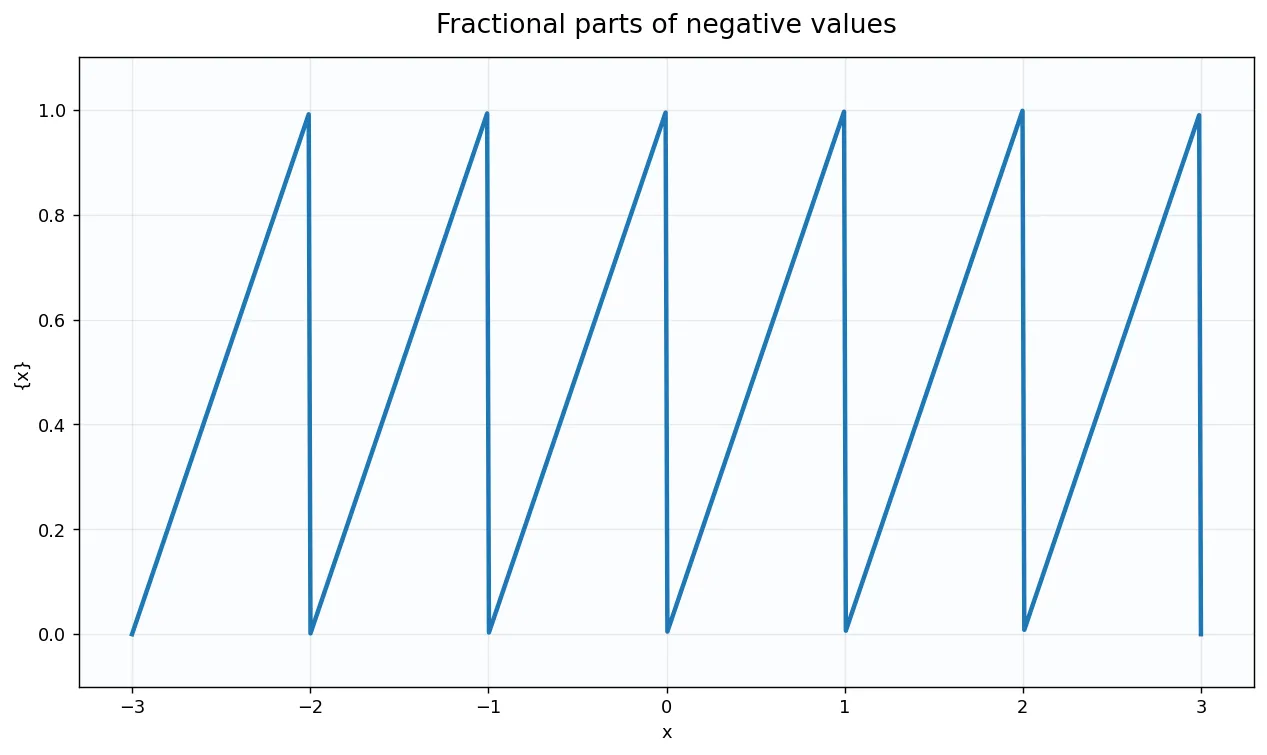
Applying the formula, we get ##\{-1.5\} = -1.5 - (-2)##, which simplifies to ##0.5##. This confirms that the result remains within the required range of ##[0, 1)##.
A common mistake is to assume the fractional part of ##-1.5## is ##-0.5## or ##0.5## by simple truncation. Truncation does not follow the mathematical definition of the fractional part function.
By adhering to the floor-based definition, the function maintains its periodic and non-negative properties. This consistency is required for the function to be useful in higher-level mathematical analysis.
Computational Logic and Programming
In computer science, the fractional part is often implemented using the modulo operator. For positive numbers, the expression ##x \pmod 1## typically returns the fractional part of the value.
However, different programming languages handle the modulo of negative numbers in various ways. Some return a negative remainder, which violates the mathematical definition of the fractional part.
To ensure a correct mathematical implementation in code, developers often use the floor function explicitly. A robust implementation would be x - \lfloor x \rfloor rather than a simple modulo call.
This function is widely used in computer graphics for generating textures and procedural patterns. The sawtooth wave can be used to create repeating gradients or to wrap coordinates.
It also plays a role in numerical algorithms that require normalization of data. By mapping values to the ##[0, 1)## range, it helps in maintaining stability in periodic simulations.
From our network :
- EV 2.0: The Solid-State Battery Breakthrough and Global Factory ExpansionDiscover the impact of the Solid-State Battery Breakthrough on the EV market. Learn about CATL and BYD stock growth, global factory expansion in Europe, and the future of EV 2.0 technology.
- Mastering DB2 LUW v12 Tables: A Comprehensive Technical GuideComprehensive guide on DB2 LUW v12 tables. Explore CREATE TABLE syntax, BLU Acceleration, range partitioning, data types, and security features for IBM DB2 LUW v12.
- Mastering DB2 12.1 Instance Design: A Technical Deep Dive into Modern Database ArchitectureComprehensive guide to DB2 12.1 Instance Design. Explore architectural components, HADR setup, buffer pool tuning, and security policies for IBM DB2 12.1. Includes 10 functional SQL and Shell samples.
- AI-Powered 'Precision Diagnostic' Replaces Standard GRE Score ReportsDiscover the new GRE Precision Diagnostic. Learn how AI-powered behavioral analytics and time-to-solve tracking are replacing standard GRE score reports to empower students.
- 98% of Global MBA Programs Now Prefer GRE Over GMAT Focus EditionExplore why 98% of global MBA programs now prefer the GRE over GMAT Focus. Learn about the shorter GRE format, verbal logic importance, and strategic versatility for students.
- Vite 6/7 'Cold Start' Regression in Massive Module GraphsIn-depth analysis of Vite 6/7 cold start regressions in massive module graphs. Learn about barrel file issues, pre-bundling optimizations, and how to improve Vite dev server performance.
- Trump Political Strategy How Geopolitical Stunts Serve As Media Diversions
- Analyzing Trump Deportation Numbers Insights Into The 2026 Immigration Crackdown
- 10 Physics Numerical Problems with Solutions for IIT JEEPrepare for IIT JEE with 10 physics numerical problems, complete with detailed solutions and conceptual explanations. Ideal for mastering kinematics, thermodynamics, electromagnetism, and optics.
RESOURCES
- Fractional part - Wikipedia
- Fractional Part -- from Wolfram MathWorld
- Fractional Part Function | Brilliant Math & Science Wiki
- How do I get the fractional part of x in desmos? for example ... - Reddit
- FractionalPart: Fractional part of x—Wolfram Documentation
- What is a fractional part function? - Formula & Definition - CK-12
- How to return the fractional part of a number? [closed] - Stack Overflow
- fractional part of sin x - Desmos
- Simple math: how to extract the fractional portion from a decimal
- Fractional Part Function - Formula, Properties, Range, Examples ...
- A sum involving fractional part function - Math Stack Exchange
- Whole and Fractional part symbols? - LaTeX.org
- Calculate fractional part of square root without taking square root
- fractional part of x - Wolfram|Alpha
- How to obtain the integer and fractional parts of a number


0 Comments