
On This Page
Defining the Concept of a Hole in a Graph
A hole in a graph represents a single point where a function lacks a value despite the surrounding curve being continuous. This phenomenon typically appears in rational functions where a factor in the numerator cancels with one in the denominator. Mathematically, the function is undefined at that specific input because it results in an indeterminate form.
In visual terms, mathematicians represent this gap with an open circle on the coordinate plane. This symbol indicates that while the curve leads directly to that point from both directions, the point itself is missing from the domain. Understanding this distinction is vital for mastering the behavior of complex mathematical models.
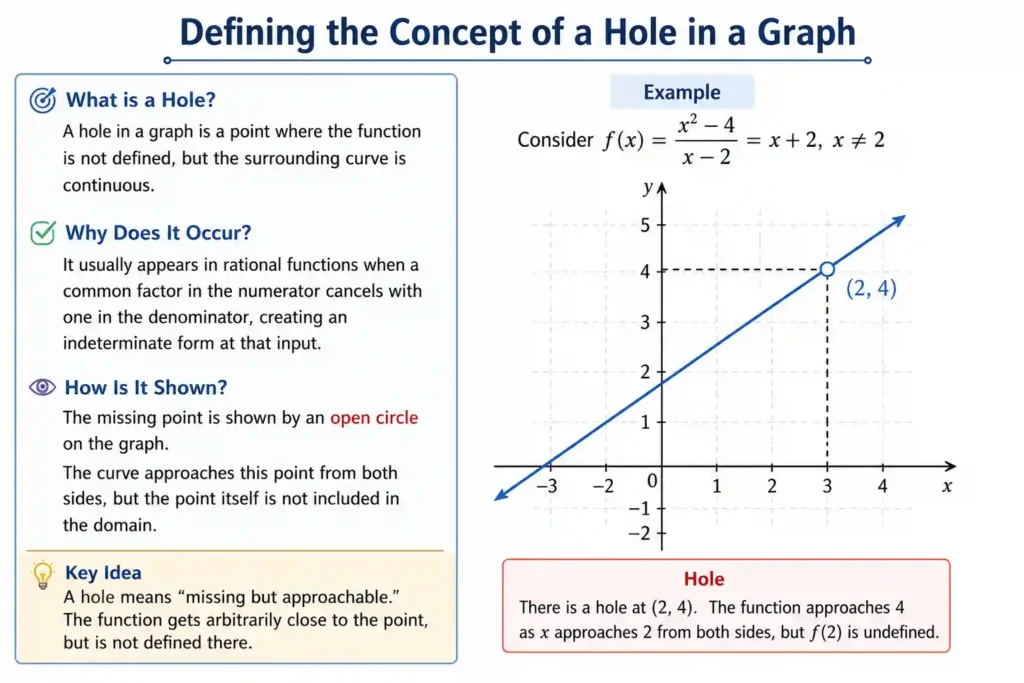
The open circle shows that the function gets close to the value but is not defined there.
The Difference Between ##f(a)## and the Limit
The value ##f(a)## is the actual output of a function when you plug in ##x = a##. If the function is undefined at that point, ##f(a)## does not exist. This is common in expressions where the denominator becomes zero, preventing a standard arithmetic solution.
Conversely, the limit describes the behavior of the function as ##x## gets infinitely close to ##a##. The limit focuses on the neighborhood surrounding the point rather than the point itself. It tells us the height the graph approaches from the left and right sides.
Identifying Removable Discontinuities
A removable discontinuity is the technical name for a hole. It is called "removable" because you can redefine the function at that single point to make it continuous. This differs from non-removable discontinuities, like vertical asymptotes, where the graph breaks entirely.
To identify a hole, you must look for common factors in the numerator and denominator of a rational function. If a factor ##(x - a)## cancels out, a hole exists at ##x = a##. This algebraic cancellation reveals the hidden path the function follows.
Visual Representation on a Coordinate Plane
When graphing a function with a hole, the line or curve remains smooth until it reaches the excluded ##x## value. At that exact coordinate, an open circle is drawn to show the exclusion. The rest of the graph continues as if the point were there.
This visual tool helps students distinguish between different types of breaks. A hole is a "missing pixel" in the graph, whereas an asymptote is a "wall" that the graph never touches. Correct visualization is key to interpreting limits and continuity.
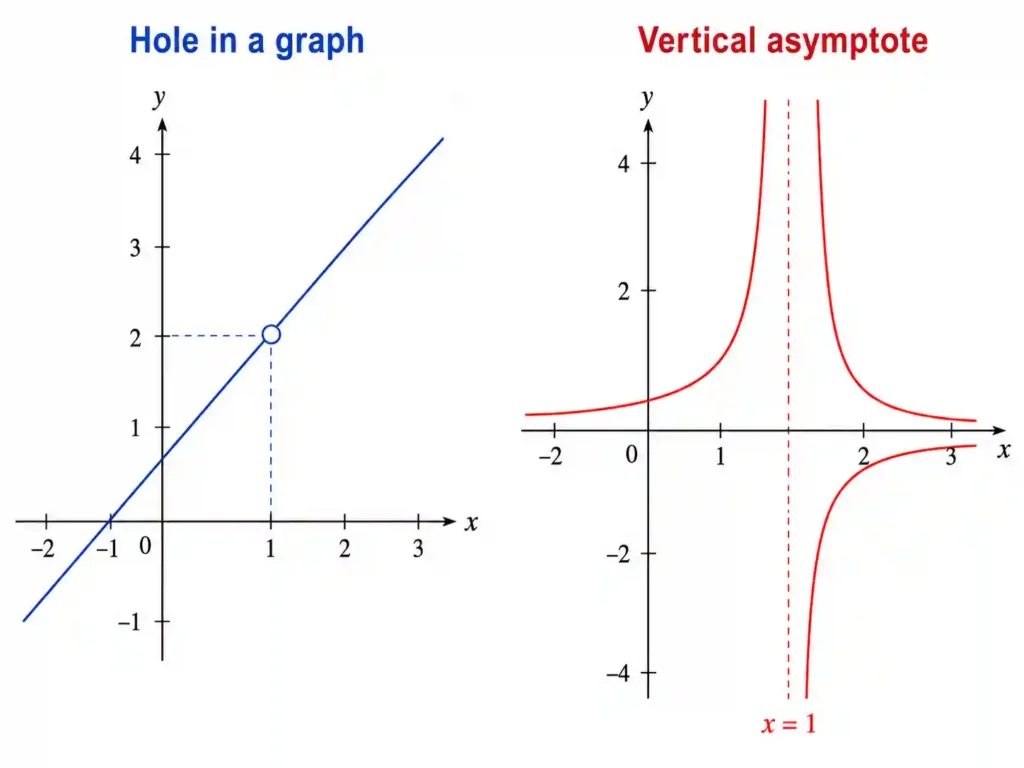
A vertical asymptote acts like a boundary that controls the graph's direction.
Mathematical Origins of Holes
Holes originate from the structural properties of rational expressions. When we divide one polynomial by another, we must ensure the divisor is never zero. However, some functions contain hidden vulnerabilities where the numerator also approaches zero at the same location.
These "zero over zero" situations create the indeterminate form ##\dfrac{0}{0}## . This form does not mean the value is zero or undefined; it means the current expression is insufficient to determine the value. We must use algebraic manipulation to reveal the true limit.
Rational Functions and Common Factors
Rational functions are the primary source of holes in elementary calculus. When the numerator and denominator share a linear factor, they effectively cancel each other out for all values except where the factor equals zero. This leaves the simplified version of the function intact.
For example, if you have ##f(x) = \dfrac{x(x-1)}{x-1}##, the ##(x-1)## terms cancel. The graph looks identical to ##y = x##, but it has a hole at ##x = 1##. The original function cannot accept ##1## as an input.
The Role of Division by Zero
Division by zero is undefined in standard arithmetic because no number multiplied by zero can result in a non-zero value. In the context of a hole, both the top and bottom of the fraction reach zero simultaneously. This creates a specific type of mathematical tension.
Calculus resolves this tension by looking at the ratio of the two values as they shrink. While we cannot divide by zero, we can divide by a number that is ##0.000001##. The limit provides the result of this ongoing ratio as the values vanish.
Simplifying Expressions to Reveal Limits
Simplification is the process of removing the "troublesome" factors that cause the hole. By factoring the polynomials, we can identify which parts of the expression are responsible for the undefined state. Once canceled, the remaining expression is easy to evaluate.
The simplified expression represents the "intended" path of the function. By plugging the excluded ##x## value into this simplified version, we find the ##y##-coordinate of the hole. This value is the limit of the function as it approaches the gap.
Limits and the "Intended" Value
The limit is often described as the "intent" of the function. Imagine a bridge with a single missing plank in the middle. Even if you cannot step on that spot, you know exactly where the plank should be based on the rest of the bridge.
In calculus, limits allow us to talk about these missing planks with precision. We use them to define derivatives and integrals, which are the foundations of modern physics and engineering. The limit bridges the gap between the finite and the infinitesimal.
Approaching the Gap from Both Sides
For a limit to exist at a hole, the function must approach the same height from both the left and the right. If the left-hand limit and the right-hand limit are equal, the hole is well-defined. This symmetry is a requirement for a removable discontinuity.
If the function approached two different heights, it would be a jump discontinuity instead. Holes are unique because the "bridge" is aligned perfectly; there is simply a tiny gap at the center point. This makes them easier to handle algebraically.
Formal Definition of One-Sided Limits
One-sided limits are expressed using a plus or minus sign in the superscript of the target value. For instance, ##\lim_{x \to a^-} f(x)## represents the approach from the left. Similarly, ##\lim_{x \to a^+} f(x)## represents the approach from the right.
When these two values match, we say the general limit exists. In the case of a hole, both one-sided limits equal the same finite number ##L##. This number ##L## is the vertical coordinate where the open circle is placed on the graph.
Why the Limit Exists Where ##f(a)## Does Not
The existence of a limit does not depend on the existence of the function at that exact point. This is a fundamental rule of calculus. The limit only cares about the behavior of the function in the "deleted neighborhood" of ##a##.
This allows us to perform calculations on systems that have singularities or undefined states. By focusing on the limit, we can predict the behavior of physical systems even when the governing equations face a division-by-zero error at a specific moment.
Algebraic Techniques for Filling the Hole
To find the location of a hole, we use several algebraic strategies. The most common is factoring, but other methods like rationalization are necessary for functions involving square roots. These tools allow us to "fill" the hole and see the underlying curve.
Each technique aims to transform the indeterminate form
into a determinate form. Once the expression is simplified, we can use direct substitution to find the limit. This value tells us exactly where the hole sits on the ##y##-axis.
Factoring Polynomials
Factoring is the first line of defense when dealing with rational functions. By breaking down the numerator and denominator into their linear components, we can see which factors are shared. This process reveals the hidden structure of the equation.
Consider the following math problem as an example of this technique in action:
Find the hole in the function ##f(x) = \dfrac{x^2 - 9}{x - 3}##.
1. Factor the numerator: ##x^2 - 9 = (x - 3)(x + 3)##.
2. Rewrite the function: ##f(x) = \dfrac{(x - 3)(x + 3)}{x - 3}##.
3. Cancel the common factor ##(x - 3)##.
4. The simplified function is ##y = x + 3## for ##x \neq 3##.
5. Find the limit: ##\lim_{x \to 3} (x + 3) = 6##.
The hole is at ##(3, 6)##.
Find the hole in ##f(x) = \dfrac{x^2 - 1}{x + 1}##.
1. Factor the numerator: ##(x - 1)(x + 1)##.
2. Cancel ##(x + 1)##.
3. Simplified function: ##y = x - 1##.
4. Limit as ##x \to -1##: ##-1 - 1 = -2##.
The hole is at ##(-1, -2)##.
We Also Published
Rationalizing Numerators and Denominators
When a function contains radicals, factoring might not be immediately obvious. In these cases, we multiply the expression by the conjugate of the part containing the square root. This process, called rationalization, often clears the indeterminate form.
Find the limit of ##f(x) = \dfrac{\sqrt{x} - 2}{x - 4}## as ##x \to 4##.
1. Multiply the top and bottom by the conjugate: ##\sqrt{x} + 2##.
2. Numerator: ##(\sqrt{x} - 2)(\sqrt{x} + 2) = x - 4##.
3. Expression: ##\dfrac{x - 4}{(x - 4)(\sqrt{x} + 2)}##.
4. Cancel ##(x - 4)##: ##\dfrac{1}{\sqrt{x} + 2}##.
5. Limit: ##\dfrac{1}{\sqrt{4} + 2} = \dfrac{1}{4}##.
The hole is at ##(4, 0.25)##.
Find the hole in ##f(x) = \dfrac{x^2 - 25}{x - 5}##.
1. Factor: ##\dfrac{(x-5)(x+5)}{x-5}##.
2. Cancel: ##x+5##.
3. Limit: ##5+5 = 10##.
The hole is at ##(5, 10)##.
Using L'Hôpital's Rule for Indeterminate Forms
For more advanced functions, such as those involving trigonometry or logarithms, factoring may be impossible. L'Hôpital's Rule allows us to take the derivative of the numerator and denominator separately to find the limit. This is a powerful tool for complex holes.
Find the limit of ##f(x) = \dfrac{\sin(x)}{x}## as ##x \to 0##.
1. Direct substitution gives
.
2. Take the derivative of the top: ##\cos(x)##.
3. Take the derivative of the bottom: ##1##.
4. New limit: ##\lim_{x \to 0} \dfrac{\cos(x)}{1} = \cos(0) = 1##.
The hole is at ##(0, 1)##.
Find the hole in ##f(x) = \dfrac{x^2 + 5x + 6}{x + 2}##.
1. Factor the top: ##(x+2)(x+3)##.
2. Cancel ##(x+2)##.
3. Limit as ##x \to -2##: ##-2 + 3 = 1##.
The hole is at ##(-2, 1)##.
Continuity vs. Discontinuity
Continuity is a state where a graph can be drawn without lifting your pencil. A hole is a specific type of discontinuity that breaks this flow at exactly one point. Understanding the criteria for continuity helps us classify these breaks accurately.
A function is continuous at ##a## if three conditions are met. First, ##f(a)## must be defined. Second, the limit as ##x \to a## must exist. Third, the limit must equal the function value. A hole fails the first or third condition.
The Three Criteria for Continuity
The first criterion is existence. The function must have a defined output at the point in question. If the input is outside the domain, the function is discontinuous. This is the most basic requirement for a smooth curve.
The second criterion is the existence of a limit. The curve must approach a specific value from both sides. Finally, the limit and the function value must be identical. If any of these fail, the graph has a discontinuity, such as a hole or a jump.
Distinguishing Holes from Vertical Asymptotes
While both holes and asymptotes involve division by zero, they behave differently. A hole occurs when the zero in the denominator is "canceled out" by a zero in the numerator. The graph remains bounded and approaches a finite number.
A vertical asymptote occurs when the zero in the denominator remains after simplification. In this case, the function values explode toward positive or negative infinity. Visually, the graph follows a vertical line that it never crosses, creating an infinite gap.
Identify if ##f(x) = \dfrac{x-2}{x^2-4}## has a hole or asymptote at ##x=2##.
1. Factor: ##\dfrac{x-2}{(x-2)(x+2)}##.
2. Cancel ##(x-2)##: ##\dfrac{1}{x+2}##.
3. Since the factor canceled, there is a hole at ##x=2##.
4. Since ##(x+2)## remains in the denominator, there is an asymptote at ##x=-2##.
Find the hole in ##f(x) = \dfrac{x^2 - 16}{x - 4}##.
1. Factor: ##(x-4)(x+4)##.
2. Cancel: ##x+4##.
3. Limit: ##4+4 = 8##.
The hole is at ##(4, 8)##.
Jump Discontinuities vs. Removable Ones
A jump discontinuity occurs when the left-hand and right-hand limits exist but are not equal. This is common in piecewise functions. The graph "jumps" from one height to another instantly, leaving no single "intended" value.
A removable discontinuity (hole) is different because the limits from both sides are the same. The "intent" is clear, but the point is simply missing. This distinction is crucial when determining if a function can be "repaired" to be continuous.
Find the hole in ##f(x) = \dfrac{2x^2 - 8}{x + 2}##.
1. Factor out 2: ##2(x^2 - 4)##.
2. Factor further: ##2(x-2)(x+2)##.
3. Cancel ##(x+2)##: ##2(x-2)##.
4. Limit as ##x \to -2##: ##2(-2-2) = -8##.
The hole is at ##(-2, -8)##.
Real-World Applications of Hole Analysis
Hole analysis is not just an academic exercise; it has practical applications in science and engineering. Many physical models use rational functions to describe behavior. Identifying where these models break down helps engineers design safer and more efficient systems.
In many cases, a "hole" represents a point of instability or a transition state. By understanding the limit, scientists can predict what happens "at the edge" of these states. This allows for the interpolation of data where direct measurement is impossible.
Engineering Tolerances and Limits
In mechanical engineering, parts are designed with specific tolerances. Sometimes, a mathematical model for stress or strain might have a point where the equation becomes undefined. Engineers use limits to determine the safe operating conditions near these points.
By "filling the hole," they can estimate the maximum load a structure can handle. This ensures that even if a specific theoretical point is undefined, the surrounding physical reality is well-understood. Limits provide the safety margin necessary for construction.
Signal Processing and Missing Data
In digital signal processing, data can sometimes be lost or corrupted, creating "holes" in a stream of information. Algorithms use interpolation techniques, which are essentially based on limits, to fill in these gaps. This restores the continuity of the signal.
By analyzing the values before and after the gap, the system calculates the "intended" value of the missing data. This is how audio and video streaming services maintain quality even when the network connection fluctuates. The limit ensures a smooth experience.
Find the hole in ##f(x) = \dfrac{x^3 - 1}{x - 1}##.
1. Use the difference of cubes: ##(x-1)(x^2 + x + 1)##.
2. Cancel ##(x-1)##.
3. Limit as ##x \to 1##: ##1^2 + 1 + 1 = 3##.
The hole is at ##(1, 3)##.
Find the hole in ##f(x) = \dfrac{x^2 - x - 6}{x - 3}##.
1. Factor: ##\dfrac{(x-3)(x+2)}{x-3}##.
2. Cancel: ##x+2##.
3. Limit: ##3+2 = 5##.
The hole is at ##(3, 5)##.
Economics and Marginal Analysis
Economists use limits to study marginal cost and revenue. Sometimes, a cost function might be undefined at a specific volume of production due to fixed costs or structural changes. Limits allow them to see the trend of costs as production approaches that point.
Understanding these holes helps businesses make decisions about scaling. If the limit of the cost function is low, it might be profitable to bridge the gap and expand operations. Calculus provides the framework for these complex financial predictions.
Computational Methods for Identifying Holes
Modern technology allows us to identify holes using software. Programming languages like Python have libraries for symbolic mathematics that can factor expressions and calculate limits automatically. This is invaluable for complex functions that are difficult to solve by hand.
Numerical methods can also estimate the location of a hole by evaluating the function at points very close to the discontinuity. While not as precise as algebraic methods, numerical estimation is useful for verifying results or handling non-algebraic functions.
Using Python for Symbolic Math
The SymPy library in Python is a powerful tool for calculus. It can handle symbolic variables and perform operations like limit() and simplify(). This allows researchers to find holes in equations with hundreds of terms.
By defining a symbol x and an expression, a programmer can find the limit as x approaches any value. This automated approach reduces the risk of human error in long calculations. It is a standard tool in data science and academic research.
Find the hole in ##f(x) = \dfrac{x^2 + x - 2}{x - 1}##.
1. Factor the numerator: ##(x-1)(x+2)##.
2. Cancel ##(x-1)##.
3. Limit as ##x \to 1##: ##1 + 2 = 3##.
The hole is at ##(1, 3)##.
Find the hole in ##f(x) = \dfrac{3x^2 - 3}{x - 1}##.
1. Factor: ##3(x-1)(x+1)##.
2. Cancel: ##3(x+1)##.
3. Limit: ##3(1+1) = 6##.
The hole is at ##(1, 6)##.
Numerical Estimation Techniques
Numerical estimation involves plugging in values like ##2.999## and ##3.001## to see what the function approaches. If both values are very close to a specific number, say ##6##, we can reasonably assume the limit is ##6##.
This method is particularly useful when graphing. Most graphing calculators use numerical estimation to decide where to draw the curve. However, they often fail to show the hole because the gap is infinitely small, which is why manual identification remains important.
Find the hole in ##f(x) = \dfrac{x^2 - 4x + 4}{x - 2}##.
1. Factor: ##\dfrac{(x-2)(x-2)}{x-2}##.
2. Cancel: ##x-2##.
3. Limit as ##x \to 2##: ##2 - 2 = 0##.
The hole is at ##(2, 0)##.
Find the hole in ##f(x) = \dfrac{x^2 - 7x + 12}{x - 4}##.
1. Factor: ##\dfrac{(x-4)(x-3)}{x-4}##.
2. Cancel: ##x-3##.
3. Limit: ##4-3 = 1##.
The hole is at ##(4, 1)##.
Visualizing Holes with Graphing Software
Tools like Desmos or GeoGebra are excellent for visualizing holes. While they might not show the open circle by default, you can click on the specific point to see that the ##y##-value is "undefined." This provides immediate feedback on your algebraic work.
Educators use these tools to show students how the curve "wants" to pass through the hole. By zooming in, students can see that the graph doesn't break or jump; it simply skips a single coordinate. This visual reinforcement is vital for conceptual understanding.
Advanced Calculus Perspectives
In higher-level mathematics, the concept of a hole is formalized using the epsilon-delta definition of a limit. This rigorous approach proves that the limit exists without relying on visual intuition or simple algebraic tricks. It is the gold standard of mathematical proof.
Advanced calculus also explores how holes behave in multidimensional space. In complex analysis, these points are often referred to as "removable singularities." The study of these points leads to deep insights into the nature of functions and their domains.
Epsilon-Delta Definition of a Limit
The formal definition states that for every ##\epsilon > 0##, there exists a ##\delta > 0## such that if ##0 < |x - a| < \delta##, then ##|f(x) - L| < \epsilon##. This means we can get the function as close to the limit ##L## as we want by picking an ##x## close enough to ##a##.
This definition specifically excludes ##x = a## from the condition. This is why the limit can exist even if the function is undefined at the point. It provides the logical foundation for everything we do with holes and discontinuities.
Pointwise Convergence in Sequences
In the study of sequences of functions, a hole can appear as a result of pointwise convergence. A sequence of continuous functions might converge to a limit function that has a hole. This raises interesting questions about the preservation of continuity.
Understanding how these gaps form in the limit of a process is essential for theoretical physics. Many quantum mechanical models involve sequences that converge to distributions with singular points. Holes are the simplest examples of these complex phenomena.
Topology and Deleted Neighborhoods
In topology, we describe the area around a hole as a "deleted neighborhood." This is a set of points that includes everything near ##a## except for ##a## itself. Limits are defined entirely within these deleted neighborhoods.
This perspective allows mathematicians to generalize the concept of a hole to any space, not just the real number line. Whether in three dimensions or abstract vector spaces, the logic of "approaching without touching" remains the same. It is a universal principle of mathematical analysis.
__ZARTOM_QUIZ_ITEMS_BELOW__29FCM
| | | Holes and Limits Quiz | What is the formal name for a "hole" in a graph? | | Jump Discontinuity | | Removable Discontinuity | | Infinite Discontinuity | | Oscillating Discontinuity | | B | A hole is called a removable discontinuity because it can be "filled" by redefining the function at that single point. | 1
| | | Holes and Limits Quiz | If ##f(x) = \dfrac{x-5}{x-5}##, what is ##f(5)##? | | 1 | | 0 | | Undefined | | 5 | | C | Direct substitution results in 0/0, which is undefined in the original function's domain. | 2
| | | Holes and Limits Quiz | In the function ##f(x) = \dfrac{x^2-9}{x-3}##, where is the hole located? | | (3, 3) | | (3, 6) | | (3, 0) | | (3, 9) | | B | Factoring gives (x-3)(x+3)/(x-3). Canceling (x-3) leaves x+3. The limit as x approaches 3 is 3+3=6. | 3
| | | Holes and Limits Quiz | Which condition must be met for a limit to exist at a hole? | | f(a) must be defined | | The graph must have an asymptote | | Left-hand and right-hand limits must be equal | | The function must be a polynomial | | C | A limit exists if and only if the function approaches the same value from both the left and the right sides. | 4
| | | Holes and Limits Quiz | How is a hole visually represented on a standard graph? | | A solid dot | | A vertical dashed line | | An open circle | | A horizontal dashed line | | C | An open circle indicates the point is excluded from the graph while the surrounding curve is present. | 5
| | | Holes and Limits Quiz | What results from a factor in the denominator that does NOT cancel out? | | A hole | | A vertical asymptote | | A jump | | A horizontal asymptote | | B | Non-removable factors in the denominator typically result in vertical asymptotes where the function goes to infinity. | 6
| | | Holes and Limits Quiz | What is the limit of ##\dfrac{\sin(x)}{x}## as ##x## approaches 0? | | 0 | | Undefined | | 1 | | Infinity | | C | Using L'Hopital's Rule or the Squeeze Theorem, the limit is proven to be 1. | 7
| | | Holes and Limits Quiz | If a hole is at ##(2, 4)##, what is the value of the limit as ##x \to 2##? | | 2 | | 4 | | Undefined | | 0 | | B | The y-coordinate of the hole represents the limit of the function as it approaches that x-value. | 8
| | | Holes and Limits Quiz | Which algebraic technique is best for finding holes involving square roots? | | Factoring | | Rationalization | | Long Division | | Synthetic Division | | B | Multiplying by the conjugate (rationalization) helps clear indeterminate forms involving radicals. | 9
| | | Holes and Limits Quiz | Why does calculus use limits to study holes? | | To make the function zero | | To bypass division by zero | | To find the domain | | To calculate the slope | | B | Limits allow us to analyze the behavior of a function near a point where it is mathematically undefined. | 10
From our network :
- AI-Powered 'Precision Diagnostic' Replaces Standard GRE Score ReportsDiscover the new GRE Precision Diagnostic. Learn how AI-powered behavioral analytics and time-to-solve tracking are replacing standard GRE score reports to empower students.
- Mastering DB2 12.1 Instance Design: A Technical Deep Dive into Modern Database ArchitectureComprehensive guide to DB2 12.1 Instance Design. Explore architectural components, HADR setup, buffer pool tuning, and security policies for IBM DB2 12.1. Includes 10 functional SQL and Shell samples.
- Mastering DB2 LUW v12 Tables: A Comprehensive Technical GuideComprehensive guide on DB2 LUW v12 tables. Explore CREATE TABLE syntax, BLU Acceleration, range partitioning, data types, and security features for IBM DB2 LUW v12.
- 10 Physics Numerical Problems with Solutions for IIT JEEPrepare for IIT JEE with 10 physics numerical problems, complete with detailed solutions and conceptual explanations. Ideal for mastering kinematics, thermodynamics, electromagnetism, and optics.
- 98% of Global MBA Programs Now Prefer GRE Over GMAT Focus EditionExplore why 98% of global MBA programs now prefer the GRE over GMAT Focus. Learn about the shorter GRE format, verbal logic importance, and strategic versatility for students.
- EV 2.0: The Solid-State Battery Breakthrough and Global Factory ExpansionDiscover the impact of the Solid-State Battery Breakthrough on the EV market. Learn about CATL and BYD stock growth, global factory expansion in Europe, and the future of EV 2.0 technology.
- Analyzing Trump Deportation Numbers Insights Into The 2026 Immigration Crackdown
- Vite 6/7 'Cold Start' Regression in Massive Module GraphsIn-depth analysis of Vite 6/7 cold start regressions in massive module graphs. Learn about barrel file issues, pre-bundling optimizations, and how to improve Vite dev server performance.
- Trump Political Strategy How Geopolitical Stunts Serve As Media Diversions
RESOURCES
- [Graphing, Holes] How can a graph just have a hole? Please explain ...
- How can a function with a hole (removable discontinuity) equal a ...
- Can you still have a limit if there is a hole? : r/calculus - Reddit
- Functions Holes Calculator
- I need some help understanding the concept of "holes" in a graph.
- Example of a real-life graph with a "hole"? - Math Stack Exchange
- Does a point underneath a hole in a graph above it take precedence ...
- Why does factoring eliminate a hole in the limit?
- How to Tell your Asymptote from a Hole in the Graph.
- Why don't graphing tools represent holes in a graph?
- The Formal Definition of the Derivative, or Why Holes Matter
- Holes in Rational Functions | CK-12 Foundation
- Finding the Holes In a Graph - Algebra Examples - Mathway
- What is a Removable Discontinuity?: AP® Calculus AB-BC Review
- Math problems involving Calculus - Space Math @ NASA



0 Comments