Where Exploration Meets Excellence

Kinematics Online Practice Quiz for Physics Students

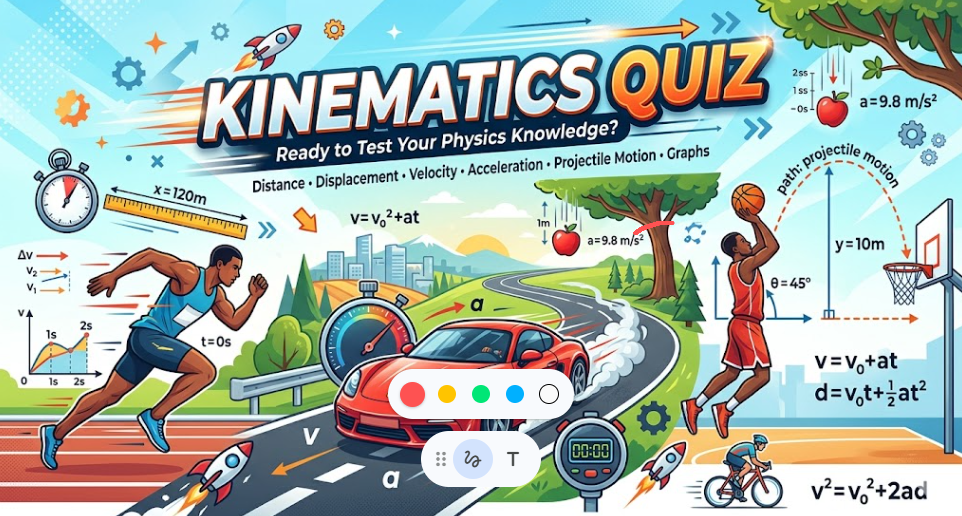
Kinematics online practice quiz banner showing motion arrows, acceleration vectors, physics graphs, and projectile motion.

This standalone Kinematics Online Practice Quiz is designed to help students revise the core ideas of motion in physics, including distance, displacement, speed, velocity, acceleration, equations of motion, graphs, free fall, and projectile motion. The questions are suitable for CBSE Class 11, school-level physics revision, and early IIT JEE foundation practice, with clear options and explanations to strengthen conceptual understanding and problem-solving confidence.


Kinematics Online Practice Quiz for Physics Students

Q1. What does kinematics mainly study?

Kinematics describes motion using quantities such as displacement, velocity, acceleration, and time without directly discussing the forces that cause the motion.

Q2. Which quantity gives the shortest straight-line distance from initial position to final position with direction?

Displacement is a vector quantity. It depends only on the initial and final positions and includes direction.

Q3. A car travels 60 km east and then 20 km west. What is its displacement?

Net displacement is final position minus initial position. The car is 40 km east of the starting point.

Q4. Which of the following is a scalar quantity?

Speed has magnitude only, while velocity, acceleration, and displacement require direction.

Q5. The SI unit of acceleration is which of the following?

Acceleration is the rate of change of velocity with time, so its SI unit is meter per second squared.

Q6. If an object moves with uniform velocity, its acceleration is what?

Uniform velocity means velocity does not change with time, so acceleration is zero.

Q7. A body starts from rest and reaches a velocity of ##20 m s^{-1}## in 5 s. What is its acceleration?

Using ##a = (v-u)/t##, we get ##a = (20-0)/5 = 4 m s^{-2}##.

Q8. Which equation is correct for uniformly accelerated motion?

For constant acceleration, the first equation of motion is ##v = u + at##.

Q9. In the equation ##s = ut + \frac{1}{2}at^2##, what does ##u## represent?

In standard kinematics notation, ##u## represents initial velocity.

Q10. A ball is dropped from rest. Ignoring air resistance, its acceleration is approximately what near Earth’s surface?

A freely falling body near Earth’s surface has acceleration due to gravity approximately ##9.8 m s^{-2}## downward.

Q11. What is the slope of a displacement-time graph?

The slope of a displacement-time graph gives velocity because velocity is the rate of change of displacement with time.

Q12. What does the area under a velocity-time graph represent?

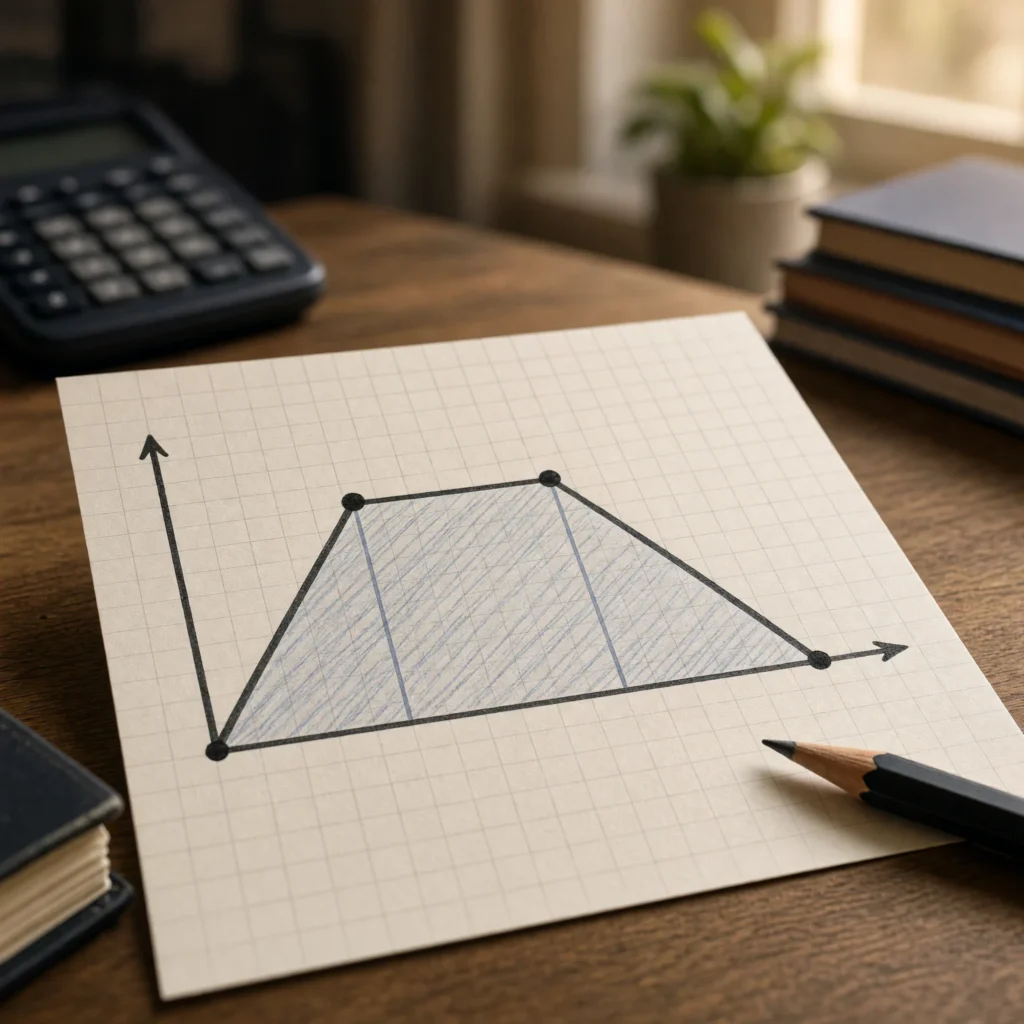
The area under a velocity-time graph gives displacement. If velocity is always positive, it also equals distance traveled.

Q13. A straight horizontal line on a velocity-time graph indicates what type of motion?

A horizontal velocity-time graph means velocity remains constant with time. The object may be moving uniformly if the velocity is non-zero.

Q14. If velocity changes from ##10 m s^{-1}## to ##30 m s^{-1}## in 4 s, what is the acceleration?

Using ##a = (v-u)/t##, we get ##a = (30-10)/4 = 5 m s^{-2}##.

Q15. A cyclist covers 100 m in 20 s. What is the average speed?

Average speed is total distance divided by total time, so ##100/20 = 5 m s^{-1}##.

Q16. Which condition is necessary for using the standard equations of motion directly?

The standard equations ##v = u + at##, ##s = ut + \frac{1}{2}at^2##, and ##v^2 = u^2 + 2as## apply directly when acceleration is constant.

Q17. A body moving in a straight line slows down uniformly. What can be said about its acceleration?

When a body slows down in straight-line motion, acceleration acts opposite to its velocity.

Q18. Which quantity can be negative in one-dimensional motion?

Displacement can be positive, negative, or zero depending on the chosen direction and final position.

Q19. A particle starts from rest and moves with acceleration ##2 m s^{-2}## for 5 s. What is its final velocity?

Using ##v = u + at##, we get ##v = 0 + 2 \times 5 = 10 m s^{-1}##.

Q20. A particle starts from rest and moves with acceleration ##2 m s^{-2}## for 5 s. What displacement does it cover?

Using ##s = ut + \frac{1}{2}at^2##, we get ##s = 0 + \frac{1}{2} \times 2 \times 25 = 25 m##.

Q21. Which statement is true for average velocity?

Average velocity is total displacement divided by total time. It is a vector quantity and can differ from average speed.

Q22. A runner completes one full circular lap and returns to the starting point. What is the displacement?

After one complete lap, final position is the same as initial position, so displacement is zero.

Q23. In projectile motion without air resistance, the horizontal acceleration is what?

In ideal projectile motion, gravity acts vertically downward, so horizontal acceleration is zero.

Q24. For a projectile launched horizontally, which quantity remains constant if air resistance is neglected?

Without air resistance, no horizontal force acts on the projectile, so horizontal velocity remains constant.

Q25. A stone is thrown vertically upward. At the highest point, which statement is correct?

At the highest point, instantaneous velocity becomes zero, but acceleration due to gravity still acts downward.

TAGS:

Comments

What do you think?

1 Comment

Submit a Comment

Your email address will not be published. Required fields are marked *

Recommended Reads for You

Simple Physics Practice Quiz

Simple Physics Practice QuizQ1. What is the SI unit of force? A. Joule B. Newton C. Watt D. Pascal Force is measured in Newton. Q2. Which quantity tells us how fast an object is moving? A. Mass B. Speed C. Force D. Pressure Speed tells us how fast an object moves. Q3....