On This Page
Defining the Characteristic Function of Integers
Mathematical Formulation and Symbols
The characteristic function of integers, often denoted by ##\chi_{\mathbb{Z}}(x)##, is a mapping from the set of real numbers to the set ##\{0, 1\}##. It distinguishes whether a given input belongs to the set of integers.
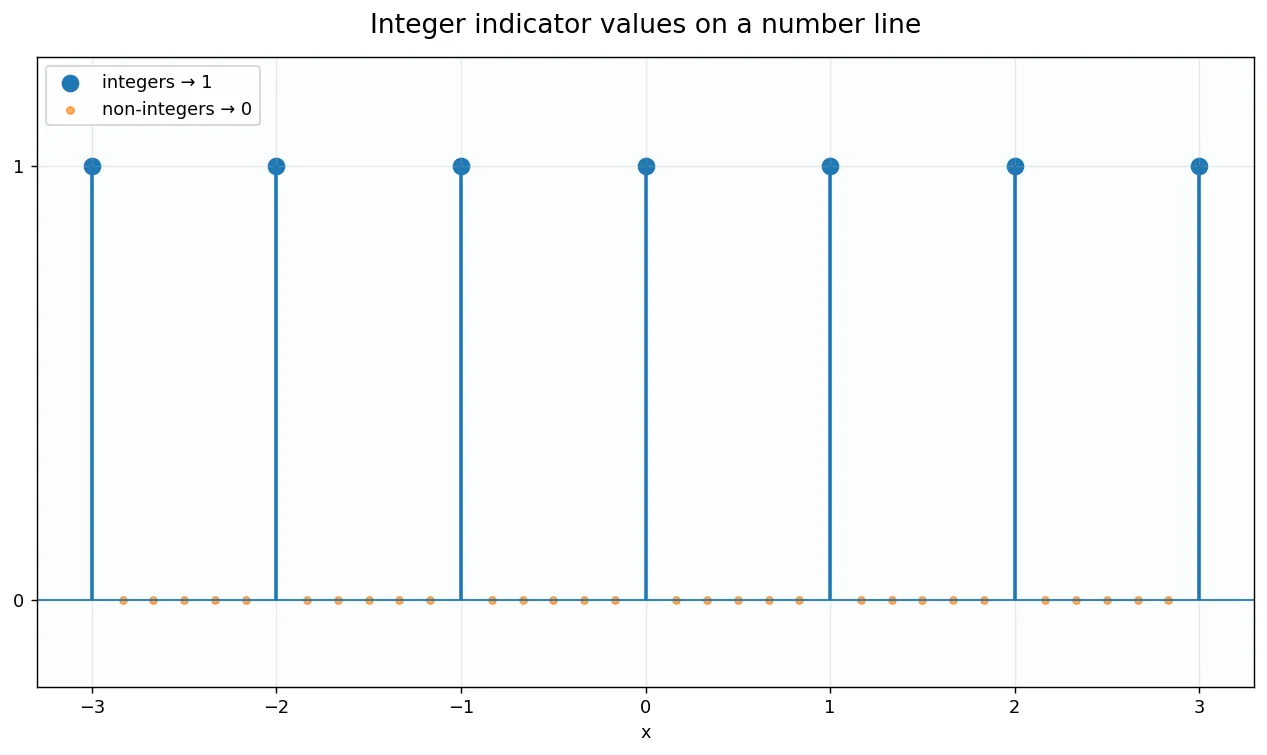
Formally, the function evaluates the membership of a real number ##x## within the set ##\mathbb{Z}##. If the input is a whole number, the output is unity; otherwise, the output remains zero.
The piecewise definition is expressed as:
This function is essential for isolating discrete points along a continuous real line. It allows mathematicians to treat the set of integers as a filter within broader analytical expressions.
By using this notation, complex summations and integrals can be restricted to integer values. This simplifies the transition between continuous calculus and discrete number theory in various theoretical frameworks.
The Role of Indicator Functions
In set theory, the characteristic function of integers is a specific type of indicator function. Indicator functions are used to signal the presence of an element within a defined subset.
The utility of ##\chi_{\mathbb{Z}}(x)## lies in its ability to convert qualitative membership into quantitative data. This transformation is vital for constructing formal proofs and performing algebraic manipulations in higher mathematics.
When working with probability or measure theory, these functions help define the density of sets. The integer indicator specifically highlights the countable nature of the integer set within the uncountable real field.
Mathematically, indicator functions are idempotent, meaning that squaring the function results in the same output. This property is useful when simplifying expressions involving multiple characteristic functions or boolean logic gates.
Furthermore, these functions serve as building blocks for more complex distributions. By combining indicator functions, researchers can model stepped gradients or discrete probability mass functions used in statistical mechanics.
Relationship with the Floor and Ceiling Functions
Constructing the Function via Floor Logic
A common way to represent the characteristic function of integers without piecewise notation is through the floor function. The floor function, denoted ##\lfloor x \rfloor##, returns the greatest integer less than or equal to ##x##.
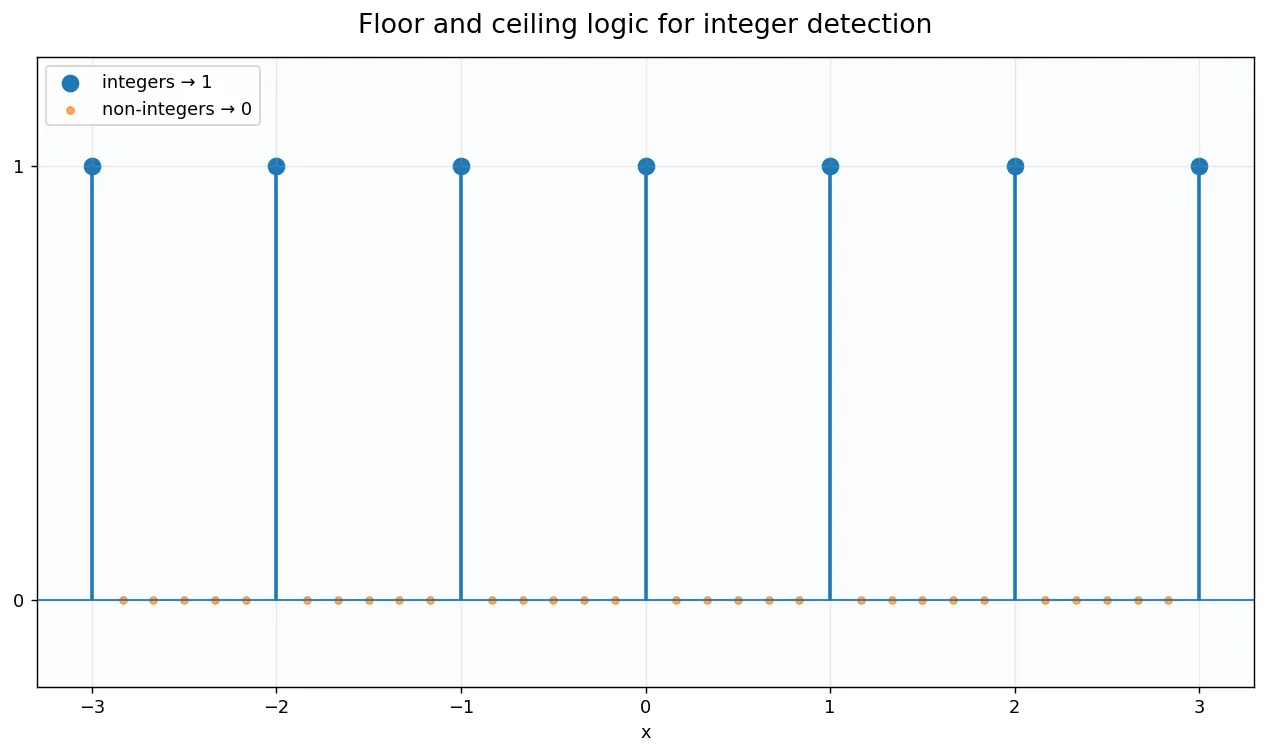
An equality exists such that ##x## is an integer if and only if ##x = \lfloor x \rfloor##. This identity provides a direct mechanism for testing the integrality of any real number programmatically.
Using this logic, we can define the function as a boolean comparison. If the condition ##x - \lfloor x \rfloor = 0## is met, the function returns 1, signaling an integer value.
Alternatively, the function can be expressed using the fractional part function. Since the fractional part ##\{x\}## is defined as ##x - \lfloor x \rfloor##, the characteristic function is 1 when ##\{x\} = 0##.
This floor-based approach is particularly useful in computer science. It allows algorithms to verify data types and perform rounding checks without requiring complex branching logic or external library dependencies.
Analytical Properties and Discontinuity
The characteristic function of integers is inherently discontinuous at every real point. Specifically, it exhibits jump discontinuities at every integer value, making it a non-smooth function in traditional calculus.
Because the function is zero almost everywhere on the real line, its Lebesgue integral over any finite interval is zero. This property highlights the "thinness" of the integer set relative to the reals.
Despite its lack of continuity, the function is bounded between 0 and 1. This boundedness ensures that it can be used as a weight in various series without causing divergence issues.
In the context of distributions, the characteristic function is related to the Dirac comb. While the Dirac comb consists of impulses, the characteristic function provides a discrete binary mapping for each point.
Understanding these analytical properties is crucial for physicists. It helps in modeling phenomena that occur at discrete intervals, such as digital sampling or the quantization of energy levels in quantum systems.
We Also Published
Applications in Number Theory and Series
Counting Integer Points in Intervals
One of the primary uses of the characteristic function is counting lattice points. By summing the function over a specific range, one can determine the number of integers within that interval.
The sum
effectively counts every whole number between ##a## and ##b##. This technique is a cornerstone of combinatorial geometry and analytic number theory.
In higher dimensions, this concept extends to counting points within complex shapes. Mathematicians use variations of this function to solve the Gauss circle problem and other lattice-related challenges.
The function also aids in defining the prime counting function and other arithmetic sequences. By filtering out non-integers, researchers can focus exclusively on the properties of natural numbers and primes.
This filtering capability is vital for the Riemann Zeta function and related series. It allows for the formal transition from continuous complex analysis back to the discrete realm of integers.
Integration and Summation Transforms
The characteristic function of integers plays a role in the Euler-Maclaurin formula. This formula relates integrals to sums, providing a way to approximate one using the other with high precision.
By incorporating the indicator function into an integral, one can transform a continuous operation into a discrete sum. This is often represented using the Stieltjes integral notation in advanced analysis.
In Fourier analysis, the periodic nature of the integer set allows for interesting transformations. The characteristic function can be viewed as a limiting case of periodic trigonometric series.
Researchers use these transforms to analyze the frequency of integer-based patterns in signals. This is particularly relevant in cryptography, where integer periodicity can reveal vulnerabilities in certain encryption algorithms.
Ultimately, these mathematical transforms bridge the gap between different branches of math. They allow tools from calculus to be applied to problems that are fundamentally discrete and algebraic.
Computational Implementation and Discrete Contexts
Algorithmic Check for Integrality
In software engineering, implementing the characteristic function is a common task. Most programming languages provide a "floor" or "modulo" operator to facilitate this check efficiently within the CPU.
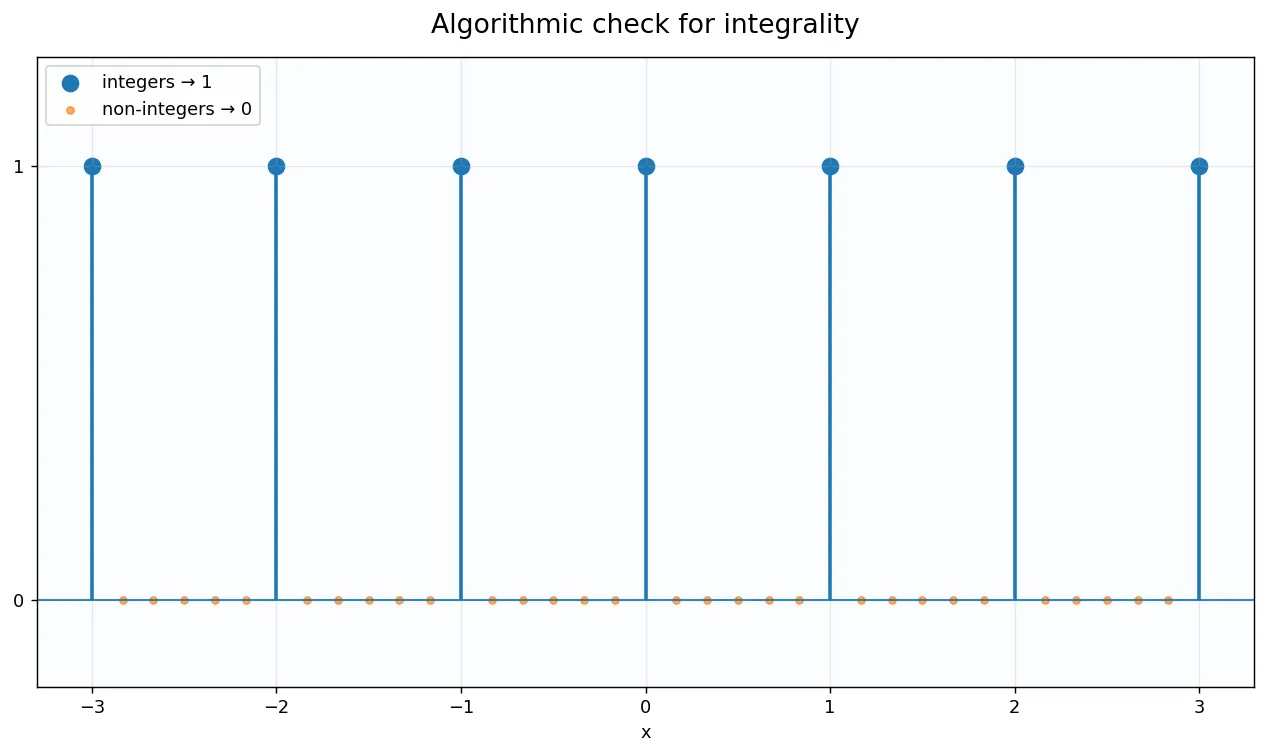
A typical implementation involves comparing the floating-point value to its truncated integer version. If the difference is zero, the function returns a boolean true, representing the value 1.
This logic is used in data validation and numerical analysis. It ensures that inputs to specific functions, like array indexing or bitwise operations, are valid whole numbers before processing.
Handling floating-point precision is a critical consideration here. Due to rounding errors in binary arithmetic, developers often use a small epsilon value to check if a number is "close enough" to an integer.
Role in Combinatorial Optimization
In the field of optimization, the characteristic function helps define integer constraints. Integer programming relies on ensuring that certain variables remain within the set of whole numbers during calculation.
By using the indicator function, constraints can be mathematically formalized within objective functions. This allows solvers to navigate the feasible region while respecting the discrete nature of the variables.
This is particularly useful in logistics and resource allocation. For example, when calculating the number of vehicles needed for a fleet, the solution must be an integer value.
The function also appears in graph theory and network analysis. It helps identify nodes or edges that meet specific criteria, allowing for the automated traversal of complex data structures.
In conclusion, the characteristic function of integers is more than a simple definition. It is a versatile tool that enables precision in both theoretical mathematics and practical computational applications across various disciplines.
From our network :
- 10 Physics Numerical Problems with Solutions for IIT JEEPrepare for IIT JEE with 10 physics numerical problems, complete with detailed solutions and conceptual explanations. Ideal for mastering kinematics, thermodynamics, electromagnetism, and optics.
- 98% of Global MBA Programs Now Prefer GRE Over GMAT Focus EditionExplore why 98% of global MBA programs now prefer the GRE over GMAT Focus. Learn about the shorter GRE format, verbal logic importance, and strategic versatility for students.
- Trump Political Strategy How Geopolitical Stunts Serve As Media Diversions
- Vite 6/7 'Cold Start' Regression in Massive Module GraphsIn-depth analysis of Vite 6/7 cold start regressions in massive module graphs. Learn about barrel file issues, pre-bundling optimizations, and how to improve Vite dev server performance.
- Mastering DB2 12.1 Instance Design: A Technical Deep Dive into Modern Database ArchitectureComprehensive guide to DB2 12.1 Instance Design. Explore architectural components, HADR setup, buffer pool tuning, and security policies for IBM DB2 12.1. Includes 10 functional SQL and Shell samples.
- Mastering DB2 LUW v12 Tables: A Comprehensive Technical GuideComprehensive guide on DB2 LUW v12 tables. Explore CREATE TABLE syntax, BLU Acceleration, range partitioning, data types, and security features for IBM DB2 LUW v12.
- EV 2.0: The Solid-State Battery Breakthrough and Global Factory ExpansionDiscover the impact of the Solid-State Battery Breakthrough on the EV market. Learn about CATL and BYD stock growth, global factory expansion in Europe, and the future of EV 2.0 technology.
- Analyzing Trump Deportation Numbers Insights Into The 2026 Immigration Crackdown
- AI-Powered 'Precision Diagnostic' Replaces Standard GRE Score ReportsDiscover the new GRE Precision Diagnostic. Learn how AI-powered behavioral analytics and time-to-solve tracking are replacing standard GRE score reports to empower students.
RESOURCES
- discrete mathematics - Characteristic Function Comprehesnion
- Crash by using multiple BLE Characteristic --> RegisterForBytes ...
- Characteristic function of an integer-valued distribution, inversion ...
- Linearizing objective function with variables inside an indicator ...
- Indicator function - Wikipedia
- The distribution of square-full integers - Project Euclid
- How do you get mathbb{1} to work (characteristic function of a set)?
- Transition from an irrational number to a rational numbers - Reddit
- THE LAW OF LARGE NUMBERS Contents 1. Probability Spaces 1 2 ...
- When is a monic integer polynomial the characteristic polynomial of ...
- mathfrak{B}$-free integers in number fields and dynamics - arXiv
- The characteristic (indicator) function of a set is not in the Sobolev ...
- New moment formulas for moments and characteristic function of the ...
- Homework set 6 - University of Bristol
- Sign Patterns of the Liouville Function and Mobius Function over the ...


0 Comments