Every solid object you have ever touched, every breath you have drawn, and every star burning in the night sky is built upon a particle that hides in plain sight. The neutron sits at the heart of the atom, nestled beside the proton, yet it carries no electric charge whatsoever. That single absence of charge transforms it into one of the most consequential and least understood actors in modern physics. Because it slips past electric barriers that would repel any charged particle, the neutron becomes a unique probe of matter and a powerful agent of transformation.
Understanding the neutron requires abandoning some comfortable intuitions about how matter behaves. We tend to imagine atoms as miniature solar systems held together by electrical attraction, but the nucleus would fly apart instantly if electromagnetism were the only force at work. The neutron supplies the strong nuclear glue that binds protons together despite their mutual repulsion. It also determines the stability, mass, and radioactive destiny of every isotope in existence. This guide unpacks what a neutron actually is, where it originates, and why its strange neutrality reshaped chemistry, medicine, and energy production.
Beyond the textbook definition, the neutron opens a window onto the deepest questions of existence. Its slight excess of mass over the proton governs whether free neutrons decay, and its internal structure of quarks reveals the machinery of the strong force. Neutron stars compress matter to densities no laboratory can replicate, while neutron scattering lets scientists peer inside materials without disturbing them. By the end of this analysis, the humble chargeless particle will appear less like a passive building block and more like a quiet architect of the physical world.
On This Page
- The Neutron Defined: Anatomy of a Chargeless Particle
- Inside the Nucleus: The Neutron as Nuclear Glue
- Where Neutrons Come From: Origins and Creation
- Why Neutrality Matters: Interactions and Applications
- Neutron Stars and the Cosmic Scale of Neutrality
- Measuring the Neutron: Precision, Puzzles, and Open Questions
- Worked Calculations: Ten Neutron Physics Problems
The Neutron Defined: Anatomy of a Chargeless Particle
The neutron is a subatomic particle found in the nucleus of every atom except the most common form of hydrogen. It carries no net electric charge, possesses a mass marginally greater than the proton, and interacts primarily through the strong nuclear force. Discovered in 1932 by James Chadwick, it completed the picture of atomic structure that had puzzled physicists for decades. Its neutrality explains why atomic nuclei can remain stable despite containing multiple positively charged protons.
Mass, Spin, and the Quark Interior
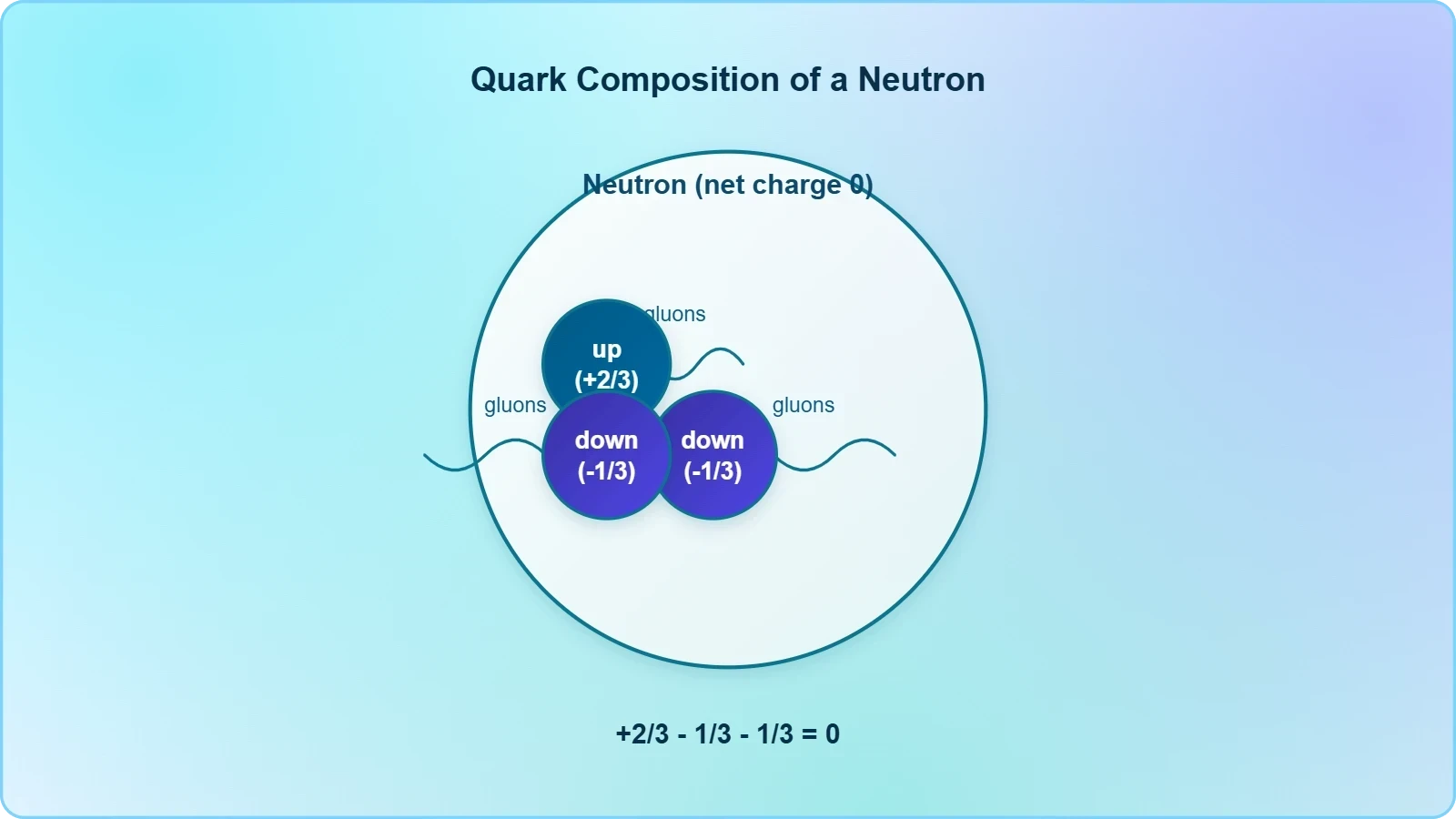
Although the neutron appears elementary in simple models, it is actually a composite particle built from three quarks bound by gluons. Two down quarks and one up quark combine to produce a net charge of zero, yet the internal dynamics are anything but static. The neutron's rest mass of approximately ##[1.675 \times 10^{-27}\ \text{kg}]## dwarfs the sum of its constituent quark masses, with the remainder arising from binding energy. This mass-energy equivalence, captured by ##[E = mc^2]##, reveals that most of the neutron's substance is confined field energy rather than matter in the traditional sense.
The neutron also carries a spin of one-half, making it a fermion subject to the Pauli exclusion principle. This quantum property prevents neutrons from collapsing into identical states and underpins the structure of neutron stars. Its magnetic moment, though tiny, points opposite to its spin, a subtle signature of the internal quark arrangement. Precision measurements of these properties test the Standard Model and constrain theories of physics beyond it.
How the Neutron Compares to Other Particles
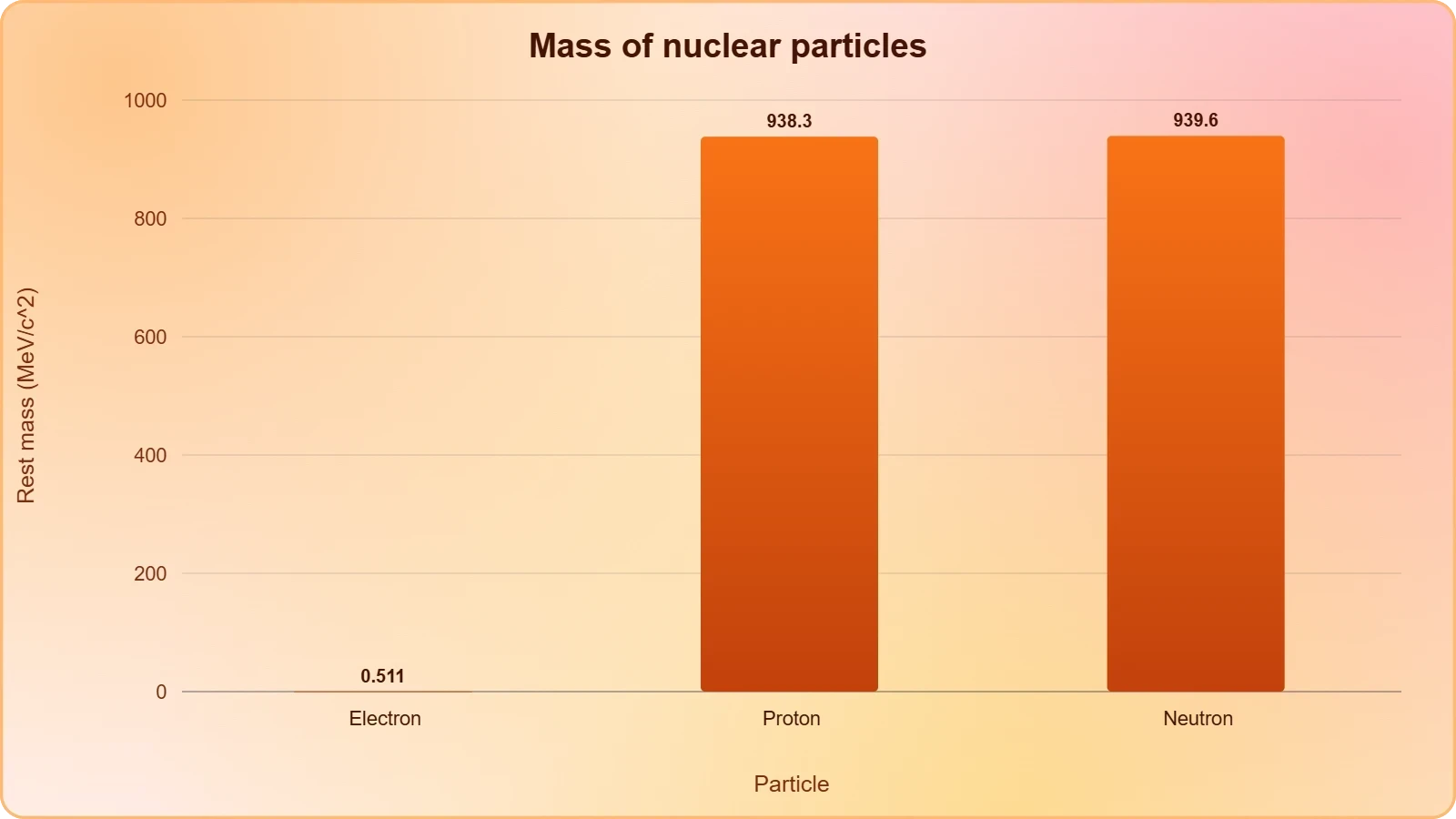
Placing the neutron beside its nuclear neighbors clarifies its distinctive role. The proton carries positive charge and defines the chemical element, while the electron orbits far outside the nucleus and governs bonding. The neutron contributes mass and stability without altering the element's identity, which is why isotopes of the same element differ only in neutron count. This comparative view explains why chemists and physicists treat the neutron as the silent partner in atomic structure.
Inside the Nucleus: The Neutron as Nuclear Glue
Within the atomic nucleus, the neutron performs a role that no other particle can replicate. Protons repel one another through the electromagnetic force, and without a counterbalancing attraction the nucleus would rupture immediately. The strong nuclear force, mediated by gluon exchange between quarks, provides that attraction across extremely short distances. Neutrons contribute to this binding without adding extra repulsion, making them indispensable for nuclear stability.
The Balance of Forces and the Stability Line
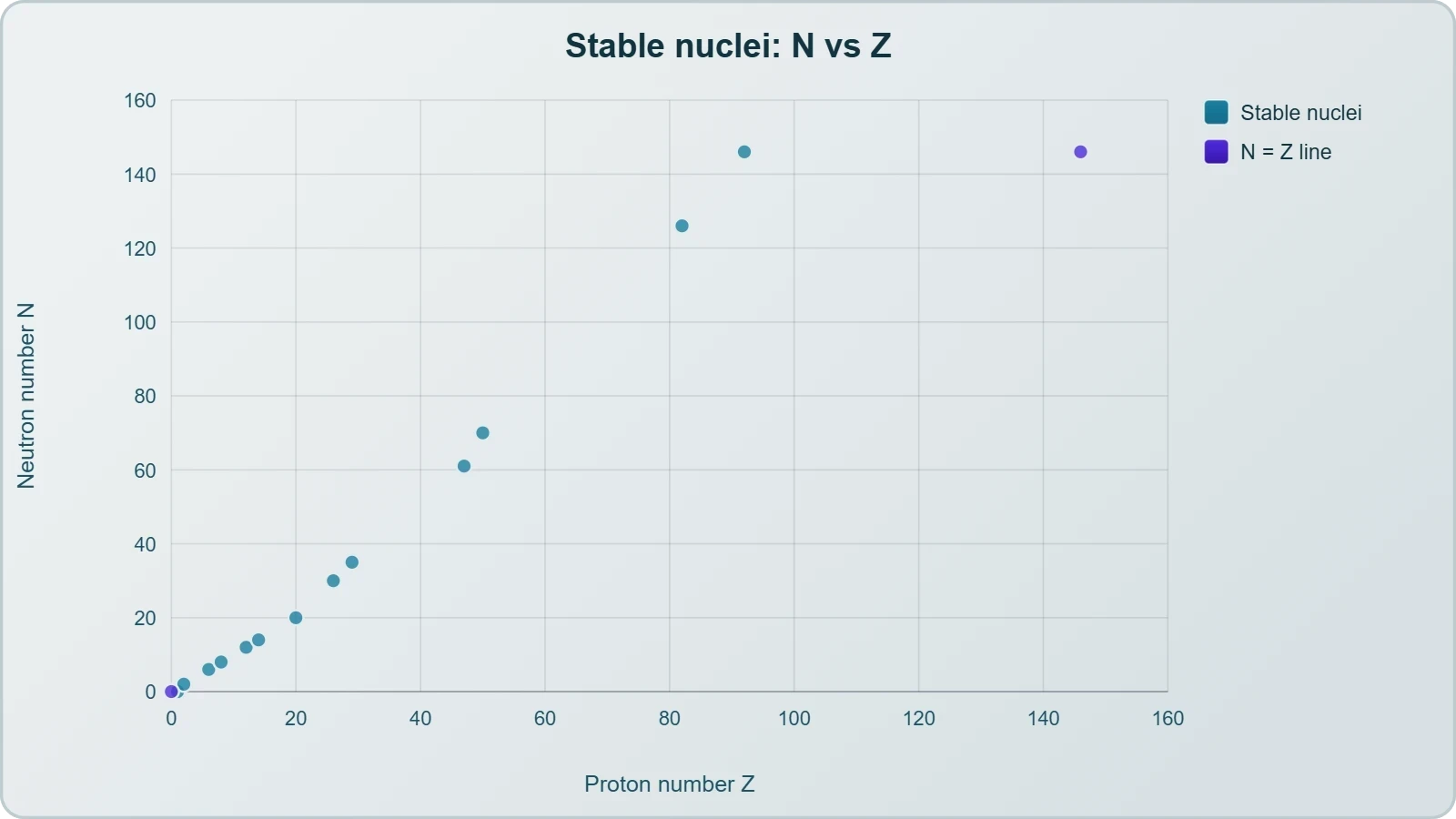
Stable nuclei exist only within a narrow band where the strong force and electrostatic repulsion reach equilibrium. As nuclei grow heavier, more neutrons are required to dilute the proton repulsion, which is why the neutron-to-proton ratio climbs steadily across the periodic table. Carbon-12 holds six of each, while uranium-238 carries 146 neutrons against only 92 protons. This ratio defines the so-called valley of stability, and nuclei outside it decay radioactively.
The semi-empirical mass formula quantifies this balance by treating the nucleus as a charged liquid drop. Its asymmetry term penalizes unequal neutron and proton counts, while the Coulomb term penalizes proton excess. The binding energy per nucleon peaks near iron-56, explaining why both fusion in stars and fission in reactors release energy. Neutrons therefore sit at the mathematical center of nuclear energetics.
Isotopes, Radioactivity, and Neutron Richness
Changing the neutron count transforms an atom into a different isotope of the same element, with profoundly different nuclear behavior. Carbon-12 is stable, carbon-14 decays with a half-life of 5,730 years, and carbon-11 vanishes within minutes. This variability gives scientists powerful tools for dating, tracing, and medical imaging. The neutron count, not the proton count, dictates whether a nucleus endures or disintegrates.
Neutron-rich nuclei frequently undergo beta decay, converting a neutron into a proton while emitting an electron and an antineutrino. The underlying transformation follows ##[n \rightarrow p + e^- + \bar{\nu}_e]##, a process governed by the weak interaction. Conversely, proton-rich nuclei may capture electrons or emit positrons. These decay pathways map the boundaries of nuclear existence and inform models of stellar nucleosynthesis.
We Also Published
Where Neutrons Come From: Origins and Creation
Neutrons are not permanent fixtures of the universe; they are manufactured in specific astrophysical and laboratory environments. The early universe forged a brief population during Big Bang nucleosynthesis, but most neutrons today reside inside atomic nuclei formed in stars. Free neutrons, by contrast, are fleeting and decay within minutes. Understanding their origins connects particle physics to cosmology and to the engineered reactors that produce them on demand.
Big Bang Nucleosynthesis and Stellar Forging
Roughly three minutes after the Big Bang, the cosmos cooled enough for protons and neutrons to fuse into deuterium and helium. The neutron-to-proton ratio at that moment, frozen near one to seven, determined the primordial abundance of helium and lithium. Free neutrons decayed rapidly, so only those captured into nuclei survived. This ancient ratio remains imprinted in the chemical composition of the oldest stars.
In stellar cores, neutron production occurs through fusion chains that build progressively heavier nuclei. When massive stars exhaust their fuel, core collapse triggers electron capture on protons, generating a flood of neutrons. These neutrons drive the rapid capture process that synthesizes elements heavier than iron. Every gold atom on Earth owes its existence to neutron-rich stellar explosions.
Free Neutrons and Their Brief Existence
A neutron liberated from its nucleus becomes unstable and decays through the weak interaction with a mean lifetime of about 879 seconds. This half-life of roughly fifteen minutes makes free neutrons useful for experiments but impractical for storage. Reactors and spallation sources generate intense neutron beams for research and industry. Each free neutron carries a precise clock that tests fundamental symmetries.
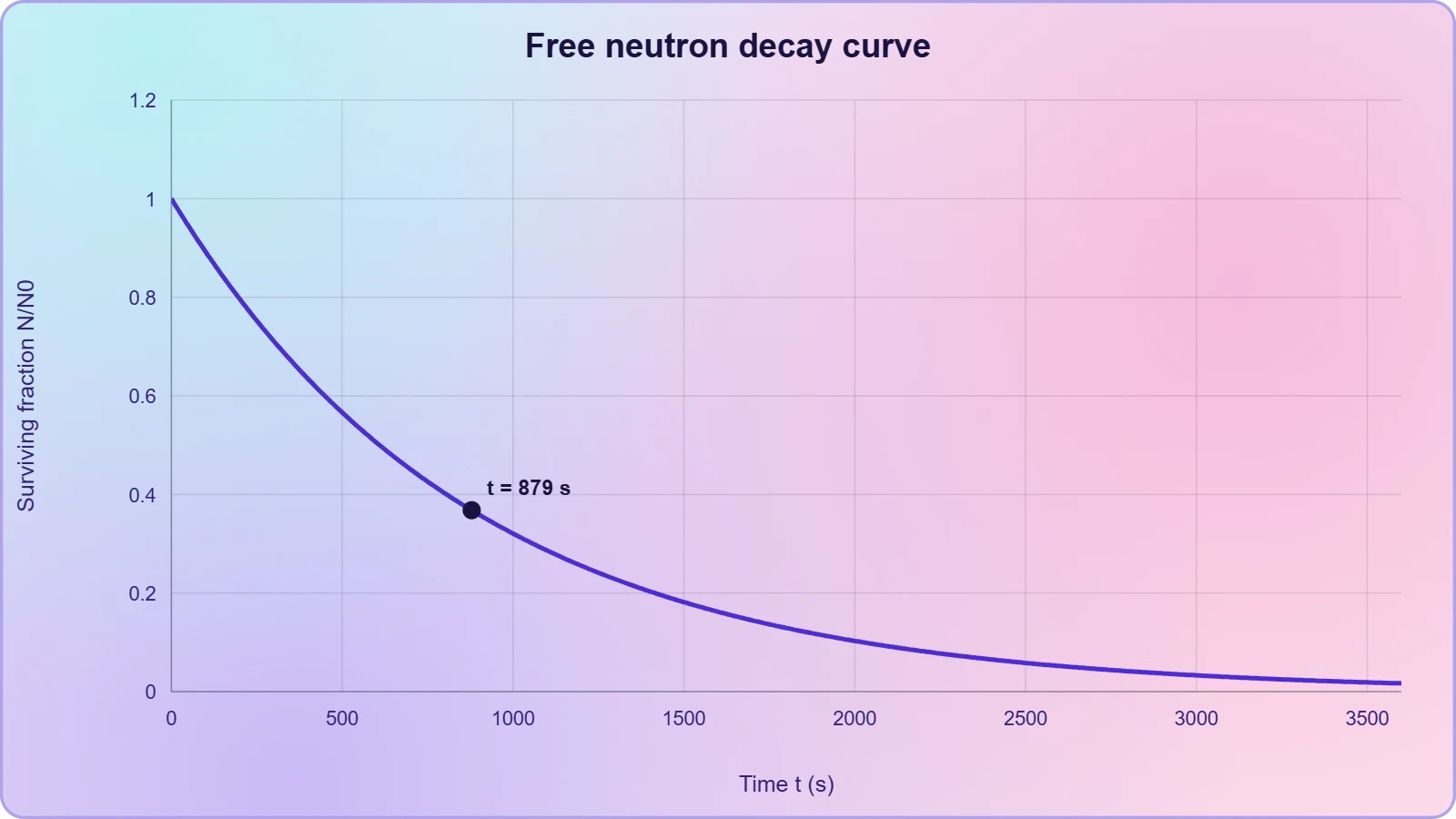
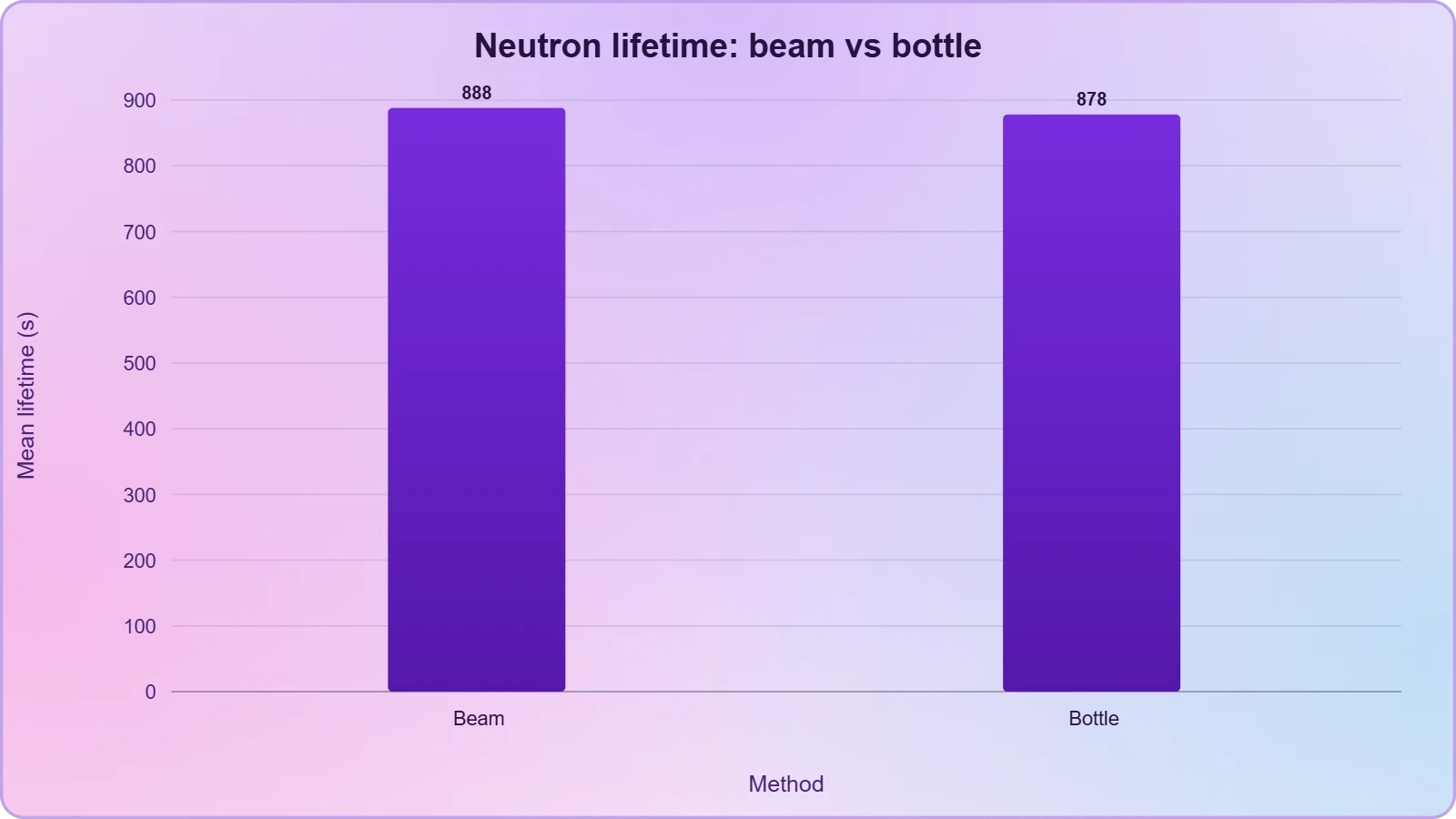
The decay process releases an electron, an antineutrino, and a proton, converting the neutron's mass excess into kinetic energy. The energy release follows ##[\Delta E = (m_n - m_p - m_e)c^2 \approx 0.782\ \text{MeV}]##, a value measured with extraordinary precision. Discrepancies between beam and bottle lifetime measurements hint at possible new physics. Resolving this neutron lifetime puzzle remains an active frontier.
Why Neutrality Matters: Interactions and Applications
The neutron's lack of charge is not a trivial detail but the source of its scientific and practical power. Charged particles are deflected by electric fields and stopped by modest material thickness, whereas neutrons pass through electron clouds as if they were absent. They interact only with atomic nuclei, and only when they happen to strike one closely. This selective interaction makes neutrons extraordinary probes and formidable agents of change.
Penetration, Scattering, and Imaging
Neutron scattering reveals the positions and motions of atomic nuclei in materials, complementing X-ray techniques that highlight electron density. Because neutrons interact with magnetic moments, they expose magnetic structures invisible to other methods. They also detect hydrogen atoms with exceptional sensitivity, a capability invaluable in biology and polymer science. Facilities such as spallation sources and research reactors supply these beams.
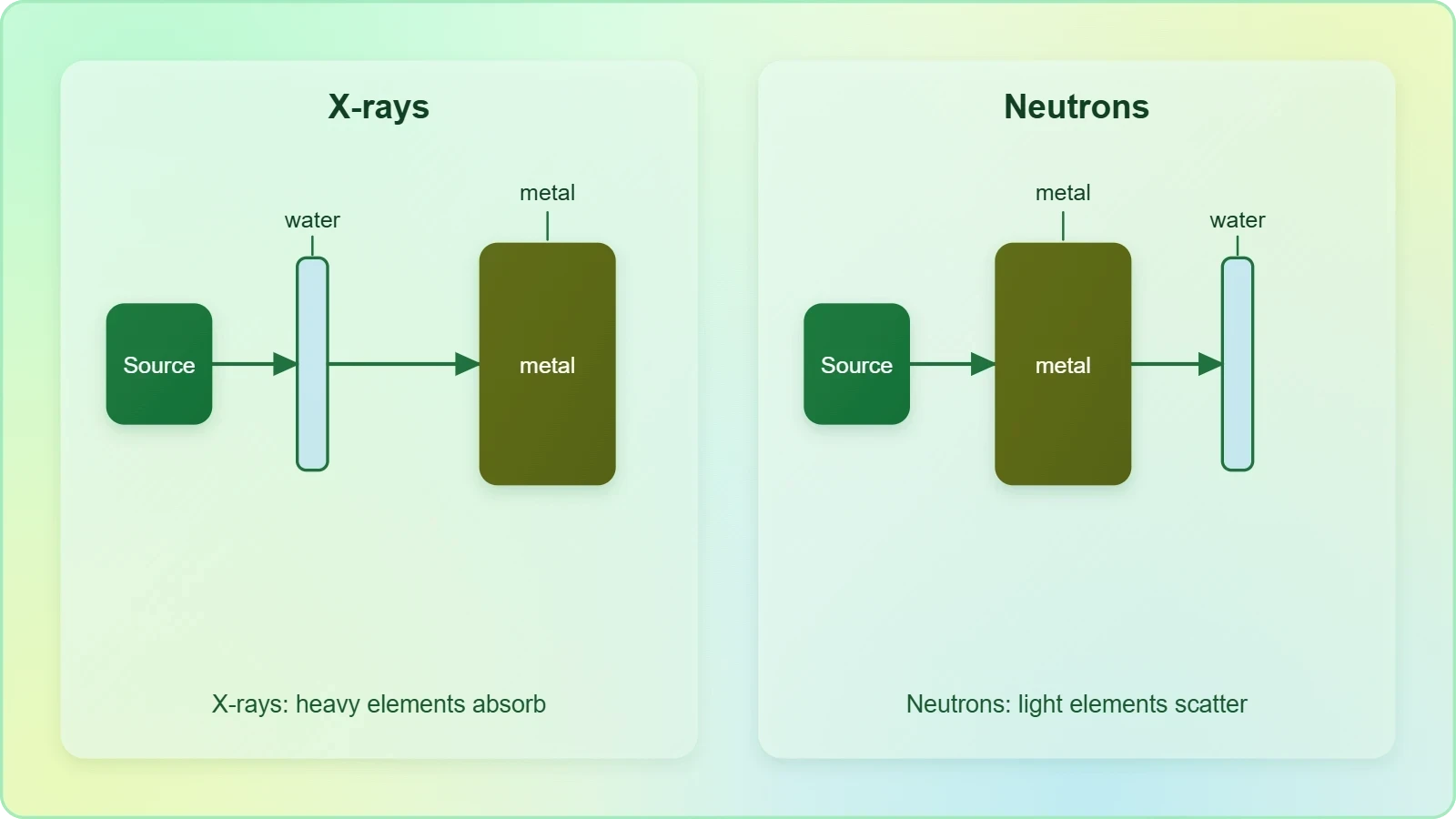
Neutron radiography images dense materials that X-rays cannot penetrate, including engine components and archaeological artifacts. The technique distinguishes light elements and isotopes with remarkable clarity. In medicine, boron neutron capture therapy exploits the neutron's affinity for boron-10 to destroy tumor cells selectively. These applications all stem from the particle's chargeless nature.
Fission, Fusion, and Energy Frontiers
Neutrons drive the chain reactions inside nuclear power plants, sustaining fission by splitting uranium nuclei and releasing further neutrons. Controlling this multiplication factor determines whether a reactor operates steadily, shuts down, or accelerates. Fusion research also depends on neutrons, since deuterium-tritium reactions release energetic neutrons that must be captured for energy extraction. Mastering neutron behavior is central to the future of energy.
Each fission event releases roughly 200 MeV, with neutrons carrying a substantial fraction of that energy as kinetic motion. The multiplication factor ##[k = \dfrac{\text{neutrons produced}}{\text{neutrons absorbed}}]## governs reactor criticality, where ##[k = 1]## denotes a stable chain reaction. Precise neutron accounting separates safe operation from catastrophe. This arithmetic of neutrality underpins the entire nuclear industry.
Neutron Stars and the Cosmic Scale of Neutrality
At the extreme end of physics, the neutron becomes the dominant constituent of some of the densest objects in existence. Neutron stars form when massive stellar cores collapse under gravity until protons and electrons merge into neutrons. A single teaspoon of neutron star material would weigh billions of tons on Earth. These objects test our understanding of matter under conditions no laboratory can reproduce.
Degeneracy Pressure and Stellar Collapse
Neutron stars resist gravitational collapse through neutron degeneracy pressure, a quantum effect arising from the Pauli exclusion principle. Because neutrons are fermions, they cannot occupy identical quantum states, and this crowding generates immense outward pressure. The balance between gravity and degeneracy pressure sets the star's radius near ten kilometers. Beyond a certain mass, even this pressure fails and a black hole forms.
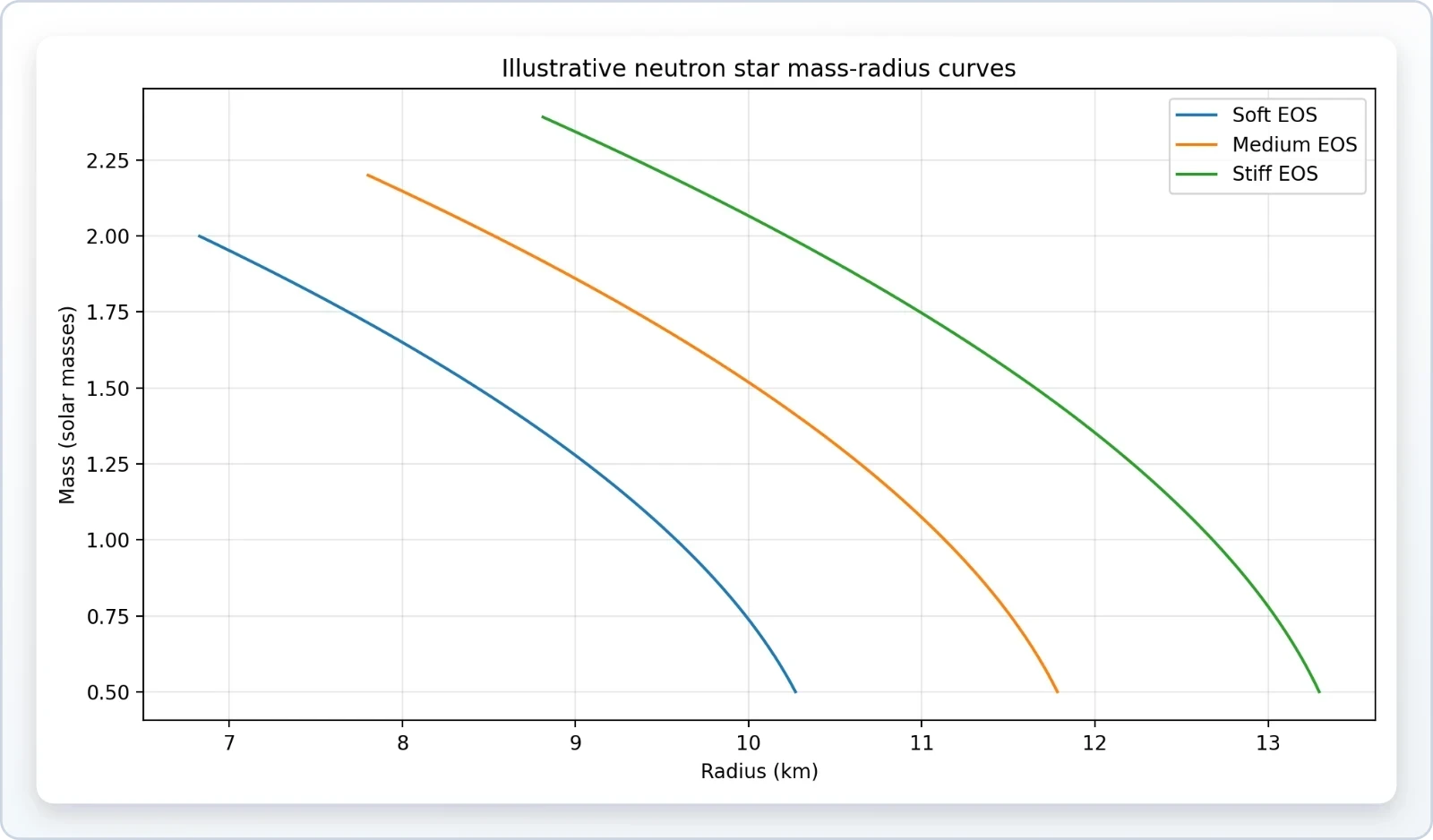
The equation of state for neutron star matter remains one of the great unsolved problems in astrophysics. Nuclear physicists model how neutrons and protons behave at densities several times that of an atomic nucleus. Observations of pulsars and gravitational waves constrain these models. Each neutron star is a natural laboratory for the strong force.
Pulsars, Magnetism, and Gravitational Waves
Rapidly rotating neutron stars emit beams of radiation that sweep past Earth like cosmic lighthouses, appearing as pulsars. Their magnetic fields, trillions of times stronger than Earth's, accelerate particles to extreme energies. Mergers of binary neutron stars produce gravitational waves and forge heavy elements through rapid neutron capture. The 2017 detection of such a merger confirmed this cosmic alchemy.
These observations tie the neutron's microscopic properties to the largest observable phenomena. The same strong force that binds a helium nucleus governs the structure of a neutron star. The same weak interaction that decays a free neutron shapes the composition of stellar remnants. Neutrality, in this sense, scales from the infinitesimal to the astronomical.
Measuring the Neutron: Precision, Puzzles, and Open Questions
Modern physics measures the neutron with astonishing precision, yet each refinement exposes new puzzles. The neutron's electric dipole moment, if nonzero, would signal violations of fundamental symmetries and help explain why matter dominates antimatter. Its lifetime measurements disagree depending on the method used, hinting at unknown decay channels. These anomalies drive experimental programs across the globe.
The Neutron Lifetime Puzzle and Symmetry Tests
Beam experiments count protons produced as neutrons decay in flight, while bottle experiments trap ultracold neutrons and count survivors. The two approaches yield lifetimes differing by several seconds, a discrepancy too large to dismiss. Possible explanations include exotic decay modes or experimental systematics. Resolving this puzzle could reveal physics beyond the Standard Model.
Precision measurements of the neutron's magnetic moment and charge radius probe the internal quark distribution. The charge radius, though nominally zero, arises from the spatial arrangement of charged quarks and is measured through electron scattering. Discrepancies between methods have sparked debate about experimental corrections. Each decimal place sharpens our picture of the strong force.
Neutron Sources and Experimental Frontiers
Research reactors, spallation sources, and compact accelerators supply neutrons for science and industry. Ultracold neutrons, slowed to walking pace, enable sensitive tests of gravity and fundamental interactions. Neutron interferometry measures quantum phases with remarkable accuracy. These instruments transform the neutron from a passive subject into an active tool of discovery.
Emerging applications include neutron imaging for battery research, neutron therapy for resistant cancers, and neutron-based detection of illicit materials. Each advance relies on understanding how neutrons scatter, absorb, and decay. The particle that carries no charge continues to illuminate the structure of matter. Its neutrality, once a curiosity, is now a cornerstone of modern science.
Worked Calculations: Ten Neutron Physics Problems
Numerical practice transforms abstract descriptions of the neutron into concrete understanding. The following ten problems span mass-energy conversion, decay kinematics, nuclear binding, and reactor criticality. Each solution demonstrates how fundamental constants and conservation laws combine to predict measurable quantities. Working through them builds intuition for both laboratory and astrophysical neutron behavior.
Mass, Energy, and Decay Calculations
These first five problems address the neutron's mass, its decay energetics, and the quantum statistics that govern neutron populations. They connect Einstein's mass-energy relation to the weak interaction and to degeneracy pressure. Each result can be checked against accepted physical constants.
Problem 1: Rest Energy of the Neutron
Compute the rest energy of a neutron using its mass ##[m_n = 1.675 \times 10^{-27}\ \text{kg}]## and the speed of light ##[c = 3.00 \times 10^8\ \text{m/s}]##. Applying mass-energy equivalence yields the total energy locked within a single neutron at rest.
Problem 2: Energy Released in Beta Decay
Determine the maximum kinetic energy released when a free neutron decays into a proton, electron, and antineutrino. The mass difference between parent and products, converted through ##[E = \Delta m\, c^2]##, sets the endpoint of the beta spectrum.
Problem 3: Number of Neutrons in a Sample
Estimate the number of neutrons in one kilogram of pure carbon-12, given that each atom contains six neutrons and one mole weighs twelve grams. Avogadro's number links macroscopic mass to microscopic particle counts.
Problem 4: Decay Fraction After One Hour
Calculate the fraction of a free neutron population remaining after one hour, using the mean lifetime ##[\tau = 879\ \text{s}]## and the exponential decay law. This illustrates why free neutrons vanish quickly outside nuclei.
Problem 5: Neutron Degeneracy Pressure Estimate
Estimate the degeneracy pressure of neutrons at a density of ##[10^{17}\ \text{kg/m}^3]## using the non-relativistic Fermi gas relation. This pressure supports neutron stars against gravitational collapse.
Nuclear Binding and Reactor Calculations
The remaining five problems examine binding energy, the semi-empirical mass formula, neutron activation, and reactor criticality. They demonstrate how neutron accounting governs both stellar nucleosynthesis and engineered power systems. Each calculation uses standard nuclear data.
Problem 6: Binding Energy of Helium-4
Calculate the total binding energy of helium-4 from its mass defect, where two protons and two neutrons combine into a nucleus of mass ##[4.0026\ \text{u}]##. The result explains why helium-4 is exceptionally stable.
Problem 7: Coulomb Term in the Liquid Drop Model
Evaluate the Coulomb contribution to the binding energy for uranium-238 using ##[a_c = 0.711\ \text{MeV}]## and ##[A = 238]##, ##[Z = 92]##. This term quantifies the electrostatic penalty that neutrons must offset.
Problem 8: Asymmetry Energy Penalty
Compute the asymmetry energy term for a nucleus with ##[N = 146]## and ##[Z = 92]## using ##[a_a = 23.2\ \text{MeV}]##. This term penalizes the neutron-proton imbalance and shapes the valley of stability.
Problem 9: Neutron Activation Decay Constant
A sample activated by neutron capture has a half-life of 12.4 hours. Determine its decay constant in inverse seconds, a quantity essential for calculating induced radioactivity after irradiation.
Problem 10: Reactor Multiplication Factor
For a reactor producing 2.45 neutrons per fission and losing 1.40 to absorption and leakage, compute the multiplication factor and classify the reactor state. The value of ##[k]## determines whether the chain reaction grows, stabilizes, or dies.
These ten calculations illustrate the neutron's dual identity as a quantum particle and an engineering quantity. From the 939.6 MeV locked in its rest mass to the multiplication factor that governs a reactor, the same physics applies. Mastery of these relationships equips students to analyze nuclear phenomena with confidence. The neutron rewards careful arithmetic with genuine insight.
Also Read
- Euclidean Geometry Explained: A Beginner’s Guide
- Largest Angle of Triangle with Ratio 2:3:4
- Suppose the diameter of aerosol particles in a particular application is uniformly distributed between 2 and 6 nanometers. Find the probability that a randomly measured particle has diameter greater than 3 nanometers.
From our network :
- AI-Powered 'Precision Diagnostic' Replaces Standard GRE Score ReportsDiscover the new GRE Precision Diagnostic. Learn how AI-powered behavioral analytics and time-to-solve tracking are replacing standard GRE score reports to empower students.
- 98% of Global MBA Programs Now Prefer GRE Over GMAT Focus EditionExplore why 98% of global MBA programs now prefer the GRE over GMAT Focus. Learn about the shorter GRE format, verbal logic importance, and strategic versatility for students.
- Trump Political Strategy How Geopolitical Stunts Serve As Media Diversions
- Analyzing Trump Deportation Numbers Insights Into The 2026 Immigration Crackdown
- 10 Physics Numerical Problems with Solutions for IIT JEEPrepare for IIT JEE with 10 physics numerical problems, complete with detailed solutions and conceptual explanations. Ideal for mastering kinematics, thermodynamics, electromagnetism, and optics.
- Mastering DB2 LUW v12 Tables: A Comprehensive Technical GuideComprehensive guide on DB2 LUW v12 tables. Explore CREATE TABLE syntax, BLU Acceleration, range partitioning, data types, and security features for IBM DB2 LUW v12.
- Vite 6/7 'Cold Start' Regression in Massive Module GraphsIn-depth analysis of Vite 6/7 cold start regressions in massive module graphs. Learn about barrel file issues, pre-bundling optimizations, and how to improve Vite dev server performance.
- EV 2.0: The Solid-State Battery Breakthrough and Global Factory ExpansionDiscover the impact of the Solid-State Battery Breakthrough on the EV market. Learn about CATL and BYD stock growth, global factory expansion in Europe, and the future of EV 2.0 technology.
- Mastering DB2 12.1 Instance Design: A Technical Deep Dive into Modern Database ArchitectureComprehensive guide to DB2 12.1 Instance Design. Explore architectural components, HADR setup, buffer pool tuning, and security policies for IBM DB2 12.1. Includes 10 functional SQL and Shell samples.
RESOURCES
- DOE Explains...Neutrons - Department of Energyenergy.govNeutrons, along with protons, are subatomic particles found inside the nucleus of every atom. The only exception is hydrogen, where the nucleus contains ...
- ELI5 Neutron dummy explanation : r/explainlikeimfive - Redditreddit.comOct 3, 2023 ... A Neutron is an uncharged elementary particle that equals a protons mass in a nucleus this stabilizing it, I also…
- Neutron - Wikipediaen.wikipedia.orgA neutron is a subatomic particle, symbol n or n 0 , that has no electric charge, and a mass slightly greater than that…
- ESA - What is a neutron star? - European Space Agencyesa.intMar 12, 2024 ... A neutron star is formed in the last moments of the life of a very large star (with more than…
- What is a Neutron Star? - NASA Scientific Visualization Studiosvs.gsfc.nasa.govMay 18, 2017 ... Here's just some of what we already know about neutron stars. An upcoming NASA mission will further investigate these unusual…
- What is a Neutron Beam? | What Are They Used For?shinefusion.comA neutron beam is a focused stream of neutrons. However, neutron emitters tend to release neutrons in all directions instead of just in a…
- Neutron | Definition, Charge, Mass, Properties, & Facts | Britannicabritannica.com4 days ago ... Neutron, neutral subatomic particle that, in conjunction with protons, makes up the nucleus of every atom except ordinary hydrogen (whose ...
- Neutron Stars - Imagine the Universe! - NASAimagine.gsfc.nasa.govA neutron star is the densest object astronomers can observe directly, crushing half a million times Earth's mass into a sphere about 12 miles…
- What are neutron stars? - Phys.orgphys.orgOct 16, 2017 ... Thrilled physicists and astronomers announced Monday the first-ever observation of the merger of two neutron stars, one of the most ...
- What is an Atom? - International Atomic Energy Agencyiaea.orgJan 5, 2026 ... Each atom consists of three types of particles: protons, neutrons and electrons. At the centre of an atom is a…
- What is the difference between a neutron star and a white dwarf?astronomy.stackexchange.comDec 16, 2015 ... In a neutron star, the force of gravity is strong enough to press the protons and electrons together to form…
- Mining a neutron star -- what do you get? - Physics Stack Exchangephysics.stackexchange.comMar 24, 2021 ... The neutrons in a neutron star are kept from decaying by the degenerate electron gas (both neutrons and electrons, as…
- What is the smallest possible radius for a neutron star?astronomy.stackexchange.comSep 25, 2021 ... Basing neutron star sizes only on measurements, Capano et al* concluded that a typical neutron star has a radius of…
- What is Deuterium? - International Atomic Energy Agencyiaea.orgJan 13, 2023 ... Deuterium is a stable isotope of hydrogen, which, unlike “normal” hydrogen atoms, or protium, also contains a neutron.
- At the core of a cosmic mystery: What's inside a neutron star? | Physicsphysics.illinois.eduDecember 17, 2023. Debora Mroczek. Share on Facebook · Share on Twitter · Share on LinkedIn. Enjoyed this read? Share it on social media…