On This Page
Foundations of the Quotient Function
The quotient function serves as a fundamental pillar in the realm of discrete mathematics and computational logic. It provides a structured method for dividing integers while ensuring the resulting value remains within a specific and predictable integer set.
In technical contexts, floored division represents a specific approach to integer division that differs significantly from traditional truncation. It prioritizes the downward rounding of the result toward negative infinity, ensuring a consistent behavior across all real numbers.
Understanding this function is essential for software developers and mathematicians alike, as it dictates how remainders are calculated. Without a standardized quotient function, algorithms involving modular arithmetic would yield inconsistent and unpredictable results in complex systems.
Modern programming languages often implement this specific behavior to maintain mathematical integrity during complex calculations. By defining the quotient as a floor of the ratio, systems achieve a reliable symmetry that simplifies many common algorithmic processes.
This lesson explores the nuances of the floored quotient function, focusing on its mathematical definition and practical implications. We will examine how it shapes the relationship between dividends, divisors, and the resulting integer remainders in various applications.
Defining Floored Division
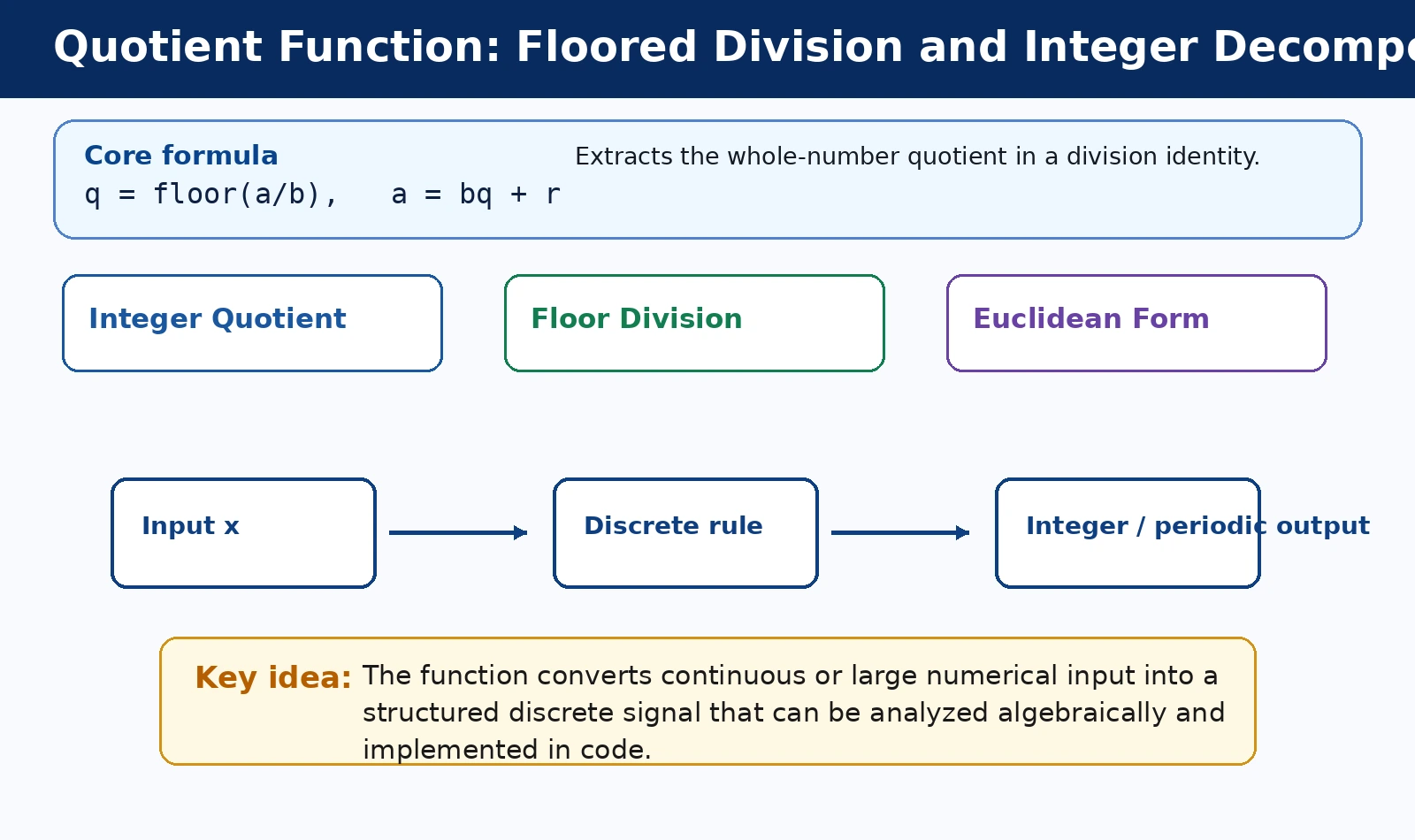
Floored division is formally defined by the operation where the quotient is the greatest integer less than or equal to the ratio. This mathematical operation ensures that the result always moves leftward on the horizontal number line toward negative infinity.
The notation for this operation typically involves the floor brackets surrounding the division of two integers, ##a## and ##b##. By applying the floor function, we effectively remove any fractional component, regardless of the decimal's specific magnitude.
Unlike ceiling division, which rounds toward positive infinity, floored division provides a predictable and useful downward bias. This characteristic is particularly helpful when mapping continuous data into discrete bins or slots within a fixed computational memory space.
In the expression
, the variable ##q## represents the integer quotient derived from the division. This value is critical for maintaining the fundamental identity that links the dividend to the divisor and the remainder.
For positive numbers, floored division behaves identically to truncation, simply discarding the decimal part of the result. However, the distinction becomes significant when dealing with negative values, where the rounding direction alters the final integer outcome.
The Mathematical Identity
Every integer division operation must satisfy a specific mathematical identity to be considered valid within number theory. The relation
serves as the cornerstone for establishing this consistency between integers in any system.
In this identity, ##a## represents the dividend, ##b## is the divisor, and ##q## is the quotient produced by the floor function. The variable ##r## denotes the remainder, which must satisfy specific constraints to ensure the uniqueness of the solution.
For floored division, the remainder is constrained by the inequality
, ensuring it is always non-negative. This property is highly desirable in computer science because it simplifies the logic required for various modular operations.
The uniqueness of the quotient ##q## and remainder ##r## is guaranteed for any pair of integers where the divisor is non-zero. This mathematical certainty allows developers to build robust systems that handle edge cases with absolute numerical precision.
By adhering to this identity, the floored quotient function provides a bridge between pure mathematics and applied logic. It ensures that the sum of the product and the remainder always reconstructs the original dividend accurately and consistently.
Algorithmic Implementation in Programming
Programming languages vary in their approach to integer division, but floored division is a popular standard for many. Languages like Python and Haskell utilize this method to provide a more intuitive experience for complex mathematical modeling.
The implementation of floored division in software requires careful consideration of how the hardware handles bitwise shifts and subtractions. Most modern processors offer native support for operations that align with the floor rounding convention for integers.
When a programmer uses the double-slash operator in Python, they are explicitly invoking the floored quotient function for their logic. This design choice prevents many common bugs associated with negative number arithmetic in financial and scientific applications.
Haskell also adopts this convention, emphasizing the importance of mathematical purity in its functional programming paradigm. By using floored division, Haskell ensures that its algebraic properties remain consistent across different data types and numeric ranges.
Understanding how your specific language implements the quotient function is vital for cross-platform development and system integration. Discrepancies in division behavior can lead to subtle errors that are often difficult to debug in a production environment.
Floored Division in Python
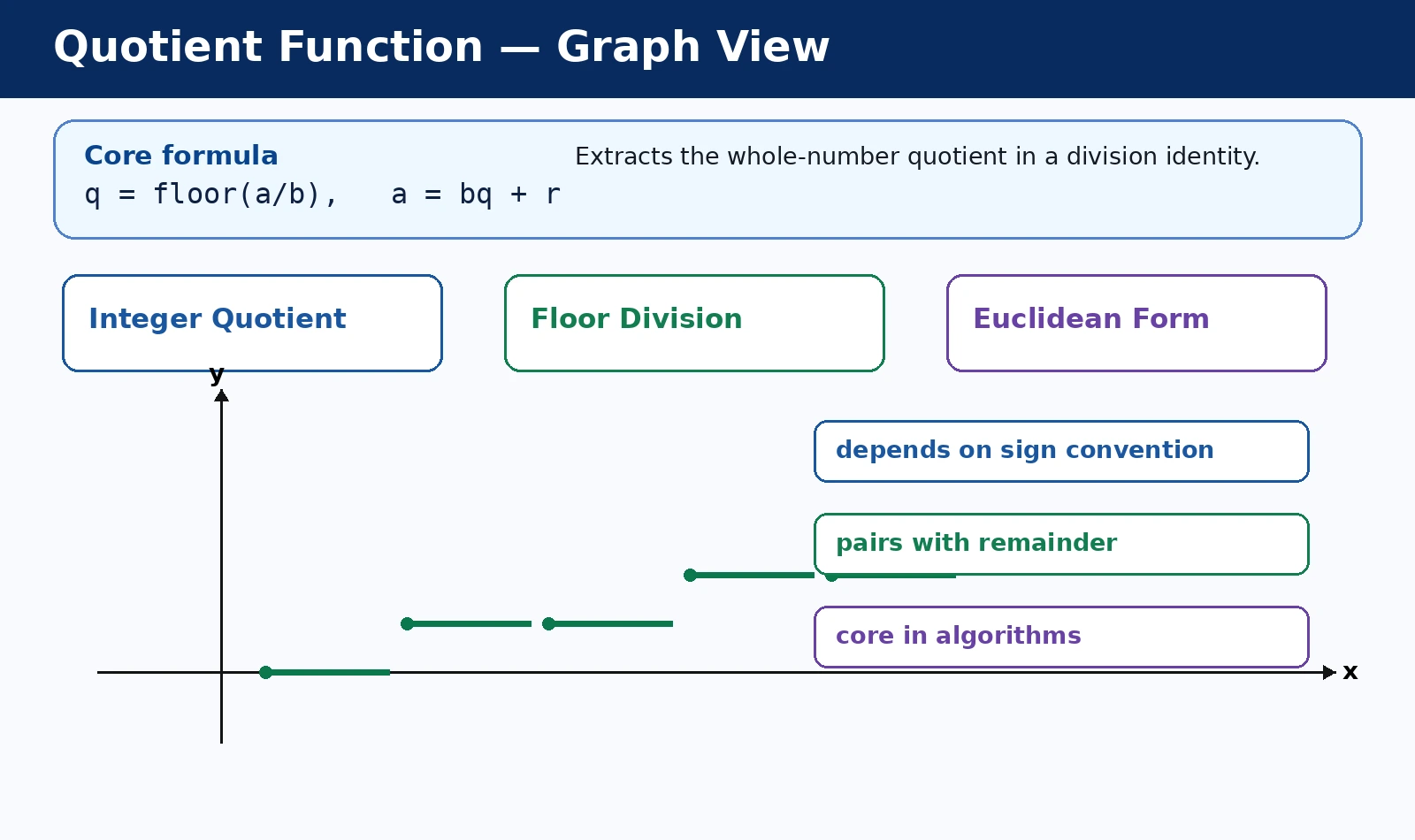
Python’s approach to integer division is often praised for its consistency with mathematical theory regarding negative numbers. The floor division operator, denoted as ##//##, always returns the floor of the division result for the user's input.
This means that an expression like ##-5 // 2## results in ##-3## rather than ##-2##, as one might initially expect. By rounding toward negative infinity, Python maintains a consistent floor regardless of the sign of the operands involved.
This behavior is particularly helpful when using the modulo operator in conjunction with integer division in script logic. In Python, the remainder always carries the same sign as the divisor, which simplifies cyclic or periodic calculations.
We Also Published
Developers transitioning from languages like C++ or Java must be mindful of this distinction during their coding process. Python’s choice to use floored division reflects a commitment to mathematical correctness over simple hardware-level truncation methods.
As a result, Python code involving coordinate transformations or grid-based movement is often cleaner and more concise. The floored quotient function eliminates the need for manual adjustments when navigating negative coordinate spaces in game development.
Comparison with Truncated Division
Truncated division is the alternative approach where the fractional part is simply discarded, effectively rounding the result toward zero. This method is common in languages like C, Java, and JavaScript for most integer division operations.
While truncation is computationally faster on some legacy hardware, it introduces complexities when handling negative dividends or divisors. The resulting quotient and remainder patterns are often less intuitive than those produced by the floored division method.
In truncated division, the remainder typically takes the sign of the dividend, which can break certain modular identities. This requires additional logic to correct the remainder if a non-negative value is needed for a specific algorithm.
Floored division avoids these issues by keeping the remainder sign tied to the divisor rather than the dividend's sign. This consistency makes it the preferred choice for mathematicians working with groups, rings, and other complex algebraic structures.
Choosing between these two methods often depends on the specific requirements of the project and the target language. However, understanding the difference is crucial for ensuring that numerical algorithms behave as expected across different computing environments.
Mathematical Properties and Constraints
The floored quotient function possesses several unique properties that make it an invaluable tool for theoretical and applied mathematics. One primary property is its monotonicity, meaning it preserves the order of numbers during the division operation.
Additionally, the function exhibits a periodic nature when applied to sequences of integers, which is vital for signal processing. This periodicity allows engineers to map continuous time signals into discrete digital representations with high mathematical accuracy.
The constraints placed on the divisor ##b## are also important, as division by zero remains undefined in this context. Mathematicians must ensure that the divisor is non-zero to maintain the integrity of the quotient function throughout.
Another significant constraint involves the range of the remainder, which must be strictly less than the absolute value of ##b##. This ensures that the division process is complete and no further integer units can be extracted.
These properties and constraints form the backbone of modern number theory and provide a framework for solving complex equations. By mastering these rules, one can navigate the intricacies of modular arithmetic and integer relations effectively and efficiently.
Handling Negative Operands
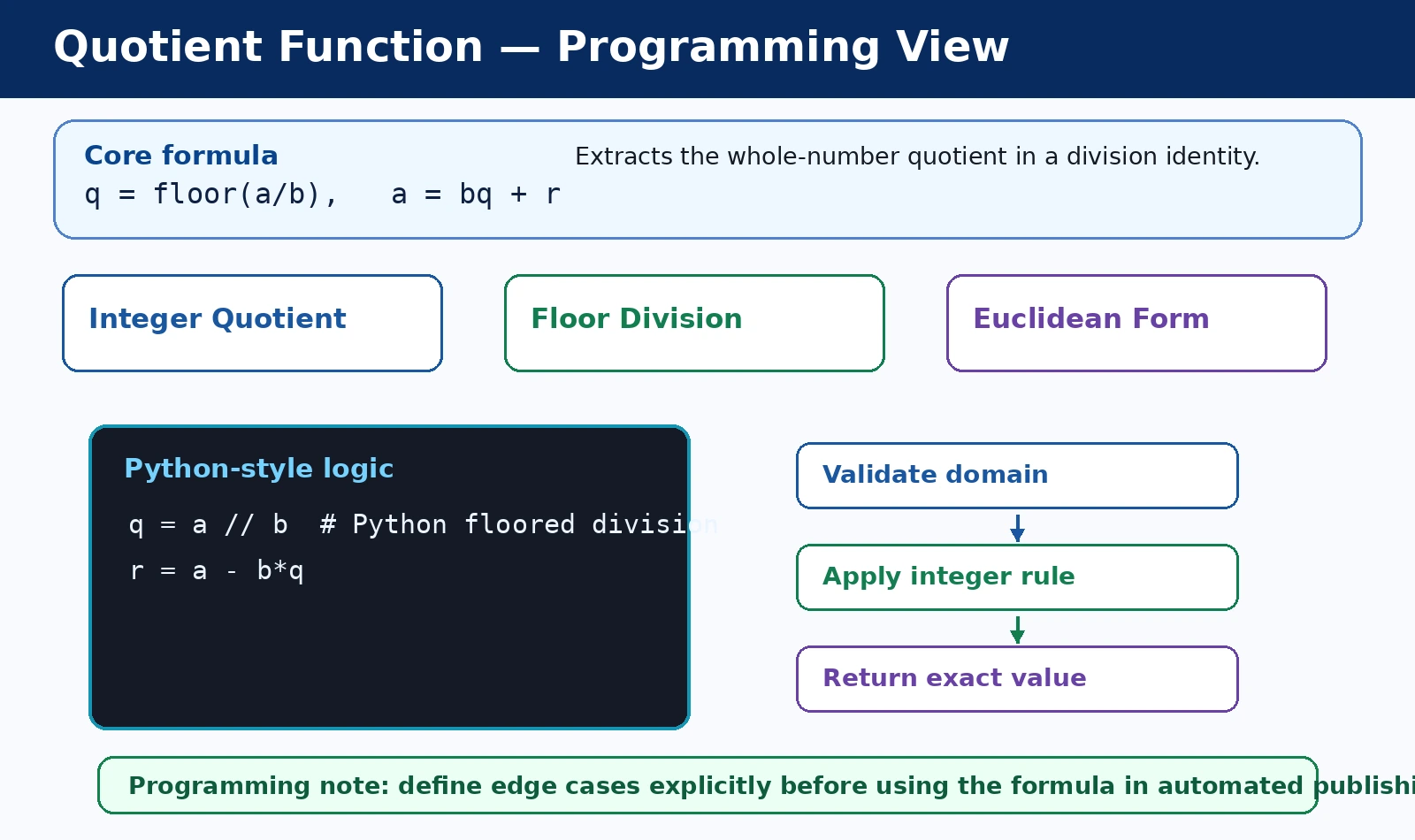
Handling negative operands is where the distinction of the floored quotient function truly shines in practical and theoretical use. When the dividend ##a## is negative, the floor function pulls the result further from the origin.
For example, dividing ##-7## by ##3## yields a real result of approximately ##-2.33##, which floors directly to ##-3##. This behavior ensures that the division always moves in a consistent direction along the entire real number line.
This consistency is vital for algorithms that rely on tiling or partitioning space into regular, predictable intervals or blocks. Without floored division, negative coordinates would require special case handling to prevent overlapping or missing data segments.
When the divisor ##b## is negative, the direction of the floor function still follows the rule of rounding down. This results in a quotient that correctly satisfies the primary division identity while maintaining the required remainder range.
Understanding the interaction between negative signs and the floor function is a common hurdle for students learning computer science. However, once grasped, it provides a powerful tool for creating robust and mathematically sound software applications today.
The Remainder Relationship
The relationship between the floored quotient and the remainder is defined by the requirement for a non-negative remainder value. This relationship is often expressed as
in standard mathematical notation.
Because the quotient is floored, the product ##b \cdot q## will always be less than or equal to the dividend ##a##. This mathematical certainty ensures that the subtraction will always yield a remainder that is zero or positive.
In many applications, having a non-negative remainder is more useful than the sign-matching remainders found in truncated division systems. It simplifies the implementation of hash tables, where the remainder serves as an index for data storage.
The remainder ##r## effectively represents the "leftover" amount after as many full units of ##b## as possible are removed. In the floored system, this leftover is always measured in the positive direction from the calculated product.
This elegant relationship ensures that the division process is reversible and consistent, regardless of the magnitude of the integers. It provides a reliable foundation for more advanced topics like the Euclidean algorithm and modern cryptography.
Practical Applications and Use Cases
The practical applications of the floored quotient function extend far beyond simple arithmetic and basic classroom exercises for students. It is a critical component in the design of algorithms for computer graphics and data structures.
In memory management, floored division helps determine the correct page or block index for a given memory address. This ensures that data is stored and retrieved efficiently without overlapping into adjacent memory segments in the system.
Engineers also use this function in timing circuits and scheduling algorithms to manage recurring tasks and events over time. By flooring the division of time intervals, they can create precise triggers for various system operations.
Furthermore, the function plays a role in data compression, where integers are mapped to smaller bit representations for storage. Floored division allows for a predictable mapping that can be easily reversed during the decompression process later.
These use cases demonstrate the versatility and importance of the quotient function in modern technology and engineering disciplines today. Its ability to provide consistent integer results makes it a staple of efficient and reliable algorithmic design.
Cyclic Indexing and Arrays
Cyclic indexing is a common technique in software development where an index must wrap around the bounds of an array. Floored division, combined with the modulo operator, provides a seamless way to implement this wrap-around logic.
When navigating a circular buffer, developers use the quotient to determine how many full cycles have been completed by the pointer. This information is crucial for managing buffer overflows and ensuring data integrity in real-time systems.
In game development, floored division is used to calculate tile coordinates on a map that extends in all directions. It allows the game engine to translate a player's world position into a specific grid cell index.
By using the floor function, the engine handles negative coordinates automatically, ensuring the player remains within the correct grid cell. This avoids the "off-by-one" errors that often plague systems using truncated division for coordinate mapping.
This application highlights how a simple mathematical concept can solve complex problems in spatial reasoning and data organization for developers. Floored division simplifies the logic and reduces the potential for bugs in coordinate-based systems.
Number Theory and Cryptography
In the field of number theory, the quotient function is essential for exploring the properties of prime numbers and divisibility. It is a key element in the Euclidean algorithm for finding the greatest common divisor of integers.
Cryptography relies heavily on modular arithmetic, which in turn depends on the consistent behavior of the quotient and remainder. Secure communication protocols use these functions to encrypt and decrypt sensitive data across the global internet daily.
The floor function ensures that large integer operations remain within the bounds of the cryptographic keys being used for security. This prevents data leakage and maintains the mathematical hardness of the underlying encryption algorithms for all users.
Public-key infrastructure, such as RSA, utilizes the relationship between quotients and remainders to perform complex exponentiation and modular reduction. The reliability of floored division is a cornerstone of digital trust in the modern world.
As we continue to develop more advanced computing systems, the role of the quotient function in security will only grow. Its mathematical precision remains a vital asset in the ongoing effort to protect digital information on a global scale.
From our network :
- EV 2.0: The Solid-State Battery Breakthrough and Global Factory ExpansionDiscover the impact of the Solid-State Battery Breakthrough on the EV market. Learn about CATL and BYD stock growth, global factory expansion in Europe, and the future of EV 2.0 technology.
- 10 Physics Numerical Problems with Solutions for IIT JEEPrepare for IIT JEE with 10 physics numerical problems, complete with detailed solutions and conceptual explanations. Ideal for mastering kinematics, thermodynamics, electromagnetism, and optics.
- Analyzing Trump Deportation Numbers Insights Into The 2026 Immigration Crackdown
- Trump Political Strategy How Geopolitical Stunts Serve As Media Diversions
- AI-Powered 'Precision Diagnostic' Replaces Standard GRE Score ReportsDiscover the new GRE Precision Diagnostic. Learn how AI-powered behavioral analytics and time-to-solve tracking are replacing standard GRE score reports to empower students.
- Vite 6/7 'Cold Start' Regression in Massive Module GraphsIn-depth analysis of Vite 6/7 cold start regressions in massive module graphs. Learn about barrel file issues, pre-bundling optimizations, and how to improve Vite dev server performance.
- Mastering DB2 12.1 Instance Design: A Technical Deep Dive into Modern Database ArchitectureComprehensive guide to DB2 12.1 Instance Design. Explore architectural components, HADR setup, buffer pool tuning, and security policies for IBM DB2 12.1. Includes 10 functional SQL and Shell samples.
- 98% of Global MBA Programs Now Prefer GRE Over GMAT Focus EditionExplore why 98% of global MBA programs now prefer the GRE over GMAT Focus. Learn about the shorter GRE format, verbal logic importance, and strategic versatility for students.
- Mastering DB2 LUW v12 Tables: A Comprehensive Technical GuideComprehensive guide on DB2 LUW v12 tables. Explore CREATE TABLE syntax, BLU Acceleration, range partitioning, data types, and security features for IBM DB2 LUW v12.
RESOURCES
- What's the difference between % (modulo) and // (floor division)
- How to perform an integer division, and separately get the ...
- Ways to have operators for both normal and floor division
- Python Floor Division: Syntax, Usage, and Examples - Mimo
- Quotient/Remainder function should have "mod" or "Modulo" as ...
- Modulo - Wikipedia
- SQL Modulo Function gives the wrong value? - Andy M Mallon - AM²
- Python's modulo operator and floor division - The Teclado Blog
- The Strange Case of the Modulus Operation in Kotlin | by Juan Rada
- Fast Integer Division – A Differentiated Offering From C2000 Product ...
- Division and Modulus for Computer Scientists - Microsoft
- Signed Integer Division - AtariWiki V3.1
- Add a // operator for floored division to Roblox Lua - Engine Features
- Mathematical Operations and Elementary Functions
- Integer division - Python discussion forum


0 Comments