On This Page
The Fundamental Nature of the Ruler Function
The ruler function, often denoted in number theory as the 2-adic valuation, provides a systematic way to categorize integers based on their divisibility. It is a sequence that reveals the hidden structural layers within the set of natural numbers.
This function is particularly interesting because it bridges the gap between simple arithmetic and complex fractal geometry. By analyzing how powers of two interact with integers, mathematicians can uncover patterns that appear across various scientific disciplines.
In practical terms, the function assigns a value to every positive integer, creating a rhythmic progression. This progression is not merely random but follows a strictly defined logical path dictated by the binary nature of our number system.
Understanding the ruler function requires a shift in perspective from traditional linear counting to a more hierarchical view of numbers. Each integer is seen not just as a value, but as a composite of prime factors.
As we delve deeper into its properties, we see how this simple rule generates an infinite variety of applications. From computer science to theoretical physics, the ruler function remains a cornerstone of discrete mathematical analysis.
Definition and Mathematical Formulation
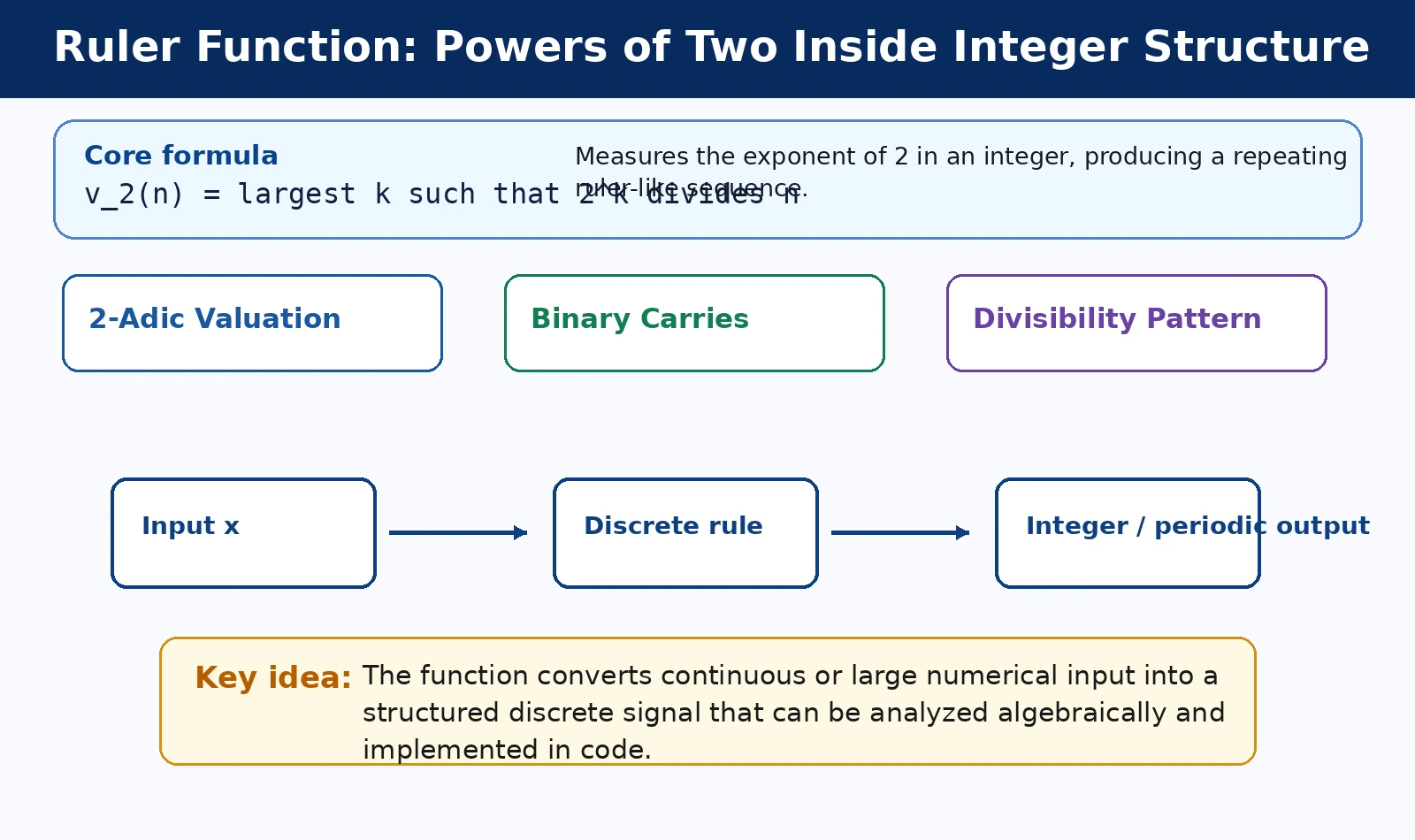
The formal definition of the ruler function focuses on the exponent of the prime number two. For any positive integer ##n##, the function returns the largest integer ##k## such that ##2^k## divides the number.
Mathematically, we express this using the 2-adic valuation notation, often written as ##v_2(n)##. If we write a rational number in its lowest terms, the function specifically examines the numerator's relationship with the base two.
Consider the expression for the function:
This formula ensures that we are always seeking the highest possible power, providing a unique output for every input.
When applied to a sequence of natural numbers, the outputs generate a distinctive pattern: 0, 1, 0, 2, 0, 1, 0, 3, and so on. This sequence is the foundation of the ruler's characteristic visual appearance.
The definition can also be extended to rational numbers by considering the difference between the valuations of the numerator and denominator. This generalization allows the function to be applied within broader algebraic fields.
Visual Representation and Symmetry
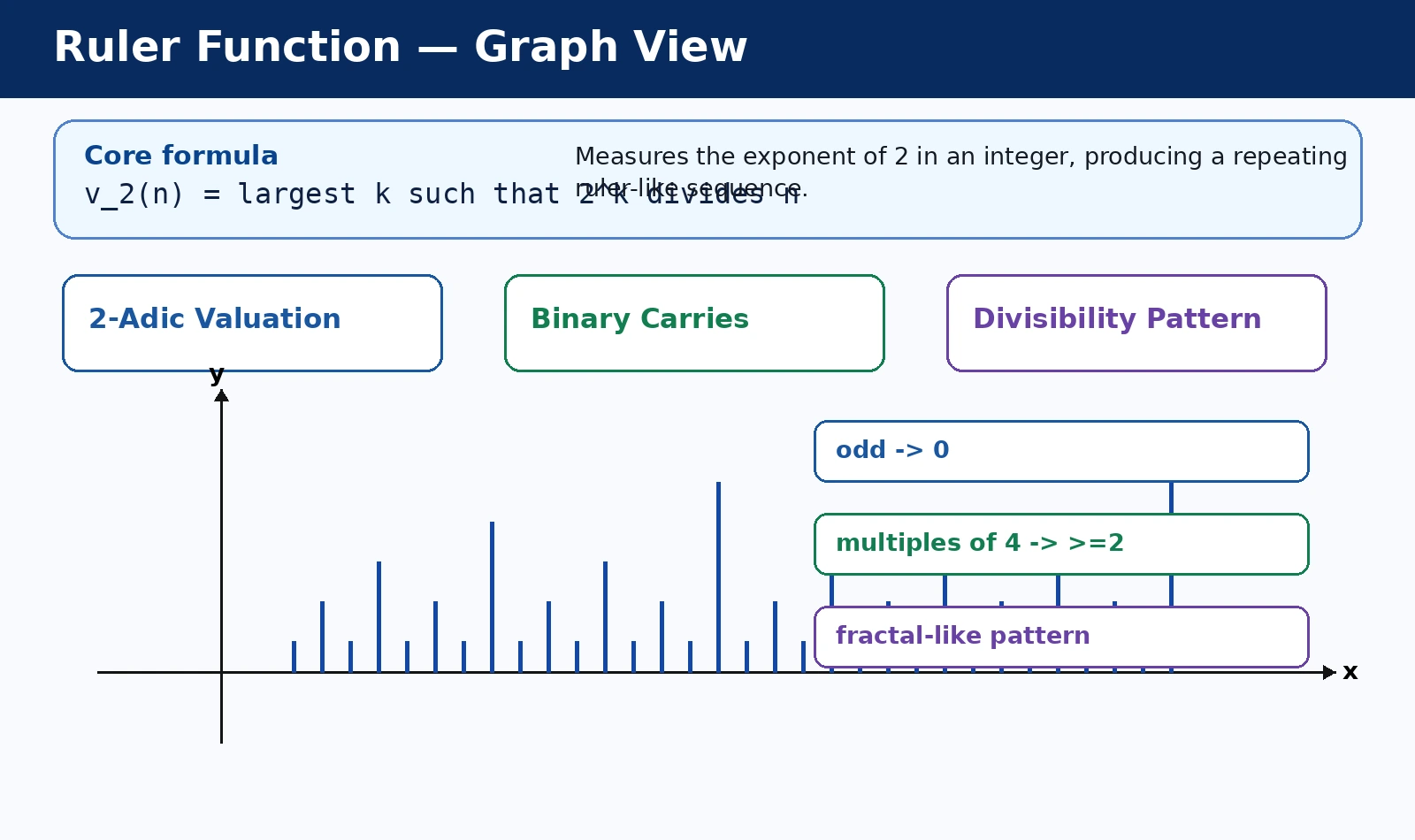
The visual representation of the ruler function is where it earns its common name. When the values of the sequence are plotted as vertical lines, they resemble the markings on a physical measuring ruler.
Short lines represent integers divisible only by low powers of two, while taller lines represent those divisible by higher powers. This creates a recursive, nested structure that repeats at different scales across the horizontal axis.
This symmetry is a hallmark of fractal geometry, where the whole pattern is mirrored within its smaller parts. Each segment of the plot is a scaled version of a larger section, demonstrating self-similarity.
As the scale increases, the complexity of the "ruler" grows, but the underlying logic remains identical. This predictability makes it a popular example for teaching the concepts of recursive patterns and mathematical beauty.
Graphic designers and computer scientists often use this visualization to demonstrate how simple rules can create complex aesthetics. The ruler function stands as a perfect intersection of pure mathematics and visual art.
Connections to Binary and Sequences
The ruler function is intrinsically linked to the binary number system, which forms the basis of modern computing. Every value in the sequence corresponds to the number of trailing zeros in the binary representation of an integer.
Because computers process information in base two, the ruler function appears naturally in many low-level algorithms. It provides a direct way to measure the "binarity" of a specific piece of data or address.
In the realm of combinatorics, this function identifies specific properties of sequences that are generated through iterative processes. It acts as a counter for how many times a process can be halved before reaching an odd value.
The relationship between the ruler function and binary logic is not coincidental. It arises from the fundamental way that powers of two partition the set of integers into disjoint sets based on divisibility.
By studying these connections, researchers can optimize data structures and improve the efficiency of bitwise operations. The ruler function serves as a bridge between abstract number theory and practical computer engineering.
The Binary Carry Sequence Explained
The binary carry sequence is a closely related mathematical concept that tracks the number of carries generated when adding one to a binary number. Remarkably, this sequence is identical to the ruler function.
When you increment a binary counter, the number of bits that flip from one to zero indicates the power of two that divides the new total. This bit-flipping is the physical manifestation of the function.
For example, moving from binary 011 to 100 involves two carries, and the resulting number, four, is divisible by ##2^2##. This direct mapping allows for rapid calculation of the function in digital systems.
This sequence is also known as the "p-adic valuation of n factorial" in some contexts, specifically when analyzing the growth of trailing zeros in factorials. It provides a deep insight into the structure of arithmetic.
The binary carry sequence highlights the efficiency of base-two systems. By understanding the frequency of carries, engineers can better predict the power consumption and heat generation in high-speed processors.
Algorithmic Implementation and Efficiency
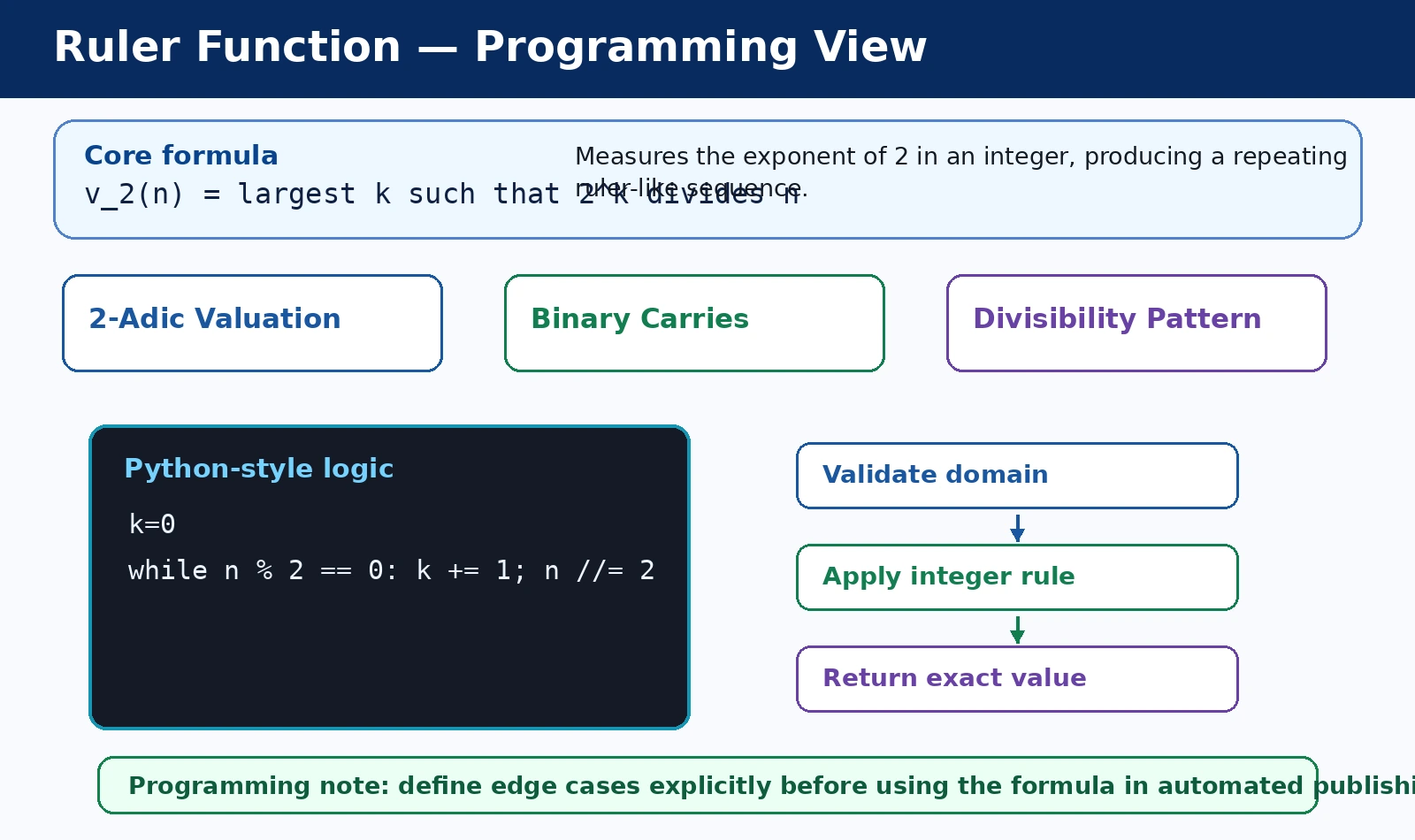
In software development, calculating the ruler function is often achieved through bitwise manipulation. Most modern processors include a specific instruction known as "Count Trailing Zeros" (CTZ) to perform this task.
Using bitwise operators, one can find the ruler value of ##n## by isolating the least significant bit. The expression ##n \text{ & } -n## yields the highest power of two that divides the integer.
This efficiency is crucial for algorithms that require high-frequency calculations, such as those found in cryptography or graphics rendering. The ruler function allows for constant-time complexity in these specific operations.
We Also Published
Recursive implementations are also common, where the function calls itself by halving the input until an odd number is reached. While less efficient than bitwise methods, recursion demonstrates the function's self-similar nature.
Programmers value the ruler function for its ability to simplify complex logic into a few machine instructions. It remains a staple tool in the arsenal of any developer working with low-level systems.
Analytical and Geometric Perspectives
Beyond discrete sequences, the ruler function plays a significant role in continuous mathematics and real analysis. It is used to construct functions that are continuous but nowhere differentiable, challenging classical intuition.
One of the most famous examples is the blancmange curve, which uses a variation of the ruler function to create its unique shape. This curve appears smooth from a distance but is infinitely jagged.
The analytical study of these structures helps mathematicians understand the limits of calculus. It provides a laboratory for testing theories about measure, dimension, and the nature of space itself.
Geometric interpretations of the ruler function often involve the concept of "height" in the context of rational numbers. This height determines how "close" a rational number is to being an integer in the 2-adic metric.
These perspectives allow the ruler function to be applied in fields like topology and dynamical systems. It serves as a fundamental building block for constructing complex mathematical objects with specific properties.
Relation to the Blancmange Curve
The blancmange curve, named for its resemblance to the dessert, is constructed by summing scaled versions of a simple sawtooth wave. The ruler function describes the distribution of the peaks in this summation.
As more layers are added to the curve, the influence of the ruler function becomes more apparent. The heights of the various "humps" in the curve are directly related to the 2-adic valuation of the coordinates.
This relationship demonstrates how a discrete function can give rise to a continuous, albeit non-smooth, geometric object. It is a primary example of how fractals are constructed through infinite series.
The blancmange curve is often used in finance to model price fluctuations that exhibit self-similarity across different timescales. The underlying ruler function provides the mathematical skeleton for these volatile models.
Studying this curve allows researchers to visualize the ruler function in a new dimension. It transforms a sequence of numbers into a tangible, albeit complex, physical shape that can be analyzed.
Ruler Function in Number Theory
In number theory, the ruler function is indispensable for studying the properties of p-adic numbers. It defines the "size" of a number in a way that differs fundamentally from the standard absolute value.
Under the 2-adic metric, numbers that are divisible by large powers of two are considered "small" or "close to zero." This counterintuitive approach reveals deep symmetries in the distribution of prime numbers.
The function is also used to solve Diophantine equations, which are polynomial equations with integer solutions. By analyzing the 2-adic valuation of each term, mathematicians can rule out possible solutions.
It also appears in the study of binomial coefficients and Pascal's triangle. Kummer's theorem, for instance, relates the carries in prime-base addition to the divisibility of binomial coefficients by that prime.
These applications show that the ruler function is not just a curiosity but a vital tool for exploring the foundations of arithmetic. It remains at the heart of many unsolved problems in modern mathematics.
Broader Implications in Modern Science
The influence of the ruler function extends into various branches of applied science, particularly where periodic or recursive phenomena occur. Its ability to model hierarchical systems makes it a versatile analytical tool.
In physics, the function can describe the energy levels in certain quantum systems or the branching patterns in fluid dynamics. It provides a mathematical language for systems that exhibit discrete scaling laws.
The function also appears in the study of music theory and acoustics. The division of octaves and the frequency ratios of harmonics often mirror the patterns found in the ruler sequence.
As we move toward more complex computational models, the ruler function helps in organizing data in a way that reflects natural growth. It is a model for how complexity arises from simple, iterative rules.
Ultimately, the ruler function serves as a reminder of the unity of mathematics. It connects the simplest act of counting to the most sophisticated theories of the universe's geometric structure.
Role in Digital Signal Processing
In digital signal processing (DSP), the ruler function is used to manage sampling rates and filter banks. It helps in determining the optimal points for signal decomposition in wavelet transforms.
The recursive nature of the function aligns perfectly with the Fast Fourier Transform (FFT) algorithms. These algorithms rely on breaking down signals into smaller components based on powers of two.
By utilizing the ruler function, engineers can design filters that are more efficient and have better frequency response characteristics. It allows for the precise control of data flow through complex processing pipelines.
The function also plays a role in error detection and correction codes. By analyzing the binary structure of data packets, the ruler function helps identify where bits may have been corrupted during transmission.
This practical utility ensures that the ruler function remains relevant in the age of high-speed telecommunications. It is an invisible but essential component of the technology that powers our modern world.
Importance in Recursive Algorithm Design
Recursive algorithms often use the ruler function to determine the depth of recursion or the branching factor at each step. It provides a natural way to balance workloads across multiple processors.
In divide-and-conquer strategies, the function helps in identifying the base cases and the transition points between different levels of the problem. This ensures that the algorithm terminates correctly and efficiently.
The ruler function is also used in the design of data structures like segment trees and Fenwick trees. These structures exploit the binary properties of indices to provide fast updates and queries.
By understanding the ruler sequence, developers can write code that is both elegant and performant. It encourages a way of thinking that prioritizes the inherent logic of the data over brute-force computation.
As software systems become increasingly complex, the reliance on fundamental mathematical patterns like the ruler function will only grow. It remains a guiding principle for building robust and scalable digital solutions.
From our network :
- Analyzing Trump Deportation Numbers Insights Into The 2026 Immigration Crackdown
- Mastering DB2 LUW v12 Tables: A Comprehensive Technical GuideComprehensive guide on DB2 LUW v12 tables. Explore CREATE TABLE syntax, BLU Acceleration, range partitioning, data types, and security features for IBM DB2 LUW v12.
- AI-Powered 'Precision Diagnostic' Replaces Standard GRE Score ReportsDiscover the new GRE Precision Diagnostic. Learn how AI-powered behavioral analytics and time-to-solve tracking are replacing standard GRE score reports to empower students.
- EV 2.0: The Solid-State Battery Breakthrough and Global Factory ExpansionDiscover the impact of the Solid-State Battery Breakthrough on the EV market. Learn about CATL and BYD stock growth, global factory expansion in Europe, and the future of EV 2.0 technology.
- 10 Physics Numerical Problems with Solutions for IIT JEEPrepare for IIT JEE with 10 physics numerical problems, complete with detailed solutions and conceptual explanations. Ideal for mastering kinematics, thermodynamics, electromagnetism, and optics.
- Trump Political Strategy How Geopolitical Stunts Serve As Media Diversions
- Mastering DB2 12.1 Instance Design: A Technical Deep Dive into Modern Database ArchitectureComprehensive guide to DB2 12.1 Instance Design. Explore architectural components, HADR setup, buffer pool tuning, and security policies for IBM DB2 12.1. Includes 10 functional SQL and Shell samples.
- 98% of Global MBA Programs Now Prefer GRE Over GMAT Focus EditionExplore why 98% of global MBA programs now prefer the GRE over GMAT Focus. Learn about the shorter GRE format, verbal logic importance, and strategic versatility for students.
- Vite 6/7 'Cold Start' Regression in Massive Module GraphsIn-depth analysis of Vite 6/7 cold start regressions in massive module graphs. Learn about barrel file issues, pre-bundling optimizations, and how to improve Vite dev server performance.
RESOURCES
- Ruler function - Wikipedia
- Ruler Function definition and graphical representation
- Thomae's function - Wikipedia
- Ruler function - Rhino for Windows - McNeel Forum
- The Ruler Sequence Revisited: A Dynamic Perspective - MDPI
- Is there a grid or ruler function? : r/krita - Reddit
- How to draw a laptop using the perspective ruler function
- iterative implementation of the ruler function (1,2,1,3,1,2,1,4,1,2,1,3,...)
- a ruler function similar to autodesk sketchbook? : r/adobeanimate
- 8.4 The Ruler Function
- assessing the role of titin during thick filament patterning and assembly
- Multi-Function Curved Ruler (Metric) | GoldStar Tool
- Introducing RULER: A Universal Reward Function for AI - LinkedIn
- Where is the show ruler function in the latest Canva workspace ...
- Vps41 functions as a molecular ruler for HOPS tethering complex ...



0 Comments