
On This Page
Fundamentals of the Remainder Function
The remainder function is a cornerstone of modular arithmetic, serving as a vital bridge between pure number theory and applied computational logic. It provides a structured method to determine what remains after an integer division process is fully completed.
In various mathematical frameworks, the concept of a remainder can be interpreted through different division algorithms. The choice of division strategy—whether floored, truncated, or Euclidean—significantly alters the sign and magnitude of the resulting remainder in specific calculations.
Floored division is particularly notable for its consistency across the number line, especially when dealing with negative integers. By definition, it prioritizes the floor function over simple truncation, leading to more predictable behavior in periodic cycles and modular offsets.
Understanding this function requires a clear distinction between the dividend, the divisor, and the quotient. When we divide an integer 'a' by 'b', the remainder 'r' must satisfy a specific relationship that maintains the integrity of the original division.
This technical exploration focuses on the floored division remainder, a method widely adopted by modern programming languages like Python. We will examine its formal definition, its unique properties, and the practical implications it holds for software developers and mathematicians.
Defining the Mathematical Identity
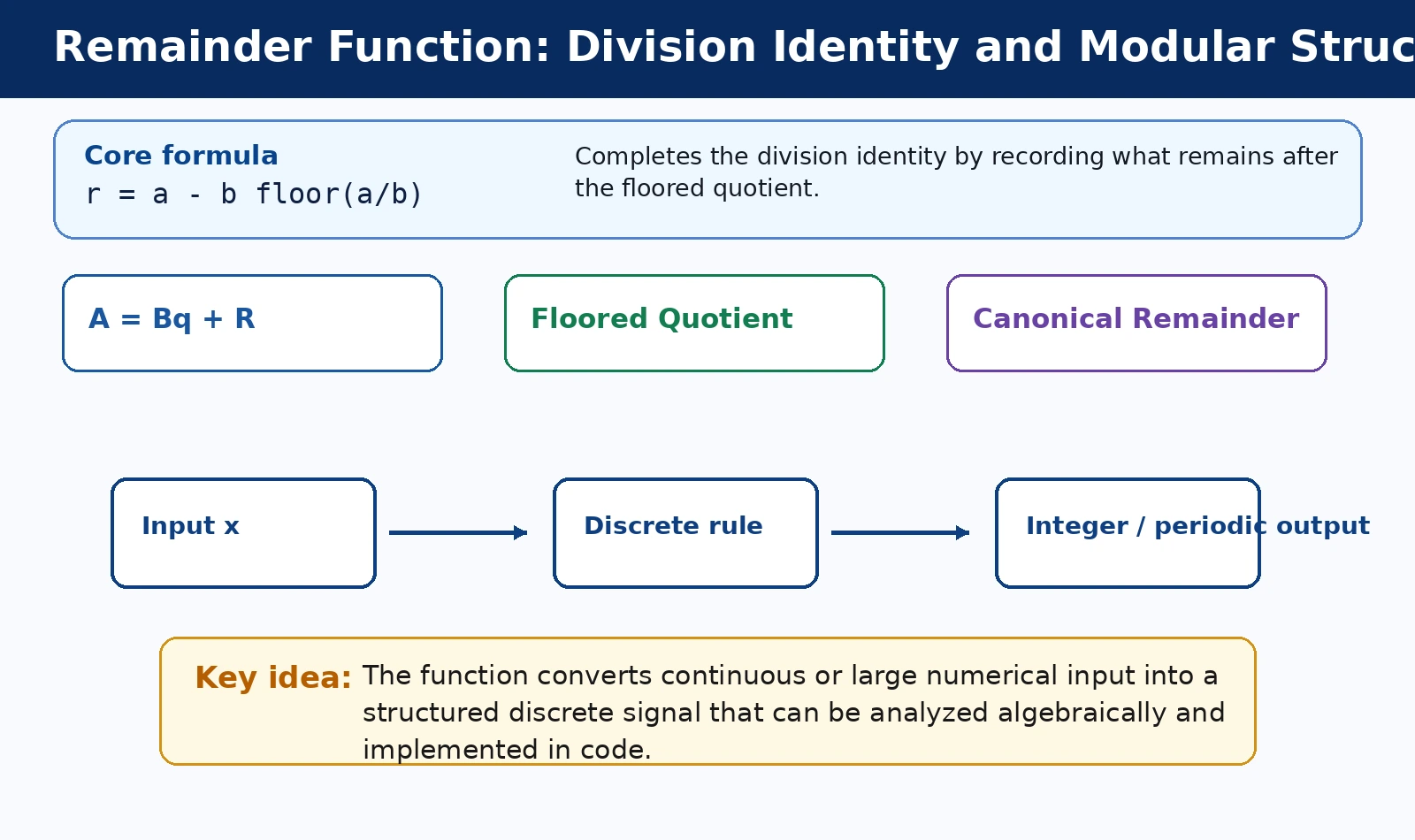
The formal definition of the floored remainder is expressed through a precise algebraic identity that links the dividend and divisor. This identity is written as ##r = a - b \cdot \text{floor}(a/b)##, where 'r' represents the remainder of the operation.
In this expression, the floor function serves as the primary mechanism for determining the quotient. By multiplying the divisor by the floored quotient and subtracting it from the dividend, we isolate the value that cannot be evenly divided.
This approach ensures that the remainder always aligns with the direction of the divisor's sign. It creates a mathematical environment where the remainder is inherently tied to the floor of the ratio, rather than the zero-centered distance of the values.
Mathematically, this identity is robust because it satisfies the fundamental division theorem. It guarantees that the dividend is always equal to the sum of the product of the divisor and quotient plus the calculated remainder in every case.
The identity
remains valid for all real numbers, though it is most commonly applied within the domain of integers. It provides a universal standard for calculating remainders across various computational and theoretical platforms.
The Role of the Floor Function
The floor function, denoted by the symbol ##\lfloor x \rfloor##, is defined as the greatest integer less than or equal to 'x'. This specific rounding behavior is what distinguishes floored division from other common methods like truncation.
When applied to positive numbers, the floor function behaves identically to truncation, effectively removing the fractional part. For example, the floor of 2.3 is 2, and the floor of 2.7 is also 2, leading to standard remainders.
However, the behavior changes significantly when the input is a negative value. The floor of -2.3 is -3, because -3 is the largest integer that is actually less than or equal to the decimal value of -2.3.
By using the floor function in the remainder formula, we ensure that the quotient always rounds toward negative infinity. This downward rounding is the key to producing remainders that remain non-negative when the divisor itself is a positive integer.
Without the floor function, the remainder would fluctuate in sign based on the proximity of the ratio to zero. The floor function provides a directional bias that is essential for maintaining the periodic properties required in many algorithmic designs.
Behavior with Negative Operands
Negative operands often introduce complexity into division algorithms because different systems handle the sign of the remainder differently. In floored division, the remainder's sign is strictly governed by the sign of the divisor, ensuring a consistent mathematical output.
When the dividend is negative but the divisor is positive, the floored division remainder remains positive. This is a deliberate design choice that simplifies many mathematical proofs and computer science applications, such as array indexing or circular buffers.
Consider the scenario where we must map a negative index back into a positive range. Floored division provides an elegant solution by naturally wrapping the value around the modulus, creating a continuous and predictable sequence of non-negative remainder values.
In contrast, systems that use truncated division would produce a negative remainder for a negative dividend. This often requires additional logic or conditional statements to correct the result, increasing the potential for bugs in complex software engineering projects.
By analyzing how negative operands interact with the floored remainder formula, we can better appreciate the elegance of this approach. It treats the number line as a continuous progression rather than two mirrored halves separated by the zero point.
Contrasting Truncated and Floored Division
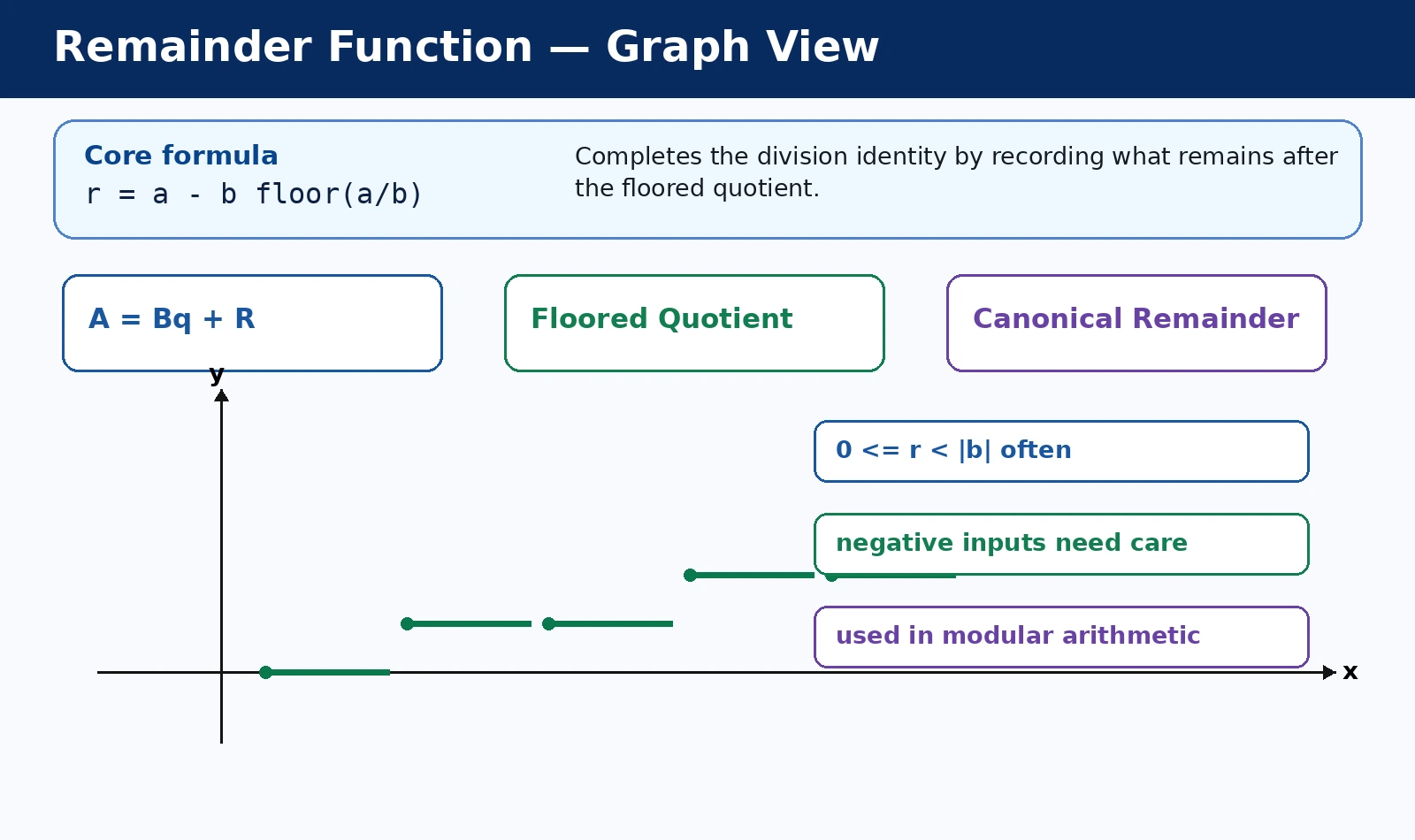
Truncated division is the standard in languages like C, C++, and Java, where the quotient is simply rounded toward zero. This results in a remainder that always shares the same sign as the dividend, which can be counter-intuitive.
In truncated division, dividing -7 by 3 yields a quotient of -2 and a remainder of -1. This occurs because -7 = 3 * (-2) + (-1), where the remainder is allowed to be negative to match the dividend's sign.
Floored division, used in Python and Ruby, yields a different result for the same operation. The quotient is rounded down to -3, resulting in a positive remainder of 2, since -7 = 3 * (-3) + 2 is true.
The primary advantage of the floored approach is that the remainder ##r## always satisfies the constraint ##0 \le r < |b|## when ##b## is positive. This mathematical property is highly desirable for operations involving periodic functions or cycles.
Choosing between these two methods depends on the specific requirements of the application. While truncation is often faster on modern hardware, floored division offers superior mathematical consistency for high-level logic and complex algorithmic structures used in research.
Case Study: Calculating -7 mod 3
To illustrate the mechanics of the floored remainder function, let us perform a step-by-step calculation using the values ##a = -7## and ##b = 3##. This example clearly demonstrates the impact of the floor function on the result.
First, we calculate the ratio of the dividend to the divisor, which is ##-7 / 3 \approx -2.333##. In a floored division system, we must take the floor of this decimal value to determine the integer quotient for the operation.
The floor of -2.333 is -3, as it is the nearest integer that is less than the value. We then plug these values into our primary remainder formula:
to find the final result.
Multiplying 3 by -3 gives us -9, and subtracting -9 from -7 is equivalent to adding 9 to -7. Therefore, the remainder ##r## is equal to 2, which is a positive value despite the dividend being negative.
This result, ##r = 2##, is exactly what the Python modulo operator would return for the expression -7 % 3. It demonstrates how the floored remainder ensures that the result stays within the expected range of 0 to 2.
We Also Published
Applications in Computational Logic
Computational logic relies heavily on the remainder function to manage data structures, control loops, and implement security protocols. The floored version of this function is particularly useful because it simplifies the handling of negative offsets and indices.
In many algorithms, developers need to ensure that a value stays within a specific range, regardless of whether the input increments or decrements. Floored division allows for a seamless transition across the zero boundary without requiring special cases.
For example, in graphics programming, wrapping a coordinate around a screen width requires a consistent modulo operation. If a coordinate becomes negative, a floored remainder correctly maps it to the opposite side of the screen automatically and efficiently.
Cryptography also utilizes modular arithmetic where the properties of the remainder are strictly defined. Using a floored remainder helps maintain the mathematical group properties necessary for encryption algorithms to function correctly across a wide range of integer inputs.
By standardizing the behavior of the remainder function, programming languages provide a reliable tool for engineers. This reliability is essential when building complex systems that must behave predictably under diverse and potentially edge-case mathematical conditions during runtime.
Python’s Implementation of Modulo
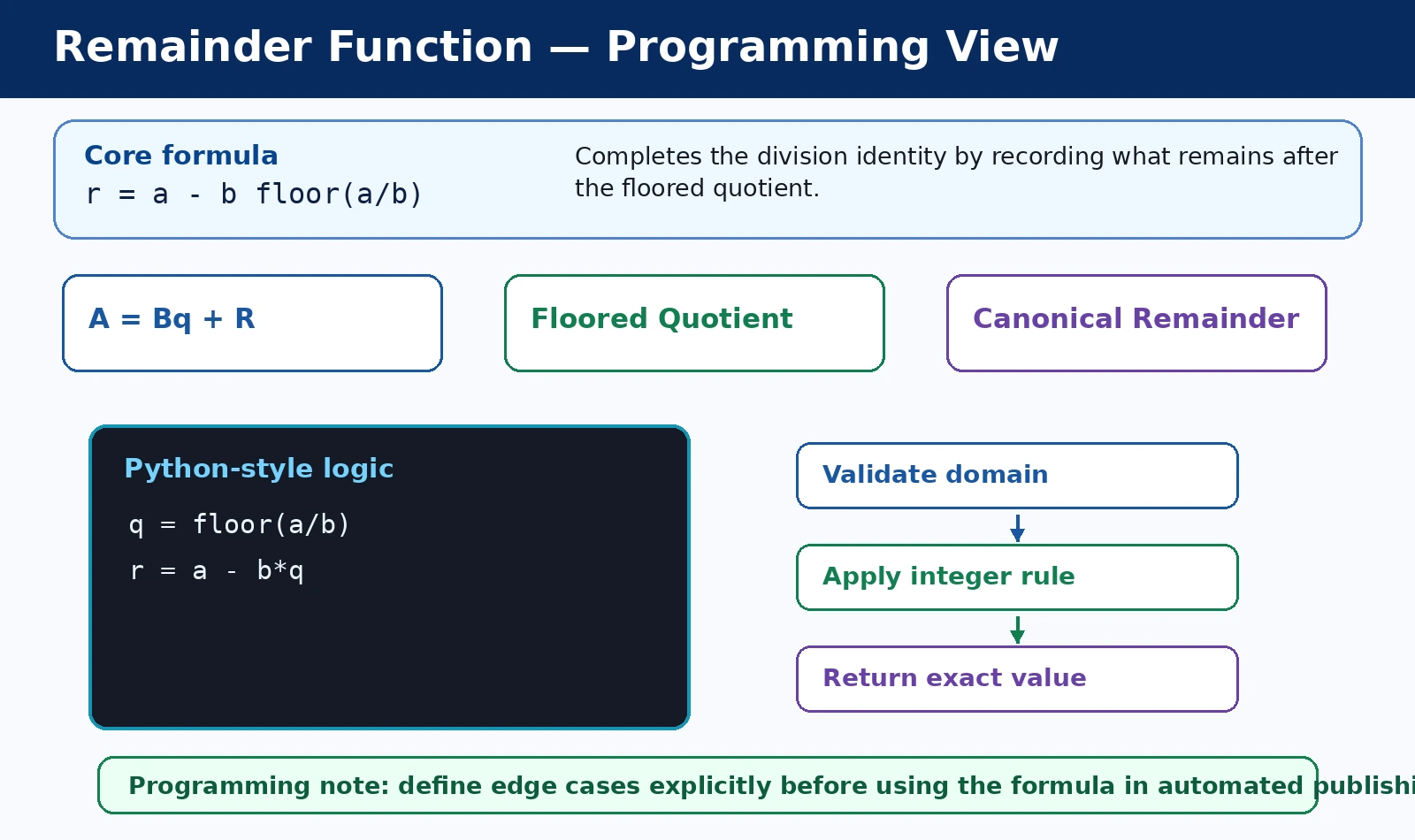
Python is one of the most prominent programming languages that implements the modulo operator % using the floored division rule. This design choice was made by Guido van Rossum to ensure mathematical consistency for negative numbers.
In Python, the expression a % b is defined to return a result that has the same sign as the divisor b. This means that if you divide by a positive number, you will always receive a non-negative remainder.
This behavior is highly beneficial for tasks like determining the day of the week or processing circular arrays. It prevents the common "off-by-one" errors that occur when developers forget to handle negative remainders in truncated division systems.
The Python implementation aligns with the mathematical definition of the modulo operation in number theory. It treats the modulo as an equivalence class, where -7 and 2 are considered congruent modulo 3 because they share the same remainder.
While this may surprise programmers coming from C or Java, it is generally considered a more robust approach for high-level logic. It reflects a shift toward prioritizing mathematical correctness and developer productivity over low-level hardware-specific division behaviors.
Cyclic Data Structures and Periodicity
Cyclic data structures, such as ring buffers or circular queues, are fundamental in computer science for managing streaming data. These structures use the remainder function to wrap the write and read pointers back to the start.
When a pointer is decremented, it may become negative, which would break a truncated remainder calculation. Floored division ensures that a negative pointer correctly wraps to the end of the buffer, maintaining the integrity of the data structure.
Periodicity is another area where the floored remainder shines, especially in signal processing and physics simulations. It allows for the calculation of phases and oscillations without worrying about the sign of the time or position variable involved.
In game development, the floored remainder is used to tile textures and manage infinite scrolling backgrounds. As the camera moves in a negative direction, the remainder function ensures that the background tiles continue to align perfectly and seamlessly.
By providing a consistent way to handle cycles, the floored remainder function simplifies the implementation of complex temporal and spatial logic. It removes the need for manual range checking, leading to cleaner, more maintainable, and efficient code.
Advanced Properties and Constraints
The floored remainder function possesses several advanced properties that make it a favorite for formal verification and mathematical modeling. One such property is the strict bound it places on the output relative to the divisor's magnitude.
Specifically, the remainder ##r## generated by floored division will always satisfy the inequality ##0 \le r < |b|## if the divisor ##b## is positive. This property is vital for ensuring that the output is always a valid index.
Furthermore, the function is translationally invariant in a way that relates to the divisor. Adding any multiple of the divisor to the dividend will not change the resulting remainder, which is a key requirement for modular arithmetic systems.
The continuity of the floored remainder function across the integer domain allows for the creation of smooth sawtooth waves in digital signal processing. This predictability is essential for synthesizers and other audio equipment that rely on periodic waveforms.
These constraints and properties ensure that the function behaves as a true mathematical operator. By adhering to these rules, the floored remainder provides a solid foundation for both theoretical explorations and practical engineering solutions in various fields.
Ensuring Non-Negative Results
The primary motivation for using floored division in many contexts is the guarantee of a non-negative result when the divisor is positive. This simplifies the logic required to map integers into a fixed range of natural numbers.
In many programming tasks, such as accessing an array, a negative index would result in a runtime error or undefined behavior. Using a floored remainder ensures that every input is mapped to a valid, non-negative array index automatically.
This non-negative guarantee is also useful in hash table implementations. Hash functions often produce large integer values, which must be constrained to the size of the hash table using a modulo operation that avoids negative bucket indices.
Without the floored remainder, developers would often write code like ((a % b) + b) % b to force a positive result. Floored division eliminates this redundancy, making the code more readable and reducing the overhead of extra arithmetic operations.
By embedding this logic into the division operator itself, the floored approach promotes safer coding practices. It encourages developers to think about remainders as positions within a cycle rather than just the leftovers of a subtraction process.
Mathematical Consistency in Algorithms
Consistency is the hallmark of a well-designed algorithm, and the floored remainder function contributes significantly to this goal. It ensures that the relationship between the quotient and the remainder remains stable across the entire number line.
In computational geometry, this consistency is used to determine the relative positions of points in a grid. The floored remainder allows for the calculation of grid cell coordinates that remain accurate even in negative coordinate spaces.
Furthermore, the use of floored division aligns with the Euclidean algorithm for finding the greatest common divisor in some contexts. It provides a reliable way to reduce numbers while maintaining the properties required for the algorithm's convergence.
As we have seen, the definition
is more than just a formula; it is a logical framework. It provides a unified approach to division that bridges the gap between negative and positive integers.
In conclusion, the floored remainder function is an essential tool for any technical professional. Its ability to provide consistent, non-negative results makes it an invaluable asset in the toolkit of mathematicians, computer scientists, and software engineers alike.
From our network :
- Mastering DB2 LUW v12 Tables: A Comprehensive Technical GuideComprehensive guide on DB2 LUW v12 tables. Explore CREATE TABLE syntax, BLU Acceleration, range partitioning, data types, and security features for IBM DB2 LUW v12.
- AI-Powered 'Precision Diagnostic' Replaces Standard GRE Score ReportsDiscover the new GRE Precision Diagnostic. Learn how AI-powered behavioral analytics and time-to-solve tracking are replacing standard GRE score reports to empower students.
- Trump Political Strategy How Geopolitical Stunts Serve As Media Diversions
- 98% of Global MBA Programs Now Prefer GRE Over GMAT Focus EditionExplore why 98% of global MBA programs now prefer the GRE over GMAT Focus. Learn about the shorter GRE format, verbal logic importance, and strategic versatility for students.
- EV 2.0: The Solid-State Battery Breakthrough and Global Factory ExpansionDiscover the impact of the Solid-State Battery Breakthrough on the EV market. Learn about CATL and BYD stock growth, global factory expansion in Europe, and the future of EV 2.0 technology.
- Vite 6/7 'Cold Start' Regression in Massive Module GraphsIn-depth analysis of Vite 6/7 cold start regressions in massive module graphs. Learn about barrel file issues, pre-bundling optimizations, and how to improve Vite dev server performance.
- 10 Physics Numerical Problems with Solutions for IIT JEEPrepare for IIT JEE with 10 physics numerical problems, complete with detailed solutions and conceptual explanations. Ideal for mastering kinematics, thermodynamics, electromagnetism, and optics.
- Analyzing Trump Deportation Numbers Insights Into The 2026 Immigration Crackdown
- Mastering DB2 12.1 Instance Design: A Technical Deep Dive into Modern Database ArchitectureComprehensive guide to DB2 12.1 Instance Design. Explore architectural components, HADR setup, buffer pool tuning, and security policies for IBM DB2 12.1. Includes 10 functional SQL and Shell samples.
RESOURCES
- How to perform an integer division, and separately get the ...
- What's the difference between % (modulo) and // (floor division)
- Getting Floor Division and Remainder at same time in 2 separate ...
- Quotient/Remainder function should have "mod" or "Modulo" as ...
- Distinguishing modulo (Euclidean division) from remainder
- Modulo - Wikipedia
- (Mathematical) modulo operator - language design - Rust Internals
- Python's modulo operator and floor division - The Teclado Blog
- Math: functions to get a proper ceiling or a floor of an integer division
- builtin functions for integer division and remainder division #217
- Python Floor Division: Syntax, Usage, and Examples - Mimo
- Division and Modulus for Computer Scientists - Microsoft
- URScript division operation involving integers produces unwanted ...
- Add a floored or euclidean modulo implementation to wgsl #3987
- Integer division - Python discussion forum


0 Comments