On This Page
Problem: Application of Cauchy-Schwarz Inequality in Work Done
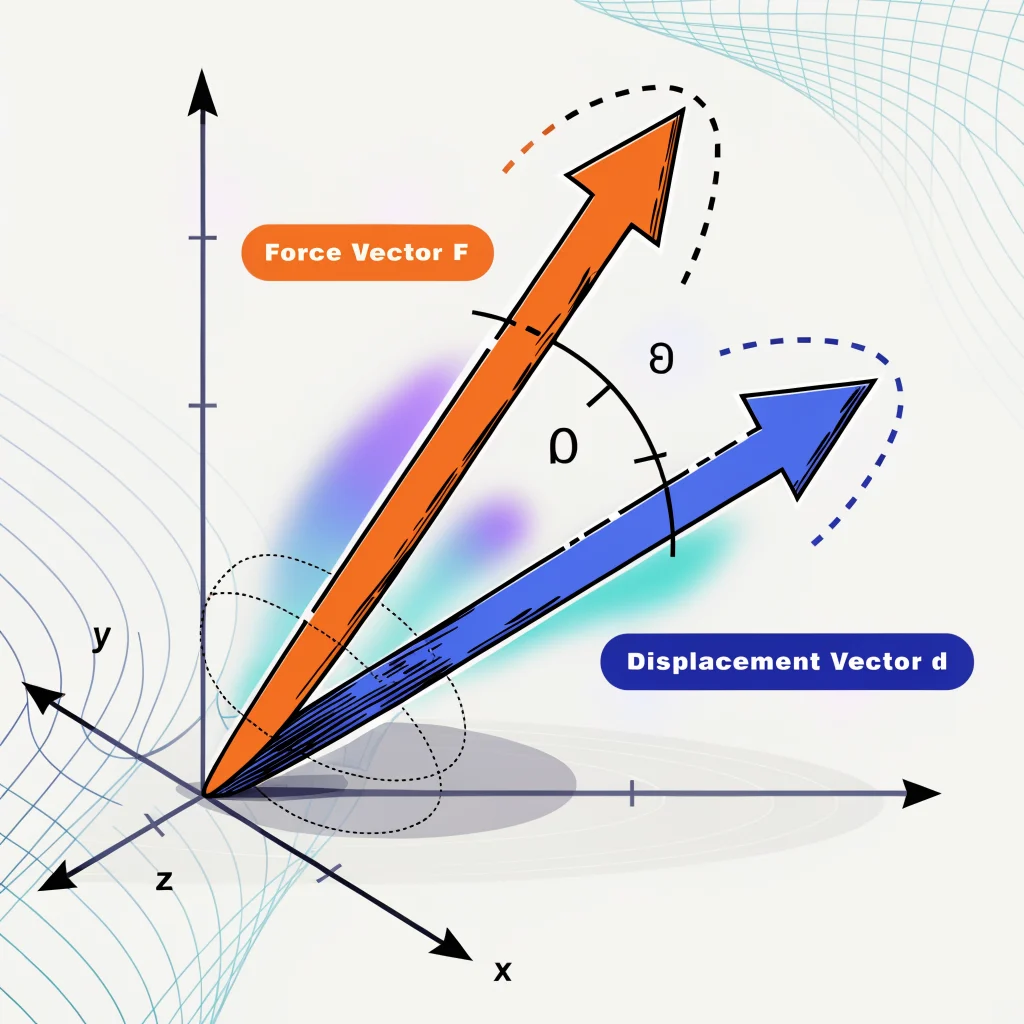
In classical mechanics, the work done ##W## by a constant force ##\vec{F} = F_x\hat{i} + F_y\hat{j}## acting on a particle undergoing a displacement ##\vec{d} = d_x\hat{i} + d_y\hat{j}## is defined as the scalar product, or dot product, of the force and displacement vectors.
Thus,
###W = \vec{F}\cdot\vec{d} = F_xd_x + F_yd_y###
The objective is to use the Cauchy-Schwarz inequality to determine the theoretical upper bound of the work done and to identify the condition under which this maximum value is achieved.
| Concept | Mathematical Representation | Physical Significance |
|---|---|---|
| Force Vector | ##\vec{F} = F_x\hat{i} + F_y\hat{j}## | The push or pull acting on the particle. |
| Displacement Vector | ##\vec{d} = d_x\hat{i} + d_y\hat{j}## | The change in position of the particle. |
| Work Done | ##W = \vec{F}\cdot\vec{d}## | The energy transferred by a force during displacement. |
| Upper Bound | ##|W| \leq |\vec{F}|\,|\vec{d}|## | The magnitude of work cannot exceed the product of the magnitudes of force and displacement. |
| Condition for Maximum Positive Work | ##\vec{F} = k\vec{d}, \quad k > 0## | The force must act in the same direction as the displacement. |
Worked Solution and Step-by-Step Explanation
To determine the maximum possible work, we use the Cauchy-Schwarz inequality. This inequality gives a sharp upper bound for the dot product of two vectors. Since work is itself a dot product, the result applies naturally to this problem.
Step 1: Recall the Cauchy-Schwarz Inequality
For any two real sequences ##(a_1, a_2)## and ##(b_1, b_2)##, the Cauchy-Schwarz inequality states:
###(a_1b_1 + a_2b_2)^2 \leq (a_1^2 + a_2^2)(b_1^2 + b_2^2)###
Taking the non-negative square root of both sides gives the absolute-value form:
###|a_1b_1 + a_2b_2| \leq \sqrt{a_1^2 + a_2^2}\,\sqrt{b_1^2 + b_2^2}###
| Form | Mathematical Expression | Use |
|---|---|---|
| Squared Form | ##(a_1b_1+a_2b_2)^2 \leq (a_1^2+a_2^2)(b_1^2+b_2^2)## | Useful when avoiding square roots during algebraic manipulation. |
| Absolute-Value Form | ##|a_1b_1+a_2b_2| \leq \sqrt{a_1^2+a_2^2}\sqrt{b_1^2+b_2^2}## | Useful for bounding the magnitude of a dot product. |
| Vector Form | ##|\vec{A}\cdot\vec{B}| \leq |\vec{A}|\,|\vec{B}|## | Useful in mechanics, geometry, and vector analysis. |
| General Sequence Form | ##\left|\sum a_i b_i\right| \leq \sqrt{\sum a_i^2}\sqrt{\sum b_i^2}## | Extends the same idea to higher-dimensional vectors. |
The vector form of the inequality is especially important here:
###|\vec{A}\cdot\vec{B}| \leq |\vec{A}|\,|\vec{B}|###
Step 2: Map the Inequality to Force and Displacement
We now connect the abstract variables in the Cauchy-Schwarz inequality with the physical quantities in the problem.
| Cauchy-Schwarz Variable | Physical Variable | Description |
|---|---|---|
| ##a_1## | ##F_x## | The x-component of the force vector. |
| ##a_2## | ##F_y## | The y-component of the force vector. |
| ##b_1## | ##d_x## | The x-component of the displacement vector. |
| ##b_2## | ##d_y## | The y-component of the displacement vector. |
Substituting these physical variables into the Cauchy-Schwarz inequality gives:
###|F_xd_x + F_yd_y| \leq \sqrt{F_x^2+F_y^2}\,\sqrt{d_x^2+d_y^2}###
Step 3: Identify the Physical Meaning of Each Side
The expression on the left-hand side is the magnitude of the work done because
###W = F_xd_x + F_yd_y = \vec{F}\cdot\vec{d}###
Therefore,
###|W| = |F_xd_x + F_yd_y|###
The two square-root expressions on the right-hand side represent the magnitudes of the force and displacement vectors:
###|\vec{F}| = \sqrt{F_x^2+F_y^2}###
and
###|\vec{d}| = \sqrt{d_x^2+d_y^2}###
Hence, the inequality becomes:
###|W| \leq |\vec{F}|\,|\vec{d}|###
Key Result: The magnitude of the work done by a constant force cannot exceed the product of the magnitudes of the force and displacement vectors.
###|W| \leq |\vec{F}|\,|\vec{d}|###
This result has a clear physical meaning: even if the force is large and the displacement is large, the work done also depends on how well the direction of the force aligns with the direction of displacement.
Step 4: Determine the Condition for Equality
Equality in the Cauchy-Schwarz inequality occurs if and only if the two vectors are linearly dependent. In this problem, that means the force vector must be a scalar multiple of the displacement vector:
###\vec{F} = k\vec{d}###
where ##k## is a real scalar. This means that the force and displacement vectors are parallel or antiparallel.
If the components of the displacement vector are non-zero, this proportionality can also be written as:
###\frac{F_x}{d_x} = \frac{F_y}{d_y} = k###
| Condition | Mathematical Meaning | Physical Interpretation |
|---|---|---|
| ##k > 0## | ##\vec{F} = k\vec{d}## | The force is in the same direction as displacement. Here, ##\theta = 0^\circ## and work is maximum positive. |
| ##k < 0## | ##\vec{F} = k\vec{d}## | The force is opposite to displacement. Here, ##\theta = 180^\circ## and work is maximum negative. |
| ##k = 0## | ##\vec{F} = \vec{0}## | No force acts on the particle, so the work done is zero. |
Step 5: Connect with the Standard Formula for Work
The usual formula for work done by a constant force is:
###W = |\vec{F}|\,|\vec{d}|\cos\theta###
Since ##-1 \leq \cos\theta \leq 1##, we immediately get:
###-|\vec{F}|\,|\vec{d}| \leq W \leq |\vec{F}|\,|\vec{d}|###
Therefore, the maximum positive value of work is:
###W_{\max} = |\vec{F}|\,|\vec{d}|###
This maximum occurs when ##\theta = 0^\circ##, meaning the force acts exactly in the direction of displacement.
The most negative value of work is:
###W_{\min} = -|\vec{F}|\,|\vec{d}|###
This occurs when ##\theta = 180^\circ##, meaning the force acts exactly opposite to the displacement.
Final Answer
The Cauchy-Schwarz inequality gives the bound:
###|W| \leq |\vec{F}|\,|\vec{d}|###
Hence, the maximum positive work done by the force is:
###W_{\max} = |\vec{F}|\,|\vec{d}|###
This occurs when the force and displacement are in the same direction, that is, when:
###\vec{F} = k\vec{d}, \quad k > 0###
Thus, the Cauchy-Schwarz inequality confirms a familiar physical principle: the work done is greatest when the force is applied directly along the direction of motion.
RESOURCES
- Why does the Cauchy-Schwarz inequality hold in any inner product ...math.stackexchange.comAug 8, 2013 ... I am working through linear algebra problems in Apostol's Calculus, and he has numerous problems that seem to imply that…
- Who attached Buniakovsky's name to the Cauchy-Schwarz inequality?hsm.stackexchange.comMar 3, 2016 ... Petersburg in 1859. Bunyakovsky (1804-1889) had studied in Paris with Cauchy, and he was quite familiar with Cauchy's work on…
- Constructive proof of the Cauchy Schwarz inequalitymath.stackexchange.comSep 4, 2018 ... (I would not even have touched the question in that form, if this direction would have been made clear from…
- The Cauchy-Schwarz Inequality and a Paradox/Puzzle - SIAMsiam.orgNov 1, 2019 ... ... Cauchy-Schwarz inequality ... Potential energy increases precisely by the amount of work done to overcome the hydrostatic pressure; friction…
- The Two Cultures of Mathematics Revisited | The n-Category Cafégolem.ph.utexas.eduMay 22, 2007 ... ... Cauchy-Schwarz inequality won't work there. On the other hand, if one thinks of the Cauchy-Schwarz inequality as having to…
- Generalizing the Cauchy-Schwarz inequality - arXivarxiv.orgJul 15, 2025 ... This is by no means an exhaustive list of work done to generalize or strengthen the Cauchy–Schwarz inequality, but it…
- I have a PhD in Analysis, and I feel like I'm still learning new ... - Redditreddit.comOct 11, 2021 ... ... work, whether you are an undergrad or a seasoned researcher? The triangle inequality and Cauchy Schwarz are part of…
- [1907.05024] Improving the Cauchy-Schwarz inequality - arXivarxiv.orgJul 11, 2019 ... More importantly, a variant of it is seen to work desirably in certain singular situations where the celebrated inequality appears…
- Researchers are using the Cauchy-Schwarz inequality to train ...reddit.comMar 5, 2025 ... Any mathematicians here working in ML? Please tell us what are you doing.
- A matrix extension of the Cauchy-Schwarz inequality - ScienceDirectsciencedirect.comA simple argument is used to obtain a very useful generalization of the well known Cauchy-Schwarz inequality.
- Cauchy–Schwarz inequality - Wikipediaen.wikipedia.orgThe Cauchy–Schwarz inequality is an upper bound on the absolute value of the inner product between two vectors in an inner product space in…
- Every mathematician has only a few tricks - MathOverflowmathoverflow.netJun 15, 2020 ... Hölder's inequality and the special cases, Cauchy-Buniakovski-Schwarz ... Replacing an object by one which is easier to work with but…
- Lean Game Serveradam.math.hhu.deProve famous results like the Cauchy-Schwarz inequality and work through ... Done Right'. Prerequisites. Worlds, 5. Levels, 43. Language, English. Server ...
- Cauchy-like inequality for Kronecker (tensor) product - MathOverflowmathoverflow.netFeb 7, 2011 ... The best I have done so ... The first inequality, attributed to Haagerup, is an analog of the Cauchy-Schwarz inequality…
- Ma116 Homework Exercisesweb.stevens.eduHow much work is done by the truck in pulling the car 1km ... (b) Use the Cauchy-Schwarz Inequality from Exercise 49 to prove…



0 Comments