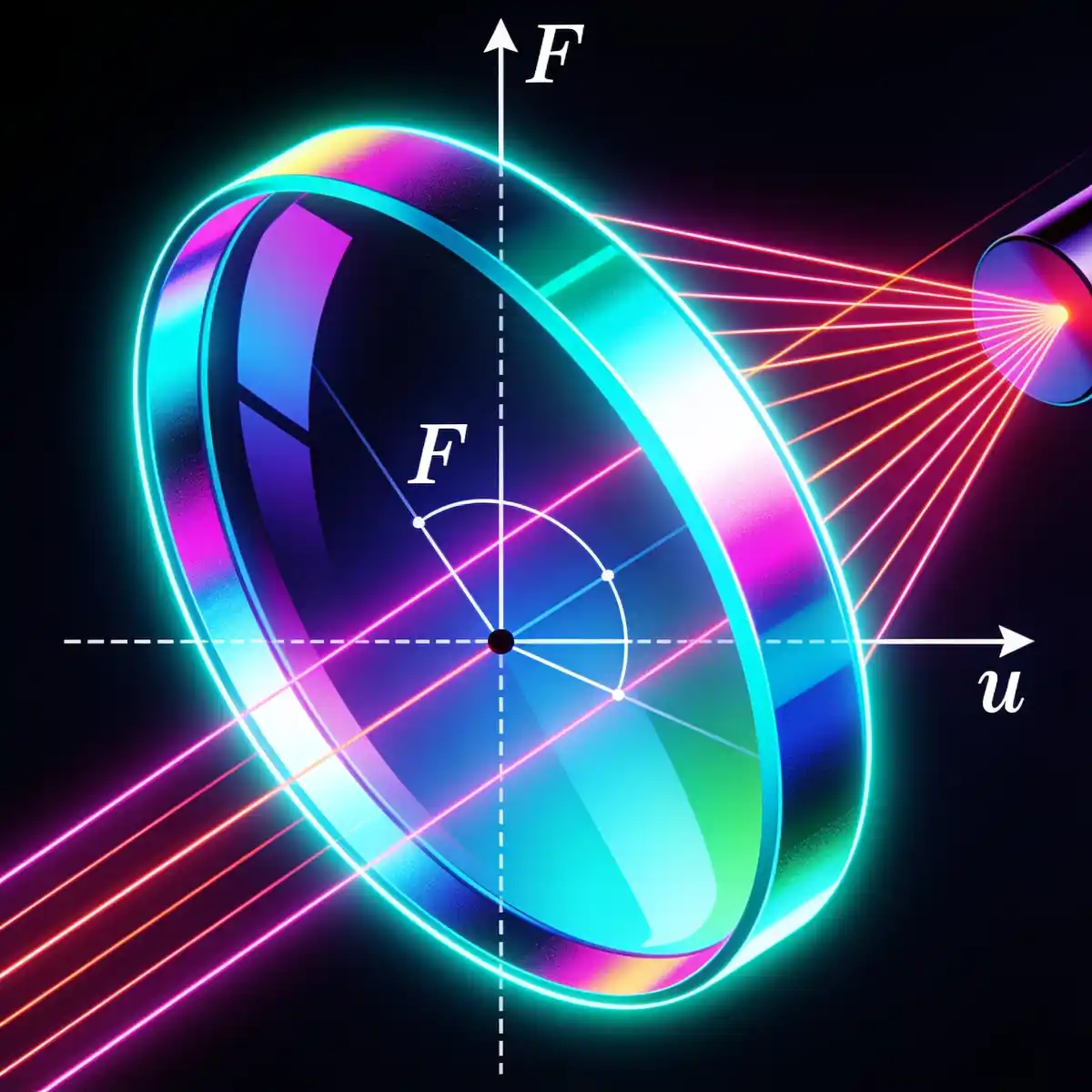
Problem: AM-GM Inequality in Optical Lens Systems
In geometric optics, a fundamental constraint exists regarding the distance between a real object and its corresponding real image formed by a thin convex lens. Given a lens with a fixed focal length ##f##, we define ##u## as the object distance and ##v## as the image distance. For a real object and a real image, we seek to determine the minimum value of the total separation distance ##D = u + v##.
Using the thin lens equation:
Prove that the minimum distance ##D## between the object and the real image is equal to ##4f##.
Worked Solution & Step-by-Step Explanation
To determine the minimum value of ##D##, we treat the lens equation as a constrained optimization problem.
Step 1: Expressing the separation distance ##D##
The total distance ##D## is defined as the sum of the object distance and image distance:
From the lens formula, we have:
By substituting ##D = u + v## into the equation above, we obtain a relationship between the product ##uv## and the focal length ##f##:
Step 2: Applying the AM-GM Inequality
The Arithmetic Mean-Geometric Mean (AM-GM) inequality states that for any two non-negative real numbers ##u## and ##v##:
This inequality provides a lower bound for the sum of two variables when their product is constant.
Step 3: Substitution and Algebraic Manipulation
We substitute ##D = u + v## and ##uv = fD## into the AM-GM expression:
To solve for ##D##, we square both sides of the inequality. Since distance is a positive quantity (##D > 0##), the inequality sign remains unchanged:
Dividing both sides by ##D## (as ##D \neq 0##):
Step 4: Determining the Condition for Minimum Distance
The AM-GM inequality reaches its equality condition when the two terms are equal:
Substituting ##u = v## into the original lens formula:
Since ##u = v##, we find ##v = 2f##. Thus, the minimum separation ##D_{min}## occurs when the object is placed at a distance of ##2f## from the lens, resulting in a real image at ##2f## on the opposite side.
| Parameter | Value at Minimum Distance |
|---|---|
| Object distance (##u##) | ##2f## |
| Image distance (##v##) | ##2f## |
| Total distance (##D##) | ##4f## |
Conceptual Significance in Physics
This result is a cornerstone for experimental optics, particularly in the displacement method used to measure the focal length of a convex lens.
- Existence of Real Image: For a real image to form, the object must be placed beyond the focal point (##u > f##).
- The 4f Constraint: If the screen (where the image is captured) is placed at a distance less than ##4f## from the object, no real image can be formed by moving the lens between the object and the screen.
- Symmetry: The configuration ##u = v = 2f## represents a symmetric optical state where the magnification ##m = -v/u = -1##. The image is the same size as the object but inverted.
RESOURCES
- Food Insecurity, Neighborhood Food Environment, and Health ...pmc.ncbi.nlm.nih.govPrioritizing support for researchers from and funding for minority and underrepresented groups could bring an expanded lens ... Leddy A.M., Roque A ...
- Nonstationary optics: tutorial - Optica Publishing Groupopg.optica.orgMar 11, 2024 ... S. A. Collins, “Lens-system diffraction integral written in terms of matrix optics,” J. Opt. Soc. Am. 60, 1168–1177 (1970). Crossref.…
- Are fast primes f1.2 or faster worth it ? : r/photography - Redditreddit.comMay 14, 2025 ... ... am never going to resell that lens. naitzyrk. •. 1y ago ... They are generally the top of the…
- The Problem With the Phrase Women and Minoritiesajph.aphapublications.orgJun 7, 2012 ... ... inequality in health. The aforementioned DHHS report on health ... I am grateful to the graduate students in my…
- Optical Bottle Shaping Using Axicons with Amplitude or Phase ...mdpi.comFeb 13, 2023 ... Sometimes, a tandem of two optical elements, a lens, and an axicon ... G.M. Axially symmetric hollow beams using refractive…
- Presbyopia - StatPearls - NCBI Bookshelf - NIHncbi.nlm.nih.govJun 2, 2025 ... ... inequality in healthcare services. ... 38. Glasser A, Campbell MC. Presbyopia and the optical changes in the human crystalline…
- Optical Design of Generalised Gradient-Index Lensesresearch.tudelft.nlMar 18, 2025 ... The optical mass of the solution was estimated to be 3.70 grams ... [AMBproc1] A. M. Boyd, Optical design of…
- Help & Support - Help Center - Brilliantbrilliant.org... Inequality AM-GM Inequality Applying the AM-GM Inequality Power Mean Inequality (QAGH) Quadratic Mean Triangle Inequality RMO Math Contest Preparation INMO ...
- my Imperial Physics degree in a blog post? | by Kenton Kwok | Mediummedium.comJan 9, 2022 ... ... AM/GM inequality etc.). I thought the mathematical proofs were ... Optics (3/5)- more diffraction, interference, coherence, lenses. A ...
- Harmonic mean - Wikipediaen.wikipedia.orgExpressed as optical power, two thin lenses of optical powers P 1 and P 2 in series is equivalent to two thin lenses of…
- The AM-GM inequality relates the arithmetic mean (AM ... - Instagraminstagram.comJan 15, 2025 ... 974 likes, 4 comments - mathtype_by_wiris on January 15, 2025: "The AM-GM inequality relates the arithmetic mean (AM) to the…
- A functionally ordered visual feature map in the Drosophila brainsciencedirect.comMay 18, 2022 ... The input signal is spatiotemporally filtered to simulate the lens optics and photoreceptor response time of the fly eye. (J)…
- Starting with 'why?'. The journey to a whole system, place based ...hayleyleverblog.wordpress.comJan 22, 2024 ... ... inequalities, and that a much wider lens was needed. ... Posted in UncategorizedTagged active-lives, GM Moving, inactivity, inequality ...
- The Lancet Global Health Commission on Global Eye Health: vision ...thelancet.com... vision impairment; addressing gender inequality will help advance eye health. ... Finally, optical interventions such as spectacles and contact lenses ...
- Vision degrading myodesopsia from vitreous floaters in the youngsciencedirect.comThis artery's course is axial (antero-posterior) from the optic disc towards the lens through the vitreous body. ... Am J Ophthalmol, 99 (1985), pp.…


0 Comments