Every multicellular animal, from a simple freshwater polyp to a human being, confronts the same fundamental problem: a single cell cannot simultaneously digest food, exchange gases, circulate nutrients, and reproduce with any real efficiency. Nature's answer is division of labour, achieved through a graduated hierarchy of organisation that runs from cells to tissues, from tissues to organs, and from organs to organ systems. This lesson, the opening unit of a course on the structural organisation of animals, examines that hierarchy in precise detail, using the material's own definitions and sequence of ideas, before the course moves on to the frog as a representative vertebrate.
The organising principle is deceptively simple. In unicellular organisms, all functions such as digestion, respiration and reproduction are performed by a single cell. In the complex body of multicellular animals, the same basic functions are carried out by different groups of cells in a well organised manner. Even a simple organism like Hydra is built from different types of cells, and the number of cells in each type can run into thousands, while the human body is composed of billions of cells performing various functions. Understanding how these cells work together is the central task of this lesson.
By the end of this unit, you should be able to define a tissue, explain how the four basic tissue types are organised into organs such as the heart, and describe how organs associate into organ systems that divide labour for the survival of the body as a whole. The lesson also introduces two terms, morphology and anatomy, that will frame the entire course, and it closes with a short "Going further" block on histology and the four tissue types. Everything here prepares the ground for the next lesson, which turns to the habitat and external form of the frog.
On This Page
- From Single Cells to Tissues: The First Level of Organisation
- The Four Basic Tissue Types and the Making of Organs
- Morphology and Anatomy: Two Lenses on Animal Form
- Reading the Hierarchy as a Working System
- Going Further: Histology and the Identification of Tissues
- Consolidating the Lesson and Preparing for the Frog
- Key Terms and Definitions from the Material
From Single Cells to Tissues: The First Level of Organisation
The starting point of the chapter is a comparison between two ways of running a living body. In unicellular organisms, all functions like digestion, respiration and reproduction are performed by a single cell, which must therefore carry out every task within one membrane. In the complex body of multicellular animals, the same basic functions are carried out by different groups of cells in a well organised manner. This contrast is not merely a curiosity of classification; it explains why multicellularity demanded an entirely new architecture of cooperation, specialisation and internal communication that single cells never needed.
The scale of that architecture is worth pausing over. The body of a simple organism like Hydra is made of different types of cells, and the number of cells in each type can be in thousands. The human body is composed of billions of cells to perform various functions. With numbers of that magnitude, coordination cannot rest on chance encounters between cells; it requires stable groupings with fixed roles. The question the chapter poses is direct: how do these cells in the body work together? The answer begins with the concept of tissue.
The Definition of Tissue
In multicellular animals, a group of similar cells along with intercellular substances performing a specific function is called a tissue. Three elements of this definition deserve emphasis. The cells are similar, meaning they share structure and role; the intercellular substances are part of the tissue, not mere packing material; and the group performs a specific function, which is what distinguishes a tissue from an arbitrary cluster of cells. This definition, drawn directly from the material, is the foundation on which every later level of organisation in the chapter is built.
The presence of intercellular substances in the definition is easy to overlook but conceptually important. Cells in a tissue do not float in isolation; they are embedded in and supported by material they themselves secrete, and that material contributes to the tissue's function. This is why the definition speaks of cells along with intercellular substances rather than cells alone. Keeping this phrasing intact will matter when the course later examines connective tissue, where the intercellular matrix is often the dominant functional component.
Why Division of Labour Matters
Cells, tissues, organs and organ systems split up the work in a way that exhibits division of labour and contribute to the survival of the body as a whole. This single sentence is the thesis of the entire lesson. Division of labour means that no group of cells attempts to do everything; instead, each specialises, and the body survives because the specialised parts complement one another. The hierarchy is therefore not a taxonomic convenience but a functional necessity, an arrangement that makes more efficient and better coordinated activity possible among millions of cells.
It is useful to think of the hierarchy as a series of nested commitments. A cell commits to a role, a tissue commits to a function, an organ commits to a task, and an organ system commits to a broad life process. Each commitment narrows what an individual unit can do while expanding what the collective can achieve. The material states plainly that such an organisation is essential for more efficient and better coordinated activities of millions of cells constituting an organism, and that claim repays close reading because it links structure directly to performance.
The Four Basic Tissue Types and the Making of Organs
One of the most striking facts in the chapter is that all complex animals consist of only four basic types of tissues. Despite the enormous diversity of animal form, the building blocks are remarkably few. These tissues are organised in specific proportion and pattern to form an organ like the stomach, lung, heart and kidney. The word pattern matters as much as the word proportion: it is not only how much of each tissue an organ contains but how those tissues are arranged relative to one another that determines what the organ can do.
This principle explains why organs with utterly different functions can share the same raw materials. A stomach, a lung, a heart and a kidney are all assembled from the same four tissue types, yet each performs a distinct task because the proportions and the spatial arrangement differ. The chapter's phrasing, organised in specific proportion and pattern, captures a general rule of animal construction: identity emerges from composition and geometry, not from exotic ingredients. The next subsection examines the heart as the material's own illustration of this rule.
The Heart as a Composite Organ
Each organ in our body is made of one or more types of tissues. The material gives a precise and memorable example: our heart consists of all the four types of tissues, that is, epithelial, connective, muscular and neural. This single organ therefore demonstrates the full set at once. The muscular tissue provides contraction, the connective tissue gives structure and support, the epithelial tissue lines surfaces, and the neural tissue contributes to the control of rhythm and coordination. No one tissue could sustain the heart's function alone.
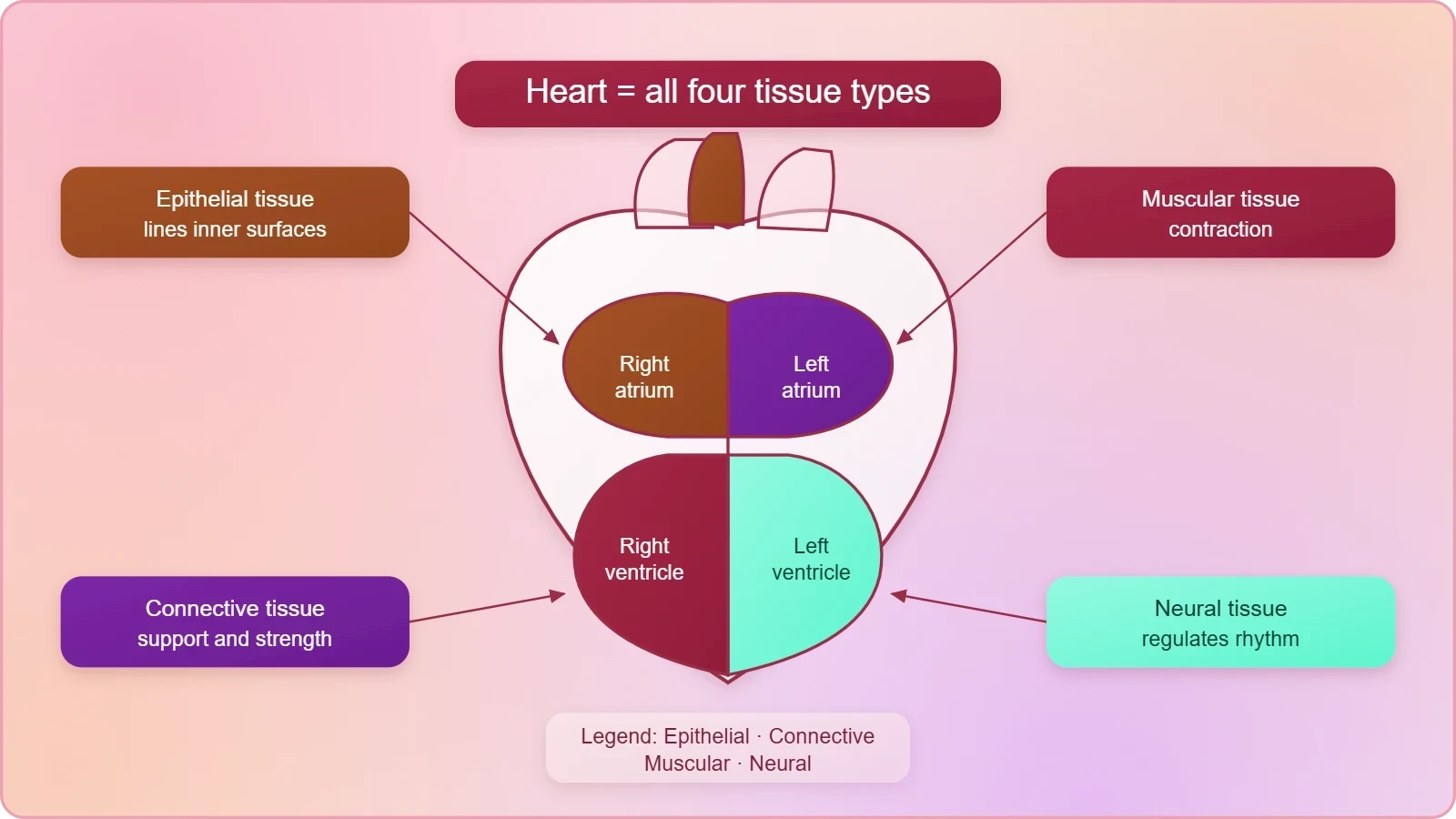
The heart example is worth internalising because it recurs throughout the course. When the lessons later examine the frog's digestive, respiratory, circulatory and excretory systems, the same logic applies: every organ encountered is a composite of tissues arranged in a purposeful pattern. Recognising the four tissue types inside each organ turns anatomy from a list of names into an exercise in reading structure. The heart simply makes the principle vivid because all four types are present within a single, familiar organ.
Organs, Organ Systems and Evolutionary Trend
When two or more organs perform a common function by their physical and or chemical interaction, they together form an organ system, for example the digestive system or the respiratory system. The definition is deliberately broad: interaction may be physical, as when organs are connected by tubes or membranes, or chemical, as when one organ's secretion acts on another. Organs, in other words, associate not merely by proximity but by functional partnership, and the system is defined by the common function they jointly perform.
The material also notes that the complexity in organ and organ systems displays certain discernable trend, and this discernable trend is called evolutionary trend, with details reserved for a later class. For now, the point is that the hierarchy is not static across the animal kingdom; the degree of organ and system complexity varies in patterned ways. This observation prepares learners for comparative anatomy without requiring the full evolutionary account at this stage, and it signals that the frog studied later is one point on a much longer comparative spectrum.
Morphology and Anatomy: Two Lenses on Animal Form
Before the course turns to the frog, the material carefully defines two terms that will govern every subsequent lesson. Morphology refers to the study of form or externally visible features. In the case of plants or microbes, the term morphology precisely means only this. In the case of animals, morphology refers to the external appearance of the organs or parts of the body. The definition is deliberately scoped: what counts as morphology depends on the kind of organism being described, and for animals the emphasis falls on external appearance.
Anatomy is then distinguished from morphology. The word anatomy conventionally is used for the study of morphology of internal organs in the animals. The phrasing is subtle and worth preserving: anatomy is described as the study of the morphology of internal organs, which keeps the two terms in a clear relationship rather than treating them as unrelated subjects. Morphology looks at what is visible from outside; anatomy looks at the internal organs using the same logic of form and arrangement. Together they provide the two lenses through which the frog will be examined.
Why the Distinction Is Taught First
Placing these definitions before the frog material is a deliberate pedagogical choice. Learners who confuse morphology with anatomy tend to describe internal organs as though they were external features, or to treat external form as incidental. By fixing the terms early, the chapter ensures that when the frog's body is divided into head and trunk, that observation is recognised as morphology, and when its internal systems are later described, those observations are recognised as anatomy. The distinction also clarifies why the course description lists morphology and anatomy as separate objects of study.
The definitions carry a further implication for the course's structure. Because morphology concerns externally visible features, it can be studied on a living, intact animal, while anatomy requires examination of internal organs. This is one reason the course sequence moves from the frog's habitat and external form in the next lesson toward its digestive, respiratory, circulatory, excretory and reproductive systems in later lessons. The terminological groundwork laid here thus anticipates the order of everything that follows, and it prevents later confusion between what is seen and what is inferred.
Setting Up the Frog as a Representative Vertebrate
The chapter states its purpose plainly: in this chapter, you are being introduced to the morphology and anatomy of frog. The frog is chosen to represent vertebrates, which means the detailed study of this one animal is intended to illuminate the general body plan of a much larger group. This is why the lesson on organ and organ system precedes the frog material: the hierarchy of cells, tissues, organs and organ systems must be understood abstractly before it can be observed concretely in a single organism's body.
Keeping the representative role in mind prevents the frog from becoming an isolated list of facts. Every structure described in later lessons, whether an organ of the digestive tract or a component of the circulatory system, is an instance of the general principles established here. The frog is not the subject of the course so much as its demonstration. The material's own order, organ and organ system first and frogs second, reflects this logic and should be respected when revising, because the general framework gives meaning to the specific details.
Reading the Hierarchy as a Working System
Once the four levels are defined, it becomes possible to read the hierarchy as a working system rather than a list. A tissue is defined by similarity of cells and a shared function; an organ is defined by the proportion and pattern of tissues; an organ system is defined by the common function of interacting organs. Each definition refers to the level below it, which is why the levels cannot be learned in isolation. The material's insistence that cells, tissues, organs and organ systems split up the work captures this interdependence in a single, memorable formulation.
The phrase division of labour deserves one further comment. It implies that specialisation is accompanied by dependence: a tissue that specialises in one function becomes unable to perform others, and therefore relies on other tissues for everything else. This is precisely why the hierarchy contributes to the survival of the body as a whole rather than to the survival of any individual cell. The body survives because its parts are interdependent, and interdependence is the price and the benefit of multicellular complexity. The material states this relationship directly and without embellishment.
A Quantitative View of Tissue Proportions
Although the material does not assign numerical values to tissue proportions, the idea of specific proportion invites a simple quantitative expression. If an organ contains four tissue types with fractional contributions ##p_1, p_2, p_3, p_4##, then the proportions must sum to unity, which can be written as a constraint on the composition of any organ:
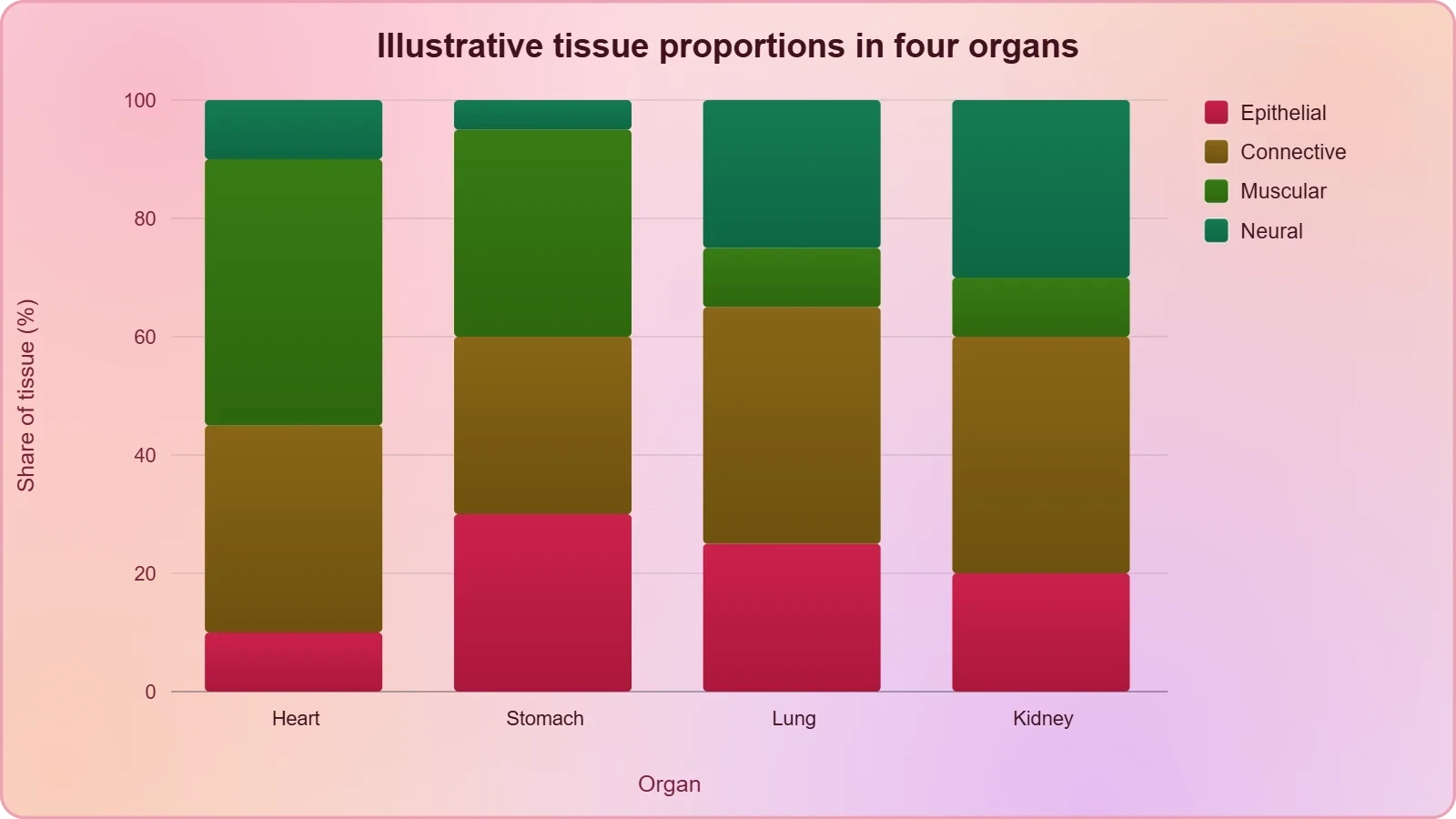
This expression is not a formula from the material but a formal way of stating what the material says in words: tissues are organised in specific proportion. The constraint alone does not determine an organ's identity, because the pattern of arrangement matters as well. Two organs could share identical proportions yet differ in pattern and therefore in function. The equation is best read as a reminder that proportion is a measurable property, while pattern is the additional, structural variable that completes the description of an organ.
From Composition to Function
The heart illustrates how composition and pattern combine. Because it contains epithelial, connective, muscular and neural tissue, it can contract, resist mechanical stress, line its internal surfaces and regulate its rhythm. Remove any one tissue type and the organ fails, not because the remaining tissues are defective but because the pattern is incomplete. This is the practical meaning of the material's statement that each organ is made of one or more types of tissues: the number of tissue types present is itself a functional specification, and the heart's possession of all four marks it as a highly integrated organ.
The same reasoning extends to organ systems. When two or more organs perform a common function by physical and or chemical interaction, the system inherits the properties of its organs and adds coordination between them. The digestive system, for instance, is not merely a collection of organs but a sequence in which each organ's output becomes another's input. Recognising this continuity helps learners see why the course later treats each system as an integrated whole rather than as a set of separate structures to be memorised in isolation.
Going Further: Histology and the Identification of Tissues
Histology is the branch of biology that studies tissues under the microscope, and it is the discipline through which the four basic tissue types are identified in practice. The material states that all complex animals consist of only four basic types of tissues, but it does not describe how those types are recognised. Histology supplies that method: by examining thin sections of tissue, prepared and stained so that cellular detail becomes visible, observers can distinguish tissue types by the shapes of their cells, the nature of the intercellular substances, and the arrangement of the cells relative to one another.
This background is offered as a supplement, clearly separate from the material, and it does not alter any definition given above. Its value lies in making the four tissue types concrete. When the material says that tissues are organised in specific proportion and pattern to form an organ, histology is the tool that reveals that proportion and pattern. Without microscopic examination, the claim would remain an abstraction; with it, the arrangement of tissues within the heart, stomach, lung or kidney becomes directly observable and measurable.
The Four Basic Animal Tissue Types
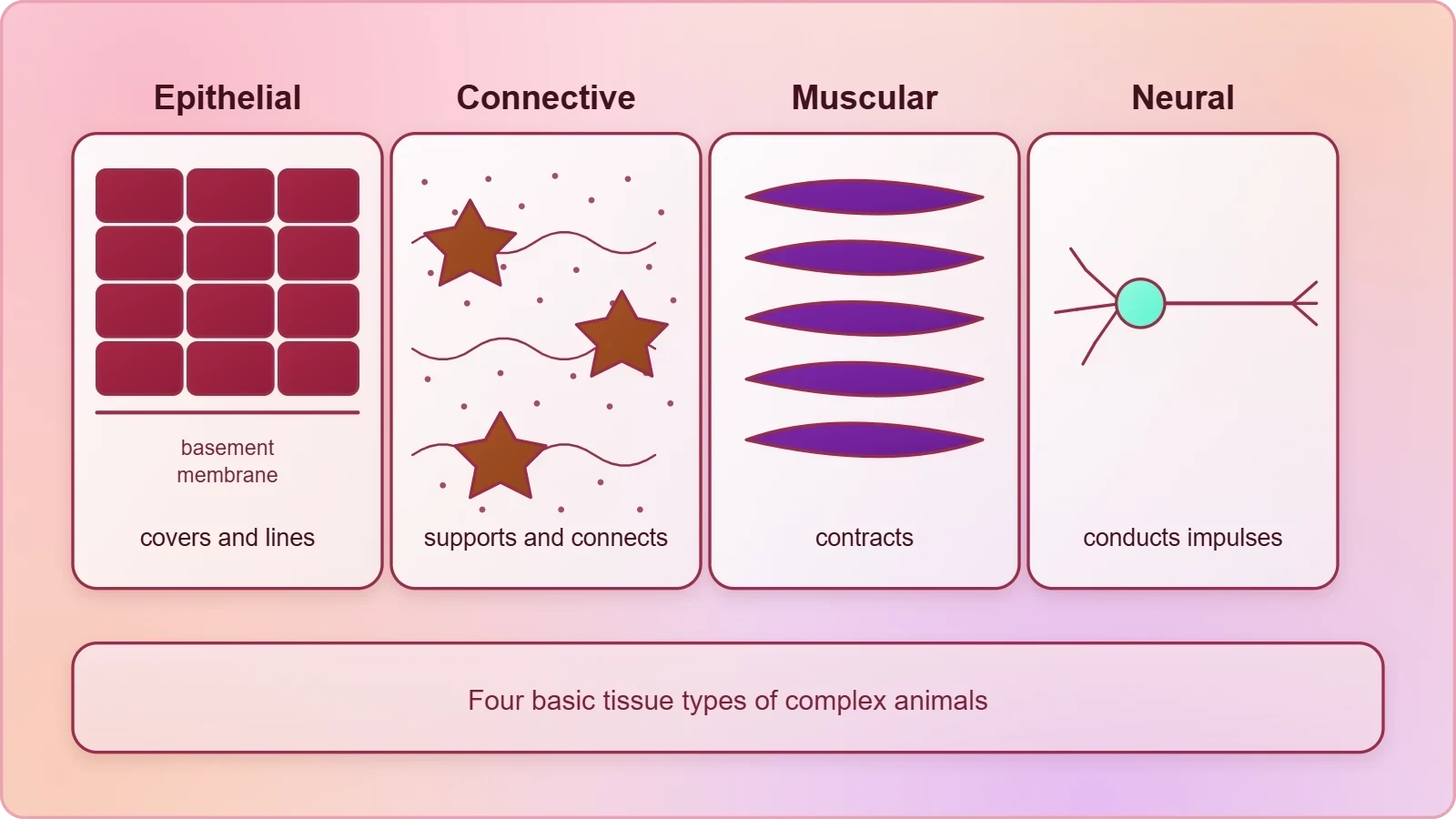
The four basic animal tissue types are epithelial, connective, muscular and neural tissue, and each has characteristic cell shapes and functions. Epithelial tissue consists of closely packed cells that cover body surfaces and line internal cavities and organs. Connective tissue is characterised by abundant intercellular material and binds, supports and connects other tissues. Muscular tissue is composed of elongated cells specialised for contraction. Neural tissue consists of cells specialised for receiving, conducting and transmitting impulses. These descriptions are standard background and are consistent with the material's list of the four types.
Recognising characteristic cell shapes is the practical skill that histology develops. Epithelial cells tend to be tightly apposed with little intervening space, connective tissue shows generous extracellular matrix, muscle cells are elongated and aligned in the direction of contraction, and neural cells display branching processes. These morphological signatures allow an observer to identify tissue types in a section and then to assess their proportion and pattern within an organ. The exercise connects directly to the material's central claim that organs are built from tissues arranged in specific proportion and pattern.
Connecting Histology to the Course Ahead
Histology also clarifies why the definition of tissue includes intercellular substances. In connective tissue especially, the extracellular material is functionally dominant, and a definition that mentioned only cells would fail to describe it adequately. Keeping the material's full phrasing in mind therefore prepares learners for the microscopic study of tissues that underlies all later anatomy. The four tissue types are not merely a list to be memorised; they are categories that histology can demonstrate, and the demonstration reinforces the definitions given in the material.
As the course proceeds to the frog, this background will help in two ways. First, it will make the description of organs more than a recitation of names, because each organ can be understood as a particular arrangement of the four tissue types. Second, it will prepare learners for the comparative perspective implied by the material's mention of evolutionary trend. The frog's organs, like those of other vertebrates, are composites of the same four basic tissues, and recognising this commonality is the first step toward understanding both the unity and the diversity of animal body plans.
Consolidating the Lesson and Preparing for the Frog
The lesson can be consolidated in a single chain of reasoning. Similar cells with intercellular substances form tissues; the four basic tissue types are organised in specific proportion and pattern to form organs such as the heart; and organs associate into organ systems that divide labour for the survival of the body. This chain is the material's own sequence, and it should be reproduced in that order when revising. Each link depends on the one before it, and the final link, division of labour, is the reason the whole hierarchy exists.
Two further points from the material should be retained. First, the complexity in organ and organ systems displays a discernable trend called evolutionary trend, a topic reserved for a later class but worth noting now as a sign that the hierarchy varies across animals. Second, morphology and anatomy are defined as the study of external form and of the morphology of internal organs respectively, and these definitions frame the frog study that follows. Together, these points close the lesson while opening the door to the next.
Self-Check Questions
A short self-check helps confirm that the definitions have been absorbed. Can you state, in the material's own words, what a tissue is? Can you name the four basic tissue types and explain why the heart is described as containing all four? Can you define an organ system and give the two examples the material provides? Can you distinguish morphology from anatomy as the material defines them? If each of these can be answered without reference to notes, the conceptual foundation for the frog lessons is secure.
Learners who wish to extend the check can attempt a further exercise: take any organ named in the material, such as the stomach, lung, heart or kidney, and explain how its function depends on the proportion and pattern of its tissues. This exercise rehearses the central claim of the lesson and prepares for the detailed organ descriptions in later units. It also reinforces the habit of reading anatomy as arrangement rather than as a list, which is the habit the course as a whole is designed to build.
Looking Ahead to Habitat and Morphology
The next lesson turns to frogs, their habitat and their morphology. Frogs can live both on land and in freshwater and belong to class Amphibia of phylum Chordata, with Rana tigrina the most common species found in India. They are poikilotherms, meaning their body temperature varies with the environment, and they exhibit protective coloration called mimicry, along with summer sleep, aestivation, and winter sleep, hibernation. These topics belong to the next lesson and are mentioned here only to show how the present lesson prepares for them.
The connection is direct. The present lesson establishes the general hierarchy of cells, tissues, organs and organ systems, and the next lesson begins the concrete study of one vertebrate that embodies that hierarchy. The material's own order, organ and organ system first and frogs second, is therefore not arbitrary but pedagogical: the abstract framework must precede the specific case. Learners who master the definitions in this lesson will find the frog's external features and internal systems far easier to interpret, because they will recognise each structure as an instance of a general principle rather than an isolated fact.
Key Terms and Definitions from the Material
A final reference table gathers the material's core definitions in one place, so that learners can check their understanding quickly. The definitions are reproduced in substance and order, with no additions that alter their meaning. Used alongside the self-check questions, this table supports revision before the next lesson and provides a compact summary of the conceptual framework that the frog study will later illustrate. The terms should be recalled in the material's own phrasing wherever possible, because the precision of that phrasing is part of what the lesson teaches.
Beyond revision, the table serves a diagnostic purpose. A learner who can supply each definition from memory, and who can give the material's examples for organs and organ systems, has met the learning objectives of this lesson. A learner who cannot should revisit the relevant section before proceeding, since the next lesson assumes fluency with these terms. The hierarchy is cumulative, and gaps at this stage tend to surface later when the frog's organ systems are described in detail.
Using the Definitions in Later Study
When the course reaches the frog's digestive, respiratory, circulatory and excretory systems, each system should be analysed using the definitions established here. Identify the organs involved, note the tissues that compose them, and describe how the organs interact physically or chemically to perform a common function. This method turns each later lesson into an application of the present one, and it keeps the course coherent rather than fragmentary. The material's own organisation supports this approach, since it introduces the general framework before the specific animal.
The same method applies to the final lesson on control, coordination and reproduction. Whatever organs and systems are described there, they will be instances of the hierarchy defined in this unit. Learners who internalise the chain from cells to tissues to organs to organ systems will find that new material fits into an existing structure rather than requiring separate memorisation. That is the practical benefit of studying organisation before studying the organism, and it is the reason this lesson comes first.
A Closing Note on Scope
This lesson has deliberately avoided the details of frog morphology and anatomy, which belong to the neighbouring lessons. It has also avoided the full treatment of evolutionary trend, which the material reserves for a later class. What it has done is establish the vocabulary and the logic of structural organisation: tissue, organ, organ system, division of labour, morphology and anatomy. With these in hand, the learner is prepared for the frog, and the frog in turn will make these abstractions concrete.
The material's final sentence on the topic states the outcome clearly: cells, tissues, organs and organ systems split up the work in a way that exhibits division of labour and contribute to the survival of the body as a whole. That sentence is the lesson in miniature. Everything else, from the definition of tissue to the example of the heart, supports it. Learners who can explain why division of labour contributes to survival have understood the lesson, and they are ready to see the same principle at work in the body of Rana tigrina.
Also Read
- No links available.
From our network :
- EV 2.0: The Solid-State Battery Breakthrough and Global Factory ExpansionDiscover the impact of the Solid-State Battery Breakthrough on the EV market. Learn about CATL and BYD stock growth, global factory expansion in Europe, and the future of EV 2.0 technology.
- Mastering DB2 12.1 Instance Design: A Technical Deep Dive into Modern Database ArchitectureComprehensive guide to DB2 12.1 Instance Design. Explore architectural components, HADR setup, buffer pool tuning, and security policies for IBM DB2 12.1. Includes 10 functional SQL and Shell samples.
- 10 Physics Numerical Problems with Solutions for IIT JEEPrepare for IIT JEE with 10 physics numerical problems, complete with detailed solutions and conceptual explanations. Ideal for mastering kinematics, thermodynamics, electromagnetism, and optics.
- Vite 6/7 'Cold Start' Regression in Massive Module GraphsIn-depth analysis of Vite 6/7 cold start regressions in massive module graphs. Learn about barrel file issues, pre-bundling optimizations, and how to improve Vite dev server performance.
- Mastering DB2 LUW v12 Tables: A Comprehensive Technical GuideComprehensive guide on DB2 LUW v12 tables. Explore CREATE TABLE syntax, BLU Acceleration, range partitioning, data types, and security features for IBM DB2 LUW v12.
- AI-Powered 'Precision Diagnostic' Replaces Standard GRE Score ReportsDiscover the new GRE Precision Diagnostic. Learn how AI-powered behavioral analytics and time-to-solve tracking are replacing standard GRE score reports to empower students.
- Analyzing Trump Deportation Numbers Insights Into The 2026 Immigration Crackdown
- Trump Political Strategy How Geopolitical Stunts Serve As Media Diversions
- 98% of Global MBA Programs Now Prefer GRE Over GMAT Focus EditionExplore why 98% of global MBA programs now prefer the GRE over GMAT Focus. Learn about the shorter GRE format, verbal logic importance, and strategic versatility for students.
RESOURCES
- Resources will be updated soon.