Every organism that rises above the single-cell condition confronts the same fundamental problem: how to divide labour among its parts so that the whole survives. In the previous lesson we saw that an organ is built from one or more types of tissue, and that the heart, for instance, draws on epithelial, connective, muscular and neural tissue at once. That layering of complexity, from cell to tissue to organ to organ system, follows a discernible evolutionary trend. The frog offers a particularly clear window into that trend because its body plan is simple enough to grasp whole, yet rich enough to illustrate every principle of vertebrate organisation.
This lesson turns to Rana tigrina, the common Indian frog, and examines it first as a living animal in its habitat and then as a visible form. Morphology, in the animal context, refers to the external appearance of the organs or parts of the body, while anatomy conventionally denotes the study of the morphology of internal organs. We begin with the outside: the skin that breathes and drinks, the colouring that conceals, the divisions of the body, the sense organs and the limbs, and the differences that separate male from female. These external features are not decorative details; each one is a functional answer to the demands of a dual life on land and in freshwater.
By the end of this lesson you should be able to place the frog within class Amphibia of phylum Chordata, explain what it means to be a poikilotherm, describe camouflage and the two forms of dormancy, and label the external parts of the body with confidence. This groundwork prepares directly for the next lesson, where the internal systems, beginning with digestion and respiration, take centre stage.
On This Page
The Frog as an Amphibian: Habitat and Physiological Identity
Frogs can live both on land and in freshwater, and this double citizenship is the defining fact of their biology. They belong to class Amphibia of phylum Chordata, a group whose name itself speaks of two modes of existence. The most common species of frog found in India is Rana tigrina, and it is this species that serves as our representative vertebrate throughout the chapter. Understanding where the animal lives, and how its physiology accommodates that life, is the necessary first step before any description of its form can make sense.
Cold-Blooded Life and the Meaning of Poikilothermy
Frogs do not have a constant body temperature; their body temperature varies with the temperature of the environment. Animals of this kind are called cold blooded or poikilotherms. The term describes a physiological strategy rather than a deficiency: instead of spending metabolic energy on internal heating, the frog's physiology tracks the surrounding conditions. This has direct consequences for behaviour, because the animal must seek out environments whose temperature suits its activity. A warm pond edge and a cool burrow become, in effect, instruments of thermoregulation, and the frog's daily movements are partly a search for tolerable conditions.
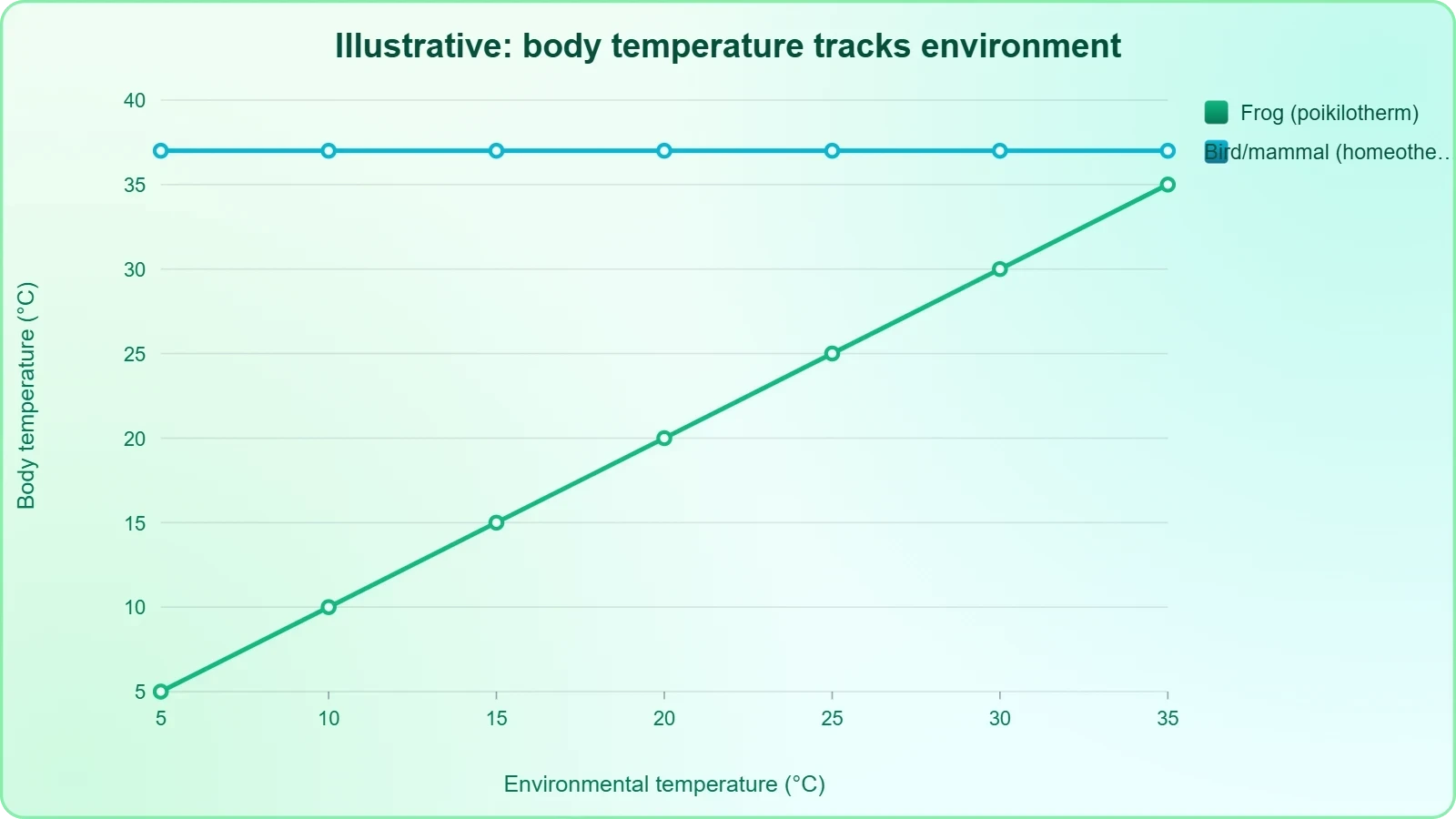
The distinction matters when comparing vertebrates. Birds and mammals maintain a steady internal temperature and are described as warm blooded, whereas the frog's internal state fluctuates with its surroundings. For a learner, the practical implication is that the frog's activity, digestion and responsiveness all rise and fall with ambient warmth. On a cold morning the animal is sluggish; on a warm one it is quick and alert. Poikilothermy therefore links habitat choice directly to physiology, and it explains why the frog's life is so tightly bound to the seasons and to the temperature of water and air alike.
Camouflage, Mimicry and Seasonal Dormancy
You may have noticed changes in the colour of frogs while they are in grasses and on dry land. They have the ability to change colour to hide themselves from their enemies, a phenomenon called camouflage. This protective coloration is termed mimicry in the chapter's usage. The shifting of hue allows the animal to blend with vegetation or bare earth, reducing the chance of detection by predators. Colour, in this reading, is not a fixed label but a dynamic response, and it reinforces the point that the frog's external appearance is functional through and through.
Frogs are also not seen during peak summer and winter. During these periods they take shelter in deep burrows to protect themselves from extreme heat and cold. The summer sleep is known as aestivation and the winter sleep as hibernation. These two forms of dormancy allow the animal to sidestep the seasons in which its poikilothermic body would be most stressed. Burrowing thus complements camouflage as a survival strategy, and together they show how behaviour, colour and physiology cooperate to keep a cold-blooded animal alive across an unforgiving annual cycle.
Morphology: The Skin as a Living Interface
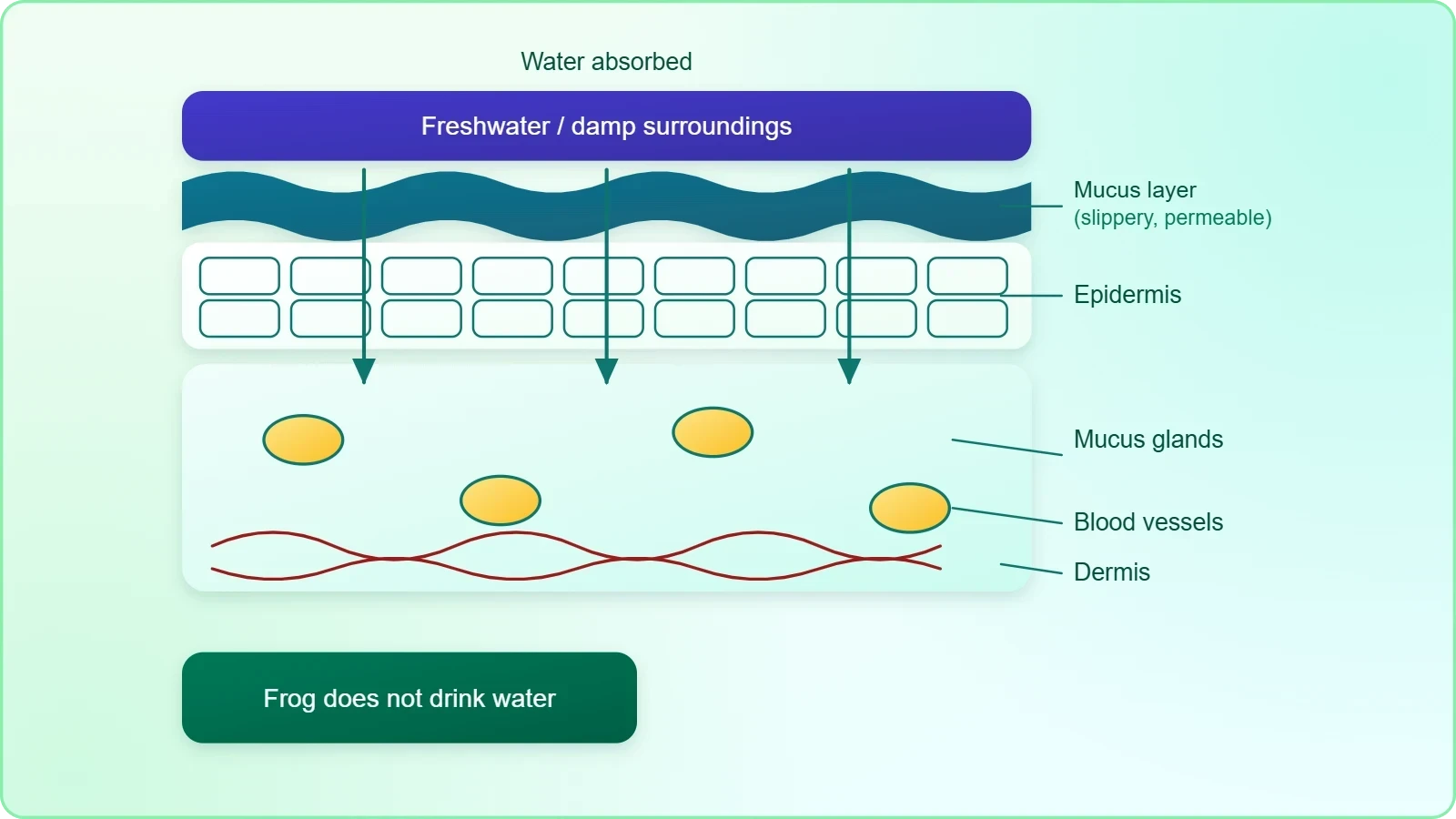
Morphology refers to the study of form or externally visible features. In the case of plants or microbes the term means precisely this, and in animals it refers to the external appearance of the organs or parts of the body. For the frog, the most instructive starting point is the skin, because it is far more than a covering. If you have ever touched the skin of a frog, you will recall that it is smooth and slippery due to the presence of mucus. The skin is always maintained in a moist condition, and this moisture is not incidental but essential to the animal's survival.
Moist, Mucus-Covered Skin and Cutaneous Water Uptake
The frog never drinks water; it absorbs water through the skin. This single fact transforms our understanding of the integument. The mucus that keeps the surface slippery also keeps it permeable and functional, allowing water to pass inward from the surroundings. The skin therefore performs a role that in other vertebrates belongs to the mouth and digestive tract. Any condition that dries the skin threatens the animal directly, which is one reason frogs stay close to damp places and freshwater. The moist surface is, in effect, the frog's drinking apparatus, permanently worn on the outside of the body.
This arrangement also ties the animal to its habitat in a strict way. A frog cannot wander far into dry country without risking dehydration, because its water supply is the environment itself, mediated by the skin. The mucus layer and the moisture it holds are thus a structural commitment to damp surroundings. When we later study respiration, we will see that the same moist, thin skin serves gas exchange as well, so the integument carries a double burden. For now it is enough to register that the skin is a living interface, not a passive wrapper.
Coloration of the Dorsal and Ventral Surfaces
The colour of the dorsal side of the body is generally olive green with dark irregular spots. On the ventral side the skin is uniformly pale yellow. This two-toned arrangement is worth pausing over, because it is consistent with the animal's habits and with the camouflage already described. The darker, mottled upper surface blends with vegetation and shadow when seen from above, while the pale underside is far less conspicuous from below against water or sky. The pattern is not random decoration but a stable feature of the species, and it complements the frog's ability to change colour when it moves between grasses and dry land.
Students often memorise the colours without asking why they matter. The dorsal olive green with dark irregular spots and the uniform pale yellow of the ventral side together constitute a textbook example of protective coloration. The description also gives us a reliable way to orient ourselves when examining a specimen: the spotted, darker surface is dorsal, the plain, lighter surface is ventral. This simple convention of orientation will be indispensable when we turn to internal anatomy, where the positions of organs are described relative to these surfaces.
Divisions of the Body and the Sense Organs
The body of a frog is divisible into head and trunk. A neck and tail are absent. This compact plan is easy to remember and easy to observe, and it distinguishes the adult frog from many other vertebrates at a glance. The absence of a neck means the head cannot turn independently of the trunk, and the absence of a tail gives the animal its characteristic squat silhouette. Within this simple framework, however, the head carries a remarkable concentration of sense organs, each suited to the amphibious life the frog leads.
Head, Trunk, Nostrils, Eyes and Tympanum
Above the mouth, a pair of nostrils is present. The eyes are bulged and covered by a nictitating membrane that protects them while in water. On either side of the eyes a membranous tympanum, or ear, receives sound signals. These three features, nostrils, eyes and tympanum, are the principal sense organs visible on the head, and each is placed where its function is best served. The bulging eyes give a wide field of view above the waterline, the nostrils open above the mouth for air, and the tympanum sits exposed on the side of the head to catch sound.
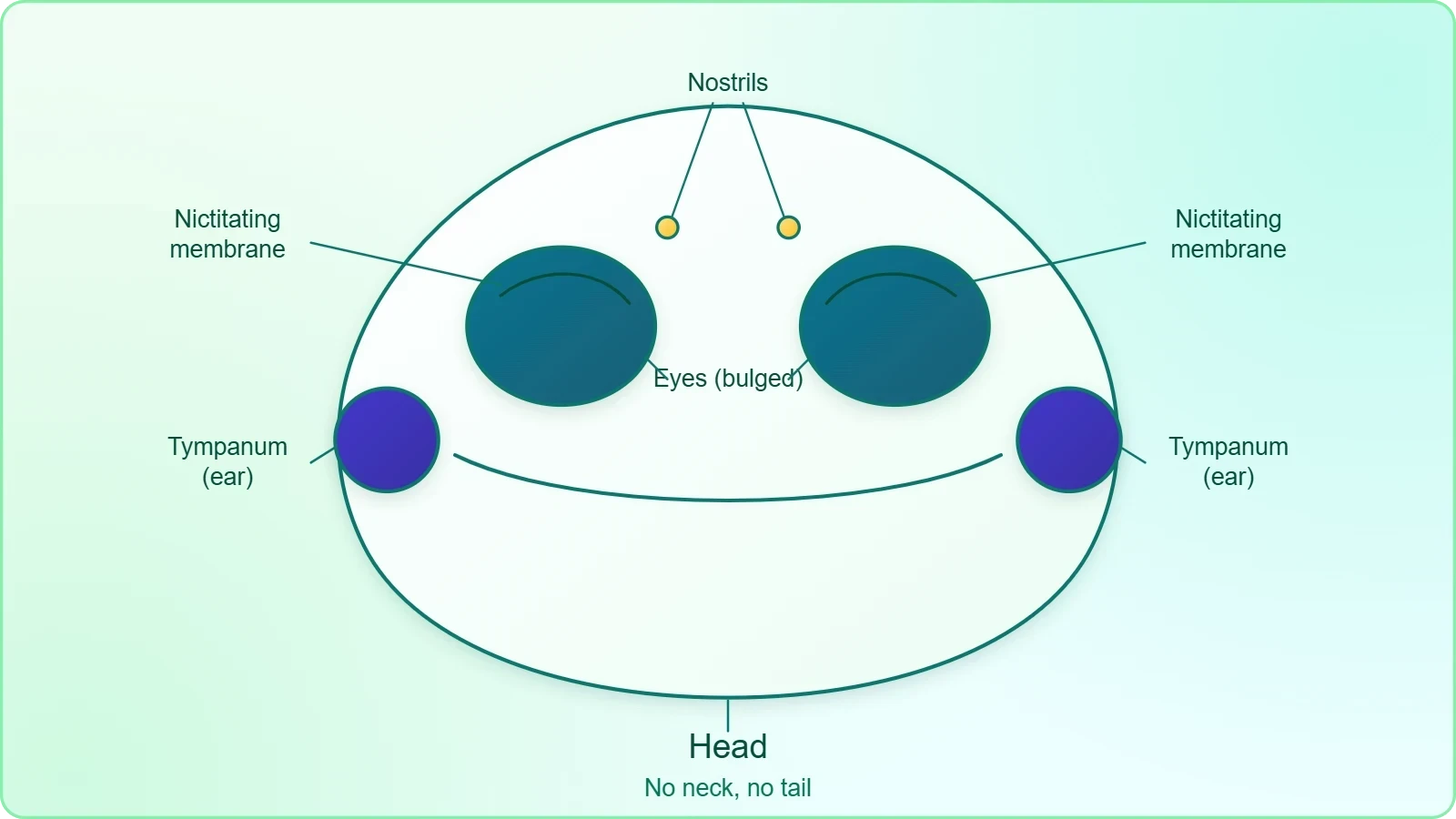
The nictitating membrane deserves particular attention because it solves a problem peculiar to an animal that divides its time between two media. Underwater, the eye needs protection without losing sight, and the membrane provides exactly that compromise. The tympanum, meanwhile, is a membranous structure rather than an external ear flap, and it receives sound signals directly. Together these organs show how the head of the frog is organised around sensory awareness of both air and water, and they prepare the ground for the study of the nervous system in a later lesson.
Forelimbs, Hind Limbs and Webbed Feet
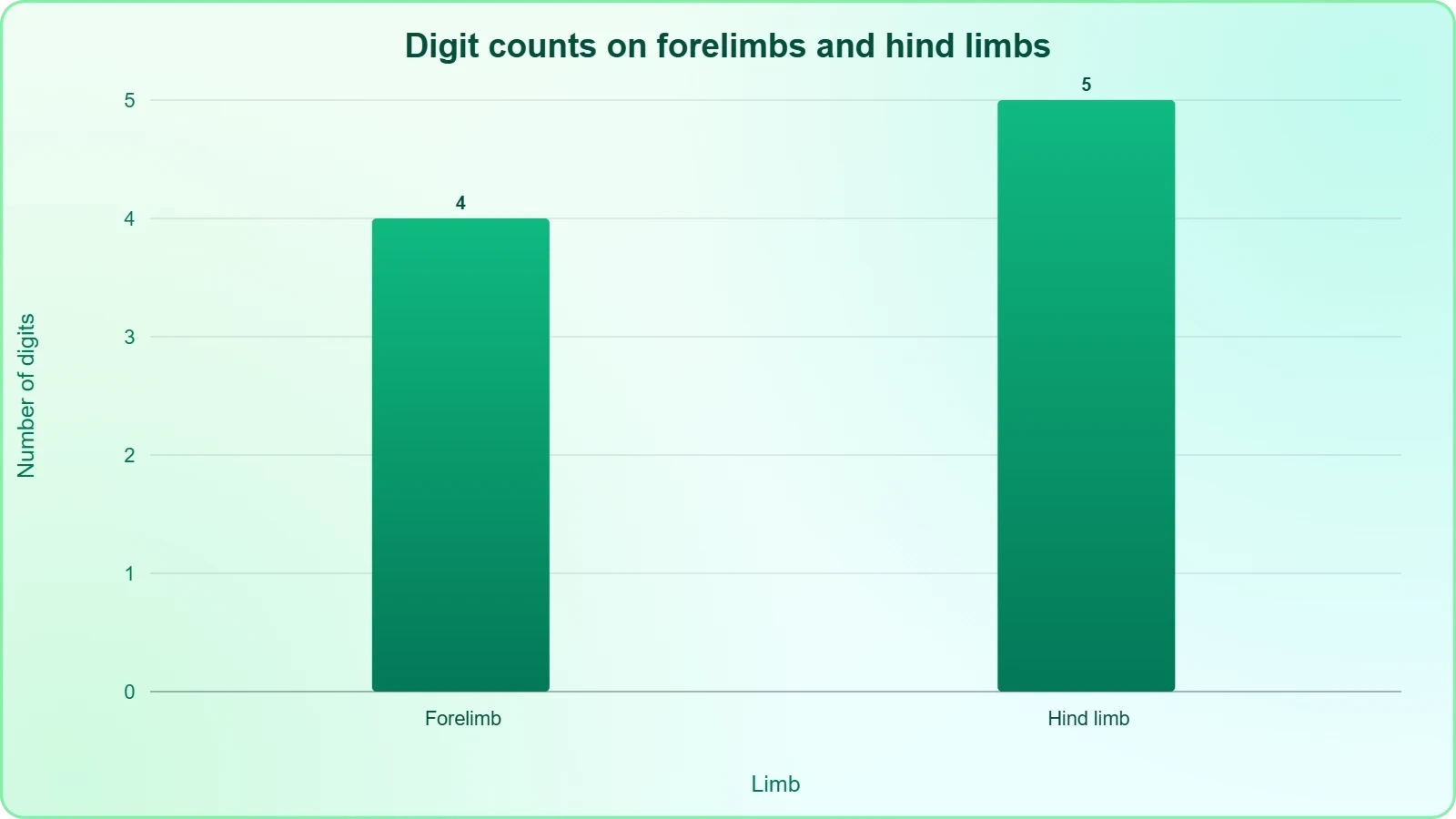
The forelimbs and hind limbs help in swimming, walking, leaping and burrowing. The hind limbs end in five digits and they are larger and muscular than the forelimbs, which end in four digits. The feet have webbed digits that help in swimming. This asymmetry between front and back is one of the most instructive features of frog morphology: the hind limbs are the engines of propulsion, built for the leap and the swim, while the forelimbs are shorter and serve support, steering and burrowing. The webbing between the digits of the feet turns the hind limb into an effective paddle.
Counting the digits is a practical exercise that also tests observation. Five on each hind limb and four on each forelimb is the rule for this species, and the difference is easy to verify on a specimen or a clear diagram. The muscular bulk of the hind limbs reflects their role in leaping, while the smaller forelimbs are suited to cushioning the landing and to manipulating the substrate during burrowing. When we reach the lesson on locomotion and the skeleton, these external proportions will explain much about the internal arrangement of bones and muscles.
Sexual Dimorphism: Telling Male from Female
Frogs exhibit sexual dimorphism, meaning that the two sexes differ in visible external features. Male frogs can be distinguished by the presence of sound producing vocal sacs and also a copulatory pad on the first digit of the forelimbs, both of which are absent in female frogs. These two markers are reliable and, with practice, quickly observed. The vocal sacs account for the loud calling that fills ponds during the breeding season, while the copulatory pad assists the male in gripping the female during mating. Neither structure appears in the female, so the presence or absence of these features settles the question of sex.
Vocal Sacs and the Copulatory Pad
The vocal sacs are sound producing structures, and their presence in the male explains why the calling of frogs is so conspicuous at certain times of year. The copulatory pad on the first digit of the forelimbs is a thickened gripping surface, and its position on the first digit is a detail worth remembering precisely. Both features are secondary sexual characters, appearing in the male and absent in the female. When examining specimens, a student should look first at the forelimbs for the pad and then at the throat region for the vocal sacs, since these are the two diagnostic regions the chapter identifies.
It is worth noting what the chapter does not claim. It does not say that males are larger, or that the sexes differ in colour, and we should not invent such differences. The material gives exactly two distinguishing features, and a careful learner will restrict the answer to those. This discipline of staying with the stated evidence is itself part of scientific training. Sexual dimorphism in the frog, as presented here, rests on the vocal sacs and the copulatory pad, and these two facts are sufficient to separate male from female in the field or the laboratory.
Why External Differences Matter for the Whole Organism
Sexual dimorphism is not an isolated curiosity; it connects morphology to behaviour and reproduction. The vocal sacs serve communication, drawing individuals together, while the copulatory pad serves the physical act of mating. Both are external features with clear internal and behavioural consequences, and both will become relevant when we study the reproductive system in a later lesson. For now, the lesson is that morphology is never merely descriptive. Every external feature we have catalogued, from the mucus-covered skin to the webbed feet and the male's vocal sacs, is an answer to a specific demand of the frog's amphibious life.
This is also the point at which the chapter's larger argument becomes visible. The frog is presented as a representative vertebrate, and its external organisation illustrates the division of labour among parts that we met in the previous lesson on organs and organ systems. The skin absorbs water, the limbs propel, the sense organs inform, and the secondary sexual characters enable reproduction. Each part has a role, and the whole is greater than the sum of its parts. With this external map in hand, we are ready to look inside.
Reading the Frog as a Representative Vertebrate
The chapter's purpose in choosing the frog is stated plainly: it represents vertebrates, and its morphology and anatomy are studied together. What we have assembled in this lesson is the external half of that study. The frog lives on land and in freshwater, belongs to class Amphibia of phylum Chordata, and is represented in India by Rana tigrina. Its body temperature varies with the environment, it changes colour to hide from enemies, and it retreats into deep burrows for aestivation and hibernation. Its skin is moist and mucus-covered, absorbing water directly, and its body divides into head and trunk with no neck or tail.
Connecting External Form to Internal Organisation
Every external feature we have described anticipates an internal arrangement. The moist skin that absorbs water will also serve respiration. The short, compact body with its muscular hind limbs will house a body cavity accommodating the digestive, circulatory, respiratory, nervous, excretory and reproductive systems. The sense organs on the head will connect to a nervous system that coordinates the animal's responses. Even the sexual dimorphism of the male, with its vocal sacs and copulatory pad, points forward to the reproductive system. Morphology, in this sense, is the visible surface of a deeper functional logic, and the next lesson opens the body to reveal it.
It is useful to keep the chapter's definitions in mind as we proceed. Morphology is the study of form or externally visible features; anatomy is the study of the morphology of internal organs. The two are complementary, and the frog is studied through both. Having mapped the outside, we can now approach the inside with a clear sense of orientation: dorsal and ventral surfaces identified, head and trunk located, and the positions of the mouth, nostrils, eyes and tympanum fixed. This external map will make the internal diagram intelligible rather than confusing.
A Brief Look Ahead to Digestion and Respiration
The next lesson takes up the digestive and respiratory systems. The body cavity of the frog accommodates these systems along with the circulatory, nervous, excretory and reproductive systems, each with well developed structures and functions. The digestive system consists of the alimentary canal and digestive glands, and because frogs are carnivores the alimentary canal is short and the intestine reduced in length. The mouth opens into the buccal cavity, which leads through the pharynx to the oesophagus, a short tube opening into the stomach, which continues as the intestine, rectum and finally the cloaca. The liver secretes bile stored in the gall bladder, and the pancreas produces pancreatic juice.
These details belong to the following lesson, but they are worth previewing because they show how the external features we have studied connect to internal function. The mouth above which the nostrils sit is the entrance to the buccal cavity; the body that we have divided into head and trunk is the container for the organs just named. When you next meet the diagram of internal organs, you will already know where the head ends and the trunk begins, and which surface is dorsal. That orientation is the quiet gift of this lesson to the next.
Going Further
The material above is the backbone of the lesson, and nothing in this closing block contradicts it. A few well-established points of background can deepen understanding without altering the chapter's account. Amphibians typically return to water to breed, which links their life cycle to both aquatic and terrestrial habitats. This is why the frog's dual citizenship is not merely a matter of where it feeds but of where it reproduces, and it explains why ponds and damp places remain central to the animal's existence even when it spends much of its time on land. The habitat, in other words, is a life-cycle requirement, not a preference.
The nictitating membrane is a transparent or translucent eyelid found in many animals; in frogs it helps protect the eye underwater. This broader context clarifies why the membrane is described as protecting the eyes while the frog is in water, and it shows that the structure is a common solution to a common problem rather than a peculiarity of this species. Such background is offered as orientation only. The definitions, features and terminology that govern the lesson remain those of the chapter, and the examination of the frog's internal systems in the next lesson will build directly on the external map we have drawn here.
Also Read
- No links available.
From our network :
- Trump Political Strategy How Geopolitical Stunts Serve As Media Diversions
- Mastering DB2 LUW v12 Tables: A Comprehensive Technical GuideComprehensive guide on DB2 LUW v12 tables. Explore CREATE TABLE syntax, BLU Acceleration, range partitioning, data types, and security features for IBM DB2 LUW v12.
- Vite 6/7 'Cold Start' Regression in Massive Module GraphsIn-depth analysis of Vite 6/7 cold start regressions in massive module graphs. Learn about barrel file issues, pre-bundling optimizations, and how to improve Vite dev server performance.
- AI-Powered 'Precision Diagnostic' Replaces Standard GRE Score ReportsDiscover the new GRE Precision Diagnostic. Learn how AI-powered behavioral analytics and time-to-solve tracking are replacing standard GRE score reports to empower students.
- 10 Physics Numerical Problems with Solutions for IIT JEEPrepare for IIT JEE with 10 physics numerical problems, complete with detailed solutions and conceptual explanations. Ideal for mastering kinematics, thermodynamics, electromagnetism, and optics.
- EV 2.0: The Solid-State Battery Breakthrough and Global Factory ExpansionDiscover the impact of the Solid-State Battery Breakthrough on the EV market. Learn about CATL and BYD stock growth, global factory expansion in Europe, and the future of EV 2.0 technology.
- Analyzing Trump Deportation Numbers Insights Into The 2026 Immigration Crackdown
- 98% of Global MBA Programs Now Prefer GRE Over GMAT Focus EditionExplore why 98% of global MBA programs now prefer the GRE over GMAT Focus. Learn about the shorter GRE format, verbal logic importance, and strategic versatility for students.
- Mastering DB2 12.1 Instance Design: A Technical Deep Dive into Modern Database ArchitectureComprehensive guide to DB2 12.1 Instance Design. Explore architectural components, HADR setup, buffer pool tuning, and security policies for IBM DB2 12.1. Includes 10 functional SQL and Shell samples.
RESOURCES
- Resources will be updated soon.