Every root that pushes through soil is performing a small act of engineering, and the tip of that root is where the engineering is most concentrated. The previous lesson established the root as an organ of absorption, anchorage, storage and hormone synthesis, and it distinguished tap, fibrous and adventitious systems. This lesson moves from the whole organ to the millimetre-scale architecture of the root apex, where four distinct zones cooperate in sequence: the protective root cap, the region of meristematic activity, the region of elongation and the region of maturation. Understanding this sequence is the foundation for everything that follows in plant morphology, because the same logic of dividing, expanding and differentiating cells recurs in the shoot, the leaf and the flower.
The regions of the root tip are not merely a list to memorise. Each region has a specific cellular character, a specific job and a specific position relative to the others, and the order matters: cells are produced at the apex, stretched behind it, and matured further back. A learner who grasps this spatial logic can predict what happens when a root is damaged, why root hairs appear only in a narrow band, and how water uptake is coupled to growth. The lesson keeps the standard terminology of the unit, including the terms root cap, meristematic activity, elongation, maturation and root hairs, and it treats each in the order in which a cell would experience them as it is left behind by the advancing tip.
Because this is the second lesson of twelve, it deliberately stops at the root tip. The stem, with its nodes, internodes and buds, is the subject of the next lesson, and the leaf follows thereafter. What matters here is that the root tip is a model system: a compact, accessible example of how a plant builds itself by combining division, expansion and differentiation in space rather than in time alone. Mastery of this small region pays dividends later, when the same vocabulary is used to describe apical meristems in the shoot and the development of lateral organs.
On This Page
The Root Cap: A Thimble at the Apex
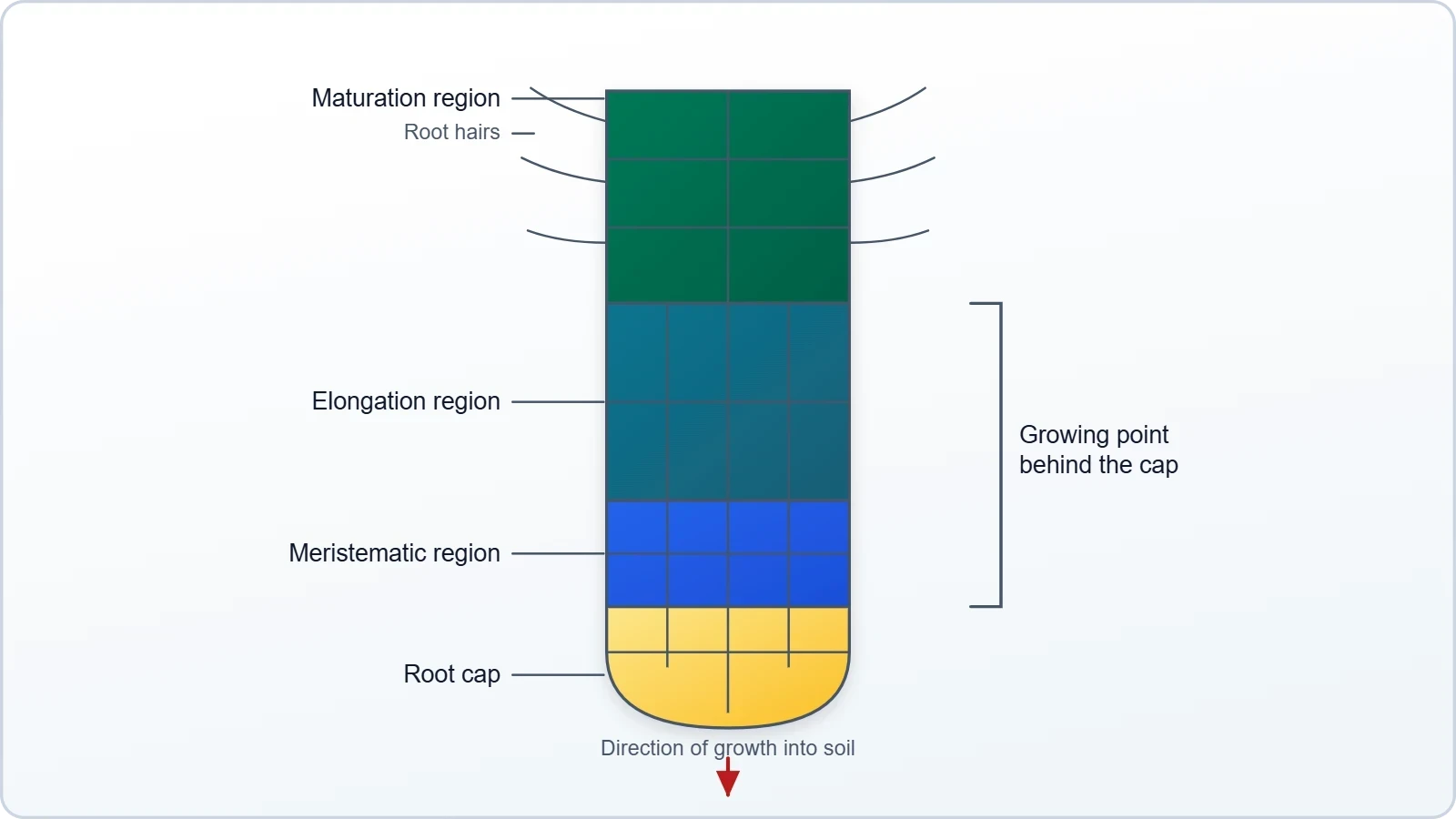
The root is covered at the apex by a thimble-like structure called the root cap. The comparison to a thimble is not decorative; it captures both the shape and the function of the structure, which sits like a protective sheath over the tender growing point. As the root makes its way through the soil, the apex would otherwise be abraded by grit particles and damaged by the mechanical resistance of the substrate. The root cap absorbs that wear. It is the first structure a soil particle meets and the last structure to be left behind as the root extends forward, and its presence explains why a growing root can move through abrasive material without losing its capacity to divide.
Position and Appearance
The root cap lies at the very tip of the root, distal to every other region, and it is therefore the structure that defines the anatomical apex of the organ. In the standard diagram of the root tip, it appears as a cap-shaped mass of cells overlying the meristematic zone, and its boundary with the meristem beneath is usually clearly visible. Because it is at the extreme tip, the root cap is also the region most exposed to the soil environment, and its cells are correspondingly specialised for protection rather than for absorption or elongation. The thimble image in the unit is a useful anchor: a thimble covers the fingertip without being part of the finger, and the root cap covers the apex without contributing directly to the lengthening of the root.
Protective Function
The stated function of the root cap is to protect the tender apex of the root as it makes its way through the soil. This is a mechanical role, and it is worth appreciating how specific it is. The cells of the meristematic region immediately behind the cap are thin-walled and rich in protoplasm, which makes them metabolically active but mechanically fragile. Without a covering, those cells would be crushed or scraped away within a short distance of growth. The root cap therefore creates a buffer zone in which the cost of soil contact is paid by expendable cells rather than by the dividing cells that generate the entire root body. Protection, in this context, is not a vague virtue but a precise precondition for continued growth.
Key points on the root cap
The essential facts are compact and worth stating plainly. The root cap is thimble-like, it covers the apex, and it protects the tender apex as the root moves through soil. It is positioned distal to the region of meristematic activity, and it is the structure that a soil particle encounters first. These points are the ones the unit emphasises, and they should be retained in exactly that form before any additional background is added.
The Region of Meristematic Activity
A few millimetres above the root cap lies the region of meristematic activity. The unit describes its cells with three precise attributes: they are very small, they are thin-walled, and they contain dense protoplasm. Each attribute follows from the cell's occupation. Small size means a large ratio of surface to volume and a nucleus that can exert control over the whole cell; thin walls mean that the cell can divide without the mechanical burden of heavy secondary thickening; dense protoplasm means abundant cytoplasm, organelles and genetic material ready for repeated cycles of division. These cells divide repeatedly, and that repeated division is the source of every cell that will later occupy the elongation and maturation zones.
Cellular Characteristics
The description of these cells is worth pausing over, because it is a model of economical botanical writing. Very small cells, thin walls and dense protoplasm together define a meristem in general, not only the root meristem. The same combination appears in the shoot apex and in the cambium, and recognising it allows a learner to identify meristematic tissue wherever it occurs. The absence of large vacuoles is implied by the density of the protoplasm: a cell that is dividing repeatedly cannot afford to devote most of its volume to a storage vacuole. The cells are, in effect, built for production rather than for storage, transport or support, and their anatomy reflects that single purpose.
Repeated Division and Cell Supply
Because the cells of this region divide repeatedly, the region functions as a cell factory. Divisions at the apex supply new cells to the root cap in front and to the elongation zone behind, and the balance between these two outputs determines whether the root lengthens, thickens its cap or pauses. The unit does not elaborate on the arithmetic of division, but the principle is straightforward: if a population of cells doubles at regular intervals, the number of cells produced grows geometrically, and the root can extend at a steady rate even though individual cells are tiny. The meristematic region is therefore the engine of root growth in length, and its position immediately behind the protective cap is no accident.
Why position matters
The meristem sits between the cap and the elongation zone, and that placement is functionally ideal. Cells produced on the apical side replace the cap; cells produced on the proximal side enter the elongation zone and are stretched. A meristem placed anywhere else would either be exposed to soil abrasion or would fail to supply the elongating region efficiently. The unit's phrase "a few millimetres above the root cap" is a useful spatial anchor, and it reminds the learner that these regions are measured in millimetres, not centimetres.
The Region of Elongation
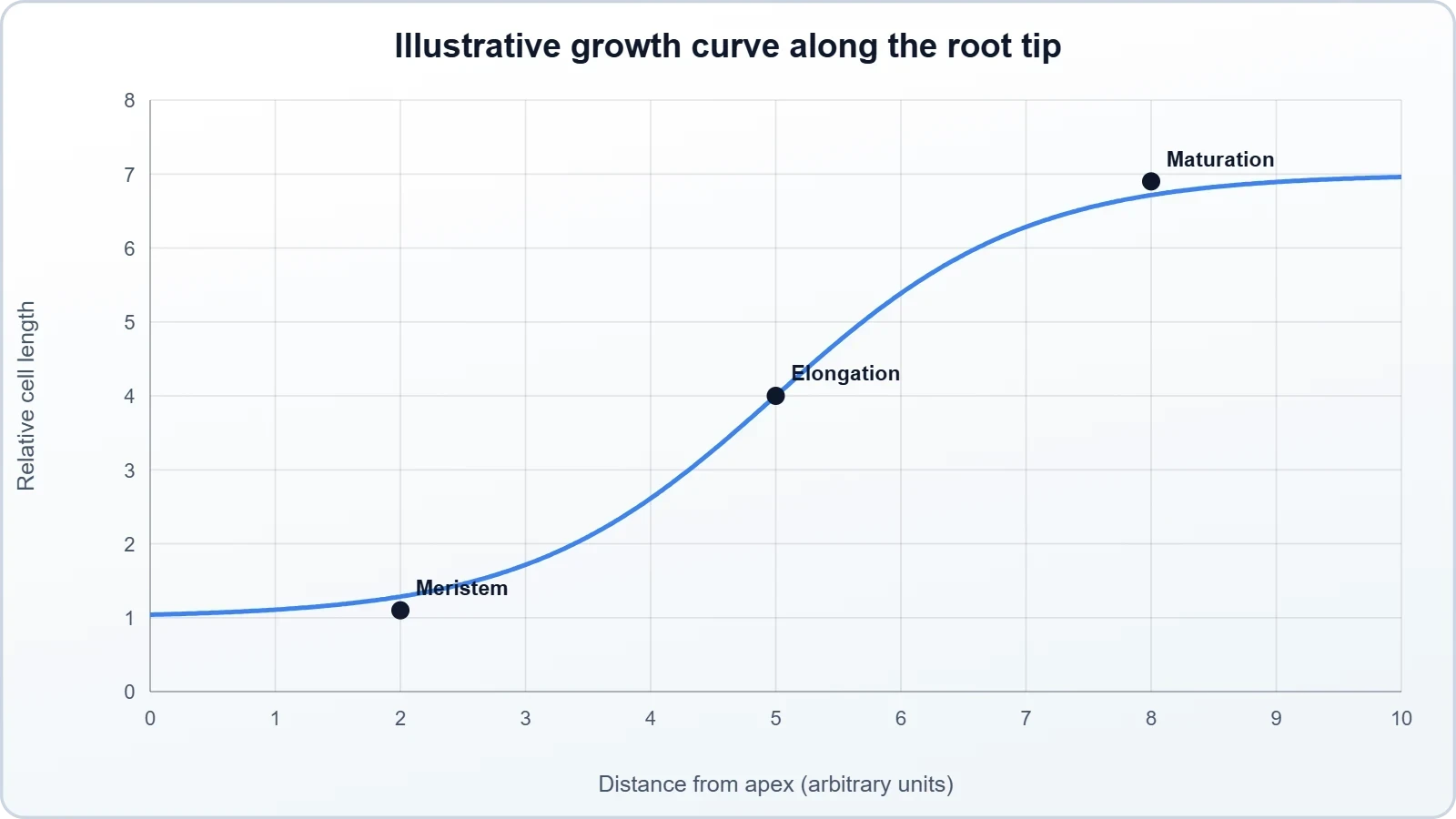
The cells proximal to the meristematic region undergo rapid elongation and enlargement, and they are responsible for the growth of the root in length. This region is called the region of elongation. The wording of the unit is deliberate: elongation and enlargement are named together because the cells both stretch along the root axis and increase in girth, and it is this combined expansion that pushes the tip forward through the soil. Division alone adds cells but does not move the tip; expansion is what converts a supply of small cells into actual forward movement. The elongation zone is therefore the region where the root's forward progress is physically generated.
Rapid Elongation and Enlargement
The phrase "rapid elongation and enlargement" captures a process that is dramatic at the cellular scale. A cell that leaves the meristem may expand many times over in length within a short period, largely through the uptake of water into a central vacuole and the controlled loosening of its wall. The result is a cylinder of stretched cells behind the tip, and the cumulative effect of thousands of such cells is the visible extension of the root. Because the cells are expanding rather than dividing, the elongation zone is where the root's growth in length is actually achieved, and the unit assigns responsibility for that growth to this region explicitly.
Growth in Length
Growth in length is the headline function of the elongation region, and it has a direct consequence for the root as a whole. A root that cannot elongate cannot explore new soil, cannot reach deeper water and cannot anchor the plant more securely. The elongation zone is thus the point at which the cellular machinery of the meristem is converted into the ecological functions described in the previous lesson: absorption, anchorage and storage all depend on the root first reaching the soil that supplies them. The unit's order of ideas, from cap to meristem to elongation to maturation, mirrors this causal chain, and it is worth preserving that order when revising.
We Also Published
The Region of Maturation and the Root Hairs
The cells of the elongation zone gradually differentiate and mature, and the zone proximal to the region of elongation is therefore called the region of maturation. This is the region in which cells acquire their mature identities: some become epidermal cells, some become cortical cells, some become vascular elements, and the tissue pattern of the root is established. The unit emphasises that differentiation is gradual, which is an important qualification. There is no sharp line at which a cell stops elongating and starts maturing; instead, cells progressively acquire mature features as they are displaced further from the tip. The maturation region is thus the zone of identity, where the root's cells become the tissues that the previous lesson described.
Differentiation and Maturation
Differentiation in this region is the process by which cells with a common origin acquire distinct structures and functions. The unit does not catalogue every tissue type here, and neither should this lesson, because the focus is on the external morphology of the root tip rather than on internal anatomy. What matters is the principle: the maturation region is where the products of division and expansion become the specialised cells of the root. Because the region lies proximal to the elongation zone, it is also the part of the root tip that is oldest in cellular terms, and its position explains why mature tissues are found further back from the apex rather than at the very tip.
Root Hairs as Epidermal Extensions
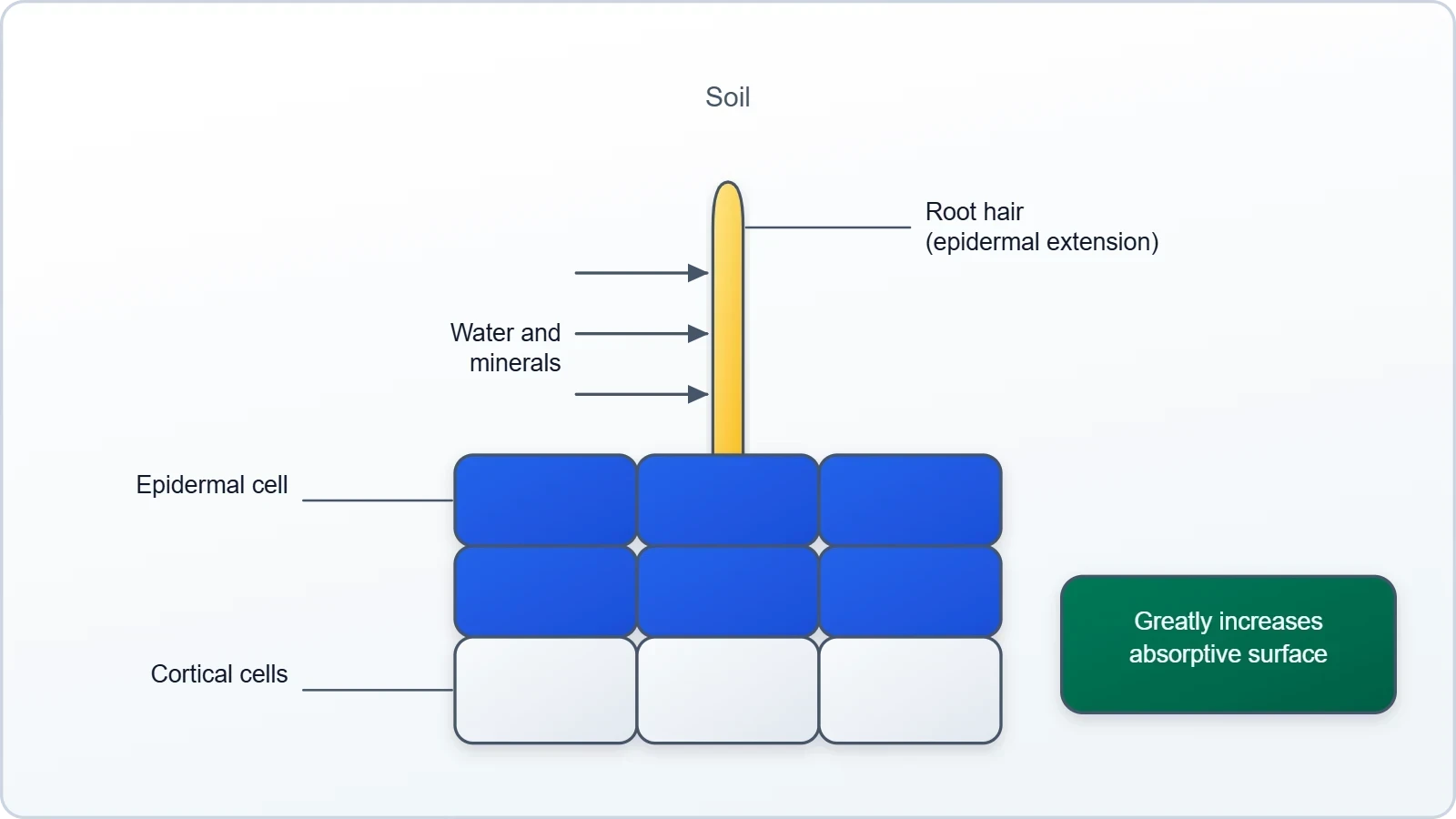
From this region some of the epidermal cells form very fine and delicate, thread-like structures called root hairs. The unit's description is precise: root hairs are formed from epidermal cells, they are fine and delicate, and they are thread-like. Their function is equally precise: they absorb water and minerals from the soil. Root hairs are therefore the structures that connect the morphology of the root tip to the physiological functions introduced in the previous lesson. Without them, the absorptive surface of the root would be limited to the epidermis itself; with them, the surface available for uptake is multiplied enormously within a narrow band of the root.
Structure and function of root hairs
Root hairs are fine, delicate and thread-like, and they arise from epidermal cells in the maturation region. Their function is the absorption of water and minerals from the soil. These three facts, structure, origin and function, are the ones the unit supplies, and they are sufficient to explain why the maturation region is the absorptive zone of the root tip. The delicacy of the hairs is consistent with their role: a thin, thread-like extension offers a large surface with minimal investment of material, which is exactly what an absorptive structure requires.
Reading the Root Tip as a Sequence
The four regions are best understood not as separate structures but as a single sequence experienced by every cell. A cell is produced in the meristematic region, displaced proximally, stretched in the elongation region, and matured in the maturation region, while the root cap is continually left behind at the apex. The unit's order of presentation, cap, meristem, elongation, maturation, follows the direction of displacement, and that order is the most efficient way to remember the anatomy. Once the sequence is secure, the functions attach naturally to their regions: protection at the cap, division at the meristem, lengthening at the elongation zone, and absorption at the maturation zone.
From Division to Absorption
The transition from division to absorption is the central narrative of the root tip. Division supplies cells; elongation converts the supply into forward movement; maturation converts the moving column into an absorptive surface. Each stage depends on the one before it, and a failure at any stage propagates along the sequence. If division slows, elongation has fewer cells to stretch; if elongation is impeded, maturation delivers fewer root hairs to the soil. The unit does not state these dependencies explicitly, but they follow directly from the order of the regions and from the functions assigned to each, and they make the sequence a coherent system rather than a list.
Common Misreadings to Avoid
Several misreadings are common and worth correcting early. The root cap is not the growing point; it protects the growing point, which lies behind it in the meristematic region. The elongation region is not where cells divide; it is where they expand. The maturation region is not a single sharp boundary but a zone of gradual differentiation. Root hairs are not separate organs but extensions of epidermal cells. Keeping these distinctions clear prevents the most frequent errors in examination answers, and it keeps the terminology of the unit intact.
Going Further
The material above is the backbone of the lesson, and it stands on its own. The following observations are well-established background that helps connect the unit's description to the living plant, and they are kept separate so that the core content remains clearly distinguished from supplementary context. None of them contradicts the unit; they simply extend it. Read them as a short appendix rather than as part of the required terminology, and return to the four regions and their functions as the primary content to be retained.
Wear and Replacement at the Cap
The root cap is continually worn away as the root pushes through soil and is replaced by new cells from the meristem. This is a useful extension of the unit's protective description: the cap is not a permanent shield but a renewable one, and its cells are sacrificed and replaced continuously. The arrangement explains why the meristem can remain protected even as the root advances through abrasive material, and it reinforces the functional link between the cap and the meristematic region that lies immediately behind it.
The Short Life of Root Hairs
Root hairs are extensions of epidermal cells and are short-lived. This background point clarifies why root hairs are confined to the maturation region: they are produced there, function there, and are lost as the root continues to grow and the older parts of the root mature further. The observation also explains why the absorptive surface of a root is concentrated in a narrow band near the tip rather than distributed along the entire length of the organ, and it complements the unit's statement that root hairs absorb water and minerals from the soil.
Preparing for the Stem
The next lesson turns to the stem, the ascending part of the axis bearing branches, leaves, flowers and fruits, which develops from the plumule of the embryo of a germinating seed. The stem bears nodes, where leaves are born, and internodes, the portions between two nodes, and it bears buds that may be terminal or axillary. The contrast with the root is instructive: the root tip is organised into a linear sequence of regions behind a protective cap, whereas the stem is organised around repeating units of node and internode. Carrying the vocabulary of regions and zones forward will make that contrast easier to state precisely.
What to Carry Forward
Three habits of thought from this lesson transfer directly. First, describe position before function: say where a region lies relative to the apex, then say what it does. Second, distinguish division from expansion from differentiation, because the same three processes organise the shoot apex. Third, treat protective structures as functional rather than incidental, since the stem too has protective and meristematic tissues that repay the same kind of attention. With these habits in place, the stem lesson becomes an application of familiar logic rather than a fresh start.
Revision Checklist
Before moving on, confirm that you can state the following without notes: the root cap is thimble-like and protects the tender apex; the meristematic region lies a few millimetres above the cap and its cells are very small, thin-walled and dense in protoplasm, dividing repeatedly; the elongation region is responsible for growth in length through rapid elongation and enlargement; the maturation region is where cells gradually differentiate and mature; and root hairs are fine, delicate, thread-like structures formed from some epidermal cells in the maturation region, absorbing water and minerals from the soil. If each statement comes easily, the lesson has done its work.
From our network :
- EV 2.0: The Solid-State Battery Breakthrough and Global Factory ExpansionDiscover the impact of the Solid-State Battery Breakthrough on the EV market. Learn about CATL and BYD stock growth, global factory expansion in Europe, and the future of EV 2.0 technology.
- Trump Political Strategy How Geopolitical Stunts Serve As Media Diversions
- AI-Powered 'Precision Diagnostic' Replaces Standard GRE Score ReportsDiscover the new GRE Precision Diagnostic. Learn how AI-powered behavioral analytics and time-to-solve tracking are replacing standard GRE score reports to empower students.
- 98% of Global MBA Programs Now Prefer GRE Over GMAT Focus EditionExplore why 98% of global MBA programs now prefer the GRE over GMAT Focus. Learn about the shorter GRE format, verbal logic importance, and strategic versatility for students.
- 10 Physics Numerical Problems with Solutions for IIT JEEPrepare for IIT JEE with 10 physics numerical problems, complete with detailed solutions and conceptual explanations. Ideal for mastering kinematics, thermodynamics, electromagnetism, and optics.
- How to Print Cheaply: Cutting the Cost per PageA practical, measured guide to lowering what each printed page costs — duplex and draft modes, third-party ink, yield mathematics, and knowing when a new printer beats refills.
- Do You Need a New Router or Is Your Internet Plan the Problem?A practical comparison of the signs that point to router limits versus signs your broadband speed or provider is the bottleneck, so you can decide what to replace before spending money.
- Where to Put Your Wireless Router for Better CoverageA practical, physics-grounded guide to router placement: why the centre of the home beats the corner, how walls and metal sap signal, and how to run a simple survey that proves the improvement.
- Analyzing Trump Deportation Numbers Insights Into The 2026 Immigration Crackdown