Every flowering plant you have ever pulled from the soil, however humble or however ornamental, is organised around a single quiet division of labour: an underground root system and an above-ground shoot system. This first lesson of the course on the morphology of flowering plants begins precisely there, with the root. Before flowers, fruits and seeds can be described with any confidence, the learner must be able to recognise the anchoring, absorbing half of the plant body and to name its principal forms using the standard technical vocabulary that botanists share.
The lesson works from the general to the particular. It first establishes the two-system architecture of a flowering plant, then distinguishes the tap root system of most dicotyledonous plants from the fibrous root system of monocotyledonous plants, and finally introduces adventitious roots, which arise from parts of the plant other than the radicle. Alongside these three categories, the lesson sets out the main functions of the root system as the source material defines them: absorption of water and minerals, anchorage, storage of reserve food, and synthesis of plant growth regulators.
Because this is the opening lesson of twelve, it deliberately stops short of the internal geography of the root tip. The regions of the root — root cap, meristematic region, elongation and maturation — belong to the lesson that follows, and the treatment here is kept to external form and function. What matters at this stage is that the learner can look at a mustard plant, a wheat plant and a banyan tree and explain, in correct terms, why their root systems differ.
On This Page
- The Two Systems of a Flowering Plant
- Tap Root System: The Dicotyledonous Pattern
- Fibrous Root System: The Monocotyledonous Pattern
- Adventitious Roots and the Functions of the Root System
- Reading a Root System: A Practical Identification Method
- Going Further: Background That Supports the Lesson
- Preparing for the Regions of the Root
The Two Systems of a Flowering Plant
Angiosperms display an extraordinary range of external form, yet the source material is emphatic that they are all characterised by the presence of roots, stems, leaves, flowers and fruits. Morphology, the study of this external structure, is therefore the natural entry point into plant biology. Any successful attempt at classification, and any serious attempt to understand a higher plant, depends on knowing the standard technical terms and standard definitions that describe these parts, together with the variations that appear as adaptations to habitat, protection, climbing and storage.
The simplest and most useful of these organising ideas is the division of the plant body into two systems. The underground portion of the flowering plant is the root system; the portion above the ground forms the shoot system. Pull out any weed and the arrangement is immediately visible: roots below, and stems, leaves, buds, flowers and fruits above. This single distinction frames everything that follows, not only in this lesson but across the whole course, because each system has its own architecture, its own vocabulary and its own set of functions.
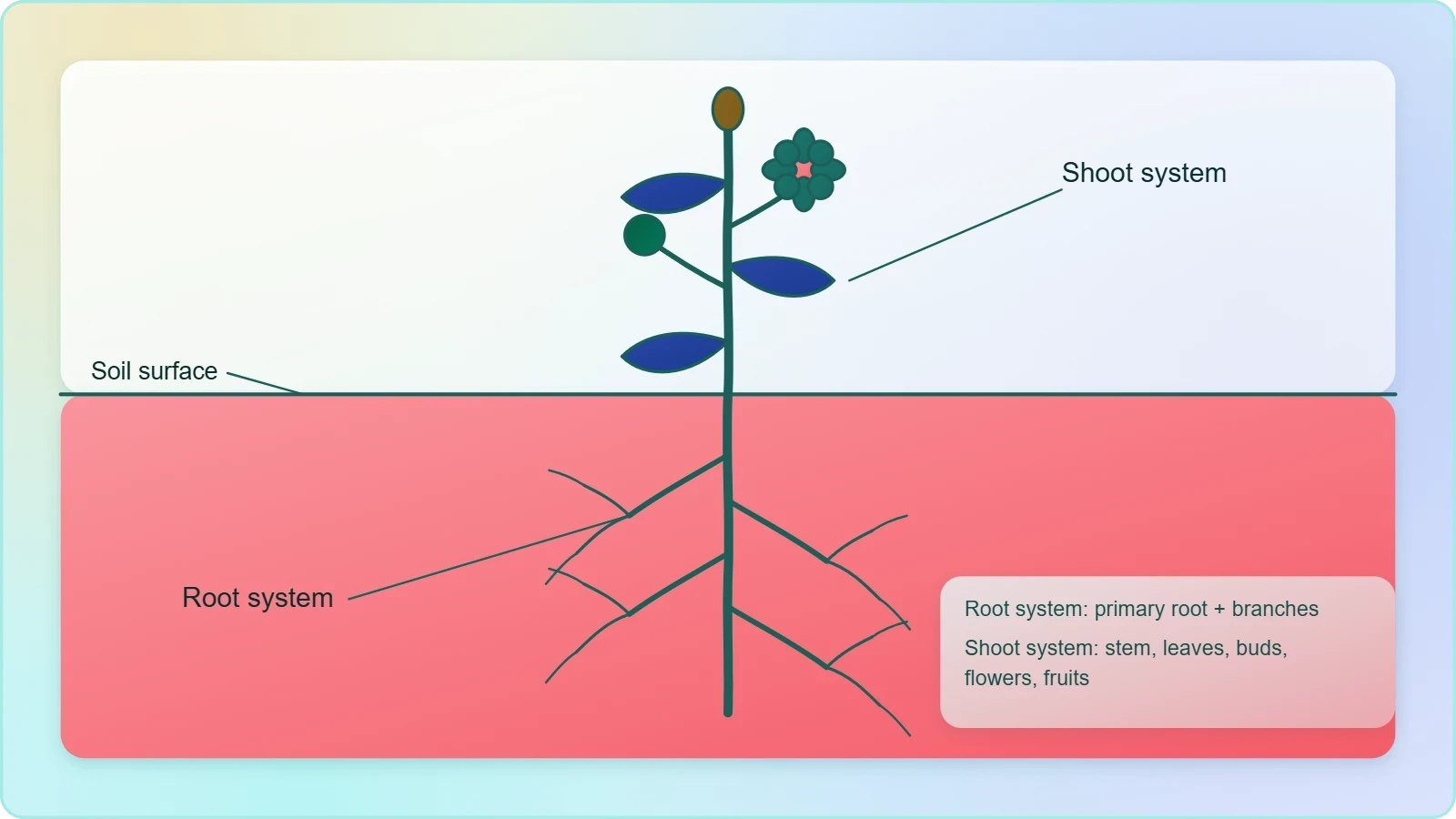
What the Root System and Shoot System Each Contain
The root system comprises the primary root and its branches, and in many plants it is the sole organ of absorption and anchorage. The shoot system, by contrast, is the ascending axis and carries the stem, the leaves borne at nodes, the buds that may be terminal or axillary, and the reproductive structures — flowers and, later, fruits. Recognising which organs belong to which system prevents a great deal of confusion later, particularly when storage roots are mistaken for tubers or when adventitious roots emerging from a stem are misread as branches.
It is worth noting that the two systems are not merely spatially separated but functionally complementary. The root system draws water and dissolved minerals from the soil, while the shoot system intercepts light and conducts the products of photosynthesis downward. The source material describes the stem as conducting water, minerals and photosynthates, which makes the stem the bridge between the two systems. A learner who holds this picture in mind will find the detailed treatment of stems and leaves in later lessons far easier to absorb.
Why Standard Terms and Definitions Matter
Classification of plants rests on morphological and other characteristics, and classification in turn rests on a shared vocabulary. The source material makes this point directly: for any successful attempt at classification, and for understanding any higher plant, we need standard technical terms and standard definitions. A root is not simply "the part underground"; it is a defined organ with defined origins, and the three root systems are distinguished by how they arise, not merely by how they look.
This is why the lesson insists on precise labels. Tap root, fibrous root and adventitious root are not interchangeable descriptions of appearance; each names a distinct developmental origin. The same discipline applies to the variations found across plants, which the source material frames as adaptations to various habitats, for protection, for climbing and for storage. Learning the terms now means that later lessons on stems, leaves and flowers can proceed without re-defining the basics at every step.
We Also Published
Tap Root System: The Dicotyledonous Pattern
In the majority of dicotyledonous plants, the root system begins with a single event: the direct elongation of the radicle, the embryonic root, leads to the formation of the primary root, which grows down into the soil. This primary root is the dominant axis of the system, and it bears lateral roots of several orders, referred to as secondary roots, tertiary roots and so on. The primary root together with all its branches constitutes what the source material calls the tap root system, as seen in the mustard plant.
The defining feature of the tap root system is therefore its descent from one principal root. Because the primary root persists and continues to enlarge, the system typically shows a clear hierarchy, with a stout main axis and progressively finer laterals. This is the pattern most learners will encounter first, since it is characteristic of the majority of dicotyledonous plants, and it provides the clearest illustration of the relationship between the radicle and the mature root system of the plant.
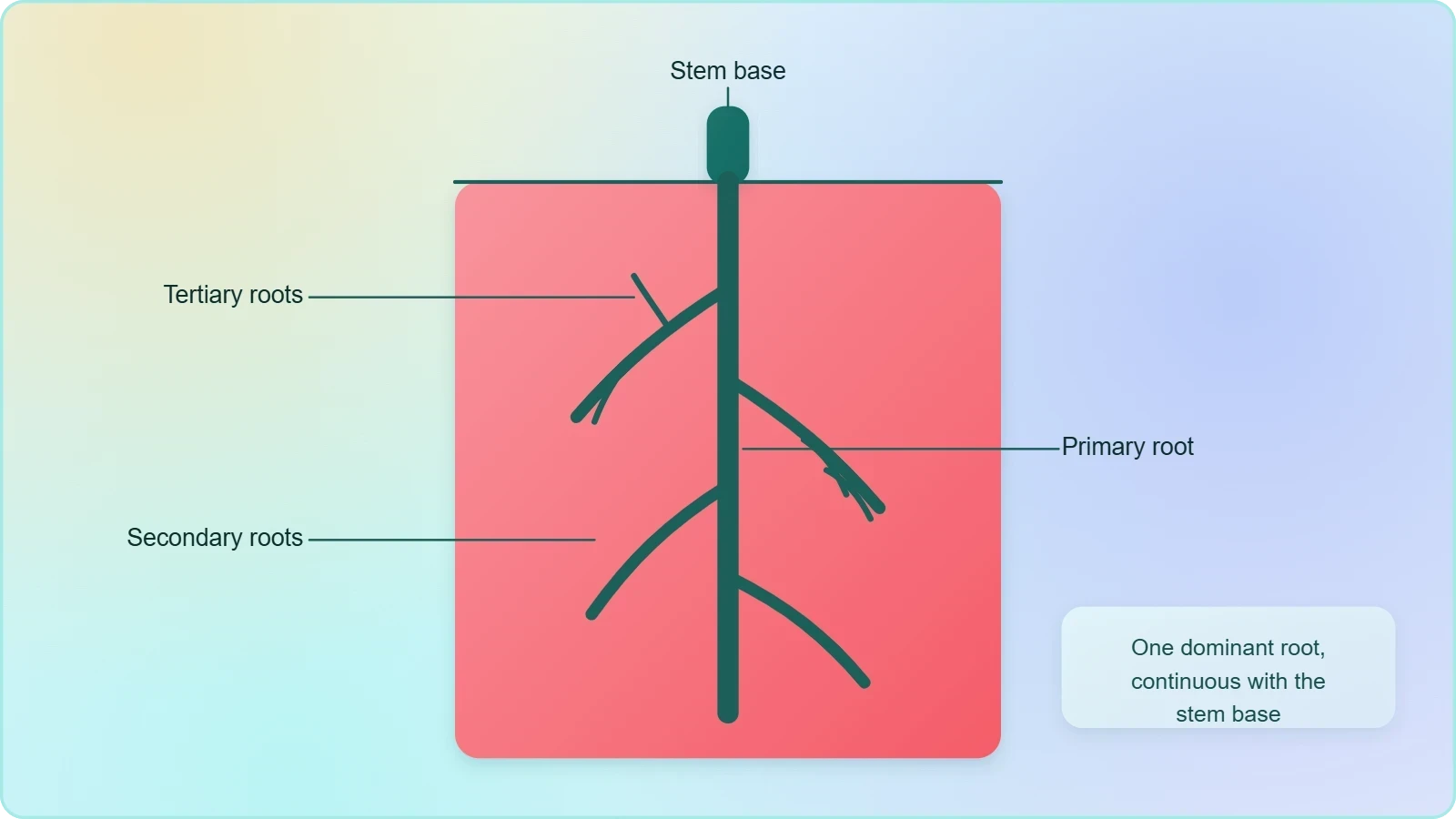
The Radicle, the Primary Root and Lateral Orders
The chain of derivation is short and worth committing to memory. The radicle gives rise to the primary root; the primary root gives rise to secondary roots; secondary roots give rise to tertiary roots, and the series continues. Each order is named for its position in this branching sequence rather than for its size, although in practice the orders do tend to become finer with distance from the main axis. The mustard plant, cited in the source material, shows the arrangement plainly.
This ordered branching is what allows a tap root system to explore a large volume of soil while retaining a strong central anchor. The primary root grows inside the soil and thickens as the plant develops, while the laterals spread outward and downward from it. When you examine a seedling of a dicotyledonous plant, the single root emerging from the germinating seed is the primary root, and every branch you later find on it belongs to one of the lateral orders described above.
Recognising a Tap Root System in the Field
Field recognition is straightforward once the criterion is clear. Lift a mustard seedling carefully and a single main root will be visible, with smaller roots attached along its length. The main root is continuous with the base of the stem, and the laterals arise from it rather than from the stem itself. This continuity distinguishes the tap root system from the fibrous and adventitious patterns, where the roots that dominate the system arise elsewhere.
Practical observation also reveals why the distinction matters beyond the classroom. A tap root system anchors the plant by means of one deep, strong axis, which is one reason such plants can be difficult to transplant without damage. The source material lists proper anchorage among the main functions of the root system, and the tap root pattern is the clearest single illustration of that function in action, combining a deep hold on the soil with an extensive network of absorbing laterals.
Fibrous Root System: The Monocotyledonous Pattern
In monocotyledonous plants the story begins differently. The primary root is short lived and is replaced by a large number of roots, and these replacement roots originate from the base of the stem. Together they constitute the fibrous root system, as seen in the wheat plant. The essential contrast with the tap root system is therefore one of persistence and origin: the radicle-derived primary root does not endure, and the roots that take over arise from the stem base rather than from a continuing main axis.
The visual consequence is a dense, bushy cluster of roots of broadly similar thickness, rather than a single dominant root with subordinate laterals. Because no one root outranks the others, the fibrous system spreads widely and holds the upper soil in a fine mesh. This is the pattern familiar from grasses and cereals, and it explains much about how such plants secure themselves and gather water in the shallow layers of the soil where most of their roots are concentrated.
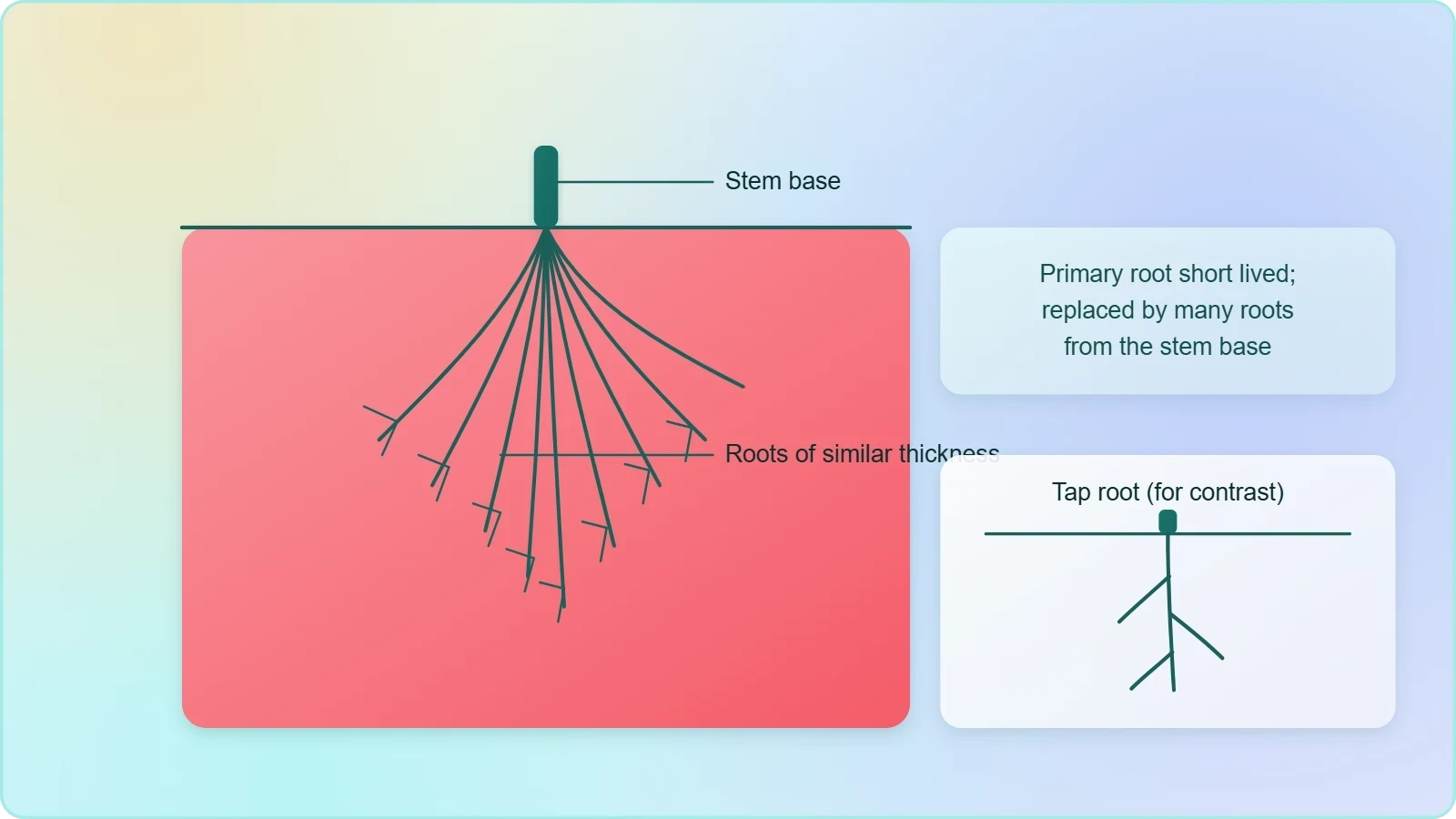
Why the Primary Root Is Short Lived
The source material states the point plainly: in monocotyledonous plants the primary root is short lived and is replaced by a large number of roots. The replacement is not a repair but a developmental programme. The young seedling briefly possesses a radicle-derived root, and then the base of the stem produces the numerous roots that will serve the plant for the rest of its life. The primary root's early decline is thus a normal feature of the pattern, not a failure.
Understanding this prevents a common misreading. A learner who assumes every plant retains its primary root will look at a wheat seedling and expect a tap root that simply is not there. The correct expectation is a transient primary root followed by a dense cluster arising from the stem base. Once that expectation is in place, the fibrous system becomes as easy to identify as the tap root system, and the two can be told apart at a glance.
Wheat as the Standard Example
Wheat is the example the source material gives, and it repays close attention. The roots of a wheat plant form a tuft of many similar strands emerging together from the base of the stem, with no single root claiming dominance. This tuft is the fibrous root system in its clearest form. Grasses generally share the pattern, which is one reason grass swards bind soil so effectively and recover so readily after grazing or mowing.
For the learner, wheat also serves as a reminder that root systems are diagnostic aids in classification. A plant with a fibrous system points toward the monocotyledonous group, just as a plant with a persistent tap root points toward the dicotyledonous group. The source material presents these as the two principal patterns of the majority of plants, and the examples of mustard and wheat anchor each pattern in a familiar species that can be examined directly.
Adventitious Roots and the Functions of the Root System
Beyond the two principal patterns lies a third category defined entirely by origin. In some plants, such as grass, Monstera and the banyan tree, roots arise from parts of the plant other than the radicle, and these are called adventitious roots. The term does not describe a shape or a position in the soil but a departure from the usual source: any root that does not trace its beginning to the radicle is adventitious, whether it emerges from a stem, a leaf or another root.
This category matters because it shows that the root system of a plant is not fixed at germination. New roots can be initiated from the shoot, and in the banyan tree they descend from branches to become pillar-like supports. The source material lists grass, Monstera and the banyan tree together, and the grouping is instructive: three quite different habits, united by the single criterion that their roots arise from parts of the plant other than the radicle.
Adventitious Roots in Grass, Monstera and the Banyan Tree
Grass illustrates the adventitious habit at its most modest, producing roots from the base of the stem that supplement or replace the short-lived primary root. Monstera, a climbing plant, produces adventitious roots that assist it in clinging and in drawing moisture. The banyan tree carries the habit to its most conspicuous expression, sending roots down from its branches so that they reach the ground and thicken into supporting columns, giving the tree its characteristic spreading, many-trunked appearance.
These three examples together demonstrate the adaptive range that the source material attributes to plant structure. Roots may serve anchorage, absorption, climbing or support depending on where they arise and how they develop. The learner should resist the temptation to treat adventitious roots as an anomaly; they are a normal and widespread feature of flowering plants, and recognising them requires only that one ask where a given root began rather than what it looks like.
The Four Main Functions of the Root System
The source material sets out the main functions of the root system in a compact list, and each item deserves separate attention. The first is absorption of water and minerals from the soil, the function most readily associated with roots. The second is providing a proper anchorage to the plant parts, holding the shoot upright against wind and the pull of its own weight. The third is storage of reserve food material, and the fourth is synthesis of plant growth regulators, a function easily overlooked because it is invisible.
These four functions are not ranked, and different root systems express them to different degrees. A tap root system excels at deep anchorage; a fibrous system excels at binding soil and absorbing from shallow layers; storage roots, which are modified roots, specialise in reserve food. The synthesis of plant growth regulators reminds the learner that the root is a living, chemically active organ and not merely a passive sponge, a point that becomes important when physiology is studied later.
Reading a Root System: A Practical Identification Method
Identification becomes reliable when it follows a fixed sequence of questions rather than a general impression. The first question is whether a single dominant root persists, continuous with the base of the stem; if it does, the system is a tap root system. The second is whether the primary root is short lived and replaced by many roots arising from the base of the stem; if so, the system is fibrous. The third is whether the roots in question arise from parts of the plant other than the radicle; if they do, they are adventitious, whatever else is true of the plant.
This sequence works because each question tests origin, which is the criterion the source material uses. Appearance alone can mislead: a cluster of fine roots might belong to a fibrous system or might be adventitious roots from a stem. Asking where the roots began resolves the ambiguity. The method also scales upward, since the same discipline of asking about origin rather than appearance underlies the classification of plants more generally.
Distinguishing the Systems Without a Microscope
No magnification is required for this lesson. The distinctions rest on gross structural features visible to the naked eye, which is precisely the tradition of observation the source material describes. Lift a plant, wash the soil from its roots, and lay the system out. A tap root system shows a main axis with laterals; a fibrous system shows a tuft of similar strands; adventitious roots show themselves by emerging from a stem or branch rather than from a continuing root axis.
Sketching the system as you observe it is a useful discipline. Label the primary root, the secondary roots and any higher orders, and note where each root attaches. For a fibrous system, note that the roots converge at the base of the stem. For adventitious roots, mark the point of origin on the stem or branch. These simple annotations convert a casual glance into a morphological record and prepare the learner for the semi-technical descriptions that close the course.
Common Misreadings and How to Avoid Them
The most frequent misreading is to call every cluster of fine roots fibrous. Fibrous refers specifically to the monocotyledonous pattern in which the short-lived primary root is replaced by roots from the base of the stem. A dicotyledonous plant may also produce many fine laterals, but as long as the primary root persists, the system remains a tap root system. The label follows the origin and persistence of the primary root, not the fineness of the roots.
A second misreading is to treat adventitious roots as abnormal. The source material lists grass, Monstera and the banyan tree as ordinary examples, and the category is defined simply by origin from parts other than the radicle. A third is to confuse the root system with the shoot system when storage organs are involved. Keeping the two-system division firmly in mind, and asking always where a structure arises, prevents all three errors.
Going Further: Background That Supports the Lesson
The material in this lesson is self-contained, but two pieces of well-established background help the learner see why the definitions take the form they do. Neither contradicts the source material; both simply add context that a beginner may find useful. They are offered separately so that the core lesson remains exactly as the unit presents it, and so that the learner can tell the difference between the required content and the supporting explanation.
The first concerns the radicle, the first root that emerges from a germinating seed and the starting point of the tap root system. The second concerns the root hairs, the fine thread-like structures formed from some epidermal cells in the region of maturation, which greatly increase the surface area through which water and minerals are absorbed. Both ideas connect this lesson to the one that follows, on the regions of the root, without trespassing on its territory.
The Radicle as the Starting Point
When a seed germinates, the first structure to emerge is the radicle, and it is from this embryonic root that the primary root of a dicotyledonous plant develops by direct elongation. This is why the tap root system is described as radicle-derived: the entire hierarchy of primary, secondary and tertiary roots traces back to that single emergence. The fibrous system, by contrast, is defined by the early loss of that radicle-derived root and its replacement from the stem base.
Holding the radicle in mind makes the three categories easier to remember. Tap root systems are those in which the radicle's product persists and dominates. Fibrous systems are those in which it does not. Adventitious roots are those that bypass the radicle altogether. The whole classification, in other words, can be reconstructed from a single question about what happened to the radicle after germination, which is a compact and durable way to retain the lesson.
Root Hairs and the Absorbing Surface
Absorption of water and minerals is the first function the source material lists, and the root hairs are the structures chiefly responsible for it. Formed from some of the epidermal cells in the region of maturation, they are very fine and delicate, thread-like in form, and they vastly increase the surface area available for uptake. A root system without root hairs would present far less contact with the soil water film, and absorption would be correspondingly reduced.
This is why the external form of the root matters functionally and not only descriptively. A fibrous root system, with its dense mesh of fine roots, presents an enormous absorbing surface in the upper soil, while a tap root system reaches deeper with a more concentrated axis. The lesson's emphasis on gross structure thus connects directly to the plant's ability to obtain water and minerals, and it sets up the next lesson, in which the regions of the root tip are examined in detail.
Preparing for the Regions of the Root
This lesson has dealt with the root system as a whole: its place in the plant body, its three principal forms and its four main functions. The next lesson moves inward and downward, to the root tip itself, where the root cap, the region of meristematic activity, the region of elongation and the region of maturation are found. Nothing in this lesson needs to be unlearned to make that move; the external categories simply acquire an internal geography.
The connection is direct. The root hairs that absorb water and minerals are formed in the region of maturation, so the absorbing function described here has a precise location that the next lesson will identify. The elongation of the root in length, which allows a tap root to grow deep into the soil, occurs in the region of elongation. The learner who arrives at the next lesson already knowing what the root system does will find it far easier to understand how the root tip is built to do it.
What the Next Lesson Will Cover
The next lesson, Regions of the Root, examines the root tip from apex to maturation. It describes the thimble-like root cap that protects the tender apex as the root makes its way through the soil, the region of meristematic activity a few millimetres above it where small, thin-walled cells with dense protoplasm divide repeatedly, the region of elongation where cells enlarge and lengthen, and the region of maturation where cells differentiate and root hairs form. Each region will be treated in the order in which it occurs along the root.
That lesson builds directly on the present one. The functions of absorption, anchorage and growth in length, introduced here as properties of the root system as a whole, will there be traced to the specific tissues and zones that perform them. The learner is therefore advised to secure the vocabulary of this lesson firmly — root system, shoot system, primary root, tap root system, fibrous root system, adventitious roots — before proceeding, since the next lesson assumes all of them.
Consolidating the Lesson
A short consolidation exercise will fix the material. First, state the difference between the root system and the shoot system in one sentence each. Second, name the three root systems and give the example associated with each: mustard for the tap root system, wheat for the fibrous root system, and grass, Monstera and the banyan tree for adventitious roots. Third, list the four main functions of the root system without consulting the text. Fourth, explain why the fibrous root system is characteristic of monocotyledonous plants.
Finally, and most importantly, examine a real plant. Pull a weed, wash its roots and identify what you see using the checklist given earlier in this lesson. Ask where each root began, and let the answer, rather than the appearance, decide the label. This habit of observation, which the source material identifies as the original method of describing the diverse forms of life, is the foundation on which the rest of this course on the morphology of flowering plants is built.
From our network :
- 10 Physics Numerical Problems with Solutions for IIT JEEPrepare for IIT JEE with 10 physics numerical problems, complete with detailed solutions and conceptual explanations. Ideal for mastering kinematics, thermodynamics, electromagnetism, and optics.
- Where to Put Your Wireless Router for Better CoverageA practical, physics-grounded guide to router placement: why the centre of the home beats the corner, how walls and metal sap signal, and how to run a simple survey that proves the improvement.
- EV 2.0: The Solid-State Battery Breakthrough and Global Factory ExpansionDiscover the impact of the Solid-State Battery Breakthrough on the EV market. Learn about CATL and BYD stock growth, global factory expansion in Europe, and the future of EV 2.0 technology.
- How to Print Cheaply: Cutting the Cost per PageA practical, measured guide to lowering what each printed page costs — duplex and draft modes, third-party ink, yield mathematics, and knowing when a new printer beats refills.
- 98% of Global MBA Programs Now Prefer GRE Over GMAT Focus EditionExplore why 98% of global MBA programs now prefer the GRE over GMAT Focus. Learn about the shorter GRE format, verbal logic importance, and strategic versatility for students.
- AI-Powered 'Precision Diagnostic' Replaces Standard GRE Score ReportsDiscover the new GRE Precision Diagnostic. Learn how AI-powered behavioral analytics and time-to-solve tracking are replacing standard GRE score reports to empower students.
- Do You Need a New Router or Is Your Internet Plan the Problem?A practical comparison of the signs that point to router limits versus signs your broadband speed or provider is the bottleneck, so you can decide what to replace before spending money.
- Analyzing Trump Deportation Numbers Insights Into The 2026 Immigration Crackdown
- Trump Political Strategy How Geopolitical Stunts Serve As Media Diversions