Mitosis is often introduced as a mechanical sequence of chromosome movements, yet its biological purpose is far more consequential than the choreography of a single division. Every act of growth in a multicellular organism, every replacement of a worn epidermal cell, and every new leaf produced at the tip of a shoot depends on this equational division delivering two daughter cells that carry an identical genetic complement. Understanding why mitosis matters transforms it from a list of stages into a principle of biological continuity, one that connects the molecular fidelity of DNA replication to the visible architecture of tissues and organs.
This lesson examines the significance of mitosis through four connected themes: the production of diploid daughter cells with identical genetic complements, the growth of multicellular organisms, the restoration of the nucleo-cytoplasmic ratio, and the repair of tissues through constant cell replacement. It also considers the continuous growth of plants through meristematic tissues, the apical and lateral cambium, where mitotic divisions persist throughout the life of the plant. Each theme builds directly on the cytokinesis lesson that preceded it, where the physical separation of cytoplasm completed the division process.
Because mitosis is usually restricted to diploid cells, with notable exceptions in some lower plants and social insects where haploid cells also divide by mitosis, the lesson also clarifies the boundaries of equational division. The treatment stays faithful to the established terminology and order of ideas, while a short "Going further" block adds well-established background on meristematic activity and tissue maintenance. Learners preparing for the next lesson on meiosis will find here the conceptual baseline against which reduction division can be contrasted.
On This Page
- Mitosis as Equational Division: Identical Diploid Daughter Cells
- Growth of Multicellular Organisms Through Mitosis
- Restoring the Nucleo-Cytoplasmic Ratio
- Cell Repair and the Constant Replacement of Tissues
- Continuous Growth of Plants Through Meristematic Tissues
- Consolidating the Significance: From Cells to Organisms
Mitosis as Equational Division: Identical Diploid Daughter Cells
Mitosis is described as equational division because the chromosome number of the parent cell is conserved in each daughter cell. When a diploid cell enters M phase, its replicated chromosomes are distributed with such precision that the two resulting nuclei receive identical genetic complements. This fidelity is the foundation of every subsequent claim about growth and repair, since a daughter cell that differed genetically from its parent could not reliably perform the same functions within a tissue. The term equational therefore signals conservation rather than change.
The Diploid Scope and Its Exceptions
Mitosis is usually restricted to diploid cells only, which is the standard case across most multicellular organisms. However, in some lower plants and in some social insects, haploid cells also divide by mitosis, showing that the mechanism is not absolutely tied to ploidy level. These exceptions matter because they prevent an oversimplified rule from taking hold. The essential point is that mitosis preserves whatever chromosome number the dividing cell possesses, whether that number is diploid or, in these special cases, haploid.
Recognising this scope helps learners interpret the phrase "identical genetic complement" correctly. Identity here refers to the daughter cells matching the parent cell, not to a universal diploid outcome. In a haploid organism dividing mitotically, the daughters remain haploid and genetically identical to the parent. The equational logic is unchanged; only the starting ploidy differs. This distinction prepares the ground for meiosis, where the chromosome number is deliberately halved rather than conserved.
Genetic Fidelity and Its Consequences
The production of diploid daughter cells with identical genetic complement has direct consequences for tissue function. Because no genetic information is lost or reshuffled, the daughter cells can express the same proteins and perform the same roles as their parent. This is precisely what a growing tissue requires: new cells that fit seamlessly into existing structures. The fidelity of mitosis is thus not an abstract virtue but a practical requirement for coordinated multicellular life.
This fidelity also explains why mitosis cannot generate genetic variation on its own. Variation arises through recombination and the halving of chromosome number in meiosis, or through mutation. Mitosis, by contrast, is a conservative process. Its purpose is to multiply cells without altering their genetic identity, and this conservative character is what makes it suitable for growth, maintenance, and repair across the lifespan of an organism.
Growth of Multicellular Organisms Through Mitosis
The growth of multicellular organisms is due to mitosis, and this single sentence carries the weight of an entire developmental principle. From a fertilised egg to a mature adult, the increase in cell number that underlies growth is achieved by repeated mitotic divisions. Each division adds cells that are genetically identical to their predecessors, allowing tissues to expand while preserving their functional identity. Growth in this sense is quantitative, an accumulation of equivalent units rather than a transformation of cell type.
From Zygote to Mature Body
Development begins with a single cell and proceeds through successive rounds of mitosis, each doubling the cell population. Because the daughter cells retain the same genetic complement, the expanding embryo maintains coherence even as its size increases dramatically. The process is orderly, with divisions occurring in patterns that shape tissues and organs. Mitosis supplies the raw material of growth, while other processes determine how that material is arranged. The division itself remains conservative and equational throughout.
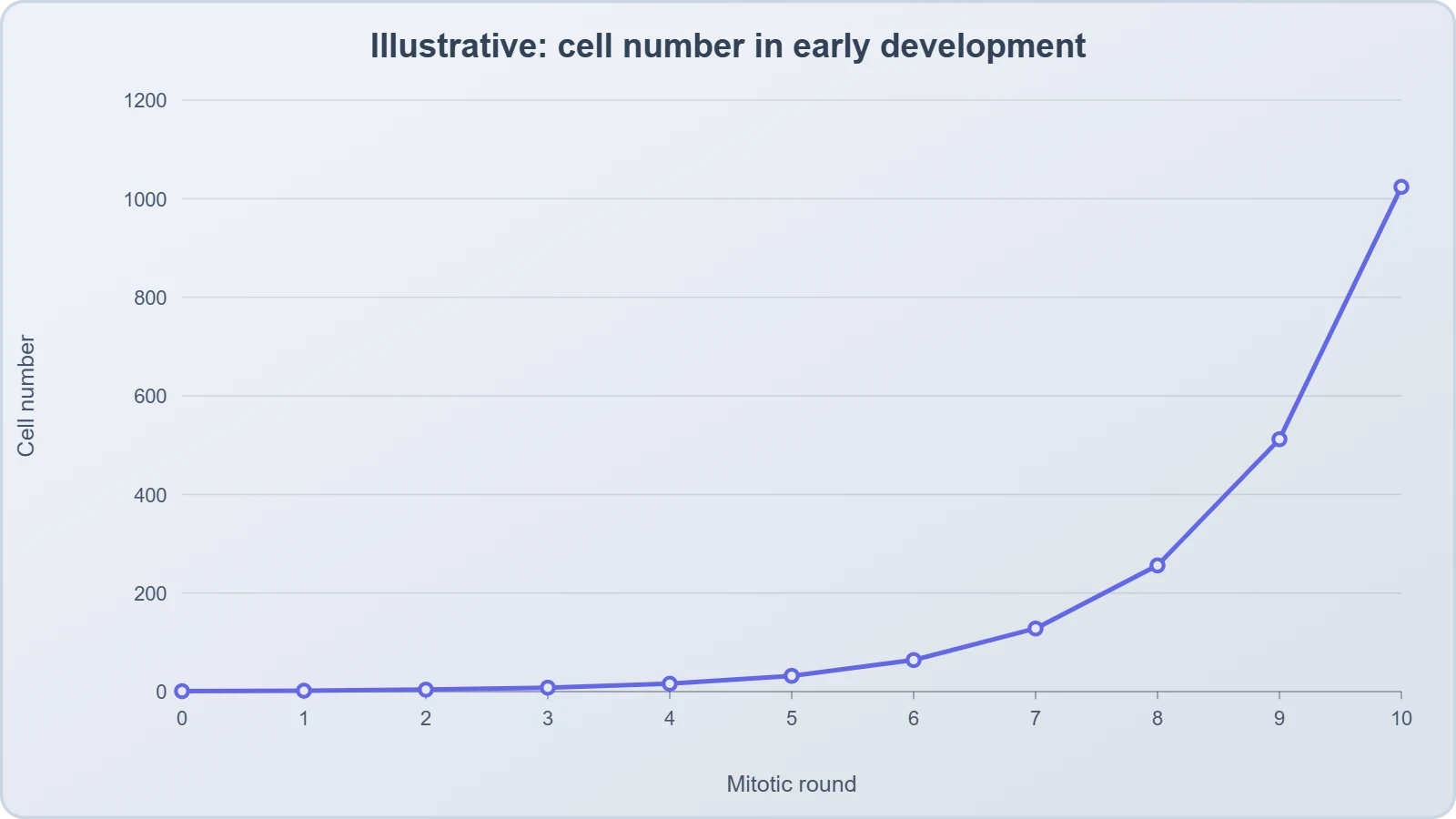
This dependence on mitosis continues beyond embryonic development. Juvenile growth, the enlargement of organs, and the increase in body size during maturation all rely on mitotic activity in appropriate tissues. When growth ceases in many animals, mitosis does not stop entirely; it shifts toward maintenance and repair. The same mechanism that built the body continues to sustain it, which is why the significance of mitosis cannot be confined to a single developmental window.
Why Identical Daughters Matter for Growth
Growth requires that new cells integrate into existing tissues without disrupting function. Identical genetic complements make this possible, because a newly produced cell possesses the same instructions as its neighbours. If mitotic daughters varied genetically, tissues would become mosaics of divergent cell types, and coordinated function would be difficult to maintain. The equational character of mitosis is therefore not incidental to growth but the very condition that makes orderly expansion feasible.
This principle also explains why mitosis is described as producing diploid daughter cells in the usual case. The diploid state is preserved across divisions, so the growing organism retains a consistent genomic constitution in its somatic tissues. Learners should connect this point to the earlier lessons on the phases of M phase and cytokinesis: the accurate segregation of chromatids and the physical separation of cytoplasm together ensure that growth proceeds without genetic loss.
Restoring the Nucleo-Cytoplasmic Ratio
Cell growth disturbs the ratio between the nucleus and the cytoplasm, and this disturbance is one of the most instructive reasons for division. As a cell enlarges, its cytoplasmic volume increases faster than its nuclear volume, so the balance between the two compartments shifts. It therefore becomes essential for the cell to divide to restore the nucleo-cytoplasmic ratio. Division effectively resets the relationship by partitioning the enlarged cytoplasm between two daughter cells, each with its own nucleus.
Why the Balance Matters
The nucleus directs cellular activity through the genetic information it contains, while the cytoplasm carries out and supports that activity. When cytoplasmic volume grows disproportionately, the nucleus must oversee an increasingly large domain, and the functional balance becomes strained. Restoring the ratio through division returns each daughter cell to a workable proportion of nuclear to cytoplasmic material. This is a homeostatic argument: division is not merely reproductive but regulatory, keeping cell size and nuclear influence within viable limits.
The concept also clarifies why cells cannot grow indefinitely without dividing. Unlimited enlargement would push the ratio further from its functional optimum, so periodic division becomes a necessity rather than an option. Mitosis, by producing two cells from one, halves the cytoplasmic share per nucleus and re-establishes the balance. Learners should note that this reasoning applies to the division as a whole, including the cytoplasmic partitioning accomplished in cytokinesis.
Expressing the Ratio Conceptually
The nucleo-cytoplasmic ratio can be expressed as a simple quotient of nuclear volume to cytoplasmic volume. When a cell grows, the denominator increases more than the numerator, and the ratio falls. Division restores it by reducing the cytoplasmic volume assigned to each nucleus.
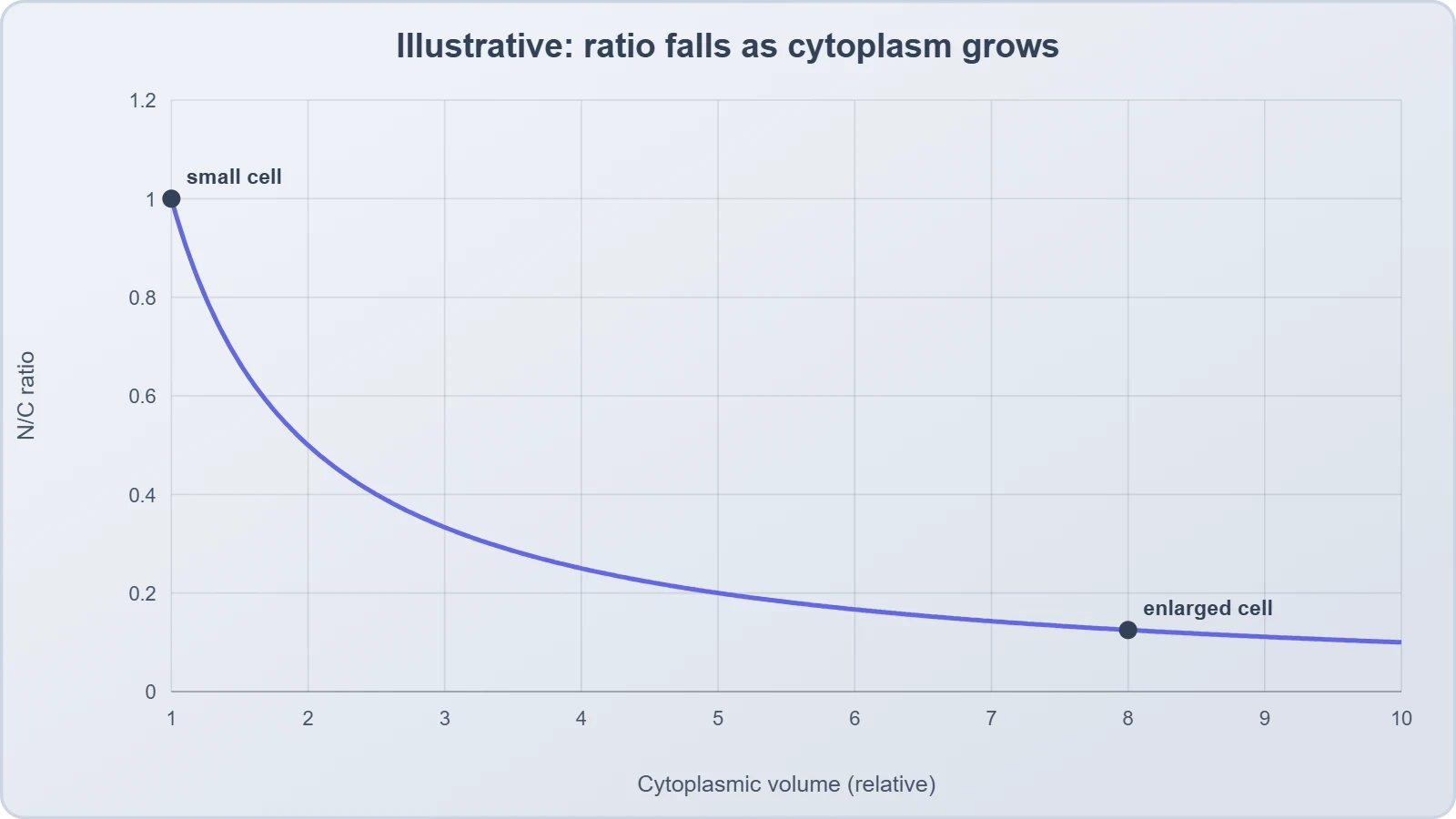
After division, each daughter cell receives approximately half of the parental cytoplasm while retaining a full nucleus, so the ratio rises back toward its functional range. This is a conceptual model rather than a precise numerical law, but it captures the logic that cell growth disturbs the balance and division restores it. The same reasoning explains why very large cells are rare and why division is coupled to growth in actively proliferating tissues.
Cell Repair and the Constant Replacement of Tissues
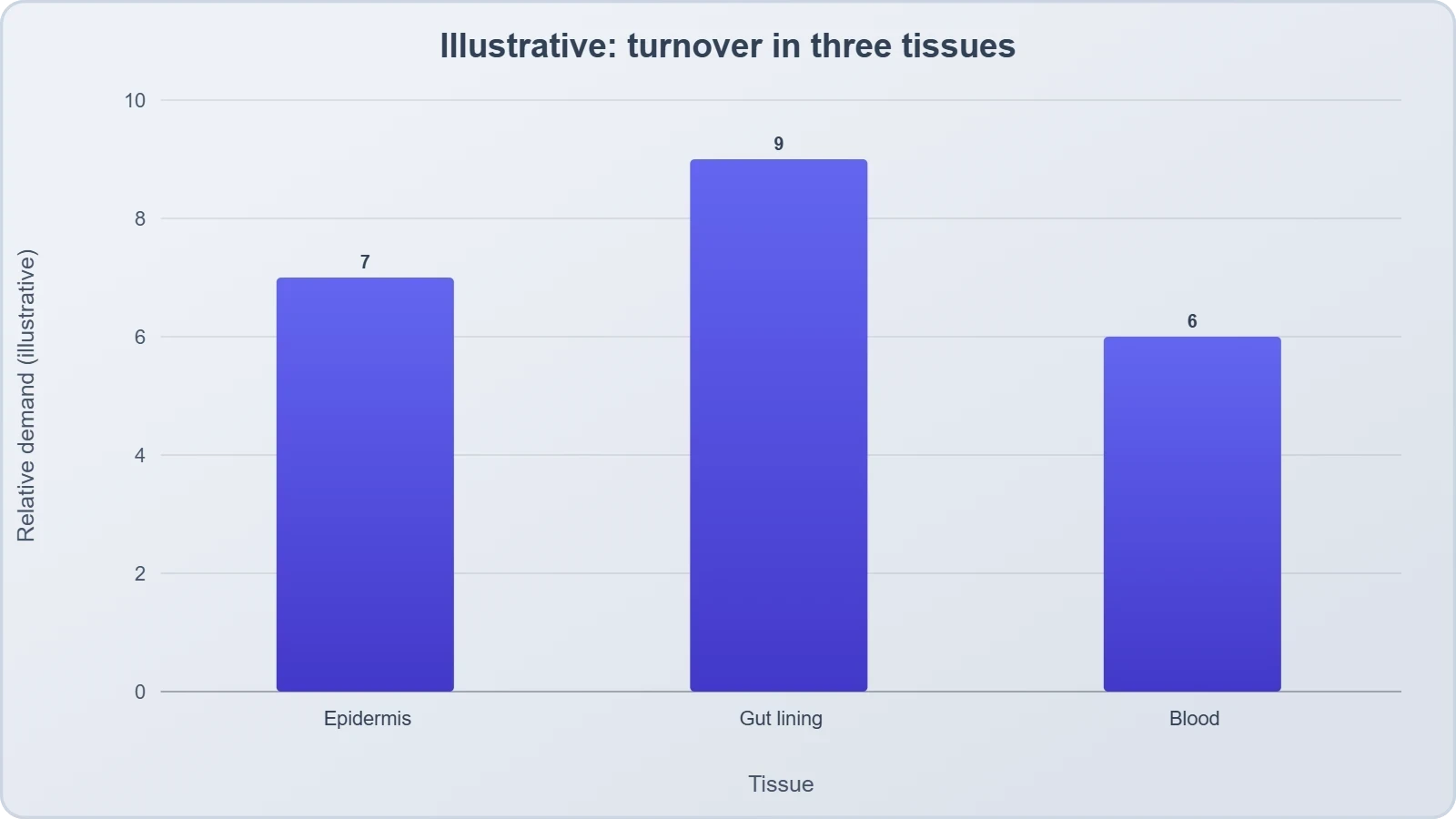
A very significant contribution of mitosis is cell repair, a function that operates continuously throughout the life of an organism. The cells of the upper layer of the epidermis, the cells of the lining of the gut, and blood cells are being constantly replaced. Each replacement is the product of mitotic divisions in the underlying proliferative tissues. Without this ongoing supply, surfaces exposed to friction and environments exposed to chemical and mechanical stress would deteriorate, and the blood would lack a renewable population of cells.
Epidermis, Gut Lining and Blood
The upper layer of the epidermis is shed and abraded continuously, so new cells must be produced from below to maintain the protective barrier. The lining of the gut faces constant turnover as it absorbs nutrients and encounters abrasive contents, and its cells are replaced at a high rate. Blood cells likewise have finite lifespans and are replenished by division in the tissues that produce them. In each case, mitosis supplies genetically identical replacements that assume the functions of the cells they succeed.
These three examples are chosen because they illustrate different kinds of wear. The epidermis suffers mechanical loss, the gut lining suffers both mechanical and chemical stress, and blood cells age and are removed. Despite these differences, the remedy is the same: mitotic division producing new cells with the same genetic complement. The examples therefore reinforce the general principle that repair is a form of localised growth, governed by the same equational mechanism that drives overall body growth.
Repair as Localised Growth
Repair can be understood as growth directed to a specific site rather than distributed across the whole organism. When cells are lost, mitotic activity in the relevant tissue increases to replace them, and the new cells restore the tissue's structure and function. This localised character distinguishes repair from developmental growth, but the underlying division is identical. The same fidelity that keeps a growing tissue coherent also keeps a repairing tissue functional, since the replacements match the cells they replace.
Learners should appreciate that repair is not a separate mechanism but an application of mitosis. The phases of M phase, the segregation of chromatids, and the partitioning of cytoplasm all proceed as in any other division. What differs is the context and the trigger: cell loss rather than organismal growth. This continuity of mechanism is a recurring theme in cell biology and prepares the ground for understanding how tissues maintain themselves over long periods.
Continuous Growth of Plants Through Meristematic Tissues
Mitotic divisions in the meristematic tissues, the apical and the lateral cambium, result in a continuous growth of plants throughout their life. This is a distinctive feature of plant biology: whereas many animals cease growth after maturation, plants retain regions of active division that can add new cells indefinitely. The apical meristems extend roots and shoots, while the lateral cambium increases girth. Both depend on mitosis to supply the cells that become new tissues, and both illustrate the significance of equational division in a long-lived organism.
Apical and Lateral Cambium
The apical meristems are located at the tips of roots and shoots, where they produce cells that allow the plant to extend in length. The lateral cambium, by contrast, lies within stems and roots and adds cells that increase diameter. Together these meristematic tissues account for the continuous growth of plants throughout their life. Because the divisions are mitotic, the new cells retain the plant's genetic complement, ensuring that the expanding body remains genetically uniform in its somatic tissues.
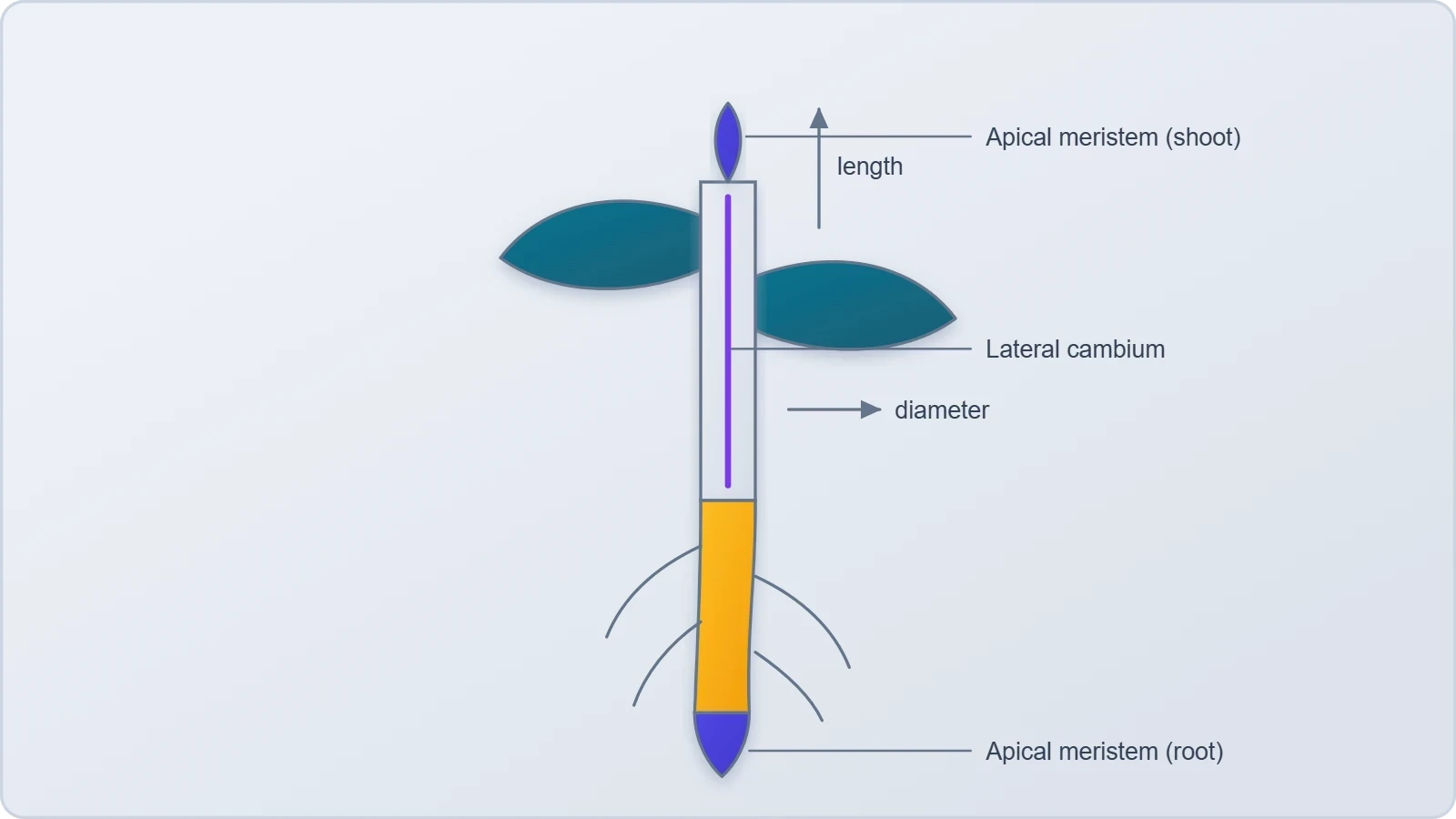
The persistence of these regions explains why many plants can grow for decades or centuries. Each season of growth draws on the same meristematic activity, and the plant adds new tissues without replacing its genetic identity. This is a striking demonstration of the significance of mitosis: the mechanism that builds an embryo also sustains an adult plant across its entire lifespan. Learners should connect this to the earlier point about growth in multicellular organisms, since the principle is the same even though the duration differs.
Why Plants Retain Growth Capacity
Plants retain growth capacity because their meristematic tissues remain active rather than being exhausted during development. This allows them to respond to their environment by growing toward light or deeper into soil, and to replace lost parts. The mitotic basis of this capacity means that new growth is genetically consistent with existing tissues. The continuous growth of plants is therefore not a different kind of division but the same equational process deployed over an extended period.
This contrast with many animals is instructive. In animals, growth largely ceases after maturation and mitosis shifts toward repair, whereas in plants meristematic activity continues to produce new organs. The underlying division remains mitotic in both cases, producing diploid daughter cells with identical genetic complements. The difference lies in the persistence of the dividing tissues, not in the mechanism of division itself. This prepares learners for the next lesson, where meiosis introduces a fundamentally different outcome.
Consolidating the Significance: From Cells to Organisms
The four themes of this lesson converge on a single conclusion: mitosis is the mechanism by which a multicellular organism maintains and extends itself. It produces diploid daughter cells with identical genetic complements, drives the growth of multicellular organisms, restores the nucleo-cytoplasmic ratio disturbed by cell growth, and supports cell repair through constant replacement. In plants, meristematic tissues extend these functions across the entire lifespan. Together these points explain why equational division is indispensable rather than merely routine.
Connecting the Four Themes
Growth, repair, ratio restoration, and meristematic persistence are not separate phenomena but expressions of one conservative process. Growth adds cells, repair replaces them, ratio restoration keeps their proportions viable, and meristems sustain the capacity over time. Each depends on the same fidelity of chromosome segregation and cytoplasmic partitioning that earlier lessons described. Recognising this unity helps learners see the cell cycle as an integrated system rather than a collection of stages to be memorised in isolation.
The nucleo-cytoplasmic ratio argument is particularly useful for linking cell-level regulation to organism-level outcomes. A cell that failed to divide when growth disturbed its ratio would become functionally compromised, and a tissue composed of such cells would deteriorate. By restoring the ratio, mitosis keeps individual cells viable and, by extension, keeps tissues healthy. The same logic applies to repair, where replacement restores both cell numbers and functional proportions within the tissue.
Preparing for Meiosis
This lesson has emphasised conservation: identical genetic complements, preserved chromosome number, and continuity of tissue identity. The next lesson introduces meiosis, a specialised division that reduces the chromosome number by half and produces haploid daughter cells. The contrast is deliberate and instructive. Where mitosis conserves, meiosis reduces; where mitosis supports growth and repair, meiosis supports the formation of gametes for sexual reproduction. Understanding the significance of mitosis sharpens the appreciation of what meiosis must accomplish.
Learners should carry forward the key vocabulary: equational division, identical genetic complement, nucleo-cytoplasmic ratio, meristematic tissues, apical and lateral cambium. These terms will reappear in comparisons with meiosis, where the halving of chromosome number and the pairing of homologous chromosomes become central. The foundation laid here, grounded in the material's own order of ideas, ensures that the transition to reduction division is a genuine development rather than a fresh start.
Going further
Meristematic tissues are regions of active cell division in plants, and their persistence explains why many plants grow throughout their lives rather than ceasing at maturity. The replacement of worn-out cells by mitosis helps maintain tissues, ensuring that surfaces exposed to stress are continually renewed. These background points reinforce the material's central claims without altering them, and they offer learners a broader context for appreciating why equational division is so deeply embedded in the biology of multicellular life.
From our network :
- AI-Powered 'Precision Diagnostic' Replaces Standard GRE Score ReportsDiscover the new GRE Precision Diagnostic. Learn how AI-powered behavioral analytics and time-to-solve tracking are replacing standard GRE score reports to empower students.
- Analyzing Trump Deportation Numbers Insights Into The 2026 Immigration Crackdown
- Trump Political Strategy How Geopolitical Stunts Serve As Media Diversions
- How to Print Cheaply: Cutting the Cost per PageA practical, measured guide to lowering what each printed page costs — duplex and draft modes, third-party ink, yield mathematics, and knowing when a new printer beats refills.
- 98% of Global MBA Programs Now Prefer GRE Over GMAT Focus EditionExplore why 98% of global MBA programs now prefer the GRE over GMAT Focus. Learn about the shorter GRE format, verbal logic importance, and strategic versatility for students.
- Where to Put Your Wireless Router for Better CoverageA practical, physics-grounded guide to router placement: why the centre of the home beats the corner, how walls and metal sap signal, and how to run a simple survey that proves the improvement.
- 10 Physics Numerical Problems with Solutions for IIT JEEPrepare for IIT JEE with 10 physics numerical problems, complete with detailed solutions and conceptual explanations. Ideal for mastering kinematics, thermodynamics, electromagnetism, and optics.
- Do You Need a New Router or Is Your Internet Plan the Problem?A practical comparison of the signs that point to router limits versus signs your broadband speed or provider is the bottleneck, so you can decide what to replace before spending money.
- EV 2.0: The Solid-State Battery Breakthrough and Global Factory ExpansionDiscover the impact of the Solid-State Battery Breakthrough on the EV market. Learn about CATL and BYD stock growth, global factory expansion in Europe, and the future of EV 2.0 technology.
RESOURCES
- Effects of high-intensity resistance training on untrained older men. II ...pubmed.ncbi.nlm.nih.govDuring growth and repair of skeletal muscle fibers, satellite cells become activated, undergo mitosis, and a daughter nucleus becomes incorporated into the ...
- The Nuclear-to-Cytoplasmic Ratio: Coupling DNA Content to Cell ...pmc.ncbi.nlm.nih.govA cell maintains a relatively constant N/C ratio by coupling DNA content, nuclear size, and cell size. We explore how cells couple cell division…
- The Drosophila cellularization gene nullo produces a blastoderm ...pubmed.ncbi.nlm.nih.govThe initial development of the Drosophila embryo is characterized by rapid nuclear mitosis without cytokinesis. After 13 such mitoses, a coordinated cell ...
- Nuclear Membrane Rupture and Its Consequences - PMC - NIHpmc.ncbi.nlm.nih.govDisruption of mitosis and persistent DNA damage are frequent causes of micronucleation, but micronuclei also accumulate at a low rate in healthy tissue ( ...
- Mitotic chromosomes scale to nuclear-cytoplasmic ratio and cell size ...elifesciences.orgApr 25, 2023 ... Upon fertilization, embryos undergo a series of rapid cell divisions in the absence of cell growth, resulting in decreasing cell…
- Regulating Access to the Genome: Nucleocytoplasmic Transport ...sciencedirect.comFeb 21, 2003 ... In silico simulations estimated a nuclear to cytoplasmic RanGTP ratio of approximately 500 (Smith et al., 2002). ... mitosis, as…
- Expression of the nuclear export protein chromosomal region ...acsjournals.onlinelibrary.wiley.comFeb 27, 2008 ... ... nuclear-cytoplasmic transport ... There was a significant correlation between cytoplasmic CRM1 expression and higher mitotic rate (P = .
- KIF14 silencing suppresses cell proliferation and enhances ... - Naturenature.comJul 14, 2026 ... ... repair by regulating the nucleocytoplasmic shuttling of 53BP1 (Fig. ... significant inhibition in orthotopic tumor growth. In conclusion ...
- Cell Cycle and Cell Division Chapter 10 - NCERTncert.nic.inThe growth of multicellular organisms is due to mitosis. Cell growth results in disturbing the ratio between the nucleus and the cytoplasm. It therefore…
- Getting nuclear size just right – emerging mechanisms regulating ...journals.biologists.comJun 11, 2026 ... ... nuclear growth and cytoplasmic vimentin ... R. (. 2023. ). Mitotic chromosomes scale to nuclear-cytoplasmic ratio and cell size…
- A systematic genomic screen implicates nucleocytoplasmic transport ...journals.plos.orgDisruption of lipid synthesis dysregulates nuclear membrane growth and results in an enlarged N/C ratio. We propose that both properly regulated ...
- ATM phosphorylates PP2A subunit A resulting in nuclear export and ...link.springer.comNov 24, 2022 ... Furthermore, S401D cells displayed increased ERK and AKT signaling resulting in enhanced growth rate further underscoring the multiple roles ATM ...
- Mitosis | CK-12 Foundationflexbooks.ck12.orgThese cells contain two sets of chromosomes and divide by mitosis to support growth, repair, and tissue maintenance. ... Restoration of Nucleo-Cytoplasmic Ratio ( ...
- Mitosis: Stages & Significance How does one cell produce two ...facebook.comSep 1, 2026 ... Uuter Uuterarrer Nucleo- Ratio Division restares o.nter! ngth the ... Mitosis is essential for growth, development, and tissue maintenance ...
- TUMOR CELL MORPHOLOGY - Comparative Oncology - NCBI - NIHncbi.nlm.nih.govChanges concern its surface, volume, the nucleus/cytoplasm ratio, shape and density, as well as structure and homogeneity. ... mitosis and tumor growth. The cell ...