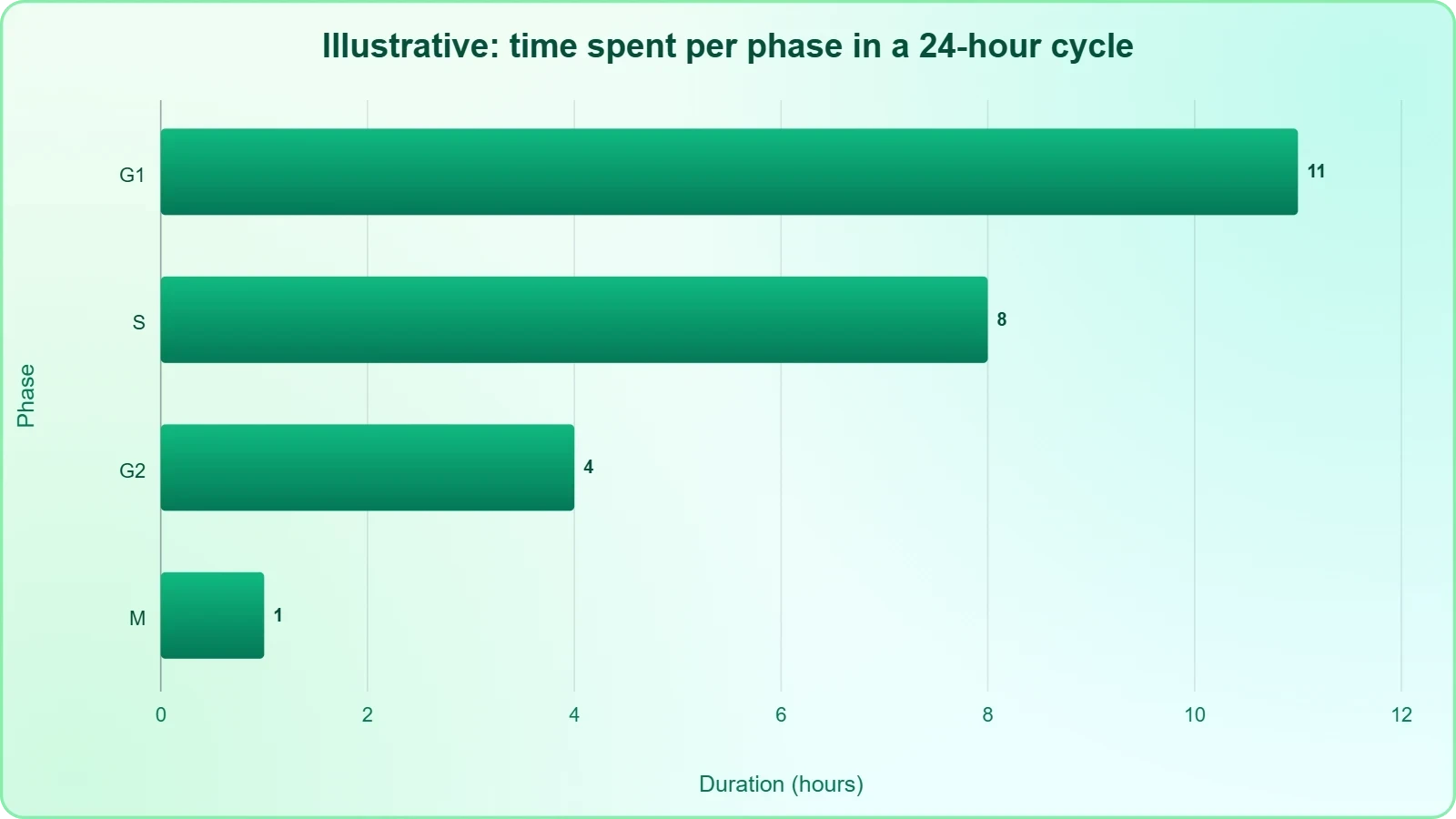
Interphase is the longest and most consequential stretch of a eukaryotic cell's life, yet it is routinely misread as a passive pause between divisions. In a typical human cell cycling roughly once every twenty-four hours, the actual division occupies barely an hour, while interphase consumes more than 95% of the cycle. That disproportion is not idle time; it is the interval in which the cell grows, accumulates metabolites, duplicates its genetic material with extraordinary fidelity, and assembles the molecular machinery required for the coming mitosis. Understanding what happens inside G1, S and G2 therefore reframes the entire cell cycle as a sequence of deliberate preparations rather than a single dramatic event.
This lesson examines the three sub-phases of interphase in the order they occur, beginning with the metabolically busy G1 interval between mitosis and the onset of DNA replication. It then turns to S phase, where the DNA content per cell doubles from 2C to 4C even though the chromosome number remains unchanged at 2n, and where centrioles duplicate in the cytoplasm of animal cells. Finally, it considers G2, the protein-synthesis window that readies the cell for mitosis while growth continues. Each phase is treated with the terminology, quantities and sequence of ideas that define the standard account, so that the arithmetic of DNA and chromosome counts becomes intuitive rather than memorised.
Because the preceding lesson established the broad division of the cycle into interphase and M phase, the discussion here moves inward to the internal architecture of interphase itself. The material deliberately stops short of the quiescent G0 state and of cells that exit the cycle permanently, which form the subject of the next lesson. What remains is a focused study of how a cell converts time, energy and raw material into two faithful copies of its genome, and why the distinction between DNA content and chromosome number is the single most useful idea a learner can carry forward into mitosis and meiosis.
On This Page
The G1 Phase: Growth Without Replication
G1 phase corresponds precisely to the interval between the completion of mitosis and the initiation of DNA replication. During this window the cell is metabolically active and continuously grows, synthesising RNA and proteins, expanding its cytoplasmic volume and replenishing organelles, yet it does not replicate its DNA. The genetic material remains in its pre-synthetic state, and the cell is best understood as a working cell performing its ordinary physiological duties while quietly accumulating the resources that a future division will demand. This is why the older habit of calling interphase the resting phase is misleading: G1 is among the busiest periods in the life of a cell.
Metabolic Activity and Cellular Growth
The metabolic character of G1 deserves emphasis because it explains why the phase can be long and variable. A cell that has just divided is often smaller than its parent, and G1 provides the interval in which it restores its size and rebuilds structures consumed during mitosis. Ribosome production rises, enzyme pools are restocked, and membrane systems are extended. The duration of G1 is the principal reason cell cycle lengths differ so widely between organisms and tissues, ranging from the roughly ninety-minute cycle of yeast to the twenty-four-hour cycle typical of cultured human cells.
Growth in G1 is not merely an increase in bulk; it is a qualitative preparation. The cell must reach a size and physiological condition that permit safe replication of its genome, and the machinery that monitors this readiness operates throughout the phase. Learners should therefore resist the temptation to treat G1 as a simple waiting room. It is the phase in which the cell assesses its own fitness and commits resources, and the orderly manner of that preparation is what allows the later stages of the cycle to proceed without error.
The Pre-Synthetic State of the Genome
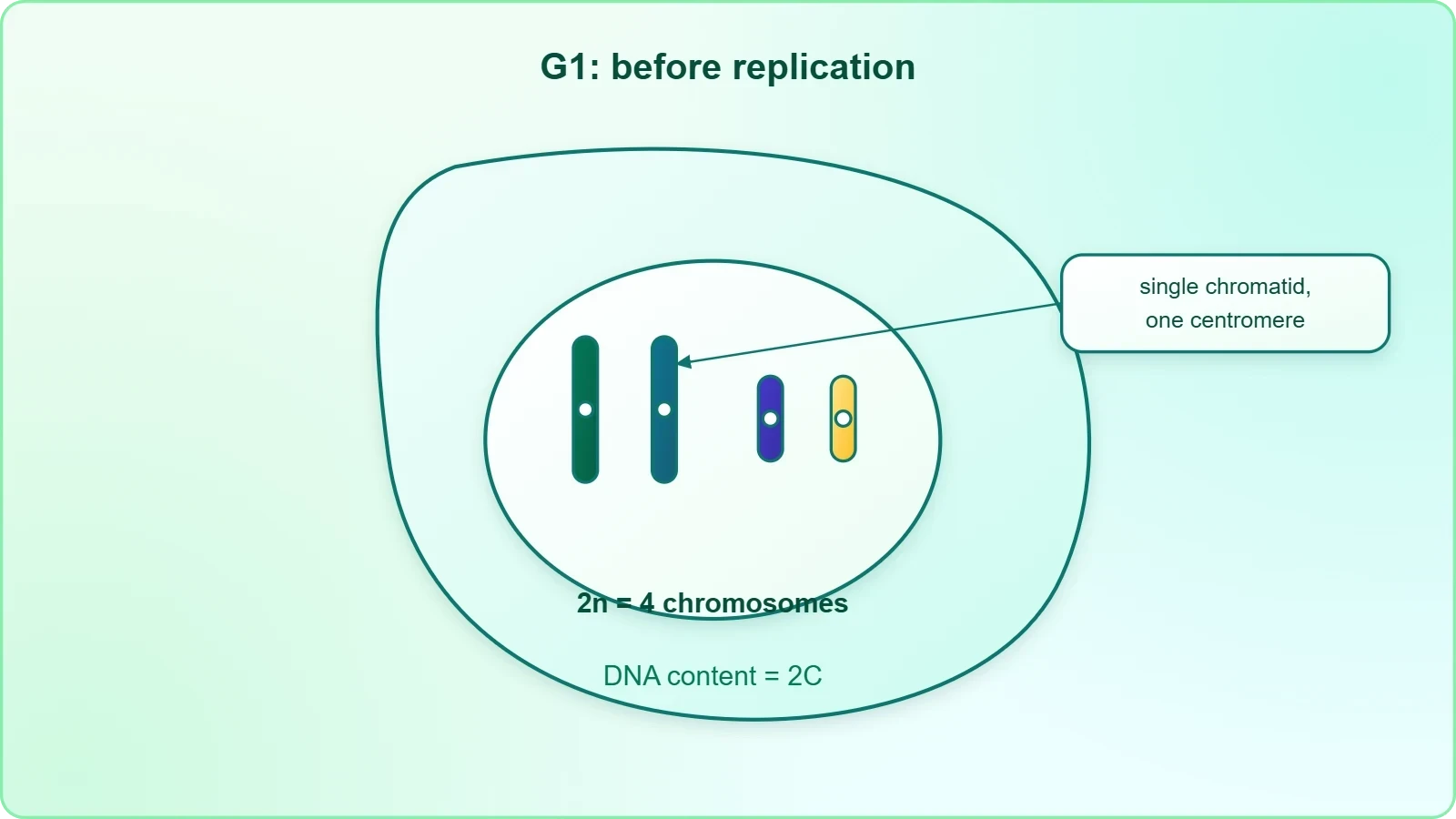
At the start of G1, following the separation of daughter chromosomes in the preceding mitosis, each chromosome consists of a single chromatid. The DNA content of the cell can be denoted as 2C, and if the cell is diploid its chromosome number is 2n. These two quantities are independent descriptions: C measures the mass of DNA per cell, while n counts chromosomes. Keeping them separate from the outset prevents the confusion that arises later, when S phase doubles one value while leaving the other untouched.
Because no replication occurs in G1, the ratio between DNA content and chromosome number remains fixed throughout the phase. A diploid cell in G1 carries 2C of DNA distributed across 2n chromosomes, each a single chromatid. This baseline is the reference point against which every subsequent change is measured, and it is worth committing to memory before proceeding to the synthesis phase, where the first and most dramatic numerical shift of the cycle takes place.
S Phase: Doubling DNA Without Doubling Chromosomes
S phase, or the synthesis phase, marks the period during which DNA synthesis or replication takes place. It is the point of no return in the cycle, the interval in which every chromosome is copied so that the eventual daughter cells each receive a complete genome. The phase is defined by a single measurable outcome: the amount of DNA per cell doubles. If the initial amount of DNA is denoted as 2C, it increases to 4C by the end of synthesis. Everything else about S phase, including its timing, its enzymology and its proofreading, exists to serve that doubling with accuracy.
The 2C to 4C Transition Explained
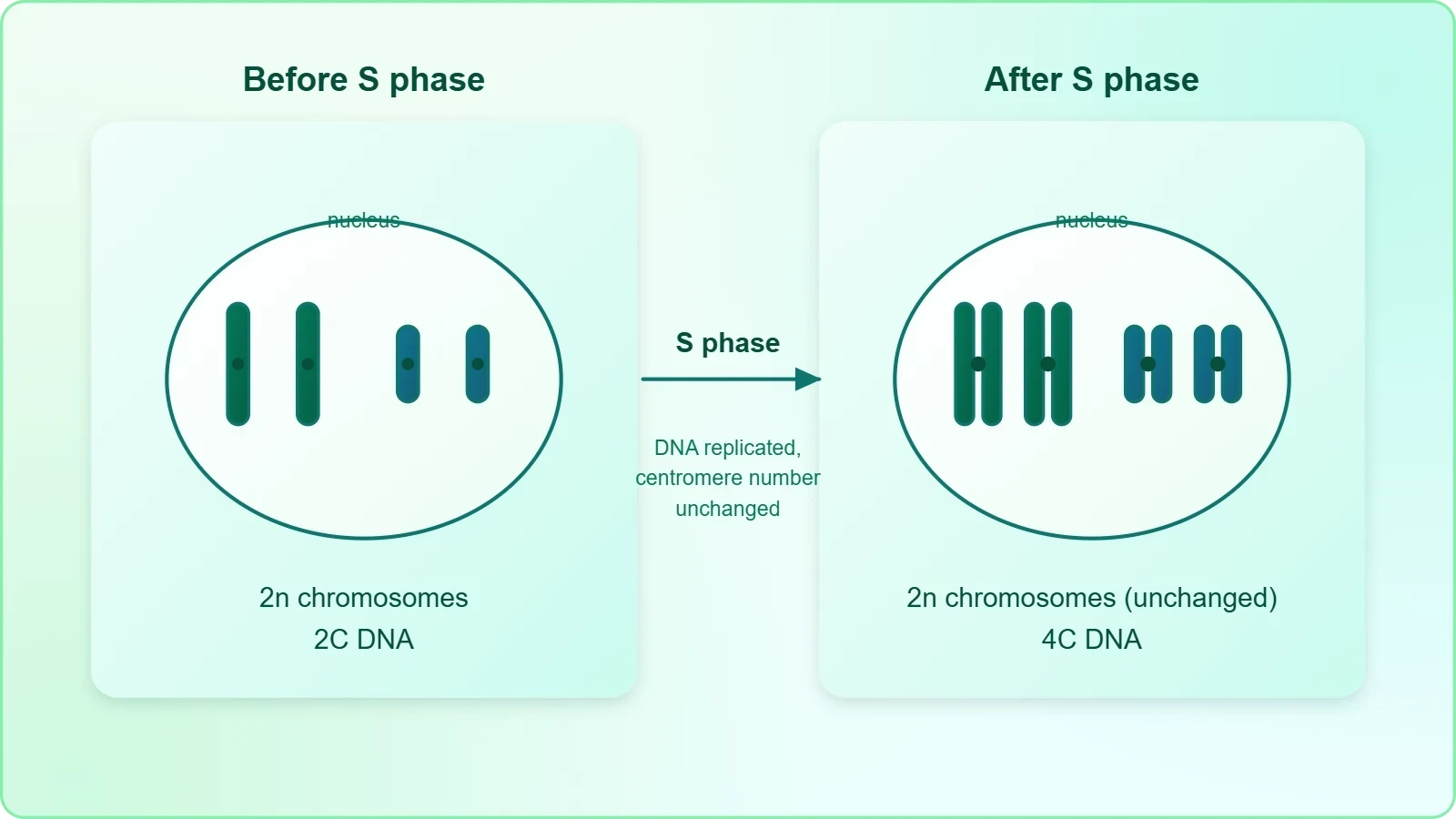
The arithmetic of S phase is simple but frequently misapplied. Before synthesis, a diploid cell holds 2C of DNA across 2n chromosomes. After synthesis, it holds 4C of DNA across the same 2n chromosomes, because each chromosome now consists of two sister chromatids joined together. The chromosome count has not changed; only the amount of DNA associated with each chromosome has. This is the crucial distinction that learners must internalise, since it explains why a cell entering mitosis appears to contain twice the genetic material yet still possesses the normal diploid chromosome number.
Expressed formally, the relationship can be written as a pair of statements that hold before and after synthesis. Before S phase, DNA content equals 2C and chromosome number equals 2n; after S phase, DNA content equals 4C while chromosome number remains 2n. The ratio of DNA to chromosome therefore doubles, and this doubling is the physical basis of the sister chromatids that will later be separated during karyokinesis. No new chromosomes are created in S phase, only new DNA molecules templated on the old ones.
Centriole Duplication in Animal Cells
In animal cells, S phase carries a second obligation beyond the genome. While DNA replication begins in the nucleus, the centriole duplicates in the cytoplasm during the same interval. This duplication ensures that the cell will possess two centriole pairs by the time mitosis begins, providing the poles from which the spindle apparatus will later be organised. The coordination is elegant: the nuclear and cytoplasmic preparations for division proceed in parallel, so that chromosome segregation and spindle assembly are ready at the same moment.
Plant cells lack centrioles yet divide perfectly well, organising their spindle by other means, which is why the duplication event is described specifically as a feature of animal cells. For learners, the centriole is best remembered as a cytoplasmic counterpart to the nuclear events of S phase, a reminder that the cell prepares for division as an integrated whole rather than as a nucleus acting alone. The next lesson's discussion of cells that leave the cycle will show how these preparations can be suspended indefinitely.
G2 Phase: Protein Synthesis and Final Preparation
G2 phase follows the completion of DNA synthesis and precedes the onset of mitosis. During this interval, proteins are synthesised in preparation for mitosis while cell growth continues. The emphasis on protein synthesis is deliberate: mitosis requires tubulin for the spindle, histones and chromatin-remodelling factors for chromosome condensation, and a host of regulatory proteins that will orchestrate the events of M phase. The cell is not merely waiting in G2; it is manufacturing the instruments of its own division, and the phase provides the final opportunity to verify that replication has been completed correctly before the irreversible commitment to mitosis.
Building the Machinery of Mitosis
The proteins assembled in G2 fall into recognisable functional groups. Structural proteins supply the cytoskeletal components of the spindle apparatus, while chromosomal proteins support the compaction of the duplicated genome into visible mitotic chromosomes. Regulatory proteins accumulate in a controlled fashion, their levels rising until the cell is competent to enter M phase. Because growth continues alongside synthesis, the cell also increases its cytoplasmic mass, ensuring that when cytokinesis finally divides the cytoplasm, each daughter receives an adequate share of organelles and soluble components.
This dual activity, synthesis and growth, distinguishes G2 from the purely replicative work of S phase. A cell in G2 already possesses a fully duplicated genome at 4C, so its remaining tasks are qualitative: assembling, checking and stockpiling. The phase therefore functions as a quality-control interval as much as a manufacturing one, and its orderly completion is a precondition for the nuclear division, karyokinesis, that opens M phase and for the cytoplasmic division, cytokinesis, that closes it.
Why the Order G1, S, G2 Matters
The sequence of the three sub-phases is not arbitrary. Growth must precede replication so that the genome is copied in a cell of adequate size and metabolic capacity; replication must precede protein synthesis for mitosis so that the proteins assembled in G2 have a duplicated genome to act upon. Reversing or overlapping these tasks would produce a cell attempting to divide chromosomes it had not yet copied, or copying DNA with insufficient resources to do so accurately. The order is thus a logical dependency chain, and the terminology of Gap 1, Synthesis and Gap 2 encodes that dependency.
Learners preparing for examinations should be able to state the sequence, the defining event of each phase, and the numerical state of the genome at each stage without hesitation. The gaps are named for their position relative to synthesis, not because nothing happens within them. Recognising this transforms a list of three labels into a coherent narrative of preparation, and it prepares the ground for the next topic, the quiescent G0 stage, in which cells withdraw from this sequence entirely and pause their preparations indefinitely.
Reading the Numbers: DNA Content Versus Chromosome Number
The most common error in this topic is to assume that doubling the DNA must double the chromosome count. It does not. Chromosome number is a count of centromere-bearing structures, whereas DNA content is a measure of the total genetic material. When a chromosome replicates, it gains a second chromatid but retains a single centromere, so it is still counted as one chromosome. The cell therefore moves from 2C to 4C while remaining at 2n, and this asymmetry is the conceptual hinge on which both mitosis and meiosis turn.
Interpreting the C and n Notations
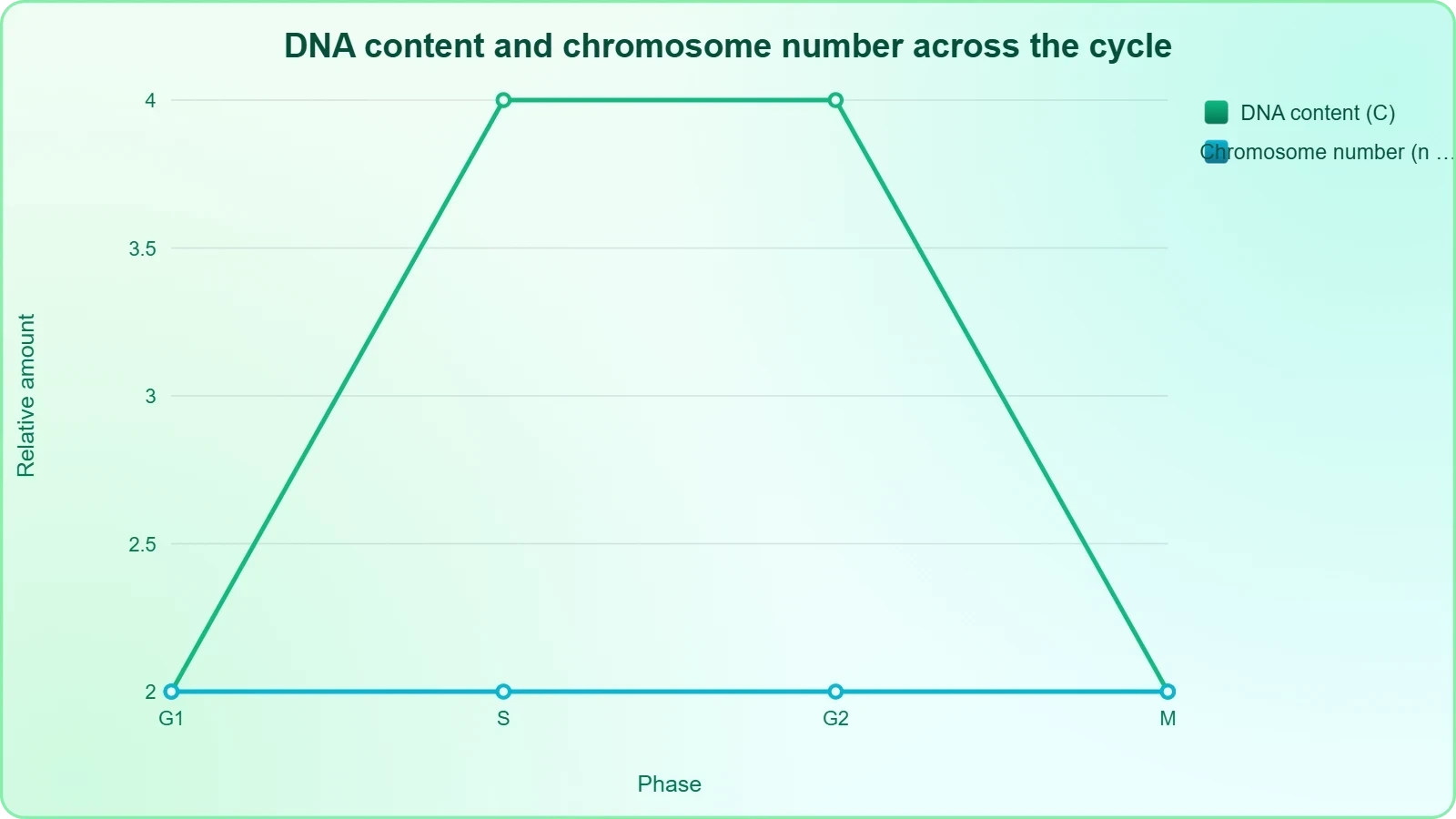
The notation is worth stating plainly. The symbol C denotes the amount of DNA per cell, and the symbol n denotes the chromosome number. A diploid cell in G1 is 2C and 2n; after S phase it is 4C and still 2n; after mitosis each daughter returns to 2C and 2n. The two symbols move independently, and tracking them separately is the surest way to answer examination questions about ploidy, chromatid number and DNA content without confusion.
This independence also explains why a cell in G2 is not tetraploid. It contains twice the DNA of a G1 cell but the same number of chromosomes, each now bipartite. Tetraploidy would require double the chromosome number, which does not occur here. Learners who grasp this point can predict the state of the genome at any moment in the cycle simply by knowing which phase the cell occupies and whether synthesis has yet taken place.
Applying the Framework to Examination Questions
Questions on this topic typically ask for the DNA content and chromosome number at a named stage, or for the phase in which a particular event occurs. The reliable method is to anchor at G1, apply the single transformation of S phase, and read forward. If a question states that a cell has 4C DNA and 2n chromosomes, the cell is in G2 or in M phase before anaphase; if it has 2C and 2n, it is in G1 or in a daughter cell after cytokinesis. The framework converts recall into reasoning.
Practice should include the reverse direction as well: given a described event, name the phase. Centriole duplication points to S phase in animal cells; accumulation of mitotic proteins points to G2; metabolic growth without replication points to G1. Building fluency in both directions prepares learners for the detailed treatment of mitosis and meiosis that follows, where the same numerical bookkeeping is applied to the separation of sister chromatids and, later, of homologous chromosomes.
Going Further: Clarifying Content, Count and Spindle Poles
Two clarifications, offered as background rather than as part of the core account, help consolidate the material. The first concerns notation: the C in 2C and 4C refers to DNA content per cell, while n refers to chromosome number, and the two are measured in different currencies. The second concerns the centriole, whose duplication in S phase is mentioned in the material but whose purpose is not spelled out there. Understanding what the centriole does makes its duplication in S phase feel necessary rather than incidental, and it connects the cytoplasmic events of interphase to the mechanics of the division that follows.
What the C and n Symbols Measure
DNA content is a quantity of genetic material, conventionally expressed relative to the haploid amount, so that a diploid G1 cell holds 2C and a haploid gamete holds 1C. Chromosome number is a count of chromosomes, expressed relative to the haploid number n, so that a diploid cell holds 2n. Because replication adds material without adding chromosomes, S phase changes C but not n. Keeping the two currencies distinct is the single most reliable defence against errors in questions about ploidy, chromatid counts and DNA content.
The Role of Centrioles in Spindle Organisation
Centrioles help organise the spindle during animal cell division. The pair inherited by each daughter cell duplicates in S phase, so that by mitosis the cell possesses two pairs capable of migrating to opposite poles and nucleating the microtubules that will capture and separate sister chromatids. This is why the duplication is timed to S phase rather than to mitosis itself: the spindle must be assembled from ready-made components. Plant cells achieve the same end without centrioles, which is why the duplication is described as a feature of animal cells specifically.
Consolidating the Lesson and Looking Ahead
The three sub-phases of interphase form a single continuous programme of preparation. G1 supplies growth and metabolic readiness without replication; S phase doubles the DNA from 2C to 4C while leaving the chromosome number at 2n and, in animal cells, duplicates the centriole; G2 synthesises the proteins required for mitosis while growth continues. Together these phases account for more than 95% of a typical human cell cycle, which is why the older description of interphase as a resting phase has been abandoned in favour of a view that emphasises ordered, purposeful activity.
Key Takeaways for Revision
Four statements capture the essentials. G1 is the interval between mitosis and the initiation of DNA replication, metabolically active and growing but not replicating. S phase is when DNA synthesis occurs, raising DNA content from 2C to 4C without altering chromosome number, and when centrioles duplicate in animal cells. G2 is when proteins are synthesised in preparation for mitosis while growth continues. Throughout all three phases the chromosome number remains 2n, and only the DNA content changes, and only during S phase.
Preparing for the Quiescent Stage
The account so far assumes a cell that proceeds through the cycle without interruption. Many cells do not. The next lesson examines the quiescent stage, G0, in which cells exit the cycle and cease dividing, and considers the tissues whose cells divide throughout the life of the organism. The framework established here, with its clear separation of DNA content from chromosome number and its phase-by-phase event map, provides the vocabulary needed to describe what happens when a cell steps off the cycle entirely and what it means for a tissue when its cells stop dividing.
Also Read
- No links available.
From our network :
- Vite 6/7 'Cold Start' Regression in Massive Module GraphsIn-depth analysis of Vite 6/7 cold start regressions in massive module graphs. Learn about barrel file issues, pre-bundling optimizations, and how to improve Vite dev server performance.
- Mastering DB2 LUW v12 Tables: A Comprehensive Technical GuideComprehensive guide on DB2 LUW v12 tables. Explore CREATE TABLE syntax, BLU Acceleration, range partitioning, data types, and security features for IBM DB2 LUW v12.
- 98% of Global MBA Programs Now Prefer GRE Over GMAT Focus EditionExplore why 98% of global MBA programs now prefer the GRE over GMAT Focus. Learn about the shorter GRE format, verbal logic importance, and strategic versatility for students.
- AI-Powered 'Precision Diagnostic' Replaces Standard GRE Score ReportsDiscover the new GRE Precision Diagnostic. Learn how AI-powered behavioral analytics and time-to-solve tracking are replacing standard GRE score reports to empower students.
- Mastering DB2 12.1 Instance Design: A Technical Deep Dive into Modern Database ArchitectureComprehensive guide to DB2 12.1 Instance Design. Explore architectural components, HADR setup, buffer pool tuning, and security policies for IBM DB2 12.1. Includes 10 functional SQL and Shell samples.
- Analyzing Trump Deportation Numbers Insights Into The 2026 Immigration Crackdown
- Trump Political Strategy How Geopolitical Stunts Serve As Media Diversions
- EV 2.0: The Solid-State Battery Breakthrough and Global Factory ExpansionDiscover the impact of the Solid-State Battery Breakthrough on the EV market. Learn about CATL and BYD stock growth, global factory expansion in Europe, and the future of EV 2.0 technology.
- 10 Physics Numerical Problems with Solutions for IIT JEEPrepare for IIT JEE with 10 physics numerical problems, complete with detailed solutions and conceptual explanations. Ideal for mastering kinematics, thermodynamics, electromagnetism, and optics.
RESOURCES
- Phases Of Cell Cycle G0 G1 S G2 M - Mitosis - MCAT Contentjackwestin.comThe cell cycle has two major phases: interphase (G0, G1, S, G2) and the mitotic…
- Learn: Phases of the cell cycle (article) | Khan Academykhanacademy.orgInterphase is composed of G1 phase (cell growth). Image credit: "The cell cycle: Figure 1" by OpenStax College, Biology (CC BY 3.0).
- Cell Cycle - National Human Genome Research Institute (NHGRI)genome.govCell cycle has different stages called G1, S, G2, and M. G1 is the stage where the cell is preparing to divide. To do…
- Enrichment of non-synchronized cells in the G1, S and G2 phases of ...pubmed.ncbi.nlm.nih.govThe susceptibility of cells to apoptosis induction is deeply influenced by their position in the cell cycle. Unfortunately, however, current methods for the ...
- Regulation of Cell Cycle Progression by Growth Factor-Induced Cell ...pmc.ncbi.nlm.nih.govNov 26, 2021 ... G1, S, and G2 together are called interphase. M phase is ... The cell cycle consists of G1, S, G2,…
- Cell Cycle Assay Solution Deep Red - dojindodojindo.comInterphase is composed of G1 phase (preparation for DNA synthesis which ... Doxorubicin (DOX) acts to inhibit cell proliferation during G2/M phases of the…
- Cell Cycle G2 Phase - an overview | ScienceDirect Topicssciencedirect.comG1 phase: gap 1 phase, or interphase. ... In this regard, the cell can activate cell-cycle checkpoints to arrest cells in the G1, S,…
- Reversible and effective cell cycle synchronization method for ...life-science-alliance.orgMar 4, 2025 ... The cell division cycle includes four major stages: G1, S, G2, and M phases, each with distinct functions. During the…
- What Happens in the G1 and G2 Phases of The Cell Cycle? - Albert.ioalbert.ioThe two G phases bookend the S phase (DNA replication), and the M phase (mitosis/meiosis) follows G2. ... Cells that have stopped dividing (terminally ...
- The Cell Cycle - News-Medicalnews-medical.netG1, S and G2 phases are all cumulatively referred to as interphase involving the growth of a cell and the replication of its DNA.…
- Cell-cycle-resolved Hi-C reveals unexpected plasticity of A/B ... - eLifeelifesciences.org(A) The Fucci2 reporter (top) labels cell cycle phases: G1/early S (mCherry-hCdt1; red) and S/G2/M (mVenus-hGeminin; green). Asynchronous mESC cultures ...
- Genetics, Cancer Cell Cycle Phases - StatPearls - NCBI Bookshelfncbi.nlm.nih.govDuring interphase, some subdivisions are important to cell division and maintenance of the genetic material. The subdivisions consist of G1, S, and G2.[1] The ...
- a high-precision immunofluorescence-based method for cell cycle ...journals.biologists.comNov 20, 2024 ... The reproductive cell cycle consists of four stages: G1, S, G2 and M phases. G1, S and G2 phases are…
- Leukemia Cell Cycle Chemical Profiling Identifies the G2-Phase ...pubs.acs.orgMay 2, 2019 ... Compounds that arrested cells in G1/S phase with >2 standard deviations (SDs) from the dimethyl sulfoxide (DMSO) control or in…
- cell sequencing identifies multiple waves of mRNA decay during the ...hubrecht.euFeb 1, 2022 ... G2/M phase and early G1 phase cell populations were isolated by FACS and ... Control of cell cycle transcription during…