Every living cell runs on energy, and that energy is released when simple molecules such as glucose, amino acids and fatty acids are broken down. Oxygen is the agent that makes this breakdown possible, and carbon dioxide is the harmful by-product that the same reactions leave behind. Because cells cannot store oxygen for long and cannot tolerate accumulating carbon dioxide, a continuous two-way traffic must be maintained between the body and the surrounding atmosphere. Breathing is the name given to that traffic: the exchange of oxygen from the atmosphere with the carbon dioxide produced by the cells, commonly known as respiration.
This opening lesson of the course establishes the foundation on which every later topic rests. Before examining respiratory organs, the mechanics of ventilation, gas transport or neural control, a learner must first understand why the exchange exists at all. The reasoning is chemical and practical: catabolic reactions consume oxygen and release carbon dioxide, so supply and removal must be constant, not occasional. Place your hands on your chest and you can feel the chest moving up and down; that simple observation is the outward sign of the process this lesson explains.
The treatment below stays close to the chapter's own terminology and order of ideas, beginning with the cellular need for oxygen and the definition of breathing, then surveying how the exchange is achieved across animal groups. A short "Going further" block adds well-established background on cellular respiration without disturbing the chapter's sequence. By the end, you will be able to state precisely what breathing is, why it is indispensable, and how the principle of exchange is realised in organisms as different as sponges, earthworms, insects, fishes and mammals.
On This Page
- The Cellular Demand for Oxygen and the Harmful By-product of Catabolism
- Reading the Outward Sign: The Chest That Moves Up and Down
- Mechanisms of Breathing Vary Across Animal Groups
- Habitat and Organisation as the Two Governing Constraints
- Breathing and Respiration: One Word, Two Senses
- Going Further: Cellular Respiration and the Visible Rhythm
- Preparing for the Respiratory Organs
The Cellular Demand for Oxygen and the Harmful By-product of Catabolism
Oxygen is utilised by organisms to indirectly break down simple molecules like glucose, amino acids and fatty acids, and thereby to derive energy for performing various activities. The word "indirectly" matters: oxygen does not itself supply energy but enables the stepwise dismantling of fuel molecules whose bonds hold the usable energy. During these same catabolic reactions, carbon dioxide, which is harmful, is also released. The chapter therefore presents the cell as a site of continuous consumption and continuous waste production, both of which must be managed by the organism as a whole.
Why Supply and Removal Cannot Pause
It is evident from the above that oxygen has to be continuously provided to the cells and the carbon dioxide produced by the cells has to be released out. Continuity is the operative word. A cell that is briefly deprived of oxygen cannot sustain the breakdown of simple molecules, and a cell in which carbon dioxide accumulates is exposed to a harmful substance it has itself generated. The requirement is not seasonal or occasional but steady, which is why breathing appears as an uninterrupted rhythm rather than an isolated event.
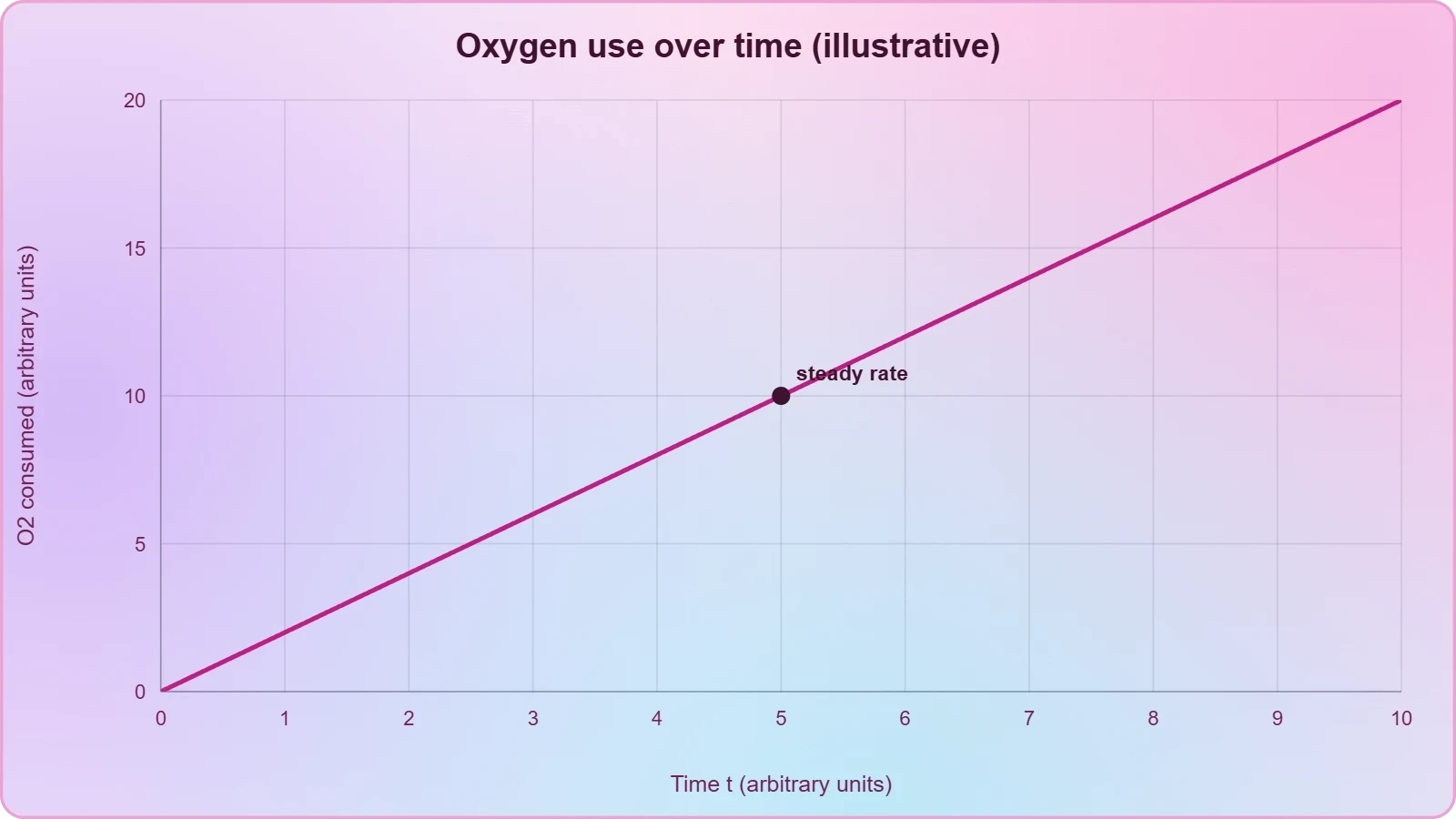
The logic can be expressed compactly. If a cell consumes oxygen at a rate ##R_{O_2}## and produces carbon dioxide at a rate ##R_{CO_2}##, then over a time interval ##t## the quantities involved are:
These quantities must be matched by exchange with the atmosphere. The equation is a bookkeeping statement rather than a new fact, but it makes the chapter's point exact: the exchange rate, not the total body store, determines whether the cell's needs are met. This is why the definition of breathing speaks of exchange with the atmosphere rather than of a single act of inhalation.
The Definition of Breathing
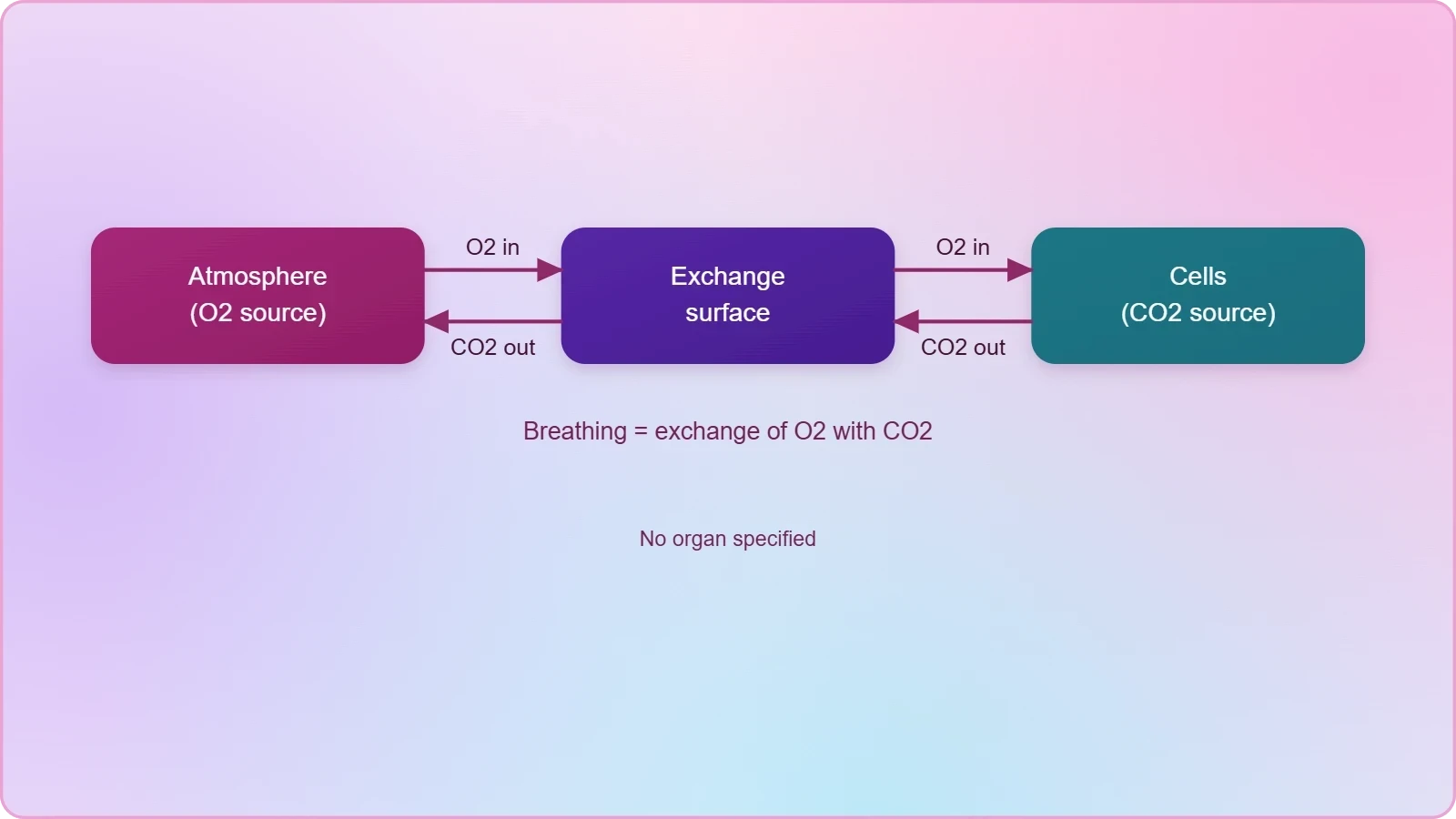
The process of exchange of oxygen from the atmosphere with carbon dioxide produced by the cells is called breathing, commonly known as respiration. The definition contains three elements that deserve separate attention. First, the exchange is between two defined parties: the atmosphere as source and sink, and the cells as consumer and producer. Second, the direction is fixed: oxygen inward, carbon dioxide outward. Third, the term respiration is used as the common name for this exchange, a usage the chapter adopts throughout and which learners should carry into later lessons.
It is worth noting what the definition does not say. It does not restrict breathing to lungs, to vertebrates, or to any particular organ, because the chapter immediately proceeds to show that mechanisms of breathing vary among different groups of animals. The definition is functional, not anatomical, and this generality is deliberate. It allows a sponge, an insect and a mammal to be described within a single framework, each achieving the same exchange by different means suited to its habitat and level of organisation.
Reading the Outward Sign: The Chest That Moves Up and Down
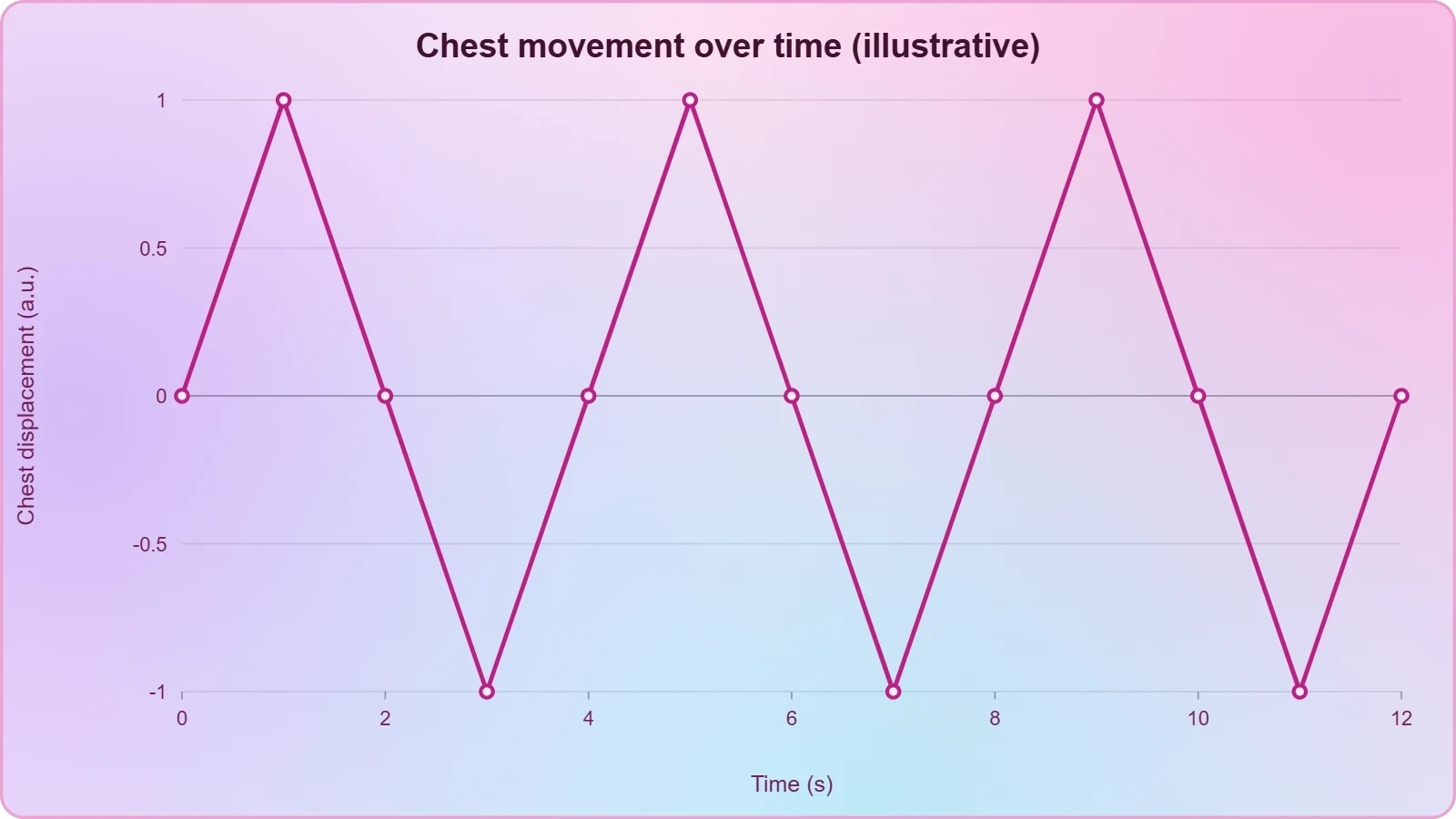
Place your hands on your chest; you can feel the chest moving up and down. You know that it is due to breathing. The chapter uses this everyday observation as its entry point, and the choice is pedagogically sound. Before any organ is named or any mechanism described, the learner is invited to notice the visible rhythm that accompanies the invisible exchange. The movement of the chest is not itself the exchange of gases, but it is the reliable external signature of the process that makes the exchange possible.
Observation Before Explanation
How do we breathe? The chapter poses this question immediately after the observation and then defers the answer, stating that the respiratory organs and the mechanism of breathing are described in the following sections. This deliberate postponement is worth respecting. The first lesson establishes the need and the definition; the machinery comes later. Learners who rush to the mechanism before grasping the purpose tend to memorise structures without understanding why they exist, and the chapter's order is designed to prevent exactly that.
The observation also carries a diagnostic value that becomes relevant in later lessons. Because the chest movement is regular, countable and externally visible, it provides a natural measure of breathing rate. The chapter will later treat respiratory volumes and capacities, and those quantities are ultimately read from the same visible rhythm. What begins here as a simple sensation on the palm becomes, in due course, a set of measurable physiological variables.
From Sensation to Principle
The step from feeling the chest to stating a principle is small but important. The sensation tells you that something moves; the definition tells you what that movement achieves. Air is drawn in so that oxygen from the atmosphere can reach the cells, and air is expelled so that carbon dioxide produced by the cells can leave the body. The up-and-down motion is therefore the transport leg of a longer chain whose endpoints are the atmosphere outside and the catabolic reactions inside the cell.
Keeping this chain in view prevents a common confusion. Breathing, as the chapter defines it, is not the same as the cellular breakdown of glucose, even though the two are intimately linked and the word respiration is used for both in ordinary language. The distinction will be sharpened in the "Going further" block below, where cellular respiration is described as the set of reactions inside cells that releases energy from food molecules, with breathing supplying the oxygen and removing the carbon dioxide.
Mechanisms of Breathing Vary Across Animal Groups
Mechanisms of breathing vary among different groups of animals, depending mainly on their habitats and levels of organisation. This single sentence governs the whole comparative survey that follows in the chapter, and it deserves to be treated as a principle rather than a preamble. Habitat determines the medium from which oxygen must be extracted, whether water or air, and level of organisation determines how elaborate the extracting structure can be. The diversity of respiratory organs is therefore not arbitrary but a set of solutions to two constraints acting together.
Simple Diffusion in Lower Invertebrates
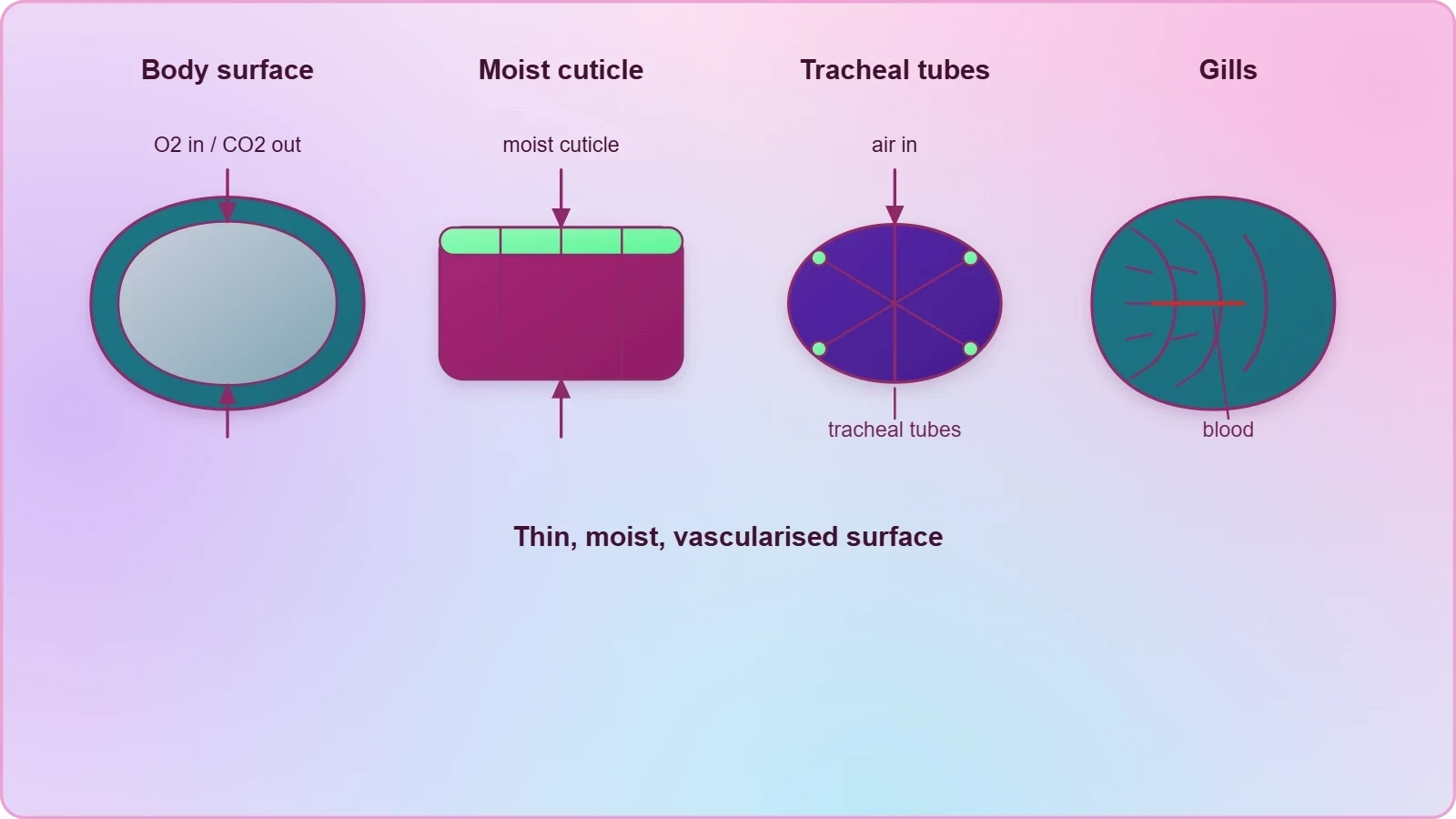
Lower invertebrates like sponges, coelenterates and flatworms exchange oxygen with carbon dioxide by simple diffusion over their entire body surface. No specialised organ is required because the body plan is simple and every cell lies close enough to the exterior for diffusion to suffice. The entire body surface functions as the respiratory surface. This is the most economical solution available, and it illustrates the general rule that specialised organs become necessary only when distance, size or metabolic demand outgrows what unaided diffusion can deliver.
The phrase "simple diffusion" should be read precisely. It refers to the spontaneous movement of gases across the body surface, driven by the difference in their concentrations between the environment and the interior of the organism. No pump, no blood, no tube is involved. The elegance of the arrangement lies in its directness: the exchange surface is the animal itself, and the medium surrounds it on all sides.
Cuticle, Tracheal Tubes, Gills and Lungs
Earthworms use their moist cuticle, and insects have a network of tubes, the tracheal tubes, to transport atmospheric air within the body. Special vascularised structures called gills, the basis of branchial respiration, are used by most aquatic arthropods and molluscs, whereas vascularised bags called lungs, the basis of pulmonary respiration, are used by terrestrial forms for the exchange of gases. Among vertebrates, fishes use gills, while amphibians, reptiles, birds and mammals respire through lungs. Amphibians like frogs can respire through their moist skin as well, a mode called cutaneous respiration.
Two features recur across these examples and are worth isolating. The first is vascularisation: gills and lungs are described as vascularised, meaning they are richly supplied with blood, which carries gases between the respiratory surface and the rest of the body. The second is moisture: the earthworm's cuticle is moist, the frog's skin is moist, and this is no accident, since respiratory surfaces must remain wet for gases to cross them. The tracheal tubes of insects represent a third strategy, delivering atmospheric air directly through a network of tubes rather than relying on a blood-borne carrier.
Habitat and Organisation as the Two Governing Constraints
The chapter's explanation for this diversity is compact and should be unpacked carefully. Mechanisms of breathing vary depending mainly on habitats and levels of organisation. Habitat decides the medium: aquatic animals must extract oxygen dissolved in water, while terrestrial forms draw it from air. Level of organisation decides the structural budget: a flatworm can afford to leave exchange to the body surface, whereas a large, active vertebrate cannot. The two constraints together explain why gills cluster among aquatic forms and lungs among terrestrial ones, and why simpler animals manage without either.
Water, Air and the Choice of Gills or Lungs
Gills are the characteristic solution of aquatic life, used by most aquatic arthropods and molluscs and by fishes among the vertebrates. Lungs are the characteristic solution of terrestrial life, used by amphibians, reptiles, birds and mammals. The correlation is strong enough to be stated as a rule, though the chapter is careful to note the exceptions that keep it from being absolute. Amphibians like frogs, for instance, respire through lungs but can also respire through their moist skin, a dual arrangement suited to an animal that divides its time between water and land.
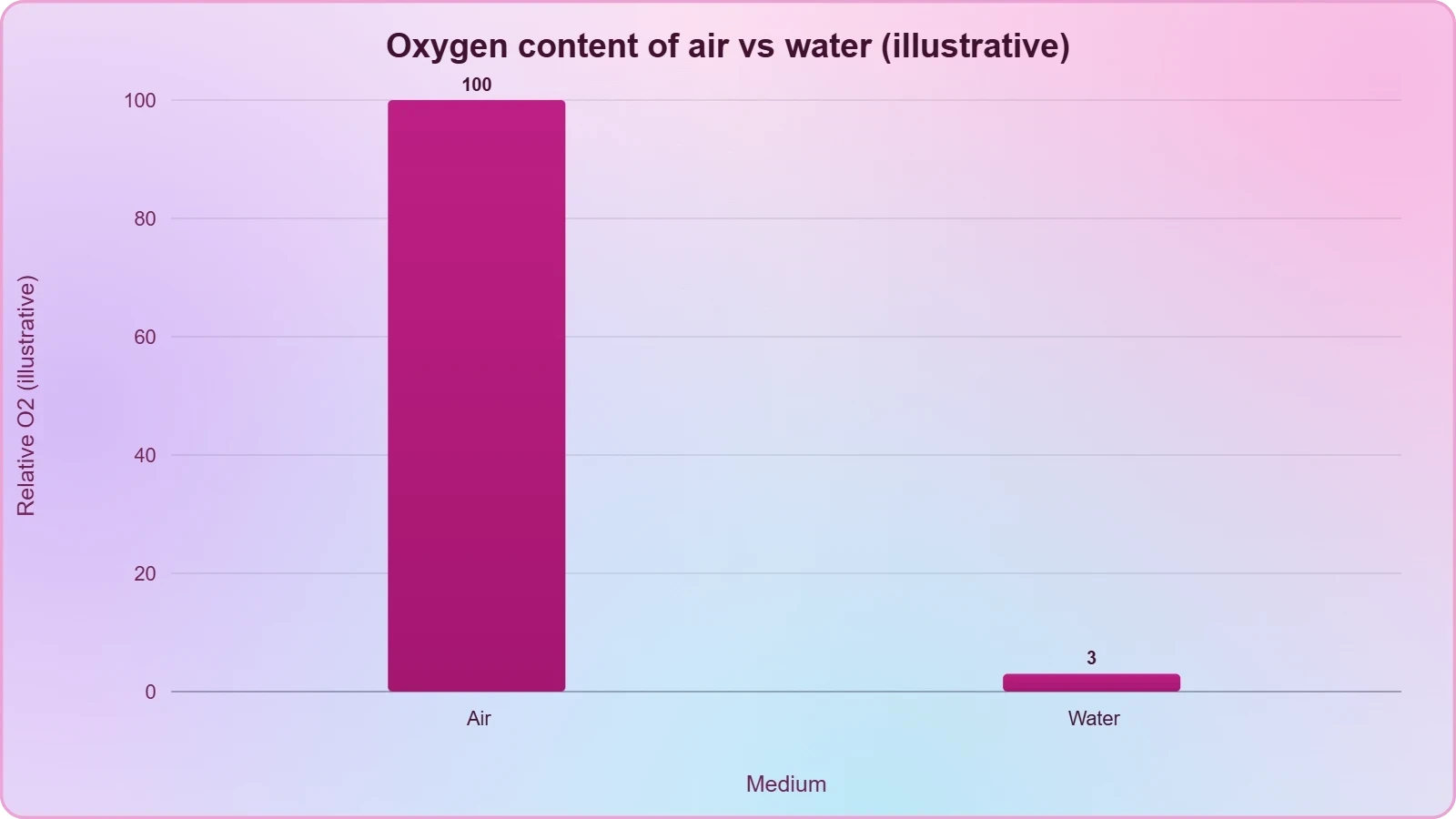
The reason for the correlation lies in the physical difference between the two media. Water holds far less oxygen than air and is denser, so an aquatic animal must pass a large volume of the surrounding medium over its respiratory surface, which is precisely what a gill is built to do. Air is richer in oxygen and easier to move, so a terrestrial animal can afford to internalise its exchange surface as a lung, protected from drying. The chapter does not develop this physics, but it is consistent with everything the chapter states.
Why Simplicity Persists
It would be a mistake to read the survey as a ladder of progress in which simple diffusion is primitive and lungs are advanced. Each arrangement is adequate for the animal that possesses it. Sponges, coelenterates and flatworms exchange gases over the entire body surface because their organisation permits it, and the arrangement costs them nothing in specialised structure. The earthworm's moist cuticle and the insect's tracheal tubes are equally serviceable solutions to the same problem, each matched to a particular body plan and way of life.
What changes across the groups is the distance over which gases must travel and the rate at which they must be delivered. As bodies become larger and metabolically more demanding, diffusion alone becomes insufficient, and vascularised structures or internal tube networks take over. The progression from body surface to cuticle to tracheal tubes to gills and lungs is therefore best read as a series of responses to increasing distance and demand, not as a ranking of sophistication.
Breathing and Respiration: One Word, Two Senses
The chapter states plainly that the exchange of oxygen from the atmosphere with carbon dioxide produced by the cells is called breathing, commonly known as respiration. This sentence does double duty. It names the process and it records the common usage, in which respiration serves as the everyday synonym for breathing. Learners should register the synonym without losing sight of the fact that the same word is used elsewhere for the cellular reactions that consume oxygen and release carbon dioxide. The context, not the word alone, tells you which sense is intended.
Keeping the Two Senses Apart
In this course, the term respiration in the chapter's own usage refers to the exchange of gases between the atmosphere and the cells. The cellular reactions that break down simple molecules and release energy are a distinct set of events, and the "Going further" block below treats them under the name cellular respiration. Holding the two apart is not pedantry; it clarifies why breathing is necessary in the first place. Breathing exists to serve the cellular reactions, supplying oxygen and removing the carbon dioxide they produce.
A useful discipline is to ask, whenever the word appears, which endpoint is being discussed. If the sentence concerns the movement of gases between the atmosphere and the body, it is breathing in the chapter's sense. If it concerns the breakdown of glucose, amino acids or fatty acids inside cells, it is the cellular process. The two are linked by a common currency of gases, and that link is the central theme of this lesson.
What the Definition Commits Us To
Accepting the definition commits the learner to several expectations that later lessons will fulfil. It commits us to a respiratory surface where the exchange occurs, whether body surface, cuticle, tracheal tube, gill or lung. It commits us to a mechanism that keeps the surface supplied with the appropriate medium, which is the subject of the mechanism of breathing. It commits us to transport between the surface and the cells, which is the subject of the transport of gases. And it commits us to regulation, since a continuous exchange must be continuously adjusted.
These commitments correspond to the chapter's own sequence: respiratory organs, mechanism of breathing, exchange of gases, transport of gases, regulation of respiration and disorders of the respiratory system. The first lesson therefore functions as a map. Having established why the exchange is needed and what it is called, the course can proceed to ask where it happens, how the medium is moved, how the gases cross, how they travel and how the whole arrangement is controlled.
Going Further: Cellular Respiration and the Visible Rhythm
The material above is the backbone of this lesson. The two notes that follow are well-established background, offered to deepen understanding and clearly separated from the chapter's own statements. Neither contradicts anything in the material; both explain why the material takes the shape it does. Read them as context rather than as additional definitions, and keep the chapter's terminology as the reference point for all later lessons in the course.
Cellular Respiration as the Client of Breathing
Cellular respiration is the set of reactions inside cells that releases energy from food molecules. Breathing supplies the oxygen that these reactions need and removes the carbon dioxide that they produce. This relationship explains the direction of the exchange described in the chapter: oxygen moves inward because the cells are consuming it, and carbon dioxide moves outward because the cells are generating it. The continuous character of breathing follows directly from the continuous character of the cellular reactions it serves.
Seen this way, the definition of breathing becomes a statement about logistics. The cells place a steady demand for oxygen and a steady burden of carbon dioxide, and the body must meet both without interruption. Every structure surveyed in the chapter, from the flatworm's body surface to the mammalian lung, is an answer to that logistical problem. The variety of answers reflects differences in habitat and organisation, while the problem itself is universal among the organisms considered.
The Chest Movement as the Outward Sign
The chest moving up and down, felt by placing hands on the chest, is the outward sign of breathing. It is the visible and tangible accompaniment of the gas exchange, not the exchange itself. Recognising this distinction helps the learner connect the everyday observation to the physiological definition: the movement is what we notice, the exchange is what it accomplishes. Later lessons will explain the mechanism behind the movement, but the observation recorded here remains the simplest available evidence that breathing is happening.
There is a practical benefit to this habit of observation. Because the rhythm is regular and countable, it gives the learner a personal reference point for the respiratory volumes and capacities treated later in the course. The same chest that rises and falls with each breath will be described in terms of the volume of air moved, and the connection between the felt rhythm and the measured quantity is easier to grasp when the observation has been made first-hand. The chapter's opening invitation to place your hands on your chest is, in this sense, an invitation to begin measuring.
Preparing for the Respiratory Organs
This lesson has established the need, the definition and the comparative principle. Oxygen is utilised by organisms to break down simple molecules and derive energy, carbon dioxide is released as a harmful by-product, and the exchange of atmospheric oxygen with cellular carbon dioxide is called breathing, commonly known as respiration. The mechanisms vary among animal groups depending mainly on habitats and levels of organisation, and the survey of body surfaces, cuticles, tracheal tubes, gills and lungs has shown how that principle plays out in practice.
The next lesson, Respiratory Organs Across Animal Groups, takes up the comparative survey in detail and prepares the ground for the human respiratory system that follows. Learners should arrive with the definition secure and with the correlation between habitat and organ clearly in mind. The observation of the chest moving up and down should also be retained, since it will reappear when the mechanism of breathing and the respiratory volumes are treated. Nothing in this lesson needs to be relearned; it needs to be carried forward intact.
A final word on method. The chapter's order of ideas is deliberate, moving from need to definition to comparative anatomy to mechanism to exchange to transport to regulation to disorder. Following that order is the surest way to retain the material, because each section answers a question raised by the one before it. The learner who understands why breathing matters is already equipped to ask where it happens, how the medium is moved, how the gases cross, how they travel and how the whole system is controlled.
Also Read
- No links available.
From our network :
- Analyzing Trump Deportation Numbers Insights Into The 2026 Immigration Crackdown
- 10 Physics Numerical Problems with Solutions for IIT JEEPrepare for IIT JEE with 10 physics numerical problems, complete with detailed solutions and conceptual explanations. Ideal for mastering kinematics, thermodynamics, electromagnetism, and optics.
- 98% of Global MBA Programs Now Prefer GRE Over GMAT Focus EditionExplore why 98% of global MBA programs now prefer the GRE over GMAT Focus. Learn about the shorter GRE format, verbal logic importance, and strategic versatility for students.
- Mastering DB2 12.1 Instance Design: A Technical Deep Dive into Modern Database ArchitectureComprehensive guide to DB2 12.1 Instance Design. Explore architectural components, HADR setup, buffer pool tuning, and security policies for IBM DB2 12.1. Includes 10 functional SQL and Shell samples.
- Vite 6/7 'Cold Start' Regression in Massive Module GraphsIn-depth analysis of Vite 6/7 cold start regressions in massive module graphs. Learn about barrel file issues, pre-bundling optimizations, and how to improve Vite dev server performance.
- Trump Political Strategy How Geopolitical Stunts Serve As Media Diversions
- AI-Powered 'Precision Diagnostic' Replaces Standard GRE Score ReportsDiscover the new GRE Precision Diagnostic. Learn how AI-powered behavioral analytics and time-to-solve tracking are replacing standard GRE score reports to empower students.
- Mastering DB2 LUW v12 Tables: A Comprehensive Technical GuideComprehensive guide on DB2 LUW v12 tables. Explore CREATE TABLE syntax, BLU Acceleration, range partitioning, data types, and security features for IBM DB2 LUW v12.
- EV 2.0: The Solid-State Battery Breakthrough and Global Factory ExpansionDiscover the impact of the Solid-State Battery Breakthrough on the EV market. Learn about CATL and BYD stock growth, global factory expansion in Europe, and the future of EV 2.0 technology.
RESOURCES
- unit 5 - human physiology - NCERTncert.nic.inOne of the major causes of this is cigarette smoking. Reprint 2026-27. Page 11. 191. BREATHING AND EXCHANGE OF GASES. SUMMARY. Cells utilise oxygen…
- Breathing and exchange of gases - Khan Academykhanacademy.org- Class 11. Unit 2: Breathing and exchange of gases. 4 skills. Mastered ... Breathing and exchange of gases: Unit test · The respiratory…
- Class 11 Biology: Breathing And Exchange Of Gases - Spotifyopen.spotify.comFor easy understanding of the concepts the entire lesson disucssion of Breathing & Exchange of gases is divided into 6-episodes. It is advisable to…
- Breathing and exchange of gases: Quiz 1 - Khan Academykhanacademy.orgReview the following recommended lessons to help you learn: {list of lessons covered by quiz}
- Breathing and Gas Exchange in Humans | PDF - Scribdscribd.comIntroduction to Breathing and Exchange of Gases; Respiratory Anatomy and ... Class 11 Breathing & Gas Exchange Notes. 27 pages. Class 11 Chemical ...
- NEET Biology - Breathing & Exchange Of Gases (NCERT 11thquizlet.comNEET Biology - Breathing & Exchange Of Gases (NCERT 11th - Chapter 17) ... Breathing and Exchange of Gases - NCERT class 11 flashcards.…
- BREATHING AND EXCHANGE OF GASES ZOOLOGY MED EASY ...scribd.comOR EXCHANGE OF GASES Factors Affecting Exchange of Gases 1, Thickness ... Class 11 Breathing & Gas Exchange Notes. 27 pages. Evolution Zoology Med…
- NCERT Solutions for Class 11 Biology Chapter 17 – Breathing and ...byjus.comFeb 19, 2023 ... respiratory system. Why? Solution: Alveoli are the small air sacs of the lungs that allow rapid gas exchange. These structures…
- Mechanism of Breathing and Exchange of Gases | CK-12 Foundationflexbooks.ck12.orgNov 1, 2026 ... This NCERT-aligned CBSE Class 11 Biology lesson explains the mechanism of breathing (pulmonary ventilation) in humans, ...
- Important Notes for NEET – Breathing and Exchange of Gasesbyjus.comThis process of gaseous exchange is called breathing or respiration. All the animals have different organs specialised for the gaseous exchange. Mode of gaseous ...
- Breathing and Exchange of Gases | Unacademyunacademy.comThese respiratory bronchioles also contain some alveoli and in turn subdivide into several alveolar ducts (about 2-11). y Alveolar ducts open in expanded areas ...
- Breathing and exchange of gases | PPTX - Slideshareslideshare.netRespiration involves the exchange of oxygen and carbon dioxide between the environment and body through breathing. It is a catabolic process where oxygen is ...
- Breathing and Exchange of Gases Ncert Highlight Ncert notes Every ...instagram.comOct 28, 2021 ... ... exchange of gases neet, ncert biology, ncert highlights, neet biology, neet biology notes, neet biology revision, class 11 biology,…
- Class 11th Breathing and Exchange of Gases Notes - Pinterestpinterest.comDiscover Pinterest's best ideas and inspiration for Class 11th breathing and exchange of gases notes. Get inspired and try out new things.
- Important Questions for Class 11 Biology Chapter 14 – Breathing ...vedantu.comAns: Alveoli of Lungs acts as primary site of exchange of gases. 14. Cigarette smoking causes emphysema. Give reason. Ans: Cigarette smoking harms alveolar ...