Breathing is a rhythm so constant that we rarely notice it until something interrupts it. The preceding lesson examined how the medulla's respiratory rhythm centre, the pneumotaxic centre of the pons, and the chemosensitive area sensitive to carbon dioxide and hydrogen ions keep that rhythm tuned to the body's demands. This lesson turns from regulation to breakdown: what happens when the airways, the alveoli, or the lung tissue itself are injured. Three groups of disorders are treated here — asthma, emphysema, and the occupational respiratory disorders produced by industrial dust — each described in the terminology and order of the source material.
The clinical importance of these conditions becomes clear when they are set against the normal architecture of gas exchange. Diffusion at the alveoli depends on partial pressure gradients of oxygen and carbon dioxide, on the solubility of the gases, and on the thickness and area of the diffusion surface. Asthma narrows the conducting airways; emphysema destroys alveolar walls and reduces the respiratory surface; dust-induced fibrosis thickens and stiffens lung tissue. Each disorder, in its own way, attacks one of the very factors that make efficient diffusion possible, which is why all three present as breathlessness.
Because this lesson builds directly on the neural regulation of respiration, it assumes familiarity with the rhythm centre, the chemosensitive area, and the receptors of the aortic arch and carotid artery. It does not repeat the mechanics of inspiration and expiration, the respiratory volumes and capacities, or the transport of oxygen as oxyhaemoglobin and carbon dioxide as bicarbonate and carbamino-haemoglobin. Instead, it asks what happens to breathing when the structures that carry out these processes are damaged, and it prepares the ground for the closing summary that will draw the chapter's threads together.
On This Page
- Asthma: Inflammation of the Bronchi and Bronchioles
- Emphysema: Damage to the Alveolar Walls
- Occupational Respiratory Disorders: Dust, Inflammation and Fibrosis
- Linking Disorder to the Physiology of Gas Exchange
- Prevention, Protection and the Limits of the Material
- Consolidating the Lesson: Definitions, Causes and Consequences
Asthma: Inflammation of the Bronchi and Bronchioles
Asthma is defined in the material as a difficulty in breathing that causes wheezing, arising from inflammation of the bronchi and bronchioles. The definition is deliberately compact, and each element of it deserves attention. The site of the problem is the conducting portion of the respiratory tract — the bronchi and their finer branches, the bronchioles — rather than the alveoli themselves. The mechanism named is inflammation. The consequence is difficulty in breathing, and the audible sign is wheezing, the whistling sound produced as air moves through narrowed airways.
The Conducting Airways as the Seat of the Disorder
Air must travel through the bronchi and bronchioles before it can reach the alveolar surface where diffusion occurs. When these passages are inflamed, their calibre is reduced, and the work of moving air in and out of the lungs rises accordingly. The material does not elaborate on the cellular events of inflammation, and this lesson keeps to its wording: inflammation of bronchi and bronchioles produces difficulty in breathing. What matters for the student is the location — the disorder sits upstream of gas exchange, in the plumbing rather than in the diffusion membrane itself.

This anatomical point explains why asthma is experienced chiefly as an effort to breathe rather than as a failure of oxygen uptake at the tissue level. The alveoli may be perfectly intact, and the partial pressure gradients across the diffusion surface may be entirely favourable, yet the patient still struggles because the airways that deliver air to that surface are narrowed. Recognising this distinction between airway obstruction and alveolar damage is the first step in distinguishing asthma from emphysema, the disorder considered next.
Wheezing as the Clinical Sign
Wheezing, the whistling sound that accompanies breathing in asthma, is the audible signature of airflow through narrowed tubes. The material lists it as the characteristic feature of the asthmatic difficulty in breathing, and it is worth treating the sign with the seriousness it deserves. A wheeze tells the listener that air is being forced through a passage that does not want to admit it, and it therefore points directly to obstruction within the bronchi and bronchioles. In examination settings, the pairing of "difficulty in breathing" with "wheezing" and "inflammation of bronchi and bronchioles" is the complete answer the material expects.
Emphysema: Damage to the Alveolar Walls
Emphysema is described in the material as a chronic disorder in which the alveolar walls are damaged, with the result that the respiratory surface is decreased. Cigarette smoking is named as one of the major causes. The definition is short but its logic is exact: the alveolar walls are the physical fabric across which the respiratory surface is spread, so damage to those walls necessarily shrinks the surface available for diffusion. Where asthma obstructs the delivery of air, emphysema removes the membrane at which the air would otherwise be exchanged.
Loss of Respiratory Surface and Its Consequences
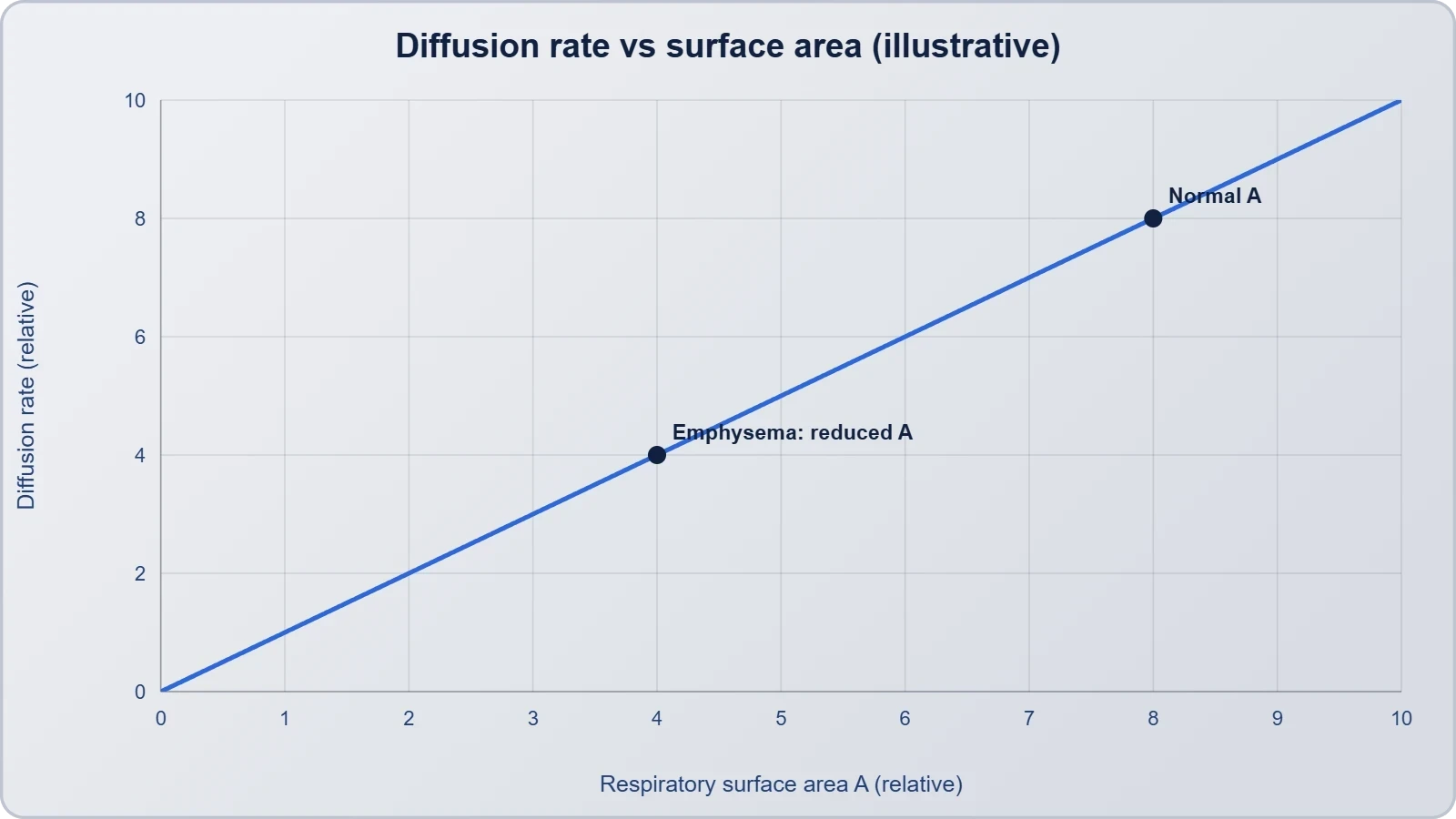
The respiratory surface is the total area over which oxygen and carbon dioxide diffuse between alveolar air and deoxygenated blood. The material's summary of gas exchange makes the dependence explicit: the rate of diffusion is governed by the partial pressure gradients of oxygen and carbon dioxide, their solubility, and the thickness of the diffusion surface. A decrease in surface area therefore strikes directly at one of the determinants of diffusion. Fewer and larger air spaces replace the many small alveoli, and the total area across which gas can move falls, so that the lungs become less able to oxygenate blood even when ventilation itself is adequate.

Because the disorder is chronic, the reduction in respiratory surface is not a transient event but a lasting structural change. The material does not describe the microscopic sequence by which alveolar walls are destroyed, and this lesson does not invent one. What it does insist upon is the causal chain the source supplies: alveolar walls damaged, respiratory surface decreased, gas exchange compromised. Students should be able to state that chain in that order, because it is the order in which the material presents the disorder and the order in which the physiology makes sense.
Cigarette Smoking as a Major Cause
The material identifies cigarette smoking as one of the major causes of emphysema, and this statement carries a preventive message as well as a descriptive one. Unlike asthma, where the material names no external agent, emphysema is linked explicitly to an avoidable exposure. The phrasing "one of the major causes" is careful: it does not claim that smoking is the only cause, but it places smoking at the centre of the aetiology. For the learner, the pairing of emphysema with cigarette smoking is as essential a fact as the pairing of asthma with inflammation of the bronchi and bronchioles.
Occupational Respiratory Disorders: Dust, Inflammation and Fibrosis
The material next turns to a third category: occupational respiratory disorders. In certain industries, especially those involving grinding or stone-breaking, so much dust is produced that the defence mechanism of the body cannot fully cope with the situation. Long exposure can give rise to inflammation leading to fibrosis, that is, proliferation of fibrous tissues, and thus causing serious lung damage. The material closes with a practical instruction: workers in such industries should wear protective masks. This is a disorder of the workplace, and its prevention is correspondingly a matter of workplace protection.
How Industrial Dust Overwhelms the Body's Defences
The respiratory system possesses defence mechanisms that ordinarily deal with the particles inhaled in everyday life, and the material's phrasing assumes this without detailing it. The critical point is one of scale: in grinding and stone-breaking, the quantity of dust produced is so great that these defences are overwhelmed. The body is not described as defenceless but as unable to cope fully with the load. This distinction matters, because it explains why the disorder is tied to particular occupations and to long exposure rather than to a single incident. Duration and intensity of exposure together determine the risk.
The sequence the material gives is precise and should be retained in its original order: long exposure gives rise to inflammation, inflammation leads to fibrosis, and fibrosis causes serious lung damage. Each link in that chain is a stage, not a synonym for the others. Inflammation is the earlier response; fibrosis is the later consequence, defined in the material as proliferation of fibrous tissues. Students who can reproduce this three-stage progression, with the definition of fibrosis attached to its middle term, will have captured the whole of the material's account of occupational lung disease.
Fibrosis and the Stiffening of Lung Tissue
Fibrosis, the proliferation of fibrous tissues, changes the character of the lung in a way that bears directly on the physiology of breathing. The material states that it causes serious lung damage; the mechanism by which that damage translates into breathlessness is best understood through the diffusion factors already established. A lung in which fibrous tissue has proliferated is a lung whose diffusion surface is thickened and whose tissue is stiffened, so that both the thickness of the diffusion membrane and the mechanical ease of breathing are affected. The result is a respiratory system that must work harder for less exchange.
Because the material presents fibrosis as the endpoint of prolonged occupational exposure, the protective mask it recommends is not a trivial afterthought but the logical conclusion of the whole section. If the disorder arises because dust overwhelms the body's defences, then reducing the inhaled dose at source is the most direct intervention available. The material's instruction that workers in such industries should wear protective masks should therefore be remembered alongside the pathology, as part of the same piece of knowledge rather than as a separate practical footnote.
Linking Disorder to the Physiology of Gas Exchange
The three disorders become far more intelligible when they are mapped onto the physiology established earlier in the chapter. Diffusion at the alveoli depends on partial pressure gradients, on the solubility of the gases, and on the thickness of the diffusion surface. Asthma compromises the delivery of air to that surface by inflaming the bronchi and bronchioles. Emphysema reduces the surface itself by damaging alveolar walls. Occupational fibrosis thickens and stiffens the tissue through proliferation of fibrous tissues. Each disorder therefore removes or degrades one of the conditions on which efficient exchange depends.
Diffusion Factors Under Attack
It is useful to express the dependence of diffusion on surface area and thickness in a compact form. The rate of diffusion across the alveolar membrane is proportional to the surface area available and inversely related to the thickness of the barrier, while the partial pressure gradient supplies the driving force. Written as a proportionality, this relationship can be stated as follows.
Here ##A## stands for the respiratory surface area, ##\Delta p## for the partial pressure gradient of the gas, and ##T## for the thickness of the diffusion surface. Emphysema attacks ##A## by damaging alveolar walls and decreasing the respiratory surface. Fibrosis attacks ##T## by proliferating fibrous tissue that thickens the barrier. Asthma, by narrowing the bronchi and bronchioles, impairs the maintenance of ##\Delta p## at the alveoli because fresh air is delivered less effectively. The equation is a teaching aid rather than a formula from the material, but it organises the three disorders around the very factors the material names.
Why Oxygen Transport and Regulation Matter Here
The earlier lessons on transport and regulation are not idle background in this context. Oxygen is carried mainly as oxyhaemoglobin, binding in the alveoli where ##pO_2## is higher and dissociating at the tissues where ##pO_2## is low and ##pCO_2## and ##H^+## concentration are high. A reduced respiratory surface or a narrowed airway lowers alveolar ##pO_2##, and haemoglobin loading suffers accordingly. Likewise, the chemosensitive area adjacent to the rhythm centre is highly sensitive to carbon dioxide and hydrogen ions, so a disorder that impairs carbon dioxide elimination will tend to stimulate the regulatory machinery. The material notes that the role of oxygen in regulating respiratory rhythm is quite insignificant, which sharpens the point: it is carbon dioxide and hydrogen ions that drive the adjustment.
Prevention, Protection and the Limits of the Material
The material's treatment of prevention is brief but pointed. For occupational disorders, it recommends that workers in dusty industries wear protective masks, a measure that follows directly from the recognition that the body's defences cannot cope with the dust load. For emphysema, the identification of cigarette smoking as a major cause carries an implicit preventive message, though the material does not spell out a programme of avoidance. For asthma, the material names no external cause and therefore offers no specific preventive instruction. The asymmetry is instructive: the material tells the reader what it knows and declines to speculate beyond it.
What the Material States and What It Leaves Open
A disciplined reading distinguishes sharply between the claims the material makes and the questions it leaves unanswered. It states that asthma is a difficulty in breathing causing wheezing due to inflammation of bronchi and bronchioles. It states that emphysema is a chronic disorder in which alveolar walls are damaged, decreasing the respiratory surface, with cigarette smoking as a major cause. It states that occupational dust exposure leads to inflammation, fibrosis and serious lung damage, and that protective masks should be worn. It does not describe treatments, diagnostic tests, or the cellular details of any of these processes, and this lesson does not supply them.
This restraint is not a weakness but a feature of good scientific writing at this level. The learner is given a clean, memorable set of definitions and causal chains, each anchored to a named structure and, where relevant, a named cause. The task of the examination candidate is to reproduce those definitions faithfully, using the material's own vocabulary: inflammation of bronchi and bronchioles, wheezing, alveolar walls damaged, respiratory surface decreased, cigarette smoking, grinding or stone-breaking, fibrosis as proliferation of fibrous tissues, and protective masks. Precision of language here is inseparable from precision of understanding.
Going further
Two pieces of well-established background help the material's descriptions come alive without altering them. First, fibrosis means proliferation of fibrous tissue, and such tissue can stiffen the lungs and make breathing harder; this is why the material's phrase "serious lung damage" is more than a formality, since a stiffer lung demands greater muscular effort during inspiration. Second, wheezing is a whistling sound made during breathing, often when the airways are narrowed; this explains why the material pairs wheezing so closely with the inflammation of bronchi and bronchioles in asthma. Both points are offered as context, not as additions to the material's own claims.
Consolidating the Lesson: Definitions, Causes and Consequences
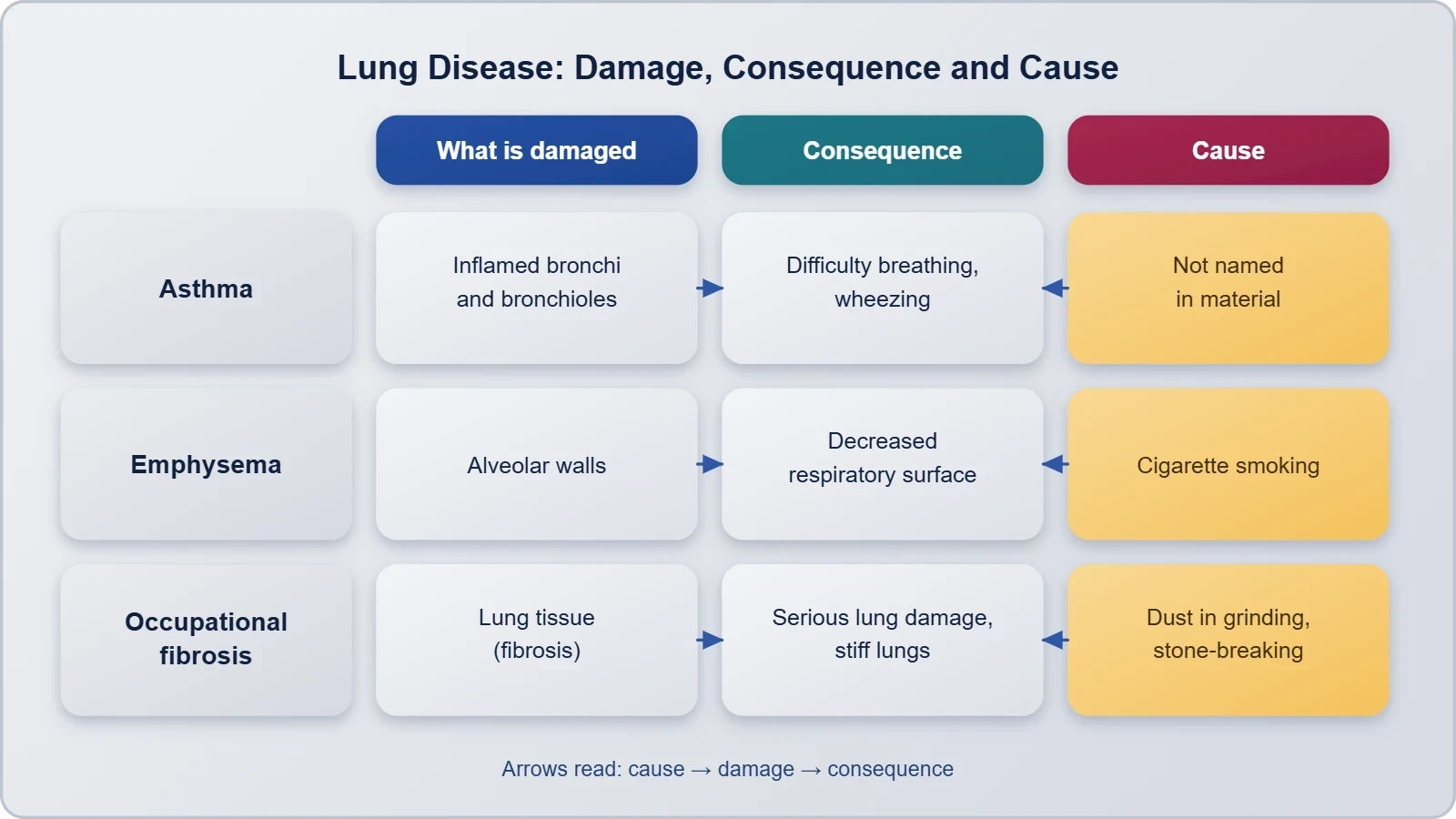
This lesson has covered three disorders of the respiratory system, each defined in the material's own terms. Asthma is a difficulty in breathing causing wheezing due to inflammation of bronchi and bronchioles. Emphysema is a chronic disorder in which alveolar walls are damaged, decreasing the respiratory surface, with cigarette smoking as a major cause. Occupational respiratory disorders arise where dust from grinding or stone-breaking overwhelms the body's defences, and long exposure gives rise to inflammation leading to fibrosis and serious lung damage, so that workers in such industries should wear protective masks. These definitions, causes and consequences form the core of what must be retained.
A Compact Revision Framework
The most efficient way to hold these facts is to organise them around three questions: what is damaged, what is the consequence, and what is the cause. For asthma, the bronchi and bronchioles are inflamed, the consequence is difficulty in breathing with wheezing, and no cause is named. For emphysema, the alveolar walls are damaged, the consequence is a decreased respiratory surface, and cigarette smoking is a major cause. For occupational disorders, the lung tissue undergoes inflammation and fibrosis after dust exposure, the consequence is serious lung damage, and the cause is industrial dust. Answering the three questions for each disorder reproduces the material almost completely.
It also helps to connect each disorder to the physiology of the preceding lessons. The respiratory rhythm centre in the medulla, moderated by the pneumotaxic centre in the pons and informed by the chemosensitive area sensitive to carbon dioxide and hydrogen ions, will respond to any disorder that impairs gas exchange by adjusting the respiratory process. The receptors associated with the aortic arch and carotid artery likewise recognise changes in carbon dioxide and hydrogen ion concentration. A disorder of the respiratory system is therefore never merely a local problem; it is a disturbance of the whole regulated system that the previous lesson described.
Preparing for the Chapter Summary
The next lesson draws the chapter together, and this one has supplied the final substantive content it will need. The summary will revisit breathing as the first step of respiration, the pressure gradients created by the intercostals and diaphragm, the respiratory volumes measured with a spirometer, diffusion driven by partial pressure gradients, the transport of oxygen as oxyhaemoglobin and of carbon dioxide as bicarbonate and carbamino-haemoglobin, and the neural regulation of rhythm. To these, this lesson adds the disorders: asthma, emphysema and the occupational lung diseases caused by dust. A learner who can move fluently between the normal physiology and these three forms of breakdown will be well prepared for the closing synthesis.
Finally, the material's emphasis on prevention deserves to be carried forward. The recommendation of protective masks for workers in dusty industries, and the identification of cigarette smoking as a major cause of emphysema, both point to the same principle: where a cause is known and avoidable, the most valuable knowledge is the knowledge that avoids it. The physiology of breathing and exchange of gases is, in the end, the physiology of a system that works silently and continuously, and the disorders studied here show how much is lost when any part of that system is damaged.
Also Read
- No links available.
From our network :
- AI-Powered 'Precision Diagnostic' Replaces Standard GRE Score ReportsDiscover the new GRE Precision Diagnostic. Learn how AI-powered behavioral analytics and time-to-solve tracking are replacing standard GRE score reports to empower students.
- Mastering DB2 12.1 Instance Design: A Technical Deep Dive into Modern Database ArchitectureComprehensive guide to DB2 12.1 Instance Design. Explore architectural components, HADR setup, buffer pool tuning, and security policies for IBM DB2 12.1. Includes 10 functional SQL and Shell samples.
- 10 Physics Numerical Problems with Solutions for IIT JEEPrepare for IIT JEE with 10 physics numerical problems, complete with detailed solutions and conceptual explanations. Ideal for mastering kinematics, thermodynamics, electromagnetism, and optics.
- Mastering DB2 LUW v12 Tables: A Comprehensive Technical GuideComprehensive guide on DB2 LUW v12 tables. Explore CREATE TABLE syntax, BLU Acceleration, range partitioning, data types, and security features for IBM DB2 LUW v12.
- Analyzing Trump Deportation Numbers Insights Into The 2026 Immigration Crackdown
- EV 2.0: The Solid-State Battery Breakthrough and Global Factory ExpansionDiscover the impact of the Solid-State Battery Breakthrough on the EV market. Learn about CATL and BYD stock growth, global factory expansion in Europe, and the future of EV 2.0 technology.
- Trump Political Strategy How Geopolitical Stunts Serve As Media Diversions
- 98% of Global MBA Programs Now Prefer GRE Over GMAT Focus EditionExplore why 98% of global MBA programs now prefer the GRE over GMAT Focus. Learn about the shorter GRE format, verbal logic importance, and strategic versatility for students.
- Vite 6/7 'Cold Start' Regression in Massive Module GraphsIn-depth analysis of Vite 6/7 cold start regressions in massive module graphs. Learn about barrel file issues, pre-bundling optimizations, and how to improve Vite dev server performance.
RESOURCES
- Resources will be updated soon.