Phylum Echinodermata occupies a distinctive position within the animal kingdom, and for good reason. These are exclusively marine organisms whose bodies are built around an internal skeleton of calcareous ossicles, a construction that gives the group its name — literally "spiny-bodied." Every starfish on a rock pool ledge, every sea urchin lodged in a crevice, and every sea cucumber resting on the sea floor belongs to this phylum. What unites them is not merely appearance but a shared architecture: organ-system level of organisation, triploblastic and coelomate bodies, and a radial symmetry in adults that gives way to bilateral symmetry in their larvae.
This lesson, the eighteenth in a systematic survey of Animalia, builds directly on the molluscan body plan examined previously and prepares the ground for the hemichordates that follow. The emphasis here rests on the features that define echinoderms as a group: the calcareous endoskeleton, the unusual symmetry that shifts between larval and adult life, the complete digestive tract with its ventral mouth and dorsal anus, and above all the water vascular system — a hydraulic network that manages locomotion, food capture, food transport and respiration simultaneously. The absence of an excretory system is equally instructive, and it will be examined alongside the reproductive biology of the phylum.
Students preparing for Class 11 and 12 examinations will find that echinoderms reward careful attention. The phylum is compact enough to master in a single sitting, yet it contains several features that examiners return to repeatedly: the ossicle-based endoskeleton, the indirect development through free-swimming larvae, external fertilisation, and the five named examples that anchor the classification. The comparative tables in this lesson place these traits beside neighbouring phyla so that the distinctions remain sharp rather than blurred.
On This Page
- The Identity of Echinoderms: Spiny Bodies and Calcareous Ossicles
- The Water Vascular System: Hydraulics at the Heart of the Phylum
- Digestive Anatomy and the Ventral–Dorsal Axis
- Reproduction, Fertilisation and Indirect Development
- The Five Classes and Their Representative Examples
- Comparative View: Echinoderms Beside Molluscs and Hemichordates
The Identity of Echinoderms: Spiny Bodies and Calcareous Ossicles
The name Echinodermata translates directly from its Greek roots as "spiny-bodied," and the designation is not decorative. Beneath the skin of every member of this phylum lies an endoskeleton constructed from calcareous ossicles — small plates and spicules of calcium carbonate that provide structural support and, in many species, project outward as spines. This internal skeleton distinguishes echinoderms from animals whose support comes from an external shell or from hydrostatic pressure alone. The ossicles are mesodermal in origin, sitting within the body wall rather than on its surface, which is why the skeleton is described as internal despite the spiny exterior it often produces.
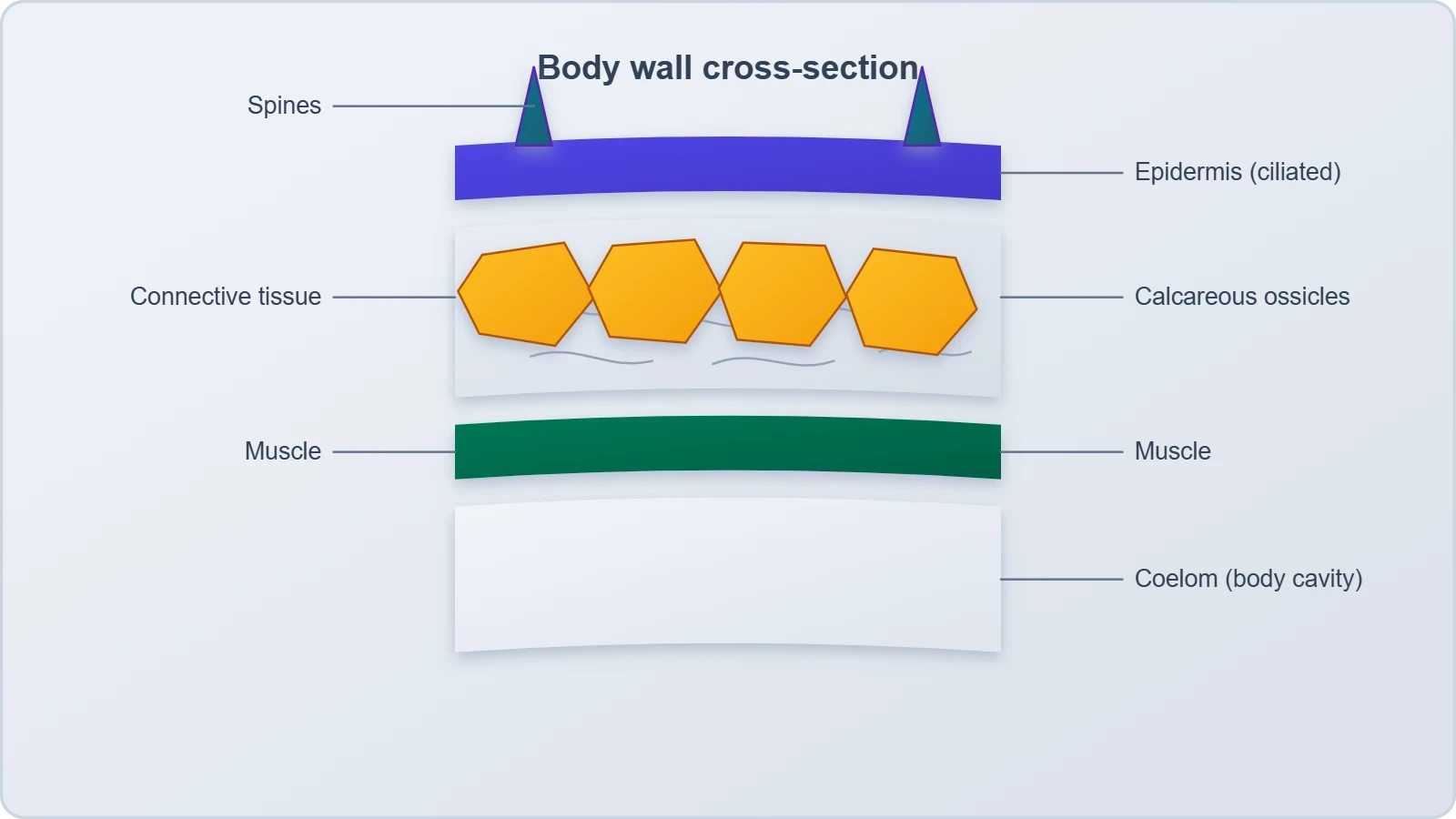
All echinoderms are marine. No freshwater species and no terrestrial species exist within the phylum, a restriction that shapes everything about their biology, from respiration to reproduction. They display the organ-system level of organisation, meaning their tissues are grouped into discrete organs that cooperate within functional systems. This places them alongside molluscs and chordates rather than among the simpler diploblastic animals. The combination of a calcareous endoskeleton, an exclusively marine habitat and organ-system organisation forms the first layer of the phylum's identity.
Symmetry: Radial Adults, Bilateral Larvae
The symmetry of echinoderms is one of the most examined facts in the entire animal kingdom syllabus. Adult echinoderms are radially symmetrical, their body parts arranged around a central axis, typically in fivefold or pentaradial fashion. This radial plan suits a largely sedentary or slow-moving marine existence, allowing the animal to sense and respond to its environment from all directions at once. Yet the radial adult does not begin life that way, and the contrast between the two stages is precisely what examiners test.
Echinoderm larvae are bilaterally symmetrical. They swim freely through the plankton, with a distinct front and back, left and right — a body plan suited to directed movement through open water. Only later, through metamorphosis, does the radial adult form emerge. This shift from bilateral larva to radial adult is a striking illustration of the principle that symmetry is not fixed across a life cycle. It also offers indirect evidence of the phylum's evolutionary history, since bilateral ancestry is preserved in the larval stage even as the adult adopts a radial arrangement.
Germ Layers and the Coelom
Echinoderms are triploblastic, possessing all three germ layers — ectoderm, mesoderm and endoderm — during embryonic development. The mesoderm gives rise not only to the musculature and the calcareous ossicles but also to the coelomic lining, and the coelom itself is unusually extensive in this phylum. These animals are coelomate, meaning a true body cavity lined by mesoderm separates the gut from the body wall. The spacious coelom houses the internal organs and contributes to the hydraulic systems that make echinoderm locomotion possible.
The combination of triploblastic organisation and a true coelom places echinoderms firmly among the higher invertebrates. Segmentation, notably, is absent — a point worth marking because it separates echinoderms from annelids and arthropods, where metameric repetition of body units is a defining trait. The echinoderm body is not built from repeated segments but from a radial arrangement of organ systems around a central axis. This absence of segmentation, together with the coelomate and triploblastic condition, completes the fundamental body-plan description of the phylum.
The Water Vascular System: Hydraulics at the Heart of the Phylum
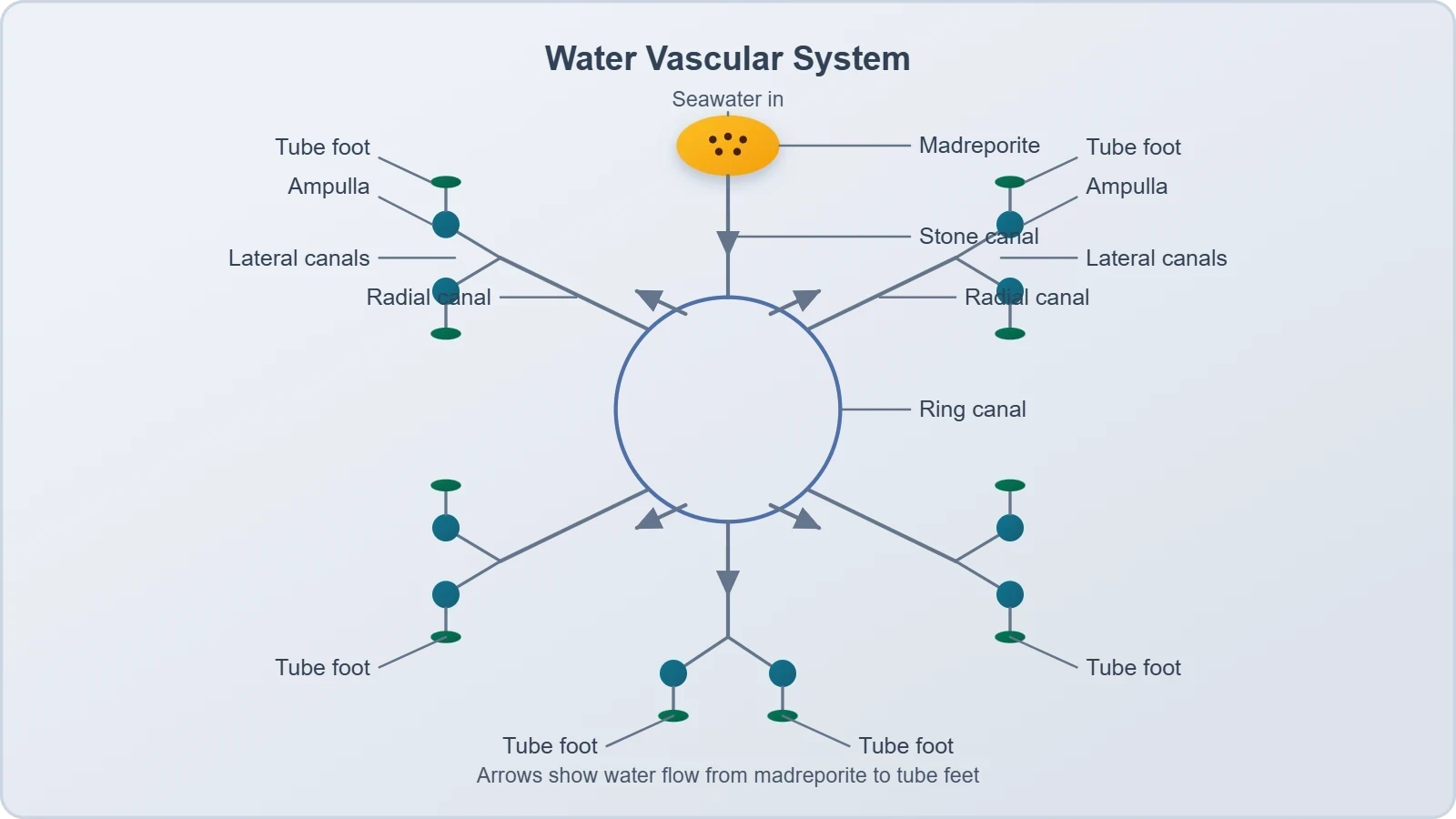
The most distinctive feature of echinoderms is the water vascular system, a network of fluid-filled canals that performs several functions at once. This system helps in locomotion, in the capture and transport of food, and in respiration. No other phylum possesses an arrangement quite like it, which is why the water vascular system is treated as the diagnostic character of Echinodermata. Its canals are derived from the coelom and operate hydraulically: fluid pressure extends and retracts the tube feet that line the ambulacral grooves, allowing the animal to grip surfaces, creep across the sea floor and manipulate prey.
The functional versatility of this system deserves emphasis. A single hydraulic network serves movement, feeding and gas exchange simultaneously, which is an economical solution for an animal with no gills in the conventional sense and no excretory organs. When a starfish prises open a bivalve shell, the tube feet provide the grip; when it transports digested material toward the mouth, the same system assists; and across the thin walls of the tube feet, dissolved gases are exchanged with seawater. The water vascular system thus unifies several physiological roles within one anatomical structure.
Locomotion, Feeding and Respiration Combined
Locomotion in echinoderms is slow but remarkably powerful. The tube feet operate in coordinated waves, each foot extending under hydraulic pressure, attaching to the substrate, contracting to pull the body forward, then releasing. Because the feet are arranged along the radial arms or around the body, movement can proceed in any direction without the animal turning. This arrangement suits the radial body plan perfectly and explains how starfish can glide across rock and how sea urchins can move across the sea floor or bore into soft substrates.
Feeding relies on the same apparatus. The capture and transport of food are functions explicitly attributed to the water vascular system, and in many species the tube feet pass food particles along the ambulacral grooves toward the mouth. Respiration occurs through the general body surface and the thin-walled tube feet, where the fluid within the system is separated from seawater by only a delicate membrane. The absence of a separate respiratory organ is compensated by this distributed exchange across the body surface and the hydraulic appendages.
The Absence of an Excretory System
An excretory system is absent in echinoderms. This is a notable departure from the pattern seen in molluscs, annelids and most other coelomate invertebrates, where specialised organs such as nephridia or kidneys remove nitrogenous waste. Instead, echinoderms rely on diffusion across the body surface and the walls of the water vascular system, together with the activities of amoebocyte cells that wander through the coelomic fluid and body tissues, collecting and removing waste materials. The arrangement is simple but effective for marine animals with relatively low metabolic rates.
For examination purposes, the absence of an excretory system should be memorised as a defining negative character of the phylum. Negative characters — features that are conspicuously missing — are as diagnostic as positive ones, and examiners frequently test whether students can distinguish echinoderms from molluscs on precisely this point. The molluscan lesson established the presence of specialised excretory organs; the echinoderm lesson removes them. This contrast reinforces the comparative method that runs through the entire survey of animal phyla.
Digestive Anatomy and the Ventral–Dorsal Axis
The digestive system of echinoderms is complete, running from a mouth to an anus without interruption. What makes the arrangement distinctive is its orientation: the mouth lies on the lower, ventral side of the body, while the anus opens on the upper, dorsal side. This vertical passage of the gut through the body is a direct consequence of the radial plan, in which the oral surface faces the substrate and the aboral surface faces upward. Food is taken in from below and waste is expelled above, a configuration that students should visualise clearly because it is frequently examined.
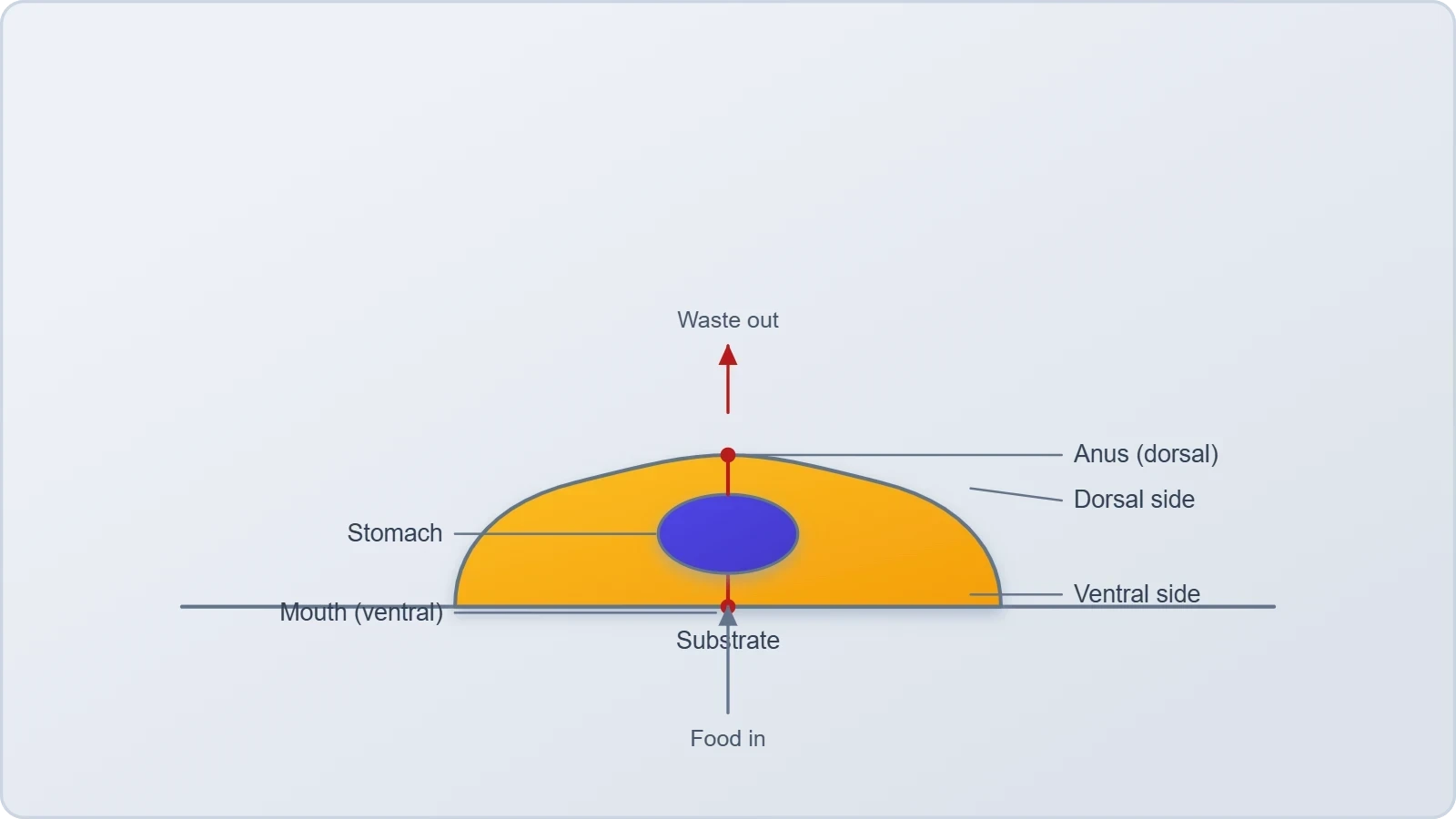
A complete digestive tract represents an advance over the gastrovascular cavity of simpler animals. It permits one-way flow of food, regional specialisation along the gut, and the separation of ingestion from egestion. In echinoderms the tract typically includes a mouth, oesophagus, stomach, intestine and anus, though the precise proportions vary across the five classes. The ventral mouth and dorsal anus remain constant, however, and this constancy is one of the reliable identifying features of the phylum when specimens are examined in the laboratory.
Feeding Diversity Across the Phylum
Although the basic gut plan is shared, feeding habits differ widely among echinoderms. Starfish are often predatory, using their tube feet to grip prey and, in some species, everting the stomach through the mouth to digest food externally before drawing it back. Sea urchins graze on algae, scraping surfaces with a complex jaw apparatus. Sea cucumbers ingest sediment and extract organic matter from it, while sea lilies filter food from the water with their feathery arms. Brittle stars scavenge and feed on small particles. The complete gut accommodates all these strategies.
This diversity of feeding illustrates how a single anatomical plan can support varied ecological roles. The ventral mouth and dorsal anus remain fixed, but the structures associated with them — jaws, stomachs, filtering arms — are modified according to diet. For students, the lesson is that classification rests on fundamental architecture rather than on feeding habit. Two echinoderms that eat entirely different things still share the same body plan, the same water vascular system and the same calcareous endoskeleton, and it is these shared features that define the phylum.
Organ-System Organisation in Practice
The organ-system level of organisation means that echinoderm tissues are grouped into organs, and organs into systems that perform discrete functions. The digestive system handles nutrition; the water vascular system handles locomotion, feeding assistance and respiration; the reproductive system handles gamete production and release. Each system operates with a degree of independence, yet all are integrated within the coelomic body cavity. This level of organisation places echinoderms among the more complex invertebrates and aligns them with molluscs and chordates in the hierarchy of animal complexity.
It is worth noting what the phylum lacks as well as what it possesses. There is no excretory system, as established, and there are no specialised respiratory organs comparable to gills or lungs. The circulatory apparatus is reduced, with the coelomic fluid and the water vascular system assuming much of the transport burden. These absences do not indicate simplicity so much as a different evolutionary solution: the echinoderm body achieves its physiological needs through hydraulic and diffusive mechanisms rather than through the concentrated organs found in other coelomate groups.
Reproduction, Fertilisation and Indirect Development
Sexes are separate in echinoderms, and reproduction is sexual. Fertilisation is usually external, occurring in the surrounding seawater where gametes are released and meet. This mode of reproduction is well suited to a marine existence: adults shed eggs and sperm into the water column, and the resulting zygotes develop without parental care. External fertilisation is common among marine invertebrates generally, but in echinoderms it is the norm rather than an exception, and it ties the phylum to its oceanic habitat in a direct physiological way.
Development is indirect, proceeding through free-swimming larval stages before metamorphosis produces the radial adult. The larva is bilaterally symmetrical, as established earlier, and its free-swimming existence disperses the species across the sea floor. Indirect development of this kind means the animal passes through a body plan markedly different from its adult form, and the transition is accomplished by metamorphosis. For students, the sequence — separate sexes, external fertilisation, free-swimming larva, metamorphosis into a radial adult — should be learned as an ordered chain of events.
From Bilateral Larva to Radial Adult
The transformation from bilateral larva to radial adult is one of the most instructive life-cycle transitions in the animal kingdom. The larva swims with a definite orientation, feeding and dispersing in the plankton. Upon settling, it undergoes metamorphosis, during which the adult rudiment develops and the larval tissues are largely reorganised. The radial symmetry of the adult emerges from this reorganisation, and the water vascular system takes on its mature form. The bilateral symmetry of the larva is not lost so much as subordinated to the new radial plan of the adult body.
This transition has evolutionary implications that extend beyond the phylum. The presence of bilateral larvae in a radially symmetrical adult group suggests that radial symmetry in echinoderms is a secondary condition, derived from bilateral ancestors rather than primitive. The larval stage preserves the ancestral plan, while the adult adopts a specialised radial arrangement suited to a slow-moving marine life. This interpretation is widely accepted and helps explain why echinoderms, despite their radial appearance, are classified among the bilaterian animals in broader schemes of animal phylogeny.
Ecological and Practical Significance
Echinoderms play substantial roles in marine ecosystems. Starfish are significant predators of bivalves and can alter the composition of rocky-shore communities when their numbers change. Sea urchins graze on algae and, when abundant, can transform kelp forests into barren ground. Sea cucumbers process sediment and recycle nutrients on the sea floor. Brittle stars are among the most abundant animals in some deep-sea habitats. These ecological functions give the phylum an importance that far exceeds the modest number of species it contains.
From a practical standpoint, echinoderms are also valuable in research and in the classroom. Their embryos and larvae are widely used in developmental biology because they are transparent, abundant and easy to obtain. Sea urchin gametes have contributed to fundamental discoveries in fertilisation and cell division. For students, preserved specimens of starfish and sea urchins are standard laboratory material, and the external features of these animals — the radial arms, the spines, the tube feet — can be examined directly, reinforcing the anatomical facts learned from the textbook.
The Five Classes and Their Representative Examples
The phylum Echinodermata is conventionally illustrated through five named examples, each representing a distinct class. Asterias is the star fish, with its familiar five arms radiating from a central disc. Echinus is the sea urchin, a compact globular animal covered in movable spines. Antedon is the sea lily, a stalked or free-living form with feathery arms that filter food from the water. Cucumaria is the sea cucumber, an elongated soft-bodied animal that lies on its side on the sea floor. Ophiura is the brittle star, with long slender arms that move with remarkable agility.
These five examples should be learned with their common names attached, because examination questions frequently ask students to identify the animal from its scientific name or vice versa. The star fish and the brittle star are easily confused by name, so the distinction should be fixed firmly: Asterias is the star fish, Ophiura the brittle star. The sea lily, Antedon, is the least familiar of the five to most students, yet it is the one that most closely resembles the ancestral echinoderm condition, with its stalk and feathery feeding arms.
Distinguishing Features of Each Class
Each class modifies the basic echinoderm plan in a characteristic way. Star fish have broad arms containing extensions of the digestive and reproductive systems. Sea urchins have fused ossicles forming a rigid test, with spines mounted on it. Sea lilies retain a stalk in many forms and use their arms for filter feeding. Sea cucumbers have reduced ossicles, a leathery body wall and a elongated form. Brittle stars have a small central disc and long flexible arms that allow rapid movement. These differences illustrate how the shared body plan is adapted across the class.
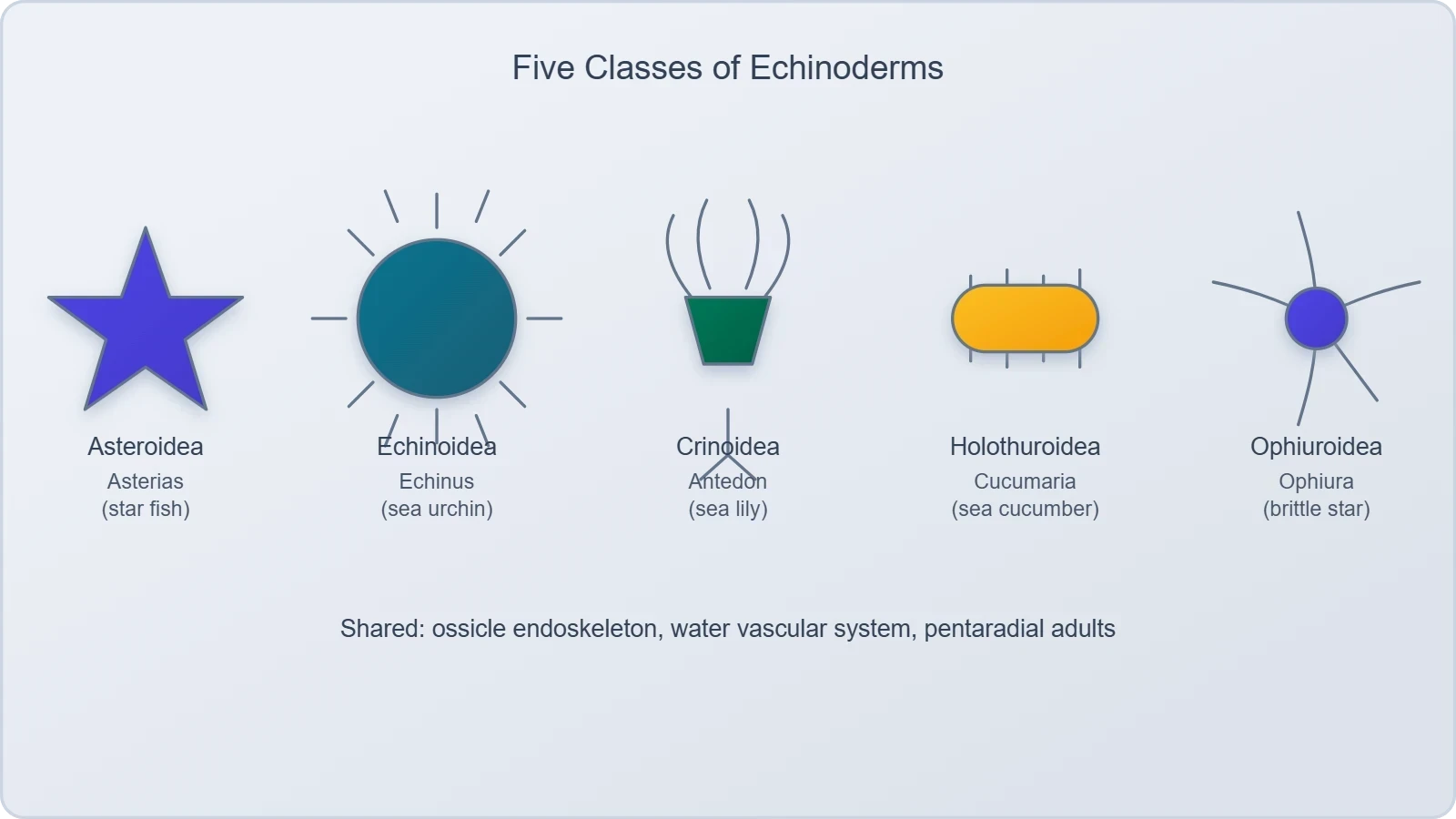
For the purposes of this lesson, the essential point is that all five examples share the defining features of the phylum: the calcareous endoskeleton, the water vascular system, the radial adult symmetry, the complete gut with ventral mouth and dorsal anus, and the absence of an excretory system. The class-level differences are matters of proportion and modification, not of fundamental design. Students who grasp this principle will be able to place any unfamiliar echinoderm within the phylum by checking the shared characters rather than relying on superficial resemblance.
Position of Echinodermata Among the Phyla
Echinodermata follows Mollusca in the survey of animal phyla and precedes Hemichordata. The sequence is not arbitrary: it moves from animals with a soft unsegmented body and a shell, through animals with a calcareous endoskeleton and radial symmetry, to animals with a rudimentary stomochord that anticipates the notochord of the chordates. Each phylum prepares the ground for the next, and the echinoderms occupy a pivotal position because their larvae are bilateral while their adults are radial, bridging the two symmetry conditions that dominate animal classification.
The contrast with the preceding lesson is instructive. Molluscs possess a specialised excretory system, a reduced coelom and, in most cases, a shell secreted by the mantle. Echinoderms possess no excretory system, an extensive coelom and an internal skeleton of ossicles. The contrast with the following lesson is equally sharp: hemichordates are bilaterally symmetrical throughout life and possess a stomochord, a structure resembling the notochord. Echinoderms, standing between these two groups, are bilateral only in their larval stage and possess no structure resembling a notochord at any point in their life cycle.
Comparative View: Echinoderms Beside Molluscs and Hemichordates
Placing echinoderms beside their neighbours sharpens the defining characters of each group. Molluscs, treated in the previous lesson, are soft-bodied and typically unsegmented, with a mantle that secretes a shell in most species, a reduced coelom and specialised excretory organs. Echinoderms are also unsegmented, but they possess a calcareous endoskeleton, an extensive coelom, a water vascular system and no excretory organs at all. The two phyla share the organ-system level of organisation and a marine distribution, yet their internal architectures diverge sharply.
Hemichordates, treated in the next lesson, are worm-like marine animals with organ-system organisation, bilateral symmetry throughout life, triploblastic and coelomate bodies, an open circulatory system, gills for respiration and a proboscis gland as the excretory organ. They possess a stomochord in the collar region, a structure similar to the notochord. The contrast with echinoderms is instructive: hemichordates retain bilateral symmetry as adults, possess an excretory organ and lack both the calcareous endoskeleton and the water vascular system that define the echinoderms.
Shared Characters and Divergent Solutions
All three phyla share the organ-system level of organisation, triploblastic development and a true coelom. These shared characters reflect their common position among the higher invertebrates. What differs is the solution each has found to the problems of support, movement, feeding and waste removal. Molluscs rely on a shell and a muscular foot; echinoderms on a calcareous endoskeleton and hydraulic tube feet; hemichordates on a hydrostatic body and gills. The comparison shows that the same fundamental grade of organisation can support markedly different body plans.
For examination preparation, the comparative approach is more efficient than isolated memorisation. A student who understands why echinoderms lack an excretory system while molluscs possess one, and why hemichordates retain bilateral symmetry while echinoderms do not, will retain the facts far longer than one who learns them as disconnected lists. The tables in this lesson are designed to support exactly this kind of comparative recall, placing the three phyla side by side so that the distinctive characters of each stand out clearly against the shared background.
Consolidating the Lesson
The essential facts of Phylum Echinodermata can now be assembled into a coherent picture. These are marine animals with an endoskeleton of calcareous ossicles, organ-system level of organisation, radial symmetry in adults and bilateral symmetry in larvae, triploblastic and coelomate bodies, a complete digestive system with a ventral mouth and dorsal anus, a distinctive water vascular system serving locomotion, food capture and transport and respiration, no excretory system, separate sexes, sexual reproduction, usually external fertilisation and indirect development with a free-swimming larva. The five examples are Asterias, Echinus, Antedon, Cucumaria and Ophiura.
Students should test their understanding by attempting to reconstruct this list from memory and then checking it against the lesson. Particular attention should be paid to the negative character — the absence of an excretory system — and to the symmetry shift between larva and adult, since these are the features most likely to appear in examination questions. The water vascular system should be understood functionally rather than merely named, because questions often ask what the system does rather than what it is called. With these points secure, the phylum is fully mastered and the ground is prepared for the hemichordates that follow.
Going further
The water vascular system is a network of fluid-filled canals unique to echinoderms, and its exclusivity is what makes it such a reliable diagnostic character. No other phylum possesses this arrangement of canals, ampullae and tube feet, and its presence alone is sufficient to identify an animal as an echinoderm. The system connects to the exterior through a perforated plate called the madreporite, and from there the fluid is distributed through a ring canal and radial canals to the tube feet. This hydraulic architecture is the anatomical signature of the phylum.
Echinoderms include star fish, sea urchins, sea lilies, sea cucumbers and brittle stars, a grouping that covers a remarkable range of body forms within a single phylum. The star fish is the most familiar, the sea urchin the most robustly armoured, the sea lily the most ancient in appearance, the sea cucumber the most elongated and the brittle star the most agile. Together they illustrate how a single architectural plan — calcareous ossicles, radial symmetry, water vascular system — can be elaborated into strikingly different animals, all of them confined to the marine environment.
Also Read
- No links available.
From our network :
- Trump Political Strategy How Geopolitical Stunts Serve As Media Diversions
- 98% of Global MBA Programs Now Prefer GRE Over GMAT Focus EditionExplore why 98% of global MBA programs now prefer the GRE over GMAT Focus. Learn about the shorter GRE format, verbal logic importance, and strategic versatility for students.
- Vite 6/7 'Cold Start' Regression in Massive Module GraphsIn-depth analysis of Vite 6/7 cold start regressions in massive module graphs. Learn about barrel file issues, pre-bundling optimizations, and how to improve Vite dev server performance.
- Analyzing Trump Deportation Numbers Insights Into The 2026 Immigration Crackdown
- EV 2.0: The Solid-State Battery Breakthrough and Global Factory ExpansionDiscover the impact of the Solid-State Battery Breakthrough on the EV market. Learn about CATL and BYD stock growth, global factory expansion in Europe, and the future of EV 2.0 technology.
- Mastering DB2 12.1 Instance Design: A Technical Deep Dive into Modern Database ArchitectureComprehensive guide to DB2 12.1 Instance Design. Explore architectural components, HADR setup, buffer pool tuning, and security policies for IBM DB2 12.1. Includes 10 functional SQL and Shell samples.
- Mastering DB2 LUW v12 Tables: A Comprehensive Technical GuideComprehensive guide on DB2 LUW v12 tables. Explore CREATE TABLE syntax, BLU Acceleration, range partitioning, data types, and security features for IBM DB2 LUW v12.
- 10 Physics Numerical Problems with Solutions for IIT JEEPrepare for IIT JEE with 10 physics numerical problems, complete with detailed solutions and conceptual explanations. Ideal for mastering kinematics, thermodynamics, electromagnetism, and optics.
- AI-Powered 'Precision Diagnostic' Replaces Standard GRE Score ReportsDiscover the new GRE Precision Diagnostic. Learn how AI-powered behavioral analytics and time-to-solve tracking are replacing standard GRE score reports to empower students.
RESOURCES
- Phylum Echinodermata- Characteristics And Classifications - BYJU'Sbyjus.comCharacteristics of Echinodermata · They have a star-like appearance and are spherical or elongated. · They are exclusively marine animals. · The organisms are ...
- General characteristics and Classification upto classesgoalparacollege.ac.inThe phylum Echinodermata represents a relatively small group of unique, marine animals. They appear embryologically most closely related to the chordates but ...
- Phylum Echinodermata- Characteristics, classification, examplesmicrobenotes.comAug 3, 2023 ... Phylum Echinodermata- Echinoderms are enterocoelous coelomates with pentamerous radial symmetry, without distinct head or brain.
- General Characteristics and Classification of Echinodermatapatnawomenscollege.indermis, which are mesodermal in origin. Page 8. Ambulacral System. It is characteristic feature of this phylum. This ...
- Echinodermata classification | PPTX - Slideshareslideshare.netThey exhibit characteristics like regeneration, autotomy, and radial symmetry as adults with bilateral symmetry as larvae. Major classes include Asteroidea, ...
- Phylum Echinodermata- Characteristics, classification, examplespinterest.comDec 7, 2020 ... Last Updated on December 7, 2020 by Sagar Aryal Echinodermata (Echinoderms) Definition Echinoderms are enterocoelous coelomates with ...
- Echinodermata: Characteristics & Classification | PDF - Scribdscribd.comClassification of phylum Echinodermata · 1. Asteroidea · 2. Ophiuroidea · 3. Echinoidea · 4. Holothuroidea · 5. Crinoidea.
- Echinodermata (sea stars, sea urchins, sea cucumbers, and relatives)animaldiversity.orgJan 29, 2005 ... Echinodermata · Scientific Classification · Diversity · Geographic Range · Habitat · Physical Description · Development · Reproduction · Behavior.
- Echinodermata: Characteristics and Classification | PDF - Scribdscribd.comPhylum. Echinodermata Echinoderms Characteristics • Bilaterally symmetrical or pentameral • Named after their endoskeleton of spiny calcareous ossicles • with ...
- Phylum Echinodermata General Characteristics and Classificationonlinebiologynotes.comJun 11, 2017 ... Classification of phylum Echinodermata · Body is flattened star shaped with five arms · They possesses tube feet with a…
- Phylum Echinodermata | Overview, Characteristics & Examplesstudy.comCharacteristics of Phylum Echinodermata Species · Spiny, bumpy skin · Five-sided radial symmetry · Presence of a water vascular system · Tube feet ·…
- Echinoderm - Wikipediaen.wikipedia.orgAn echinoderm is any animal of the phylum Echinodermata which includes starfish, brittle stars, sea urchins, sand dollars and sea cucumbers, as well as…
- Classification of Phylum Echinodermatabanipurmahilamahavidyalaya.inReproduction is sexual. Gonads simple in nature. Fertilization external. xiv. Eggs cleave radially. Page 2. Classificatory plan outlined by Ruppert and ...
- Echinoderm | Definition, Characteristics, Species, & Facts - Britannicabritannica.comOct 25, 2026 ... Echinoderm, any of a variety of invertebrate marine animals belonging to the phylum Echinodermata, characterized by a hard, spiny covering ...
- Phylum Echinodermata | manoa.hawaii.edu/ExploringOurFluidEarthmanoa.hawaii.eduAlthough they may appear very different, echinoderms all have two major defining characteristics that set them apart from all other animals: a water vascular ...