Classification in biology is never an exercise in labelling for its own sake; it is a disciplined act of inference. When zoologists place an animal within Kingdom Animalia, they are reading a set of architectural decisions made deep in embryonic development and preserved across hundreds of millions of years. The broad classification of Animalia rests on exactly this principle: a small number of fundamental features — the level of organisation, the symmetry of the body plan, the number of germ layers, the presence or absence of a true coelom, the occurrence of metameric segmentation, and the formation of a notochord — act as successive filters that sort an enormous diversity of forms into manageable groups. Each filter removes a large set of possibilities and narrows the field until a phylum emerges.
This lesson assembles those filters into a single working scheme. Having already examined segmentation and the notochord in the preceding session, the learner now sees how every criterion studied so far converges into one comparative framework, and how that framework governs the order in which the phyla are described. The sequence is deliberate rather than arbitrary: sponges come first because they possess the simplest organisation, and the chordates come last because they carry the most elaborate set of derived features. Understanding why the sequence runs as it does is as valuable as memorising the names themselves, because it trains the habit of reasoning from structure to relationship.
What follows is therefore both a summary and a map. It consolidates the coelom, the germ layers, segmentation and the notochord into a coherent classification of Animalia, then demonstrates how that classification predicts the characteristic features of the phyla that lie ahead — beginning with Porifera and Coelenterata, whose body plans illustrate the lowest grades of animal organisation. The aim is not passive recall but the ability to look at an unfamiliar animal and ask the right questions in the right order.
On This Page
The Logic of Broad Classification in Animalia
Broad classification works by arranging animals into nested groups according to shared fundamental features, so that each group is defined by the features its members hold in common and distinguished from its neighbours by the features it lacks. The criteria are applied in a fixed sequence, from the most general to the most specific, and the resulting scheme is hierarchical: a phylum sits inside the kingdom, and the classes of vertebrates sit inside the phylum Chordata. Because the criteria are developmental rather than superficial, the scheme reflects genuine structural affinity rather than mere resemblance in appearance or habitat.
Why Fundamental Features Outrank Surface Appearance
Two animals may look alike and be unrelated, or look utterly different and be close relatives. A jellyfish and a fish both swim, yet they share almost nothing in body plan; a sea squirt and a human being look nothing alike, yet both are chordates at some stage of life. This is precisely why classification relies on fundamental features — the level of organisation, symmetry, germ layers, coelom, segmentation and notochord — rather than on colour, size, habitat or mode of locomotion. These features are laid down during embryonic development, are inherited from common ancestors, and are therefore far more stable than the outward form that natural selection can reshape quickly.
The practical consequence is that a single specimen can be placed with considerable confidence by answering a short series of structural questions. Is the body organised at the cellular, tissue or organ level? Is the symmetry radial, bilateral or absent altogether? Are there two germ layers or three? Is there a body cavity, and if so, is it lined by mesoderm? Is the body segmented? Is a notochord present at any stage? Each answer eliminates a large block of possibilities, and the sequence of answers leads directly to a phylum. The scheme is efficient because it asks the most discriminating questions first.
The Six Criteria as Successive Filters
The criteria function as successive filters, and their order matters. Level of organisation separates the sponges, which remain at the cellular grade, from everything above them. Symmetry then divides the radially symmetrical cnidarians from the bilaterally symmetrical remainder. Germ layers separate the diploblastic cnidarians from the triploblastic animals that run from platyhelminthes to chordates. The coelom then splits the triploblastic animals into acoelomates, pseudocoelomates and coelomates. Segmentation and the notochord refine the coelomate groups further, ultimately isolating the chordates. Each filter is applied only to the animals that survived the previous one.
This layered logic explains why the phyla are described in a particular order in any systematic treatment of the animal kingdom. The order is not alphabetical and not arbitrary; it follows the progressive acquisition of structural complexity. A learner who grasps the sequence can reconstruct the classification from first principles rather than memorising a list, and can predict which features an unfamiliar phylum is likely to display. The filters also make the scheme falsifiable in a useful way: if a specimen appears to violate the expected sequence, that anomaly is itself informative and invites closer examination of the specimen or the criterion.
Coelom: The Cavity That Divides the Triploblasts
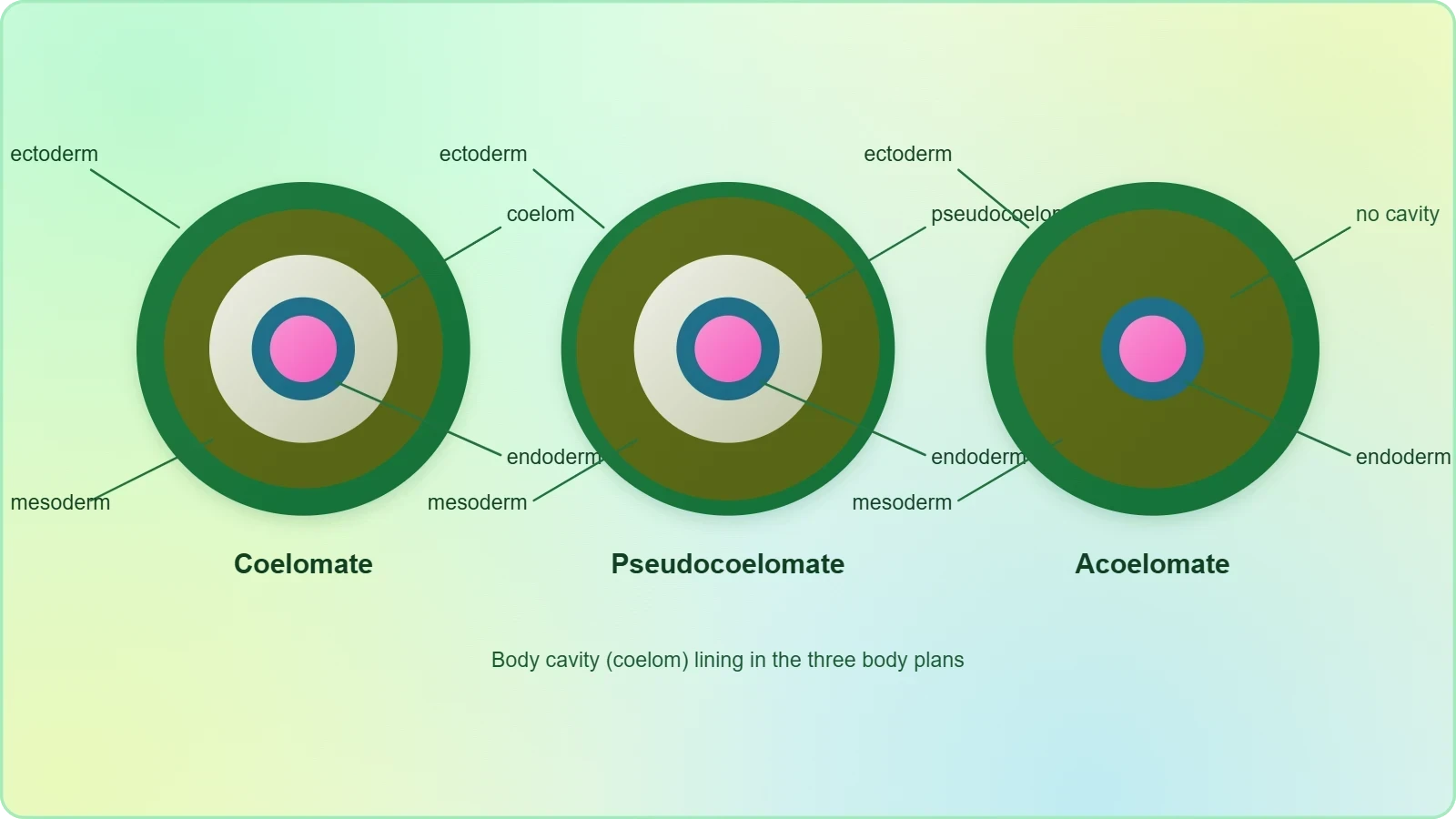
The presence or absence of a cavity between the body wall and the gut wall is very important in classification. The body cavity, when it is lined by mesoderm, is called a coelom, and animals possessing one are called coelomates. The distinction is not merely anatomical housekeeping: a mesodermally lined cavity provides a hydrostatic skeleton, permits the independent movement of the gut and body wall, and creates space in which organs can be suspended and supplied. It is one of the most consequential structural innovations in animal evolution, and it is why the coelom occupies such a prominent place in the classification of Animalia.
Coelomates, Pseudocoelomates and Acoelomates
Animals possessing a true coelom are called coelomates, and the group includes annelids, molluscs, arthropods, echinoderms, hemichordates and chordates. In some animals, however, the body cavity is not lined by mesoderm; instead, the mesoderm is present as scattered pouches in between the ectoderm and endoderm. Such a body cavity is called a pseudocoelom, and the animals possessing it are called pseudocoelomates, of which aschelminthes are the standard example. The animals in which the body cavity is absent altogether are called acoelomates, and platyhelminthes illustrate this condition. Three grades, three distinct developmental solutions to the same architectural problem.
The distinction between a true coelom and a pseudocoelom is easy to state and easy to confuse. In a coelomate, mesoderm lines the cavity on both its outer and inner faces, so the cavity is fully enclosed by mesodermal tissue. In a pseudocoelomate, mesoderm is scattered in pouches between ectoderm and endoderm, so the cavity is not fully lined. In an acoelomate, there is no cavity at all, and the space between the body wall and the gut is filled with solid tissue. A diagrammatic sectional view of the three conditions makes the difference immediately visible, and learners are advised to sketch all three side by side.
Reading the Three Grades Together
Placed side by side, the three grades tell a coherent story about the relationship between body architecture and function. The acoelomate plan is compact and permits little internal movement, which constrains the size and complexity an animal can achieve. The pseudocoelomate plan introduces a cavity but without the full mesodermal lining that would allow precise muscular control of the gut. The coelomate plan provides a fully lined cavity, a hydrostatic skeleton, and the spatial freedom for organ systems to become specialised. The progression is not a ladder of value but a sequence of structural possibilities, each with its own functional consequences.
It is worth noting that the coelom is a criterion of classification, not a measure of superiority. Acoelomate flatworms are highly successful in their own habitats, and pseudocoelomate aschelminthes are among the most abundant animals on earth. What the coelom does is open a particular set of evolutionary possibilities, and the phyla that possess one have exploited those possibilities in strikingly different ways. When the phyla are surveyed in the lessons that follow, the coelom grade of each group should be noted alongside its symmetry and germ-layer condition, because the three together define the structural identity of the phylum.
Germ Layers, Segmentation and the Notochord
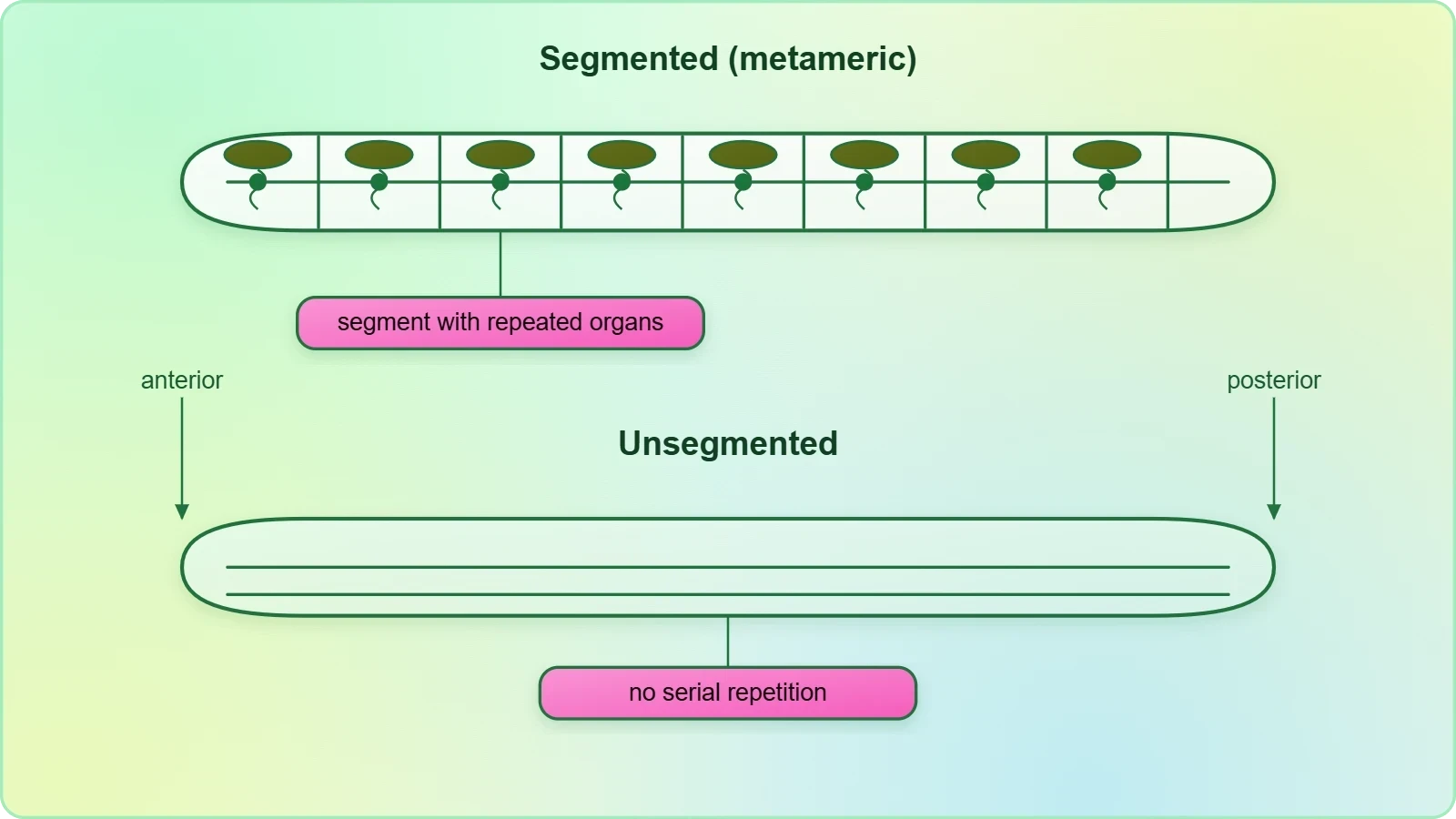
Three further criteria complete the set. Those animals in which the developing embryo has a third germinal layer, mesoderm, in between the ectoderm and endoderm are called triploblastic animals, and this condition runs from platyhelminthes to chordates. Segmentation, in some animals, divides the body externally and internally into segments with a serial repetition of at least some organs; in the earthworm the body shows this pattern, called metameric segmentation, and the phenomenon is known as metamerism. Finally, the notochord is a mesodermally derived rod-like structure formed on the dorsal side during embryonic development in some animals, and its presence defines the chordates.
Triploblasty and Metameric Segmentation
Triploblasty is the precondition for almost everything that follows. With a third germ layer in place, the mesoderm can give rise to muscle, connective tissue, skeletal elements and the linings of cavities, while ectoderm and endoderm retain their own specialised destinies. The diploblastic condition, by contrast, restricts the body to two layers with a non-cellular mesoglea between them. This is why the germ-layer criterion is applied immediately after symmetry: it separates the cnidarians from the great triploblastic assemblage that includes every phylum from platyhelminthes onward, and it sets the stage for the coelom, which is itself a mesodermal structure.
Metameric segmentation introduces a different kind of order. When the body is divided into segments with a serial repetition of at least some organs, each segment can carry its own muscles, nerves, excretory structures and appendages, and the segments can become specialised for different functions. In the earthworm this pattern is visible externally as a series of rings and internally as repeated organs. Segmentation is not universal among coelomates, but where it occurs it permits a modular body plan in which repetition provides both redundancy and the raw material for regional specialisation, a theme that becomes central in the annelids and arthropods.
The Notochord as the Defining Chordate Feature
The notochord is a mesodermally derived rod-like structure formed on the dorsal side during embryonic development in some animals. Animals with a notochord are called chordates, and those animals which do not form this structure are called non-chordates, a group that runs from porifera to echinoderms. The notochord provides axial support and a reference line around which the nervous system and musculature organise. In vertebrates it is present in the embryo and is largely replaced by the vertebral column in the adult, but its embryonic appearance is what places the group within Chordata.
The notochord is the last of the six filters, and it is the one that isolates the most derived group in the kingdom. Its position in the sequence is instructive: it is applied only after organisation, symmetry, germ layers, coelom and segmentation have already narrowed the field. This is why the chordates are described last in any systematic survey, and why the vertebrate classes are treated as subdivisions within Chordata rather than as separate phyla. The notochord does not stand alone as a definition; it is the final criterion in a cumulative argument about structural relationship.
Phylum Porifera: The Cellular Grade of Organisation
Members of Porifera are commonly known as sponges. They are generally marine and mostly asymmetrical animals, and they are primitive multicellular animals with a cellular level of organisation. The sponge body is not organised into tissues or organs in the way that higher animals are; instead, it is a colony-like arrangement of specialised cells that cooperate without forming true tissues. This is why Porifera occupies the base of the classification: it satisfies the criteria for multicellular animal life while remaining at the simplest grade of organisation, and it therefore serves as the natural starting point for the survey of phyla.
The Water Transport System and Choanocytes
Sponges have a water transport or canal system, and this system is the functional heart of the animal. Water enters through minute pores called ostia in the body wall into a central cavity, the spongocoel, from where it goes out through the osculum. This pathway of water transport is helpful in food gathering, respiratory exchange and removal of waste. Choanocytes, or collar cells, line the spongocoel and the canals, and their beating drives the current while their collars trap food particles. Digestion is intracellular, occurring within individual cells rather than in a gut cavity, which is consistent with the cellular grade of organisation.
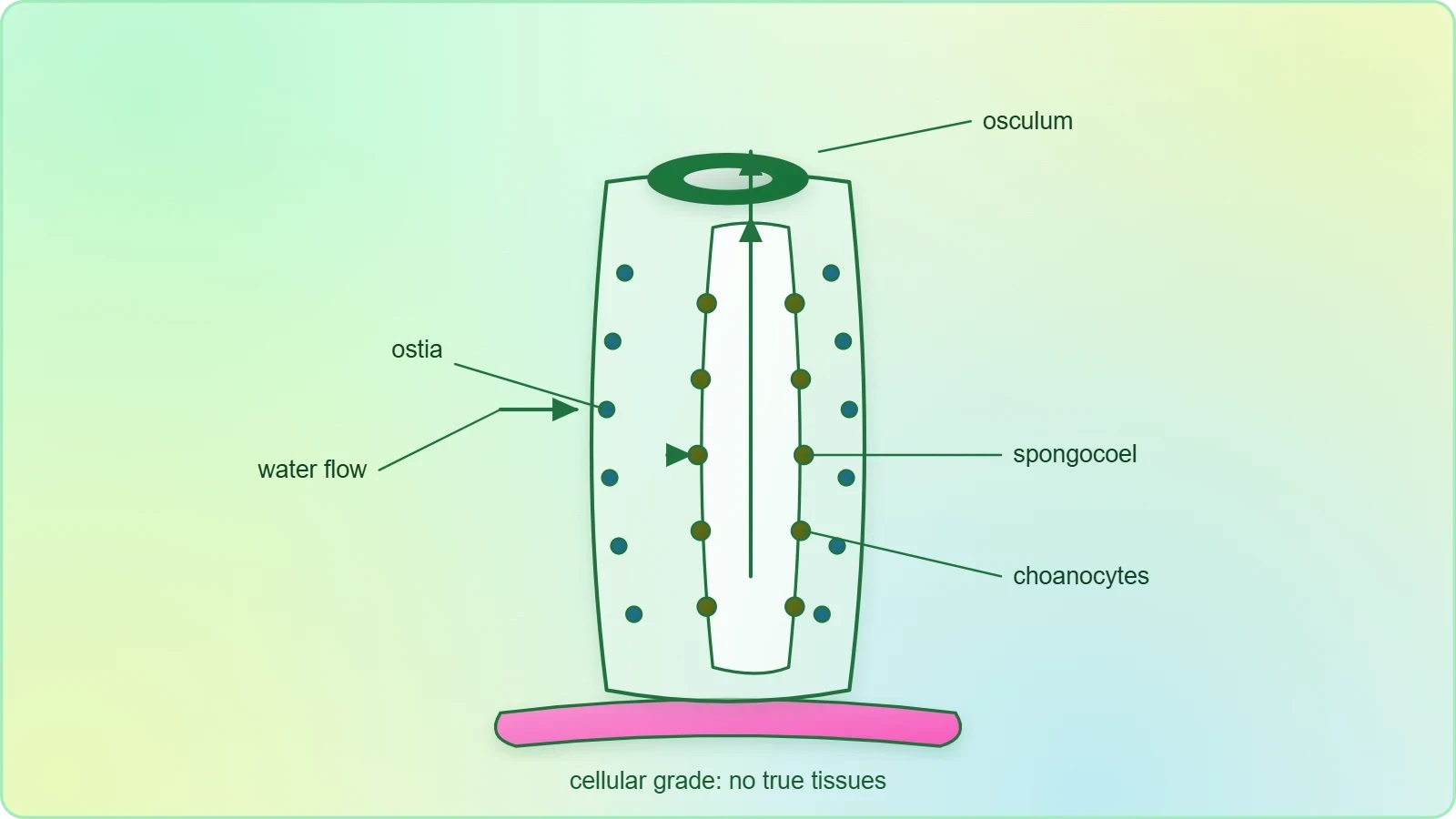
The elegance of the sponge lies in the fact that a single current of water performs three vital functions at once. Food is filtered from the stream, oxygen is drawn from the water as it passes, and metabolic waste is carried away with the outflow. The body is supported by a skeleton made up of spicules or spongin fibres, which gives the animal its shape and provides some protection from predators. Because the sponge lacks a nervous system, muscles and a gut, its entire physiology depends on the coordinated activity of individual cells and the steady flow of water through the canal system.
Reproduction and Development in Sponges
Sexes are not separate in sponges; they are hermaphrodite, meaning that eggs and sperms are produced by the same individual. Sponges reproduce asexually by fragmentation and sexually by the formation of gametes. Fertilisation is internal, and development is indirect, having a larval stage which is morphologically distinct from the adult. The free-swimming larva is the dispersal stage, and its distinctness from the sessile adult is a reminder that the life cycle of a simple animal can still involve a dramatic transformation of form and habit.
Common examples include Sycon (Scypha), Spongilla, the fresh water sponge, and Euspongia, the bath sponge. These three names are worth committing to memory because they illustrate the range of the phylum: a small marine form, a freshwater representative, and a commercially familiar species. The presence of a freshwater sponge is a useful corrective to the assumption that sponges are exclusively marine, although the phylum is generally marine. When the next lesson treats Porifera in detail, the canal system, the choanocytes and the skeletal elements will be examined more closely.
Phylum Coelenterata (Cnidaria): Tissue Grade and Radial Symmetry
Coelenterata, also called Cnidaria, comprises aquatic animals that are mostly marine, sessile or free-swimming, and radially symmetrical. The name cnidaria is derived from cnidoblasts or cnidocytes, which contain the stinging capsules or nematocysts present on the tentacles and the body. Cnidoblasts are used for anchorage, defence and for the capture of prey. Cnidarians exhibit tissue level of organisation and are diploblastic, which places them one grade above the sponges: their cells are organised into true tissues, but they lack the third germ layer and the organ systems that characterise the triploblastic phyla.
Body Plan, Digestion and the Two Forms
Cnidarians have a central gastro-vascular cavity with a single opening, the mouth, on the hypostome. Digestion is both extracellular and intracellular, a combination that reflects the transitional position of the group. Some cnidarians, such as corals, have a skeleton composed of calcium carbonate. The phylum exhibits two basic body forms called polyp and medusa. The polyp is a sessile and cylindrical form, like Hydra and Adamsia, whereas the medusa is umbrella-shaped and free-swimming, like Aurelia or jelly fish. The two forms are not separate groups but alternative expressions of the same body plan.
Those cnidarians which exist in both forms exhibit alternation of generations, or metagenesis: polyps produce medusae asexually and medusae form the polyps sexually, as in Obelia. This is a striking life-cycle arrangement in which the two body forms alternate rather than coexist as separate species. The single opening of the gastro-vascular cavity means that the same aperture serves as both mouth and anus, and the cavity itself functions in digestion and in the distribution of nutrients throughout the body. The radial symmetry of the group suits a sessile or drifting existence in which food may approach from any direction.
Representative Cnidarians
The named examples repay attention because each illustrates a different habit. Physalia, the Portuguese man-of-war, is a colonial, free-floating form; Adamsia is a sea anemone and a polyp; Pennatula is a sea-pen; Gorgonia is a sea-fan; and Meandrina is the brain coral. Corals more generally are important reef builders, and their calcium carbonate skeletons are the material of which coral reefs are constructed. The range from solitary polyps to colonial and reef-forming forms shows how much morphological variety the diploblastic, radially symmetrical plan can accommodate.
For the learner, the essential contrast with Porifera is the jump from cellular to tissue grade. Sponges have specialised cells but no true tissues; cnidarians have true tissues, including the stinging cells that give the phylum its name. Both groups remain diploblastic and both lack a coelom, which is why they are treated before the triploblastic phyla. The cnidoblast, with its nematocyst, is the phylum's signature structure, and a diagrammatic view of it is worth studying closely, because it shows how a single cell can be specialised into a miniature weapon.
Reading the Classification as a Working Scheme
The broad classification of Animalia is best understood not as a list to be memorised but as a working scheme that can be applied to any specimen. The six criteria are tested in sequence, and the sequence itself encodes the logic of the classification. A learner who can run through the questions — organisation, symmetry, germ layers, coelom, segmentation, notochord — can place an unfamiliar animal with reasonable confidence and, just as importantly, can explain why it belongs where it does. The scheme is cumulative, and each answer builds on the one before it.
From Criteria to Phyla: A Worked Sequence
Consider how the scheme operates in practice. An animal at the cellular grade, mostly asymmetrical and without true tissues, is a sponge and belongs to Porifera. An animal at the tissue grade, radially symmetrical and diploblastic, with cnidoblasts, belongs to Cnidaria. An animal that is triploblastic but acoelomate belongs among the platyhelminthes. One that is triploblastic with a pseudocoelom belongs among the aschelminthes. One that is triploblastic, coelomate and metamerically segmented belongs among the annelids. One that is coelomate and possesses a notochord belongs among the chordates. Each step follows directly from the previous answer.
This worked sequence is the practical payoff of the lesson. It shows that the phyla are not isolated categories but positions in a structured argument, and that the features used to define them are the same features used to distinguish them. When the survey proceeds to the remaining phyla, the learner should keep this sequence in view and ask, for each new group, which filters it has passed and which it has failed. The answer will locate the phylum within the scheme and explain its characteristic features in a way that memorisation alone cannot.
Preparing for the Survey of Phyla
The lessons that follow apply this framework phylum by phylum, beginning with Porifera and continuing through the coelomate groups to the chordates and their vertebrate classes. Each lesson will add detail, but the framework remains constant, and the comparative view at the end of the course will draw the salient features of all the phyla together. The value of establishing the broad classification first is that it gives every subsequent detail a place to sit. Without the framework, the phyla are a list; with it, they are a structure, and the structure is what the examiner and the working zoologist both expect.
A final word on method. The criteria are developmental, and development is where the evidence for classification ultimately lies. The germ layers, the coelom, the segments and the notochord are all laid down in the embryo, and it is there that the deepest relationships among animals are recorded. Reading the classification as a record of developmental decisions, rather than as a catalogue of adult appearances, is the habit that turns a beginner into a competent student of the animal kingdom. The next lesson takes up Porifera in detail, and the framework established here will make that study considerably easier.
Going Further
A hierarchical classification arranges groups within larger groups, so that each rank is contained within the rank above it. The phylum is a major rank in animal classification, sitting below the kingdom and above the class; within Chordata, for example, the vertebrate classes are grouped together under a single phylum. This nesting is what allows a single scheme to accommodate both the broadest divisions of animal life and the finest distinctions among closely related species, and it is why the criteria used at each level must be chosen with care.
Also Read
- No links available.
From our network :
- Mastering DB2 LUW v12 Tables: A Comprehensive Technical GuideComprehensive guide on DB2 LUW v12 tables. Explore CREATE TABLE syntax, BLU Acceleration, range partitioning, data types, and security features for IBM DB2 LUW v12.
- AI-Powered 'Precision Diagnostic' Replaces Standard GRE Score ReportsDiscover the new GRE Precision Diagnostic. Learn how AI-powered behavioral analytics and time-to-solve tracking are replacing standard GRE score reports to empower students.
- Trump Political Strategy How Geopolitical Stunts Serve As Media Diversions
- 98% of Global MBA Programs Now Prefer GRE Over GMAT Focus EditionExplore why 98% of global MBA programs now prefer the GRE over GMAT Focus. Learn about the shorter GRE format, verbal logic importance, and strategic versatility for students.
- Mastering DB2 12.1 Instance Design: A Technical Deep Dive into Modern Database ArchitectureComprehensive guide to DB2 12.1 Instance Design. Explore architectural components, HADR setup, buffer pool tuning, and security policies for IBM DB2 12.1. Includes 10 functional SQL and Shell samples.
- EV 2.0: The Solid-State Battery Breakthrough and Global Factory ExpansionDiscover the impact of the Solid-State Battery Breakthrough on the EV market. Learn about CATL and BYD stock growth, global factory expansion in Europe, and the future of EV 2.0 technology.
- Vite 6/7 'Cold Start' Regression in Massive Module GraphsIn-depth analysis of Vite 6/7 cold start regressions in massive module graphs. Learn about barrel file issues, pre-bundling optimizations, and how to improve Vite dev server performance.
- 10 Physics Numerical Problems with Solutions for IIT JEEPrepare for IIT JEE with 10 physics numerical problems, complete with detailed solutions and conceptual explanations. Ideal for mastering kinematics, thermodynamics, electromagnetism, and optics.
- Analyzing Trump Deportation Numbers Insights Into The 2026 Immigration Crackdown
RESOURCES
- animal kingdom chapter 4 - NCERTncert.nic.inFigure 4.4 Broad classification of Kingdom Animalia based on common fundamental features. (a). (b). (c). Figure 4.5. Examples of Porifera : (a) Sycon. (b) ...
- biological classification - Students | Britannica Kids | Homework Helpkids.britannica.com... basic traits of mammals, such as feeding milk to their young. ... The species is the most fundamental unit in taxonomy and ranks…
- Classification of Animal Kingdom (Animalia) - PMF IASpmfias.comPresense or absence of Notochord. The broad classification of Animalia based on common fundamental features: Animal Kingdom Classification. Levels of ...
- Platypus - The Australian Museumaustralian.museumClassification. Genus: Ornithorhynchus; Species: anatinus; Family ... Distinguishing features of a Platypus are: streamlined body with a bill and broad ...
- Illustrated Guide to Soil Taxonomynrcs.usda.govsoil judging teams, to learn the fundamental concepts of soil classification. ... The main soil properties and features considered at the suborder and ...
- Biological classification system from kingdom to species - Facebookfacebook.comApr 16, 2025 ... Kingdom: Organisms are grouped into kingdoms based on fundamental characteristics. Examples include Animalia, Plantae, Fungi, Protista ...
- Sustainable finance: Council adopts a unified EU classification systemconsilium.europa.euApr 15, 2020 ... The Council today adopted an EU-wide classification system, or "taxonomy", of environmentally sustainable activities.
- Terrestrial habitat classification schemes - JNCCjncc.gov.ukApr 28, 2019 ... It presents the user with a basic assessment of habitat type and potential importance for nature conservation. Each habitat type/feature…
- Advancing understanding of the classification of broad autism ...pubmed.ncbi.nlm.nih.gov... classification of many symptom dimensions within the Hierarchical Taxonomy of Psychopathology (HiTOP) ... characteristics relevant to ADHD and autism and ...
- Natural Community Classificationmnfi.anr.msu.eduFive broad ecological classes are subdivided into eighteen ecological groups ... Michigan Natural Features Inventory, Michigan State University Extension, Lansing ...
- Deep Learning: A Comprehensive Overview on Techniques ... - PMCpmc.ncbi.nlm.nih.govOverall, the DBN model can play a key role in a wide range of high-dimensional data applications due to its strong feature extraction and…
- Natural Communities and Ecosystems - Maine.govmaine.govIt also describes the 24 broader ecosystem types within which these natural communities typically occur, and it provides cross-walks to other classification ...
- Terpenoids in essential oils: Chemistry, classification, and potential ...sciencedirect.comThese EOs have undergone extensive research to explore their pharmacological effects, which span a wide range of applications. They have demonstrated properties ...
- [2410.00980] Heterogeneous sound classification with the Broad ...arxiv.orgOct 1, 2024 ... Our study evaluates the classification task using the Broad Sound Taxonomy, a two-level taxonomy comprising 28 classes designed to cover…
- Green Bond Principles (GBP)icmagroup.orgIt also provides a basis for comparison to other green taxonomies and classification systems currently used in the market. ... key features in alignment…