Phylum Annelida gathers the segmented worms into a single, remarkably coherent architectural plan, and that plan is the true subject of this lesson. Where the roundworms of the preceding lesson carried a fluid-filled pseudocoelom and an unsegmented cylindrical body, annelids introduce a decisive structural advance: the body is partitioned into repeating rings, each with its own slice of coelom, its own muscles and its own excretory machinery. This repetition is not cosmetic. It distributes the labour of movement, excretion and fluid regulation across many small units, allowing a worm to bend, burrow and swim with a precision that a single undivided body cavity cannot easily match.
The phylum name itself records the defining feature. Annelida derives from the Latin annulus, meaning a little ring, and the body surface of these animals is distinctly marked out into segments or metameres. Around this central fact the remaining characters arrange themselves: organ-system level of organisation, bilateral symmetry, three germ layers, a true coelom, longitudinal and circular muscles for locomotion, a closed circulatory system, nephridia for osmoregulation and excretion, and a nervous system built from paired ganglia linked to a double ventral nerve cord. The examples named in the syllabus — Nereis, Pheretima and Hirudinaria — illustrate the range from marine swimmers to soil burrowers to blood-feeding ectoparasites.
This lesson sits deliberately between two neighbours. It assumes the pseudocoelomate ground already covered and it prepares the way for the arthropods, where segmentation will reappear in a hardened, jointed form. Read the annelid body as a template: once you can explain why a segmented coelomate worm works, the jointed exoskeleton of the next phylum becomes an intelligible variation rather than a list of novelties. The treatment below follows the source material closely, preserves its terminology and order of ideas, and adds a clearly separated "Going further" block for context that extends beyond the core text.
On This Page
Positioning Annelida Within the Animal Kingdom
Every phylum in this course is best understood as an answer to a set of structural questions: how many tissue layers, what kind of body cavity, what symmetry, and how is the body divided? Annelids answer these questions in a specific and internally consistent way. They are triploblastic, meaning all three germ layers — ectoderm, mesoderm and endoderm — contribute to the adult body. They are bilaterally symmetrical, so a single plane divides the animal into mirror-image halves. They are coelomate, possessing a true body cavity lined by mesoderm. And they are metamerically segmented, the character that gives the phylum its name and its distinctive biology.
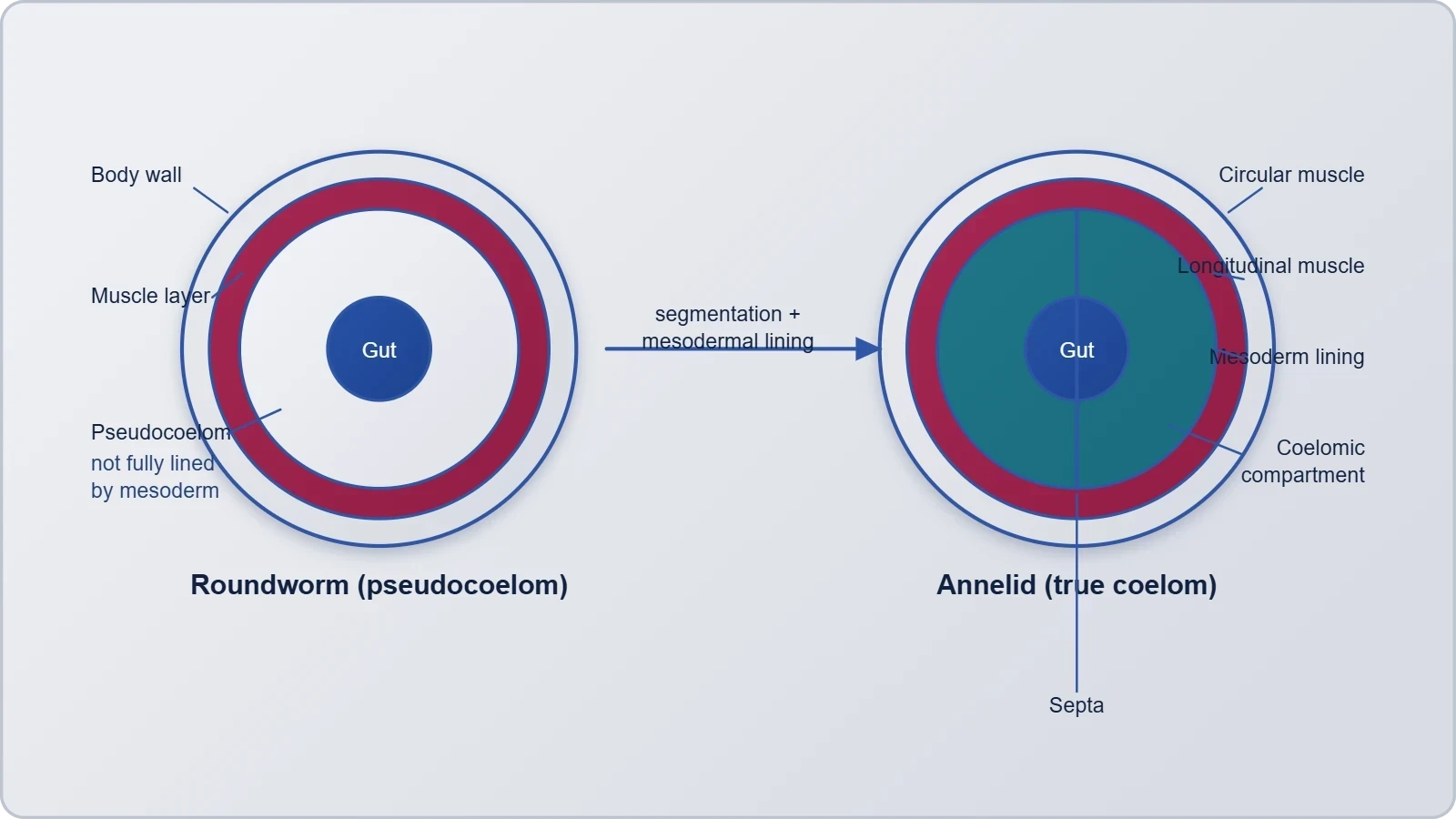
Placing Annelida correctly requires a brief backward glance at the roundworms. Aschelminthes are pseudocoelomate: the body cavity is not fully lined by mesoderm, and the body is unsegmented. Annelids replace that arrangement with a genuine coelomic lining and with repeated segmental compartments. The shift matters functionally. A true coelom can act as a hydrostatic skeleton, and when that cavity is subdivided by septa, each compartment can be pressurised independently. This is the mechanical foundation of annelid burrowing and crawling, and it explains why the phylum occupies such a wide range of habitats.
Habitat Range and Modes of Life
Annelids may be aquatic, in both marine and fresh water, or terrestrial. Most are free-living, but some are parasitic. This breadth is unusual among the phyla treated so far and reflects the adaptability of the segmented body plan. Marine forms such as Nereis move through water and sediment; earthworms such as Pheretima burrow through moist soil; leeches such as Hirudinaria attach to hosts and feed on blood. The same fundamental architecture supports all three lifestyles, with modifications in appendages, chaetae and feeding structures.
The parasitic habit deserves a precise note. The source material states that annelids are "sometimes parasitic," and the named example, Hirudinaria, is described as a blood-sucking leech. This is ectoparasitism — feeding on the exterior of a host — rather than the internal parasitism seen in some roundworms. Keeping this distinction clear prevents a common examination error, in which students transfer the internal parasitic habits of Ascaris or Wuchereria onto the annelids. The annelid body plan remains essentially that of a free-living, muscular, segmented animal even when the feeding habit is parasitic.
Organ-System Level and Bilateral Symmetry
Annelids exhibit the organ-system level of body organisation, the most complex grade encountered in this survey. Tissues are grouped into discrete organs, and organs cooperate as systems: a digestive tract, a closed circulatory network, a nervous system with a central cord, and excretory organs. This is a step beyond the tissue-and-organ grade of simpler phyla and it is the grade that persists, with modifications, through arthropods, molluscs and chordates. The annelid is therefore a useful reference point for everything that follows.
Bilateral symmetry completes the picture. A bilaterally symmetrical animal has a definite anterior and posterior end, a dorsal and a ventral surface, and a left and a right side. This arrangement concentrates sensory and neural structures at the front, which is why annelids show a recognisable head region with ganglia and, in active marine forms, eyes and tentacles. The combination of bilateral symmetry with metameric segmentation produces an animal that is both directional and modular — able to move purposefully while retaining a body built from repeated, largely interchangeable units.
The Segmented Body: Metamerism and the Coelom
Metameric segmentation is the organising principle of the phylum, and it deserves careful definition. The body is divided, along its length, into a series of similar segments or metameres. Each metamere carries its own share of body wall, muscles, coelomic cavity and excretory organs. The segments are not identical in every detail — anterior segments bear sensory structures and posterior segments differ in shape — but the underlying repetition is unmistakable. This is why the body surface is described as distinctly marked out into segments, and why the Latin root annulus was chosen for the phylum name.
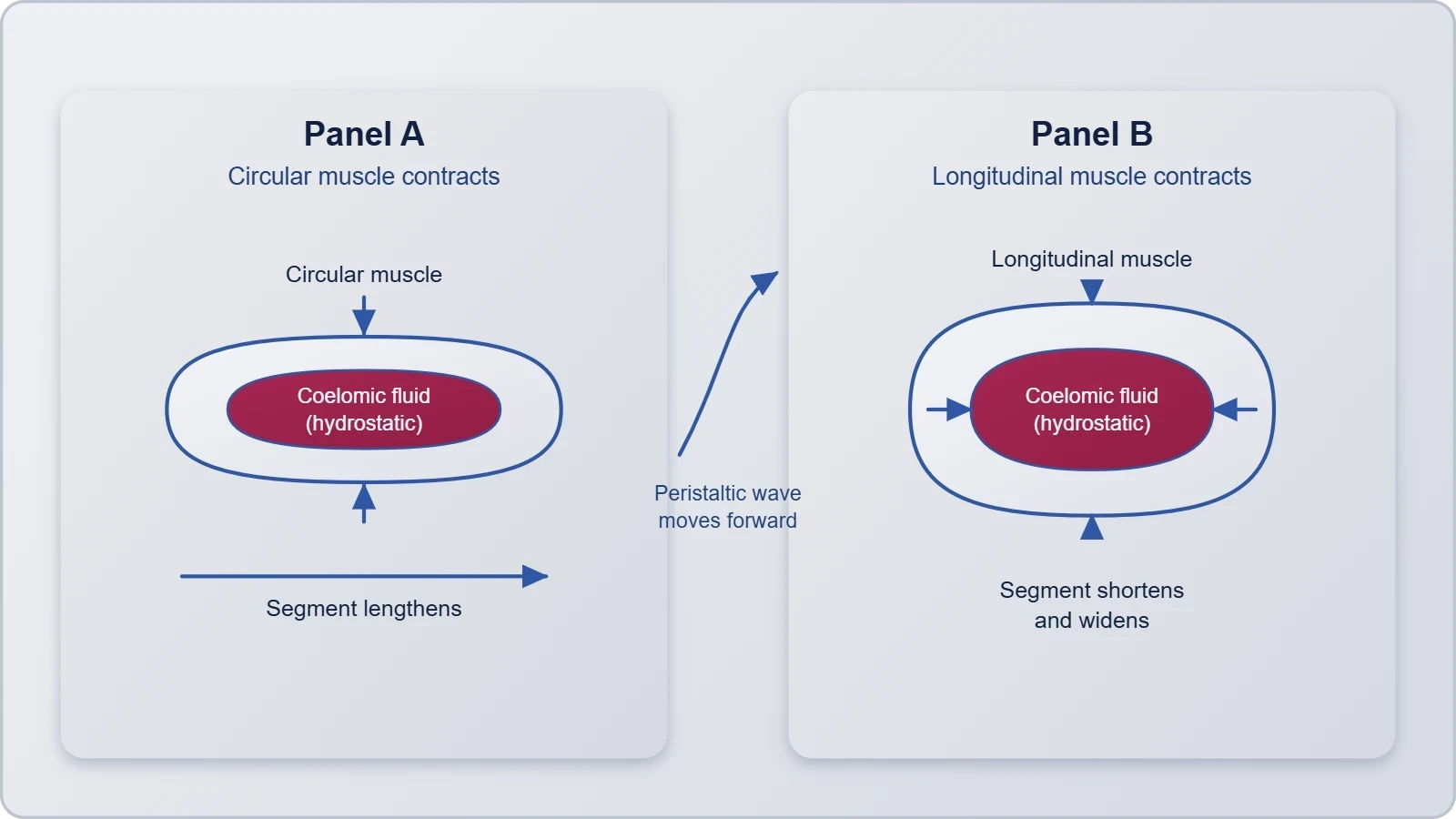
The coelom is the second pillar. Annelids are coelomate: the body cavity is a true coelom, lined by mesoderm. In segmented annelids this cavity is itself divided by transverse partitions, so that each metamere contains a pair of coelomic compartments. The combination of a fluid-filled cavity and a muscular body wall produces a hydrostatic skeleton. When circular muscles contract, the segment lengthens and narrows; when longitudinal muscles contract, it shortens and widens. Because each segment can be controlled separately, the worm can produce waves of deformation that push it forward through soil or water.

Longitudinal and Circular Muscles in Locomotion
The source material states plainly that annelids possess longitudinal and circular muscles which help in locomotion. These two muscle layers lie in the body wall, outside the coelomic lining, and they act in opposition. Circular muscle contraction reduces the diameter of a segment and extends it lengthwise; longitudinal muscle contraction shortens the segment and increases its diameter. Coordinated along the body, these alternating contractions generate the peristaltic waves by which an earthworm crawls and burrows. The hydrostatic pressure of the coelomic fluid provides the resistance against which the muscles work.
This mechanism is worth contrasting with the roundworm. A pseudocoelomate roundworm also uses hydrostatic pressure, but its body is not divided into independently controllable compartments. The annelid's segmental septa allow localised pressure changes, so one region of the body can anchor while another extends. The result is a more versatile and more efficient burrowing stroke. In marine forms the same muscular system drives undulatory swimming, assisted by the lateral appendages described in the next subsection.
Parapodia and the Aquatic Habit
Aquatic annelids such as Nereis possess lateral appendages called parapodia, which help in swimming. Parapodia are paired, fleshy outgrowths borne on the segments, and they increase the surface area available for both propulsion and gas exchange. In a swimming polychaete they beat in metachronal rhythm, producing a wave that travels along the body. Their presence is a useful diagnostic character when comparing a marine annelid with a terrestrial earthworm, which lacks them and relies on chaetae and muscular peristalsis instead.
The parapodia also illustrate how segmentation enables local specialisation. Because each segment can carry its own pair of appendages, the phylum can generate a graded series of limb-like structures along the body. This modularity is precisely the property that the arthropods will exploit in the following lesson, where segmental appendages become jointed legs, mouthparts and antennae. Annelid parapodia are not jointed, but they demonstrate the same underlying logic: a repeated body unit that can be equipped differently at different positions along the axis.
Circulation, Excretion and the Nervous System
Annelids possess a closed circulatory system, a feature that distinguishes them sharply from the roundworms and from most other invertebrate phyla treated at this level. In a closed system, blood remains confined within vessels and does not spill into an open body cavity. Vessels branch into progressively finer channels, allowing controlled delivery of materials to tissues and rapid return to the heart or contractile vessels. The arrangement is energetically more demanding than an open system, but it supports the active, muscular lifestyle that segmentation makes possible.
Excretion and osmoregulation are handled by nephridia, the paired segmental organs that give the phylum one of its most characteristic features. A nephridium is a tubular structure that collects fluid from the coelomic compartment and discharges it to the exterior through a pore. Because nephridia are repeated in each segment, the excretory system mirrors the segmental architecture of the body. This is a recurring theme in annelid anatomy: organ systems are distributed segment by segment rather than concentrated in a single central mass.
Nephridia: Osmoregulation and Excretion
The source material states that nephridia help in osmoregulation and excretion, and both functions deserve attention. Excretion removes nitrogenous metabolic waste from the body. Osmoregulation controls the balance of water and dissolved salts, which is especially important for freshwater and terrestrial annelids that face continuous osmotic exchange with their surroundings. A freshwater worm tends to gain water and lose salts; nephridia can produce dilute urine while retaining essential ions. A terrestrial earthworm must conserve water, and its nephridia are correspondingly adapted to reabsorb much of the fluid they filter.
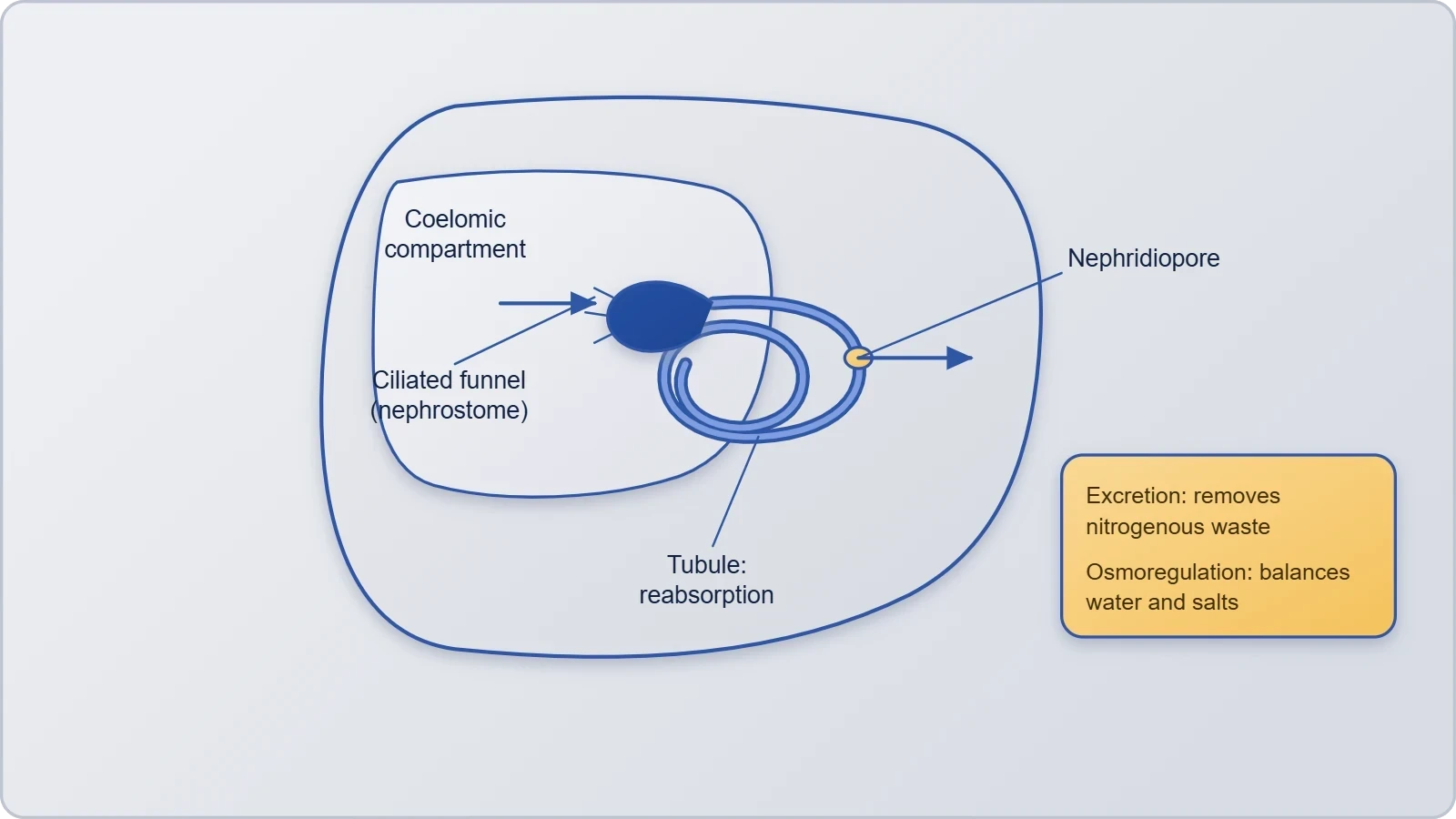
The segmental arrangement of nephridia is functionally elegant. Each metamere manages its own fluid balance, so a local disturbance in one region does not compromise the whole animal. This decentralised regulation is a direct consequence of metamerism and reinforces the lesson's central argument: segmentation is not merely a surface pattern but a principle that organises the entire physiology. When you later meet the Malpighian tubules of insects or the kidneys of vertebrates, compare how those systems concentrate excretory function rather than distributing it segment by segment.
Ganglia and the Double Ventral Nerve Cord
The neural system of annelids consists of paired ganglia connected by lateral nerves to a double ventral nerve cord. Ganglia are concentrations of nerve cell bodies, and their pairing reflects the bilateral symmetry of the body. The ventral nerve cord runs along the underside of the animal, in contrast to the dorsal spinal cord of vertebrates — a difference worth remembering. In each segment, the cord typically bears a pair of ganglia, so the nervous system, like the excretory system, is repeated along the body axis.
Anteriorly, the ganglia are enlarged into a cerebral mass associated with the head, and sensory structures such as eyes, tentacles and chemical receptors are concentrated there. This cephalisation is a natural consequence of bilateral symmetry and directed locomotion. The combination of a central cord, segmental ganglia and anterior sensory concentration gives annelids a level of behavioural coordination well beyond that of the roundworms. It is also the neural architecture that the arthropods will inherit and elaborate, fusing ganglia into larger masses and concentrating control further.
Reproduction and Sexual Patterns in Annelids
Reproduction in annelids is sexual, and the phylum displays both of the major sexual arrangements found in animals. Nereis, an aquatic form, is dioecious: males and females are distinct individuals. Earthworms and leeches, by contrast, are monoecious, meaning a single individual carries both male and female reproductive organs. This contrast within one phylum is pedagogically valuable, because it shows that the dioecious condition described for the roundworms is not a universal rule but one of several possible arrangements. The source material states the distinction explicitly and it should be memorised with the named examples attached.
The reproductive pattern also correlates with lifestyle. A free-swimming marine polychaete can release gametes into the water, where external fertilisation is feasible. A burrowing earthworm or an ectoparasitic leech faces different constraints, and cross-fertilisation between two monoecious individuals is the typical solution. The material does not elaborate these mechanisms, and this lesson does not invent them; the essential examination point is simply that reproduction is sexual, that Nereis is dioecious, and that earthworms and leeches are monoecious.
Dioecious and Monoecious Conditions Compared
A dioecious animal has separate sexes: an individual is either male or female, and reproduction requires a partner of the opposite sex. This is the condition described for Nereis among the annelids, and it matches the pattern already seen in the roundworms, where sexes are separate and females are often longer than males. The term comes from Greek roots meaning "two houses," and it is a useful label because it describes the distribution of reproductive organs across individuals rather than any particular anatomical detail.
A monoecious animal, by contrast, houses both sets of reproductive organs within one body — "one house." Earthworms and leeches fall into this category. Monoecy does not usually mean self-fertilisation; in practice, two individuals exchange gametes, which preserves genetic mixing while removing the need to find a partner of a specific sex. For a slow-moving burrower or an attached parasite, this is a practical advantage. The distinction between dioecious and monoecious is one of the most frequently examined points in this phylum, so anchor it firmly to the three named examples.
Representative Genera and Their Lifestyles
Nereis is the aquatic representative. It is a marine polychaete, possessing parapodia that assist swimming, and it is dioecious. Its body shows the segmental plan clearly, with lateral appendages repeated along the axis. In the classroom, Nereis is the form to cite whenever a question asks for an aquatic annelid with parapodia or for an example of a dioecious annelid. It is also the form that most obviously connects the phylum to its marine origins and to the free-swimming habit.
Pheretima, the earthworm, is the terrestrial representative and the most familiar annelid in most syllabi. It is monoecious, burrows through moist soil, and relies on longitudinal and circular muscles working against the hydrostatic coelom. Hirudinaria, the blood-sucking leech, is the parasitic example, also monoecious. Together the three genera span aquatic, terrestrial and parasitic modes of life, which is precisely why the source material selects them. A well-prepared answer names all three and attaches the correct habit and sexual condition to each.
Going Further: Context Beyond the Core Material
The core lesson above is complete on its own terms. This short block adds two pieces of well-established background that help the material make sense, and it is kept deliberately separate so that the syllabus content remains clearly identifiable. Nothing here contradicts the source material; it simply supplies the conceptual scaffolding that a beginner often needs before the terminology settles. Read it as commentary, not as additional examination content, and return to the core sections for the definitions and examples you will be assessed on.
The first point concerns metameric segmentation. The phrase means that the body is divided into repeated similar segments, and the key word is "similar." The segments are not identical in every respect, but they share a common ground plan, so that structures such as muscles, nephridia and ganglia recur in each one. This repetition is what allows the annelid body to be described as modular. Once you grasp that the same set of parts is repeated along the axis, the anatomy becomes far easier to remember, because you learn one segment and then apply it along the body.
Why Segmentation Matters Functionally
The second point concerns nephridia. These are excretory and osmoregulatory organs found in annelids, and their segmental repetition is the feature to hold onto. Each nephridium draws fluid from the coelomic compartment of its segment and releases it to the exterior. Because the organs are repeated, the excretory burden is shared across the body rather than concentrated in a single structure. This is a different solution from the vertebrate kidney, which centralises filtration, and comparing the two is a useful exercise in understanding how the same physiological problem can be solved by different architectural strategies.
Beyond these two clarifications, it is worth noting how the annelid plan anticipates what follows. The next lesson treats the arthropods, and the connection is direct: arthropods are also segmented, also possess a coelom (though reduced), and also show a ventral nerve cord with segmental ganglia. What changes is the exoskeleton and the jointed appendages. Seen from this vantage point, Annelida is not an isolated phylum but a hinge between the simpler pseudocoelomates behind it and the highly successful jointed animals ahead. That continuity is the real reward of studying the phyla in sequence.
Consolidating the Phylum: A Revision Framework
A reliable way to revise Annelida is to run through the characters in the order the source material presents them, because that order is itself a logical sequence. Begin with habitat and mode of life: aquatic or terrestrial, free-living or sometimes parasitic. Then state the level of organisation, the symmetry, the germ layers, the segmentation and the coelom. Move to the body surface and the muscles, then to the appendages, the circulatory system, the excretory organs and the nervous system. Finish with reproduction and the named examples. Reciting the phylum in this order ensures that no character is omitted and that each is attached to its correct technical term.
The most common errors in examination answers are predictable. Students confuse the pseudocoelom of the roundworms with the true coelom of annelids; they forget that the circulatory system is closed; they describe nephridia as kidneys; and they misassign the dioecious condition to the earthworm rather than to Nereis. Each of these errors is corrected by returning to the precise wording of the material. The phylum is not difficult once the six or seven core characters are secure; the difficulty lies in keeping them distinct from the neighbouring phyla, which is exactly why this lesson is positioned between them.
Self-Check Questions
Test your grasp with a few direct questions. What does the name Annelida mean, and from which language is it derived? Which annelid character is described as metameric, and what does that term indicate about the body? Name the excretory organs of annelids and state their two functions. Which annelid is dioecious, and which two are monoecious? What are parapodia, and in which form are they found? If you can answer these without reference to the text, the core content of the lesson is secure and you are ready for the arthropods.
For a deeper check, attempt a comparison. Write a short paragraph contrasting Nereis and Pheretima across habitat, appendages, sexual condition and mode of locomotion. Then extend the comparison to the roundworm from the previous lesson, focusing on body cavity and segmentation. This exercise forces you to use the terminology actively rather than recognise it passively, and it mirrors the comparative questions that appear in examinations. The final table below summarises the essential facts for quick revision before you move on.
Also Read
- No links available.
From our network :
- Vite 6/7 'Cold Start' Regression in Massive Module GraphsIn-depth analysis of Vite 6/7 cold start regressions in massive module graphs. Learn about barrel file issues, pre-bundling optimizations, and how to improve Vite dev server performance.
- 10 Physics Numerical Problems with Solutions for IIT JEEPrepare for IIT JEE with 10 physics numerical problems, complete with detailed solutions and conceptual explanations. Ideal for mastering kinematics, thermodynamics, electromagnetism, and optics.
- Trump Political Strategy How Geopolitical Stunts Serve As Media Diversions
- Mastering DB2 12.1 Instance Design: A Technical Deep Dive into Modern Database ArchitectureComprehensive guide to DB2 12.1 Instance Design. Explore architectural components, HADR setup, buffer pool tuning, and security policies for IBM DB2 12.1. Includes 10 functional SQL and Shell samples.
- EV 2.0: The Solid-State Battery Breakthrough and Global Factory ExpansionDiscover the impact of the Solid-State Battery Breakthrough on the EV market. Learn about CATL and BYD stock growth, global factory expansion in Europe, and the future of EV 2.0 technology.
- Mastering DB2 LUW v12 Tables: A Comprehensive Technical GuideComprehensive guide on DB2 LUW v12 tables. Explore CREATE TABLE syntax, BLU Acceleration, range partitioning, data types, and security features for IBM DB2 LUW v12.
- AI-Powered 'Precision Diagnostic' Replaces Standard GRE Score ReportsDiscover the new GRE Precision Diagnostic. Learn how AI-powered behavioral analytics and time-to-solve tracking are replacing standard GRE score reports to empower students.
- 98% of Global MBA Programs Now Prefer GRE Over GMAT Focus EditionExplore why 98% of global MBA programs now prefer the GRE over GMAT Focus. Learn about the shorter GRE format, verbal logic importance, and strategic versatility for students.
- Analyzing Trump Deportation Numbers Insights Into The 2026 Immigration Crackdown
RESOURCES
- Lab 6 Annelida - EVERYTHING Flashcards - Quizletquizlet.comWhat is metamerism and which phylum is characterized by it? body segments with repeating organs. Phylum Annelida. Metamerism Homonymous. segments more or less ...
- Annelida vs Arthropoda: comparing segmented worms and joint ...facebook.com13 hours ago ... Phylum Annelida & Arthropoda: Segmented Worms vs Joint-Legged Animals! What makes an earthworm different from a cockroach or a crab?
- Annelida (segmented worms) | INFORMATION - Animal Diversity Webanimaldiversity.orgSegmentation is also called metamerism. Segments each contain elements ... Members of the Phylum Annelida can be found throughout the world, in marine ...
- Phylum Annelida: The Segmented Worms - Facebookfacebook.comJul 27, 2026 ... ... Metameric Segmentation distinctly into segments ... Excretion: Annelids have paired nephridia in each segment, which function similarly to kidneys ...
- Segmentation in Annelids: Cellular and Molecular Basis for ...bioone.orgMetameric body plans are found in several metazoan phyla, including vertebrates, annelids and arthropods. It remains unclear, however, whether the segments of ...
- PHYLUM ANNELIDA (THE SEGMENTED WORMS)tmv.ac.inMetameric segmentation: The annelids are characterised by metameric ... 80 to 100 septal nephridia in each segment. It is made up of four components ...
- Overview of Phylum Annelida | PDF | Digestion - Scribdscribd.comTrue metameric segmentation where external segments correspond to internal segments. ... The exonephric nephridia present in clitellar segments (2500 nephridia ...
- Segmented worms | Zoology | Research Starters - EBSCOebsco.comfor the digestive system. Annelids exhibit metamerism, where body segments are ... “Segmented Worms (Phylum Annelida): A Celebration of Twenty Years of ...
- 15.4 Mollusks and Annelids - Concepts of Biology | OpenStaxopenstax.orgApr 25, 2013 ... ... nephridia. In some species, the posterior edges of the mantle may ... Phylum Annelida are segmented worms found in…
- METAMERISM IN ANNELIDA - Biozoomerbiozoomer.comIn annelids the metameric segmentation is both external and internal. The ... Metamerism, or segmentation, is a defining characteristic of the phylum Annelida, ...
- Worms: Phyla Platyhelmintes, Nematoda, and Annelidamanoa.hawaii.eduSegmented worms (phylum Annelida) ... The excretory system of annelid worms consists of a pair of small tubes in each segment. These tubes, called…
- 10.4: Phylum Annelida - Biology LibreTextsbio.libretexts.orgAug 2, 2025 ... The annelids are often called “segmented worms” due to their key characteristic of metamerism, or true segmentation. Approximately 22,000 ...
- Animal Kingdom feels impossible when you try to memorise every ...instagram.comAug 18, 2026 ... ... phylum separately But what if you could identify most phyla ... Annelida → Nephridia / Metameric Segmentation Arthropoda ...
- Vocabulary List PowerPoint Presentation, free download - ID:2028858slideserve.comJul 20, 2014 ... Vocabulary List. Crop Gizzard Nephridia Setae Clitellum Metamerism Parapodia Tagmatization. Chapter 13. Phylum Annelida.
- Annelida | Encyclopedia.comencyclopedia.com... nephridia found in each segment which function in ... Annelida Phylum of coelomate worms which posses a definite head and good metameric segmentation.