Every thought you have, every movement you make, and every sensation you register depends on a fleeting electrical event that lasts barely a thousandth of a second. That event is the nerve impulse, and its generation is one of the most elegant pieces of biophysics in the living world. Neurons earn their special status as excitable cells not because of anything exotic in their chemistry, but because their membranes sit in a carefully maintained polarised state, poised like a drawn bowstring, ready to fire the moment a stimulus arrives. Understanding this resting tension, and the sudden release of it, is the heart of Lesson 4 in our neural control and coordination series.
This lesson builds directly on the structural picture established earlier, where the neuron was introduced as the structural and functional unit of the neural system, complete with dendrites, an axon, and synaptic knobs. Here we move from anatomy to electrical behaviour. We will examine the ion channels embedded in the neural membrane, the concentration gradients they exploit, and the sodium-potassium pump that tirelessly defends those gradients. From there we trace the sequence by which a stimulus flips the polarity at a point on the axon, how that local reversal propagates forward as an action potential, and how potassium permeability quietly restores order so the fibre can fire again.
The treatment stays faithful to the terminology, definitions, and order of ideas in the source material, so learners preparing for examinations can rely on it as a precise reference. Where a little extra context sharpens understanding, such as the energy cost of active transport or the nature of the action potential as a travelling signal, that material appears in a clearly separated "Going further" block. By the end, you should be able to explain, in sequence, why a resting axon is polarised, what happens at the moment of excitation, and why the impulse moves in one direction along the fibre.
On This Page
The Polarised State of the Neuronal Membrane
Neurons are described as excitable cells because their membranes are in a polarised state. This single sentence carries the entire logic of the lesson. Polarity here means an electrical difference: the outer surface of the axonal membrane carries a positive charge while the inner surface carries a negative charge. That separation of charge across a thin membrane is what makes the neuron capable of responding to stimulation. Without it, a stimulus would have nothing to reverse and no impulse could arise. The polarised membrane is therefore not a passive backdrop but the essential precondition for all neural signalling.
Ion Channels and Selective Permeability
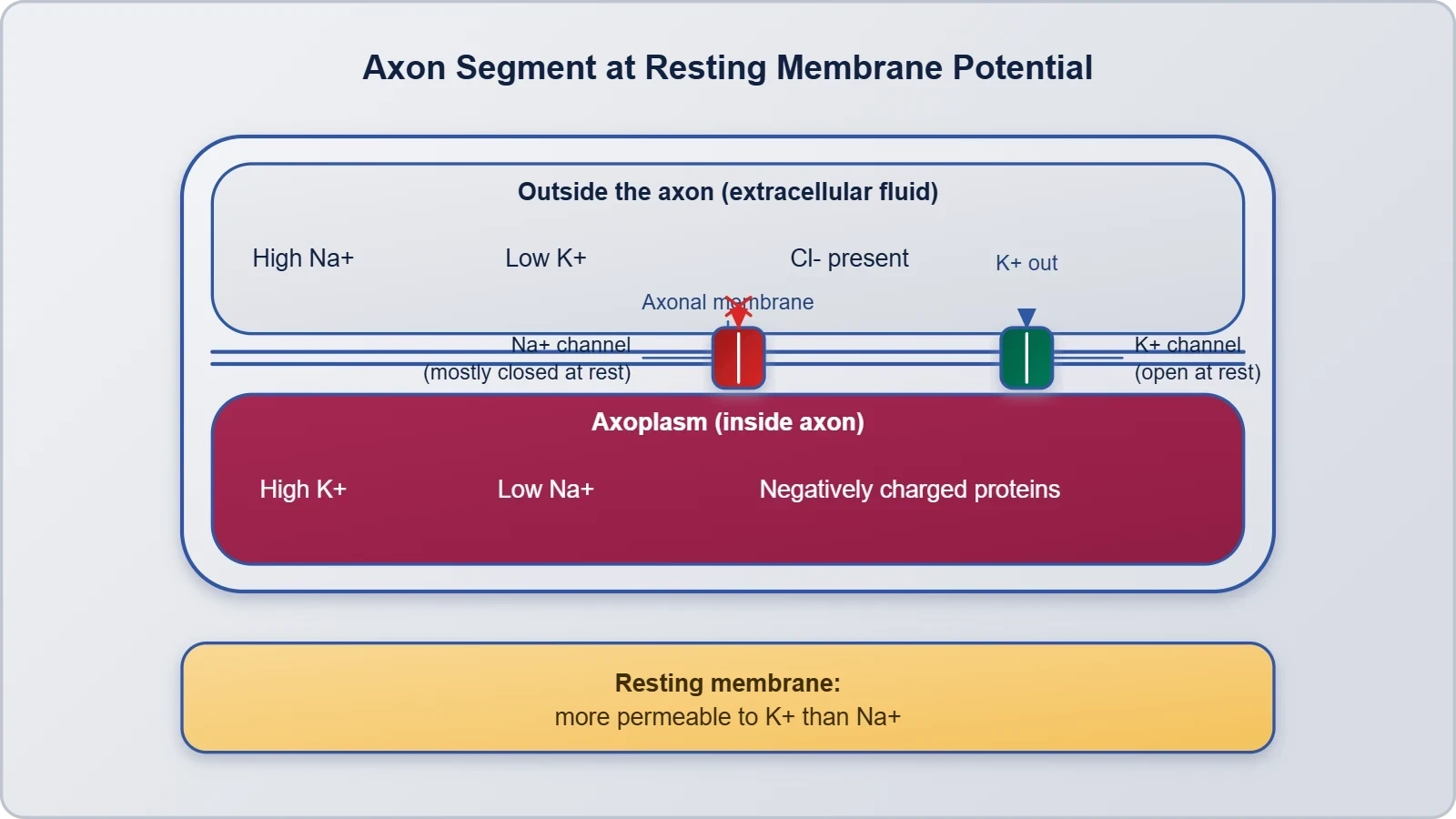
Different types of ion channels are present on the neural membrane, and these channels are selectively permeable to different ions. This selectivity is the mechanism behind polarisation. When a neuron is not conducting any impulse, that is, when it is resting, the axonal membrane is comparatively more permeable to potassium ions (K+) and nearly impermeable to sodium ions (Na+). The membrane is likewise impermeable to the negatively charged proteins present in the axoplasm. These three permeability rules, taken together, explain why charge accumulates on either side of the membrane in the pattern we observe.
Because of this selective permeability, the axoplasm inside the axon contains a high concentration of K+ and negatively charged proteins, and a low concentration of Na+. In contrast, the fluid outside the axon contains a low concentration of K+, a high concentration of Na+, and thus forms a concentration gradient across the membrane. The interior is rich in potassium and trapped anions; the exterior is rich in sodium. These ionic gradients across the resting membrane do not maintain themselves, and the next subsection explains the active transport that keeps them in place.
The Sodium-Potassium Pump and Resting Potential
The ionic gradients across the resting membrane are maintained by the active transport of ions by the sodium-potassium pump, which transports 3 Na+ outwards for 2 K+ into the cell. This unequal exchange, three positive charges expelled for every two admitted, contributes to the charge imbalance. As a result, the outer surface of the axonal membrane possesses a positive charge while its inner surface becomes negatively charged, and the membrane is therefore polarised. The electrical potential difference across the resting plasma membrane is called the resting potential, the baseline against which every subsequent event is measured.
Generation of the Action Potential
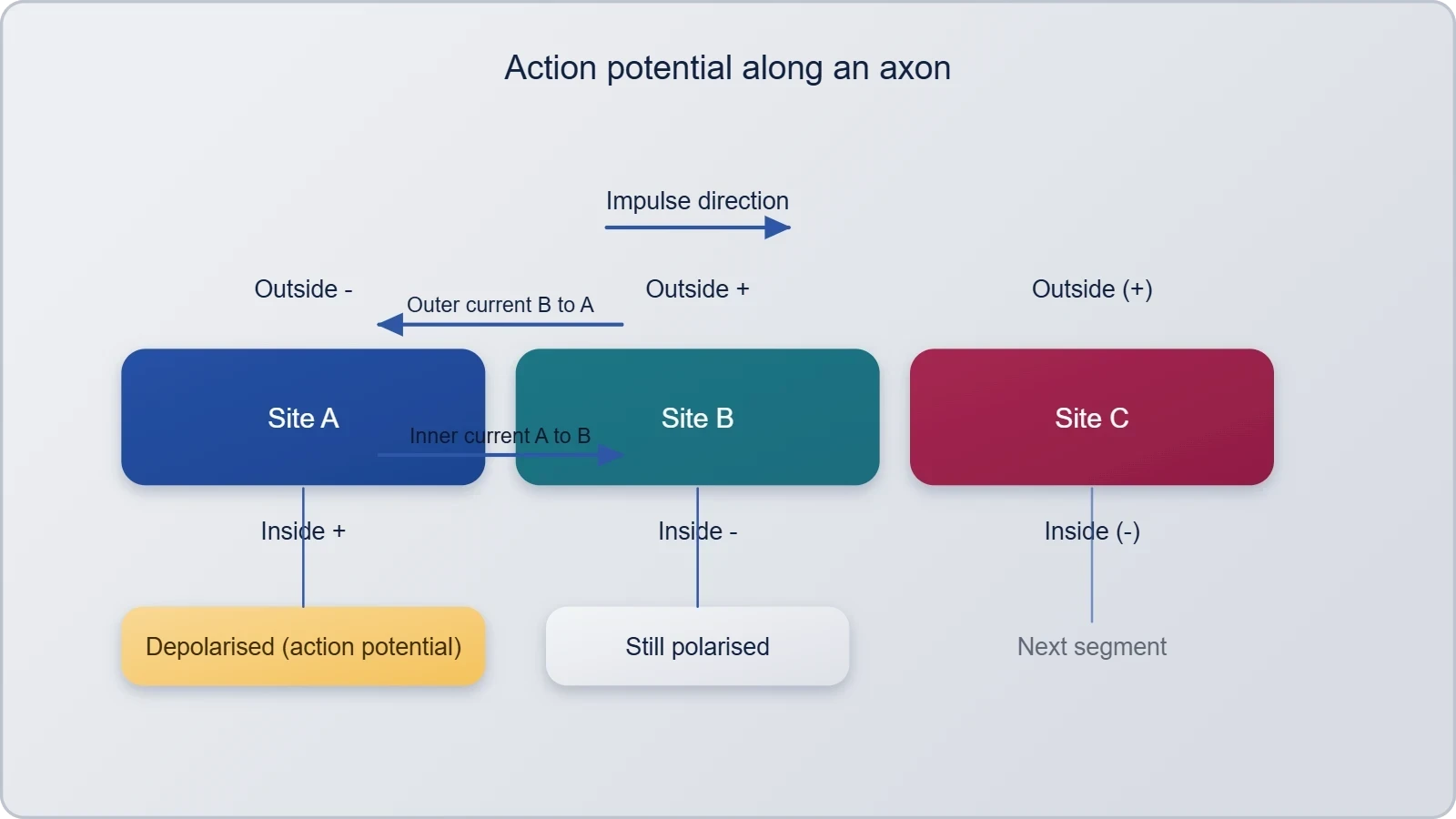
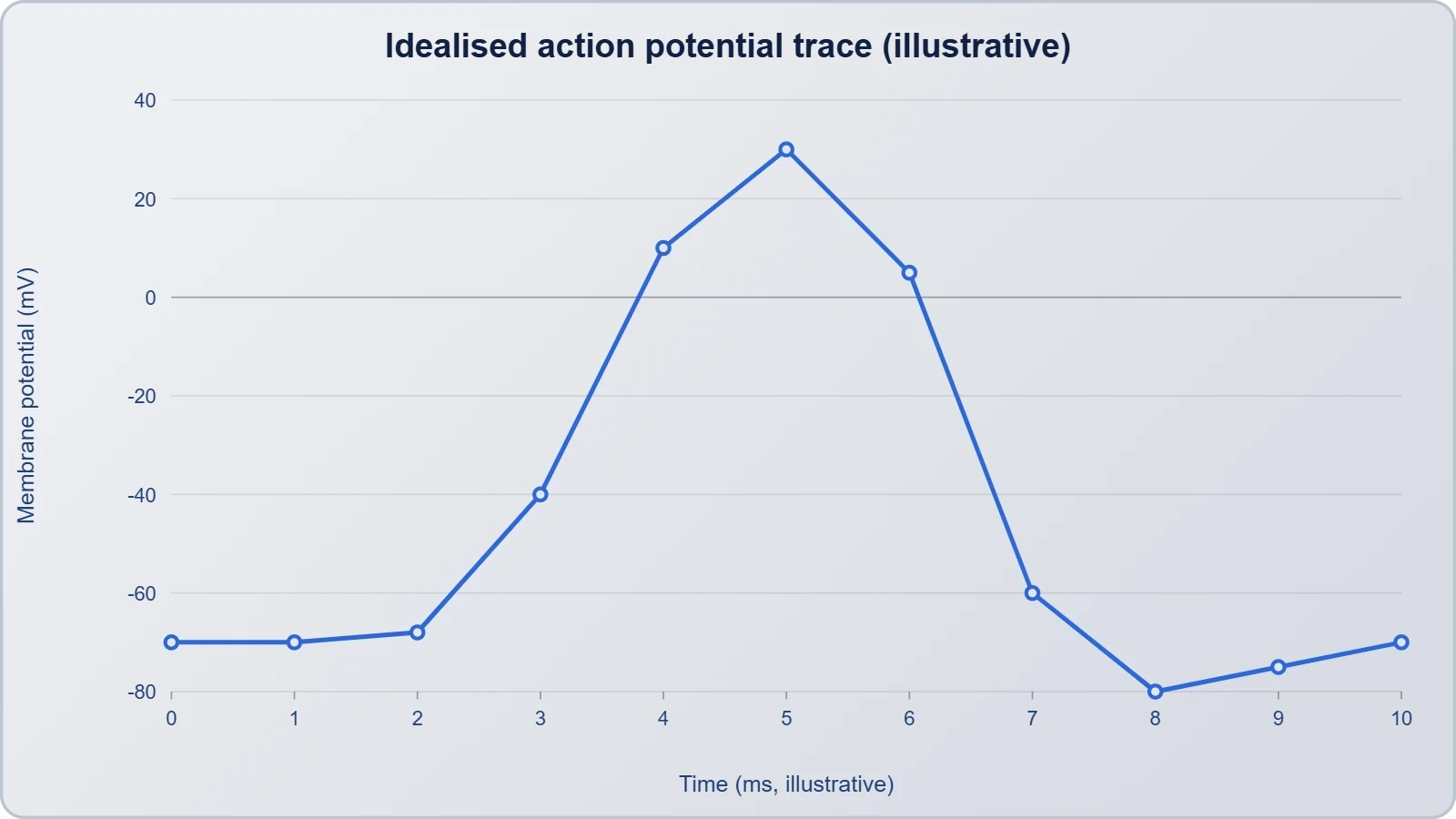
The mechanism of impulse generation follows directly from the polarised state just described. When a stimulus is applied at a site on the polarised membrane, say point A, the membrane at that site becomes freely permeable to Na+. This is the decisive change: the barrier that kept sodium outside now opens. A rapid influx of Na+ follows, and with it a reversal of polarity at that site. The outer surface of the membrane becomes negatively charged and the inner side becomes positively charged. The polarity of the membrane at site A is thus reversed, and the membrane is said to be depolarised.
Depolarisation and the Action Potential
The electrical potential difference across the plasma membrane at site A is called the action potential, which is in fact termed a nerve impulse. This equivalence matters for clear thinking: the impulse is not a separate entity travelling inside the axon but the action potential itself, a local electrical event that recurs at successive points. Depolarisation at the stimulated site is therefore the birth of the impulse. Everything that follows is the propagation of this same event along the fibre, and the vocabulary of excitation, depolarisation, and action potential should be held together as one connected idea.
It is worth pausing on the speed of this transition. The rise in stimulus-induced permeability to Na+ is extremely short-lived. The membrane does not remain freely permeable to sodium; the change is transient by design, which prevents the reversal from persisting indefinitely. This brevity is what allows the neuron to reset and respond again. A membrane that stayed depolarised would be incapable of further signalling, so the short duration of sodium permeability is as important to neural function as the permeability change itself.
Propagation from Site A to Site B
At sites immediately ahead, such as site B, the axon membrane still has a positive charge on the outer surface and a negative charge on its inner surface. Because site A has reversed while site B has not, a current flows on the inner surface from site A to site B, and on the outer surface current flows from site B to site A, completing the circuit of current flow. This local current is the courier of excitation. It disturbs the resting membrane at site B and triggers the same permeability change there that occurred at site A.
Hence the polarity at site B is reversed, and an action potential is generated at site B. The impulse generated at site A thus arrives at site B. The sequence is repeated along the length of the axon, and consequently the impulse is conducted. This stepwise relay, each segment exciting the next, is the essence of conduction along an axon. The impulse does not glide passively down the fibre; it is regenerated at each successive point, which is why the signal does not fade with distance.
Restoration of the Resting Potential
Excitation would be useless without a reset mechanism, and the neuron provides one immediately. The rise in stimulus-induced permeability to Na+ is extremely short-lived, and it is quickly followed by a rise in permeability to K+. Within a fraction of a second, K+ diffuses outside the membrane and restores the resting potential of the membrane at the site of excitation. The fibre becomes once more responsive to further stimulation. This restoration is not an afterthought but a functional necessity, because a neuron that could not recover its polarised state could never conduct a second impulse.
The Role of Potassium Permeability
The shift from sodium permeability to potassium permeability is the pivot on which the whole cycle turns. While sodium entry depolarises the membrane, potassium exit repolarises it. Because the membrane is already comparatively more permeable to K+ at rest, the outward diffusion of potassium is a natural return to the preferred condition. The negatively charged proteins remain inside, the sodium that entered is later restored to the outside by the pump, and the original charge arrangement is re-established. The site of excitation thus returns to the same polarised baseline from which it started.
This recovery also imposes a brief refractory interval during which the membrane is regaining its polarity. The material notes that the fibre becomes once more responsive to further stimulation only after restoration, which implies a short period of reduced excitability. This detail explains why impulses do not run backwards into territory that has just fired, and why the direction of conduction along the axon is orderly. The interplay of sodium entry and potassium exit therefore governs not only the impulse itself but the rhythm of neural signalling.
Why the Impulse Travels in One Direction
Conduction along the axon proceeds because each depolarised segment drives the segment ahead of it, while the segment behind is still recovering. The current flow described earlier, inner current from A to B and outer current from B to A, completes a circuit that excites the forward neighbour. Since the region just traversed is temporarily restoring its resting potential, it resists immediate re-excitation. The result is a travelling wave of depolarisation that moves steadily away from the point of stimulation, which is precisely what the term conduction of the nerve impulse describes.
Myelinated fibres, introduced in the previous lesson, add a further dimension to this picture. The myelin sheath formed by Schwann cells insulates stretches of the axon, and the gaps between adjacent sheaths are the nodes of Ranvier. Conduction in such fibres is not covered in detail here, but the principle remains the same: the action potential is regenerated at successive excitable points along the fibre. The structural features of the neuron and its electrical behaviour are two views of the same design, and the next lesson takes the story across the synapse.
Going Further: Energy and the Nature of the Signal
Two pieces of well-established background help place this lesson in a wider context, and both are kept separate from the core material above. The first concerns the sodium-potassium pump. It is an active transport mechanism that uses energy to move ions against their concentration gradients. The pump transports 3 Na+ outwards for 2 K+ into the cell, and because this movement runs against the natural tendency of the ions to diffuse, it requires metabolic energy. The gradients that make the resting potential possible are therefore maintained at a continuous energetic cost to the neuron.
Active Transport and Metabolic Cost
This energetic framing explains why neural tissue is so metabolically demanding. The pump must keep working even when the neuron is silent, defending the concentration gradients that the resting potential depends on. Each impulse allows a small amount of sodium to enter and potassium to leave, and the pump must subsequently restore the precise distribution. The polarised state is thus a dynamic equilibrium rather than a static condition, sustained by active transport and momentarily disturbed by every signal the neuron carries.
The Action Potential as a Travelling Signal
The second piece of background concerns the signal itself. An action potential is a brief electrical signal that travels along the axon. This description aligns with the material's account, in which the action potential generated at site A arrives at site B and the sequence repeats along the length of the axon. The signal is brief, self-regenerating, and directional, and it is the common currency of neural communication. In the next lesson, this travelling signal reaches the synapse, where it must be converted into a chemical message to cross to the next cell.
Working Through the Numbers and the Logic
A quantitative habit of mind sharpens this topic considerably. The pump's exchange ratio is the clearest example: three sodium ions leave for every two potassium ions admitted. That imbalance of one net positive charge per cycle, repeated across countless pumps in the membrane, contributes to the charge separation that defines the polarised state. Learners who can state the ratio and explain its direction of exchange are already reasoning like physiologists. The same care applies to the language of permeability, where "nearly impermeable" and "freely permeable" mark distinct functional states of the same membrane.
Modelling the Pump Exchange
A simple calculation makes the stoichiometry concrete. If a pump completes ##n## cycles, it moves ##3n## sodium ions outward and ##2n## potassium ions inward, for a net outward movement of ##n## positive charges. The relationship can be written compactly as follows.
Here ##e## represents the elementary charge and ##n## the number of pump cycles. The expression shows that each cycle leaves the interior one positive charge poorer, reinforcing the negative charge on the inner surface. This is a simplified accounting, since other channels and leaks also shape the membrane potential, but it captures the direction and logic of the pump's contribution. The same reasoning explains why the outer surface ends up positive and the inner surface negative in the resting state.
Simulating the Permeability Cycle
Programming offers another way to internalise the sequence. The short script below encodes the order of events at a single site: resting state, sodium influx, depolarisation, potassium efflux, and restoration. It is deliberately schematic, but it mirrors the material's sequence faithfully and gives learners a concrete object to reason with. Running it and altering the flags illustrates why the sodium permeability change must be short-lived for the cycle to repeat.
def impulse_cycle(stimulus):
    state = "resting"          # polarised: outer +, inner -
    log = [state]
    if stimulus:
        state = "depolarised"  # Na+ influx, polarity reversed
        log.append(state)
        state = "repolarising" # K+ diffuses out
        log.append(state)
        state = "resting"      # resting potential restored
        log.append(state)
    return log

print(impulse_cycle(True))
The output traces the same path described in the text: a polarised membrane, a stimulus-driven reversal, and a return to the resting condition that leaves the fibre responsive once more. Learners preparing for examinations should be able to narrate this cycle without the code, using the correct terms in the correct order. The script is a scaffold, not a substitute for the physiological explanation, and the next lesson extends the story from the axon to the synapse.
Consolidating the Lesson
The lesson can be reduced to a single chain of reasoning. Neurons are excitable because their membranes are polarised. The polarised state arises from selective permeability, with the membrane more permeable to K+ and nearly impermeable to Na+ and to negatively charged proteins, so that the axoplasm holds high K+ and low Na+ while the outside holds low K+ and high Na+. The sodium-potassium pump, moving 3 Na+ out for 2 K+ in, maintains these gradients. The resulting potential difference is the resting potential, with the outer surface positive and the inner surface negative.
Key Takeaways for Revision
When a stimulus is applied at a site, the membrane there becomes freely permeable to Na+, sodium rushes in, and the polarity reverses. That reversal is depolarisation, and the potential difference at the excited site is the action potential, also called the nerve impulse. Local currents, flowing inward from A to B and outward from B to A, excite the next site, and the sequence repeats along the axon. The rise in sodium permeability is extremely short-lived, and a rise in potassium permeability follows, restoring the resting potential within a fraction of a second and making the fibre responsive again.
Preparing for Transmission of Impulses
With the impulse now travelling along the axon, the next question is what happens when it reaches the end. The axon terminates in synaptic knobs containing synaptic vesicles filled with neurotransmitters, and the impulse must be handed across a synapse or to a neuro-muscular junction. The electrical event studied here becomes a chemical message there. Learners should carry forward the vocabulary of depolarisation, action potential, and restoration, because the transmission lesson builds directly on the excitability of the membrane and the directionality of the signal.
Also Read
- No links available.
From our network :
- Vite 6/7 'Cold Start' Regression in Massive Module GraphsIn-depth analysis of Vite 6/7 cold start regressions in massive module graphs. Learn about barrel file issues, pre-bundling optimizations, and how to improve Vite dev server performance.
- EV 2.0: The Solid-State Battery Breakthrough and Global Factory ExpansionDiscover the impact of the Solid-State Battery Breakthrough on the EV market. Learn about CATL and BYD stock growth, global factory expansion in Europe, and the future of EV 2.0 technology.
- Analyzing Trump Deportation Numbers Insights Into The 2026 Immigration Crackdown
- AI-Powered 'Precision Diagnostic' Replaces Standard GRE Score ReportsDiscover the new GRE Precision Diagnostic. Learn how AI-powered behavioral analytics and time-to-solve tracking are replacing standard GRE score reports to empower students.
- 98% of Global MBA Programs Now Prefer GRE Over GMAT Focus EditionExplore why 98% of global MBA programs now prefer the GRE over GMAT Focus. Learn about the shorter GRE format, verbal logic importance, and strategic versatility for students.
- 10 Physics Numerical Problems with Solutions for IIT JEEPrepare for IIT JEE with 10 physics numerical problems, complete with detailed solutions and conceptual explanations. Ideal for mastering kinematics, thermodynamics, electromagnetism, and optics.
- Mastering DB2 12.1 Instance Design: A Technical Deep Dive into Modern Database ArchitectureComprehensive guide to DB2 12.1 Instance Design. Explore architectural components, HADR setup, buffer pool tuning, and security policies for IBM DB2 12.1. Includes 10 functional SQL and Shell samples.
- Trump Political Strategy How Geopolitical Stunts Serve As Media Diversions
- Mastering DB2 LUW v12 Tables: A Comprehensive Technical GuideComprehensive guide on DB2 LUW v12 tables. Explore CREATE TABLE syntax, BLU Acceleration, range partitioning, data types, and security features for IBM DB2 LUW v12.
RESOURCES
- Generation and Conduction of Nerve Impulse | Simplified | Class 11youtube.comOct 20, 2024 ... The concept is simplified and illustrated with animation. Please SUBSCRIBE to our Channel. Visit: https://www.biopassionate.net.
- GENERATION AND CONDUCTION OF NERVE IMPULSE by ...slideshare.netThe document outlines the processes involved in the generation and conduction of nerve impulses, detailing key phases such as polarization, depolarization, ...
- Generation and conduction of nerve impulse - BYJU'Sbyjus.comImpulse Generation and Conduction. When neurons are not conducting any impulses, they are in a resting state. The membrane, in this event, is not…
- Subblocking concentrations of local anesthetics: effects on impulse ...pubmed.ncbi.nlm.nih.govSubblocking concentrations of local anesthetics: effects on impulse generation and conduction in single myelinated sciatic nerve axons in frog. Anesth Analg ...
- Physiology, Nerve - StatPearls - NCBI Bookshelf - NIHncbi.nlm.nih.gov... nerve conduction velocities. The physiology of nerve impulses generation and conduction, how it is attenuated by myelin or the lack thereof, and ...
- Impulse conduction in sympathetic nerve terminals in the guinea-pig ...pubmed.ncbi.nlm.nih.govThe safety factor for generating an action potential in the postganglionic cell body was raised by increasing the frequency of stimulation. These findings ...
- Generation And Conduction Of Nerve Impulse - GeeksforGeeksgeeksforgeeks.orgMay 25, 2026 ... A nerve impulse is a rapid and temporary change in the electrical potential across the membrane of a neuron, caused…
- Generation of Nerve Impulse | CK-12 Foundationflexbooks.ck12.orgNov 1, 2026 ... In myelinated neurons, impulse transmission occurs much faster through a process called saltatory conduction. In this type of conduction, the ...
- Neuroanatomy, Neuron Action Potential - StatPearls - NCBI Bookshelfncbi.nlm.nih.govMar 23, 2026 ... Neuronal action potentials enable impulse propagation along nerve ... impulse generation and conduction, as observed with various neurotoxins and ...
- Nerve Impulse - 3D Model - MSD Manualsmsdmanuals.comNerve Impulse. Interact in 3D ... Quick Facts: The Nerves >. zoonotic When it comes to health, we're all connected. Explore our Zoonotic ...
- Thinking About the Nerve Impulse - PMCpmc.ncbi.nlm.nih.govMay 15, 2019 ... ... generation and propagation of a nerve impulse. This model is still ... conduction and excitation in nerve. The Journal…
- generation and conduction of nerve impulse: how do neurons transmitfacebook.comNov 2, 2026 ... GENERATION AND CONDUCTION OF NERVE IMPULSE: HOW DO NEURONS TRANSMIT SIGNALS? Every time you touch a hot object, move your…
- neural control and coordination chapter 18 - NCERTncert.nic.inlike transmission of nerve impulse and impulse conduction across a synapse ... 18.3.1 Generation and Conduction of. Nerve Impulse. Neurons are excitable ...
- Ropivacaine: Uses, Interactions, Mechanism of Action | DrugBankgo.drugbank.comLocal anesthetics like ropivacaine block the generation and conduction of nerve impulses ... nerve impulse, and by reducing the rate of rise of the…
- “Knowing It Before Blocking It,” the ABCD of the Peripheral Nervescureus.comJul 12, 2023 ... Nerve physiology (impulse generation and conduction). An interplay between receptors and stimuli generates the impulse, or AP. Such receptors ...