Respiration is one of those physiological ideas that quietly resists a single definition. In everyday speech it means breathing, yet in physiology it names a chain of events that begins with air moving at the nostrils and ends with oxygen being consumed inside a mitochondrion. The five steps set out in this lesson trace that chain in order, from pulmonary ventilation through diffusion, blood transport, tissue diffusion, and finally cellular utilisation. Each step has its own physical logic, and each depends on the one before it, which is why the sequence is worth learning as a sequence rather than as a list of separate facts.
This lesson builds directly on the anatomy already covered: the lungs sitting inside an air-tight thoracic chamber, the pleural membranes, and the division of the respiratory system into a conducting part and an exchange part. Those structures exist to serve the steps described here. The conducting part humidifies, warms, and filters air on its way to the alveoli; the exchange part is where diffusion actually happens. Understanding what each region is for makes the five steps feel inevitable rather than arbitrary, and it prepares the ground for the next lesson, where the mechanics of inspiration and expiration are worked out in detail.
What follows keeps the terminology and order of ideas exactly as they are given, so that the vocabulary you meet here will match the lessons before and after it. Expect a clear statement of each step, a short account of the physics or physiology that makes it work, and a set of comparison tables that hold the five steps side by side. A brief "Going further" block at the end adds context without disturbing the main sequence. Read the steps as links in one continuous chain, and the chapter's larger argument becomes much easier to hold in mind.
On This Page
The Five Steps of Respiration as a Single Sequence
Respiration, in the physiological sense used here, is not one event but five. The first is breathing, or pulmonary ventilation, by which atmospheric air is drawn in and carbon dioxide-rich alveolar air is released out. The second is the diffusion of gases, oxygen and carbon dioxide, across the alveolar membrane. The third is the transport of gases by the blood. The fourth is the diffusion of oxygen and carbon dioxide between blood and tissues. The fifth is the utilisation of oxygen by cells for catabolic reactions and the resultant release of carbon dioxide. The order matters: each step hands its output to the next.
Why the sequence is ordered this way
The ordering follows the path of a molecule of oxygen from the outside world to its site of use. Air must first be moved into the alveoli, because diffusion alone cannot supply enough gas to a body of this size; the distances are too great and the gradients too small. Once fresh air is present in the alveoli, a concentration difference allows oxygen to cross the alveolar membrane into the blood. The blood then carries it, and a second diffusion step delivers it to tissue cells. Only then can the cell use it. Carbon dioxide travels the same route in reverse, which is why the steps are usually stated once and understood in both directions.
This is also why the steps are described as a chain rather than a cycle. A failure at any link limits everything downstream. If ventilation is inadequate, alveolar oxygen falls and the diffusion gradient weakens, so less oxygen enters the blood regardless of how well the heart is pumping. If the blood cannot carry oxygen, tissue diffusion starves even when the lungs are healthy. The five-step scheme is therefore a diagnostic tool as much as a description: it tells you where to look when something goes wrong, and it explains why respiratory disorders so often present as a combination of problems rather than a single fault.
Where the conducting and exchange parts fit
The respiratory system divides into a conducting part, running from the external nostrils to the terminal bronchioles, and a respiratory or exchange part formed by the alveoli and their ducts. The conducting part transports atmospheric air to the alveoli, clears it of foreign particles, humidifies it, and brings it to body temperature. The exchange part is the site of the actual diffusion of oxygen and carbon dioxide between blood and atmospheric air. The first step of respiration belongs to the conducting part and the lungs as a whole; the second step belongs specifically to the exchange part.
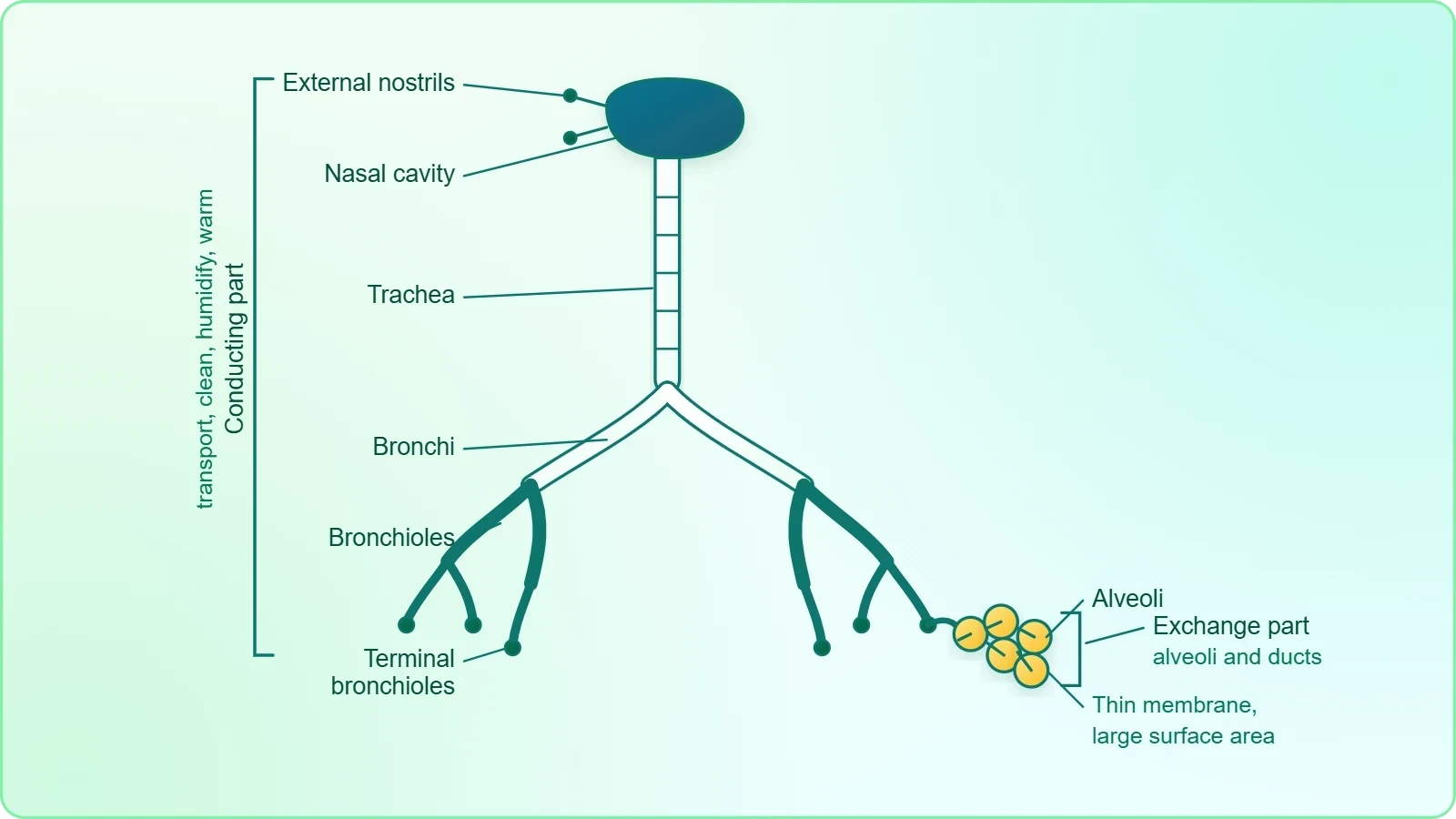
This division explains why the first two steps are kept separate. Ventilation is bulk movement of air, driven by pressure differences and muscle action; diffusion is the passive movement of individual molecules down a concentration gradient across a thin membrane. They are different kinds of process operating at different scales, and the body regulates them differently. Recognising the boundary between them, at the alveolar membrane, is the single most useful landmark in the whole sequence, because it is where the outside world becomes the internal environment.
Breathing or Pulmonary Ventilation
The first step is breathing, also called pulmonary ventilation, by which atmospheric air is drawn in and carbon dioxide-rich alveolar air is released out. It is the only step that involves bulk movement of air rather than movement of individual molecules, and it is the only step the body can adjust quickly and deliberately. The lungs themselves cannot change their own volume; they sit in an air-tight thoracic chamber formed dorsally by the vertebral column, ventrally by the sternum, laterally by the ribs, and below by the dome-shaped diaphragm. Any change in the volume of the thoracic cavity is reflected in the pulmonary cavity, and that arrangement is what makes ventilation possible.
Why bulk flow is necessary
Diffusion is fast over microscopic distances and hopeless over macroscopic ones. The distance from the nostrils to the alveoli is measured in tens of centimetres, far too great for diffusion to supply oxygen at the rate a working body demands. Ventilation solves this by physically replacing the air in the alveoli, keeping the oxygen concentration there high and the carbon dioxide concentration low. In effect, breathing maintains the gradients on which the second step depends. Without it, alveolar oxygen would fall and alveolar carbon dioxide would rise until diffusion slowed to a trickle, no matter how healthy the membrane itself might be.
The conducting part of the respiratory system supports this step in ways that are easy to overlook. As air passes from the external nostrils to the terminal bronchioles, it is cleared of foreign particles, humidified, and brought to body temperature. This conditioning protects the delicate alveolar surface and ensures that the gas arriving at the exchange part is fit for diffusion. The first step, then, is not merely a pump but a preparation: it delivers air of the right quality to the right place, and it does so continuously, adjusting its rate to the demands of the moment.
What the step accomplishes
The measurable outcome of ventilation is a steady renewal of alveolar air. Because the thoracic chamber is air-tight and the lungs are coupled to it, the volume changes produced by the respiratory muscles are transmitted directly to the pulmonary cavity. This is the anatomical reason the chapter insists on the arrangement of lungs within the thorax: we cannot directly alter pulmonary volume, so we alter thoracic volume and let the lungs follow. The first step therefore converts muscular effort into a pressure gradient, and the pressure gradient into a flow of air. The next lesson takes up exactly how inspiration and expiration generate that gradient.
It is worth noting what the first step does not do. It does not move oxygen into the blood, and it does not remove carbon dioxide from the blood; it only changes the composition of the air on the alveolar side of the membrane. The actual transfer is the work of the second step. Keeping this boundary clear prevents a common confusion, in which breathing and gas exchange are treated as the same thing. They are consecutive and interdependent, but they are distinct processes with distinct mechanisms, and the five-step scheme exists precisely to keep them apart.
Diffusion of Gases Across the Alveolar Membrane
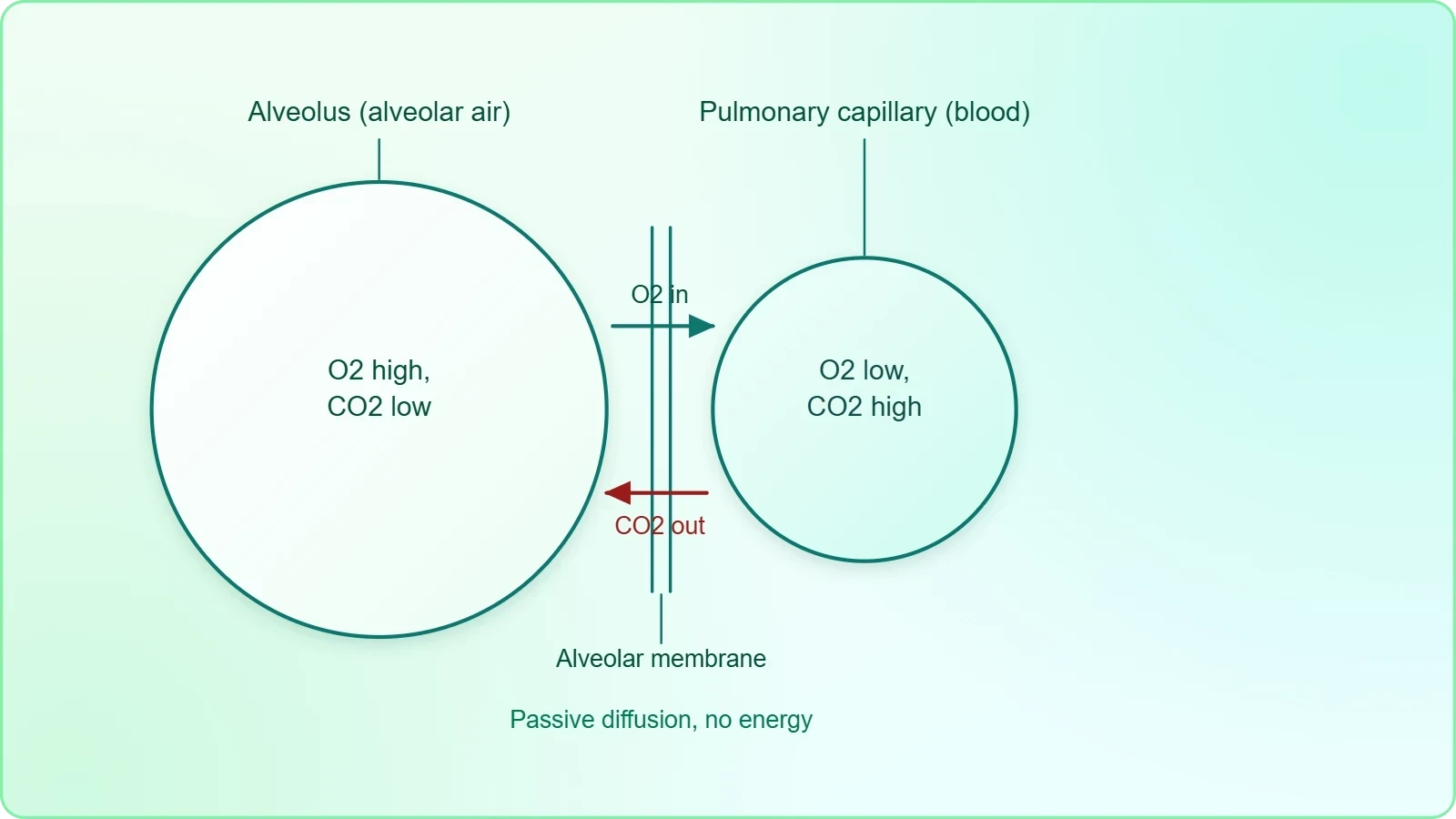
The second step is the diffusion of gases, oxygen and carbon dioxide, across the alveolar membrane. Here the exchange part of the respiratory system does its work: the alveoli and their ducts are the site of the actual diffusion of oxygen and carbon dioxide between blood and atmospheric air. Because ventilation has kept alveolar oxygen high and alveolar carbon dioxide low, concentration gradients exist across the membrane, and the gases move down those gradients without any expenditure of energy by the body. This is passive transport in its purest form, driven entirely by the difference in partial pressures on the two sides.
The membrane as the boundary of two worlds
The alveolar membrane is where the outside world becomes the internal environment. On one side is atmospheric air, renewed by breathing; on the other is blood, moving through the pulmonary capillaries. The membrane between them is thin enough for rapid diffusion, and the surface area of the alveoli is large, both features that favour exchange. Oxygen crosses from the alveolar air into the blood, and carbon dioxide crosses from the blood into the alveolar air, each moving from a region of higher concentration to one of lower concentration. The two gases travel in opposite directions across the same membrane, which is why the step is always described as a two-way exchange.
The direction of each gas is set by the gradients that ventilation and circulation maintain. Oxygen is abundant in fresh alveolar air and relatively scarce in the returning blood, so it moves inward. Carbon dioxide is relatively abundant in the returning blood and scarce in alveolar air, so it moves outward. Neither gas is pumped across; both simply follow their gradients. This is why the second step is so sensitive to the first: anything that reduces alveolar ventilation weakens the gradients and slows diffusion, even though the membrane itself is unchanged.
Why the step is passive
Because diffusion requires no energy input from the body, the second step costs nothing directly. Its currency is the concentration difference, and that difference is maintained by the first step. The elegance of the arrangement is that the expensive, muscular work is confined to ventilation, while the transfer itself happens for free. This division of labour is a recurring theme in physiology: active processes establish conditions, and passive processes exploit them. Recognising it helps explain why the body regulates breathing so carefully, since breathing is the step that pays for all the rest.
The step also illustrates why the exchange part is structurally distinct from the conducting part. The conducting airways are built for transport and conditioning, not for exchange; their walls are too thick and their total surface area too small. The alveoli are built for exchange, with thin walls and an enormous combined surface. The second step can therefore only occur where the anatomy permits it, which is why the boundary between conducting and exchange parts is drawn where it is. Structure and function coincide at the alveolar membrane, and the five-step scheme marks the coincidence precisely.
Transport of Gases by the Blood
The third step is the transport of gases by the blood. Diffusion across the alveolar membrane delivers oxygen into the blood and removes carbon dioxide from it, but the tissues are far from the lungs, and diffusion alone cannot bridge that distance. The blood therefore acts as a carrier, moving gases between the lungs and the tissues. This step is the bridge between the two diffusion steps, and it is the reason the five-step sequence has a middle: without a transport system, the lungs and the tissues would be two separate worlds with no exchange between them.
The blood as the connecting link
Once oxygen has entered the blood at the alveoli, it must be held in a form that allows it to be carried in quantity and released where it is needed. Carbon dioxide faces the mirror-image problem: it must be picked up at the tissues and carried back to the lungs for release. The blood solves both problems simultaneously, and it does so while circulating continuously between the two exchange sites. The third step is therefore a circulatory step as much as a chemical one, and its efficiency depends on both the blood's carrying capacity and the rate at which it is pumped around the body.
The step also explains why the sequence is sometimes described as two diffusion steps separated by a transport step. Oxygen diffuses into the blood at the lungs, is carried, and diffuses out of the blood at the tissues. Carbon dioxide diffuses into the blood at the tissues, is carried, and diffuses out at the lungs. The transport step is the same in both directions, but the loading and unloading happen at opposite ends of the circuit. This symmetry is one of the most satisfying features of the scheme, and it makes the whole sequence easier to remember as a single loop rather than five separate items.
Why transport cannot be skipped
The distances involved rule out direct diffusion from lungs to tissues. A molecule of oxygen leaving an alveolus would have to travel through the body's interior to reach, say, a muscle cell in the leg, and diffusion is far too slow over such distances to meet metabolic demand. The blood solves the distance problem by convection: it moves the gases bodily, at the speed of circulation, and delivers them close enough to their destinations that diffusion can finish the job. The third step is thus the enabler of the fourth, and the fourth is the enabler of the fifth.
Transport also allows the body to match supply to demand. Tissues that are working harder need more oxygen and produce more carbon dioxide, and the blood's behaviour at the tissue level can respond to those local conditions. The third step is not a fixed conveyor belt but a responsive system, and its responsiveness is what allows the five-step sequence to serve a body whose needs change from moment to moment. The details of how the blood carries each gas belong to later lessons; here the point is simply that transport exists, that it connects the two diffusion steps, and that the sequence depends on it.
Diffusion Between Blood and Tissues
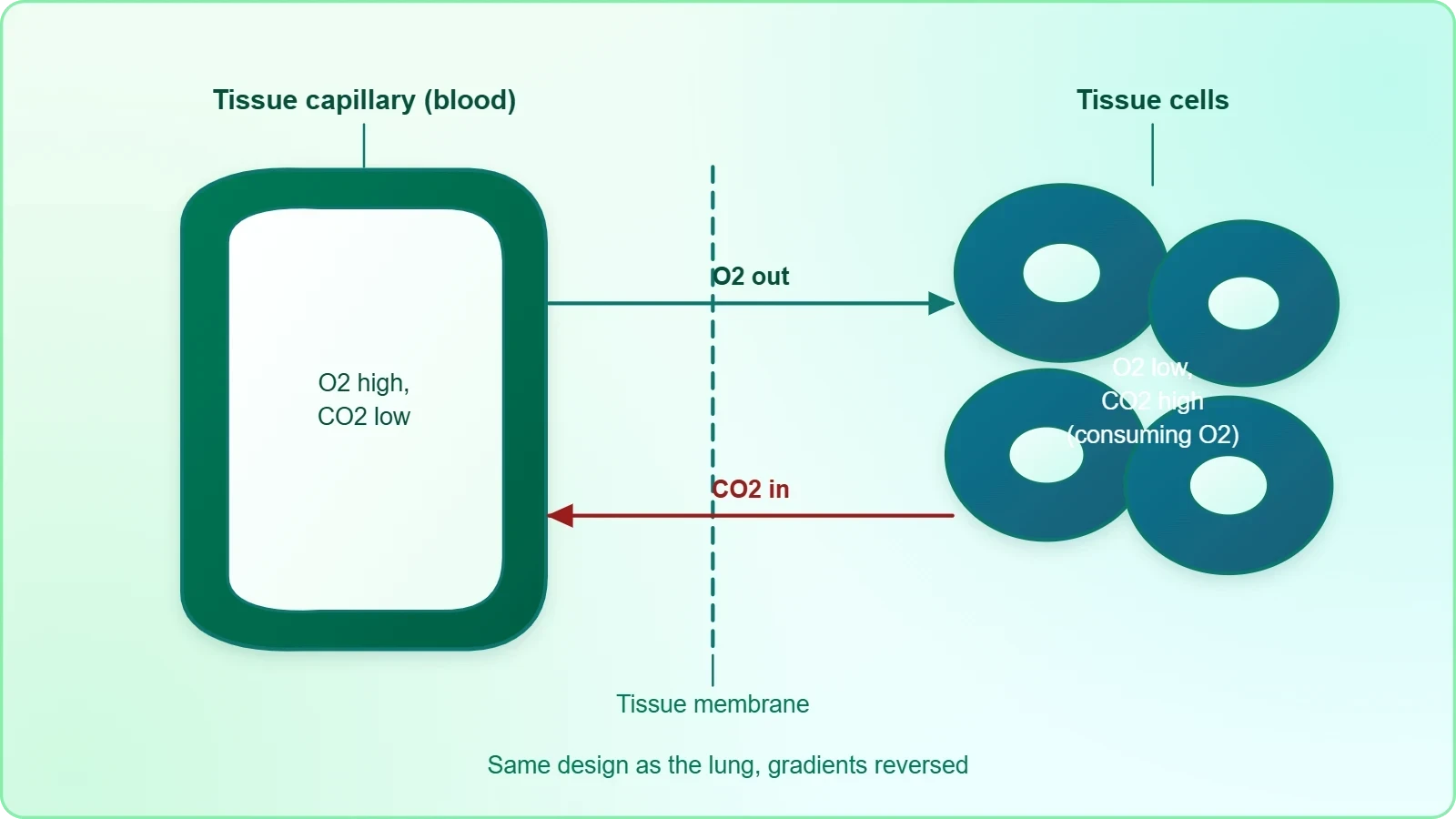
The fourth step is the diffusion of oxygen and carbon dioxide between blood and tissues. It mirrors the second step at the other end of the circuit. At the lungs, oxygen entered the blood and carbon dioxide left it; at the tissues, oxygen leaves the blood and enters the cells, while carbon dioxide leaves the cells and enters the blood. The mechanism is the same in both cases: passive movement down a concentration gradient across a thin membrane. What differs is the direction and the setting, and the fourth step is where the blood finally delivers what the first three steps have been assembling.
The mirror image of the alveolar exchange
At the tissue capillaries, the gradients are reversed relative to the lungs. Blood arriving at the tissues is relatively rich in oxygen and relatively poor in carbon dioxide, having been loaded at the alveoli. Tissue cells, by contrast, are consuming oxygen and producing carbon dioxide, so they are relatively poor in oxygen and relatively rich in carbon dioxide. Oxygen therefore diffuses from the blood into the cells, and carbon dioxide diffuses from the cells into the blood. The fourth step is the point at which the internal environment is actually served, and it is the reason the whole sequence exists.
The symmetry between the second and fourth steps is worth dwelling on, because it reveals the underlying design. Both are diffusion steps; both depend on gradients; both occur across thin membranes; both are passive. The difference is that the second step exchanges gases between the body and the outside world, while the fourth exchanges them between the blood and the body's own cells. The transport step sits between them, carrying the gases from one exchange site to the other. Once this symmetry is grasped, the five-step sequence becomes a single idea expressed twice, with a conveyor belt in the middle.
Why the tissues depend on this step
Tissue cells cannot obtain oxygen directly from the air, and they cannot dispose of carbon dioxide directly to it. They depend entirely on the blood to bring oxygen within diffusion distance and to carry carbon dioxide away. The fourth step is therefore the cells' lifeline, and its adequacy determines whether the metabolic machinery of the fifth step can run at the required rate. When the fourth step is compromised, the consequences are felt immediately in the tissues, even if the lungs and the blood are functioning normally. This is why the five-step scheme is useful clinically: it locates the fault by locating the failing step.
The step also completes the loop that the first step began. Air was drawn in so that alveolar oxygen would be high; diffusion moved that oxygen into the blood; transport carried it to the tissues; and now diffusion delivers it to the cells. Carbon dioxide travels the same loop in reverse, from the cells to the blood, from the blood to the alveoli, and out with the expired air. The fourth step is the point at which the loop turns, and the fifth step is the point at which the loop is driven. Together they close the circuit that the first three steps opened.
Utilisation of Oxygen by Cells
The fifth step is the utilisation of oxygen by the cells for catabolic reactions and the resultant release of carbon dioxide. This is cellular respiration, and it is the purpose for which the other four steps exist. Oxygen delivered by the fourth step is consumed in the breakdown of fuel molecules, and carbon dioxide is produced as a consequence. The gas that was drawn in at the nostrils, diffused across the alveolar membrane, carried by the blood, and diffused into the tissues is finally used, and the gas that will be exhaled is finally made. The sequence ends where metabolism begins.
The endpoint of the chain
Catabolic reactions are those that break larger molecules into smaller ones, releasing energy in the process, and oxygen serves as the final acceptor in the pathways that extract that energy. The carbon dioxide released is a waste product of the same reactions, and it becomes the gas that the blood will carry back to the lungs. The fifth step is therefore both a destination and a source: it is where oxygen is consumed and where carbon dioxide originates. Everything upstream, from ventilation to tissue diffusion, exists to supply this step and to clear what it produces.
Because the fifth step is cellular, it belongs to the biochemistry of the cell rather than to the mechanics of the respiratory system. The chapter on breathing and exchange of gases therefore treats it briefly, noting it as the final step and pointing to the separate treatment of cellular respiration. This division of labour is deliberate: the respiratory system's job is to deliver oxygen and remove carbon dioxide, and what the cell does with the oxygen once it arrives is a different subject. The five-step scheme marks the boundary cleanly, and the fifth step is where the respiratory account hands over to the metabolic one.
How the fifth step closes the loop
The carbon dioxide produced in the fifth step is the same carbon dioxide that the fourth step moves into the blood, the third step carries to the lungs, the second step diffuses into the alveoli, and the first step releases into the atmosphere. The loop is complete, and every step is necessary for every other. This is why the five-step scheme is more than a list: it is a description of a circuit in which the output of the last step becomes the input of the first. The carbon dioxide released by cells is, quite literally, the carbon dioxide that breathing removes.
Seeing the loop as a whole also clarifies why the steps are numbered in the order they are. The numbering follows oxygen from the atmosphere to the cell, but the circuit runs in both directions at once, with oxygen moving inward and carbon dioxide moving outward along the same route. The fifth step is the turning point in both directions: it consumes oxygen and produces carbon dioxide, and so it drives the entire loop. The first four steps are the logistics; the fifth is the purpose. Keeping that distinction in mind makes the sequence both easier to remember and easier to reason with.
Reading the Sequence as a Whole
The five steps are best understood not as a list to be memorised but as a circuit to be traced. Oxygen enters at the first step, crosses at the second, travels at the third, crosses again at the fourth, and is used at the fifth. Carbon dioxide makes the same journey in reverse, entering the circuit at the fifth step and leaving it at the first. Every step is necessary, and every step depends on the ones before it. The scheme is a description of a working system, and its value lies in the way it connects anatomy, physics, and metabolism into a single account.
What the sequence explains
Once the sequence is clear, a great many observations become intelligible. A blockage in the conducting airways impairs the first step and weakens the gradients for the second. A disorder of the alveolar membrane impairs the second step directly. A circulatory problem impairs the third. A tissue-level problem impairs the fourth or fifth. The five-step scheme gives each fault a location, and it explains why respiratory disorders often involve more than one step at once. It is a framework for reasoning, not merely a definition to be recited.
The sequence also explains why the body regulates breathing so carefully. Breathing is the step that establishes the gradients on which the passive steps depend, and it is the step the body can adjust most quickly. When the fifth step demands more oxygen, the first step responds by increasing ventilation, and the intervening steps adjust accordingly. The whole system is coordinated around the needs of the cells, and the five-step scheme makes that coordination visible. The next lesson takes up the mechanics of the first step in detail, showing exactly how inspiration and expiration generate the pressure gradients that set the sequence in motion.
Preparing for the mechanics of breathing
The first step has been described here in terms of what it accomplishes, not how it is achieved. The how belongs to the next lesson, which examines inspiration and expiration, the pressure gradients between the lungs and the atmosphere, and the roles of the diaphragm and the intercostal muscles. What matters at this stage is the purpose: ventilation exists to renew alveolar air so that diffusion can proceed. With that purpose fixed, the mechanics become easier to follow, because every muscular action can be understood as a means of maintaining the gradients that the second step requires.
The anatomy covered earlier also falls into place. The air-tight thoracic chamber, the pleural membranes, and the arrangement of the lungs within the thorax are all adaptations that make the first step possible. Because the lungs cannot directly alter their own volume, changes in thoracic volume are transmitted to the pulmonary cavity, and that is how air is moved. The five-step scheme thus connects the anatomy of the previous lesson to the mechanics of the next, and it gives the intervening material a clear place in the larger picture of respiration.
Going further
The fifth step is cellular respiration, which is treated separately in the chapter on respiration in plants and animals. That chapter follows the catabolic pathways in detail, showing how oxygen is consumed and carbon dioxide released inside the cell. For the present purpose, it is enough to note that the respiratory system's role ends at the cell membrane: it delivers oxygen and removes carbon dioxide, and the cell does the rest. Pulmonary ventilation, the first step, is simply another name for breathing, the movement of air into and out of the lungs. Both points are worth carrying into the next lesson, where the mechanics of that movement are examined.
Consolidating the Five Steps
A final pass through the sequence confirms its internal logic. Breathing draws in atmospheric air and releases carbon dioxide-rich alveolar air. Diffusion across the alveolar membrane moves oxygen into the blood and carbon dioxide out of it. The blood transports both gases between the lungs and the tissues. Diffusion between blood and tissues delivers oxygen to the cells and collects carbon dioxide from them. The cells use oxygen in catabolic reactions and release carbon dioxide as a result. Each step is stated in the order given, and each depends on the ones before it. The sequence is complete, and it is self-consistent.
Checking your understanding
A useful test is to remove one step and ask what happens. Remove ventilation, and alveolar gradients collapse, so diffusion slows regardless of the membrane's condition. Remove transport, and the lungs and tissues become disconnected, so no amount of breathing can supply the cells. Remove cellular utilisation, and the whole system loses its purpose, since oxygen would be delivered but never used. The exercise shows that the five steps are not interchangeable parts but a chain in which each link is load-bearing. Understanding the dependencies is more valuable than memorising the labels.
Another test is to trace a single molecule of carbon dioxide from its origin to its exit. It is produced in a cell during catabolic reactions, diffuses into the blood at the tissues, is carried to the lungs, diffuses into the alveolar air, and is released to the atmosphere during expiration. The journey passes through steps five, four, three, two, and one, in that order. Tracing it in reverse confirms that the sequence is a loop rather than a line, and it reinforces the point that the first and last steps are connected by the ones in between.
Looking ahead
The next lesson examines the mechanism of breathing, which is the first step in detail. It considers inspiration, during which atmospheric air is drawn in, and expiration, by which alveolar air is released out. It explains that air moves because a pressure gradient is created between the lungs and the atmosphere, with inspiration occurring when intra-pulmonary pressure is less than atmospheric pressure and expiration when it is higher. The diaphragm and the external and internal intercostal muscles generate these gradients. With the five-step sequence in mind, those mechanics will read as the engine of a system whose purpose is already clear.
The lessons that follow will take up respiratory volumes and capacities, the exchange and transport of oxygen and carbon dioxide in finer detail, the neural regulation of respiration, and respiratory disorders. Each of these topics attaches to one or more of the five steps. Volumes and capacities describe the first step quantitatively; exchange and transport elaborate the second and third; regulation governs the first; and disorders can be located by asking which step has failed. The five-step scheme is therefore not a preliminary to the rest of the chapter but the map on which the rest of the chapter is drawn.
Also Read
- No links available.
From our network :
- AI-Powered 'Precision Diagnostic' Replaces Standard GRE Score ReportsDiscover the new GRE Precision Diagnostic. Learn how AI-powered behavioral analytics and time-to-solve tracking are replacing standard GRE score reports to empower students.
- Vite 6/7 'Cold Start' Regression in Massive Module GraphsIn-depth analysis of Vite 6/7 cold start regressions in massive module graphs. Learn about barrel file issues, pre-bundling optimizations, and how to improve Vite dev server performance.
- EV 2.0: The Solid-State Battery Breakthrough and Global Factory ExpansionDiscover the impact of the Solid-State Battery Breakthrough on the EV market. Learn about CATL and BYD stock growth, global factory expansion in Europe, and the future of EV 2.0 technology.
- Analyzing Trump Deportation Numbers Insights Into The 2026 Immigration Crackdown
- Trump Political Strategy How Geopolitical Stunts Serve As Media Diversions
- Mastering DB2 12.1 Instance Design: A Technical Deep Dive into Modern Database ArchitectureComprehensive guide to DB2 12.1 Instance Design. Explore architectural components, HADR setup, buffer pool tuning, and security policies for IBM DB2 12.1. Includes 10 functional SQL and Shell samples.
- 98% of Global MBA Programs Now Prefer GRE Over GMAT Focus EditionExplore why 98% of global MBA programs now prefer the GRE over GMAT Focus. Learn about the shorter GRE format, verbal logic importance, and strategic versatility for students.
- Mastering DB2 LUW v12 Tables: A Comprehensive Technical GuideComprehensive guide on DB2 LUW v12 tables. Explore CREATE TABLE syntax, BLU Acceleration, range partitioning, data types, and security features for IBM DB2 LUW v12.
- 10 Physics Numerical Problems with Solutions for IIT JEEPrepare for IIT JEE with 10 physics numerical problems, complete with detailed solutions and conceptual explanations. Ideal for mastering kinematics, thermodynamics, electromagnetism, and optics.
RESOURCES
- unit 5 - human physiology - NCERTncert.nic.inBREATHING AND EXCHANGE OF GASES. 14.4 TRANSPORT OF GASES. Blood is the medium ... The first step in respiration is breathing by which atmospheric…
- How Breathing Works - YouTubeyoutube.comAug 11, 2023 ... Learn about the exchange of oxygen and carbon dioxide in the lungs with this animated video. Plus, learn about the…
- How Your Lungs Work (Simple Guide to Breathing & Oxygen)lung.orgJun 4, 2026 ... Every breath you take triggers a complex process ... In addition to gas exchange, your respiratory system performs other roles…
- How the Lungs Work - The Respiratory System | NHLBI, NIHnhlbi.nih.govMar 24, 2022 ... When you breathe in, air enters your airways and travels down into the air sacs, or alveoli, in your lungs.…
- The physiological basis of pulmonary gas exchangepublications.ersnet.orgThe reason we have a lung is well known: to allow the exchange of gases between the air we breathe and the pulmonary capillary…
- Gas Exchange | Anatomy and Physiology II - Lumen Learningcourses.lumenlearning.comPulmonary ventilation provides air to the alveoli for this gas exchange process. At the respiratory membrane, where the alveolar and capillary walls meet, gases ...
- Physiology, Pulmonary Ventilation and Perfusion - StatPearls - NCBIncbi.nlm.nih.gov... breathing air and 100 per cent O2. ... Review Therapeutic benefits of proning to improve pulmonary gas exchange in severe respiratory failure: focus…
- Evolution of Air Breathing: Oxygen Homeostasis and the Transitions ...pmc.ncbi.nlm.nih.govEfficient respiratory gas exchange, coupled to downstream convective and diffusive resistances, comprise the “oxygen cascade”—step-down of PO2 that balances ...
- Physiology, Respiratory Drive - StatPearls - NCBI Bookshelf - NIHncbi.nlm.nih.govJun 5, 2023 ... Breathing is a complex process that relies heavily on the ... Subsequently, hypoxia develops due to impaired gas exchange. Hypoxia ...
- Pathophysiology of respiratory failure and physiology of gas ... - PMCpmc.ncbi.nlm.nih.govOct 15, 2020 ... Pulmonary gas exchange—relevant anatomy and physiology. Cellular respiration is a fundamental process of life. In human physiology, it involves ...
- Gas exchange in the lungs - Cigna Healthcarecigna.comIn the lungs, oxygen and carbon dioxide (a waste product of body processes) are exchanged. This happens in the tiny air sacs (alveoli) at…
- 13.36: Processes of Breathing - Biology LibreTextsbio.libretexts.orgMar 6, 2021 ... ... process of respiration, which includes these four steps: Ventilation; Pulmonary gas exchange; Gas transport; Peripheral gas exchange ...
- How Plants Breathe and Exchange Gases | RHS Advicerhs.org.ukPlants absorb oxygen for respiration and carbon dioxide for photosynthesis through tiny breathing pores in their leaves ... Respiration is the process by which ...
- Breathing, respiration and gas exchange KS3 | Lesson Resourcesthenational.academyLungs - The lungs are a pair of organs found in humans and some other animals. Cellular respiration - Cellular respiration is a chemical…