Every vertebrate body is, at heart, a logistics operation: food must be captured, broken down, absorbed and the residue expelled, while oxygen must be drawn from an environment that changes with every dive and every leap. In the frog, Rana tigrina, these two problems are solved with unusual economy. The digestive tract is deliberately short, because a carnivorous diet arrives pre-packaged and requires less processing than plant matter, and the respiratory system is split between a water-adapted skin and a pair of simple sac-like lungs that serve the animal on land. This lesson follows the digestive canal from the buccal cavity to the cloaca, examines the glands that supply it, and then turns to the two modes of breathing that let a frog occupy pond and bank alike.
The material here builds directly on the habitat and external morphology already covered: the bilobed tongue, the wide mouth and the moist skin described earlier now acquire their internal purpose. What follows is confined to digestion and respiration, leaving the heart, blood vessels, kidneys and reproductive organs for the next lesson. Learners should leave with a clear mental map of the alimentary canal, an understanding of what each gland contributes, and a precise account of cutaneous and pulmonary respiration, including why the skin remains indispensable even when lungs are fully functional.
Two features deserve attention from the outset. First, the frog's digestive anatomy is a study in proportion: a short intestine suits a carnivore, and the length of the canal is reduced accordingly. Second, respiration is not a single process but a division of labour between surfaces, with the skin acting as the aquatic respiratory organ and the buccal cavity, skin and lungs sharing the burden on land. Grasping these two organising principles makes the anatomical detail far easier to retain than a list of isolated structures.
On This Page
- The Alimentary Canal: A Short Tube for a Carnivorous Diet
- Digestive Glands: Liver, Gall Bladder and Pancreas
- Cutaneous Respiration: Breathing Through the Skin
- Pulmonary Respiration: The Lungs and the Buccal Cavity
- Going Further: Why Emulsification and Villi Matter
- Consolidating the Lesson: Key Terms and Relationships
- Self-Assessment: Checking Your Understanding
The Alimentary Canal: A Short Tube for a Carnivorous Diet
The digestive system of the frog consists of two components: the alimentary canal and the digestive glands associated with it. The canal itself is short, and this brevity is not an oversight but a consequence of diet. Frogs are carnivores, and animal food requires a shorter intestinal length than the bulky cellulose-rich material that herbivores must process at length. The canal runs from the mouth through the buccal cavity, pharynx, oesophagus, stomach, intestine and rectum, and finally opens to the outside through the cloaca. Each segment has a defined role, and the sequence of food through them follows a strict order.
From Mouth to Stomach
The mouth opens into the buccal cavity, which leads through the pharynx to the oesophagus. The oesophagus is a short tube, and it opens into the stomach, which in turn continues as the intestine. Food is captured by the bilobed tongue, a structure whose external form was noted in the previous lesson and whose function is now clear: it is the instrument of prey capture, flicked forward to secure insects and other small animals. Once swallowed, the food passes rapidly down the short oesophagus into the stomach, where the chemical work of digestion begins in earnest.
Digestion of food in the stomach takes place by the action of hydrochloric acid and gastric juices secreted from the walls of the stomach. This acidic environment begins the breakdown of the ingested prey, and the partially digested material that results is called chyme. The chyme is then passed from the stomach to the first part of the small intestine, the duodenum. The terminology matters here: chyme is the specific name for the semi-fluid mass leaving the stomach, and the duodenum is the specific name for the intestinal segment that receives it. Both terms recur in examinations and should be used precisely.
The Small Intestine and the Fate of Residue
The duodenum receives bile from the gall bladder and pancreatic juices from the pancreas through a common bile duct. Bile emulsifies fat, while pancreatic juices digest carbohydrates and proteins. Final digestion takes place in the intestine, where the combined action of these secretions completes the breakdown of the food into absorbable units. The arrangement is efficient: two glands deliver their products at a single point, and the intestine that follows is the site where the process concludes rather than where it begins.
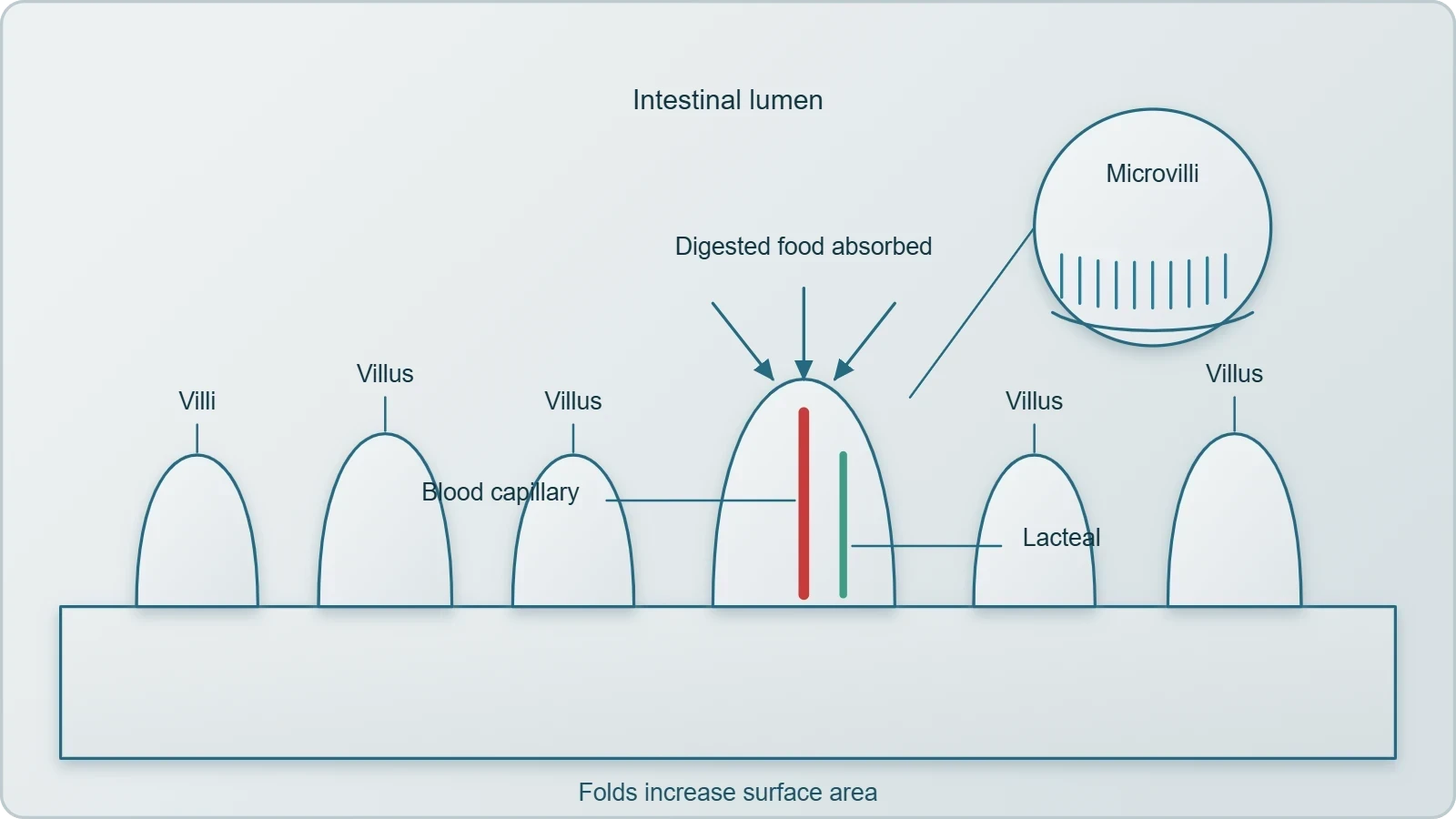
Digested food is absorbed by the numerous finger-like folds in the inner wall of the intestine called villi and microvilli. These projections vastly expand the absorptive surface, ensuring that the products of digestion are taken up rather than lost. The undigested solid waste then moves into the rectum and passes out through the cloaca. The cloaca thus serves as the common exit for the alimentary canal, a detail worth remembering because the same structure will reappear in the excretory and reproductive systems discussed in the next lesson.
Digestive Glands: Liver, Gall Bladder and Pancreas
Three glandular structures support the alimentary canal, and each has a distinct contribution. The liver secretes bile, which is stored in the gall bladder. The pancreas, a digestive gland, produces pancreatic juice containing digestive enzymes. These two secretions meet the food at the duodenum, delivered through a common bile duct. The arrangement is compact and coordinated: the liver manufactures, the gall bladder stores, and the pancreas supplies enzymes, with a single duct serving as the delivery route for both bile and pancreatic juice into the first part of the small intestine.
Bile and the Emulsification of Fat
Bile performs a specific and limited task: it emulsifies fat. It does not itself digest fat in the manner of an enzyme, but it prepares fat for digestion by dispersing it. The gall bladder serves as the reservoir for this secretion, releasing bile into the duodenum when food arrives. Learners should note the division of labour clearly, because it is a common point of confusion: bile handles fat, pancreatic juices handle carbohydrates and proteins, and the intestine is where final digestion is completed. Each secretion has its own target and its own site of action.
Pancreatic Juice and the Enzymes of Digestion
The pancreas produces pancreatic juice containing digestive enzymes, and these juices digest carbohydrates and proteins. Delivered alongside bile through the common bile duct, they act in the duodenum and the intestine beyond it. The pairing of bile and pancreatic juice at a single entry point means that fat, carbohydrate and protein digestion are initiated in close proximity, allowing the intestine to complete the process efficiently. The stomach has already begun protein breakdown with hydrochloric acid and gastric juices, so the pancreatic contribution continues work that is already under way rather than starting from nothing.
Cutaneous Respiration: Breathing Through the Skin
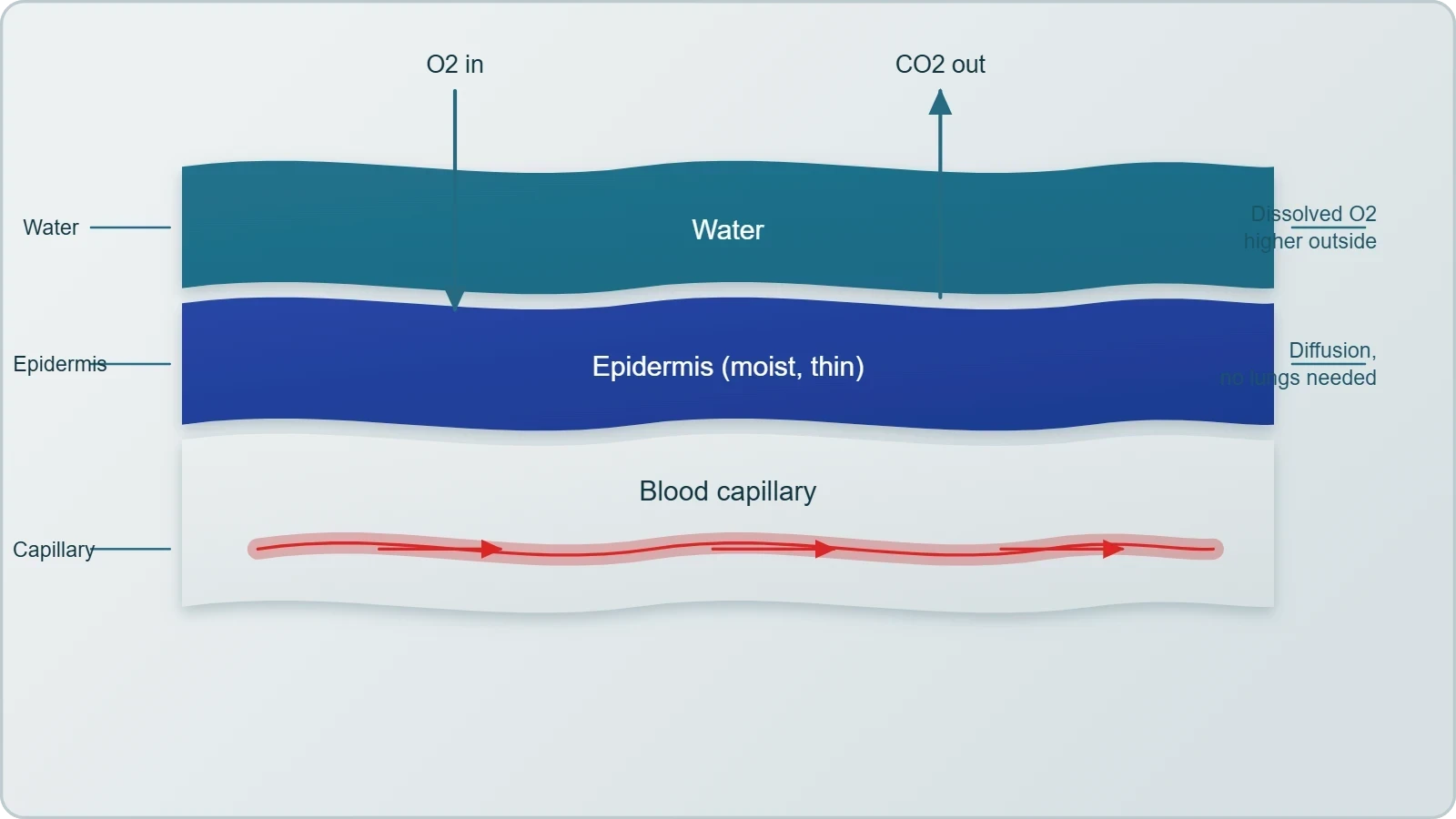
Frogs respire on land and in the water by two different methods, and the first of these is cutaneous respiration. In water, the skin acts as the aquatic respiratory organ. Dissolved oxygen in the water is exchanged through the skin by diffusion. This is a direct physical process requiring no lungs, no gills and no pumping mechanism: oxygen dissolved in the surrounding water simply crosses the skin, driven by the concentration difference between the water and the blood beneath. The moist, permeable skin noted in the morphology lesson is therefore not merely a surface feature but a functional respiratory membrane.
Diffusion Across a Permeable Surface
The principle underlying cutaneous respiration is diffusion, the movement of a substance from a region of higher concentration to one of lower concentration. Dissolved oxygen in the water is at higher concentration than in the blood arriving at the skin, so it crosses the skin into the body. The skin must remain moist and permeable for this to continue, which is why frogs are bound to damp habitats. The same surface that serves as the aquatic respiratory organ in water continues to contribute on land, where the buccal cavity, skin and lungs act together as the respiratory organs.
Respiration During Aestivation and Hibernation
During aestivation and hibernation, gaseous exchange takes place through the skin. This is a significant detail: when a frog is dormant, buried or otherwise inactive for extended periods, the lungs are not the route by which gases move. The skin alone sustains the animal. Aestivation refers to dormancy during hot, dry conditions, and hibernation to dormancy during cold conditions; in both states, the skin carries the entire respiratory load. This reinforces the point that cutaneous respiration is not a minor supplement but an essential and sometimes exclusive pathway for gas exchange.
Pulmonary Respiration: The Lungs and the Buccal Cavity
On land, the buccal cavity, skin and lungs act as the respiratory organs, and respiration by lungs is called pulmonary respiration. The lungs are a pair of elongated, pink coloured sac-like structures present in the upper part of the trunk region, the thorax. Air enters through the nostrils into the buccal cavity and then to the lungs. The pathway is therefore straightforward: nostrils, buccal cavity, lungs. The buccal cavity is not a passive corridor but an active participant, since it is listed among the respiratory organs on land alongside the skin and the lungs themselves.
Structure and Position of the Lungs
The lungs are described precisely: a pair, elongated, pink coloured, sac-like, and situated in the upper part of the trunk region, the thorax. Each of these descriptors carries information. That they are paired matches the bilateral symmetry of the body cavity. That they are elongated and sac-like indicates a simple structure rather than the finely branched architecture of mammalian lungs. That they are pink coloured reflects their vascular supply. That they sit in the upper trunk region places them near the heart and above the digestive organs, consistent with the arrangement of internal organs visible in the body cavity.
The Route of Air and the Division of Labour
Air enters through the nostrils into the buccal cavity and then to the lungs. This simple route contrasts with the aquatic pathway, where dissolved oxygen crosses the skin by diffusion. The frog thus operates two respiratory systems simultaneously when on land, since the buccal cavity, skin and lungs all contribute. The division of labour is the key idea: no single organ carries the entire burden on land, and in water the skin carries it alone. Understanding this flexibility explains how the frog can move between pond and bank without interruption to gas exchange.
Going Further: Why Emulsification and Villi Matter
Two background points sharpen the picture without altering anything the material states. The first concerns emulsification. Bile emulsifies fat, and the physical meaning of that word is worth spelling out: emulsification means breaking large fat droplets into smaller ones, which increases the surface area for digestive enzymes to act on. A large droplet presents only its outer surface to enzymes, whereas many small droplets present a far greater total area. Bile therefore does not chemically digest fat but prepares it, multiplying the surface on which the fat-digesting enzymes can work. This is why emulsification is described as a preparatory step.
The Geometry of Absorption
The second point concerns the villi and microvilli. These finger-like folds in the inner wall of the intestine increase the inner surface area of the intestine, improving absorption of digested food. The principle is geometric: folding a surface multiplies the area available for exchange without requiring a longer tube. Since the frog's intestine is short, this amplification is especially valuable, because a reduced canal must absorb efficiently to compensate for its brevity. Villi and microvilli are therefore not decorative details but the structural answer to the problem of absorbing enough from a short intestine.
Connecting Digestion to the Next Lesson
Absorption completes the digestive story, but the nutrients and gases absorbed must still be distributed, and the wastes generated must still be removed. That is the work of the circulatory and excretory systems, which form the subject of the next lesson. The blood vascular system of the frog is a well-developed closed type, and the excretory system consists of a pair of kidneys, ureters, cloaca and urinary bladder. The cloaca, already encountered here as the exit of the alimentary canal, reappears there as a shared structure, which is why the present lesson ends at that opening rather than beyond it.
Consolidating the Lesson: Key Terms and Relationships
The digestive and respiratory systems of the frog reward study as a set of relationships rather than a list of parts. The short alimentary canal follows from the carnivorous diet; the liver, gall bladder and pancreas converge on the duodenum through a common bile duct; the stomach's hydrochloric acid and gastric juices produce chyme; the intestine completes digestion and absorbs through villi and microvilli; the rectum and cloaca dispose of what remains. On the respiratory side, the skin serves in water, the buccal cavity, skin and lungs serve on land, and the skin alone serves during aestivation and hibernation. Each fact connects to another.
Terms to Know Precisely
Certain terms carry exact meanings and should be used without substitution. Chyme is the partially digested food passed from the stomach to the duodenum. The duodenum is the first part of the small intestine. Emulsification is the action of bile on fat. Villi and microvilli are the finger-like folds of the intestinal wall. Cutaneous respiration is gas exchange through the skin, and pulmonary respiration is respiration by lungs. Aestivation and hibernation are the dormant states during which gaseous exchange takes place through the skin. Precision with these terms is the difference between a vague answer and a correct one.
Preparing for Circulation and Excretion
The structures described here do not operate in isolation. The absorbed nutrients and the oxygen taken in must be transported, and the nitrogenous wastes produced by metabolism must be eliminated. The next lesson takes up the vascular system, a well-developed closed type with a three-chambered heart, and the excretory system of paired kidneys, ureters, cloaca and urinary bladder. The cloaca, which appears here as the exit of the alimentary canal, will reappear as the common opening for excretory and reproductive products, so the present lesson deliberately stops at that boundary and hands the story onward.
Self-Assessment: Checking Your Understanding
A short set of questions will confirm whether the material has settled. Answer each in a sentence or two, using the terminology exactly as given. If a term cannot be recalled, return to the relevant section rather than guessing, because the value of this lesson lies in precise vocabulary as much as in general understanding. The questions below move from the digestive canal through the glands to the two respiratory modes, and they deliberately revisit the points most often confused: the difference between bile and pancreatic juice, the meaning of chyme, and the conditions under which the skin alone sustains gas exchange.
Questions on Digestion
Why is the alimentary canal of the frog short, and what does this reveal about its diet? Trace the path of food from the buccal cavity to the cloaca, naming each segment in order. What is chyme, and where is it produced? Which gland secretes bile, where is bile stored, and what does bile do to fat? What does pancreatic juice digest, and through which duct does it reach the intestine? What are villi and microvilli, and what is their function? Answering these seven questions in sequence reconstructs the entire digestive system without reference to the text.
Questions on Respiration
What is cutaneous respiration, and in which medium does it operate? Which organs act as respiratory organs on land? Describe the lungs of the frog in terms of number, shape, colour and position. Trace the route by which air reaches the lungs. What happens to gaseous exchange during aestivation and hibernation? Why is a moist skin essential to the frog's survival? These six questions cover the respiratory material completely, and the final one links anatomy back to habitat, closing the circle opened in the previous lesson on where frogs live and how their bodies are built.
Also Read
- No links available.
From our network :
- Mastering DB2 LUW v12 Tables: A Comprehensive Technical GuideComprehensive guide on DB2 LUW v12 tables. Explore CREATE TABLE syntax, BLU Acceleration, range partitioning, data types, and security features for IBM DB2 LUW v12.
- Mastering DB2 12.1 Instance Design: A Technical Deep Dive into Modern Database ArchitectureComprehensive guide to DB2 12.1 Instance Design. Explore architectural components, HADR setup, buffer pool tuning, and security policies for IBM DB2 12.1. Includes 10 functional SQL and Shell samples.
- Analyzing Trump Deportation Numbers Insights Into The 2026 Immigration Crackdown
- 10 Physics Numerical Problems with Solutions for IIT JEEPrepare for IIT JEE with 10 physics numerical problems, complete with detailed solutions and conceptual explanations. Ideal for mastering kinematics, thermodynamics, electromagnetism, and optics.
- EV 2.0: The Solid-State Battery Breakthrough and Global Factory ExpansionDiscover the impact of the Solid-State Battery Breakthrough on the EV market. Learn about CATL and BYD stock growth, global factory expansion in Europe, and the future of EV 2.0 technology.
- AI-Powered 'Precision Diagnostic' Replaces Standard GRE Score ReportsDiscover the new GRE Precision Diagnostic. Learn how AI-powered behavioral analytics and time-to-solve tracking are replacing standard GRE score reports to empower students.
- Trump Political Strategy How Geopolitical Stunts Serve As Media Diversions
- 98% of Global MBA Programs Now Prefer GRE Over GMAT Focus EditionExplore why 98% of global MBA programs now prefer the GRE over GMAT Focus. Learn about the shorter GRE format, verbal logic importance, and strategic versatility for students.
- Vite 6/7 'Cold Start' Regression in Massive Module GraphsIn-depth analysis of Vite 6/7 cold start regressions in massive module graphs. Learn about barrel file issues, pre-bundling optimizations, and how to improve Vite dev server performance.
RESOURCES
- Resources will be updated soon.