Every flowering plant carries its reproductive history forward in two remarkable structures: the fruit that protects and disperses the seed, and the seed that holds the next generation in suspended life. This lesson, the tenth in a twelve-part course on the morphology of flowering plants, examines both organs as they are described in the standard botanical unit. It builds directly on the preceding study of the androecium and gynoecium, where the ovary, ovules and placentation were introduced, and it prepares the ground for the semi-technical description of a typical flowering plant that follows.
The central idea is one of transformation after fertilisation. The ovary matures into the fruit, and the ovules within it develop into seeds. Around this simple sentence the lesson organises the vocabulary that botanists use to describe fruits and seeds precisely: pericarp, epicarp, mesocarp, endocarp, drupe, testa, tegmen, hilum, micropyle, radicle, plumule, cotyledon and endosperm. Each term names a visible feature, and each feature carries information about how a plant reproduces and disperses.
Learners at beginner to intermediate level will find the material arranged in the order the unit presents it: the fruit first, with the mango and coconut as worked examples of the drupe, then the seed, with the dicotyledonous seed of bean, gram and pea contrasted against the monocotyledonous seed of maize and wheat. A short "Going further" block adds well-established background without disturbing the sequence of the source material. By the end, the reader should be able to look at a cut mango or a soaked gram seed and name every structure correctly.
On This Page
The Fruit as a Ripened Ovary
The fruit is a characteristic feature of the flowering plants, and the unit defines it with precision: it is a mature or ripened ovary, developed after fertilisation. This definition matters because it ties the fruit directly to the reproductive events described in the previous lesson. The ovary that bore the ovules on its placenta now becomes the container for the seeds those ovules will form. Nothing in the definition requires the fruit to be edible, colourful or soft; those qualities belong to particular kinds of fruit, not to the category as a whole.
A useful exception completes the definition. If a fruit is formed without fertilisation of the ovary, it is called a parthenocarpic fruit. The word signals that the developmental programme of fruit formation has run without the usual trigger of fertilisation, so the fruit may develop while remaining seedless. Keeping this exception in mind prevents the learner from treating fertilisation as an absolute precondition and sharpens the distinction between the ovary as it stands in the flower and the fruit as it appears afterwards.
The Pericarp and Its Layers
Generally, the fruit consists of a wall or pericarp and seeds. The pericarp may be dry or fleshy, and this single distinction already separates two great classes of fruit encountered in everyday life. When the pericarp is thick and fleshy, it is differentiated into three named layers: the outer epicarp, the middle mesocarp and the inner endocarp. The terminology is positional and cumulative, so a learner can describe any fleshy fruit by working from the outside inward and naming each layer in turn.
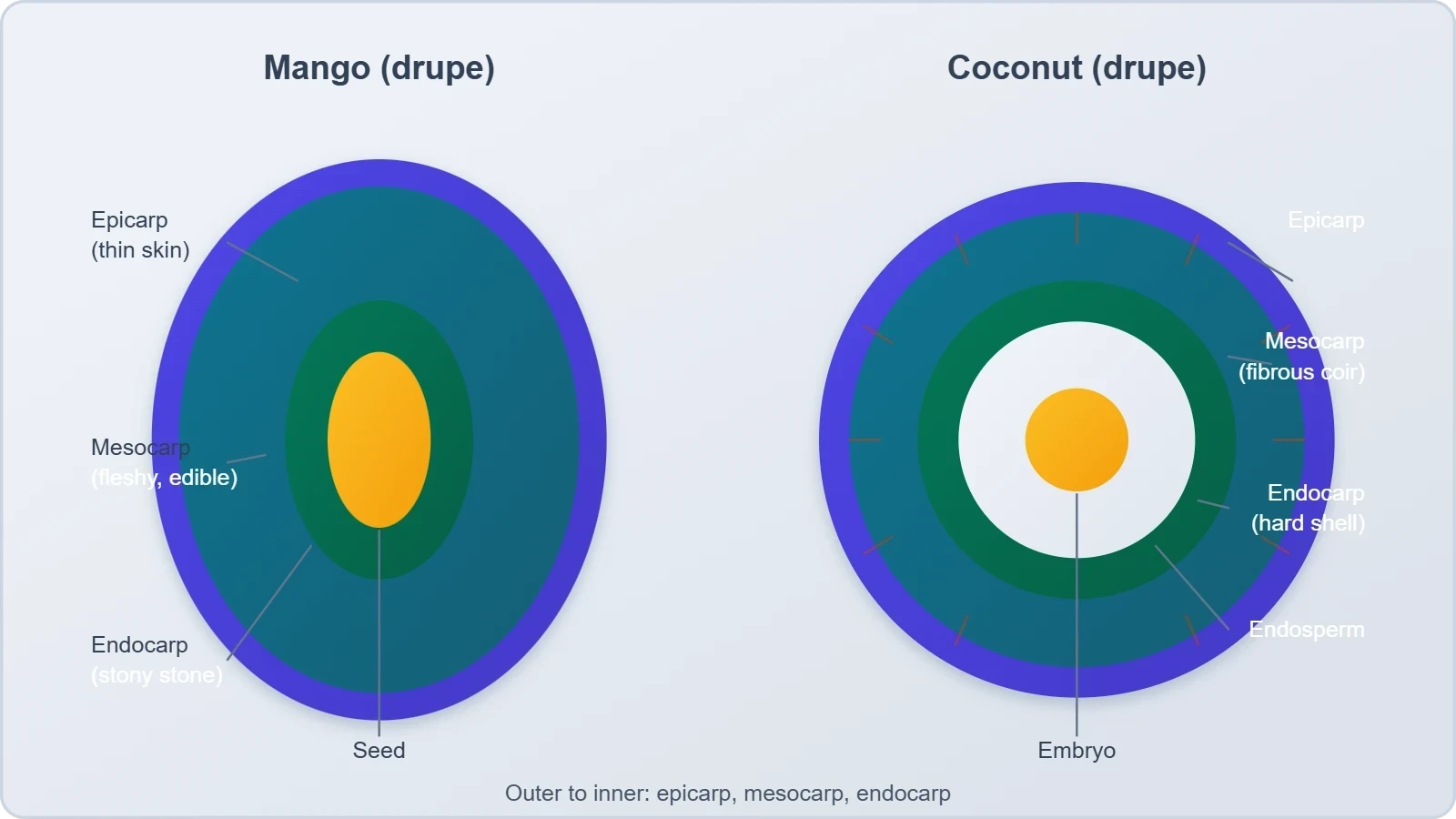
The value of this three-layer scheme becomes clear when it is applied to real specimens. In a mango, the thin skin is the epicarp, the sweet pulp is the mesocarp and the hard stone around the seed is the endocarp. In a coconut, the same three layers appear in different textures, with a fibrous mesocarp surrounding a hard shell. Recognising that the same vocabulary fits both fruits is the first step toward describing unfamiliar fruits confidently and accurately.
Why the Definition Is Worth Memorising
Botanical definitions earn their place by excluding what does not belong. Calling the fruit a ripened ovary excludes the swollen receptacle of a strawberry and the fleshy stem of a cashew apple from the strict category, even though both are treated as fruits in ordinary speech. The unit's definition keeps the learner anchored to the ovary as the point of origin, and every subsequent term in the lesson, from pericarp to seed coat, can be traced back to that single starting point.
This discipline also explains why the lesson follows the gynoecium so closely. The carpel, with its stigma, style and ovary, was described as the female reproductive part of the flower, and the ovary was identified as the enlarged basal part bearing ovules on a placenta. The fruit is simply that ovary after its work is done. Reading the two lessons together gives a continuous account of the female side of the flower from pollination to dispersal.
The Drupe: Mango and Coconut
In mango and coconut, the fruit is known as a drupe. The unit gives the drupe a precise set of characters: these fruits develop from monocarpellary superior ovaries and are one seeded. Monocarpellary means the gynoecium consists of a single carpel, and superior means the ovary sits above the other floral parts rather than being enclosed by the receptacle. One seeded means a single ovule has matured into a single seed within the fruit. These three characters together identify the drupe as a distinct and recognisable type.
The drupe is also the clearest illustration of the three-layer pericarp. In mango the pericarp is well differentiated into an outer thin epicarp, a middle fleshy edible mesocarp and an inner stony hard endocarp. The layers are easy to separate with a knife, which makes the mango an ideal classroom specimen. In coconut, which is also a drupe, the mesocarp is fibrous. The same three layers are present, but their textures differ, and the contrast between the two fruits teaches that a single structural plan can produce very different appearances.
Reading the Mango Layer by Layer
Begin with the skin. The thin outer epicarp of the mango is the layer that carries the colour and protects the fruit from minor damage. Beneath it lies the mesocarp, thick and fleshy and edible, which stores the food that makes the fruit attractive to animals and therefore useful for dispersal. At the centre is the endocarp, stony and hard, enclosing the single seed. Working outward from the seed, the learner can name all three layers in order and connect each to a function: protection, storage and further protection.
The order of the layers is fixed, and the terminology is not interchangeable. A common error is to call the edible part the endocarp because it lies inside the skin; the correct term is mesocarp, since the endocarp is the innermost layer. Correcting this error early matters, because the same three terms recur whenever a fleshy fruit is described, and a learner who fixes the order now will read later botanical descriptions without hesitation.
The Coconut as a Fibrous Drupe
The coconut repeats the mango's plan with different materials. Its mesocarp is fibrous rather than fleshy, forming the thick coir-bearing layer between the outer surface and the hard shell. The hard shell itself corresponds to the endocarp, and the seed lies within. Because the coconut is one seeded and develops from a monocarpellary superior ovary, it belongs to the same category as the mango despite looking entirely different on the outside. The lesson is that classification rests on structure and origin, not on superficial appearance.
Comparing the two drupes side by side is a productive exercise. Both are one seeded, both arise from monocarpellary superior ovaries, and both show epicarp, mesocarp and endocarp. They differ in the texture of the mesocarp, fleshy in mango and fibrous in coconut, and in the practical uses humans make of those textures. The comparison trains the eye to look past colour and size toward the underlying architecture that the vocabulary describes.
The Seed and Its Origin
The ovules after fertilisation develop into seeds. This single sentence completes the transformation begun in the previous lesson, where the ovules were described as borne on the placenta within the ovary. A seed is made up of a seed coat and an embryo, and the embryo is made up of a radicle, an embryonal axis and one or two cotyledons. One cotyledon occurs in wheat and maize; two occur in gram and pea. The seed therefore carries within it both a protective covering and the miniature plant that will emerge when conditions allow.
The vocabulary of the seed is compact but exact, and each term names a structure with a clear role. The seed coat protects, the cotyledons store or absorb food, the radicle becomes the root and the plumule becomes the shoot. Because the unit presents the dicotyledonous seed first and the monocotyledonous seed second, the learner meets the more familiar two-cotyledon plan before the specialised single-cotyledon plan of the cereals. This order makes the contrast easier to hold in mind.
Seed Coat, Hilum and Micropyle
The outermost covering of a seed is the seed coat. The seed coat has two layers, the outer testa and the inner tegmen. Two small features on the surface repay close attention. The hilum is a scar on the seed coat through which the developing seeds were attached to the fruit. Above the hilum is a small pore called the micropyle. Both are visible on a soaked gram seed with the naked eye, and locating them turns an abstract definition into a direct observation that the learner can repeat at home.
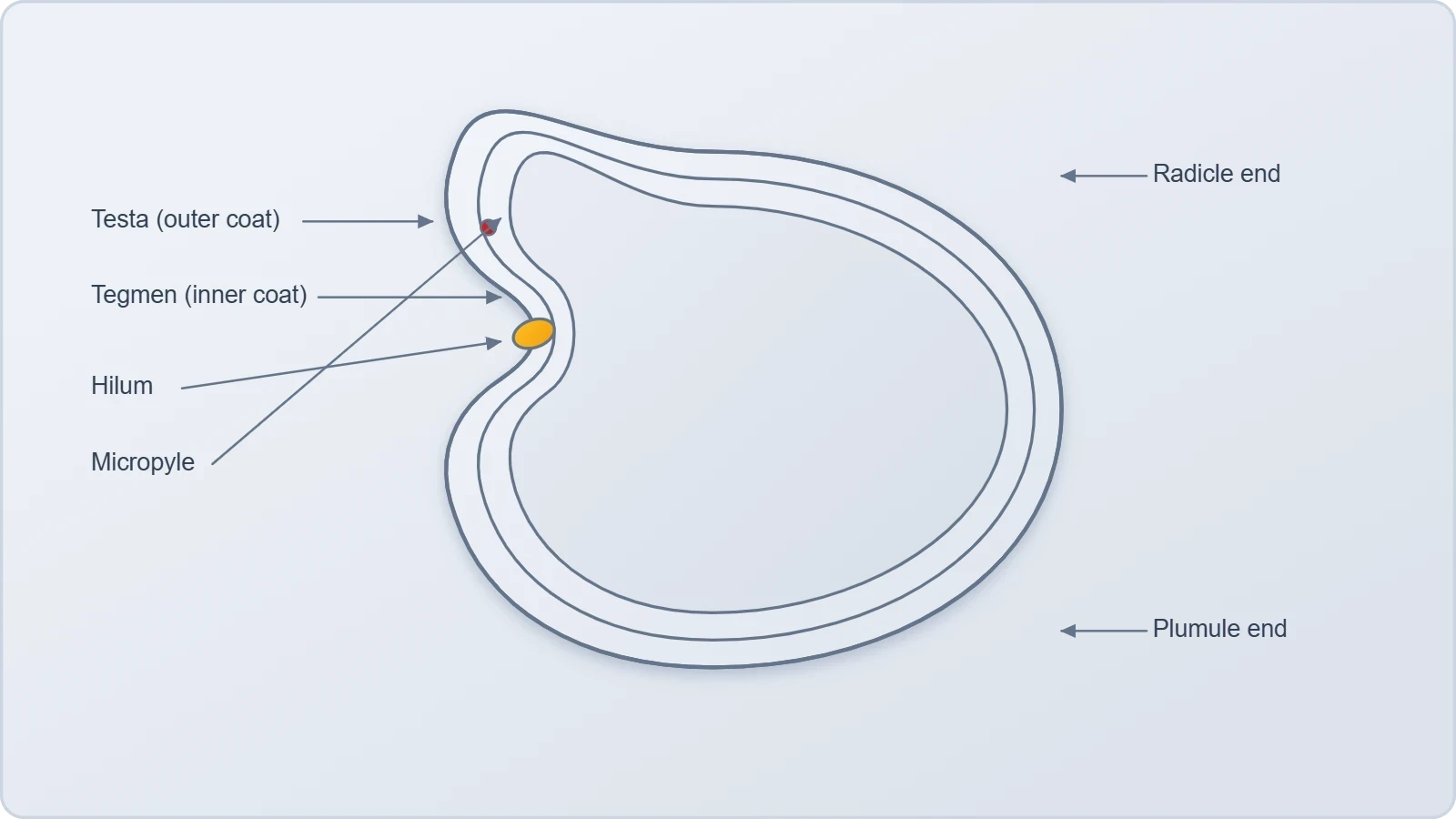
The hilum and micropyle are not decorative details. The hilum records the point of attachment, a trace of the seed's connection to the fruit wall and, through the placenta, to the parent plant. The micropyle is the pore through which the pollen tube once entered the ovule, and it remains as a small opening in the mature seed. Naming these features correctly allows a learner to orient a seed and to describe its two faces without confusion, which is exactly the skill the next lesson will require.
Embryo, Radicle and Plumule
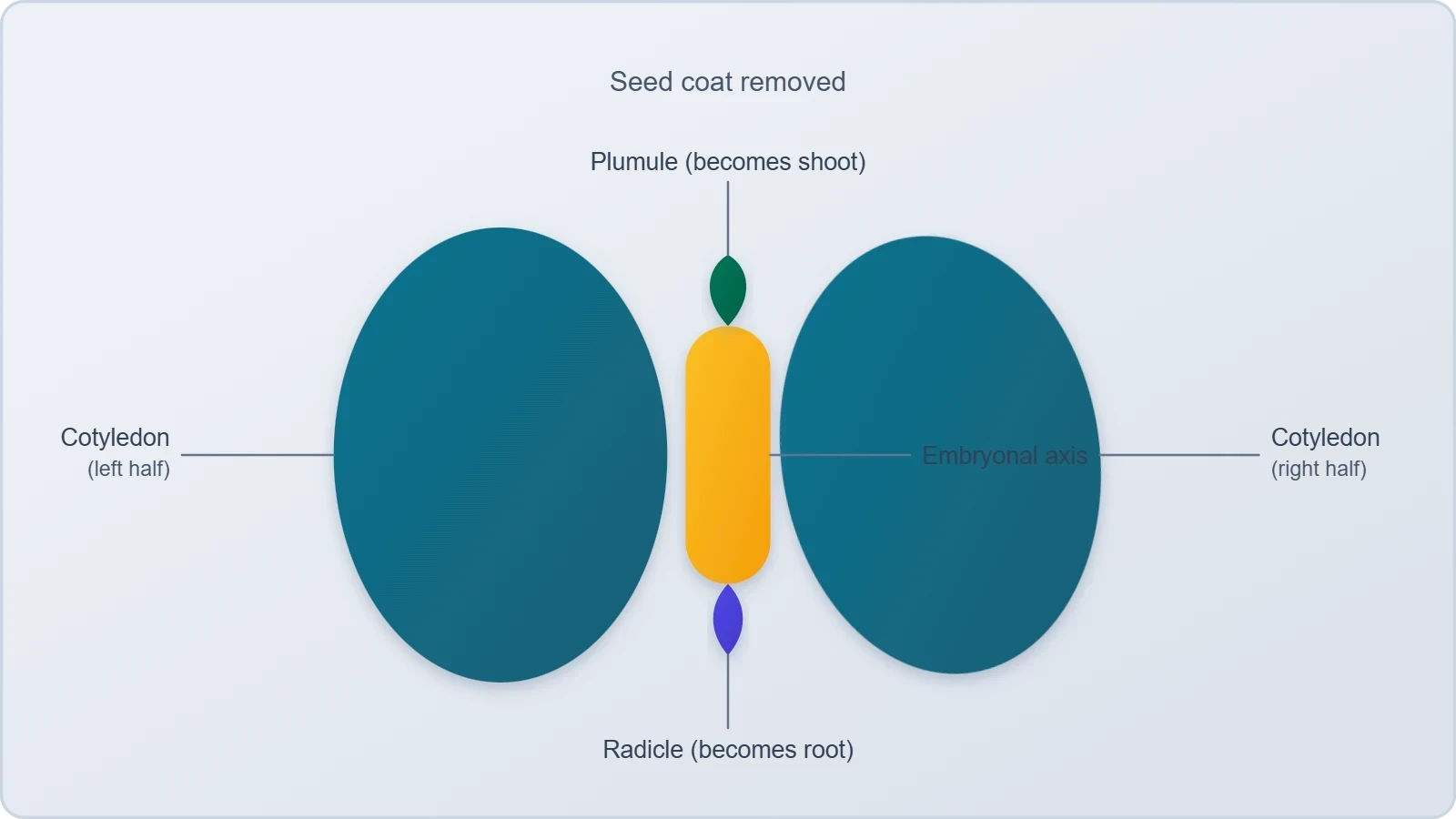
Within the seed coat lies the embryo, consisting of an embryonal axis and two cotyledons in the dicotyledonous seed. The cotyledons are often fleshy and full of reserve food materials, which is why a gram or pea seed feels solid and nourishing. At the two ends of the embryonal axis are present the radicle and the plumule. The radicle is the embryonic root and the plumule the embryonic shoot, and their positions at opposite ends of the axis anticipate the polarity of the seedling that will grow from them.
The arrangement is best learned by dissection. Remove the seed coat from a soaked gram seed and the two cotyledons separate to reveal the small embryonal axis between them, with the radicle at one end and the plumule at the other. Once the learner has seen this arrangement, the definitions become memorable rather than verbal. The exercise also shows why the cotyledons are described as fleshy: they are the seed's store of food, drawn upon during germination before the seedling can photosynthesise for itself.
We Also Published
Endospermic and Non-Endospermic Seeds
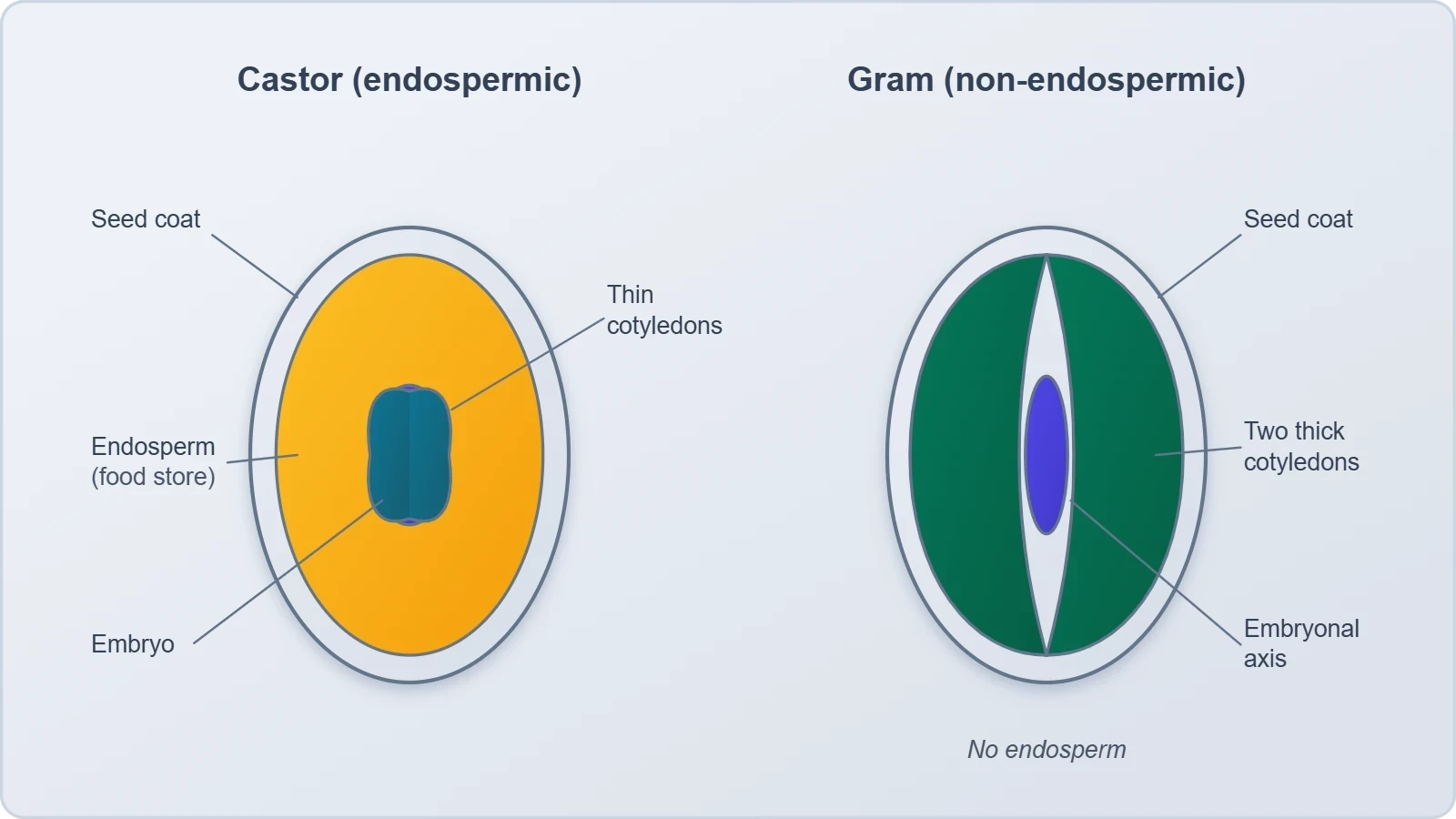
The presence or absence of endosperm in the mature seed divides seeds into two practical groups. In some seeds such as castor, the endosperm formed as a result of double fertilisation is a food storing tissue, and such seeds are called endospermic seeds. In plants such as bean, gram and pea, the endosperm is not present in mature seeds, and such seeds are called non-endospermous. The distinction is about what remains at maturity, not about whether endosperm ever formed, since double fertilisation occurs in both cases.
This point deserves emphasis because it is easy to misread. The endosperm is a product of double fertilisation, a process introduced in the earlier study of the flower, and it serves as food storing tissue where it persists. In non-endospermous seeds the cotyledons take over that storage role, which is why they are described as fleshy and full of reserve food materials. The learner should therefore ask not whether endosperm was formed but whether it is still present in the mature seed being examined.
Castor as an Endospermic Seed
Castor provides the standard example of an endospermic seed. Its mature seed retains endosperm as a food storing tissue, and the cotyledons are correspondingly thinner than those of a gram seed. When the seed coat is removed, the endosperm is visible as a substantial mass surrounding the embryo. Recognising this arrangement helps the learner understand why the term endospermic is applied to the seed as a whole rather than to any single structure within it, and why the cotyledons of such seeds need not carry the entire food reserve.
The contrast with gram and pea is instructive. In those non-endospermous seeds the cotyledons are the visible food store, and the embryo fills most of the seed. In castor the endosperm occupies much of the interior and the embryo lies within it. Both arrangements achieve the same end, the nourishment of the germinating seedling, but they distribute the storage tissue differently. Learning to predict which arrangement a seed will show, from its identity, is a mark of genuine familiarity with the material.
Why the Distinction Matters
The endospermic and non-endospermic distinction matters because it links the seed to the fertilisation events described earlier and because it guides the interpretation of a dissected specimen. A learner who expects endosperm in a gram seed will search for a tissue that is not there, while a learner who expects it in castor will find it readily. The distinction also prepares the ground for the monocotyledonous seeds that follow, where endosperm is generally present and plays a central role in the structure of the grain.
Finally, the distinction illustrates a broader habit of botanical description: a single term can summarise a whole developmental history. Calling a seed endospermic says something about double fertilisation, about the persistence of a particular tissue and about the relative size of the cotyledons. The learner who unpacks such terms gains more than vocabulary; they gain a way of reading a plant's reproductive strategy from a handful of visible features, which is precisely the aim of this course.
The Monocotyledonous Seed
Generally, monocotyledonous seeds are endospermic, but some, as in orchids, are non-endospermic. The qualification is worth noting because it prevents the learner from turning a general rule into an absolute one. In the seeds of cereals such as maize, the single cotyledon and the endosperm together dominate the interior of the grain, and the embryo occupies a smaller region. The monocotyledonous seed therefore extends the endospermic pattern already met in castor, while reducing the cotyledons to a single structure.
The unit's treatment of the monocotyledonous seed is deliberately brief, and the lesson should respect that proportion. The essential points are the general endospermic condition, the exception in orchids, and the cereal example of maize. These points are enough to establish the contrast with the dicotyledonous seed and to prepare the learner for the semi-technical description of a typical flowering plant in the next lesson, where the seed will appear as one character among many in a formal description.
Maize and the Cereal Grain
In the seeds of cereals such as maize, the endosperm is the dominant food storing tissue, and the single cotyledon lies against it. The embryo is correspondingly small relative to the whole grain. This arrangement is the monocotyledonous counterpart of the castor seed, where endosperm also persists, and it differs sharply from the gram seed, where two fleshy cotyledons fill the interior. Placing the three seeds side by side, castor, gram and maize, gives a compact survey of the storage arrangements described in the unit.
The cereal grain also shows why the number of cotyledons is such a useful character in classification. One cotyledon in wheat and maize, two in gram and pea: the count is simple to make and reliably separates the two great groups of flowering plants. The learner should be able to state the count for each named example and to connect it to the presence or absence of endosperm in the mature seed, since the two features together describe the seed's economy of storage.
Orchids and the Exception
Orchids supply the exception that keeps the rule honest. Although monocotyledonous seeds are generally endospermic, orchid seeds are non-endospermic. The exception is worth remembering because it demonstrates that botanical generalisations are statements of frequency rather than of necessity. A learner who knows both the rule and its exception can describe a new seed without forcing it into a category that does not fit, and can ask the right questions about what is actually present in the specimen before them.
Handling exceptions well is part of botanical maturity. The unit states the general condition and then names the exception in a single clause, and the lesson should mirror that economy. There is no need to multiply examples; the point is the habit of mind, the willingness to hold a general rule and a specific exception together without confusion. That habit will serve the learner well when the next lesson asks for a semi-technical description in which every character must be stated accurately.
Going Further
The pericarp is the wall of the fruit and may be dry or fleshy. This short statement, already present in the unit, repays a moment of reflection because it explains why the three-layer description applies only to some fruits. A thick fleshy pericarp differentiates into epicarp, mesocarp and endocarp, as in the mango and the coconut. A dry pericarp does not show this fleshy differentiation in the same way, and the learner should not expect to find a soft mesocarp in every fruit that is opened. The distinction between dry and fleshy is the first question to ask of any fruit.
The scutellum is the single shield-shaped cotyledon of a grass seed such as maize. The name is widely used in the botanical literature for the cotyledon of the grasses, and it describes the shape and position of the structure rather than introducing a new organ. A learner who meets the term in a description of a cereal grain can recognise it as the single cotyledon already named in the unit, seen in its characteristic shield-like form. Nothing in this background alters the definitions given above; it simply supplies the conventional name for a structure the lesson has already described.
From our network :
- AI-Powered 'Precision Diagnostic' Replaces Standard GRE Score ReportsDiscover the new GRE Precision Diagnostic. Learn how AI-powered behavioral analytics and time-to-solve tracking are replacing standard GRE score reports to empower students.
- 98% of Global MBA Programs Now Prefer GRE Over GMAT Focus EditionExplore why 98% of global MBA programs now prefer the GRE over GMAT Focus. Learn about the shorter GRE format, verbal logic importance, and strategic versatility for students.
- Where to Put Your Wireless Router for Better CoverageA practical, physics-grounded guide to router placement: why the centre of the home beats the corner, how walls and metal sap signal, and how to run a simple survey that proves the improvement.
- 10 Physics Numerical Problems with Solutions for IIT JEEPrepare for IIT JEE with 10 physics numerical problems, complete with detailed solutions and conceptual explanations. Ideal for mastering kinematics, thermodynamics, electromagnetism, and optics.
- Do You Need a New Router or Is Your Internet Plan the Problem?A practical comparison of the signs that point to router limits versus signs your broadband speed or provider is the bottleneck, so you can decide what to replace before spending money.
- EV 2.0: The Solid-State Battery Breakthrough and Global Factory ExpansionDiscover the impact of the Solid-State Battery Breakthrough on the EV market. Learn about CATL and BYD stock growth, global factory expansion in Europe, and the future of EV 2.0 technology.
- Trump Political Strategy How Geopolitical Stunts Serve As Media Diversions
- How to Print Cheaply: Cutting the Cost per PageA practical, measured guide to lowering what each printed page costs — duplex and draft modes, third-party ink, yield mathematics, and knowing when a new printer beats refills.
- Analyzing Trump Deportation Numbers Insights Into The 2026 Immigration Crackdown
RESOURCES
- The seed morphospace, a new contribution towards the ...academic.oup.comHowever, macroevolutionary studies focusing on seed and fruit morphology ... KN. 2019 . Correlated evolution of flower size and seed number in flowering plants…
- 8.1 Fruit Morphology – The Science of Plantsopen.lib.umn.eduIn Plant Propagation, we'll define fruits from the botanical standpoint: the ripened ovary of a flower, together with the seeds within that ovary. Review…
- 3. Botany | NC State Extension Publicationscontent.ces.ncsu.eduFeb 1, 2022 ... Phylum Angiosperm—Angiosperms are flowering plants that produce seeds contained in a fruit (a ripened ovary). ... Plant Morphology – Leaves…
- Fruit and seed morphology of the tribe Orobancheae ...nsojournals.onlinelibrary.wiley.comJan 14, 2016 ... Seed and fruit morphology of four genera of Orobanchaceae: Cistanche, Diphelypaea, Orobanche and Phelipanche, native to Turkey, were studied ...
- Morphology of Flowering Plants | PDF | Fruit | Seed - Scribdscribd.comAngiosperms are the most advanced group of plants that exist today. They have enclosed seeds, bear flowers, and undergo double fertilization.
- Ecology of morphological fruit types, and fruit and seed colors in 27 ...sciencedirect.comEcology of morphological fruit types, and fruit and seed colors in 27 Venezuelan plant communities ... flowering plants: APG IV. Bot. J. Linn. Soc.…
- Reproductive Plant Morphology — Seeds, Flowers, and Fruitsextensionpubs.unl.eduReproductive Plant Morphology —. Seeds, Flowers, and Fruits. Anne Streich, Horticulture Educator. Seeds. Seeds are a plant reproductive structure, containing a.
- Fruit and seed morphological divergence between wild and ...sciencedirect.comWild enset reproduce naturally via seeds. As cultivated enset is usually harvested before or shortly after flowering, the development of flowers and fruits is ...
- PLB 102 | Lab 1 - UC Davis Plant Sciencespsfaculty.plantsciences.ucdavis.edu... Floral and Fruit Morphology. >> Introduction. In this laboratory, you will learn (or re-learn) the morphology of vascular plants. As a review, recall…
- Morphology of Flowering Plants – Fruit & Seed, Description of Familiesthepractiseground.inIn Grade 11 biology, Morphology of Flowering Plants explores Fruit & Seed and Description of Families. Concepts introduced here reappear in Grade 12 and…
- kebo105.pdf - NCERTncert.nic.inMORPHOLOGY OF FLOWERING PLANTS. CHAPTER 5. 5.1 The Root. 5.2 The Stem. 5.3 The Leaf. 5.4 The Inflorescence. 5.5 The Flower. 5.6 The Fruit.…
- Full article: Morphogenesis of fruits and types of fruit of angiospermstandfonline.comOct 18, 2019 ... ... morphology of higher plants, carpology and reproductive biology of flowering plants. ... “Seed and Fruit Anatomy of Cassytha filiformis…
- Flowering plant - Wikipediaen.wikipedia.org... seed'), meaning that the seeds are enclosed within a fruit. Flowering plant ... ↑ "Fruit Anatomy". Fruit & Nut Research & Information Center ...
- 1.16: Plant Morphology - Flowers and Fruit - Biology LibreTextsbio.libretexts.orgSep 20, 2020 ... For the majority of angiosperms, when a flower is pollinated, the pollen joins with an egg to produce a seed.…
- 16. Plant Morphology – Flowers and Fruit - BC Open Textbooksopentextbc.caFor the majority of angiosperms, when a flower is pollinated, the pollen joins with an egg to produce a seed. The seed develops within…