Vertebrata stands as the most familiar and most structurally ambitious of the three chordate subphyla, and its defining logic is deceptively simple: the notochord that anchors the embryo is progressively replaced by a cartilaginous or bony vertebral column in the adult. That single substitution reshapes the entire architecture of the animal, permitting larger body sizes, stronger muscle anchorage, and a protected central nerve cord. Everything else that follows in vertebrate biology — the ventral muscular heart, the kidneys, the paired appendages — becomes intelligible once this axial skeleton is understood as the organising centre of the body plan.
This lesson builds directly on the protochordates examined previously, where the notochord either persisted lifelong or remained confined to a larval tail. Vertebrates inherit the full chordate toolkit — dorsal hollow nerve cord, pharyngeal gill slits, post-anal tail, closed circulatory system, bilateral symmetry, triploblastic coelomate organisation — and then modify it. The critical distinction to hold onto is that all vertebrates are chordates, but not all chordates are vertebrates. That asymmetry of classification is the hinge on which the entire subphylum turns, and it prepares the ground for the jawless and jawed classes that follow.
Beyond the skeleton, vertebrates acquire three further innovations that the source material isolates clearly: a ventral muscular heart with two, three or four chambers; kidneys serving both excretion and osmoregulation; and paired appendages that may take the form of fins or limbs. These features are not decorative additions but functional commitments that constrain how vertebrates breathe, move, and regulate their internal chemistry. The division into Agnatha, which lacks jaws, and Gnathostomata, which bears jaws, then organises the subphylum into two great branches whose consequences ripple through every class from Cyclostomata to Mammalia.
On This Page
- The Chordate Inheritance and the Vertebrate Departure
- The Vertebrate Body Plan: Heart, Kidneys and Paired Appendages
- Paired Appendages: Fins, Limbs and the Locomotor Divide
- The Division of Vertebrata: Agnatha and Gnathostomata
- Vertebrates Within the Wider Chordate Frame
- Going Further
- Preparing for the Classes That Follow
The Chordate Inheritance and the Vertebrate Departure
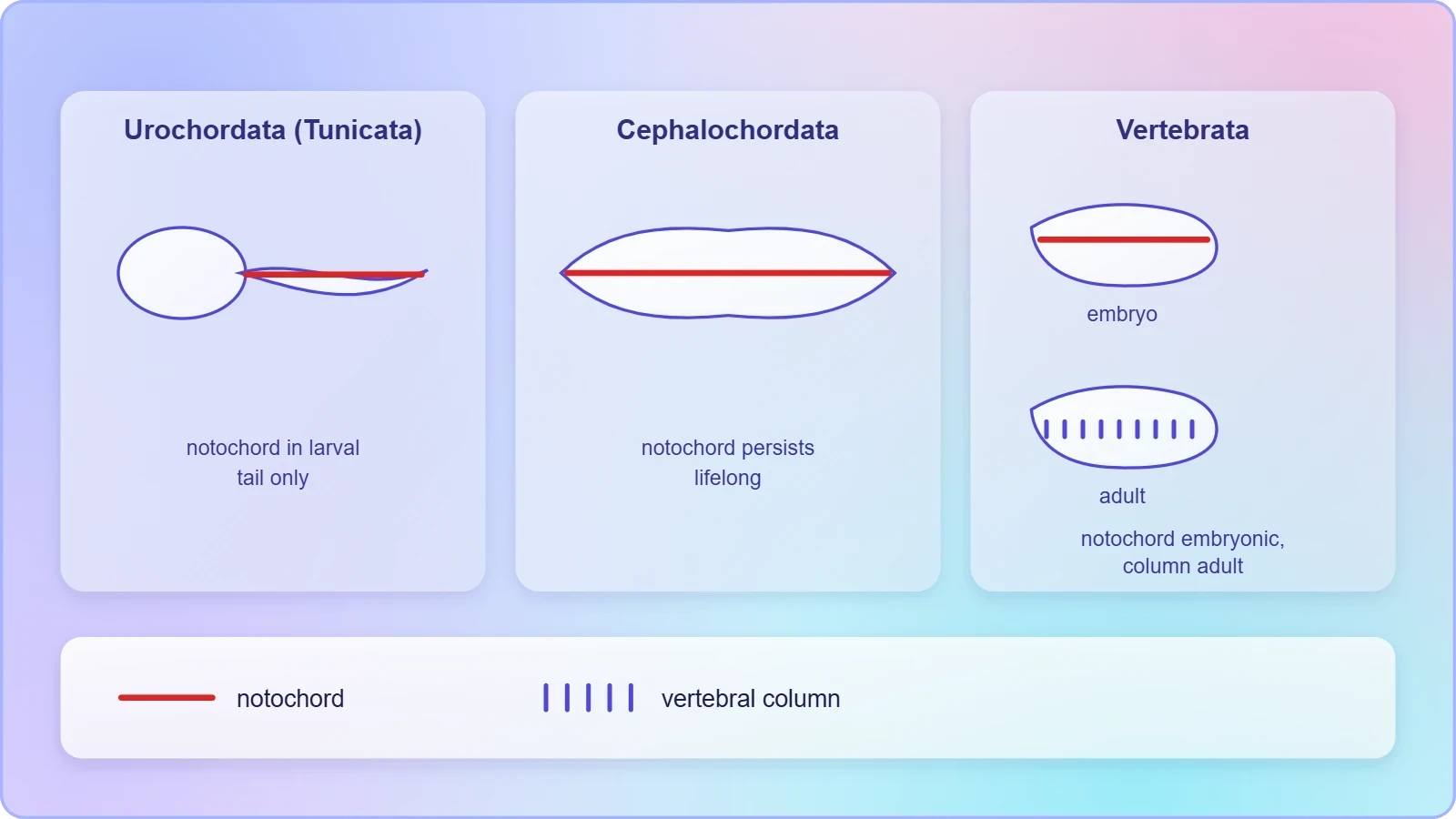
Before examining what vertebrates add, it is worth restating precisely what they inherit, because the subphylum is defined as much by continuity as by innovation. The chordate blueprint includes a hollow dorsal nerve cord, paired pharyngeal gill slits, a notochord, a post-anal tail, and a closed circulatory system, all arranged within a bilaterally symmetrical, triploblastic, coelomate body with organ-system level organisation. Vertebrates retain every one of these characters, at least during embryonic life, and the source material is careful to insist on that retention rather than treating vertebrates as a clean break from their relatives.
The departure lies in timing and fate. In Urochordata the notochord is present only in the larval tail; in Cephalochordata it extends from head to tail and persists throughout life. In Vertebrata the notochord appears during the embryonic period and is then replaced by a cartilaginous or bony vertebral column in the adult. This is a developmental succession rather than an outright loss, and it explains why vertebrate embryos so closely resemble the chordate archetype while adult vertebrates look nothing like lancelets.
Reading the Comparative Table Correctly
The comparison of chordates and non-chordates is best read as a checklist of five decisive contrasts, each of which can be traced through vertebrate anatomy. Chordates possess a notochord; non-chordates lack one. The chordate central nervous system is dorsal, hollow and single, whereas the non-chordate nervous system is ventral, solid and double. The chordate pharynx is perforated by gill slits, which are absent in non-chordates. The chordate heart is ventral, while the non-chordate heart, where present, is dorsal. Finally, chordates carry a post-anal part or tail, which non-chordates do not.
Each of these contrasts repays close attention because students frequently invert them under examination pressure. The dorsal hollow nerve cord, for instance, sits above the gut and contains a fluid-filled canal, a configuration unique to chordates and preserved in every vertebrate from lamprey to human. The ventral heart is equally diagnostic: it lies below the digestive tract and pumps blood forward through the gills or lungs. Memorising the table is useful, but understanding why each position matters functionally is what allows the vertebrate body plan to be reconstructed from first principles.
Why the Notochord Is Replaced Rather Than Retained
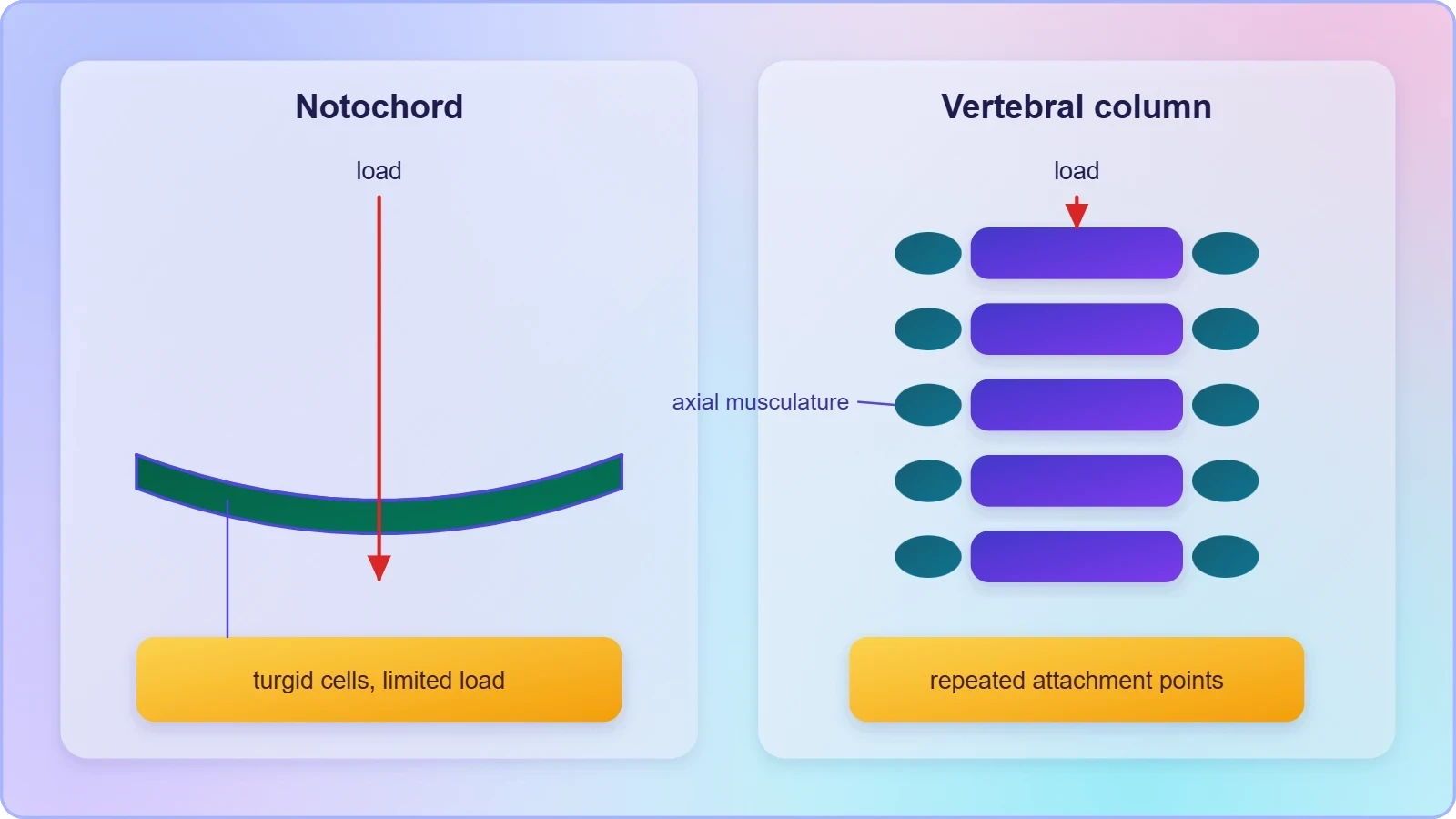
The replacement of the notochord by a vertebral column is a developmental event with profound mechanical consequences. A notochord is a flexible rod of turgid cells, excellent for a small, swimming organism but limited in the loads it can bear. A vertebral column, by contrast, is a segmented series of cartilaginous or bony elements that can anchor muscles, protect the nerve cord, and transmit force along the body axis. The transition from one to the other is therefore not a trivial substitution but the enabling condition for the vertebrate habit of active, large-bodied locomotion.
This also clarifies the phrasing that all vertebrates are chordates but not all chordates are vertebrates. The protochordates retain the notochord as their principal axial support throughout life, whether confined to the larval tail as in Urochordata or extending head to tail as in Cephalochordata. Vertebrates pass through a comparable stage embryonically, then move beyond it. The subphylum is thus defined by a trajectory rather than a static structure, and that trajectory is what the next lessons will trace class by class.
The Vertebrate Body Plan: Heart, Kidneys and Paired Appendages
Alongside the axial skeleton, the source material identifies three additional vertebrate characters that deserve separate treatment because each carries a distinct physiological burden. Vertebrates possess a ventral muscular heart with two, three or four chambers. They possess kidneys for excretion and osmoregulation. And they possess paired appendages, which may be fins or limbs. These three systems — circulatory, excretory, and locomotor — together define how a vertebrate maintains its internal environment while moving through an external one, and their variation across classes is the substance of comparative vertebrate anatomy.
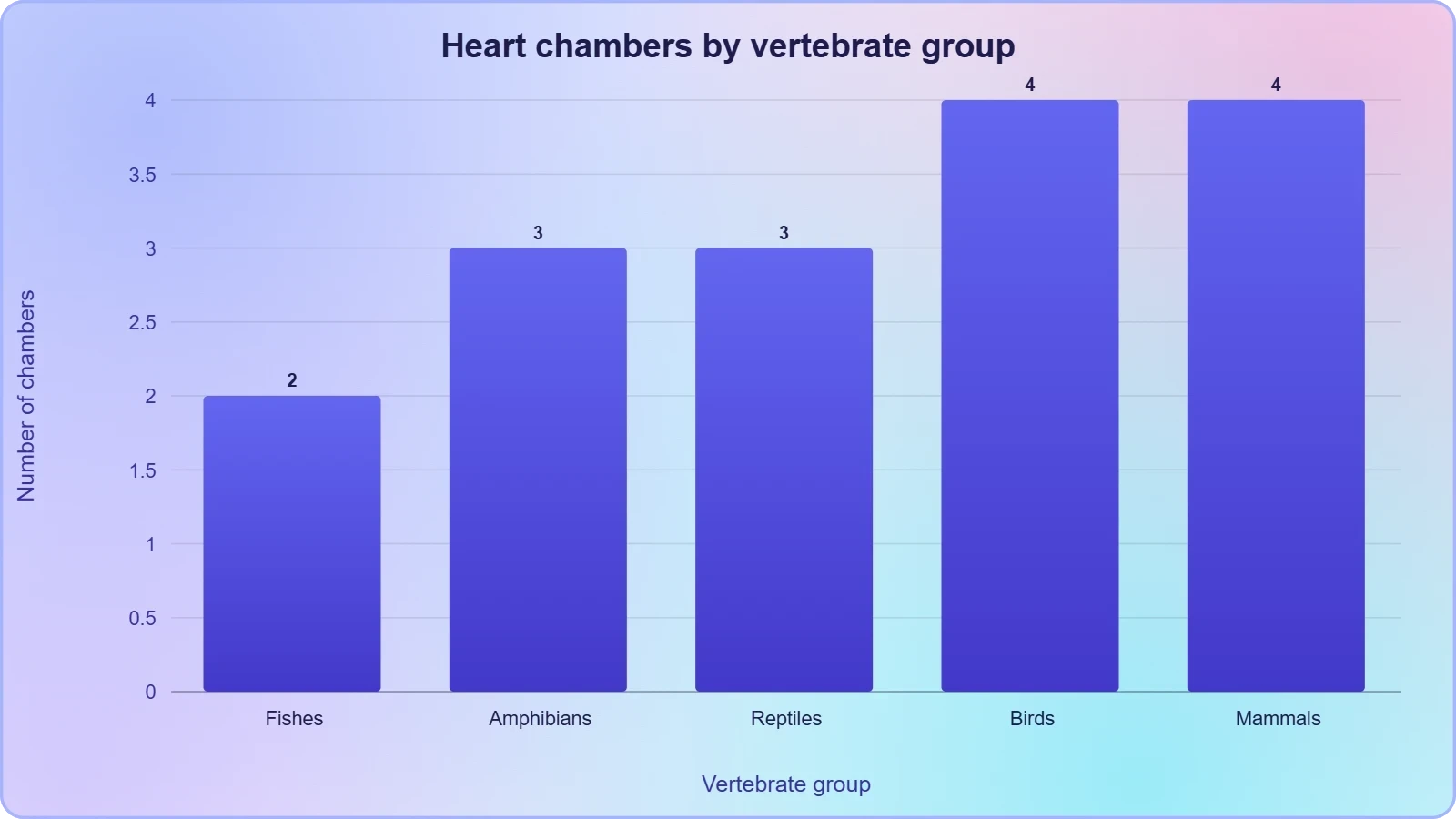
The chamber count is especially instructive because it maps onto the transition from water to land. A two-chambered heart, as seen in fishes, handles a single circuit of blood through gills and body. Three chambers appear in amphibians, and four in birds and mammals, reflecting the separation of pulmonary and systemic circuits required by air breathing. The source material does not elaborate this progression, but it establishes the chamber range as a vertebrate character, and that range is precisely what later lessons will populate with examples.
The Ventral Muscular Heart and Closed Circulation
Chordates possess a closed circulatory system, and vertebrates retain it while adding a muscular, ventrally placed pump. The ventral position is significant: blood is driven forward beneath the gut and then upward through the gills or lungs before returning through the dorsal vessel. This arrangement contrasts sharply with non-chordates, where a heart, if present, lies dorsally. The muscularity of the vertebrate heart allows higher pressures and therefore faster, more directed circulation, which in turn supports the elevated metabolic rates that active vertebrates sustain.
Chamber number is not a trivial detail but a functional index. Two chambers suffice when oxygenated and deoxygenated blood can mix freely in a single circuit, as in gill-breathing fishes. Additional chambers and partial or complete septation reduce mixing, which becomes critical when lungs supplement or replace gills. The source material's phrasing — two, three or four chambers — deliberately spans the whole subphylum, signalling that the heart is a vertebrate character whose form varies by class rather than a fixed vertebrate constant.
Kidneys, Osmoregulation and the Internal Environment
Kidneys perform two linked tasks in vertebrates: excretion of nitrogenous waste and osmoregulation, the maintenance of water and solute balance. These functions are easily conflated, but they answer different problems. Excretion removes metabolic by-products, while osmoregulation defends the concentration of the internal milieu against the osmotic pressures of the surrounding environment. A freshwater fish and a marine fish face opposite osmotic challenges, and their kidneys respond accordingly, even though both organs are recognisably vertebrate kidneys.
The pairing of excretion with osmoregulation in a single organ system is a distinctly vertebrate solution, and it reflects the subphylum's colonisation of diverse osmotic habitats. Protochordates, being exclusively marine, face a narrower range of challenges. Vertebrates, by contrast, occupy fresh water, salt water, and dry land, and the kidney is the organ that makes that breadth possible. When later lessons examine the excretory adaptations of individual classes, this foundational statement about kidneys will be the reference point.
Paired Appendages: Fins, Limbs and the Locomotor Divide
The phrase "paired appendages which may be fins or limbs" is compact but carries the whole tetrapod story inside it. In aquatic vertebrates the paired appendages are fins, used for propulsion, steering and stabilisation. In tetrapods they become limbs, used to support weight and to move across substrate. The source material does not develop this transition, but it plants the vocabulary that the classification scheme immediately exploits, since the superclass Pisces is defined as bearing fins and Tetrapoda as bearing limbs.
Paired appendages are worth distinguishing from the unpaired median fins that many fishes also possess. The paired condition — one appendage on each side of the body — is what allows asymmetric thrust and precise turning, and it is the condition that vertebrates inherited and then modified. When the classification divides Gnathostomata into Pisces and Tetrapoda on the basis of fins versus limbs, it is really dividing them on the basis of how paired appendages are used: for swimming or for walking.
From Fin to Limb as a Classification Criterion
The classification scheme treats appendage type as a superclass-level character, which is a strong claim about its importance. Fins are typically supported by rays or by cartilaginous or bony elements arranged in a fin-fold, and they work against the resistance of water. Limbs are supported by an internal skeleton of long bones articulated at joints, and they work against gravity. The mechanical demands differ so sharply that the same paired position on the body yields two entirely different structures, and the classification reflects that divergence at a high taxonomic level.
For examination purposes, the practical rule is straightforward: if the vertebrate bears fins, it belongs to Pisces; if it bears limbs, it belongs to Tetrapoda. The rule is not a substitute for understanding, but it is a reliable first filter when a specimen or description is presented. The classes nested within each superclass — Chondrichthyes and Osteichthyes under Pisces; Amphibia, Reptilia, Aves and Mammalia under Tetrapoda — then supply the finer distinctions that later lessons will address.
Segmentation, Coelom and the Vertebrate Framework
Vertebrates are coelomate, triploblastic and bilaterally symmetrical, and they exhibit organ-system level organisation, all of which they share with the wider chordate phylum. Segmentation is also present, though the source material treats it as part of the broader classification basis rather than as a vertebrate peculiarity. What vertebrates do is exploit segmentation more visibly, in the repeating vertebrae of the column, the segmental arrangement of muscles, and the serial organisation of nerves and ribs. The vertebral column is, in a literal sense, segmentation made skeletal.
This is why the replacement of the notochord matters so much for the body plan as a whole. A segmented column provides repeated points of attachment along the entire length of the body, allowing the axial musculature to be organised in blocks and the nerve cord to be protected segment by segment. The coelom, meanwhile, provides the cavity in which the ventral heart and the paired kidneys are suspended. The vertebrate framework is thus a coordinated package: skeleton, cavity, and organ placement all reinforce one another.
The Division of Vertebrata: Agnatha and Gnathostomata
The subphylum Vertebrata is divided, at the highest level, into two groups distinguished by a single decisive structure: the jaw. Agnatha lacks jaws; Gnathostomata bears jaws. This is the primary division, and everything else in the vertebrate classification tree descends from it. The source material presents the division as a simple branching diagram, with Agnatha containing the single class Cyclostomata, and Gnathostomata splitting into the superclass Pisces, bearing fins, and the superclass Tetrapoda, bearing limbs.
The elegance of this scheme lies in its economy. One character — presence or absence of jaws — separates the jawless from the jawed. A second character — fins or limbs — separates the aquatic jawed vertebrates from the terrestrial ones. The classes then sit beneath these superclasses as the finest divisions. Reading the diagram from top to bottom is therefore an exercise in successive dichotomy, and each dichotomy corresponds to a major functional threshold in vertebrate history.
Agnatha: The Jawless Vertebrates
Agnatha is defined negatively, by the absence of jaws, and it contains only the class Cyclostomata among living vertebrates. The name itself announces the defining feature: a jawless mouth. The source material does not elaborate beyond this in the present lesson, reserving the details of cyclostome anatomy for the next, but the placement is significant. The jawless condition is treated as the basal vertebrate state, the condition from which the jawed vertebrates are distinguished, and the classification therefore encodes a claim about the order in which vertebrate structures were acquired.
Students should note that Agnatha is not a residual category for vertebrates that happen to lack jaws for incidental reasons. It is a formal division of the subphylum, coordinate with Gnathostomata, and it is defined by a structural character that shapes feeding, respiration and head anatomy together. A jawless mouth cannot bite, grasp or chew; it must work by suction or by attachment. That constraint organises the entire biology of the agnathans, and it is why the jaw is treated as such a consequential innovation in the gnathostome branch.
Gnathostomata: The Jawed Vertebrates
Gnathostomata bears jaws, and it contains the overwhelming majority of vertebrate species, distributed across two superclasses. The superclass Pisces bears fins and contains the classes Chondrichthyes and Osteichthyes. The superclass Tetrapoda bears limbs and contains the classes Amphibia, Reptilia, Aves and Mammalia. The jawed condition is thus the shared inheritance of fishes, amphibians, reptiles, birds and mammals alike, and the further division into Pisces and Tetrapoda tracks the shift from aquatic to terrestrial locomotion.
The classification is worth committing to memory as a tree rather than a list, because the nesting carries meaning. Chondrichthyes and Osteichthyes are not parallel to Amphibia and Reptilia; they sit within Pisces, which sits within Gnathostomata, which sits within Vertebrata. Likewise Amphibia, Reptilia, Aves and Mammalia sit within Tetrapoda. Recognising the levels prevents the common error of treating all seven classes as equivalent branches of a single flat division, and it prepares the ground for the detailed class-by-class treatment that follows.
Vertebrates Within the Wider Chordate Frame
It is easy, once the vertebrate classes are laid out, to lose sight of the fact that Vertebrata is only one of three chordate subphyla. The other two, Urochordata or Tunicata and Cephalochordata, are collectively called protochordates and are exclusively marine. Urochordata carries the notochord only in the larval tail, with examples including Ascidia, Salpa and Doliolum. Cephalochordata carries it from head to tail persistently, with Branchiostoma, also called Amphioxus or Lancelet, as the standard example. Vertebrata is the third subphylum, and its distinctiveness lies in the fate of the notochord.
Keeping this frame in view prevents a common misconception: that vertebrates are the "advanced" chordates and protochordates the "primitive" ones in some vague sense. The classification is structural, not evaluative. Protochordates are exclusively marine and retain the notochord as their axial support; vertebrates replace it with a column and add a muscular ventral heart, kidneys and paired appendages. Both are valid chordate solutions to the problem of being an animal, and the comparison is instructive precisely because the solutions differ.
Protochordates as the Reference Point
The protochordates supply the baseline against which vertebrate innovation is measured. Because Urochordata and Cephalochordata possess the chordate characters without the vertebrate additions, they isolate what the vertebrate additions actually accomplish. A lancelet, for instance, has a notochord, a dorsal hollow nerve cord, gill slits and a post-anal tail, but no vertebral column, no chambered muscular heart of the vertebrate kind, and no paired appendages. Comparing it with a lamprey makes the vertebrate departure concrete rather than abstract.
This comparative habit is worth cultivating because it is how the phylum is best remembered. Rather than memorising Vertebrata as a list of features, one can remember it as the chordate subphylum in which the notochord is embryonic and the column is adult, the heart is ventral and muscular with two to four chambers, the kidneys handle excretion and osmoregulation, and the appendages are paired and take the form of fins or limbs. Each clause is a contrast with the protochordate condition, and the contrast fixes the fact in memory.
A Note on Terminology and Taxonomic Levels
The terminology in this section repays careful reading because the levels are nested and the names are not interchangeable. Phylum Chordata contains three subphyla: Urochordata or Tunicata, Cephalochordata, and Vertebrata. Within Vertebrata, the primary division separates Agnatha from Gnathostomata. Within Gnathostomata, the superclasses are Pisces and Tetrapoda. Within Pisces, the classes are Chondrichthyes and Osteichthyes. Within Tetrapoda, the classes are Amphibia, Reptilia, Aves and Mammalia. Each term belongs to exactly one level, and mixing them produces errors that are easy to make and easy to avoid.
A useful discipline is to state the level whenever a group is named. Agnatha is a division, not a class. Pisces is a superclass, not a class. Cyclostomata is a class, and it is the only class placed under Agnatha. Chondrichthyes and Osteichthyes are classes under Pisces, not divisions coordinate with Agnatha. Holding the levels steady makes the classification tree legible and prevents the flat-list error in which all seven classes appear to be siblings of one another rather than distributed across two divisions and two superclasses.
Going Further
A vertebral column is, in plain terms, a series of bones or cartilages arranged along the back, and this description helps explain why its substitution for the notochord is so consequential. Each element in the series is a vertebra, and the series as a whole provides repeated attachment points along the body axis. The notochord it replaces is a single continuous rod, so the change is from one flexible support to many articulated supports. That shift from continuity to segmentation is what allows the vertebrate body to bend in controlled ways while remaining structurally supported.
Jaws are biting structures in the mouth that most vertebrates possess, and the qualification "most" is exactly what the division Agnatha and Gnathostomata encodes. A jawed mouth can seize, hold, cut and chew food, which widens the range of available diets and permits a more active predatory life. A jawless mouth must rely on suction or attachment instead. The classification therefore rests on a structure whose presence or absence reorganises feeding, and through feeding, much of the animal's ecology. This background sits outside the core material but illuminates why the jaw is treated as a primary division.
Preparing for the Classes That Follow
This lesson has established the frame; the next will populate it. Cyclostomata, the sole class under Agnatha, contains ectoparasites on fishes with elongated bodies bearing six to fifteen pairs of gill slits, a sucking circular mouth without jaws, no scales and no paired fins, a cartilaginous cranium and vertebral column, and closed circulation. They are marine but migrate to fresh water to spawn, dying within days of spawning, with larvae returning to the ocean after metamorphosis. Petromyzon, the lamprey, and Myxine, the hagfish, are the standard examples.
Chondrichthyes, the first class under Pisces, contains marine animals with streamlined bodies and cartilaginous endoskeletons, ventral mouths, persistent notochords, separate gill slits without an operculum, tough skin with minute placoid scales, teeth that are modified backwardly directed placoid scales, powerful jaws, and a predaceous habit. Because they lack an air bladder, they must swim constantly to avoid sinking. Scoliodon and Pristis illustrate the class. Osteichthyes completes the superclass Pisces, and the tetrapod classes complete the tree.
Consolidating the Subphylum in One View
The subphylum Vertebrata can now be stated in a single consolidated form. Its members are chordates that possess a notochord during the embryonic period, which is replaced by a cartilaginous or bony vertebral column in the adult. Beyond the basic chordate characters, they have a ventral muscular heart with two, three or four chambers, kidneys for excretion and osmoregulation, and paired appendages that may be fins or limbs. The subphylum divides into Agnatha, which lacks jaws and contains Cyclostomata, and Gnathostomata, which bears jaws and splits into Pisces with fins and Tetrapoda with limbs.
That consolidated statement is the takeaway, and it should be reproducible without reference to the diagram. The diagram is a convenience; the logic is the substance. Jawless versus jawed is the first cut, fins versus limbs is the second, and the seven classes distribute beneath them. Every subsequent lesson in this course will add detail to one of those classes, and each addition will hang from one of the branches established here. The frame is now in place, and the classes can be examined one by one with their positions in the tree firmly understood.
Common Errors to Avoid
Three errors recur in examination answers on this topic, and each is worth naming explicitly. The first is treating Vertebrata as a phylum rather than a subphylum of Chordata. The second is asserting that all chordates are vertebrates, which inverts the correct relationship; the correct statement is that all vertebrates are chordates but not all chordates are vertebrates. The third is flattening the classification so that Agnatha, Gnathostomata, Pisces, Tetrapoda and the seven classes all appear to sit at the same level, when in fact they occupy division, superclass and class levels respectively.
A fourth, subtler error is to describe the notochord as absent in adult vertebrates. It is replaced, not abolished, and the distinction matters because the embryonic notochord is precisely what defines vertebrate membership in the chordate phylum. A vertebrate that had no notochord at any stage would not be a chordate at all. Stating the relationship as embryonic presence followed by adult replacement keeps both halves of the definition intact and avoids the trap of treating the vertebral column as a replacement for chordate status rather than for the notochord alone.
Also Read
- No links available.
From our network :
- Mastering DB2 12.1 Instance Design: A Technical Deep Dive into Modern Database ArchitectureComprehensive guide to DB2 12.1 Instance Design. Explore architectural components, HADR setup, buffer pool tuning, and security policies for IBM DB2 12.1. Includes 10 functional SQL and Shell samples.
- Mastering DB2 LUW v12 Tables: A Comprehensive Technical GuideComprehensive guide on DB2 LUW v12 tables. Explore CREATE TABLE syntax, BLU Acceleration, range partitioning, data types, and security features for IBM DB2 LUW v12.
- EV 2.0: The Solid-State Battery Breakthrough and Global Factory ExpansionDiscover the impact of the Solid-State Battery Breakthrough on the EV market. Learn about CATL and BYD stock growth, global factory expansion in Europe, and the future of EV 2.0 technology.
- AI-Powered 'Precision Diagnostic' Replaces Standard GRE Score ReportsDiscover the new GRE Precision Diagnostic. Learn how AI-powered behavioral analytics and time-to-solve tracking are replacing standard GRE score reports to empower students.
- 98% of Global MBA Programs Now Prefer GRE Over GMAT Focus EditionExplore why 98% of global MBA programs now prefer the GRE over GMAT Focus. Learn about the shorter GRE format, verbal logic importance, and strategic versatility for students.
- Analyzing Trump Deportation Numbers Insights Into The 2026 Immigration Crackdown
- 10 Physics Numerical Problems with Solutions for IIT JEEPrepare for IIT JEE with 10 physics numerical problems, complete with detailed solutions and conceptual explanations. Ideal for mastering kinematics, thermodynamics, electromagnetism, and optics.
- Trump Political Strategy How Geopolitical Stunts Serve As Media Diversions
- Vite 6/7 'Cold Start' Regression in Massive Module GraphsIn-depth analysis of Vite 6/7 cold start regressions in massive module graphs. Learn about barrel file issues, pre-bundling optimizations, and how to improve Vite dev server performance.
RESOURCES
- Agnatha - New World Encyclopedianewworldencyclopedia.orgVertebrates (subphylum Vertebrata) are generally classified ... classifications, Agnatha and Gnathostomata are each considered a superclass of Vertebrata.
- Vertebrate - Wikipediaen.wikipedia.orgVertebrates were subsequently divided into two major sister-groups: the Agnatha and the Gnathostomata (jawed vertebrates). ... Class "Agnatha" (jawless fishes) ...
- Classification of Vertebrates | CK-12 Foundationflexbooks.ck12.orgNov 1, 2026 ... You will learn about the characteristics of vertebrates, their classification into Agnatha and Gnathostomata ... The only living class under ...
- Agnatha - Wikipediaen.wikipedia.orgAgnatha or jawless fish is a paraphyletic infraphylum of animals in the subphylum Vertebrata of the phylum Chordata, characterized by the lack of jaws.
- Chordate Classification | CK-12 Foundationflexbooks.ck12.org... Agnatha (jawless vertebrates) and Gnathostomata (jawed vertebrates). ... classified into three major subphyla: Urochordata, Cephalochordata, and Vertebrata.
- Classification of Chordates and Features | PDF | Vertebrates - Scribdscribd.comClassification of subphylum Vertebrata. Vertebrata. Division. Agnatha ... Agnatha (lacks jaw) Gnathostomata (bears jaw). Class Cyclostomata. © 2020 ...
- Agnatha, Gnathostomata & Subphylum Vertebrata Classificationaakash.ac.inSubphylum Vertebrata is divided into two divisions, Agnatha and Gnathostomata as represented below. Agnatha are those animals which lack jaws and Gnathostomata ...
- Overview of Vertebrate Subphylum | PDF - Scribdscribd.com... vertebrates into two main groups: Agnatha (jawless) and Gnathostomata (jawed), with further classifications under Gnathostomata into superclasses Pisces and ...
- KSU | Faculty Web - A Classification Vertebrates and Their Relativesfacultyweb.kennesaw.eduSubphylum: Vertebrata (Craniata) 3. Superclass: Conodontophorida = (?). Superclass: Agnatha ... Superclass: Gnathostomata. Class: Placodermi = Class ...
- World Register of Marine Species - Pisces - WoRMSmarinespecies.orgBiota · Animalia (Kingdom) · Chordata (Phylum) · Vertebrata (Subphylum) · Gnathostomata (Infraphylum) · Pisces (Superclass).
- Gnathostomata - YouTubeyoutube.comGnathostomata Characters & Classification, Vertebrata , Chordata, Classification ... Division of Vertebrata | Agnatha & Gnathostomata | NEET 2026 & Class 11 ...
- Subphylum Vertebrata Superclass Agnatha - Lecture Noteslecture-notes.tiu.edu.iqclassification with examples of each ... Chondrichthyes. Class. Osteichthyes. Agnatha jawless vert. Gnathostomata jaw Vert. Super class. Super class. Page 4 ...
- Classification of Phylum Chordata (With Characters) | Zoologyramsadaycollege.comThe Subphylum Vertebrata is divided into two divisions: 1. Agnatha and. 2. Gnathostomata having contrasting characters given in Table 1.4. Division I. Agnatha:.
- Cytokine Receptor Diversity in the Lamprey Predicts ... - PubMed - NIHpubmed.ncbi.nlm.nih.govSep 1, 2022 ... The vertebrate adaptive immune systems (Agnatha and Gnathostomata) ... Gnathostomata, human cytokine receptor chains (comprising 34 class I ...
- Vertebrates class | PPT - Slideshareslideshare.netVertebrates Vertebrates belong to the subphylum Vertebrata of the ... 4. Classification of Vertebrates SubphylumVertebrata Agnatha Class Gnathostomata ...