Phylum Mollusca occupies a singular place within the animal kingdom: it is the second largest animal phylum, surpassed in species count only by the arthropods studied in the preceding lesson. Molluscs are terrestrial or aquatic, inhabiting marine and fresh water alike, and they display an organ-system level of organisation that places them among the more structurally complex invertebrates. Their bodies are bilaterally symmetrical, triploblastic and coelomate, and they are unsegmented — a feature that distinguishes them sharply from the segmented arthropods and prepares the ground for the radially symmetrical echinoderms that follow.
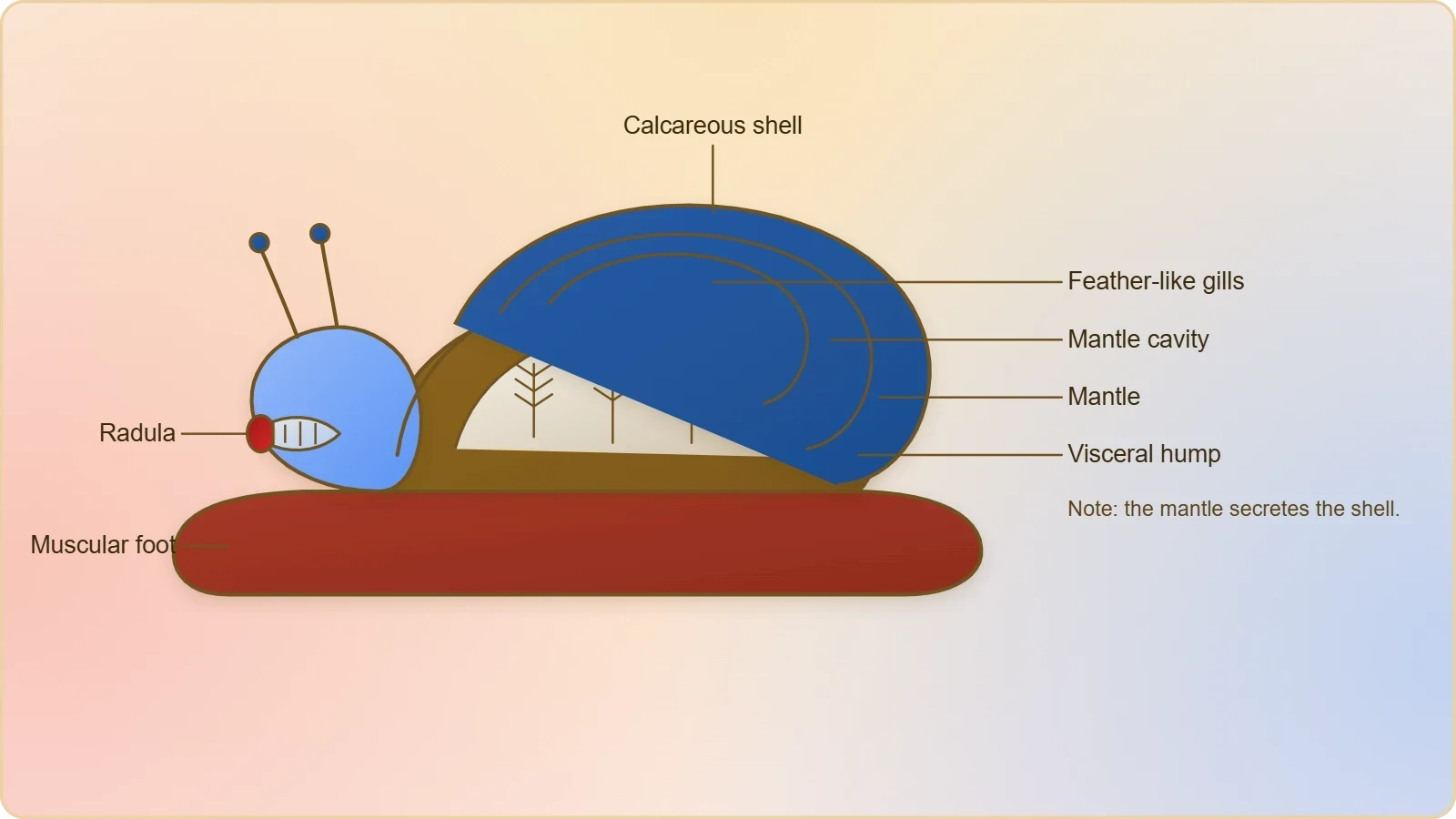
The architectural signature of a mollusc is unmistakable once recognised: a body covered by a calcareous shell, a distinct head, a muscular foot and a visceral hump. A soft and spongy layer of skin, the mantle, drapes over the visceral hump, and the space between the hump and the mantle — the mantle cavity — houses feather-like gills that serve both respiratory and excretory functions. The anterior head region carries sensory tentacles, while the mouth contains a file-like rasping organ called the radula, the feeding structure that defines the phylum in the popular imagination as much as in the laboratory.
This lesson builds directly on the arthropod survey and deliberately avoids repeating it. Where arthropods are segmented, chitin-armoured and equipped with jointed appendages, molluscs are unsegmented, shell-bearing and soft-bodied beneath their calcareous covering. Reproduction in molluscs is usually dioecious and oviparous with indirect development, a pattern worth comparing with the mostly oviparous arthropods. By the close of this lesson, learners should be able to describe molluscan body organisation, explain the roles of the mantle, mantle cavity and radula, and identify the representative genera from Pila to Chaetopleura.
On This Page
Position of Mollusca in the Animal Kingdom
Mollusca stands second only to Arthropoda in the tally of named animal species, a ranking that surprises many learners who associate molluscs with a handful of shells on a beach. The phylum's reach is genuinely broad: its members are terrestrial or aquatic, and the aquatic forms are found in both marine and fresh water. This ecological versatility, combined with an organ-system level of organisation, makes Mollusca a pivotal group for understanding how invertebrate body plans diversify without abandoning the fundamental bilateral, triploblastic and coelomate blueprint.
Placing Mollusca correctly requires holding two comparisons in mind at once. Against the arthropods of the previous lesson, molluscs lack segmentation and lack a chitinous exoskeleton, substituting a calcareous shell and a muscular foot. Against the echinoderms of the next lesson, molluscs retain bilateral symmetry in the adult and possess a well-developed excretory arrangement within the mantle cavity, whereas echinoderms are radially symmetrical as adults and have no excretory system at all. These contrasts sharpen the diagnostic value of each phylum's salient features.
Level of Organisation and Body Plan
Molluscs exhibit the organ-system level of organisation, the highest grade encountered among the invertebrates surveyed in this course. Organs are grouped into systems — digestive, respiratory, circulatory, excretory and reproductive — each discharging a specialised function. This grade of construction is shared with arthropods and echinoderms, and it stands above the tissue-level and organ-level grades seen in simpler phyla. For examination purposes, the phrase "organ-system level of organisation" should be attached to Mollusca without hesitation.
The molluscan body is bilaterally symmetrical, triploblastic and coelomate. Bilaterality means a single plane divides the body into mirror-image halves, a symmetry reflected in the distinct head, foot and hump arrangement. Triploblasty indicates three embryonic germ layers — ectoderm, mesoderm and endoderm — from which the organ systems arise. Coelomate status means a true body cavity lined by mesoderm is present, accommodating the internal organs. Crucially, the body is unsegmented, setting molluscs apart from annelids and arthropods in the same breath.
Comparison with the Arthropod Blueprint
The arthropod lesson established a body built from head, thorax and abdomen, clad in a chitinous exoskeleton and articulated by jointed appendages. Molluscs offer a counterpoint: no segmentation, no chitinous armour, no jointed limbs. Instead, the body is a continuous unsegmented mass differentiated into head, muscular foot and visceral hump, protected by a calcareous shell. The contrast is pedagogically valuable because it shows that organ-system complexity does not depend on segmentation; two phyla can reach the same organisational grade by entirely different architectural routes.
Reproductive patterns also invite comparison. Arthropods are mostly dioecious, with fertilisation usually internal and development direct or indirect. Molluscs are usually dioecious and oviparous, with indirect development. The shared dioecious condition — separate sexes — is a common invertebrate theme, but the consistent oviparity and indirect development of molluscs give the phylum a more uniform reproductive profile than the variable arthropods. Learners should note these parallels without conflating the two phyla, since the next lesson on Echinodermata will introduce external fertilisation and free-swimming larvae as yet another variation.
External Architecture: Shell, Foot and Visceral Hump
The molluscan body is covered by a calcareous shell and is unsegmented, with a distinct head, a muscular foot and a visceral hump. These three divisions are the anatomical landmarks by which the phylum is recognised in the field and in the examination hall. The head carries the sensory apparatus, the foot provides locomotion and anchorage, and the visceral hump houses the bulk of the internal organs. Because the body is unsegmented, these regions flow into one another rather than being repeated as modules along an axis.
The calcareous shell deserves particular attention because it is the feature most often cited in identification. It is a hardened covering, typically calcareous in composition, that shields the soft body beneath. In forms such as Pila, the apple snail, the shell is a familiar coiled spiral; in Dentalium, the tusk shell, it takes the form of an elongated tube; in Chaetopleura, the chiton, it is divided into plates. The shell is not merely ornamentation — it is the primary defence of a soft-bodied animal that cannot flee swiftly.
The Muscular Foot and Locomotion
The muscular foot is the organ of locomotion in molluscs. It is a thickened, muscular ventral structure that can be extended, anchored and contracted to draw the body forward, producing the slow gliding motion familiar in snails. In Sepia and Loligo, the cuttlefish and squid, the foot is modified into arms and tentacles surrounding the head, reflecting the predatory habits of these cephalopods. The foot therefore illustrates a recurring theme in molluscan biology: a single fundamental structure is remodelled across the phylum to serve strikingly different functions.
Because the foot is muscular and the body unsegmented, molluscan locomotion differs fundamentally from the jointed, lever-driven movement of arthropods. There are no articulated limbs, no exoskeletal hinges, no antagonistic muscle pairs acting across joints. Instead, muscular hydrostatic action and the adhesive properties of the foot surface do the work. This contrast is worth emphasising in the classroom, since it explains why molluscs are generally slower than arthropods and why their body plan favours protection over agility.
The Visceral Hump and Its Contents
The visceral hump is the dorsal mass of the body, containing the digestive, circulatory, excretory and reproductive organs. It sits above the foot and is the region over which the mantle is draped. In shelled forms the hump is enclosed within the shell; in forms with reduced or internal shells, such as the squid and octopus, the hump remains the visceral centre but is no longer armoured in the same way. The hump is thus the functional core of the animal, while the head and foot are its interfaces with the environment.
Understanding the hump clarifies why the mantle cavity matters so much. The cavity is the space between the hump and the mantle, and it is here that the feather-like gills are housed. Since the hump carries the viscera and the cavity carries the gills, the two structures are functionally coupled: the respiratory needs of the visceral mass are met by the gills immediately adjacent to it. This compact arrangement is one of the elegant solutions of molluscan anatomy and a favourite of examiners framing short-answer questions.
The Mantle, Mantle Cavity and Feather-Like Gills
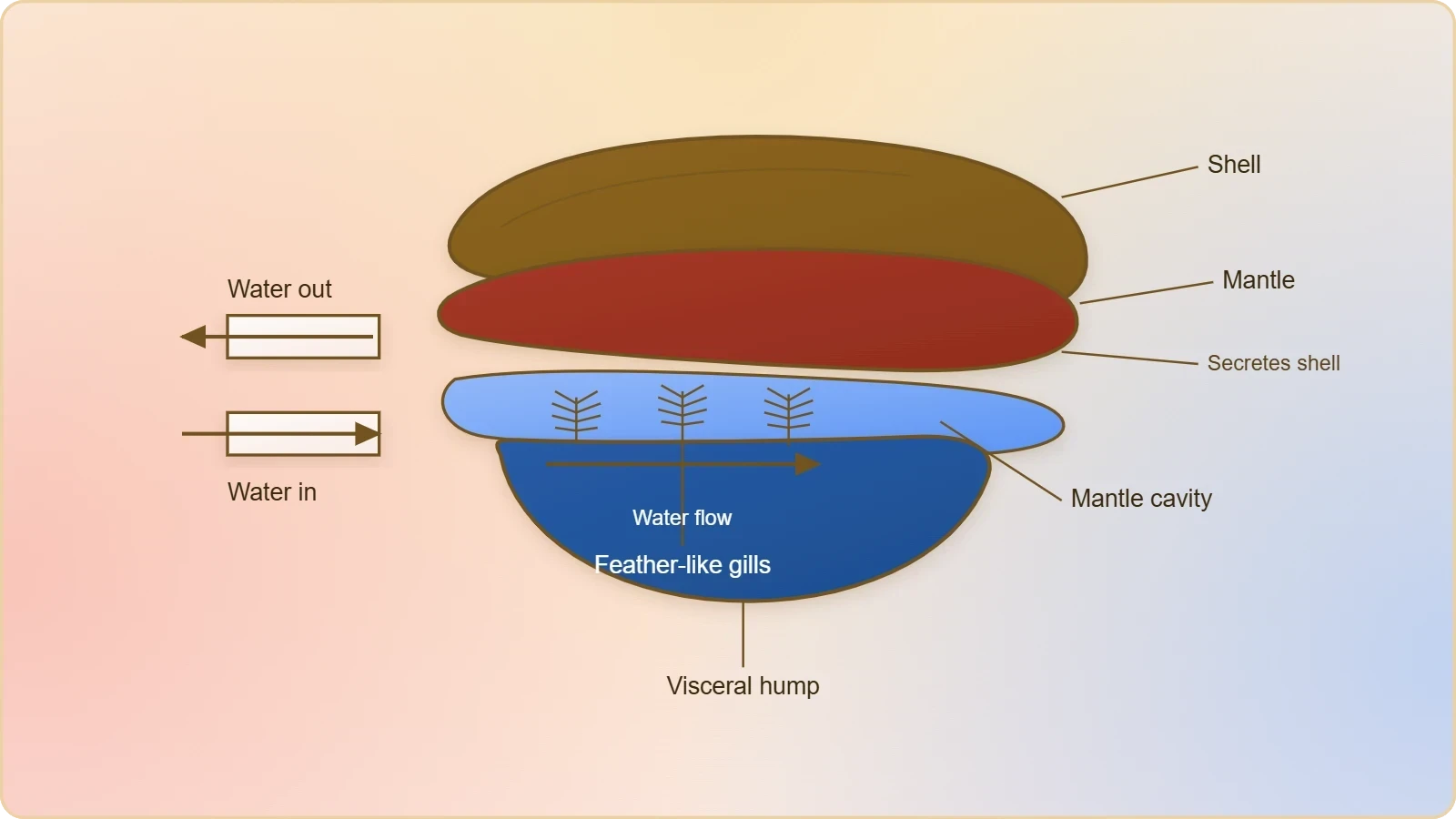
A soft and spongy layer of skin forms a mantle over the visceral hump. This mantle is one of the most important structures in the phylum, because it defines the cavity that houses the respiratory organs and because, in many molluscs, it is the tissue that secretes the shell itself. The space between the hump and the mantle is called the mantle cavity, and within it are present feather-like gills. These gills have respiratory and excretory functions, a dual role that is unusual and therefore frequently tested.
The phrase "feather-like gills" is deliberate and descriptive: the gills are filamentous, combed or plumed in appearance, increasing the surface area available for gas exchange. Their presence within the mantle cavity means that water drawn into the cavity bathes the gills directly. Because the same cavity also receives excretory products, the mantle cavity functions as a combined respiratory and excretory chamber. Learners should be able to state this dual function precisely, since it is one of the distinctive features that separate molluscs from the arthropods studied earlier.
Respiratory and Excretory Functions
Respiration in molluscs is carried out by the feather-like gills within the mantle cavity, where dissolved oxygen is absorbed from the surrounding water. Excretion is also associated with this region, so the mantle cavity serves as a shared site for the discharge of both respiratory and nitrogenous waste functions. This arrangement is efficient in aquatic forms, where a continuous flow of water through the cavity supplies oxygen and carries away wastes. In terrestrial molluscs the cavity is modified, but the underlying architecture remains recognisable.
The dual role of the gills is a useful teaching point because it illustrates how evolution economises on structures. Rather than evolving separate organs for respiration and excretion, molluscs concentrate both functions in the mantle cavity and its gills. When comparing phyla, note that echinoderms, in the next lesson, possess no excretory system at all, while arthropods excrete through malpighian tubules. Molluscs thus occupy a middle position: excretion exists, but it is housed within the respiratory chamber rather than delegated to a dedicated tubular organ.
The Mantle as Shell-Secreting Tissue
The mantle is a fold of skin that secretes the shell in many molluscs, a point worth stating explicitly because it links the soft anatomy to the hard covering. The calcareous shell does not arise independently of the body; it is deposited by the mantle, which lines the inner surface of the shell and adds material to it. This relationship explains why shelled molluscs can repair damage and why shell morphology so closely tracks the shape of the underlying visceral hump.
Recognising the mantle as a secretory tissue also clarifies the unity of the molluscan body plan. The same soft, spongy layer that forms the roof of the mantle cavity and houses the gills is the layer that builds the shell above it. Head, foot, hump, mantle, cavity and shell are therefore not a list of unrelated parts but a single integrated system. This integration is precisely what examination questions on molluscan organisation are designed to test, and it rewards learners who understand the connections rather than memorising isolated terms.
Feeding, Sense Organs and the Radula
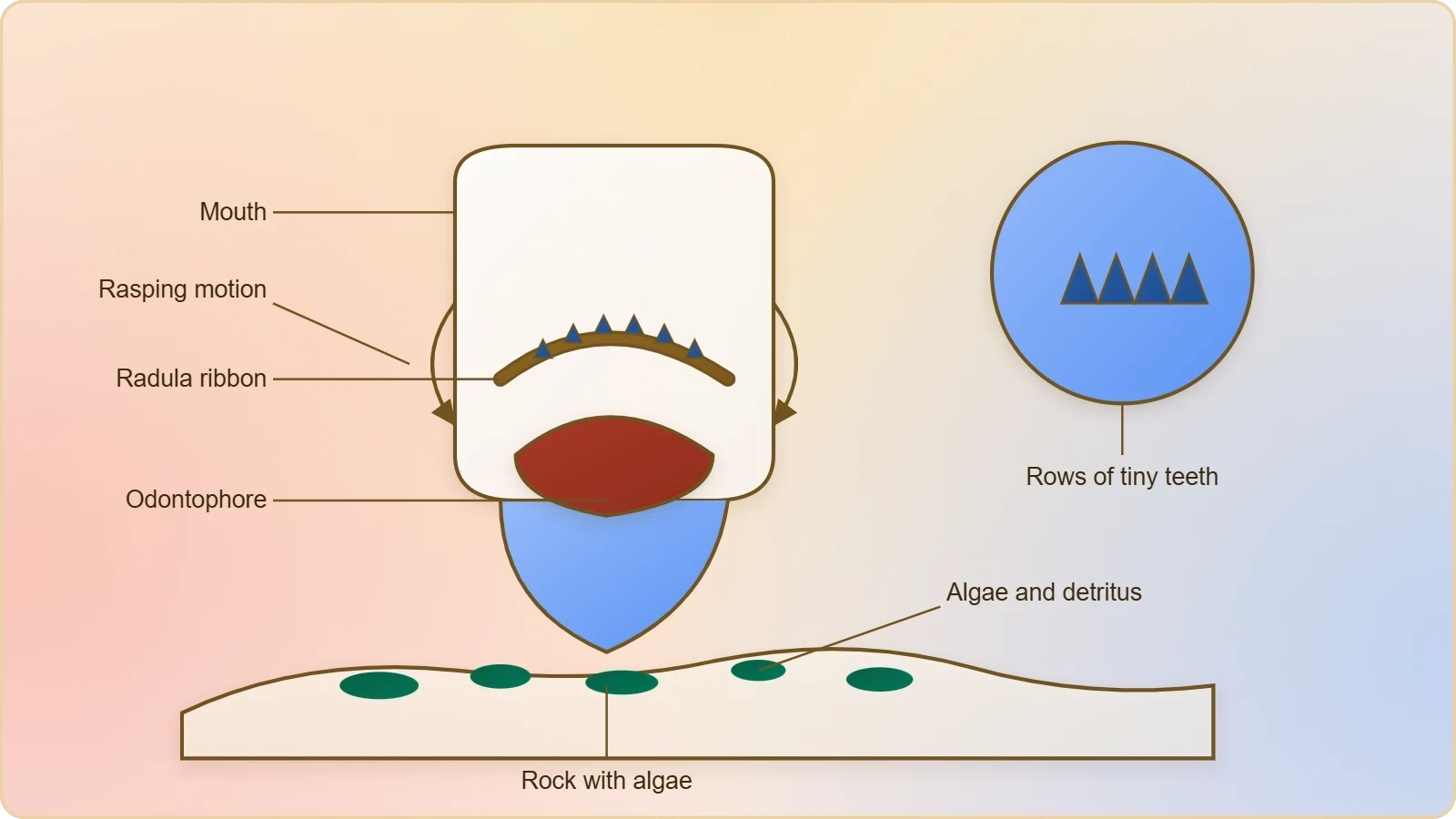
The anterior head region of a mollusc bears sensory tentacles, which sample the environment and guide the animal towards food and away from harm. The mouth, situated in the head, contains a file-like rasping organ for feeding called the radula. This structure is the phylum's most celebrated feeding adaptation and the one most likely to appear in a one-word identification question. The combination of sensory tentacles and a rasping mouth equips the mollusc to locate, assess and process food without the grasping limbs that arthropods possess.
The radula is best imagined as a ribbon bearing rows of tiny teeth, worked back and forth to scrape or rasp material from a surface. In grazing snails it removes algae and detritus from rocks and plant surfaces; in predatory forms it assists in boring into prey. Because the radula is housed within the mouth and is supported by muscular tissue, it can be protruded and retracted, giving the mollusc a precision feeding tool that compensates for its generally slow locomotion.
Sensory Tentacles and Environmental Perception
The sensory tentacles of the head region are the mollusc's principal distance receptors. They detect chemical and tactile cues, allowing the animal to orient towards food and respond to threats. In forms such as Octopus, the tentacles are elaborated into large, highly mobile arms that combine sensory and manipulative roles. Even in modest shelled snails, the tentacles provide the information the animal needs to navigate a complex environment at a slow pace, compensating for the absence of image-forming compound eyes of the arthropod kind.
This sensory arrangement reflects the molluscan lifestyle. A soft-bodied, unsegmented animal protected by a shell does not need the rapid visual tracking of a flying insect; it needs reliable close-range chemical and tactile information. The tentacles deliver exactly that. When comparing phyla, note that arthropods possess antennae, compound and simple eyes, and statocysts, whereas molluscs rely on sensory tentacles. The difference in sensory equipment mirrors the difference in locomotory strategy and habitat.
The Radula as a Defining Character
The radula is a file-like rasping organ, and its presence in the mouth is one of the most reliable defining characters of Mollusca. It is not a jaw in the vertebrate sense, nor a pair of mandibles in the arthropod sense; it is a flexible rasping ribbon that wears away and is continuously replaced. This continuous replacement is essential because rasping is abrasive work, and the teeth are consumed by use. The radula therefore represents a feeding solution that is both precise and renewable.
For learners, the radula offers a memorable anchor for the whole phylum. If a specimen has a calcareous shell, a muscular foot, a visceral hump covered by a mantle, and a radula in its mouth, it is a mollusc. The radula thus joins the mantle cavity and the feather-like gills as one of the three structures that, taken together, make molluscan identity unambiguous. Examiners frequently ask for the function of the radula, and the answer — a file-like rasping organ for feeding — should be reproduced faithfully.
Reproduction, Development and Representative Genera
Molluscs are usually dioecious and oviparous with indirect development. Dioecious means the sexes are separate, with distinct male and female individuals rather than a single hermaphroditic form. Oviparous means the young develop from eggs laid outside the body, rather than from live young. Indirect development means the animal passes through a larval stage before assuming the adult form. Together these three terms summarise the reproductive profile of the phylum and provide a compact answer to a standard examination question.
The representative genera named for this phylum span an impressive range of forms, and each illustrates a different solution to the molluscan way of life. Pila, the apple snail, is a familiar freshwater gastropod with a coiled shell. Pinctada, the pearl oyster, is the bivalve celebrated for producing pearls. Sepia, the cuttlefish, and Loligo, the squid, are active cephalopods with reduced internal shells. Octopus, the devil fish, is the eight-armed cephalopod. Aplysia, the sea-hare, is a shell-less opisthobranch. Dentalium, the tusk shell, has a tubular shell, and Chaetopleura, the chiton, has a shell of plates.
Dioecy, Oviparity and Indirect Development
The term dioecious should be distinguished carefully from monoecious. In dioecious animals, an individual is either male or female, and reproduction requires the meeting of gametes from two individuals. Molluscs are usually dioecious, though exceptions exist, and the qualifier "usually" should be retained in any written answer. Oviparity means eggs are laid and development proceeds outside the parent's body, a pattern that exposes the eggs to environmental conditions but allows large numbers to be produced at modest energetic cost.
Indirect development introduces a larval stage that differs from the adult in form and often in habitat. This larval phase is significant because it allows dispersal across distances the slow-moving adult could never cover. A sedentary or slow adult with a free-swimming larva can colonise new shores, which helps explain the wide distribution of many molluscan groups. The combination of dioecy, oviparity and indirect development is therefore not a list of trivia but a coherent reproductive strategy suited to the phylum's ecology.
Representative Genera and Their Common Names
The genera prescribed for study are best learned as a paired list of scientific and common names. Pila is the apple snail; Pinctada is the pearl oyster; Sepia is the cuttlefish; Loligo is the squid; Octopus is the devil fish; Aplysia is the sea-hare; Dentalium is the tusk shell; and Chaetopleura is the chiton. Each pairing is a potential one-mark question, and the list as a whole demonstrates the morphological range of the phylum.
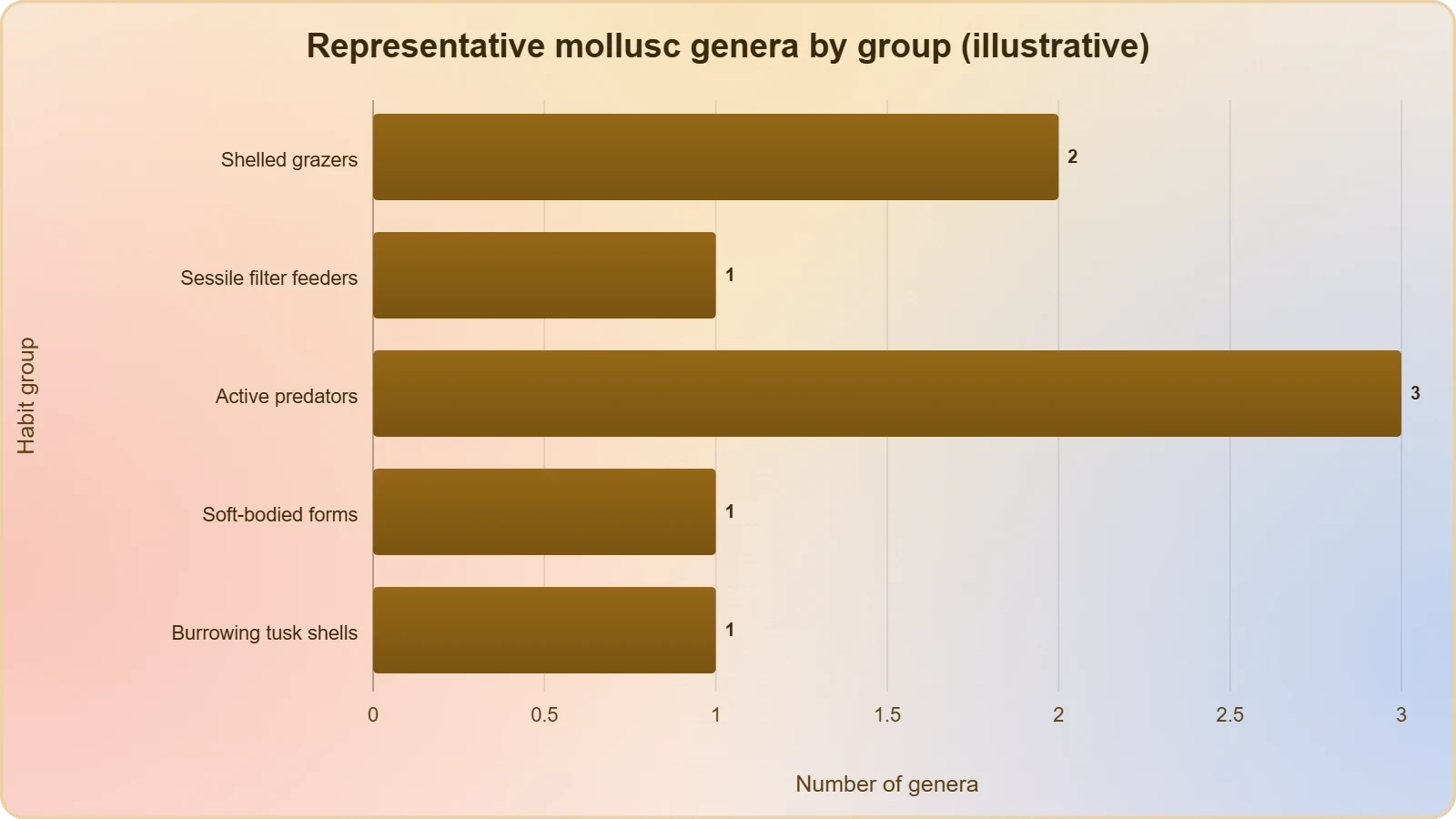
Grouping these genera by habit aids retention. Pila and Chaetopleura are slow, shelled grazers; Pinctada is a sessile filter feeder; Sepia, Loligo and Octopus are active predators with reduced or absent external shells; Aplysia is a soft-bodied sea-hare; and Dentalium is a burrowing tusk shell. Seeing the list as a spectrum from armoured grazer to agile predator makes the phylum's diversity intelligible rather than merely memorisable, and it prepares learners for the very different body plan of the echinoderms that follow.
Comparative View: Mollusca Against Its Neighbours
Placing Mollusca in a comparative frame consolidates the lesson and prepares the ground for Echinodermata. Against Arthropoda, the contrasts are stark: arthropods are segmented, chitin-armoured and jointed, while molluscs are unsegmented, calcareous-shelled and soft-bodied. Against Echinodermata, the contrasts are equally instructive: echinoderms are marine, radially symmetrical as adults, possess a water vascular system and lack an excretory system, whereas molluscs are bilateral, occupy terrestrial and aquatic habitats, and possess excretory function within the mantle cavity. A comparative table fixes these distinctions far more effectively than isolated facts.
The comparison also reveals a deeper principle. All three phyla attain the organ-system level of organisation and are triploblastic and coelomate, yet they achieve this grade through radically different architectures. Segmentation, shell armour, jointed limbs, water vascular systems and mantle cavities are alternative solutions to the same problems of support, movement, feeding and gas exchange. Recognising this unity beneath diversity is the intellectual payoff of the animal kingdom course, and it is what distinguishes genuine understanding from rote recall.
Mollusca Versus Arthropoda
The arthropod blueprint, established in the previous lesson, is segmented and armoured in chitin, with jointed appendages, an open circulatory system and excretion through malpighian tubules. The molluscan blueprint is unsegmented and armoured in calcareous shell, with a muscular foot rather than jointed limbs, and excretion associated with the mantle cavity. Both are bilaterally symmetrical, triploblastic and coelomate, and both reach the organ-system level. The differences lie in architecture, not in grade, which is precisely the point learners should carry forward.
Reproductively, the two phyla are closer: both are usually dioecious, and both may show indirect development. Arthropods are mostly oviparous with fertilisation usually internal, while molluscs are usually oviparous with indirect development. The shared dioecy and oviparity reflect common invertebrate strategies, but the details of fertilisation and larval form differ. Keeping these similarities and differences straight is essential, because examination questions often ask for a comparison between two phyla rather than a description of one.
Mollusca Versus Echinodermata
The echinoderms, treated in the next lesson, are exclusively marine with an endoskeleton of calcareous ossicles. Their adults are radially symmetrical while their larvae are bilaterally symmetrical, they possess a water vascular system for locomotion, food capture and respiration, and they have no excretory system. Molluscs, by contrast, are bilateral throughout, occupy terrestrial and aquatic habitats, and possess respiratory and excretory functions within the mantle cavity. The symmetry contrast alone is enough to separate the two phyla in any identification exercise.
Both phyla are triploblastic, coelomate and organ-system grade, so the differences are architectural rather than hierarchical. Echinoderms rely on a hydraulic water vascular system; molluscs rely on a muscular foot and a shell. Echinoderms lack an excretory system; molluscs house excretion in the mantle cavity. Echinoderms have external fertilisation and free-swimming larvae; molluscs are usually dioecious and oviparous with indirect development. Presenting these contrasts side by side turns two separate lessons into a single coherent comparative framework.
Going further
Two background points deepen the picture without altering anything stated above. First, the mantle is a fold of skin that secretes the shell in many molluscs; the calcareous covering is therefore a product of the soft tissue beneath it, deposited incrementally as the animal grows. Second, the radula is a toothed ribbon used for scraping or rasping food, and its teeth are arranged in transverse rows that are continuously replaced as they wear. These two details explain how a soft-bodied animal can build and maintain a hard shell and a renewable feeding tool.
Beyond these points, it is worth noting that the molluscan body plan has proven extraordinarily adaptable. The same fundamental components — head, foot, visceral hump, mantle and cavity — are remodelled across the phylum into grazers, filter feeders, burrowers and active predators. This adaptability, combined with the protective shell and the versatile radula, helps explain why Mollusca is the second largest animal phylum. Learners who grasp the underlying architecture will find the diversity of forms intelligible rather than bewildering, and they will be well prepared for the echinoderms that follow.
Also Read
- No links available.
From our network :
- EV 2.0: The Solid-State Battery Breakthrough and Global Factory ExpansionDiscover the impact of the Solid-State Battery Breakthrough on the EV market. Learn about CATL and BYD stock growth, global factory expansion in Europe, and the future of EV 2.0 technology.
- Trump Political Strategy How Geopolitical Stunts Serve As Media Diversions
- 98% of Global MBA Programs Now Prefer GRE Over GMAT Focus EditionExplore why 98% of global MBA programs now prefer the GRE over GMAT Focus. Learn about the shorter GRE format, verbal logic importance, and strategic versatility for students.
- 10 Physics Numerical Problems with Solutions for IIT JEEPrepare for IIT JEE with 10 physics numerical problems, complete with detailed solutions and conceptual explanations. Ideal for mastering kinematics, thermodynamics, electromagnetism, and optics.
- Mastering DB2 12.1 Instance Design: A Technical Deep Dive into Modern Database ArchitectureComprehensive guide to DB2 12.1 Instance Design. Explore architectural components, HADR setup, buffer pool tuning, and security policies for IBM DB2 12.1. Includes 10 functional SQL and Shell samples.
- Mastering DB2 LUW v12 Tables: A Comprehensive Technical GuideComprehensive guide on DB2 LUW v12 tables. Explore CREATE TABLE syntax, BLU Acceleration, range partitioning, data types, and security features for IBM DB2 LUW v12.
- Vite 6/7 'Cold Start' Regression in Massive Module GraphsIn-depth analysis of Vite 6/7 cold start regressions in massive module graphs. Learn about barrel file issues, pre-bundling optimizations, and how to improve Vite dev server performance.
- AI-Powered 'Precision Diagnostic' Replaces Standard GRE Score ReportsDiscover the new GRE Precision Diagnostic. Learn how AI-powered behavioral analytics and time-to-solve tracking are replacing standard GRE score reports to empower students.
- Analyzing Trump Deportation Numbers Insights Into The 2026 Immigration Crackdown
RESOURCES
- Phylum Mollusca – Characteristics, Classification and Examplesbyjus.comMar 10, 2021 ... The animals belonging to the phylum Mollusca have soft-bodies, triploblastic and bilaterally symmetrical and coelomate.
- Phylum Mollusca- characteristics, classification, examplesmicrobenotes.comAug 3, 2023 ... Mollusca (mollusks) are classified into 6 classes according to their symmetry and the characters of food, shell, mantle, gills, nervous…
- 28.3F: Classification of Phylum Mollusca - Biology LibreTextsbio.libretexts.orgThis phylum can be segregated into seven classes: Aplacophora, Monoplacophora, Polyplacophora, Bivalvia, Gastropoda, Cephalopoda, and Scaphopoda. Class ...
- Mollusca - Wikipediaen.wikipedia.org... mollusc (HAM) to illustrate the most common features found within the phylum. ... Classification into higher taxa for molluscan classes has been and ...
- Phylum Mollusca Study Notes: Classification, Features & Examples ...facebook.comMar 15, 2026 ... Phylum Mollusca: Soft bodies, powerful adaptations! From snails and clams to the intelligent octopus, molluscs show incredible diversity in ...
- Examples of Phylum Mollusca - Pinterestpinterest.comPhylum mollusca flashcard | All about phylenia, Phylum mollusca classification and characteristics, Phylum mollusca · Mollusk: Visual Dictionary of Interesting ...
- Mollusk | Definition, Characteristics, Shell, Classification, & Factsbritannica.comOct 30, 2026 ... Mollusk is any soft-bodied invertebrate of the phylum Mollusca ... What are some common examples of mollusks? Mollusks are a…
- Mollusk & Phylum Mollusca | Characteristics, Types & Examplesstudy.comHumans, for example, have the following taxonomic classification: domain (Eukarya), kingdom (Animalia), phylum (Chordata), class (Mammalia), order (Primates), ...
- General Character and Classification of Phylum Mollusca:ramsadaycollege.comDiagnostic Features of Phylum Mollusca: 1. Bilaterally symmetrical. 2. Majority are aquatic animals with a few being terrestrial. Page 2. 3. Body soft ...
- Phylum - Definition and Examples - Biology Online Dictionarybiologyonline.comMay 29, 2023 ... This helps in the quick identification of a species by aligning the characteristic features with the classified rank. ... Phylum…
- Phylum Mollusca | manoa.hawaii.edu/ExploringOurFluidEarthmanoa.hawaii.eduExamples include clams, oysters, mussels, and scallops. Class ... Examine the internal and external features of a squid. Question Set. Phylum Mollusca.
- Classification of Animal Phyla and Their Characteristics - Quizletquizlet.comMar 4, 2025 ... Show example answer. 5/6. Evaluate the role of coelom in the phylum Mollusca and its impact on their physiological functions.…
- Mollusca: Classification and Traits | PDF - Scribdscribd.com... examples of types within that class, and any distinguishing features. The ... General Characteristics of Phylum Mollusca • Habitat: They are mostly marine.
- General characters and classification upto classes of Phylum ...ugcmoocs.inflibnet.ac.inEffects of Torsion: Torsion is a fundamental feature of gastropods and represents their greatest departure from the ancestral molluscan plan. The peculiarities ...
- Phylum Mollusca: General Characteristics and Classificationonlinebiologynotes.comJun 11, 2017 ... Examples: Mussels, Unio, Mytilus,. Class 2 Gastropoda. Habitat: These are either aquatic or terrestrial; They possess a spiral shell. The…