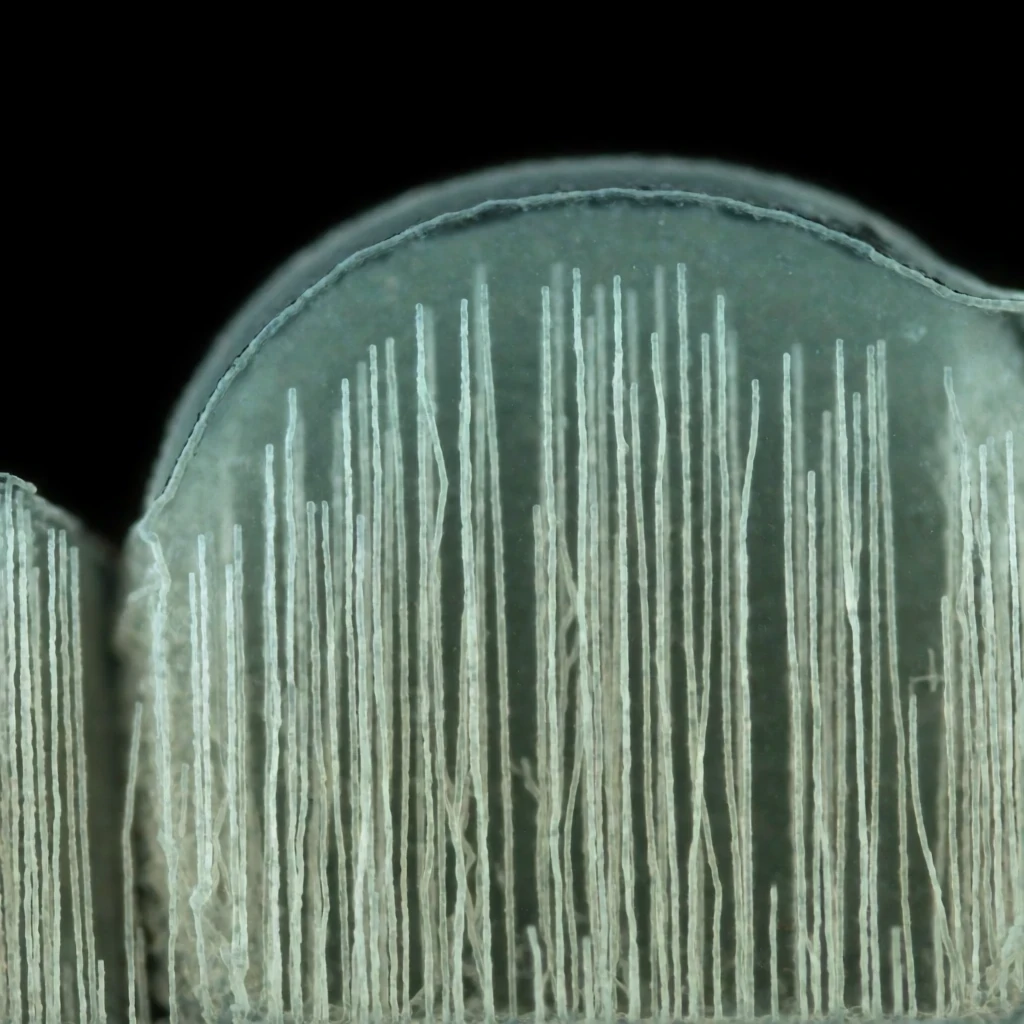
Spin ice occupies one of the most intellectually fertile territories in modern condensed matter physics, a crystalline landscape where the rules of magnetism conspire to produce behavior that looks suspiciously like the deepest structures of the universe. In these remarkable materials, the magnetic moments of rare-earth ions arrange themselves on a lattice of corner-sharing tetrahedra, and the local energetic constraints force each tetrahedron into a "two-in, two-out" configuration. This is precisely the ice rule that governs the placement of hydrogen atoms in ordinary water ice, and it is from this humble geometric analogy that an entire vocabulary of emergent phenomena has grown.
What makes spin ice genuinely extraordinary is that its low-temperature excitations behave as magnetic monopoles, and when those monopoles are strung together by the underlying lattice constraints, they form string-like defects that carry a tension and dynamics all their own. A new theoretical framework now connects these magnetic strings directly to phase transitions, offering physicists a broader and more flexible language for describing unusual magnetic materials. The crucial insight is not that we have discovered a new fundamental particle, but that we have found a powerful effective description, a way of speaking about collective behavior that transcends the microscopic details.
This distinction between emergent and fundamental phenomena sits at the heart of how modern physics actually operates. Physicists routinely build analogies, quasiparticles, and effective field theories that describe complex systems with startling accuracy without ever claiming that these entities are irreducible constituents of reality. Understanding why magnetic strings are useful even when they are not fundamental particles is therefore a lesson in scientific methodology as much as in magnetism, and it illuminates how the discipline reasons across scales.
On This Page
- The Physics of Spin Ice and the Ice Rule
- What String-Like Defects Actually Are
- Emergent Versus Fundamental: Why the Distinction Matters
- Experimental Signatures and Material Realizations
- Mathematical Toolkit for String Defects
- Broader Implications for Condensed Matter Physics
- Why the String Language Earns Its Place
The Physics of Spin Ice and the Ice Rule
Spin ice earns its name from a deceptively simple structural coincidence. The magnetic ions, typically holmium or dysprosium titanate, sit on the vertices of a pyrochlore lattice built from corner-sharing tetrahedra, and strong crystal-field effects force each magnetic moment to point either directly toward or directly away from the center of its tetrahedron. This Ising-like anisotropy reduces the problem to a binary choice at every site, and the dominant nearest-neighbor interactions then impose the two-in, two-out constraint on every tetrahedron simultaneously.
Geometry, Frustration, and the Two-in, Two-out Constraint
The pyrochlore lattice is a masterpiece of geometric frustration, a structure in which competing interactions cannot all be satisfied at once. Each tetrahedron shares its corners with neighboring tetrahedra, so the ice rule propagates through the entire crystal as a global constraint rather than a local one. The result is a macroscopic degeneracy: an enormous number of spin configurations satisfy the ice rule, and the system cannot settle into a single ordered ground state.
This degeneracy is not merely a curiosity; it is the engine that drives the material's exotic behavior. Because so many configurations are energetically equivalent, the system retains a finite entropy even as temperature approaches absolute zero, a residual entropy that mirrors the famous Pauling estimate for water ice. The measured entropy of spin ice agrees remarkably well with this prediction, confirming that the ice-rule analogy is quantitative rather than poetic.
Geometric frustration thus transforms a simple magnetic insulator into a laboratory for emergent physics. The spins are frozen into a highly correlated but disordered state, a "spin liquid" that never crystallizes into long-range magnetic order. Within this correlated background, local violations of the ice rule become the elementary excitations, and those excitations carry the story forward.
Physicists describe the constraint mathematically through a divergence-free condition on the effective magnetic field, analogous to the absence of magnetic charge in ordinary electromagnetism. The ice rule enforces this condition everywhere except at defects, and those defects behave exactly like sources and sinks of magnetic flux, which is why they are called monopoles.
Monopoles, Dirac Strings, and Emergent Gauge Fields
When a single tetrahedron flips from two-in, two-out to three-in, one-out, it creates a net magnetic charge, a localized violation of the ice rule that behaves as a magnetic monopole. These monopoles are not fundamental particles; they are collective excitations of the spin system, yet they move through the lattice and interact via a Coulomb-like force. Their existence was predicted theoretically and later confirmed through neutron scattering experiments that detected the characteristic pinch-point patterns in reciprocal space.
Monopoles in spin ice are always created in pairs, connected by a chain of flipped spins that carries the magnetic flux between them. This chain is the Dirac string, a one-dimensional defect along which the ice rule is violated. In the standard picture, the string is energetically costly and therefore short, but under certain conditions the strings themselves become the dominant players, and their collective behavior can drive phase transitions.
The emergent gauge field that governs these excitations is a beautiful example of how macroscopic physics can mimic fundamental physics. The spins collectively generate a gauge structure that is not present in the underlying Hamiltonian, yet it controls the low-energy dynamics with remarkable fidelity. This is emergence in its purest form: a new level of description that is autonomous, predictive, and irreducible to the microscopic rules in any practical sense.
Understanding this hierarchy is essential for interpreting the new framework linking strings to phase transitions. The strings are not added by hand; they arise from the same ice-rule constraint that defines the material, and their statistical mechanics determines how the system responds to temperature, field, and disorder.
What String-Like Defects Actually Are
A string-like defect in spin ice is a connected path of tetrahedra that violate the ice rule, threading through the lattice like a filament through a sponge. Each segment of the string carries a flipped spin relative to the ice-rule background, and the endpoints of the string are the monopoles themselves. The string is therefore not a separate object but a bookkeeping device that tracks the magnetic flux connecting a monopole-antimonopole pair.
Tension, Confinement, and the Energy Cost of Strings
The energy of a string grows with its length, which means that in the simplest models monopoles are confined: pulling them apart stretches the string and costs energy proportional to the separation. This linear confinement is directly analogous to the confinement of quarks in quantum chromodynamics, where the gluon field forms a flux tube between color charges. The analogy is not exact, but it is structurally deep and has guided much of the theoretical work.
However, spin ice is not a perfect analog of QCD, and the differences matter. The string tension depends sensitively on the details of the interactions, the applied magnetic field, and the temperature. Under some conditions the strings can proliferate and screen the monopoles, changing the confinement picture entirely. This flexibility is precisely what makes the string language so useful: it can be tuned to capture different regimes.
Recent theoretical work has pushed this idea further by treating the strings as the primary objects and asking how their condensation or percolation drives phase transitions. When strings become long and entangled, they can form a network that spans the sample, and the transition between a confined and a deconfined phase can be described in terms of string statistics. This reframes magnetic phase transitions as geometric transitions in the string ensemble.
The energy cost of a string segment can be written as a sum over local constraints, and in the simplest approximation the total energy scales linearly with length. We can express the confinement potential between two monopoles separated by distance ##[r]## as a linear function, which captures the essential physics of the string tension.
Here ##[\sigma]## is the string tension and ##[\kappa]## encodes the residual Coulomb attraction between the monopoles. The competition between the linear confining term and the Coulomb term determines whether the pair is bound, and the crossover scale ##[r_c = \sqrt{\kappa/\sigma}]## marks the boundary between the two regimes. This simple formula illustrates how effective models capture complex behavior with a handful of parameters.
From Defect Networks to Phase Transitions
Phase transitions in spin ice are rarely conventional. Because the ice rule is so restrictive, the system can enter a variety of exotic phases depending on the applied field direction and strength. When a magnetic field is applied along a particular crystallographic axis, the degeneracy is partially lifted and the system can order into a state with a net magnetization, but the transition is often mediated by the proliferation of string defects rather than by simple spin alignment.
The new framework connects these transitions to the statistical mechanics of strings, treating the string network as the order parameter. In this picture, a phase transition occurs when the string network changes its topology, for example when it percolates or when its characteristic length scale diverges. This is a geometric way of thinking about criticality, and it complements the more traditional Landau-Ginzburg approach based on local order parameters.
Such geometric descriptions are powerful because they are robust against microscopic details. The same string-network language can describe spin ice, artificial spin ice fabricated from nanomagnets, and even certain classes of frustrated magnets that share the same underlying constraint. This universality is the real payoff: a single framework that travels across materials and scales.
To make the connection quantitative, one can define a string density ##[\rho]## and a typical string length ##[\ell]##, and then relate the free energy to these variables. The transition occurs when the entropy of string configurations overwhelms the energy cost, a balance that can be captured by a simple free-energy functional.
Minimizing this functional with respect to ##[\rho]## and ##[\ell]## yields the equilibrium string configuration, and the phase boundary appears where the minimum jumps or where the curvature changes sign. The entropy term ##[S(\rho,\ell)]## encodes the combinatorial richness of string arrangements, and its precise form determines the order of the transition. This is the kind of effective modeling that lets physicists make predictions without solving the full microscopic problem.
Emergent Versus Fundamental: Why the Distinction Matters
The most important conceptual lesson from spin ice is that a phenomenon can be real, predictive, and deeply useful without being fundamental. Magnetic monopoles in spin ice are not the monopoles of grand unified theories; they are collective excitations that obey effective laws. Yet they are as real as any quasiparticle, and their behavior can be measured, manipulated, and used to understand the material. The distinction between emergent and fundamental is about levels of description, not about degrees of reality.
The Logic of Effective Descriptions
Effective descriptions are the workhorses of modern physics. From phonons in crystals to holes in semiconductors to Cooper pairs in superconductors, physicists constantly invent entities that are not in the fundamental Lagrangian but that capture the relevant physics at a given scale. The criterion for a good effective description is not ontological purity but predictive power and explanatory economy. If it works, it earns its place.
Spin ice strings are a particularly clear case because the analogy to fundamental physics is so striking. The Dirac string, the monopole, the emergent gauge field, and the confinement phenomenon all have direct counterparts in high-energy physics, yet they arise here from completely different microscopic ingredients. This convergence suggests that the organizational principles of physics are scale-independent, and that studying one domain can illuminate another.
The danger, of course, is overinterpretation. It is tempting to claim that spin ice contains actual monopoles or actual strings, but such claims confuse the map with the territory. The correct statement is that spin ice hosts excitations that are mathematically isomorphic to monopoles and strings in certain respects, and that this isomorphism is useful. Precision in language protects against confusion.
This is why the recommended angle for explaining spin ice emphasizes the difference between emergent and fundamental phenomena. Readers who grasp this distinction will understand not only spin ice but also a broad swath of condensed matter physics, from fractional quantum Hall states to topological insulators. The lesson generalizes far beyond a single material.
Analogy as a Scientific Instrument
Analogy is often dismissed as a soft rhetorical device, but in theoretical physics it is a precision instrument. The ice-rule analogy between water ice and spin ice led directly to the prediction of residual entropy and, later, to the prediction of monopoles. The QCD analogy for string confinement guided the search for deconfinement transitions in magnetic materials. Analogies generate hypotheses, and hypotheses generate experiments.
The key is to use analogy without reification. Saying that spin ice hosts strings is shorthand for a set of mathematical statements about correlations and constraints; it is not a claim that literal strings exist in the material. Physicists learn to hold this distinction lightly, using the analogy to build intuition while keeping the formalism honest. This disciplined flexibility is a hallmark of mature scientific practice.
For general readers, this is perhaps the most valuable takeaway. Science advances not only by discovering new things but by finding better ways to describe old things. The string framework for spin ice is a new language, and like any good language it reveals connections that were previously invisible. It does not change what the material is; it changes what we can say about it.
The broader lesson extends to many frontier areas. Emergent gravity, emergent spacetime, and emergent gauge fields are all active research themes that rely on the same logic. In each case, the question is not whether the emergent entity is "real" in a fundamental sense, but whether the effective description is coherent, predictive, and fruitful. Spin ice provides a concrete, experimentally accessible testing ground for these ideas.
Experimental Signatures and Material Realizations
The theoretical framework would be idle speculation without experimental support, and spin ice delivers. Neutron scattering experiments reveal pinch-point patterns in reciprocal space, a distinctive signature of the emergent Coulomb phase that arises from the ice rule. These pinch points are not predicted by conventional magnetic order and provide direct evidence that the system is governed by an emergent gauge structure rather than simple local interactions.
Neutron Scattering and the Coulomb Phase
The pinch-point pattern is a diffuse scattering feature that appears at specific reciprocal lattice positions, and its shape encodes the correlations of the emergent field. The intensity distribution follows a characteristic form that can be derived from the divergence-free constraint, and its observation in ##[\text{Ho}_2\text{Ti}_2\text{O}_7]## and related compounds confirmed the theoretical picture. This was a triumph of the effective-description approach.
More recently, experiments have probed the dynamics of monopoles and strings directly. By applying magnetic fields and measuring the response, researchers can track how monopoles move and how strings stretch. These measurements test the confinement picture and reveal deviations that point to additional physics, such as the role of disorder or the influence of phonons. The string framework provides the vocabulary for interpreting these results.
The scattering intensity in the Coulomb phase can be modeled with a simple formula that captures the pinch-point structure. The correlation function in momentum space takes a form proportional to the transverse projector, which enforces the divergence-free condition and produces the characteristic pinch.
This expression shows that the scattering diverges as ##[|\mathbf{q}| \to 0]##, which is why the pinch points are so pronounced. The transverse projector structure is the fingerprint of the emergent gauge field, and its experimental confirmation is one of the strongest pieces of evidence for the entire framework. Few theoretical predictions in condensed matter are this visually distinctive.
Artificial Spin Ice and Designer Materials
Artificial spin ice extends the story beyond natural crystals. By fabricating arrays of nanomagnets on a lattice, researchers can design the geometry and interactions almost at will, creating systems that realize the ice rule in two dimensions and even in curved geometries. These designer materials allow direct imaging of monopoles and strings using magnetic force microscopy, turning abstract concepts into visible objects.
In artificial spin ice, the string defects can be manipulated one at a time, and their dynamics can be studied in real space rather than inferred from scattering. This has revealed rich behavior, including avalanches, ratchet effects, and topological protection. The ability to engineer the lattice also allows tests of theoretical predictions that would be difficult or impossible in natural materials.
The connection between natural and artificial spin ice reinforces the universality of the string framework. The same concepts apply across vastly different energy scales and fabrication methods, from rare-earth titanates to lithographically patterned permalloy. This cross-scale validity is a strong indication that the framework captures something essential about constrained magnetic systems.
Looking forward, the combination of designer materials and advanced imaging promises to turn spin ice into a platform for testing ideas about emergence itself. Researchers can ask how the effective description breaks down as the lattice becomes small, how disorder alters the string network, and whether new phases appear at the boundaries. These questions are at the frontier of the field.
Mathematical Toolkit for String Defects
Quantitative analysis of string defects requires a compact mathematical toolkit, and the good news is that the essential ideas can be expressed with a handful of formulas. The ice rule is a local constraint, the monopoles are sources of the emergent field, and the strings are the field lines connecting them. Each of these statements has a precise mathematical form that can be manipulated and compared with experiment.
Divergence Constraints and Magnetic Charge
The emergent magnetic field ##[\mathbf{B}]## in spin ice is defined on the lattice and satisfies a divergence constraint everywhere except at monopoles. The constraint can be written as a lattice divergence equation, and the monopole charge is the source term. This is the discrete analog of Gauss's law, and it makes the monopole concept mathematically sharp.
Here ##[\rho_m]## is the magnetic charge density, which vanishes in the ice-rule background and is nonzero at monopole sites. The string is the path along which the flux is transported, and its tension can be derived from the energy cost of the flipped spins. This formalism connects the microscopic spin configuration to the macroscopic field description.
The magnetic charge of a single monopole is quantized in units related to the spin length and the lattice geometry. For a tetrahedron with spin ##[S]## and lattice constant ##[a]##, the effective charge can be estimated from the net moment of the three-in, one-out configuration. This estimate agrees with the values inferred from experiment, providing another consistency check.
In this expression ##[\mu]## is the magnetic moment per ion and ##[a]## is the relevant lattice spacing. The factor of two reflects the difference between the three-in, one-out and two-in, two-out configurations. Plugging in typical values for ##[\text{Dy}_2\text{Ti}_2\text{O}_7]## gives a charge that is small but measurable, and the agreement with neutron data is encouraging.
Statistical Mechanics of the String Ensemble
The statistical mechanics of strings is where the framework becomes predictive. Treating the string network as a gas of interacting lines, one can compute thermodynamic quantities using transfer-matrix methods or Monte Carlo simulations. The key control parameter is the ratio of string tension to temperature, which determines whether strings are short and rare or long and abundant.
A simple model treats the strings as random walks with a chemical potential, and the partition function can be summed approximately. The result is a crossover between a confined regime at low temperature and a proliferated regime at high temperature, with a characteristic energy scale set by the string tension. This crossover is the magnetic analog of a deconfinement transition.
Summing over string lengths ##[\ell]## with Boltzmann weight ##[e^{-\beta \sigma \ell}]## gives a geometric series that converges only when the tension is positive. When the effective tension vanishes, the sum diverges, signaling a transition. This toy model captures the essential physics and provides intuition for more sophisticated treatments.
More realistic models include interactions between strings, which can lead to screening and to the formation of a string liquid. In this phase, the strings are entangled and the monopoles are deconfined, much like quarks in a quark-gluon plasma. The existence of such a phase in spin ice is an active area of research, and the string framework provides the language to describe it.
We Also Published
Broader Implications for Condensed Matter Physics
The spin ice story is a case study in how condensed matter physics generates new concepts. The framework of emergent gauge fields, monopoles, and strings did not originate in spin ice; it was imported from high-energy physics and adapted to a magnetic context. But the adaptation was not passive. Spin ice forced physicists to sharpen their definitions, to distinguish carefully between fundamental and emergent, and to develop new experimental probes.
Universality Across Frustrated Magnets
The string framework is not limited to spin ice. Other frustrated magnets, including kagome ice and certain pyrochlore compounds with different anisotropy, exhibit related physics. The common thread is the presence of a local constraint that produces an emergent gauge structure, and the string defects are the excitations that violate the constraint. This universality suggests that the framework captures a broad class of phenomena.
Beyond magnetism, similar ideas appear in other constrained systems. Artificial colloidal ice, superconducting circuits, and even certain optical lattices can realize ice-rule physics, and the string language transfers naturally. This cross-disciplinary reach is one of the most exciting aspects of the field, and it is driving new collaborations between condensed matter physicists, cold-atom researchers, and materials scientists.
The mathematical structures involved, particularly the emergent gauge fields and topological defects, connect to deep ideas in mathematics. The study of constrained systems on lattices touches on homology, cohomology, and the theory of fiber bundles. These connections are not merely decorative; they provide powerful tools for classifying phases and transitions.
For students and early-career researchers, spin ice offers an accessible entry point to these sophisticated ideas. The material is experimentally realizable, the models are tractable, and the conceptual payoff is large. Learning to think in terms of emergent descriptions is a transferable skill that applies far beyond magnetism.
Open Questions and Future Directions
Despite the progress, many questions remain open. The precise nature of the string liquid phase, the role of quantum fluctuations, and the effect of disorder on the string network are all active research topics. Quantum spin ice, in which the spins can tunnel between configurations, is a particularly promising frontier, as it may host a quantum spin liquid with emergent photons and monopoles.
Another open question concerns the dynamics of strings under external driving. When a magnetic field is ramped, the string network can respond in complex ways, producing avalanches and hysteresis. Understanding these dynamics is important for potential applications in spintronics and neuromorphic computing, where controlled manipulation of magnetic textures is desirable.
The connection to real materials also raises practical questions. Can we design materials with tailored string properties? Can we use strings to store or process information? These questions are speculative but not fanciful, and they motivate ongoing work at the interface of materials science and fundamental physics.
Finally, the philosophical dimension deserves attention. The success of emergent descriptions challenges naive reductionism, the view that everything can be explained by the fundamental laws alone. Spin ice shows that new levels of description can be autonomous and predictive, and that understanding a system requires engaging with these levels on their own terms. This is a lesson with implications far beyond physics.
Why the String Language Earns Its Place
The deepest reason magnetic strings are useful is that they organize a vast amount of information into a compact and transferable vocabulary. Instead of tracking every spin in a frustrated lattice, physicists can speak of strings, their tension, their entanglement, and their condensation. This compression is not a loss of rigor; it is the essence of theoretical progress, and it is why the framework has spread so quickly.
From Analogy to Predictive Framework
The framework has moved beyond analogy to genuine prediction. It forecasts the shape of scattering patterns, the temperature dependence of monopole density, and the conditions under which deconfinement should occur. Some of these predictions have been confirmed, others are being tested, and a few have been revised in light of data. This is the normal life cycle of a successful effective theory.
Importantly, the framework does not require the strings to be fundamental. It requires only that they be well-defined collective variables with predictable dynamics. This is a modest requirement, and it is satisfied in spin ice and related materials. The success of the framework is therefore a vindication of the effective-description strategy, not a claim about ultimate reality.
For readers encountering this material for the first time, the takeaway is that physics is layered. Each layer has its own entities, its own laws, and its own explanatory power. The fundamental layer is not the only one that matters, and in many practical contexts it is not even the most useful. Spin ice makes this abstract point concrete and visible.
The string framework also illustrates how scientific language evolves. Terms like "monopole" and "Dirac string" are borrowed from high-energy physics, but their meaning shifts when transplanted into a magnetic context. This semantic flexibility is a feature, not a bug, and it allows physicists to carry intuition across domains while remaining alert to differences.
Lessons for Scientific Communication
Communicating this material to general audiences requires care. The temptation is to sensationalize, to claim that spin ice contains magnetic monopoles in the same sense that the universe might. The responsible approach is to explain the analogy, celebrate its power, and clearly mark its limits. Readers deserve both the excitement and the precision.
The recommended angle for this topic, emphasizing the difference between emergent and fundamental phenomena, serves this goal well. It gives readers a conceptual tool they can use to interpret other scientific claims, from emergent gravity to quasiparticles in superconductors. It also respects their intelligence by not oversimplifying.
Good science writing does not just report results; it teaches ways of thinking. The spin ice story teaches that analogies are powerful, that effective descriptions are legitimate, and that the boundary between the fundamental and the emergent is one of the most productive frontiers in modern physics. These lessons outlast any particular experiment.
As the field moves forward, the string framework will likely be extended, revised, and perhaps replaced. But the methodological lessons will remain. The willingness to use effective descriptions without reifying them, to borrow language across domains, and to test analogies against data is what makes physics such a robust enterprise. Spin ice is a vivid reminder of that robustness.
From our network :
- 10 Physics Numerical Problems with Solutions for IIT JEEPrepare for IIT JEE with 10 physics numerical problems, complete with detailed solutions and conceptual explanations. Ideal for mastering kinematics, thermodynamics, electromagnetism, and optics.
- Mastering DB2 12.1 Instance Design: A Technical Deep Dive into Modern Database ArchitectureComprehensive guide to DB2 12.1 Instance Design. Explore architectural components, HADR setup, buffer pool tuning, and security policies for IBM DB2 12.1. Includes 10 functional SQL and Shell samples.
- Analyzing Trump Deportation Numbers Insights Into The 2026 Immigration Crackdown
- Mastering DB2 LUW v12 Tables: A Comprehensive Technical GuideComprehensive guide on DB2 LUW v12 tables. Explore CREATE TABLE syntax, BLU Acceleration, range partitioning, data types, and security features for IBM DB2 LUW v12.
- Vite 6/7 'Cold Start' Regression in Massive Module GraphsIn-depth analysis of Vite 6/7 cold start regressions in massive module graphs. Learn about barrel file issues, pre-bundling optimizations, and how to improve Vite dev server performance.
- Trump Political Strategy How Geopolitical Stunts Serve As Media Diversions
- 98% of Global MBA Programs Now Prefer GRE Over GMAT Focus EditionExplore why 98% of global MBA programs now prefer the GRE over GMAT Focus. Learn about the shorter GRE format, verbal logic importance, and strategic versatility for students.
- AI-Powered 'Precision Diagnostic' Replaces Standard GRE Score ReportsDiscover the new GRE Precision Diagnostic. Learn how AI-powered behavioral analytics and time-to-solve tracking are replacing standard GRE score reports to empower students.
- EV 2.0: The Solid-State Battery Breakthrough and Global Factory ExpansionDiscover the impact of the Solid-State Battery Breakthrough on the EV market. Learn about CATL and BYD stock growth, global factory expansion in Europe, and the future of EV 2.0 technology.
RESOURCES
- Resources will be updated soon.




0 Comments