Every atom carries a dense nucleus built from protons and neutrons, and while the proton count defines the chemical element, the neutron count quietly defines the isotope. This distinction sits at the heart of modern nuclear science, shaping everything from medical imaging to archaeological chronology. Understanding neutrons and isotopes is therefore not an academic luxury but a practical gateway into how matter actually behaves.
Radiocarbon dating, the technique that famously placed the Shroud of Turin and countless prehistoric artifacts on a calendar, depends entirely on a rare carbon isotope called carbon-14. That isotope forms when cosmic rays strike nitrogen in the upper atmosphere, then travels through the food chain into every living organism. When an organism dies, the radioactive clock starts ticking, and the ratio of carbon-14 to stable carbon-12 becomes a measurable timestamp.
This FAQ-style exploration unpacks the neutron's role in isotope formation, the mathematics of radioactive decay, and the calibration science behind carbon dating. It also surveys broader applications, from nuclear medicine to geology, so readers leave with a coherent mental model rather than scattered facts. Each section pairs conceptual clarity with worked calculations, ensuring the physics remains grounded and verifiable.
On This Page
- The Neutron's Identity and the Architecture of the Nucleus
- Isotopes: Same Element, Different Neutron Count
- The Mathematics of Radioactive Decay
- How Carbon Dating Works in Practice
- Beyond Dating: Neutrons and Isotopes Across the Sciences
- Frequently Asked Questions About Neutrons and Isotopes
- Precision, Uncertainty, and the Future of Isotope Science
The Neutron's Identity and the Architecture of the Nucleus
The neutron is an electrically neutral subatomic particle with a mass marginally larger than the proton, roughly ##[1.675 \times 10^{-27}\ \text{kg}]##. Discovered by James Chadwick in 1932, it solved a persistent puzzle: helium's mass implied an unseen neutral component inside the nucleus. Its neutrality lets it penetrate atomic electron clouds without electrostatic repulsion, making it a uniquely powerful probe.
Protons, Neutrons, and the Nuclide Notation
Chemists describe a nucleus using the notation ##[^{A}_{Z}\text{X}]##, where ##Z## is the proton number and ##A## is the mass number, the sum of protons and neutrons. The neutron number follows directly as ##[N = A - Z]##. For carbon-14, ##Z = 6## and ##A = 14##, so ##N = 8## neutrons accompany six protons.
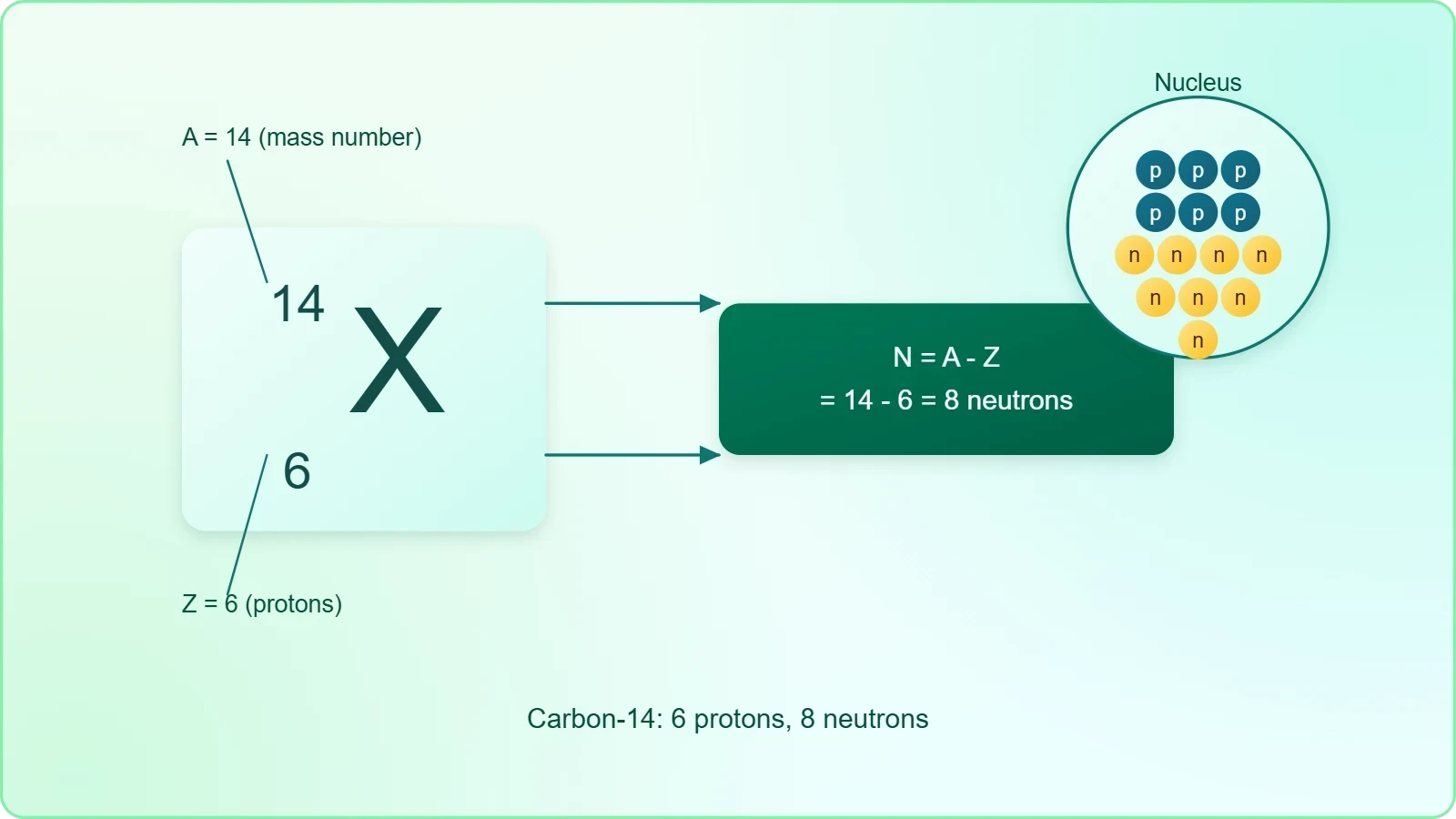
This notation is not cosmetic; it encodes stability. Nuclei with certain proton-to-neutron ratios resist decay, while others disintegrate spontaneously. The balance point shifts as nuclei grow heavier, which is why heavy elements need proportionally more neutrons to hold their protons together against mutual repulsion.
The Strong Force and Nuclear Binding
The strong nuclear force binds nucleons at extremely short ranges, roughly ##[10^{-15}\ \text{m}]##, overpowering electrostatic repulsion between protons. Neutrons contribute binding energy without adding charge, effectively acting as nuclear glue. This is why adding neutrons can stabilize a nucleus, though excess neutrons eventually destabilize it.
Binding energy per nucleon peaks near iron-56, a fact that governs both stellar nucleosynthesis and nuclear energy release. The mass defect, the difference between constituent masses and the assembled nucleus, converts to binding energy through ##[E = \Delta m c^2]##. This equation quantifies precisely how much energy holds a nucleus together.
We Also Published
Isotopes: Same Element, Different Neutron Count
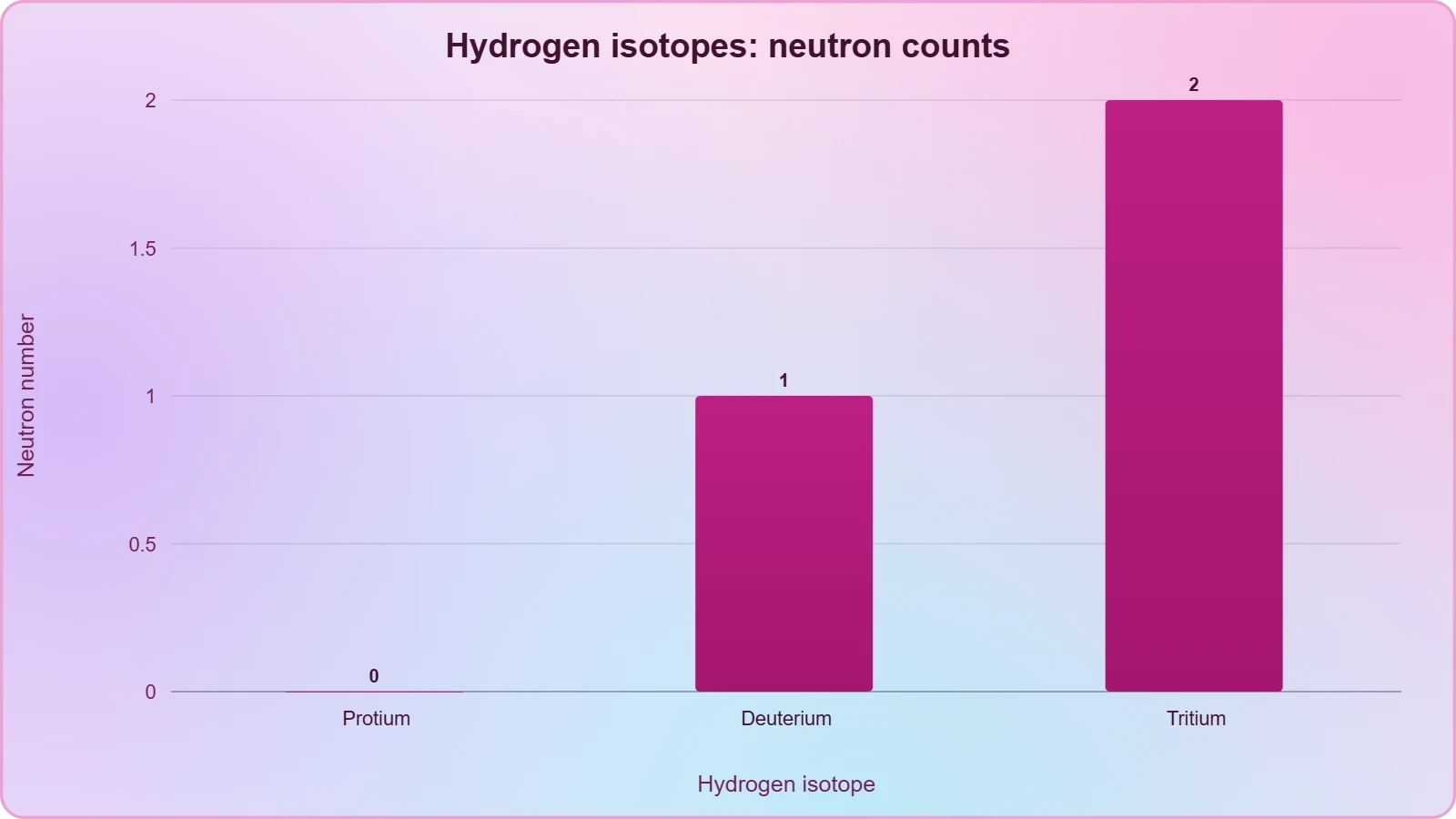
Isotopes are atoms of the same element that differ only in neutron number, and therefore in mass number. Hydrogen offers the cleanest illustration: protium has zero neutrons, deuterium has one, and tritium has two. Chemically they behave almost identically, yet their nuclear behavior diverges dramatically, which is precisely why isotopes matter so much.
Stable Versus Radioactive Isotopes
Most naturally occurring isotopes are stable, meaning their nuclear configuration persists indefinitely. Others are radioactive and decay at characteristic rates, emitting alpha particles, beta particles, or gamma rays. Carbon-12 and carbon-13 are stable; carbon-14 is radioactive with a half-life of approximately 5,730 years.
Stability depends on the interplay between the strong force and electrostatic repulsion, mapped on the chart of nuclides. Light elements favor roughly equal proton and neutron counts, while heavier elements require neutron excess. Isotopes far from this stability band decay rapidly, often within fractions of a second.
Isotopic Abundance and Atomic Weight
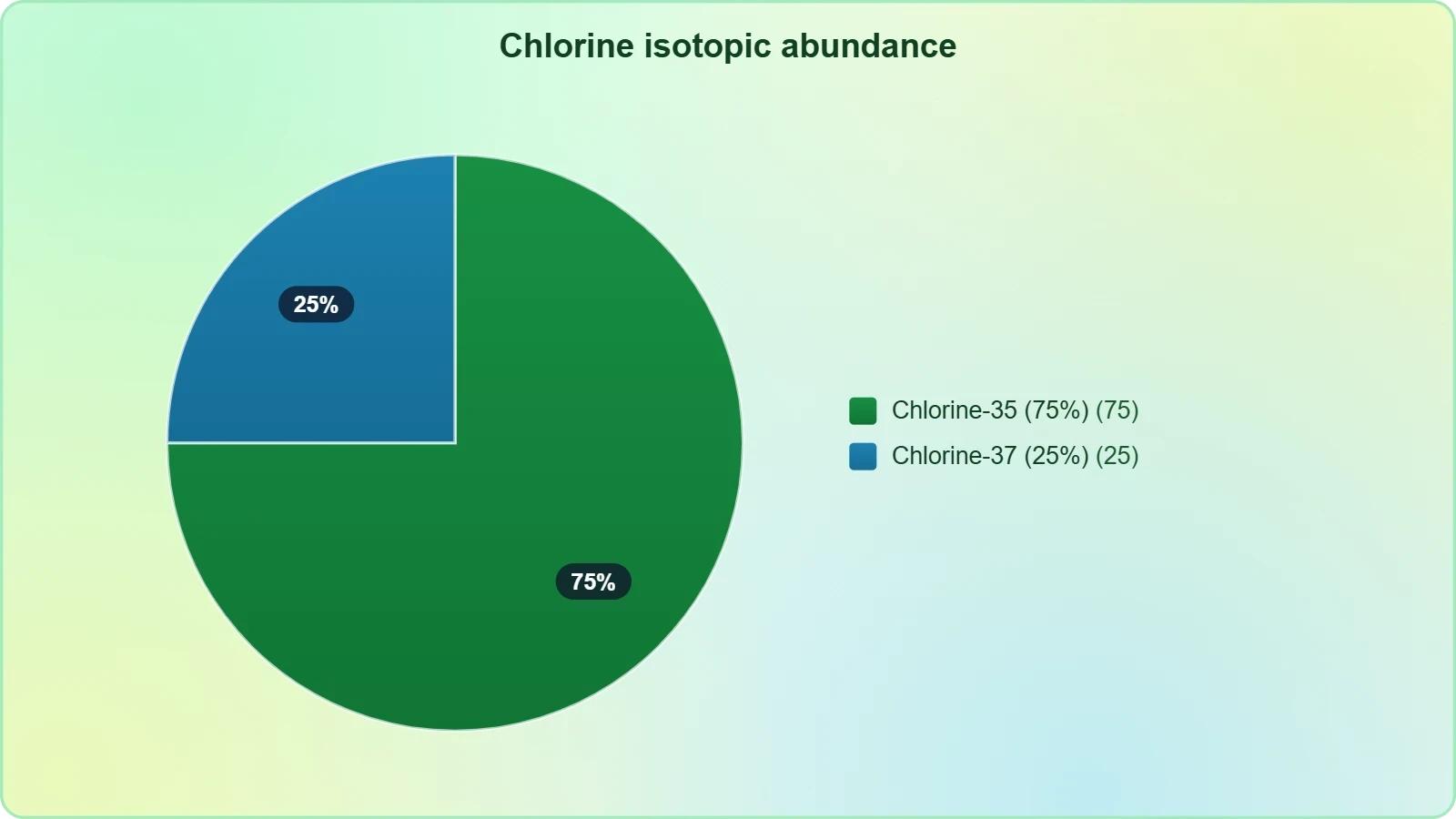
Atomic weights on the periodic table are weighted averages of isotopic masses, scaled by natural abundance. Chlorine's atomic weight of 35.45 reflects roughly 75 percent chlorine-35 and 25 percent chlorine-37. This averaging explains why atomic weights are rarely whole numbers despite protons and neutrons being nearly integer masses.
Mass spectrometry measures these abundances with extraordinary precision, separating isotopes by mass-to-charge ratio. The technique underpins fields as diverse as forensics, environmental monitoring, and planetary science. Isotopic fingerprints can even reveal the geographic origin of food, water, and human remains.
The Mathematics of Radioactive Decay
Radioactive decay follows first-order kinetics, meaning the rate of disintegration is proportional to the number of undecayed nuclei present. This yields an exponential decay law that governs every radiometric dating method. Mastering this single equation unlocks the quantitative side of isotope science and clarifies why half-life is such a central concept.
Deriving the Exponential Decay Law
The governing differential equation states that the decay rate equals the negative product of the decay constant and the number of nuclei: ##[\dfrac{dN}{dt} = -\lambda N]##. Separating variables and integrating from initial count ##N_0## to time ##t## produces the familiar exponential relationship below.
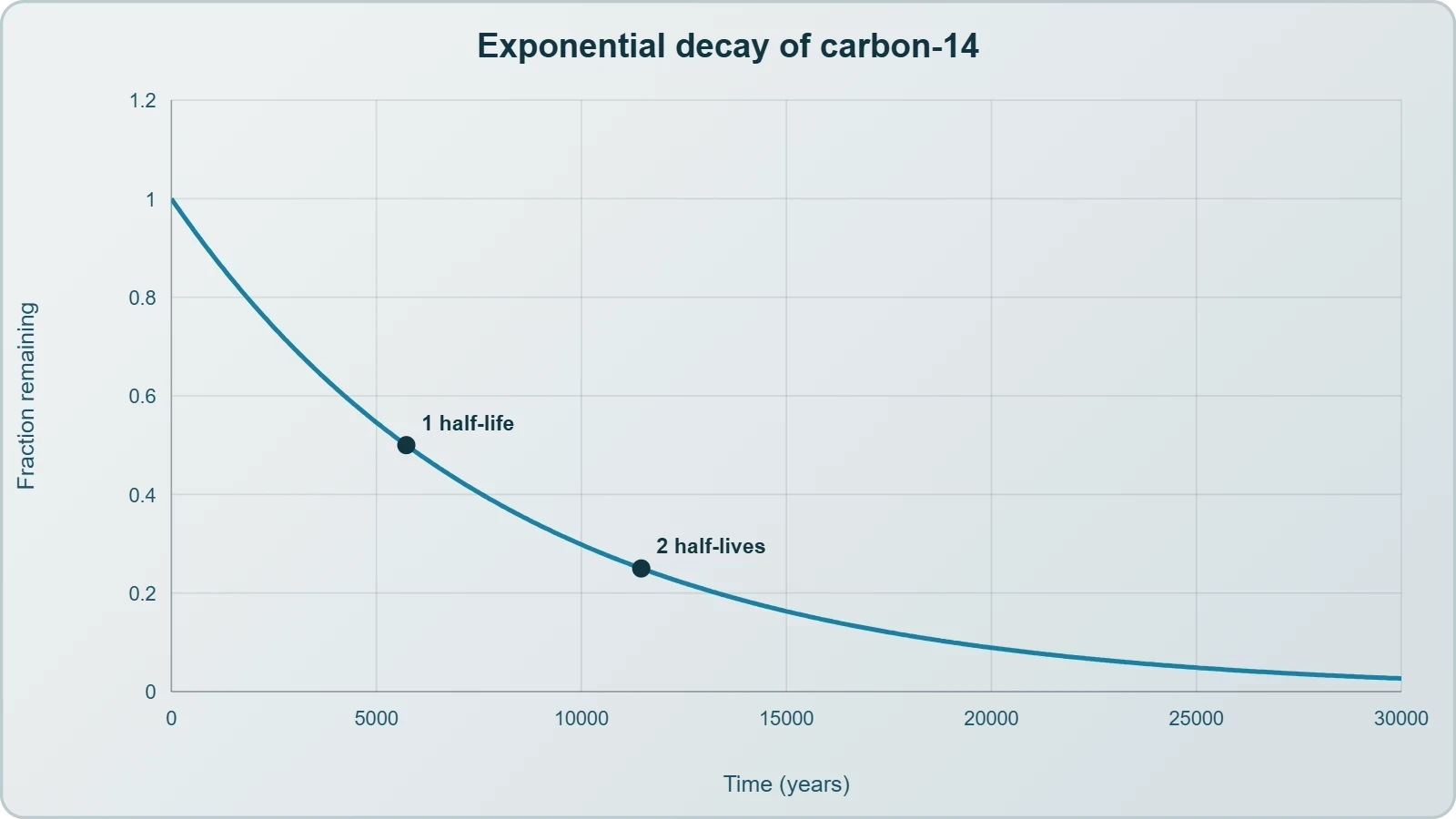
The decay constant ##\lambda## links directly to half-life through ##[\lambda = \dfrac{\ln 2}{t_{1/2}}]##. Substituting the carbon-14 half-life of 5,730 years gives ##[\lambda \approx 1.21 \times 10^{-4}\ \text{yr}^{-1}]##. This constant converts any measured activity ratio into an absolute age estimate.
Worked Carbon-14 Dating Calculations
Suppose a bone sample retains 25 percent of its original carbon-14 content. Since 25 percent equals one quarter, or two successive halvings, the sample age is simply ##[2 \times 5730 = 11{,}460]## years. This intuitive shortcut works whenever the remaining fraction is a clean power of one-half.
For non-integer fractions, the logarithmic form is required: ##[t = \dfrac{1}{\lambda}\ln\left(\dfrac{N_0}{N}\right)]##. A sample retaining 40 percent of its original carbon-14 yields ##[t = \dfrac{1}{1.21 \times 10^{-4}}\ln(2.5) \approx 7{,}572]## years. Precision depends on measuring the isotope ratio accurately.
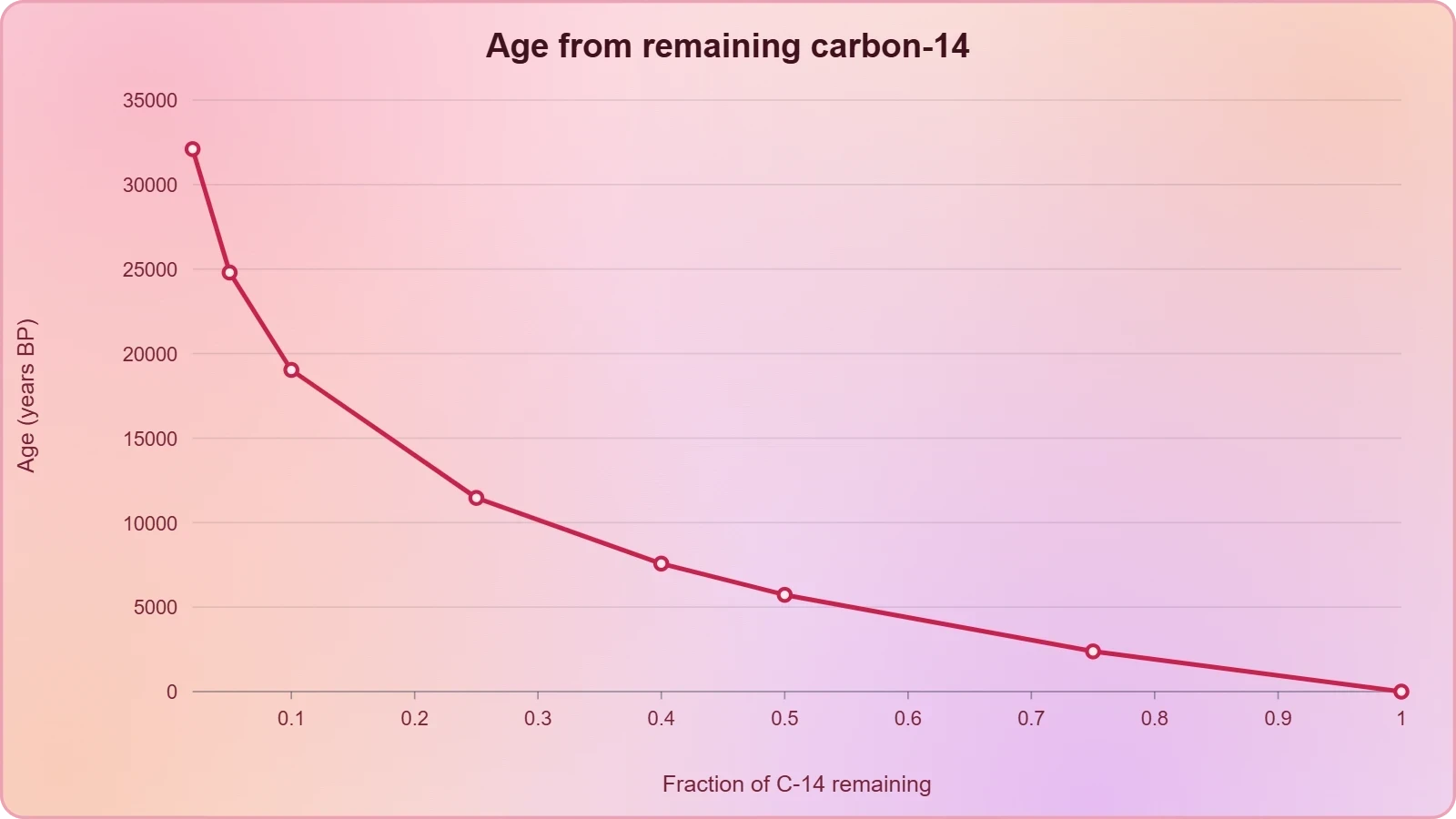
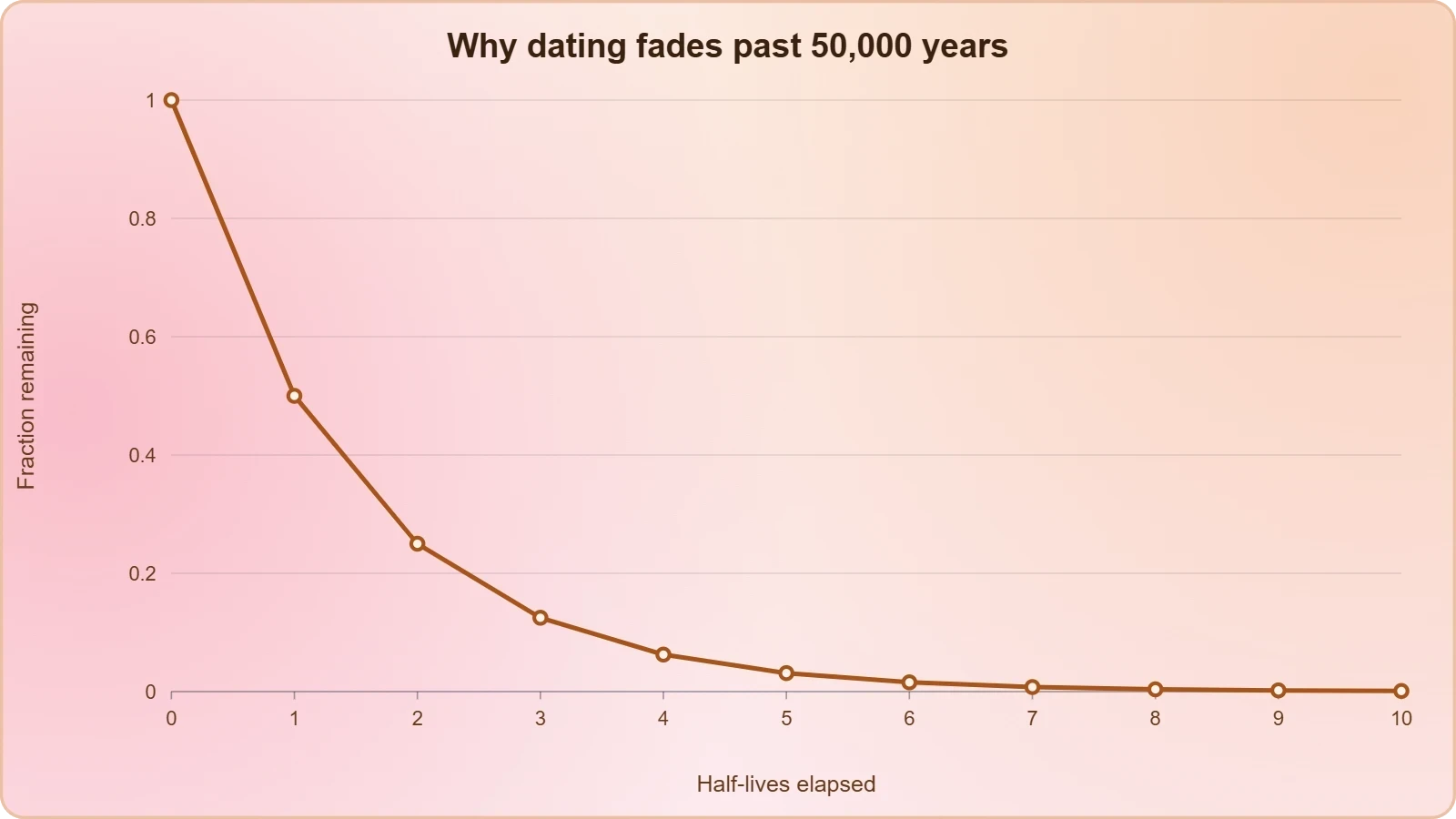
Modern accelerator mass spectrometry detects carbon-14 atoms directly rather than counting decay events, reducing required sample sizes to milligrams. This sensitivity extends reliable dating to roughly 50,000 years before present. Beyond that horizon, contamination and background radiation overwhelm the residual signal.
How Carbon Dating Works in Practice
Carbon dating translates a laboratory measurement of carbon-14 concentration into a calendar age, but the process involves several calibrated steps. Living organisms constantly exchange carbon with the atmosphere, maintaining a steady carbon-14 level. Death halts this exchange, and the isotope begins its slow decay, providing the clock that archaeologists read.
From Cosmic Rays to Living Tissue
Cosmic rays collide with atmospheric nitrogen-14, converting it into carbon-14 through neutron capture and proton emission. The resulting carbon-14 oxidizes to carbon dioxide and enters the biosphere via photosynthesis. Every living thing therefore carries a small, roughly constant proportion of radioactive carbon.
That proportion is approximately one carbon-14 atom per trillion carbon-12 atoms, a ratio small enough to demand sensitive detection. Plants absorb it, herbivores eat plants, and carnivores eat herbivores, distributing the isotope throughout food webs. The equilibrium persists until metabolic activity ceases at death.
Calibration Curves and Reservoir Effects
Raw radiocarbon ages require calibration because atmospheric carbon-14 levels have fluctuated over millennia. Tree-ring sequences, corals, and ice cores provide independent chronologies that anchor the calibration curve. Software such as IntCal converts measured radiocarbon years into calibrated calendar years with stated uncertainty ranges.
Marine organisms present special challenges because ocean carbon reservoirs age the dissolved carbon before uptake. A shell-dwelling mollusk may appear centuries older than its true age without a marine reservoir correction. Similar complications arise in freshwater systems and in organisms consuming mixed diets.
Beyond Dating: Neutrons and Isotopes Across the Sciences
Radiocarbon dating is only one application of isotope science, and arguably not the most consequential. Neutron-based techniques permeate medicine, materials science, geology, and energy production. Each application exploits a different facet of neutron behavior, from scattering to activation to fission, demonstrating the remarkable versatility of this neutral particle.
Medical Imaging and Cancer Therapy
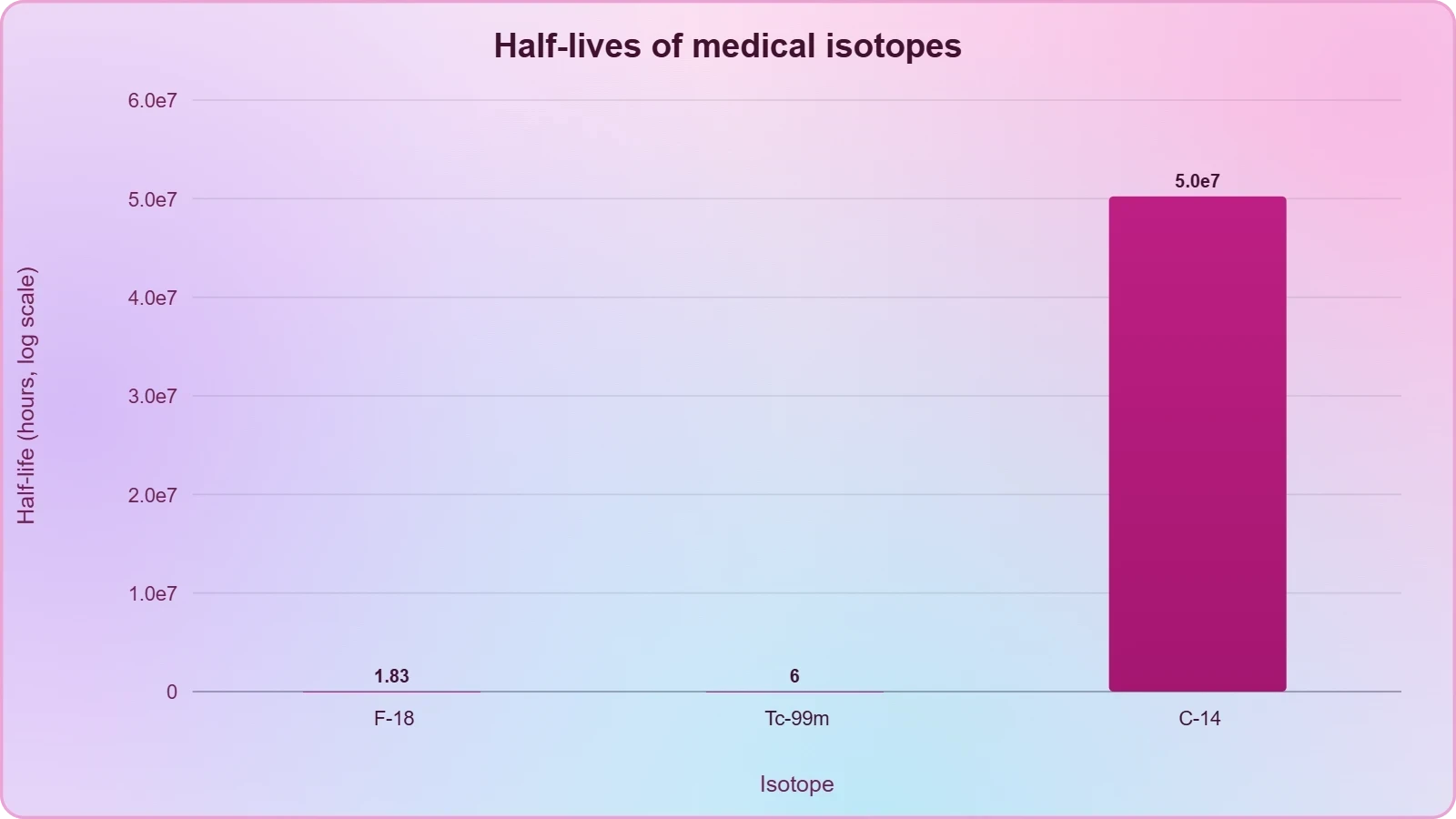
Technetium-99m, a metastable isotope, powers the majority of nuclear medicine scans worldwide. Its short half-life of six hours and gamma emission make it ideal for imaging without prolonged radiation exposure. Positron emission tomography similarly relies on fluorine-18, a neutron-deficient isotope produced in cyclotrons.
Boron neutron capture therapy offers a targeted cancer treatment, exploiting boron-10's high affinity for thermal neutrons. When boron-10 captures a neutron, it releases alpha particles that destroy nearby tumor cells. The technique spares healthy tissue because the reaction range is comparable to a single cell diameter.
Geology, Archaeology, and Environmental Tracing
Uranium-lead dating extends geological chronology to billions of years, calibrating the age of Earth itself. Potassium-argon dating proved instrumental in establishing early hominin timelines in East Africa. Stable isotope ratios of oxygen and carbon reconstruct ancient climates and diets with remarkable fidelity.
Neutron activation analysis identifies trace elements by bombarding samples with neutrons and measuring induced radioactivity. The method detects parts-per-billion concentrations without destroying the sample, making it invaluable for art authentication and forensic investigation. Environmental scientists use isotope ratios to trace pollution sources and groundwater movement.
Frequently Asked Questions About Neutrons and Isotopes
Readers encountering isotope science for the first time often share a cluster of recurring questions. This section addresses the most common ones directly, clarifying misconceptions about neutron behavior, isotope stability, and the reliability of radiocarbon dating. Each answer is concise but grounded in the physics established earlier.
Do Isotopes Behave Differently in Chemical Reactions?
Isotopes of the same element share nearly identical chemistry because electron configurations are unchanged. However, heavier isotopes react slightly more slowly, a phenomenon called the kinetic isotope effect. This subtle difference enables isotope labeling in metabolic studies and reaction mechanism investigations.
The effect scales with mass ratio, so hydrogen isotopes show the largest contrast. Deuterium substitution can slow reactions by factors of five to ten, a fact exploited in drug design to extend metabolic stability. For heavier elements, the effect is usually negligible outside precision research.
Why Does Carbon-14 Dating Fail Beyond 50,000 Years?
After roughly nine half-lives, less than 0.2 percent of original carbon-14 remains, approaching detection limits. Background radiation and trace contamination then dominate the measurement, making ages statistically unreliable. Older samples require alternative chronometers such as uranium-thorium or optically stimulated luminescence.
Sample contamination is the practical enemy of radiocarbon dating. A fingerprint's worth of modern carbon can make an ancient sample appear dramatically younger. Laboratories therefore enforce rigorous handling protocols, and reported ages always include uncertainty ranges reflecting these constraints.
Precision, Uncertainty, and the Future of Isotope Science
Modern isotope science is defined less by discovery than by precision, with measurement uncertainties now measured in parts per million. Accelerator mass spectrometry, laser spectroscopy, and resonance ionization push detection limits ever lower. These advances expand the reach of isotope techniques into forensics, climate reconstruction, and nuclear safeguards.
Error Analysis in Radiometric Measurements
Every radiocarbon age carries a statistical uncertainty derived from counting statistics and calibration. A typical reported age might read ##[3{,}200 \pm 40]## years before present, where the range reflects one standard deviation. Combining independent measurements reduces uncertainty by the square root of the sample count.
Systematic errors, including contamination and calibration offsets, often dominate statistical ones. Laboratories therefore report both internal and external error estimates, allowing researchers to assess reliability. Rigorous error propagation ensures that chronological conclusions remain defensible under scrutiny.
Emerging Frontiers and Ethical Considerations
Compact neutron sources and portable mass spectrometers are democratizing isotope analysis beyond specialized facilities. Climate scientists use isotope ratios in ice cores to reconstruct temperature histories spanning hundreds of millennia. Nuclear forensics applies isotope signatures to trace illicit materials and verify disarmament treaties.
These capabilities raise ethical questions about privacy, provenance, and dual-use research. Isotopic fingerprinting can identify individuals through hair and nail analysis, prompting debates about consent. Balancing scientific utility against civil liberties will shape the next generation of isotope policy and practice.
From our network :
- Trump Political Strategy How Geopolitical Stunts Serve As Media Diversions
- Analyzing Trump Deportation Numbers Insights Into The 2026 Immigration Crackdown
- Mastering DB2 LUW v12 Tables: A Comprehensive Technical GuideComprehensive guide on DB2 LUW v12 tables. Explore CREATE TABLE syntax, BLU Acceleration, range partitioning, data types, and security features for IBM DB2 LUW v12.
- Vite 6/7 'Cold Start' Regression in Massive Module GraphsIn-depth analysis of Vite 6/7 cold start regressions in massive module graphs. Learn about barrel file issues, pre-bundling optimizations, and how to improve Vite dev server performance.
- AI-Powered 'Precision Diagnostic' Replaces Standard GRE Score ReportsDiscover the new GRE Precision Diagnostic. Learn how AI-powered behavioral analytics and time-to-solve tracking are replacing standard GRE score reports to empower students.
- EV 2.0: The Solid-State Battery Breakthrough and Global Factory ExpansionDiscover the impact of the Solid-State Battery Breakthrough on the EV market. Learn about CATL and BYD stock growth, global factory expansion in Europe, and the future of EV 2.0 technology.
- 98% of Global MBA Programs Now Prefer GRE Over GMAT Focus EditionExplore why 98% of global MBA programs now prefer the GRE over GMAT Focus. Learn about the shorter GRE format, verbal logic importance, and strategic versatility for students.
- Mastering DB2 12.1 Instance Design: A Technical Deep Dive into Modern Database ArchitectureComprehensive guide to DB2 12.1 Instance Design. Explore architectural components, HADR setup, buffer pool tuning, and security policies for IBM DB2 12.1. Includes 10 functional SQL and Shell samples.
- 10 Physics Numerical Problems with Solutions for IIT JEEPrepare for IIT JEE with 10 physics numerical problems, complete with detailed solutions and conceptual explanations. Ideal for mastering kinematics, thermodynamics, electromagnetism, and optics.
RESOURCES
- DOE Explains...Isotopes - Department of Energyenergy.gov3 days ago ... ... carbon 13, which has 7 neutrons, and carbon 14, which has 8 neutrons. Every element has its own number…
- What are Isotopes? | IAEAiaea.orgAug 19, 2022 ... For example, the naturally occurring isotope carbon-14 present in water is used to understand the age of water and other…
- Radiocarbon dating - Antarctic Glaciersantarcticglaciers.orgRadiocarbon dating works because an isotope of carbon, 14C, is constantly ... carbon isotopes with solar radiation and free neutrons. Living organisms ...
- What is Radiocarbon Dating? - NOSAMSwww2.whoi.edu... neutrons, one is said to be an "isotope" of the other. Carbon-13 and carbon-14 are thus isotopes of carbon-12. Isotopes participate in the…
- Education - Stable Isotopes NOAA GMLgml.noaa.govThe rare carbon-14 (14C) isotope contains eight neutrons in its nucleus. Unlike 12C and 13C, this isotope is unstable, or radioactive. Over time, a…
- Carbon-14 - Wikipediaen.wikipedia.orgCarbon-14, C-14, 14C or radiocarbon, is a radioactive isotope of carbon with an atomic nucleus containing 6 protons and 8 neutrons. Carbon-14 was discovered ...
- Isotopes | Biology for Non-Majors I - Lumen Learningcourses.lumenlearning.comCarbon-12, the most common isotope of carbon, contains six protons and six neutrons. ... carbon dating. Carbon-14 (14C) is a naturally occurring ...
- Carbon-14 | Dating, Mass, & Half-life - Britannicabritannica.comOct 2, 2026 ... The carbon-14 nucleus has six protons and eight neutrons, for an atomic mass of 14. The isotope also is used…
- Radioactive dating - The Australian Museumaustralian.museumSep 30, 2020 ... Radioactive dating is a method of dating rocks and minerals using radioactive isotopes ... neutrons balance, the atom becomes stable.…
- Isotope, what to remember - Oranoorano.groupCarbon-14 is considered an unstable isotope. It decays and emits radioactivity in the form of beta rays. It has a total of 14 nucleons…
- Carbon-14 dating, explained - UChicago Newsnews.uchicago.eduFirst developed in the late 1940s at the University of Chicago by Willard Libby, the technique is based on the decay of the carbon-14…
- What are Radioisotopes? - ANSTOansto.gov.auCarbon-14 has 6 protons and 8 neutrons ... Our bodies naturally contain radioisotopes of carbon, such as carbon-14, along with stable isotopes of carbon,…
- Relative and Absolute Dating | NC Archaeologyarchaeology.ncdcr.govApr 14, 2021 ... All isotopes of carbon have 6 protons but different numbers of neutrons. One of the carbon isotopes that occurs in…
- Radiocarbon Dating Understood - Texas Beyond Historytexasbeyondhistory.netAll carbon isotopes have six protons, but the number of neutrons varies—13C has seven neutrons, and 12C has six. The radiocarbon dating method, the…
- 'Perhaps the most important isotope': how carbon-14 revolutionised ...theguardian.comAug 10, 2019 ... Crucially, those two extra neutrons make the nucleus of a carbon-14 atom unstable so that it decays radioactively into an…