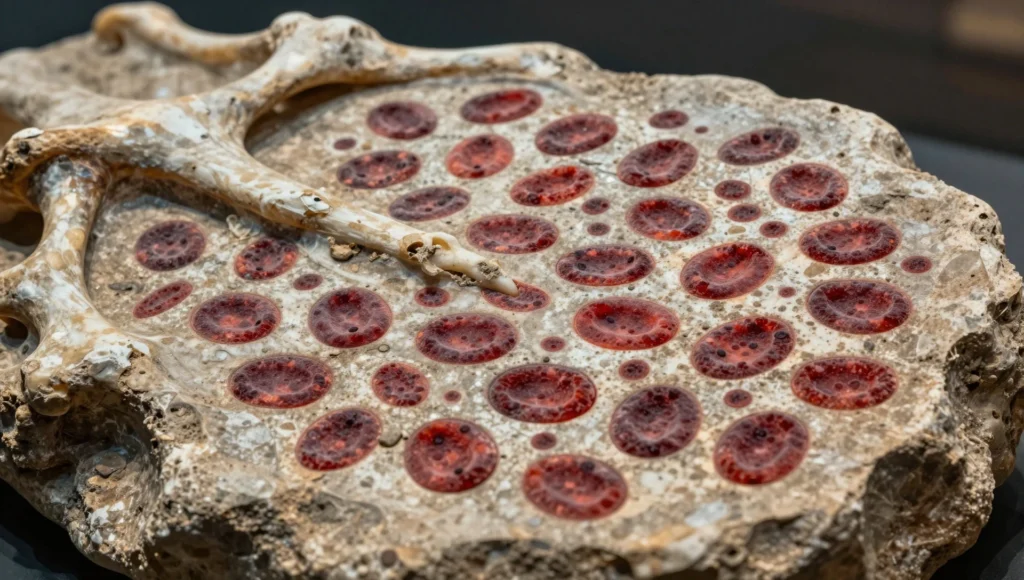
A small meat-eating dinosaur that stalked the floodplains of what is now north-eastern Brazil some 115 million years ago has become the centre of an unusually heated scientific argument. Researchers led by Prof Kliti Grice at Curtin University in Western Australia report that the leg bone of Aratasaurus contains microscopic structures resembling fossilised red blood cells, together with chemical signatures of heme — the iron-bearing compound that allows haemoglobin to ferry oxygen through the bloodstream. The work, published in the Proceedings of the National Academy of Sciences, was recovered from a mine in 2008 and is curated at the National Museum of Brazil.
The claim matters far beyond a single specimen. If the interpretation holds, palaeontology gains a mineral and molecular window into dinosaur physiology — blood chemistry, metabolic rate, perhaps even activity levels — rather than merely the shape of bones. Yet the announcement has been met with measured scepticism from researchers who have spent decades hunting soft tissue in deep time. The dispute is not about whether something unusual sits inside the fossil, but about what that something actually is, and how much biology can legitimately be read from mineral casts that have spent more than a hundred million years underground.
What follows examines the evidence on both sides, the chemistry that may have preserved these structures, and the wider question of how long original organic material can survive. It also considers why the boundary between a striking observation and a confirmed discovery is so difficult to police in fossil science, and what the answer would mean for museum collections holding specimens nobody has yet thought to examine closely.
On This Page
- The Anatomy of a Contested Discovery
- The Sceptical Counterargument
- Chemistry, Mineralisation and the Limits of Inference
- Why Deep-Time Preservation Remains So Difficult
- Implications for Dinosaur Physiology and Museum Collections
- How the Scientific Community Weighs Extraordinary Claims
- Reading the Fossil Record with New Instruments
- What the Dispute Teaches About Evidence
- Frequently Asked Questions
The Anatomy of a Contested Discovery
The fossil in question belongs to Aratasaurus museunacionali, a modest theropod whose remains were extracted from a limestone mine in Ceará and later accessioned by the National Museum of Brazil. Under an electron microscope, the Curtin-led team observed small, round structures clustered inside narrow channels where blood vessels once ran through the bone matrix. These are precisely the locations where one would expect blood to have circulated in a living animal, which is part of why the team found the distribution compelling rather than random.
What the Microscope Revealed
The structures appeared as discrete, roughly circular bodies occupying vascular canals, the microscopic tunnels that once housed capillaries and larger vessels. Their placement is anatomically coherent: blood cells do not ordinarily accumulate in bone tissue except within the vasculature that supplies it. Grice's team argues that this spatial logic, combined with the uniformity of the shapes, distinguishes the objects from incidental mineral grains or contamination introduced during excavation and storage.
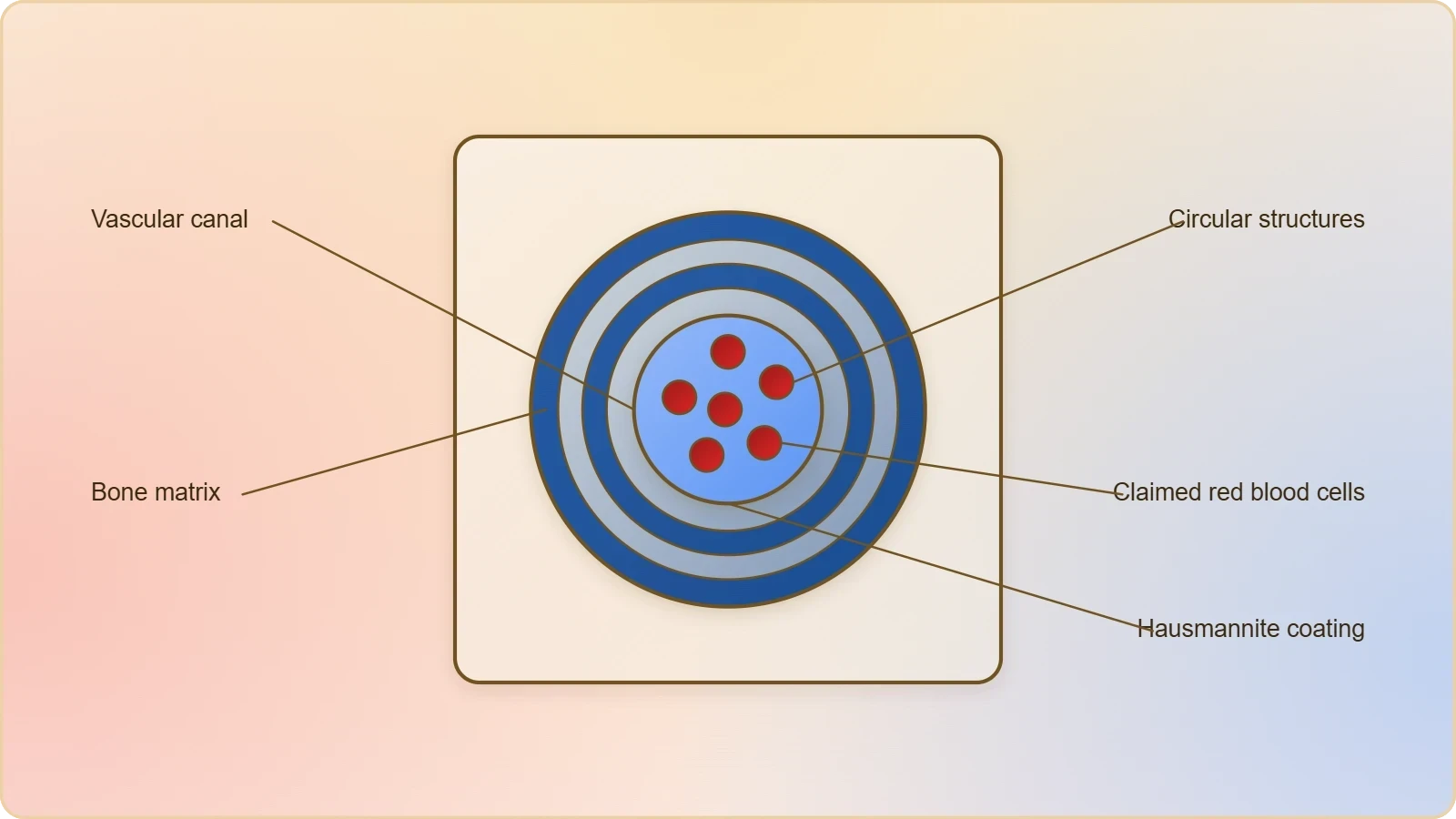
Chemical analysis strengthened the case. Tests returned positive signals for heme and its degradation products, alongside traces of amino acids that form the building blocks of collagen, the structural protein abundant in connective tissue and bone. Collagen preservation is itself a recognised phenomenon in exceptional fossils, so its presence alongside a heme signature gave the researchers a coherent chemical story rather than an isolated anomaly.
The Role of Hausmannite
Grice proposed that a manganese compound called hausmannite, which formed in and around the structures, may have stabilised them before fossilisation could erase their shape. Mineral encapsulation of this kind is a familiar mechanism in exceptional preservation: reactive iron and manganese species can catalyse the cross-linking of organic molecules and later template mineral growth, effectively freezing cellular architecture in place while the surrounding tissue decays.
This hypothesis is chemically plausible and fits a broader pattern in which iron-rich environments preserve soft tissue detail. The reasoning is that hausmannite acted as a scaffold, replacing or coating the original material at a scale fine enough to retain cell-like morphology. Whether that mechanism operated here, and whether it preserved genuine cellular remnants rather than merely their impressions, remains the crux of the disagreement.
The Sceptical Counterargument
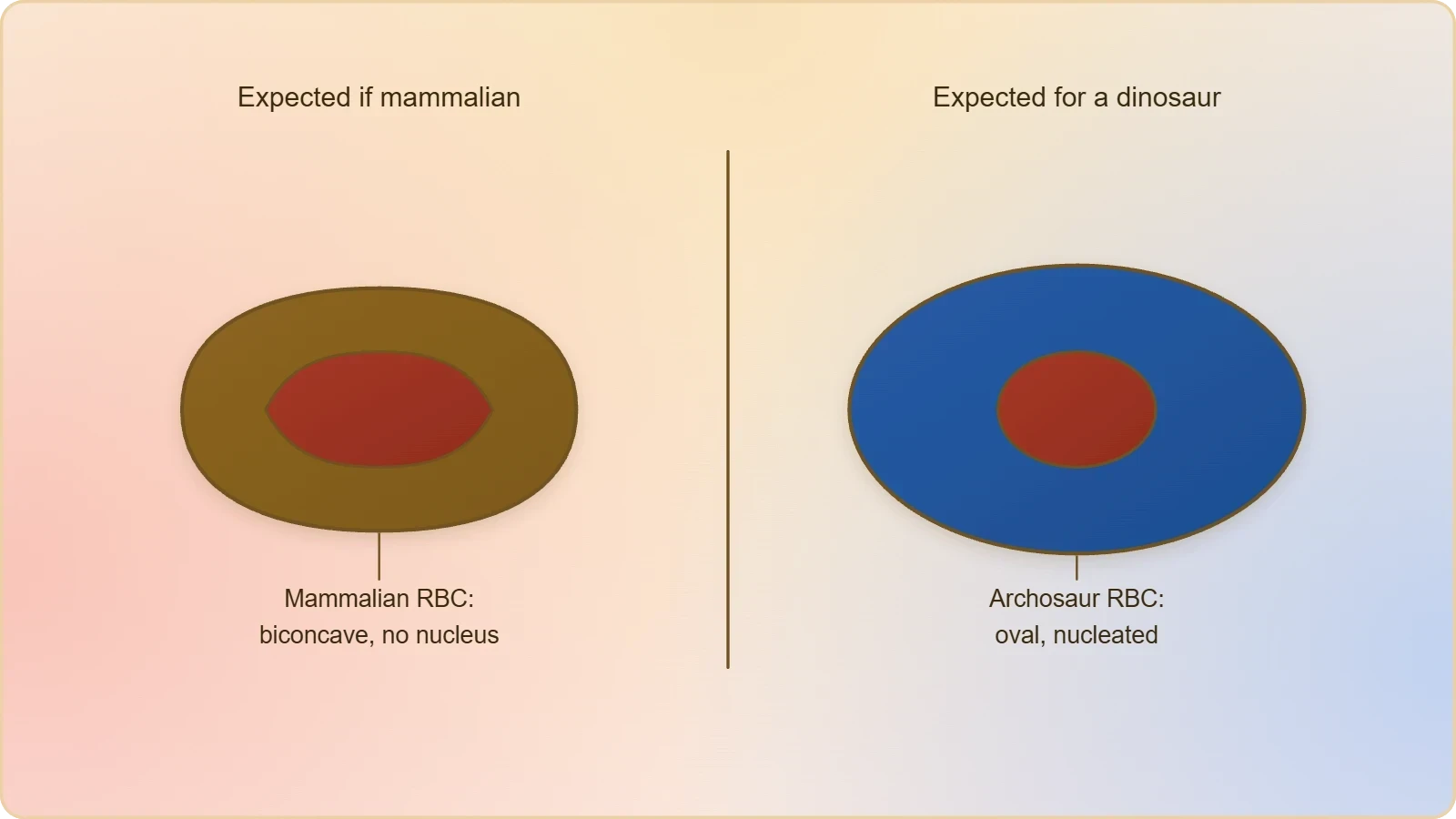
Prof Mary Schweitzer of North Carolina State University, whose own work on dinosaur soft tissue helped open this field, is unconvinced that the structures are red blood cells. Her objection is morphological and specific. Dinosaur red blood cells, like those of modern birds and many reptiles, are nucleated, and the nucleus produces a characteristic bulge that gives the cell a dome-like profile on both faces. The objects reported from Aratasaurus, by contrast, appear concave.
Shape as Evidence
That distinction is not trivial. Concavity is the signature of mammalian red blood cells, which lack a nucleus and adopt a biconcave disc shape to maximise surface area. A dinosaur, sitting on the archosaur line that gave rise to birds, should not produce mammalian-style erythrocytes. If the structures are genuinely concave, the morphological case for identifying them as dinosaur blood cells weakens considerably, and alternative explanations gain ground.
Schweitzer was more receptive to the chemical findings, acknowledging that the heme and collagen amino acid evidence carries weight. This split verdict is instructive: it shows that a discovery can be partially credible without being wholly accepted. The chemistry may reflect genuine biomolecular remnants while the morphological identification remains open, and conflating the two would overstate what the data support.
The Million-Year Assumption Under Strain
Underlying the debate is a long-held assumption that original organic material disappears within a million years or less. Schweitzer noted that this view is being challenged as new techniques are applied to fossils, and that each advance forces a re-examination of decay kinetics. The intellectual stakes are therefore larger than one specimen: accepting deep-time preservation requires revising models of how proteins, lipids and pigments degrade in mineralised environments.
Grice herself urged caution, stating plainly that the work does not mean large biological molecules such as proteins or DNA survive in ancient fossils, and that extraordinary claims demand extraordinary evidence. That restraint is scientifically appropriate. The team is claiming structures and chemical echoes, not intact biomolecules, and the distinction should govern how the result is reported and how far the interpretation is pushed.
Chemistry, Mineralisation and the Limits of Inference
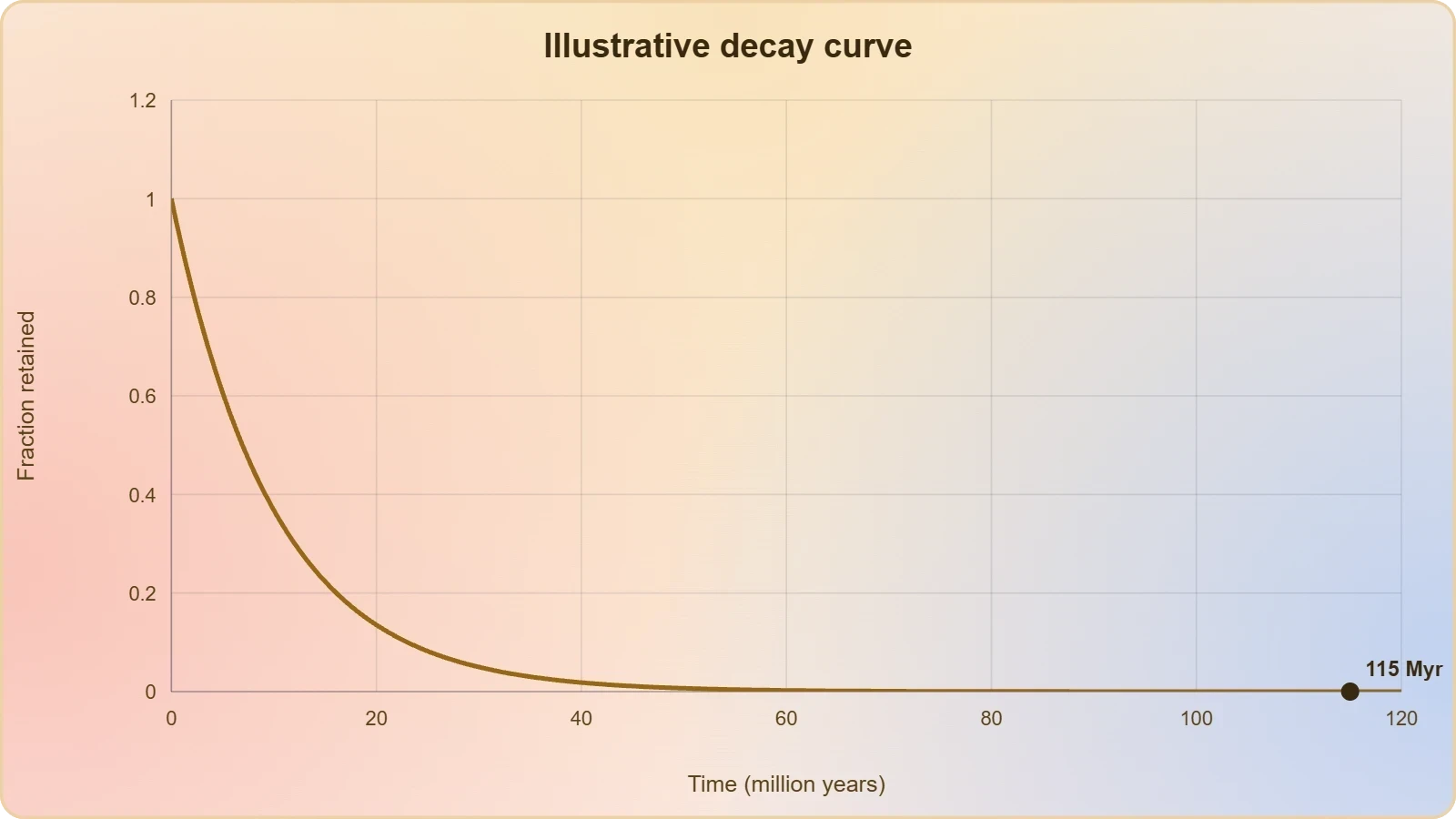
To evaluate the claim properly, it helps to quantify what "preservation" actually means at the molecular scale. Organic matter in bone does not persist unchanged; it undergoes hydrolysis, oxidation and microbial attack, and what remains is typically a cross-linked, mineral-associated residue. Estimating survival requires modelling decay as a first-order process, where the fraction remaining after time ##[t]## is governed by a rate constant ##[k]## characteristic of the tissue and environment.
For a fossil aged ##[t = 1.15 \times 10^{8}]## years, even a very slow rate constant produces vanishingly small survival fractions. Taking an illustrative ##[k = 10^{-7}\ \text{yr}^{-1}]##, the retained fraction is ##[e^{-11.5} \approx 1.0 \times 10^{-5}]##, or roughly one part in one hundred thousand. This arithmetic explains why claims of original tissue are treated with such caution: the default expectation is near-total loss, and any survival requires a protective mechanism.
Mineral templating is precisely such a mechanism. When hausmannite or iron oxyhydroxides precipitate around decaying cells, they can immobilise fragments and shield them from enzymatic attack, effectively lowering ##[k]## by orders of magnitude. The chemistry reported by the Curtin team is consistent with this scenario, but consistency is not proof, and the morphological objection remains unresolved.
Why Deep-Time Preservation Remains So Difficult
Bone is an unusually hospitable matrix for organic remnants because its mineral phase, carbonated hydroxyapatite, can occlude proteins within crystal lattices. Collagen fibrils interwoven with mineral crystals may survive in protected pockets long after exposed tissue has vanished. This is why collagen peptides have been recovered from specimens tens of millions of years old, and why the Curtin team's collagen signal is among the less controversial elements of their report.
The Decay Clock and Its Exceptions
Standard decay models treat biomolecular loss as inexorable, with rates accelerated by heat, water and microbial activity. Cold, dry, anoxic settings slow the clock dramatically, which is why permafrost and cave deposits yield far older organics than tropical sediments. A Brazilian limestone from the Cretaceous is not an obvious candidate for exceptional preservation, which makes the claim bolder and the burden of proof correspondingly heavier.
Exceptions arise when minerals precipitate early and seal the tissue. Iron-driven cross-linking, phosphate templating and manganese oxide encapsulation all appear in the preservation literature. Each mechanism buys time, sometimes millions of years, by converting soft tissue into a mineral replica before hydrolysis can complete its work. The question is whether such a replica can retain enough original chemistry to justify calling it blood.
What Would Settle the Question
Resolution would require independent replication by other laboratories, ideally on different specimens and with multiple analytical techniques converging on the same conclusion. Immunological assays, mass spectrometry of peptide fragments, and higher-resolution imaging of internal structure would all help. A single study, however carefully executed, cannot carry a claim this large on its own, and the researchers themselves acknowledge as much.
Comparative work on modern archosaur blood would also sharpen expectations. Establishing precisely how avian and crocodilian erythrocytes mineralise under laboratory conditions would give palaeontologists a reference against which fossil structures could be judged. Without such baselines, morphological arguments risk circularity, with each side interpreting ambiguous shapes according to prior expectation rather than independent criteria.
Implications for Dinosaur Physiology and Museum Collections
Should the identification be confirmed, the consequences for dinosaur biology would be substantial. Blood chemistry informs metabolic rate, thermoregulation and activity patterns, questions that bone shape alone cannot answer. Heme signatures, if reliably tied to original blood, could offer a proxy for oxygen-carrying capacity, and by extension for whether a given theropod was built for sustained pursuit or short bursts of speed.
Reading Metabolism from Molecules
Metabolic inference from fossils is normally indirect, resting on bone histology, growth rates and limb proportions. Molecular evidence would add an independent axis of inference, potentially resolving long-running debates about endothermy in non-avian dinosaurs. Even a crude estimate of haemoglobin concentration or erythrocyte dimensions would constrain the space of plausible physiologies, and the value of that constraint is difficult to overstate.
Caution is warranted, however, because the inferential chain is long. From a mineral cast to a cell, from a cell to a blood chemistry, and from a blood chemistry to a whole-animal metabolic rate, each link introduces uncertainty. The responsible framing is that such evidence would open avenues rather than close questions, and that its interpretation would be contested for years before any consensus emerged.
The Wider Collection Problem
The finding also raises a practical question for museums worldwide. If biological material can persist in fossils far longer than assumed, then existing collections may hold unrecognised evidence simply because nobody has looked with the right instruments. Specimens collected decades ago and stored in drawers could become scientifically valuable in entirely new ways, which argues for careful curation and for funding analytical access to historical collections.
That prospect carries ethical and logistical weight. Destructive sampling competes with preservation, and museums must balance the value of analysis against the irreplaceability of specimens. The debate over Aratasaurus therefore touches on stewardship as much as on science, reminding institutions that their holdings are not static archives but latent research materials whose significance may only become apparent with future techniques.
How the Scientific Community Weighs Extraordinary Claims
The Aratasaurus episode is a case study in how palaeontology adjudicates claims that push against established expectations. The discipline has been here before: initial reports of dinosaur soft tissue were met with disbelief, then partial acceptance, then a gradual recalibration of what fossils can retain. Each cycle follows a recognisable pattern of publication, challenge, replication attempt and eventual synthesis, and the current dispute fits that template closely.
Peer Review as a Starting Point
Publication in a prestigious journal signals that reviewers found the methods defensible, not that the conclusions are settled. Peer review evaluates whether the analysis was performed competently and whether the claims are proportionate to the data. It cannot substitute for independent replication, and in contentious areas the gap between acceptance and consensus can persist for years while other laboratories attempt to reproduce or refute the findings.
The public reception often collapses this distinction, treating publication as confirmation. That tendency is unhelpful, because it forces researchers into defensive postures and discourages the cautious language that good science requires. Grice's own explicit caveats about DNA and protein survival are a model of appropriate hedging, and they deserve as much attention as the headline finding itself.
What Consensus Would Require
Genuine consensus would need convergent evidence from multiple specimens, multiple laboratories and multiple techniques. It would also require a mechanistic account of preservation that predicts where such remnants should and should not be found. Until then, the finding sits in a productive limbo, generating hypotheses and prompting re-examination of museum collections, which is arguably how science is supposed to work.
The dispute is therefore not a failure of the scientific process but a demonstration of it. Two respected researchers can examine the same structures and reach different conclusions because the evidence is genuinely ambiguous at the current resolution. That ambiguity is the frontier, and the work required to resolve it will likely teach palaeontologists more about fossil preservation than a quick verdict ever could.
Reading the Fossil Record with New Instruments
Advances in analytical chemistry have repeatedly rewritten the limits of what fossils can yield. Mass spectrometry now detects trace organics at concentrations unthinkable a generation ago, and synchrotron imaging resolves internal structure without destructive sampling. These tools are why the million-year assumption is under strain, and why collections assembled under older paradigms may hold surprises that their curators never anticipated.
Instrumentation as Discovery Engine
Electron microscopy revealed the vascular structures in Aratasaurus; chemical assays identified heme and collagen signatures. Neither technique is novel, but their combination on a well-preserved specimen produced a result that neither alone could support. This pattern recurs across palaeontology: discoveries often follow methodological convergence rather than a single breakthrough, and the integration of imaging with chemistry is where much current progress lies.
The lesson for research strategy is that investment in analytical infrastructure pays dividends across disciplines. A laboratory capable of probing fossil chemistry serves palaeontology, archaeology and geobiology simultaneously, and the marginal cost of examining one more specimen is small compared with the potential return. Funding agencies that treat such facilities as shared assets tend to see disproportionate scientific output.
Open Questions and Future Work
Several questions remain unanswered. Do other Aratasaurus specimens show the same structures? Can the hausmannite stabilisation model be tested experimentally? What do modern archosaur blood cells look like after mineralisation under controlled conditions? Each question is tractable, and each would materially advance the debate beyond its current impasse of competing interpretations.
Until those questions are addressed, the prudent position is agnostic but interested. The chemical evidence is real and warrants follow-up; the morphological identification is contested and may not survive scrutiny. What is certain is that the fossil has already done useful work by forcing the field to articulate what would count as proof, and by reminding everyone that the boundary of the possible in fossil preservation is drawn by evidence, not assumption.
We Also Published
What the Dispute Teaches About Evidence
Beneath the technical details lies a broader epistemological point. The Aratasaurus debate illustrates how scientific claims are graded rather than simply accepted or rejected. Chemical evidence for heme and collagen sits at one level of confidence; morphological identification of cells sits at another; inferences about metabolism sit at a third. Conflating these levels produces confusion, while separating them allows a nuanced assessment that respects both the data and its limits.
Grading Confidence Honestly
Researchers who communicate with the public carry a responsibility to make these gradations visible. Headlines that announce "dinosaur blood found" flatten a complex result into a misleading certainty, and subsequent corrections rarely travel as far as the original claim. Grice's explicit caveats were an attempt to pre-empt this, and her caution deserves to be quoted as prominently as the finding itself.
The same discipline applies to sceptics. Schweitzer's morphological objection is specific and testable, not a blanket dismissal, and she acknowledged the strength of the chemical evidence. This is how productive disagreement looks: each party identifies precisely what would change their mind, and the field then knows what work to do next. Vague scepticism and vague enthusiasm are equally unhelpful.
The Long Arc of Fossil Chemistry
Whatever the fate of this particular claim, the trajectory is clear. Analytical techniques will continue to improve, older specimens will be re-examined, and the presumed limits of biomolecular preservation will keep shifting. Each generation of palaeontologists inherits a boundary drawn by the previous one and is expected to test it. The Aratasaurus bone is simply the latest test case in a long sequence.
For students and early-career researchers, the episode offers a practical lesson: the most interesting science often sits where evidence is ambiguous and consensus is absent. Learning to work in that space, to state confidence levels precisely and to design experiments that discriminate between competing interpretations, is more valuable than memorising settled conclusions. The dinosaur's blood cells, real or not, have already taught that much.
Frequently Asked Questions
Readers encountering this story often have the same handful of questions, and they deserve direct answers rather than hedged generalities. The most common concerns whether DNA was found (it was not), whether the discovery is confirmed (it is not), and what the practical significance would be if it were. Addressing these plainly helps separate what the study actually reports from what headlines have implied.
Clarifying Common Misconceptions
The study reports structures and chemical signatures, not living cells or intact biomolecules. No DNA was recovered, and the researchers explicitly disclaim any suggestion that genetic material survives. The heme signal indicates breakdown products consistent with blood chemistry, not functional haemoglobin. These distinctions are essential, because the gap between "chemical echo" and "biological material" is where most public misunderstanding originates.
Another frequent confusion concerns the age of the fossil. At roughly 115 million years, Aratasaurus is far older than the permafrost specimens that yield ancient DNA, and far younger than the oldest putative biomolecular traces. Context matters enormously in preservation science, and a result from a Cretaceous limestone cannot be extrapolated casually to other settings or other time periods.
What Comes Next
The immediate next step is independent replication. Other laboratories will attempt to image and analyse the specimen, and additional Aratasaurus material may be examined if available. Experimental work on modern archosaur blood mineralisation would provide a reference framework. Until such work appears, the finding remains an intriguing report rather than an established fact, and that status is entirely normal for a first-of-its-kind claim.
For the wider public, the takeaway is that science proceeds through exactly this kind of contested, iterative process. The disagreement between Grice and Schweitzer is not a scandal but a feature, and the eventual resolution will be more trustworthy precisely because it survived scrutiny. The dinosaur's blood, if blood it is, will be accepted only when the evidence is strong enough to silence reasonable doubt.
From our network :
- Vite 6/7 'Cold Start' Regression in Massive Module GraphsIn-depth analysis of Vite 6/7 cold start regressions in massive module graphs. Learn about barrel file issues, pre-bundling optimizations, and how to improve Vite dev server performance.
- AI-Powered 'Precision Diagnostic' Replaces Standard GRE Score ReportsDiscover the new GRE Precision Diagnostic. Learn how AI-powered behavioral analytics and time-to-solve tracking are replacing standard GRE score reports to empower students.
- EV 2.0: The Solid-State Battery Breakthrough and Global Factory ExpansionDiscover the impact of the Solid-State Battery Breakthrough on the EV market. Learn about CATL and BYD stock growth, global factory expansion in Europe, and the future of EV 2.0 technology.
- Mastering DB2 12.1 Instance Design: A Technical Deep Dive into Modern Database ArchitectureComprehensive guide to DB2 12.1 Instance Design. Explore architectural components, HADR setup, buffer pool tuning, and security policies for IBM DB2 12.1. Includes 10 functional SQL and Shell samples.
- Mastering DB2 LUW v12 Tables: A Comprehensive Technical GuideComprehensive guide on DB2 LUW v12 tables. Explore CREATE TABLE syntax, BLU Acceleration, range partitioning, data types, and security features for IBM DB2 LUW v12.
- Trump Political Strategy How Geopolitical Stunts Serve As Media Diversions
- 98% of Global MBA Programs Now Prefer GRE Over GMAT Focus EditionExplore why 98% of global MBA programs now prefer the GRE over GMAT Focus. Learn about the shorter GRE format, verbal logic importance, and strategic versatility for students.
- 10 Physics Numerical Problems with Solutions for IIT JEEPrepare for IIT JEE with 10 physics numerical problems, complete with detailed solutions and conceptual explanations. Ideal for mastering kinematics, thermodynamics, electromagnetism, and optics.
- Analyzing Trump Deportation Numbers Insights Into The 2026 Immigration Crackdown
RESOURCES
- Evidence of red blood cells seen in dinosaur fossil from Brazilreuters.com17 hours ago ... ... red blood cells preserved in limb bone material of the theropod dinosaur Aratasaurus. The image was released on November…
- Fossilised red blood cells found in 115m-year-old dinosaur's bone ...theguardian.com17 hours ago ... Fossilised red blood cells found in 115m-year-old dinosaur's bone, say scientists. Chemical tests on Aratasaurus bone identify presence of heme, ...
- Heme signatures in mineralized red blood cells within ... - PNASpnas.orgCellular structures and heme biomarkers typical of blood in the organic-rich Aratasaurus fossil ... Mineralized RBCs from dinosaurs have not previously ...
- Mineralised 'red blood cells' detected in 115-million-year-old ...abc.net.au17 hours ago ... An illustration of a dinosaur walking, then dead on a microbial mat and showing where. The Aratasaurus fossil comes from…
- Dinosaur red blood cells recovered from 115-million-year-old fossilnewscientist.com17 hours ago ... A bit of leg bone from an Aratasaurus dinosaur fossil collected in Brazil has preserved abundant 3D red blood cells…
- Dinosaur Blood Cells Detected in 115-Million-Year-Old Fossilsciencealert.com17 hours ago ... ... Fossil Microscope images of the fossil structures that appear to be red blood cells. ... Aratasaurus museunacionali, a small…
- Dinosaur blood—oldest discovery rewrites what fossils can reveal ...phys.org18 hours ago ... ... dinosaur known as Aratasaurus museunacionali ... While previous studies have reported possible red blood cell structures in fossils ...
- Scientists find red blood cells in dinosaur bone in "landmark discovery"discoverwildlife.com17 hours ago ... ... fossilised red blood cells in dinosaur bones is unheard of, until now. ... Aratasaurus museunacionali red blood cell. Credit:…
- Traces of dinosaur blood found in world-first discoverytheconversation.com17 hours ago ... A 115-million-year-old fossil dinosaur bone found in Brazil contains microscopic structures resembling red blood cells and molecular traces ...
- 115-Million-Year-Old Dinosaur Bones Preserve Chemical Traces of ...sci.news13 hours ago ... 115-Million-Year-Old Dinosaur Bones Preserve Chemical Traces of Red Blood Cells ... The fossilized remains belong to Aratasaurus museunacionali, a ...
- Did scientists just find 115-million-year-old dinosaur blood? | Sciencescience.org16 hours ago ... Researchers claim they finally found fossilized dinosaur red blood cells, but some remain skeptical ... Aratasaurus museunacionali, which ...
- A bit of leg bone from an Aratasaurus dinosaur fossil collected in ...facebook.com16 hours ago ... A bit of leg bone from an Aratasaurus dinosaur fossil collected in Brazil has preserved abundant 3D red blood cells…
- Evidence of Ancient Blood Found for the First Time in a 115-Million ...discovermagazine.com15 hours ago ... fossilized red blood cell. Heme and heme breakdown ... red blood cells preserved in limb bone material of the theropod…
- Incredible discovery of fossilized blood cells inside a dinosaur leg ...newatlas.com17 hours ago ... ... red blood cells preserved in limb bone material of the theropod dinosaur Aratasaurus. Victor O. Leshyk. Analysis of bone…
- Dinosaur blood – oldest discovery rewrites what fossils can reveal ...eurekalert.org17 hours ago ... An international research team has for the first time uncovered unequivocal evidence of fossilised red blood cells and amino acids…