On This Page
Understanding What the Statement Means
The sentence “real numbers are any number with a decimal expansion” is close to correct, but it is not the cleanest mathematical definition. In school mathematics, decimals are often used as representations of numbers, while in analysis, real numbers are defined more rigorously through completeness, limits, or Dedekind cuts.
A decimal expansion is a way of writing a number in base ten. For example, 4, 2.75, 0.333..., and 3.14159... are all decimal expressions. The important point is that decimal notation describes a number; it is not usually taken as the foundational definition of the number itself.
Decimal expansions as representations
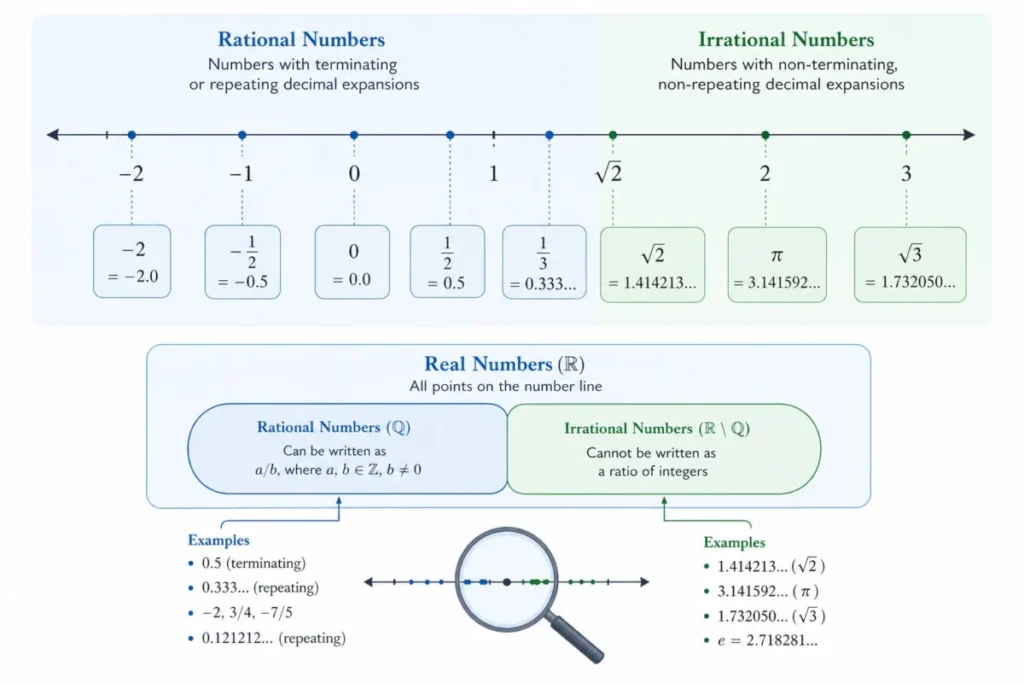
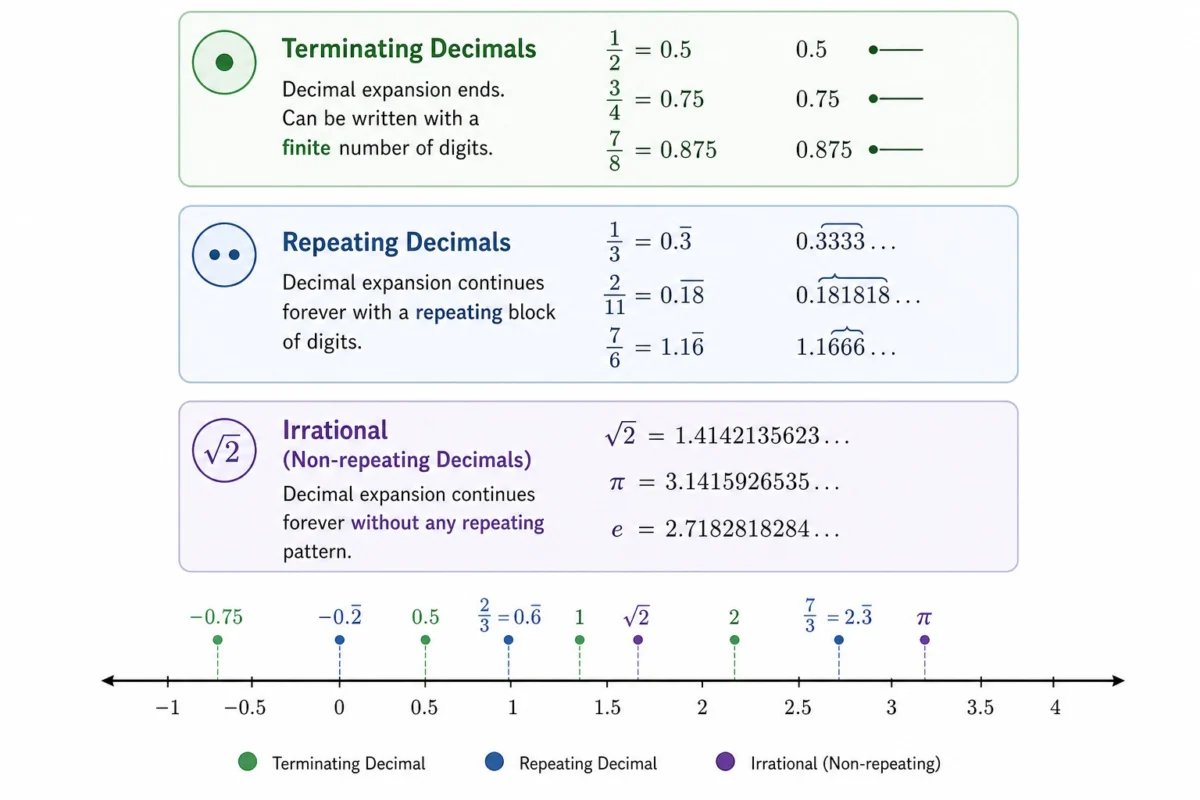
Every real number can be written in decimal form, possibly with infinitely many digits after the decimal point. Rational numbers appear as terminating or repeating decimals, while irrational numbers appear as non-terminating and non-repeating decimals. This makes decimal expansion a very practical and intuitive representation system.
Still, the statement becomes stronger and more accurate if reversed. Instead of saying real numbers are numbers with decimal expansions, mathematicians usually say that every real number has a decimal expansion. This avoids confusion between a notation system and the deeper structure of the real number system.
There is another subtle issue: some numbers have more than one decimal expansion. The classic example is ##1 = 0.999\ldots##. So decimal representation is powerful, but it is not always unique unless conventions are imposed carefully.
Which Decimals Represent Real Numbers?
To discuss the statement properly, one must distinguish finite decimals, repeating infinite decimals, and non-repeating infinite decimals. All three kinds correspond to real numbers. This is why the claim sounds persuasive: the full real line is captured by decimal notation when the notation is interpreted correctly.
A terminating decimal such as 7.25 is clearly real and also rational because it can be written as a fraction. In fact, ##7.25 = \frac{725}{100} = \frac{29}{4}##. Every terminating decimal has this property because a finite decimal always equals an integer over a power of ten.
Repeating and non-repeating cases
A repeating decimal such as 0.272727... is also rational. Its repeating block allows conversion into a fraction using algebraic manipulation. By contrast, a decimal such as 0.101001000100001... does not repeat periodically, so it can represent an irrational real number instead.
Problem 1:
Show that 0.333... is rational.

Let x = 0.333...
Then 10x = 3.333...
Subtract: 10x - x = 3
So 9x = 3, hence x = 1/3.
So the technically correct conclusion is this: every valid decimal expansion corresponds to a real number, and every real number can be expressed by a decimal expansion. That is the precise bridge between decimals and real numbers, without confusing notation with definition.
We Also Published
How Rational and Irrational Numbers Fit In
The set of real numbers consists of both rational and irrational numbers. Rational numbers are numbers that can be written as ##\frac{p}{q}## where ##p## and ##q## are integers and ##q \neq 0##. Irrational numbers cannot be written in that fractional form, even though they still have decimals.
This distinction is reflected directly in decimal behavior. A rational number has a decimal expansion that either terminates or eventually repeats. An irrational number has a decimal expansion that neither terminates nor repeats. This characterization is one of the most useful school-level tests for classifying real numbers.
Examples from familiar constants
The number ##\sqrt{2}## is irrational, and its decimal form begins as 1.41421356... without periodic repetition. The number ##\pi## behaves similarly. These numbers are real because they sit on the number line and arise naturally from geometry, limits, and measurement, even though their decimal digits continue indefinitely.
Problem 2:
Classify the following as rational or irrational:
(a) 2.125
(b) 0.121212...
(c) 3.010010001...

Answer:
(a) Rational, because it terminates.
(b) Rational, because it repeats.
(c) Irrational, because it is non-terminating and non-repeating.
One should therefore reject the oversimplified idea that decimals are only approximations. Some decimals are exact names for numbers. For example, 0.5 exactly equals ##\frac{1}{2}##, while 1.41421356 is only an approximation of ##\sqrt{2}## unless the infinite continuation is specified fully.
The Precise Conclusion and Common Pitfalls
The original statement is acceptable in an informal classroom conversation, but it is incomplete in a rigorous setting. A better wording is: real numbers are exactly the numbers represented by valid finite or infinite decimal expansions. This version emphasizes that the expansion must be mathematically well-defined.
A common pitfall is to think that only terminating decimals are “proper” numbers, while repeating decimals are somehow less exact. That is false. Repeating decimals are exact representations of rational numbers, and many familiar fractions naturally appear this way in base ten notation.
Uniqueness and equivalence issues
Another pitfall concerns uniqueness. Most real numbers have a unique decimal expansion, but some do not. Numbers with terminating decimals also admit a repeating-nine version. The standard identity is
, which follows from place-value structure and limit reasoning.
Problem 3:
Verify that 0.999... = 1.

Let x = 0.999...
Then 10x = 9.999...
Subtract: 10x - x = 9
So 9x = 9 and x = 1.
Therefore 0.999... = 1.
In conclusion, the statement is essentially correct if interpreted carefully. Decimal expansions provide a complete representation of the real numbers, including both rational and irrational values. The more precise mathematical claim is not merely that real numbers have decimals, but that decimal expansions and real numbers correspond in a well-defined way.
From our network :
- https://www.themagpost.com/post/trump-political-strategy-how-geopolitical-stunts-serve-as-media-diversions
- Mastering DB2 LUW v12 Tables: A Comprehensive Technical Guide
- EV 2.0: The Solid-State Battery Breakthrough and Global Factory Expansion
- Vite 6/7 'Cold Start' Regression in Massive Module Graphs
- 98% of Global MBA Programs Now Prefer GRE Over GMAT Focus Edition
- Mastering DB2 12.1 Instance Design: A Technical Deep Dive into Modern Database Architecture
- https://www.themagpost.com/post/analyzing-trump-deportation-numbers-insights-into-the-2026-immigration-crackdown
- AI-Powered 'Precision Diagnostic' Replaces Standard GRE Score Reports
- 10 Physics Numerical Problems with Solutions for IIT JEE
RESOURCES
- What is the difference between a keyword and a keyphrase? - Yoastyoast.com
- How to choose a focus keyphrase? - HubSpot Communitycommunity.hubspot.com
- Question regarding the focus keyphrase and Yoast SEO plugin.reddit.com
- [1704.06879] Deep Keyphrase Generation - arXivarxiv.org
- Yoast SEO recommends 4 words in the focus keyphrase section for ...reddit.com
- Keyphrase analysis - Smart Insightssmartinsights.com
- Deep Keyphrase Generation - ACL Anthologyaclanthology.org
- uclanlp/awesome-keyphrase-papers - GitHubgithub.com
- Automatic Keyphrase Extraction: A Survey of the State of the Artaclanthology.org
- What is key phrase extraction in Azure Language in Foundry Tools?learn.microsoft.com
- keyphrase-vectorizers - PyPIpypi.org
- Single Document Keyphrase Extraction Using Neighborhood ...cdn.aaai.org
- Improving unsupervised keyphrase extraction by modeling ...sciencedirect.com
- A new dataset for multilingual keyphrase generationproceedings.neurips.cc
- ml6team/keyphrase-extraction-distilbert-inspec - Hugging Facehuggingface.co


0 Comments