Quantitative genetics represents one of the most consequential expansions of Mendelian thinking, taking the discrete factors that Gregor Mendel tracked in pea plants and extending them to the continuous, smoothly varying traits that define most of the living world. Height, blood pressure, body mass index, grain yield, milk production, and susceptibility to diabetes all refuse to fall into tidy categories. They spread across a continuum, shaped by dozens, hundreds, or even thousands of genetic loci acting in concert with environmental circumstances. This lesson, the thirteenth in a fifteen-part course on the principles of inheritance and variation, examines how biologists moved from counting wrinkled and round seeds to modelling the statistical architecture of complex traits.

The material here builds deliberately on the preceding lesson on genomic imprinting and epigenetics, which established that gene expression can be modified without altering the underlying sequence. Quantitative genetics takes that insight further by asking how inherited variation distributes itself across whole populations rather than within single families. You will encounter the distinction between Mendelian and complex traits, the concept of heritability and the persistent misreadings that surround it, the logic and limitations of genome-wide association studies, and the emerging clinical promise of polygenic risk scores. Each idea connects classical transmission genetics to the statistical and genomic tools that define contemporary biology.
Because no single reference text anchors this lesson, the treatment draws on widely accepted findings from the genetics literature and the consensus positions of the research community. The aim is conceptual clarity rather than exhaustive enumeration: you should leave able to explain why a trait like height has no single "height gene," why heritability is a population statistic rather than a personal destiny, and why the diversity of study populations matters enormously for the future of genomic medicine. These competencies prepare you directly for the next lesson on genetic counselling and prenatal diagnosis, where quantitative reasoning becomes a clinical necessity.
On This Page
From Discrete Factors to Continuous Variation
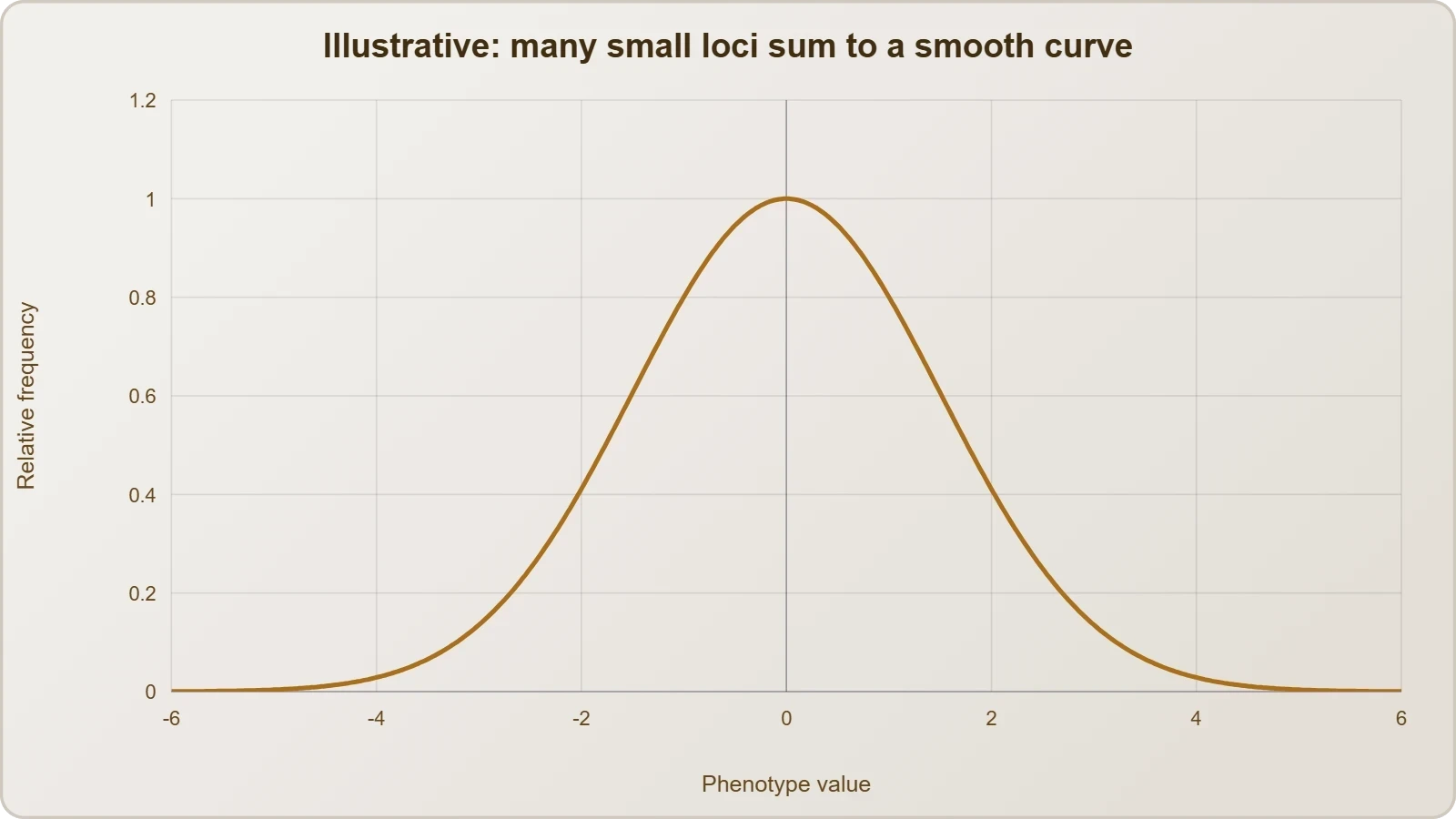
Mendel's genius lay in choosing traits with unambiguous alternatives. A pea seed was either round or wrinkled, a flower either purple or white. This experimental design allowed him to count discrete classes and derive the elegant ratios that founded genetics. Yet Mendel himself suspected that some traits might behave differently, and his successors quickly confirmed it. When continuous characters such as human stature or wheat kernel colour were examined, they produced bell-shaped distributions rather than clean 3:1 ratios, and the early biometricians who studied them initially clashed with the Mendelians over whether inheritance was particulate or blending.
The reconciliation, achieved in the early twentieth century, was conceptually decisive. If many Mendelian factors each contribute a small increment to a trait, and if environmental noise adds further variation, the aggregate outcome is a continuous, approximately normal distribution. Ronald Fisher's 1918 paper demonstrating that the correlations among relatives could be explained by large numbers of Mendelian loci of small effect effectively merged the two traditions. Quantitative genetics was born from that synthesis, and it remains the framework within which modern complex-trait analysis operates.
Defining Mendelian Versus Complex Traits
A Mendelian trait is governed principally by alleles at a single locus, producing distinct phenotypes that segregate in predictable ratios. Cystic fibrosis, sickle cell anaemia, and Huntington's disease are canonical examples: a pathogenic variant in one gene, inherited according to clear dominant or recessive patterns, yields a recognisable clinical entity. The genotype-to-phenotype mapping is strong, and family pedigrees often reveal the mode of transmission directly. Such traits are sometimes called monogenic or simple, though even these conditions show variable expressivity and incomplete penetrance that hint at modifying factors.
Complex traits, by contrast, arise from the combined action of many genetic variants, each of modest effect, interacting with one another and with environmental exposures. No single locus is necessary or sufficient. Type 2 diabetes, schizophrenia, hypertension, and educational attainment all fall into this category. Their inheritance does not follow simple ratios, and their familial clustering reflects shared genes and shared environments simultaneously. Distinguishing the two categories is not merely academic taxonomy; it determines which experimental designs, statistical methods, and clinical interpretations are appropriate.
The Polygenic Architecture of Continuous Characters
Polygenic inheritance describes the situation in which multiple genes contribute additively to a phenotype. A useful heuristic is the number of contributing loci and the size of each effect. Early models assumed a handful of loci with roughly equal effects, but empirical data revealed a far more skewed architecture. Most complex traits are influenced by a few loci of relatively large effect and a long tail of many loci with tiny effects, a pattern sometimes described as an infinitesimal model with outliers. This distribution of effect sizes has profound implications for gene discovery.
Environmental variance compounds the picture. Two individuals with identical polygenic scores can differ markedly in phenotype because of diet, physical activity, infection history, or stochastic developmental events. The phenotype ##P## can be decomposed conceptually as ##P = G + E + (G \times E)##, where ##G## is the genetic contribution, ##E## the environmental contribution, and the interaction term captures context-dependent effects. This decomposition underpins virtually every quantitative genetic analysis and reminds us that genes do not act in a vacuum.

Heritability: What It Measures and What It Does Not
Heritability is among the most frequently cited and most frequently misunderstood quantities in genetics. In its broad sense, heritability (##H^2##) is the proportion of total phenotypic variance attributable to genetic variance: ##H^2 = V_G / V_P##, where ##V_P = V_G + V_E##. In its narrow sense, ##h^2## considers only additive genetic variance, which is the component that responds to selection and predicts resemblance between relatives. Both are properties of a specific population in a specific environment at a specific time, not immutable constants of a trait or a species.
The statistic is estimated through twin studies, family designs, and increasingly through genomic methods such as SNP-based heritability. Each approach carries assumptions that can inflate or deflate estimates. Identical twins share both genes and, often, more similar environments than fraternal twins, which can bias classical estimates upward. Genomic approaches capture only the variance tagged by measured variants and therefore typically yield lower values than pedigree-based methods, a gap that has prompted extensive methodological debate.
Common Misconceptions About Heritability
The most persistent error is interpreting a heritability of 0.8 as meaning that 80 percent of an individual's trait is genetic. This is a category mistake. Heritability describes variance within a population, not the causation of any single phenotype. A trait can be highly heritable in one environment and have near-zero heritability in another if environmental conditions are uniform. The classic illustration involves identical genotypes raised under radically different nutritional regimes, where phenotypic differences are overwhelmingly environmental despite perfect genetic similarity.
A second misconception treats high heritability as evidence of immutability. Traits with substantial genetic variance often respond dramatically to environmental intervention. Myopia is highly heritable, yet its prevalence has risen sharply in populations that adopted intensive near-work and reduced outdoor time, demonstrating that environmental change can shift the mean without altering the heritability estimate. Similarly, heritability says nothing about differences between groups; a within-group statistic cannot be transposed to explain between-group variation, a point that has generated considerable confusion in public discourse.
Partitioning Genetic and Environmental Variance
Formal variance partitioning extends the simple ##V_P = V_G + V_E## model to include dominance variance, epistatic interaction variance, and genotype-by-environment interaction. The full expression becomes ##V_P = V_A + V_D + V_I + V_E + V_{G \times E}##, where the subscripts denote additive, dominance, interaction, environmental, and interaction components respectively. Each term can be estimated with appropriate designs, though separating them reliably requires large samples and careful control of confounding.

Understanding this partition matters practically. Additive variance determines the response to selection in breeding programmes, which is why animal and plant breeders rely on narrow-sense heritability when designing improvement schemes. Interaction variance, by contrast, warns that the effect of a genotype may depend on context, complicating both prediction and intervention. Modern quantitative genetics therefore treats variance components as a structured description of a population's genetic architecture rather than a fixed property of a gene.
Genome-Wide Association Studies
Genome-wide association studies transformed the search for complex-trait loci. Rather than following a candidate gene hypothesis, a GWAS surveys hundreds of thousands to millions of single nucleotide polymorphisms (SNPs) across the genome in thousands of individuals, testing each variant for statistical association with a trait or disease. The design is hypothesis-free in the sense that it does not privilege any prior biological candidate, allowing unexpected pathways to emerge. The first major successes arrived in 2005 with the identification of a complement factor H variant associated with age-related macular degeneration.
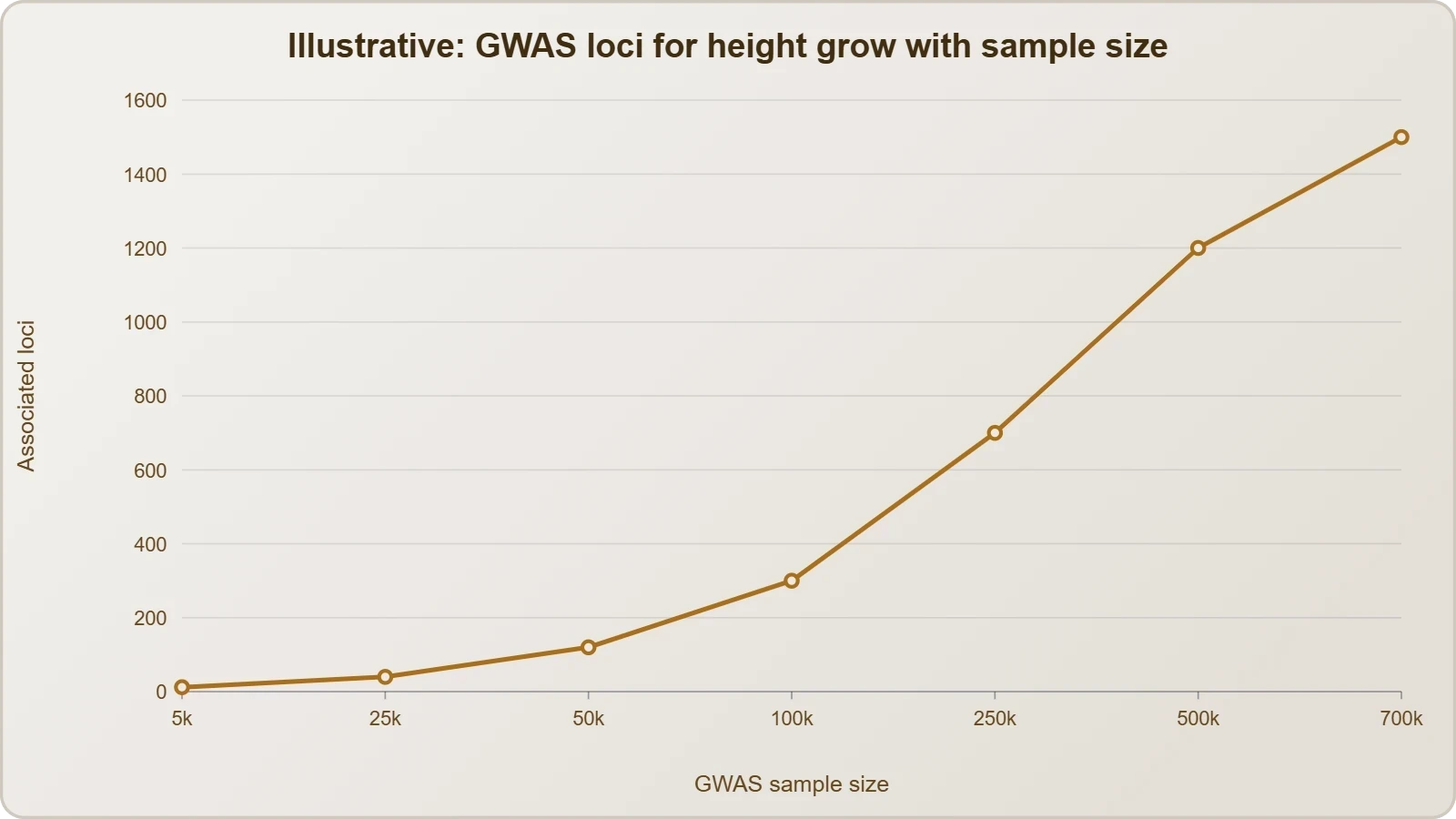
Since then, GWAS have catalogued tens of thousands of associations across hundreds of traits. The Wellcome Trust Case Control Consortium, the GIANT consortium for anthropometric traits, and the Psychiatric Genomics Consortium are among the large collaborative efforts that have shaped the field. The scale of these studies has grown from a few thousand participants to millions, and the number of independent associations for traits such as height now exceeds several thousand loci. Each locus typically explains a minuscule fraction of phenotypic variance, confirming the infinitesimal architecture predicted by classical theory.
Landmark Discoveries: Height, Disease Risk, and SNPs
Human height is the paradigmatic quantitative trait. It is highly heritable, with twin studies estimating ##h^2## around 0.8, yet early GWAS found that the most significant loci each explained less than half a percent of variance. As sample sizes grew, the number of associated loci climbed into the thousands, and together they now account for a substantial portion of the estimated SNP heritability. The lesson is that missing heritability was largely a problem of statistical power and imperfect variant tagging rather than evidence against polygenic inheritance.
Disease genetics followed a similar trajectory. For type 2 diabetes, variants near TCF7L2 remain among the strongest common signals, while dozens of additional loci implicate insulin secretion, beta-cell function, and adipose biology. For Crohn's disease, NOD2 was identified early and subsequent studies revealed autophagy and interleukin-23 signalling pathways. For schizophrenia, the major histocompatibility complex region and hundreds of common variants of small effect have been implicated. Each discovery refines biological understanding and occasionally suggests therapeutic targets.
Population Stratification and the Need for Diversity
Population stratification is the systematic difference in allele frequencies between subpopulations that also differ in trait prevalence or environmental exposure. If cases and controls are drawn from ancestrally distinct groups, spurious associations can arise because any variant that differs in frequency between those groups will appear associated with the disease. Principal component adjustment and linear mixed models are standard remedies, but they cannot fully correct for fine-scale structure or for environmental confounding correlated with ancestry.
The deeper problem is representativeness. The overwhelming majority of GWAS participants have been of European ancestry, which limits the portability of polygenic scores to other populations. Allele frequencies, linkage disequilibrium patterns, and effect sizes vary across ancestries, so a score trained in one group may predict poorly in another. Initiatives such as the Human Heredity and Ageing in Africa, the PAGE study, and the All of Us programme are working to close this gap, but progress remains uneven and the equity implications are substantial.
Polygenic Risk Scores and Clinical Prediction
A polygenic risk score aggregates the estimated effects of many variants into a single number for each individual. The score is computed as a weighted sum: ##PRS = \sum_{i} \beta_i \cdot g_i##, where ##\beta_i## is the effect size of variant ##i## and ##g_i## is the dosage of the effect allele. Scores are typically standardised and interpreted relative to a reference population, allowing individuals to be placed on a continuum of genetic liability. The approach has been applied to coronary artery disease, breast cancer, type 2 diabetes, and many other conditions.
The clinical promise is considerable. For coronary artery disease, polygenic scores can identify individuals at risk comparable to those carrying rare monogenic mutations, potentially enabling earlier statin therapy or lifestyle intervention. For breast cancer, scores may complement existing risk models to refine screening schedules. Yet the evidence base for clinical utility remains uneven, and professional bodies have been cautious about endorsing widespread deployment before randomised trials demonstrate benefit.
Strengths and Limitations of Polygenic Scores
The principal strength of polygenic scores is that they capture the aggregate effect of many small contributions that individual variant tests would miss. They can stratify populations into risk tiers and, in some cases, identify high-risk individuals who would not be flagged by family history or monogenic testing. When combined with clinical risk factors, they modestly improve discrimination and reclassification, particularly for diseases with a strong polygenic component and a well-powered discovery sample.
Limitations are equally important. Predictive power depends heavily on the discovery sample size and on the genetic similarity between discovery and target populations. Scores transfer poorly across ancestries, often losing half or more of their predictive accuracy. Calibration is another concern: a score that performs well in one clinical setting may misestimate absolute risk in another. Finally, the ethical and psychological consequences of communicating polygenic risk, including potential fatalism or unnecessary anxiety, require careful management.
From Association to Mechanism
GWAS signals mark genomic regions, not causal mechanisms. Most associated variants lie in non-coding regions, suggesting regulatory roles rather than protein-altering effects. Fine-mapping, expression quantitative trait locus analysis, chromatin interaction mapping, and functional assays are required to move from a statistical association to a credible causal variant and gene. This translational pipeline is slow and resource-intensive, but it is where the biological value of GWAS ultimately resides.
Emerging approaches integrate GWAS with single-cell transcriptomics, epigenomic annotation, and model organism experiments to prioritise effector genes. CRISPR-based perturbation screens and massively parallel reporter assays allow direct testing of candidate regulatory variants. The result is a gradual shift from cataloguing associations to constructing mechanistic models, which in turn informs drug target selection and repurposing. Several approved therapies, including agents targeting PCSK9 and IL-23, trace their origins to genetic association signals.
Statistical Foundations and Experimental Design
Quantitative genetics is inseparable from statistics, and the field's methods have evolved in step with computational capacity. Linkage analysis, which tracks co-inheritance of markers and traits within pedigrees, was the dominant approach for monogenic and oligogenic traits. Association analysis, which compares allele frequencies between trait groups, became feasible with dense genotyping arrays and is now the workhorse of complex-trait genetics. Each method carries distinct assumptions about the underlying architecture and distinct sources of error.
Modern studies combine multiple designs. Meta-analysis across cohorts increases power, while trans-ancestry meta-analysis improves generalisability. Mendelian randomisation uses genetic variants as instrumental variables to probe causal relationships between exposures and outcomes, mitigating some forms of confounding. These methods do not replace experimental biology, but they provide a rigorous framework for extracting causal inference from observational genetic data.
Linkage Disequilibrium and Imputation
Linkage disequilibrium (LD) is the non-random association of alleles at different loci. It arises because recombination is finite and because populations have histories of migration, drift, and selection. GWAS exploit LD: a genotyped SNP can tag an ungenotyped causal variant if the two are in strong LD. Imputation leverages reference panels such as the 1000 Genomes Project to infer ungenotyped variants, dramatically increasing the effective resolution of association studies without additional sequencing cost.
LD structure varies across populations and genomic regions, which complicates both discovery and replication. Regions of long-range LD, such as the major histocompatibility complex, require specialised handling. Fine-mapping methods attempt to identify credible sets of causal variants within associated regions, but resolution is often limited by the density of common variation and the correlation structure among nearby SNPs.
Reproducibility and Rigor in Complex-Trait Genetics
The credibility of genetic associations depends on stringent statistical thresholds. Genome-wide significance is conventionally set at ##p < 5 \times 10^{-8}##, reflecting a Bonferroni correction for roughly one million independent tests. Replication in independent cohorts, functional validation, and transparent reporting of methods are essential safeguards. The field has also confronted issues of publication bias, winner's curse, and the need for pre-registration in some contexts.

Data sharing has become a cornerstone of progress. Consortia such as the GWAS Catalog and the Open Targets platform aggregate summary statistics, enabling secondary analyses and meta-analyses. At the same time, privacy concerns and consent frameworks constrain how individual-level data can be shared. Balancing openness with participant protection remains an ongoing challenge, and governance structures are evolving to address it.
Applications, Ethics, and the Road Ahead
Quantitative genetics now informs agriculture, medicine, conservation, and evolutionary biology. In crop and livestock breeding, genomic selection uses dense marker data to predict breeding values, accelerating genetic gain for yield, disease resistance, and stress tolerance. In medicine, polygenic scores and Mendelian randomisation guide drug target validation and risk stratification. In conservation, quantitative genetic principles help manage small populations and preserve adaptive potential. These applications share a common reliance on accurate variance component estimation and careful interpretation of genetic architecture.
The ethical landscape is correspondingly complex. Polygenic scores raise concerns about genetic discrimination, privacy, and the potential for exacerbating health disparities if access is unequal. Embryo screening for polygenic traits, though currently limited, has prompted vigorous debate about the boundaries of reproductive choice. Regulatory frameworks vary widely across jurisdictions, and professional societies continue to issue guidance on responsible implementation. The scientific community's obligation extends beyond technical accuracy to include equitable benefit and transparent communication.
Integrating Quantitative Genetics with Molecular Biology
The future of the field lies in tighter integration with molecular and cellular biology. Single-cell atlases, spatial transcriptomics, and high-throughput perturbation screens provide the functional context needed to interpret statistical associations. Systems genetics approaches model how genetic variation propagates through molecular networks to shape organismal phenotypes. These methods promise to close the gap between statistical signal and biological mechanism, transforming our understanding of complex traits.
Computational advances are equally important. Machine learning methods are being applied to predict trait values from genomic and environmental data, though their interpretability remains limited. Causal inference frameworks are being refined to handle the complexities of correlated exposures and pleiotropy. As datasets grow in size and diversity, the field is moving toward predictive models that incorporate both genetic and non-genetic information, with the goal of personalised risk assessment that is both accurate and equitable.
Preparing for Genetic Counselling and Prenatal Diagnosis
The concepts developed in this lesson provide essential groundwork for the next lesson on genetic counselling and prenatal diagnosis. Understanding heritability prevents deterministic misinterpretation of family history. Familiarity with polygenic scores prepares you to evaluate their appropriate and inappropriate uses in clinical settings. Awareness of population stratification and ancestry-dependent prediction is directly relevant to equitable counselling across diverse patient populations.
Genetic counselling requires translating probabilistic information into terms that patients can understand and act upon. Quantitative reasoning about risk, variance, and uncertainty is therefore not an abstract skill but a practical necessity. The counsellor must explain why a family history of a complex disease does not guarantee inheritance, why a polygenic score is a relative rather than absolute measure, and why environmental modification can meaningfully alter outcomes even for highly heritable conditions. These are the applied lessons of quantitative genetics.
Also Read
- No links available.
From our network :
- 10 Physics Numerical Problems with Solutions for IIT JEEPrepare for IIT JEE with 10 physics numerical problems, complete with detailed solutions and conceptual explanations. Ideal for mastering kinematics, thermodynamics, electromagnetism, and optics.
- How to Print Cheaply: Cutting the Cost per PageA practical, measured guide to lowering what each printed page costs — duplex and draft modes, third-party ink, yield mathematics, and knowing when a new printer beats refills.
- Analyzing Trump Deportation Numbers Insights Into The 2026 Immigration Crackdown
- EV 2.0: The Solid-State Battery Breakthrough and Global Factory ExpansionDiscover the impact of the Solid-State Battery Breakthrough on the EV market. Learn about CATL and BYD stock growth, global factory expansion in Europe, and the future of EV 2.0 technology.
- Trump Political Strategy How Geopolitical Stunts Serve As Media Diversions
- AI-Powered 'Precision Diagnostic' Replaces Standard GRE Score ReportsDiscover the new GRE Precision Diagnostic. Learn how AI-powered behavioral analytics and time-to-solve tracking are replacing standard GRE score reports to empower students.
- Where to Put Your Wireless Router for Better CoverageA practical, physics-grounded guide to router placement: why the centre of the home beats the corner, how walls and metal sap signal, and how to run a simple survey that proves the improvement.
- 98% of Global MBA Programs Now Prefer GRE Over GMAT Focus EditionExplore why 98% of global MBA programs now prefer the GRE over GMAT Focus. Learn about the shorter GRE format, verbal logic importance, and strategic versatility for students.
- Do You Need a New Router or Is Your Internet Plan the Problem?A practical comparison of the signs that point to router limits versus signs your broadband speed or provider is the bottleneck, so you can decide what to replace before spending money.
RESOURCES
- Quantitative trait locus mapping based on resampling in a vast ...pubmed.ncbi.nlm.nih.gov... quantitative genetics for complex traits. Genetics. 2004 May;167(1):485-98. doi: 10.1534/genetics.167.1.485. Authors. Chris C Schön , H Friedrich Utz ...
- Genetics of complex traits: prediction of phenotype, identification of ...royalsocietypublishing.orgJul 27, 2016 ... Abstract. Complex or quantitative traits are important in medicine, agriculture and evolution, yet, until recently, few of the polymorphisms ...
- Genetic Architecture of Complex Traitsgenome.govDec 4, 2024 ... Building upon a foundation of quantitative genetics laid over a century ago, applying modern genomic approaches to resolve how genetic…
- Understanding and using quantitative genetic variation - PMC - NIHpmc.ncbi.nlm.nih.govQuantitative genetics, or the genetics of complex traits, is the study of those characters which are not affected by the action of just a…
- Review Strategies in quantitative trait locus mapping for complex ...sciencedirect.comDespite advances in genomics and quantitative genetics, identifying the genes underlying complex traits remains difficult. Quantitative trait loci (QTLs) ...
- The evolution of quantitative traits in complex environments | Hereditynature.comApr 24, 2013 ... ... quantitative traits. Quantitative genetics field studies will also shed light on the potential for natural populations to adapt to…
- Complex traits - Wikipediaen.wikipedia.orgQuantitative traits have phenotypes that are expressed on continuous ranges. ... They have many different genes that impact the phenotype, with differing effect ...
- Special issues on advances in quantitative genetics: introductionnature.comDec 11, 2013 ... Indeed, it is the cornerstone of modern breeding, evolutionary and ecological genetics, and human genetics of complex traits (such as…
- Genetic and molecular architecture of complex traits - Cell Presscell.comFeb 29, 2024 ... This technological advancement led to expression quantitative trait locus (eQTL) mapping to identify variants associated with gene expression ...
- QUANTITATIVE MODELING OF GENE EXPRESSION VARIABILITY ...geneticsmr.comKeywords: Gene expression variability, complex traits, quantitative genomics, statistical modeling, variance decomposition, gene regulation, transcriptomics.
- An integrative approach to prioritize candidate causal genes for ...journals.plos.orgGenome-wide association studies (GWAS) have identified many quantitative trait loci (QTL) associated with complex traits, predominantly in non-coding regions, ...
- Quantitative Genetics and Genomics - Gordon Research Conferencesgrc.orgThe Interactive Effects of Genetics, Environment and Ontogeny on Quantitative Traits ... Exploiting Context and Increasing Predictive Value in Complex Trait ...
- Stuart J Macdonald - KU Molecular Biosciencesmolecularbiosciences.ku.eduPostdoc (Quantitative genetics) ... genetic basis of complex traits. Our group has identified QTL (Quantitative Trait Loci) underlying a plethora of traits ...
- 5.1: Complex Traits - Biology LibreTextsbio.libretexts.orgSep 26, 2024 ... Quantitative genetics describes the connection between phenotype and genotype and provides tools to show how phenotypic selection of complex ...
- A quantitative genetic and epigenetic model of complex traitslink.springer.comOct 26, 2012 ... The model allows the prediction of how much genetic variation is produced through a change in the rate of occurrence…