Chemical equilibrium is one of those topics in Class 11 Chemistry that rewards patience and punishes shortcuts. Students who memorise the equilibrium constant expression without understanding why it takes the form it does often stumble the moment a question asks them to predict a shift, compare ##K_p## with ##K_c##, or interpret a reaction quotient that sits on the wrong side of the equilibrium value. This review lesson is designed to consolidate everything built across the preceding twenty-three lessons, transforming scattered formulas into a coherent problem-solving framework that holds up under examination pressure.
The material that follows draws on the standard treatment of dynamic equilibrium, the law of mass action, Le Chatelier's principle, and the relationship between ##K_p## and ##K_c##, while extending well beyond routine textbook exercises. You will encounter mixed problem sets, case-based reasoning, assertion-reasoning items, numerical answer type questions, and selections adapted from competitive examinations. Each section is structured to expose the logic beneath the calculation, so that a correct answer is never an accident and an incorrect one becomes a diagnostic signal rather than a source of frustration.

Because this is the twenty-fourth lesson in a twenty-six-lesson sequence, the emphasis falls deliberately on synthesis rather than introduction. The misconceptions addressed in the previous lesson — confusing equilibrium with completion, misreading catalyst effects, or mishandling heterogeneous systems — are revisited here in applied form. The next lesson turns to ionic equilibrium, so the boundary is kept clean: everything here concerns gaseous and homogeneous chemical equilibria, with only brief forward references where the two domains genuinely overlap.
On This Page
Foundations Revisited: Dynamic Equilibrium and the Law of Mass Action
At its core, chemical equilibrium describes a state in which the forward and reverse reactions proceed at identical rates, so that the concentrations of all species remain constant with time. This constancy is deceptive: molecules are continuously reacting in both directions, which is precisely why the equilibrium is called dynamic rather than static. The sealed-container thought experiment, in which liquid and vapour exchange molecules at equal rates, remains the clearest mental model. When the container volume is suddenly increased, the vapour pressure initially falls, evaporation outpaces condensation, and a new equilibrium is eventually restored at the same final vapour pressure, provided the temperature is unchanged.
The law of mass action converts this qualitative picture into a quantitative statement. For the general reaction ##aA + bB \rightleftharpoons cC + dD##, the equilibrium constant is written as the product of product concentrations raised to their stoichiometric coefficients, divided by the corresponding product for reactants. Pure solids and pure liquids are omitted because their activities are effectively unity. This omission is not a mathematical convenience but a physical consequence of their constant concentration, and it explains why heterogeneous equilibria such as the decomposition of calcium carbonate produce expressions containing only the gaseous species.
The magnitude of ##K_c## carries immediate interpretive weight. A very large value signals that products dominate at equilibrium, while a very small value indicates that reactants prevail. Crucially, ##K_c## depends only on temperature for a given reaction; it is unaffected by changes in concentration, pressure, or the presence of a catalyst. Students frequently assume that adding more reactant increases ##K_c##, but the constant merely re-establishes itself at the same numerical value through a shift in composition. Recognising this distinction early prevents a cascade of errors in later calculations.

Writing Equilibrium Expressions Correctly
Accuracy in constructing the equilibrium expression is the foundation of every subsequent calculation. Consider the oxidation of sulfur dioxide, ##2SO_2(g) + O_2(g) \rightleftharpoons 2SO_3(g)##. The expression is K_c = [SO_3]^2 / ([SO_2]^2[O_2]). If the equilibrium concentrations are ##[SO_2] = 0.60\,M##, ##[O_2] = 0.82\,M##, and ##[SO_3] = 1.90\,M##, substitution gives a value of approximately 12.3, indicating that products are favoured under these conditions. The arithmetic is trivial; the discipline lies in matching exponents to coefficients and excluding species that do not belong.
Heterogeneous systems demand particular care. For ##2Cu(NO_3)_2(s) \rightleftharpoons 2CuO(s) + 4NO_2(g) + O_2(g)##, the solids vanish from the expression, leaving K_c = [NO_2]^4[O_2]. Similarly, in the esterification reaction ##CH_3COOC_2H_5(aq) + H_2O(l) \rightleftharpoons CH_3COOH(aq) + C_2H_5OH(aq)##, water appears as a pure liquid and is omitted, so K_c = [CH_3COOH][C_2H_5OH]/[CH_3COOC_2H_5]. A useful check is to ask whether each species has a definable concentration; if not, it does not belong in the expression.
Converting Between Kp and Kc
For gaseous reactions, partial pressures are often more convenient than concentrations, and the two constants are linked by a relationship that depends on the change in the number of gaseous moles. The governing equation is:
Here ##\Delta n_g## is the difference between the sum of stoichiometric coefficients of gaseous products and gaseous reactants. For ##2NOCl(g) \rightleftharpoons 2NO(g) + Cl_2(g)##, ##\Delta n_g = 3 - 2 = 1##, so ##K_p = K_c(RT)##. Given ##K_p = 1.8 \times 10^{-2}## at 500 K, one obtains ##K_c \approx 4.3 \times 10^{-6}##. For ##CaCO_3(s) \rightleftharpoons CaO(s) + CO_2(g)##, ##\Delta n_g = 1##, and with ##K_p = 167## at 1073 K, ##K_c## works out to roughly ##1.9 \times 10^{-2}##. When ##\Delta n_g = 0##, the two constants are numerically equal.
Le Chatelier's Principle in Applied Problem Solving
Le Chatelier's principle states that a change in any factor — temperature, pressure, concentration, or the presence of inert gas — causes the equilibrium to shift in the direction that reduces or counteracts the effect of that change. The principle is qualitative, but its predictive power in examination settings is considerable. The essential discipline is to identify which side of the reaction the change favours, then translate that into a direction of shift. Students who rush to memorise rules without this reasoning often invert the answer for endothermic reactions or for changes in volume.
Temperature changes are unique because they alter the value of the equilibrium constant itself. Raising the temperature of an endothermic reaction shifts the equilibrium forward and increases ##K##; for an exothermic reaction, the same change shifts it backward and decreases ##K##. Pressure changes, by contrast, affect only systems with a change in gaseous moles, and they shift the equilibrium toward the side with fewer gaseous molecules when pressure is increased. Adding a catalyst changes neither the position nor the constant; it merely accelerates the approach to equilibrium by providing a lower-energy pathway in both directions.
Inert gas addition is a perennial source of confusion. At constant volume, adding an inert gas raises total pressure but leaves the partial pressures of the reacting species unchanged, so there is no shift. At constant pressure, the same addition increases the total volume, lowering the partial pressures of all reactants and products; the equilibrium then shifts toward the side with more gaseous moles. Distinguishing these two scenarios is essential, and case-based questions frequently test precisely this distinction.
Worked Case: The Haber Process
The synthesis of ammonia, ##N_2(g) + 3H_2(g) \rightleftharpoons 2NH_3(g)##, is exothermic with ##\Delta n_g = -2##. High pressure favours ammonia because the product side has fewer gaseous molecules. Low temperature also favours ammonia thermodynamically, yet industrial operation uses a compromise temperature of roughly 700 K because the reaction would otherwise be prohibitively slow. Continuous removal of ammonia drives the equilibrium forward, while the iron catalyst accelerates attainment without altering the yield at equilibrium. This single example integrates thermodynamics, kinetics, and Le Chatelier reasoning, which is why it appears so frequently in competitive examinations.
A typical case-based question might present the Haber process with a stated set of conditions and ask students to predict the effect of doubling the pressure, adding argon at constant volume, or raising the temperature. Each sub-question tests a distinct facet of the principle. The disciplined approach is to write the reaction, note ##\Delta n_g## and the sign of ##\Delta H##, then evaluate each change independently. Students who attempt to reason holistically without this stepwise structure tend to conflate effects and lose marks on otherwise straightforward items.
Reaction Quotient and Direction Prediction
The reaction quotient ##Q_c## has the same algebraic form as ##K_c## but is evaluated at any instant, not necessarily at equilibrium. Comparing the two reveals the direction of net change. If ##Q_c < K_c##, the forward reaction is favoured; if ##Q_c > K_c##, the reverse reaction dominates; if ##Q_c = K_c##, the system is at equilibrium. This comparison is the quantitative counterpart to Le Chatelier's qualitative reasoning and is indispensable for numerical problems involving initial concentrations.
Consider a system where ##Q_c## is calculated to be 0.05 while ##K_c## is 12.3. The quotient is far below the equilibrium value, so the reaction proceeds forward, consuming reactants and generating products until the ratio rises to 12.3. Setting up an ICE table — initial, change, equilibrium — converts this insight into a solvable equation. For simple cases the equation is linear; for others it becomes quadratic, and students should be comfortable solving both forms without losing track of physically meaningful roots.

Mixed Problem Set: Numerical and Conceptual Practice
A well-designed review must move fluidly between calculation and interpretation. The following problems are deliberately varied: some require straightforward substitution, others demand algebraic manipulation, and a few test whether students can recognise which principle applies before reaching for a formula. Attempt each problem before reading the discussion, because the diagnostic value lies in the attempt rather than the answer. Where a problem admits multiple solution routes, the most efficient one is indicated, but alternative valid approaches are equally acceptable in examinations.
Numerical answer type questions deserve particular attention because they eliminate the possibility of guessing. In competitive examinations such as JEE, a numerical answer must be entered to the correct number of significant figures, and a small arithmetic slip can cost the entire mark. Practising with disciplined notation — writing units, tracking exponents, and verifying the order of magnitude — builds the habits that prevent such losses. The problems below are calibrated to the difficulty range typical of CBSE board examinations and the easier tier of JEE Main.
Conceptual questions, by contrast, reward precision of language. When asked why a catalyst does not alter the equilibrium position, a response that merely states "it speeds up both reactions equally" is incomplete; the fuller answer notes that the catalyst lowers the activation energy of the forward and reverse pathways by the same amount, leaving the free-energy difference between reactants and products unchanged. Cultivating this level of precision is what distinguishes a strong answer from an adequate one.
Worked Numerical Problems
Problem one: at a certain temperature and total pressure of ##10^5\,Pa##, iodine vapour contains 40% by volume of iodine atoms according to ##I_2(g) \rightleftharpoons 2I(g)##. The partial pressure of ##I## is ##0.4 \times 10^5\,Pa## and that of ##I_2## is ##0.6 \times 10^5\,Pa##. Therefore ##K_p = (0.4 \times 10^5)^2 / (0.6 \times 10^5) \approx 2.67 \times 10^4\,Pa##. The problem illustrates how volume percentage translates directly into mole fraction for gases at the same temperature and pressure.

Problem two: for ##2SO_2(g) + O_2(g) \rightleftharpoons 2SO_3(g)## with equilibrium concentrations ##[SO_2] = 0.60\,M##, ##[O_2] = 0.82\,M##, and ##[SO_3] = 1.90\,M##, the equilibrium constant is ##K_c = (1.90)^2 / ((0.60)^2 \times 0.82) \approx 12.3##. Problem three: given ##K_p = 1.8 \times 10^{-2}## for ##2NOCl(g) \rightleftharpoons 2NO(g) + Cl_2(g)## at 500 K, use ##K_p = K_c(RT)^{\Delta n_g}## with ##\Delta n_g = 1## and ##R = 0.0831\,L\,bar\,K^{-1}\,mol^{-1}## to obtain ##K_c \approx 4.3 \times 10^{-6}##.

Assertion-Reasoning and Case-Based Items
Assertion: adding a catalyst to a reaction at equilibrium increases the yield of products. Reason: a catalyst provides an alternative pathway of lower activation energy. The assertion is false while the reason is true. A catalyst accelerates both forward and reverse reactions equally, so the equilibrium composition is unchanged; only the rate of attainment improves. This item tests the most persistent misconception in the topic, and students who answer "both true and reason explains assertion" have conflated kinetics with thermodynamics.
Assertion: for ##N_2(g) + 3H_2(g) \rightleftharpoons 2NH_3(g)##, increasing pressure shifts the equilibrium forward. Reason: the forward reaction is exothermic. Here the assertion is true but the reason is irrelevant to it; the shift arises from the decrease in gaseous moles, not from the enthalpy change. Such items train students to evaluate the causal link between assertion and reason rather than merely checking whether each statement is individually correct, a skill that transfers directly to competitive examination formats.
We Also Published
Competitive Examination Selections and Advanced Points
Questions drawn from JEE Main and JEE Advanced tend to combine equilibrium with other topics, particularly thermodynamics and kinetics. A representative problem asks students to determine the effect of simultaneously increasing temperature and pressure on an exothermic reaction with ##\Delta n_g < 0##. The two effects oppose each other, and the net direction depends on which dominates under the given conditions. Such problems reward students who can decompose a complex scenario into independent Le Chatelier effects and then weigh them, rather than searching for a single memorised rule.
Another recurring theme involves the relationship between ##K## and the standard Gibbs energy change, expressed as ##\Delta G^\circ = -RT \ln K##. This equation connects the equilibrium constant to thermodynamic spontaneity and appears frequently in advanced papers. A large positive ##K## corresponds to a negative ##\Delta G^\circ##, indicating that the forward reaction is spontaneous under standard conditions. Students should be able to move fluently between ##K##, ##\Delta G^\circ##, and the direction of spontaneity, since examiners often test the conversion in either direction.
Degree-of-dissociation problems form a third advanced category. For a reaction such as ##PCl_5(g) \rightleftharpoons PCl_3(g) + Cl_2(g)##, if a fraction ##\alpha## dissociates from an initial amount, the equilibrium moles can be expressed in terms of ##\alpha## and the total pressure. The resulting expression for ##K_p## in terms of ##\alpha## and ##P## is a standard derivation, and its mastery allows rapid solution of problems that would otherwise require lengthy algebra. Recognising the pattern saves valuable time in timed examinations.
Deriving Kp in Terms of Degree of Dissociation
For ##PCl_5(g) \rightleftharpoons PCl_3(g) + Cl_2(g)##, starting with one mole of ##PCl_5## and a degree of dissociation ##\alpha##, the equilibrium moles are ##1-\alpha##, ##\alpha##, and ##\alpha## respectively, giving a total of ##1+\alpha##. The partial pressures follow from mole fractions multiplied by total pressure ##P##. Substituting into the ##K_p## expression yields:

This compact result reveals several features at once. When ##\alpha## is small, ##K_p \approx \alpha^2 P##, so the degree of dissociation scales as ##1/\sqrt{P}##, confirming that higher pressure suppresses dissociation for a reaction that increases gaseous moles. When ##\alpha## approaches unity, the denominator tends to zero and ##K_p## grows without bound, signalling that the reaction proceeds essentially to completion. The derivation generalises to other dissociations with appropriate modification of the stoichiometric factors.

Common Errors in Advanced Problems
The most frequent error in advanced equilibrium problems is neglecting to convert between ##K_p## and ##K_c## when the question mixes pressure and concentration data. A second common mistake is forgetting that ##\Delta n_g## counts only gaseous species, so solids and liquids must be excluded even when they appear in the balanced equation. A third is misapplying the inert gas rule by assuming that any pressure increase shifts the equilibrium, when in fact only changes in partial pressures of the reacting species matter. Each of these errors is preventable through a consistent checking routine.
A fourth error concerns the treatment of quadratic equations. When solving for equilibrium concentrations, one root is often physically inadmissible because it implies a negative concentration. Students who report both roots without screening lose marks. A fifth error involves significant figures: competitive examinations frequently specify the required precision, and answers rounded too aggressively are marked incorrect. Building a habit of carrying extra digits through intermediate steps and rounding only at the end protects against this. These small disciplines compound into a meaningful score advantage over the course of an examination.
Self-Assessment and Consolidation Checklist
Self-assessment is most valuable when it is specific. A vague sense of having understood the chapter is a poor predictor of examination performance, whereas a checklist tied to concrete skills exposes gaps before they become costly. The checklist below is organised around the competencies that this lesson has developed: writing equilibrium expressions, converting between constants, predicting shifts, solving numerical problems, and interpreting conceptual items. Students should rate themselves honestly on each item and revisit the corresponding section where confidence is low.
Beyond the checklist, a short programming exercise can reinforce the quantitative relationships. Writing a small script to compute ##K_c## from concentration data, or to convert ##K_p## to ##K_c## for a given ##\Delta n_g##, forces precision about units and exponents. The exercise is optional but valuable for students who intend to pursue chemistry or engineering, where computational fluency with equilibrium calculations is assumed. The code below illustrates the conversion and can be adapted to any reaction by changing the parameters.
R = 0.0831  # L bar K^-1 mol^-1

def kp_from_kc(kc, delta_n, temperature):
    return kc * (R * temperature) ** delta_n

def kc_from_kp(kp, delta_n, temperature):
    return kp / (R * temperature) ** delta_n

# Example: 2NOCl(g) <=> 2NO(g) + Cl2(g), delta_n = 1
kc = kc_from_kp(1.8e-2, 1, 500)
print(f"Kc = {kc:.2e}")  # approximately 4.3e-06
The script returns a value consistent with the hand calculation performed earlier, which is itself a useful verification habit. Students preparing for practical examinations may also wish to revisit the suggested activities from the syllabus: testing the pH of fruit juices and soft drinks, preparing buffer solutions from sodium acetate and acetic acid, and observing the common ion effect on the solubility of sparingly soluble salts. Although these activities belong primarily to the ionic equilibrium lesson that follows, they reinforce the broader principle that equilibrium is a measurable, manipulable phenomenon rather than an abstract formalism.
Competency Checklist
Rate each statement from one to five, where five indicates complete confidence. First: I can write the ##K_c## expression for any balanced reaction, correctly excluding pure solids and liquids. Second: I can convert between ##K_p## and ##K_c## using ##K_p = K_c(RT)^{\Delta n_g}## and identify ##\Delta n_g## without error. Third: I can predict the direction of shift for changes in concentration, pressure, temperature, catalyst, and inert gas, distinguishing constant-volume from constant-pressure scenarios. Fourth: I can calculate ##Q_c## and compare it with ##K_c## to determine the direction of net reaction.
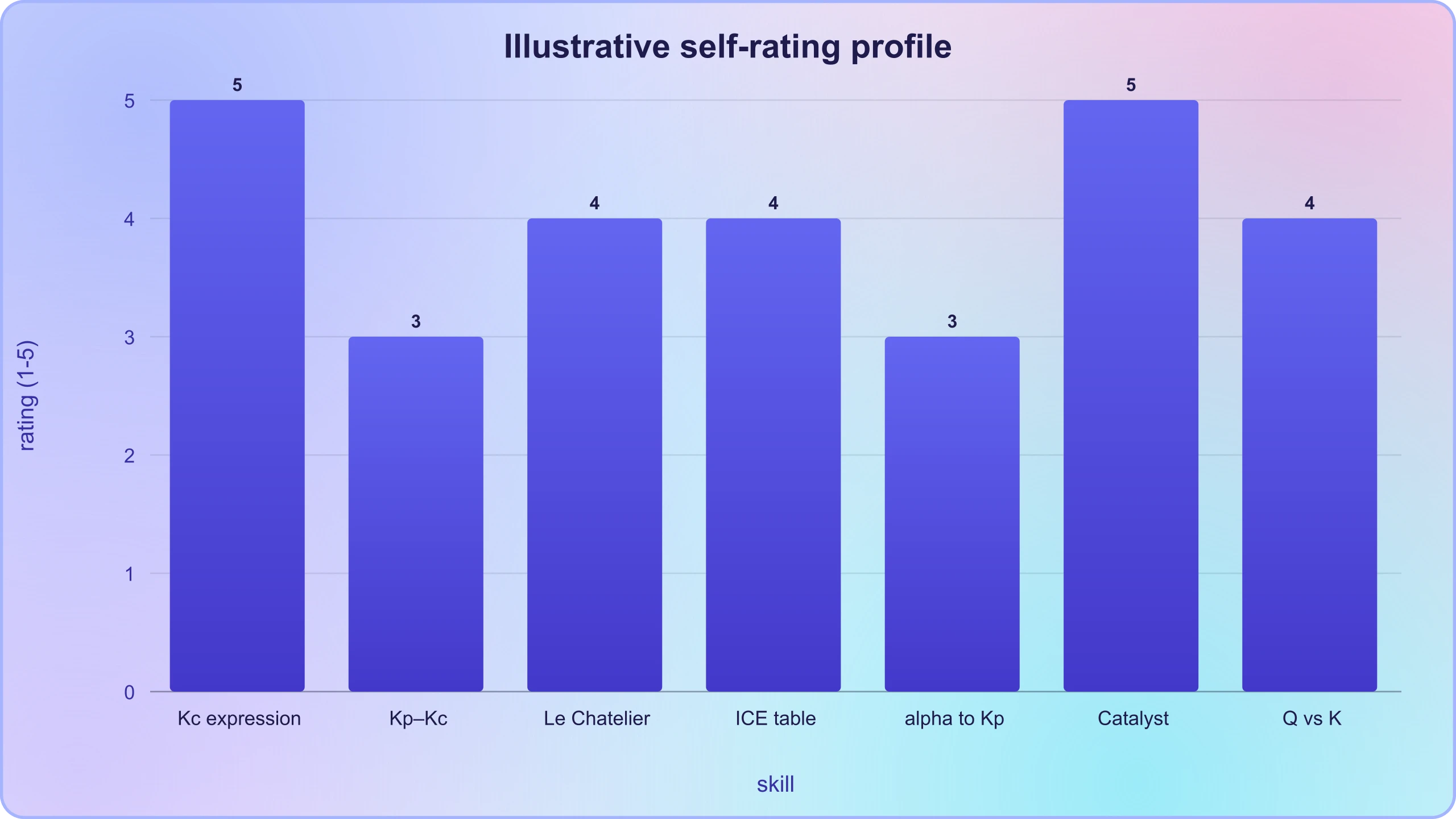
Fifth: I can construct an ICE table and solve for equilibrium concentrations, screening inadmissible roots. Sixth: I can derive ##K_p## in terms of degree of dissociation for a dissociation reaction. Seventh: I can explain why a catalyst does not alter the equilibrium position, using the language of activation energy and free-energy difference. Eighth: I can evaluate assertion-reason items by testing both the truth of each statement and the causal link between them. Any item rated below four should be revisited before the next lesson, which extends these ideas into aqueous ionic equilibria.
Looking Ahead to Ionic Equilibrium
The next lesson applies the same equilibrium logic to aqueous solutions, where acids, bases, and salts establish ionic equilibria governed by ##K_a##, ##K_b##, and ##K_w##. The conceptual machinery is identical: dynamic balance, mass action expressions, and Le Chatelier reasoning. What changes is the medium and the species involved. Students who have consolidated the gaseous and homogeneous cases covered here will find the transition natural, because the mathematics of equilibrium does not distinguish between a partial pressure and a concentration beyond the conversion factor already mastered.
The bridge between the two lessons is the common ion effect, which appears in both contexts. In chemical equilibrium it manifests as a shift when a species already present is added; in ionic equilibrium it governs the solubility of sparingly soluble salts through ##K_{sp}##. Recognising this continuity transforms two apparently separate chapters into a single coherent framework. That coherence is the ultimate aim of this review lesson, and students who achieve it will approach the remaining lessons of the course with both confidence and genuine understanding.
From our network :
- 98% of Global MBA Programs Now Prefer GRE Over GMAT Focus EditionExplore why 98% of global MBA programs now prefer the GRE over GMAT Focus. Learn about the shorter GRE format, verbal logic importance, and strategic versatility for students.
- How to Print Cheaply: Cutting the Cost per PageA practical, measured guide to lowering what each printed page costs — duplex and draft modes, third-party ink, yield mathematics, and knowing when a new printer beats refills.
- 10 Physics Numerical Problems with Solutions for IIT JEEPrepare for IIT JEE with 10 physics numerical problems, complete with detailed solutions and conceptual explanations. Ideal for mastering kinematics, thermodynamics, electromagnetism, and optics.
- EV 2.0: The Solid-State Battery Breakthrough and Global Factory ExpansionDiscover the impact of the Solid-State Battery Breakthrough on the EV market. Learn about CATL and BYD stock growth, global factory expansion in Europe, and the future of EV 2.0 technology.
- AI-Powered 'Precision Diagnostic' Replaces Standard GRE Score ReportsDiscover the new GRE Precision Diagnostic. Learn how AI-powered behavioral analytics and time-to-solve tracking are replacing standard GRE score reports to empower students.
- Analyzing Trump Deportation Numbers Insights Into The 2026 Immigration Crackdown
- Where to Put Your Wireless Router for Better CoverageA practical, physics-grounded guide to router placement: why the centre of the home beats the corner, how walls and metal sap signal, and how to run a simple survey that proves the improvement.
- Do You Need a New Router or Is Your Internet Plan the Problem?A practical comparison of the signs that point to router limits versus signs your broadband speed or provider is the bottleneck, so you can decide what to replace before spending money.
- Trump Political Strategy How Geopolitical Stunts Serve As Media Diversions