Sex determination is one of the most elegant illustrations of how a single chromosomal difference can cascade into an entire biology — anatomy, behaviour, social structure, and even the arithmetic of relatedness. In humans, the story is deceptively simple: two chromosomes, X and Y, combine in predictable ratios to produce sons and daughters. In honey bees, the same fundamental question — who becomes male and who becomes female — is answered by something far stranger: an organism can develop as a male with no father at all, and sisters can share more genes with one another than with their own mother. Understanding both systems side by side reveals that sex is not a universal constant but an evolved solution, shaped by selection and constrained by chromosomes.
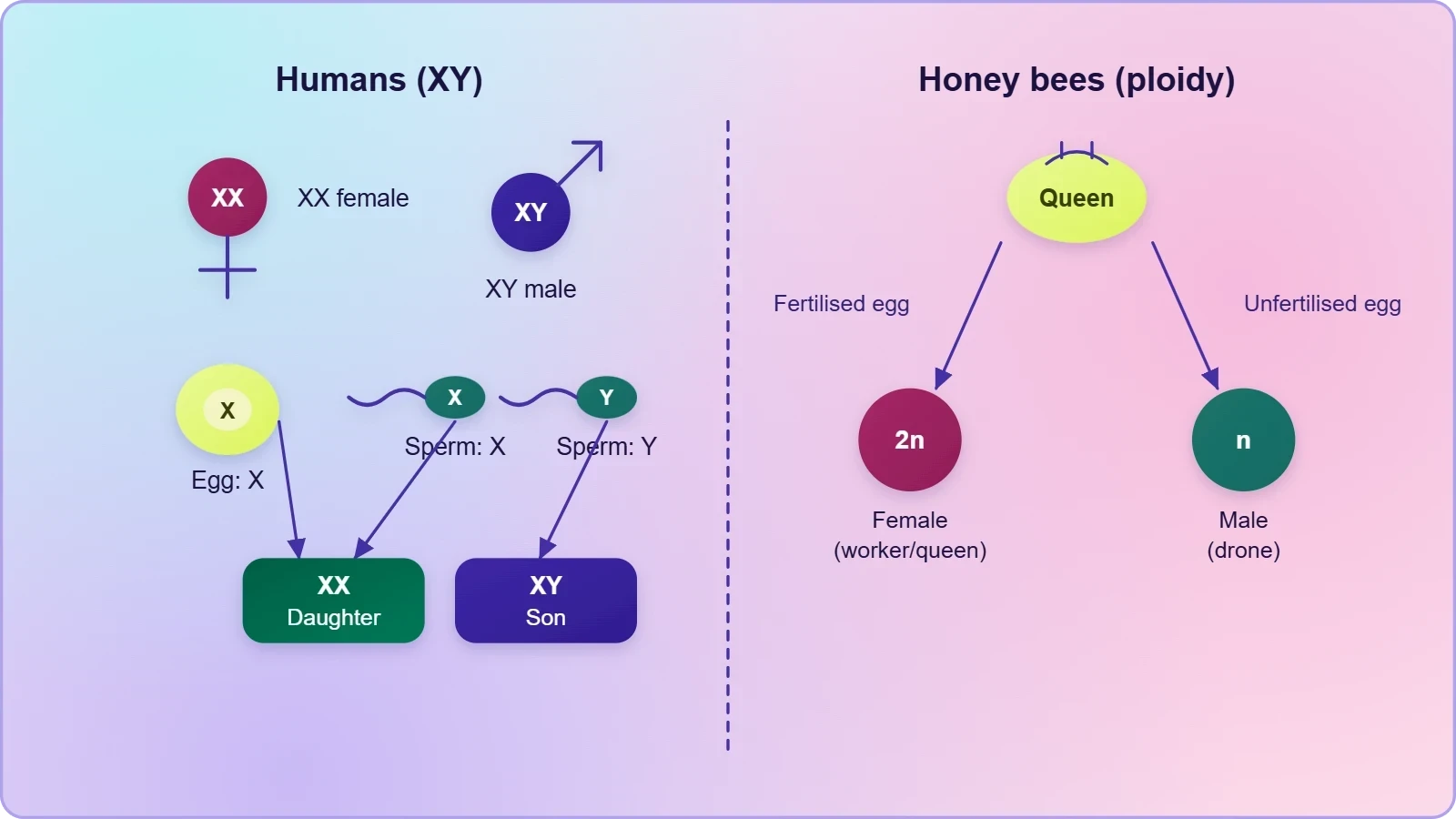
This lesson builds directly on the chromosomal mechanisms examined earlier, where the XO, XY, and ZW systems were introduced as variations on a theme. Here the focus narrows to two deeply studied cases: the human XY system, with its hormonal and genetic layers, and the haplodiploid system of honey bees, where sex is determined by ploidy rather than by a dedicated sex chromosome. Along the way, the discussion connects inheritance to real consequences — sex-linked disorders such as haemophilia and colour blindness, the mathematics of pedigree analysis, and the social and ethical questions that arise when societies attempt to influence the sex of their children.
Because this material sits between the chromosomal mechanisms of the previous lesson and the study of mutation that follows, it deliberately avoids re-teaching karyotype basics and instead pushes toward interpretation. You will see how a single base substitution in the beta globin gene produces sickle-cell anaemia, how a failure of chromatid segregation produces Down's syndrome, and how the unusual genetics of the drone bee explains the evolution of one of nature's most complex societies. Each concept is anchored in worked reasoning, so the lesson stands on its own as a complete treatment of sex determination and its genetic consequences.
On This Page
- The Human XY System: Chromosomes, Gonads, and Hormonal Cascades
- Haplodiploidy in Honey Bees: When Ploidy Determines Sex
- Mutation and Chromosomal Change: The Sources of Variation
- Sex-Linked Disorders and the Logic of Genetic Counselling
- Haplodiploidy, Eusociality, and the Wider Comparative Picture
- Consolidating the Lesson: From Chromosomes to Consequences
The Human XY System: Chromosomes, Gonads, and Hormonal Cascades
Human sex determination rests on a simple chromosomal asymmetry: females typically carry two X chromosomes, males carry one X and one Y. Of the 46 chromosomes in a normal human cell, 22 pairs are autosomes and one pair is the sex chromosomes. During gamete formation, meiosis separates the pair so that every egg carries an X, while sperm are of two kinds — half bearing X and half bearing Y. Fertilisation therefore produces a roughly 1:1 ratio of XX and XY zygotes, a Mendelian outcome that mirrors the segregation of any single gene pair.
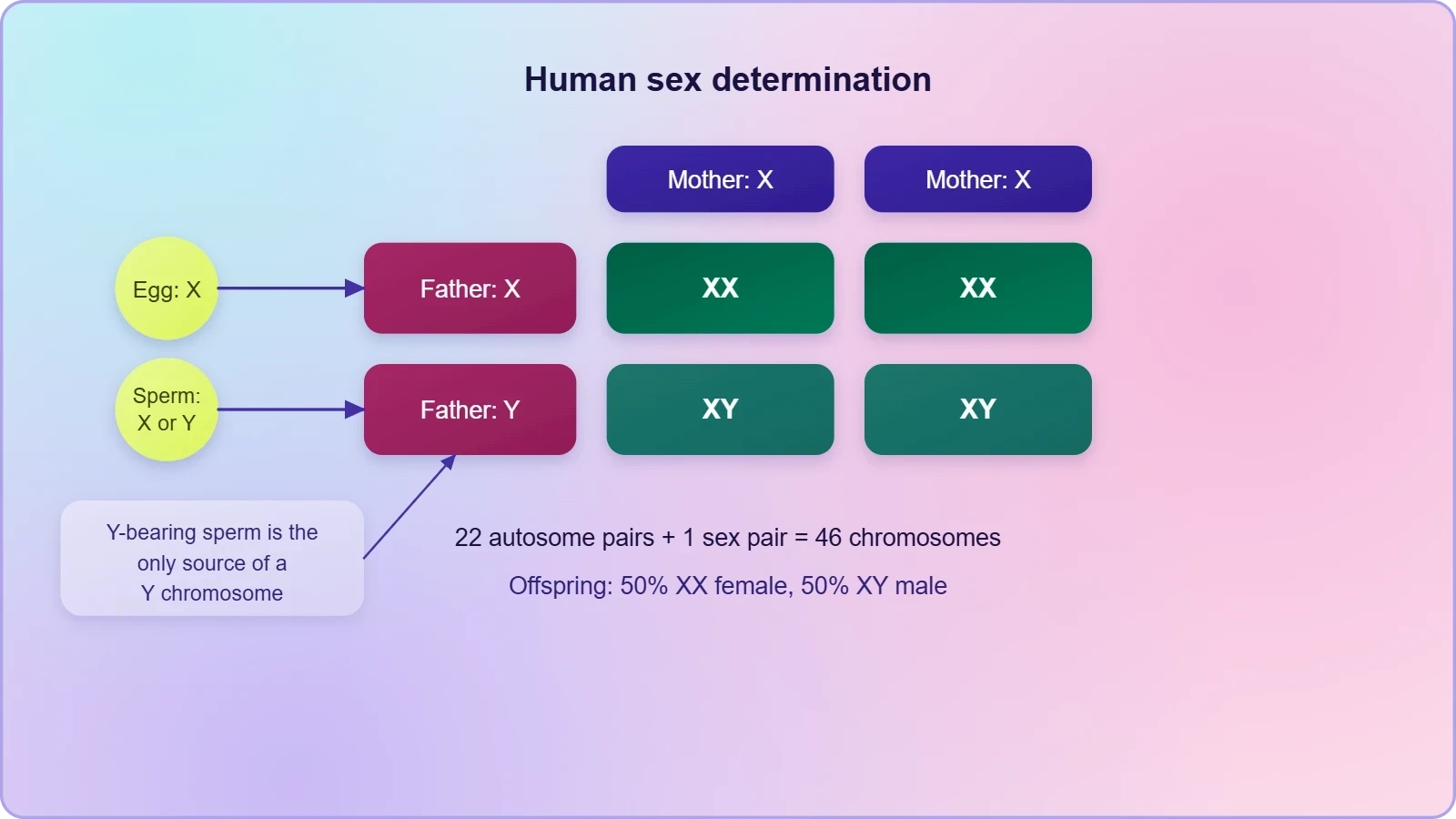
From Chromosome to Gonad: The Role of SRY
The presence of a Y chromosome is the decisive switch. A gene called SRY, located on the short arm of the Y chromosome, initiates testis development in the undifferentiated gonad. In its absence, the gonad follows the default pathway and becomes an ovary. This is why individuals with Turner's syndrome, who have a single X and no second sex chromosome (45, X0), develop as females, while individuals with an extra X in a male background (47, XXY, Klinefelter's syndrome) develop as males with altered fertility and secondary characteristics.
Once the gonad is determined, hormones complete the picture. Testes secrete testosterone and anti-Müllerian hormone, driving the development of male internal and external genitalia; in the absence of these signals, the female reproductive tract develops. Sex determination is therefore a two-stage process: a genetic trigger followed by a hormonal cascade. This distinction matters clinically, because disruptions at either stage can produce differences in sexual development that are chromosomal, gonadal, or hormonal in origin.
Reading Sex-Linked Inheritance Through Pedigrees
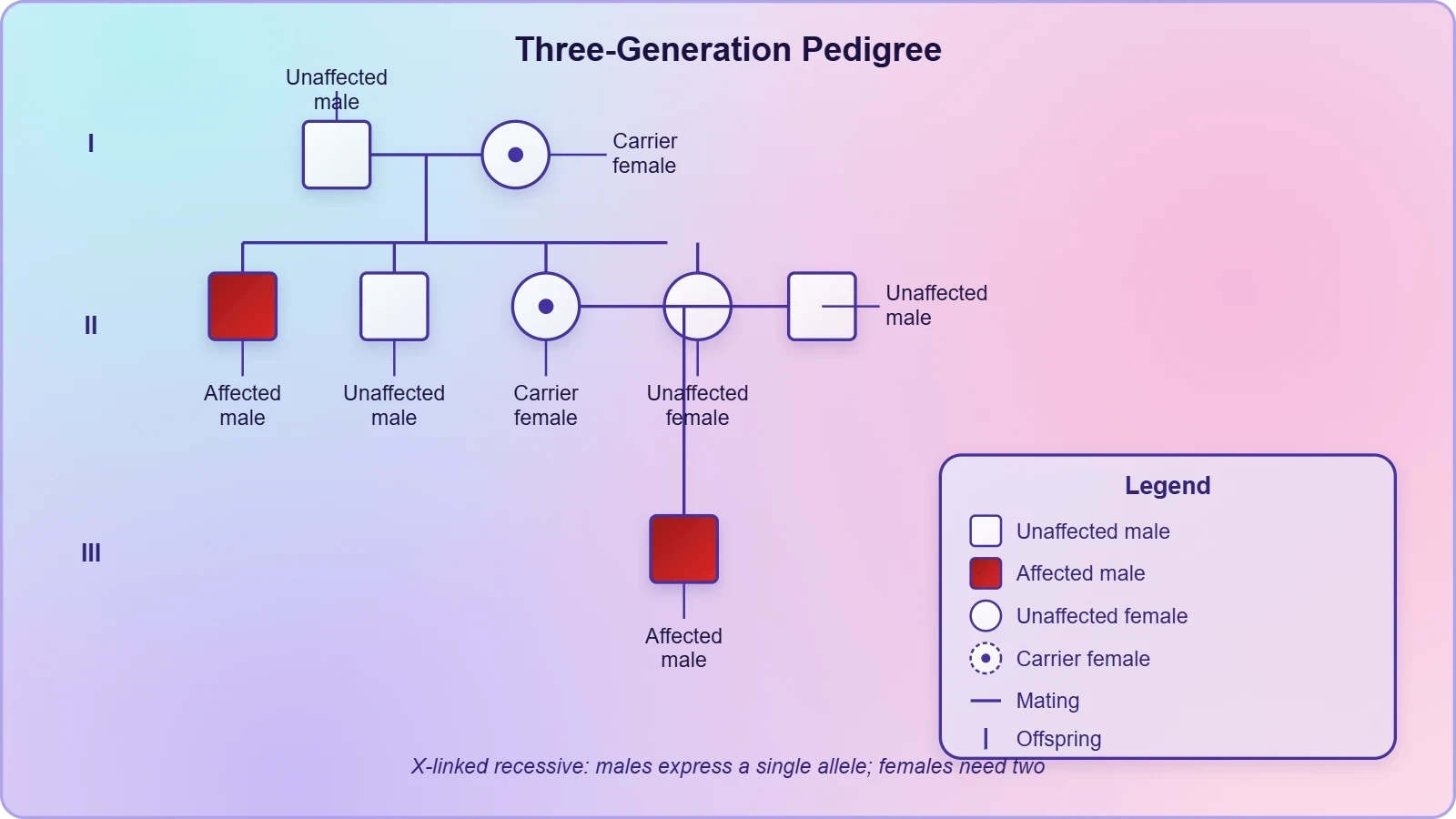
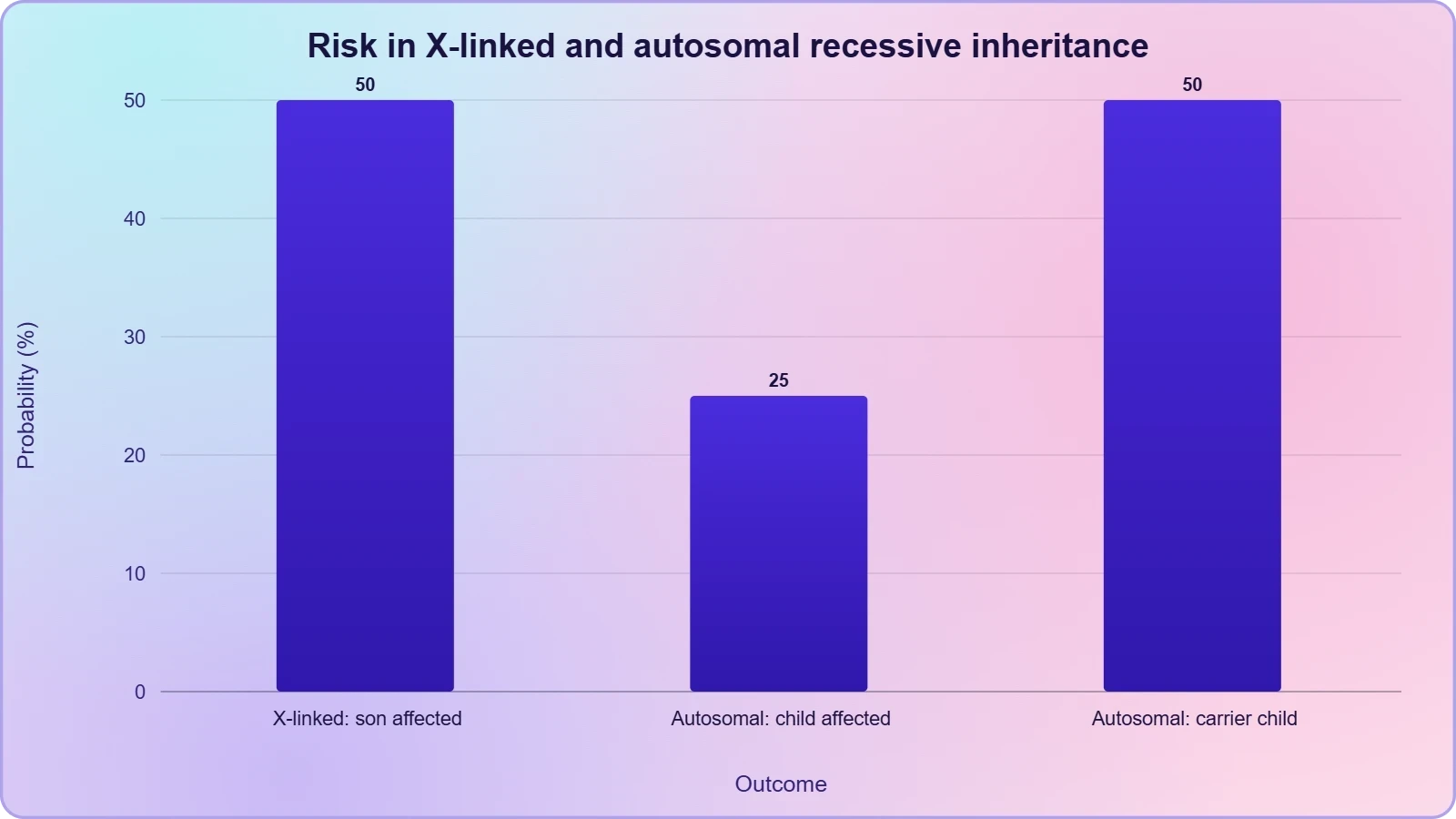
Because the X chromosome carries many genes unrelated to sex, recessive alleles on it behave distinctively. A male has only one X, so a single recessive allele is expressed; a female has two X chromosomes, so the same allele is masked by a normal dominant copy. This asymmetry explains why red-green colour blindness occurs in about 8 per cent of males but only about 0.4 per cent of females. The son of a carrier woman has a 50 per cent chance of being colour blind, while a daughter is affected only if her mother is a carrier and her father is colour blind.
Pedigree analysis is the tool that makes these patterns visible across generations. Since controlled crosses are impossible in humans, family trees over several generations substitute for experimental breeding. Standard symbols — squares for males, circles for females, filled shapes for affected individuals, half-filled for carriers — allow a trained observer to infer whether a trait is dominant or recessive, autosomal or sex-linked. A representative pedigree of an autosomal dominant trait such as myotonic dystrophy looks very different from one of an autosomal recessive trait such as sickle-cell anaemia.
Haplodiploidy in Honey Bees: When Ploidy Determines Sex
Honey bees abandon the chromosomal switch entirely. In this system, sex is determined by whether an individual develops from a fertilised or an unfertilised egg. A queen stores sperm from her mating flights and releases them selectively: fertilised eggs, which are diploid, develop into females (workers or, if specially fed, queens), while unfertilised eggs develop by parthenogenesis into haploid males called drones. This condition, in which one sex is diploid and the other haploid, is known as haplodiploidy, and it produces a genetic structure unlike anything found in vertebrates.
The Arithmetic of Relatedness Among Sisters
The consequences of haplodiploidy are best seen through relatedness coefficients. A female receives one set of chromosomes from her mother and one from her father. Because the father is haploid, all his sperm are genetically identical, so every daughter inherits exactly the same paternal genome. Sisters therefore share 100 per cent of their paternal genes and, on average, 50 per cent of their maternal genes, giving a relatedness of ##r = 0.5 \times 1 + 0.5 \times 0.5 = 0.75##. By contrast, a female shares only 50 per cent of her genes with her own offspring, and only 25 per cent with her brothers.
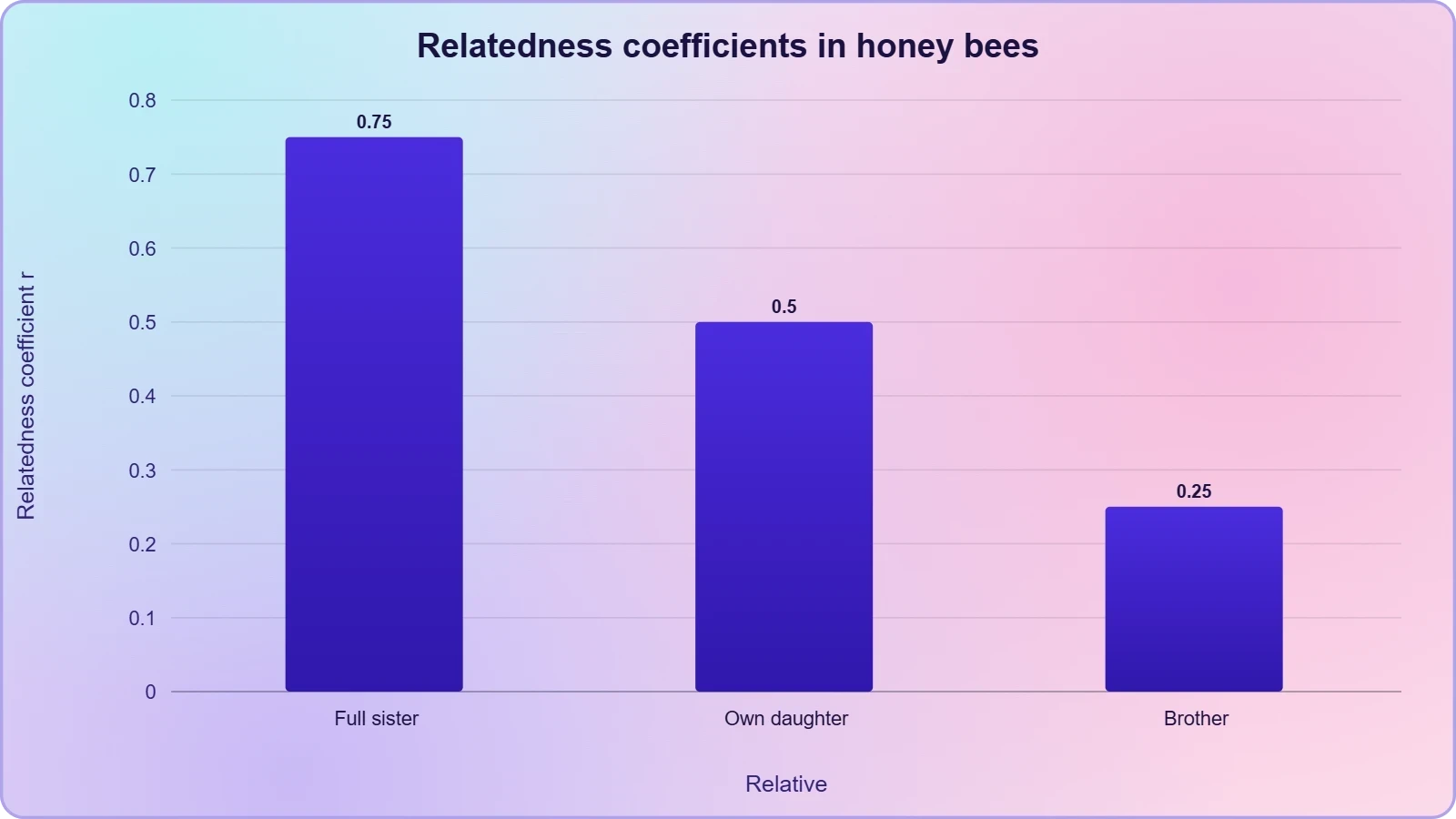
This asymmetry is the heart of W. D. Hamilton's kin selection argument. A worker bee is more closely related to her sisters than to her own daughters, so helping her mother rear more sisters can transmit more of her genes than reproducing herself. Eusociality — the division of labour into reproductive and non-reproductive castes — becomes evolutionarily favourable under exactly these conditions. The same logic applies to ants and wasps, which share the haplodiploid system and have independently evolved complex societies many times.
Drones: Fathers Without Fathers, Sons Without Sons
The drone's biology is a catalogue of oddities that follow directly from his haploid state. Because he develops from an unfertilised egg, he has no father. Because he is haploid, he produces sperm not by meiosis but by mitosis, so every sperm he makes is genetically identical to himself. And because he contributes no paternal genome to any offspring, he cannot have sons — all his offspring, if he could produce any, would be daughters. Drones exist solely to transmit their mother's genome, and they die shortly after mating.
These facts have practical consequences for beekeepers and for population genetics. A queen who mates with a single drone produces a colony in which all workers are full sisters, but a queen who mates with multiple drones produces patrilines — groups of workers sharing a father — that reduce average relatedness and can generate conflict within the hive. The haplodiploid system also means that deleterious recessive alleles are exposed in drones, since there is no second copy to mask them, a fact that shapes the genetic health of bee populations.
Mutation and Chromosomal Change: The Sources of Variation
Sex determination explains how individuals become male or female, but variation within and between sexes depends on mutation — the alteration of DNA sequences that changes genotype and phenotype. Mutation is the second great source of variation alongside recombination. Because a DNA helix runs continuously through each chromatid in a highly supercoiled form, the loss (deletion) or gain (insertion or duplication) of a segment alters the chromosome itself, producing abnormalities or aberrations. Such chromosomal aberrations are commonly observed in cancer cells, where genomic instability drives uncontrolled division.
Point Mutations, Frameshifts, and Their Consequences
At the finest scale, a change in a single base pair produces a point mutation. The classical example is sickle-cell anaemia, caused by substitution of glutamic acid by valine at the sixth position of the beta globin chain. The underlying change is a single base substitution at the sixth codon of the beta globin gene, from GAG to GUG. The mutant haemoglobin polymerises under low oxygen tension, distorting the red blood cell from a biconcave disc into an elongated sickle shape. Deletions and insertions of base pairs, by contrast, cause frame-shift mutations that scramble every downstream codon.
Mutations do not arise in a vacuum. Many chemical and physical factors induce them, and these are called mutagens. Ultraviolet radiation is a familiar example, capable of damaging DNA and producing mutations in exposed organisms. Understanding mutagens matters practically: they inform cancer risk assessment, occupational safety, and the design of laboratory experiments. The mechanism of mutation is treated in greater depth in the following lesson, but the essential point here is that mutation supplies the raw material on which selection acts, and it is the ultimate origin of the alleles responsible for the genetic disorders examined below.
Chromosomal Disorders: Aneuploidy and Polyploidy
Chromosomal disorders arise from the absence, excess, or abnormal arrangement of one or more chromosomes. Failure of chromatid segregation during the cell division cycle produces gain or loss of a chromosome, a condition called aneuploidy. Down's syndrome, for example, results from an extra copy of chromosome 21, while Turner's syndrome results from the loss of an X chromosome in human females. Failure of cytokinesis after telophase, by contrast, increases an entire set of chromosomes, a phenomenon known as polyploidy, which is common in plants but rare and usually lethal in humans.
The distinction between Mendelian and chromosomal disorders is fundamental. Mendelian disorders are determined by alteration or mutation in a single gene and are transmitted to offspring along the lines established by the principles of inheritance. Chromosomal disorders involve whole chromosomes and often arise de novo rather than being inherited. Both categories are studied through pedigree analysis, which remains the strongest tool available in human genetics, since controlled crosses cannot be performed and family history must substitute for experimental design.
Sex-Linked Disorders and the Logic of Genetic Counselling
Sex-linked disorders provide the clearest practical application of sex determination genetics. Haemophilia, a sex-linked recessive disease, shows transmission from an unaffected carrier female to some of her male progeny. A single protein in the blood-clotting cascade is affected, so a simple cut results in non-stop bleeding. The heterozygous female may transmit the disease to her sons, but the possibility of a female becoming haemophilic is extremely rare, because her mother would have to be at least a carrier and her father haemophilic — a combination that is often unviable later in life. The family pedigree of Queen Victoria, a carrier, shows a number of haemophilic descendants across European royal houses.
Carrier Status, Probability, and Risk Calculation
Genetic counselling translates these probabilities into actionable information. Consider a woman known to be a carrier of an X-linked recessive allele. Each son has a 50 per cent chance of being affected, and each daughter has a 50 per cent chance of being a carrier. If the father is also affected, the probabilities shift dramatically. Counsellors use pedigree analysis, carrier testing, and increasingly molecular diagnostics to estimate these risks, then present them in terms families can understand. The mathematics is simple conditional probability, but the human stakes are considerable.
Autosomal recessive conditions follow a different arithmetic. Sickle-cell anaemia is controlled by a single pair of alleles, HbA and HbS. Of the three possible genotypes, only homozygous HbS individuals show the diseased phenotype; heterozygotes appear unaffected but are carriers, with a 50 per cent probability of transmitting the mutant gene to each child. When both partners are carriers, each child has a 25 per cent chance of being affected, a 50 per cent chance of being a carrier, and a 25 per cent chance of being entirely unaffected. Thalassemia follows the same logic but differs in being a quantitative problem — too few globin molecules — whereas sickle-cell anaemia is a qualitative problem of an incorrectly functioning globin.
Ethical Dimensions of Sex Determination
Because sex can be determined before birth, societies face difficult questions. Sex-selective practices, driven by cultural preferences for sons, have skewed sex ratios in parts of the world and raised serious human rights concerns. Many countries have legislated against prenatal sex determination for non-medical reasons. At the same time, medical uses of prenatal diagnosis — detecting chromosomal disorders such as Down's syndrome or Turner's syndrome — remain legitimate and valuable. The ethical line lies not in the technology itself but in the intent behind its use, and genetic counsellors are trained to navigate that distinction with sensitivity.
These debates connect directly to the biology. The same chromosomal analysis that reveals a 45, X0 karyotype in Turner's syndrome also reveals XX or XY, and the information cannot be neatly separated. Understanding the science therefore carries a civic dimension: informed citizens can distinguish between legitimate medical screening and discriminatory practice, and can appreciate why professional guidelines insist on non-directive counselling that respects parental autonomy while safeguarding the interests of the future child.
Haplodiploidy, Eusociality, and the Wider Comparative Picture
The haplodiploid system is not confined to honey bees. Ants and wasps share it, and eusociality has evolved independently in these groups many times, a pattern that strongly supports the kin selection explanation. In each case, the unusual relatedness structure created by haplodiploidy makes helping behaviour evolutionarily viable. The comparative picture is instructive: termites, which are diploid, have also evolved eusociality, but through different mechanisms involving inbreeding and overlapping generations, showing that haplodiploidy is a powerful route to sociality rather than the only one.
Why Relatedness Alone Does Not Explain Everything
Critics of the haplodiploidy hypothesis point out that workers are less related to their brothers than to their own sons, and that multiple mating by queens reduces average relatedness among workers. These complications mean that haplodiploidy creates the conditions for eusociality but does not guarantee it. Modern treatments emphasise a combination of factors: high relatedness, ecological pressures that make cooperative nesting advantageous, and the life-history traits of the species. The honey bee remains a compelling case study precisely because its genetics and its social behaviour are so tightly interwoven.
For students, the lesson is methodological as much as factual. A single genetic mechanism — ploidy — ramifies into sex, relatedness, caste, and social structure. Understanding it requires moving between levels of explanation, from the molecular to the population. The same habit of mind applies to human genetics, where a single base change in the beta globin gene produces a disease whose frequency in populations reflects the selective advantage of carrier status against malaria. Genetics rewards the student who can hold several scales of explanation in view at once.
Common Misconceptions to Avoid
Several errors recur in examinations and in popular discussion. It is wrong to say that the Y chromosome determines sex in all organisms; in bees, ploidy does. It is wrong to claim that drones have fathers; they develop from unfertilised eggs. It is wrong to assume that a carrier mother will have affected sons; each son faces a 50 per cent probability. And it is wrong to treat chromosomal disorders as always inherited; many arise de novo from segregation errors during gamete formation. Careful attention to these distinctions separates precise understanding from superficial recall.
Another frequent confusion concerns the relationship between mutation and variation. Mutation is not the same as recombination; both generate variation, but by different means. Recombination shuffles existing alleles during meiosis, while mutation creates new alleles by altering DNA. The two together supply the diversity on which selection acts. Keeping this distinction clear prepares the ground for the next lesson, which examines mutation in detail — its types, its causes, and its consequences for organisms and populations.
Consolidating the Lesson: From Chromosomes to Consequences
Sex determination in humans and honey bees illustrates two radically different solutions to the same biological problem. In humans, a dedicated sex chromosome and a single genetic switch, SRY, initiate a hormonal cascade that produces male or female development. In honey bees, ploidy itself determines sex, and the resulting asymmetry in relatedness reshapes the entire social structure of the colony. Both systems demonstrate that sex is an evolved trait, not a fixed property of life, and that the mechanisms organisms use have profound consequences for inheritance, behaviour, and evolution.
Connecting to the Next Lesson
The disorders examined here — sickle-cell anaemia, thalassemia, phenylketonuria, haemophilia, colour blindness — all trace back to alterations in DNA. Some are point mutations, others are deletions or insertions, and still others are chromosomal. The next lesson takes up mutation directly, examining its types, its causes, and its consequences in detail. The groundwork laid here, particularly the distinction between point mutations and chromosomal aberrations, will make that treatment easier to follow and will connect the molecular scale to the population scale.
Students preparing for competitive examinations should pay particular attention to the numerical relationships: the 1:1 sex ratio in humans, the 0.75 relatedness among bee sisters, the 25 per cent risk for autosomal recessive conditions, and the 50 per cent transmission probability for X-linked carriers. These figures are frequently tested and are best understood rather than memorised. A student who can derive them from first principles will handle unfamiliar variations with confidence, while a student who has memorised them will struggle when a question departs from the standard case.
Key Takeaways for Revision
Human sex determination depends on the Y chromosome and the SRY gene, with hormonal cascades completing development. Honey bee sex determination depends on ploidy, with diploid females and haploid males, and produces a sister-sister relatedness of 0.75 that favours eusociality. Mutation, whether point, frameshift, or chromosomal, supplies the variation on which selection acts. Pedigree analysis remains the primary tool for tracing inheritance in humans, and genetic counselling translates its probabilities into practical guidance. Together, these ideas form a coherent framework for understanding how traits are transmitted and how variation arises.
Also Read
- No links available.
From our network :
- EV 2.0: The Solid-State Battery Breakthrough and Global Factory ExpansionDiscover the impact of the Solid-State Battery Breakthrough on the EV market. Learn about CATL and BYD stock growth, global factory expansion in Europe, and the future of EV 2.0 technology.
- Trump Political Strategy How Geopolitical Stunts Serve As Media Diversions
- Where to Put Your Wireless Router for Better CoverageA practical, physics-grounded guide to router placement: why the centre of the home beats the corner, how walls and metal sap signal, and how to run a simple survey that proves the improvement.
- Analyzing Trump Deportation Numbers Insights Into The 2026 Immigration Crackdown
- 98% of Global MBA Programs Now Prefer GRE Over GMAT Focus EditionExplore why 98% of global MBA programs now prefer the GRE over GMAT Focus. Learn about the shorter GRE format, verbal logic importance, and strategic versatility for students.
- Do You Need a New Router or Is Your Internet Plan the Problem?A practical comparison of the signs that point to router limits versus signs your broadband speed or provider is the bottleneck, so you can decide what to replace before spending money.
- 10 Physics Numerical Problems with Solutions for IIT JEEPrepare for IIT JEE with 10 physics numerical problems, complete with detailed solutions and conceptual explanations. Ideal for mastering kinematics, thermodynamics, electromagnetism, and optics.
- How to Print Cheaply: Cutting the Cost per PageA practical, measured guide to lowering what each printed page costs — duplex and draft modes, third-party ink, yield mathematics, and knowing when a new printer beats refills.
- AI-Powered 'Precision Diagnostic' Replaces Standard GRE Score ReportsDiscover the new GRE Precision Diagnostic. Learn how AI-powered behavioral analytics and time-to-solve tracking are replacing standard GRE score reports to empower students.
RESOURCES
- Honey Bee Genetics Basics - Penn State Extensionextension.psu.eduDec 20, 2024 ... Haplodiploidy. Honey bees have haplodiploid sex determination. This is common in many insects and is present in bees, wasps and…
- Heterozygosity at a conserved candidate sex determination locus is ...pubmed.ncbi.nlm.nih.govNov 5, 2025 ... CSD loci have been mapped in honeybees and two ant species, but we know little about their evolutionary history. Here,…
- Sex Determination in Humans and Other Organismsfacebook.comAug 15, 2026 ... Haplodiploidy Found in bees, ants, and wasps. Fertilized eggs ... Honey Bee System cetemninedbyth chromasoma sets. (Heterogametie) ...
- Sex Determination | CK-12 Foundationflexbooks.ck12.orgNov 1, 2026 ... Haplodiploidy in honey bees. [Figure 4]. Haplodiploidy system in honey bees for sex determination. Sex Determination in Humans. As discussed ...
- Honeybee genetics: how do they work? | Ask an Entomologistaskentomologists.comAug 5, 2015 ... You can see an example of a human female karyotype here. This is called XY sex determination, where females have…
- Diploid drones are a result of inbreeding - Honey Bee Suitehoneybeesuite.com... chromosomes in humans) bees have one gene on one chromosome that determines sex. ... Haplodiploidy is a sex-determination system in which males develop ...
- The Drone : Kingpin to the Colony. - The Beelistenerbeelistener.co.ukJan 7, 2022 ... Unlike male honey bees, male humans are diploid and so have 2 sex chromosomes. ... “Haplodiploidy—the sex determination system whereby ...
- Briefly explain the sex determination in human and honey bee | Filoaskfilo.comSex determination is the biological mechanism that determines the development of sexual characteristics in an organism. In humans and honey bees, this process ...
- Honey Bee Genetics: Why Breeding is So Difficultamericanbeejournal.comAug 1, 2018 ... You see, instead of having an entire chromosome that determines sex, like the X and Y chromosomes in humans, bees…
- Honey Bee Genetics: Why Drones Have No Father - PerfectBeeperfectbee.comNov 4, 2018 ... Diploid and Haploid. The cause of all this weirdness is a sex-determination system called haplodiploidy. In high school biology we…
- Feminizer and doublesex knock-outs cause honey bees to switch ...journals.plos.orgMay 6, 2019 ... But the nature versus nurture argument isn't only relevant for humans ... Sex and caste determination in honey bees. (A)…
- An Extraordinary Sex Determination Mechanism in a Book Lousepmc.ncbi.nlm.nih.govMOST biologists are familiar with male heterogamety, the mechanism of sex determination in most mammals, including humans. ... sexual development in the honey bee ...
- Scientific note updating allelic nomenclature standards of the highly ...link.springer.comMar 3, 2025 ... Honey bees rely on haplodiploidy for sex determination. Here, diploid eggs develop into females (i.e., queens and workers) and haploid…
- Feminizer and doublesex knock-outs cause honey bees to switch ...pmc.ncbi.nlm.nih.govMay 6, 2019 ... ... sex determination—a feat which has rarely been achieved in honey bees. ... Sex mosaics in the honeybee: how haplodiploidy…
- Sex Determination in Honey Bee - BYJU'Sbyjus.comFAQs. Q1. What type of sex-determination system is used by bees? Haplodiploidy or arrhenotoky type ...