Gregor Mendel's experiments with garden peas between 1856 and 1863 remain the intellectual foundation on which all of modern genetics rests, and the monohybrid cross is the cleanest window into his reasoning. By crossing true-breeding tall plants with true-breeding dwarf plants and tracking the trait through successive generations, Mendel demonstrated that inheritance follows discrete, predictable rules rather than the blending of parental essences that most nineteenth-century biologists assumed. His decision to apply statistical analysis and mathematical logic to biological problems was genuinely radical, and it is the reason his conclusions survived scrutiny when so many contemporary theories collapsed.
This lesson examines the monohybrid cross in full detail: the design of the experiment, the striking disappearance of the dwarf trait in the first filial generation, its reappearance in a precise 3:1 ratio in the second, and the two laws Mendel derived from these observations. We will then move well beyond the original account to explain why dominance happens at the molecular level, how Punnett squares convert gamete probabilities into genotypic and phenotypic predictions, and how test crosses allow a geneticist to determine an unknown genotype from observable offspring. The treatment assumes familiarity with the vocabulary of inheritance and variation established in the preceding lesson and deliberately stops short of incomplete dominance, co-dominance and multiple alleles, which form the subject of the next.
Throughout, worked examples, probability calculations and a chi-square goodness-of-fit test will show how Mendelian ratios are verified in practice rather than merely asserted. Lethal alleles, haplosufficiency and the chromosomal basis of segregation are introduced as extensions that sharpen the classical picture without contradicting it. By the end, you should be able to read any monohybrid cross, predict its outcomes with confidence, and recognise the situations in which the simple dominant–recessive framework requires refinement.
On This Page
- The Experimental Foundation: True-Breeding Lines and Contrasting Traits
- Genes, Alleles and the Vocabulary of Inheritance
- The Law of Segregation and Its Chromosomal Basis
- Probability, Test Crosses and Statistical Verification
- The Molecular Basis of Dominance
- Beyond Complete Dominance: A Preview of Exceptions
- Worked Examples and Computational Practice
- Consolidating the Lesson: Key Takeaways and Self-Assessment
The Experimental Foundation: True-Breeding Lines and Contrasting Traits
Mendel's methodological genius lay in controlling variables that earlier breeders had left to chance. He selected fourteen true-breeding pea varieties, arranged as seven pairs that were similar in every respect except one character with two sharply contrasting traits. A true-breeding line is one that, after continuous self-pollination, shows stable trait inheritance and expression across several generations; in practice this means the line breeds true for the trait under study, producing offspring identical to itself generation after generation. This purity of parental stock is essential, because any hidden variation would confound the ratios that emerge later.
The seven characters he chose were stem height (tall or dwarf), flower colour (violet or white), flower position (axial or terminal), pod shape (inflated or constricted), pod colour (green or yellow), seed shape (round or wrinkled) and seed colour (yellow or green). Each trait pair is unambiguous and each character is discrete, which allowed Mendel to score offspring as one category or the other without subjective judgement. He also performed artificial cross-pollination by hand, removing anthers from the seed parent before maturity and transferring pollen from the chosen male parent, thereby ensuring that every cross was controlled and every parentage known.
Why Peas Were the Right Organism
Pisum sativum offered several practical advantages that a modern researcher would recognise as excellent experimental design. The plant is self-pollinating by nature, which makes true-breeding lines easy to maintain, yet its relatively large flowers permit reliable manual cross-pollination when required. It has a short generation time, produces many seeds per pod, and can be grown in large numbers in a modest garden or greenhouse, giving the large sampling size that lent credibility to Mendel's data. The traits he studied were also visually obvious and unaffected by subtle environmental variation, so scoring was unambiguous.
Equally important, the pea's reproductive biology allowed Mendel to grow successive generations and confirm his inferences rather than resting on a single experiment. He verified that his results pointed to general rules of inheritance rather than unsubstantiated ideas by repeating crosses across many lines and generations. This insistence on replication and large numbers is precisely the standard we now demand in quantitative biology, and it explains why Mendel's conclusions, unlike those of his contemporaries, have endured.
The Monohybrid Cross Defined
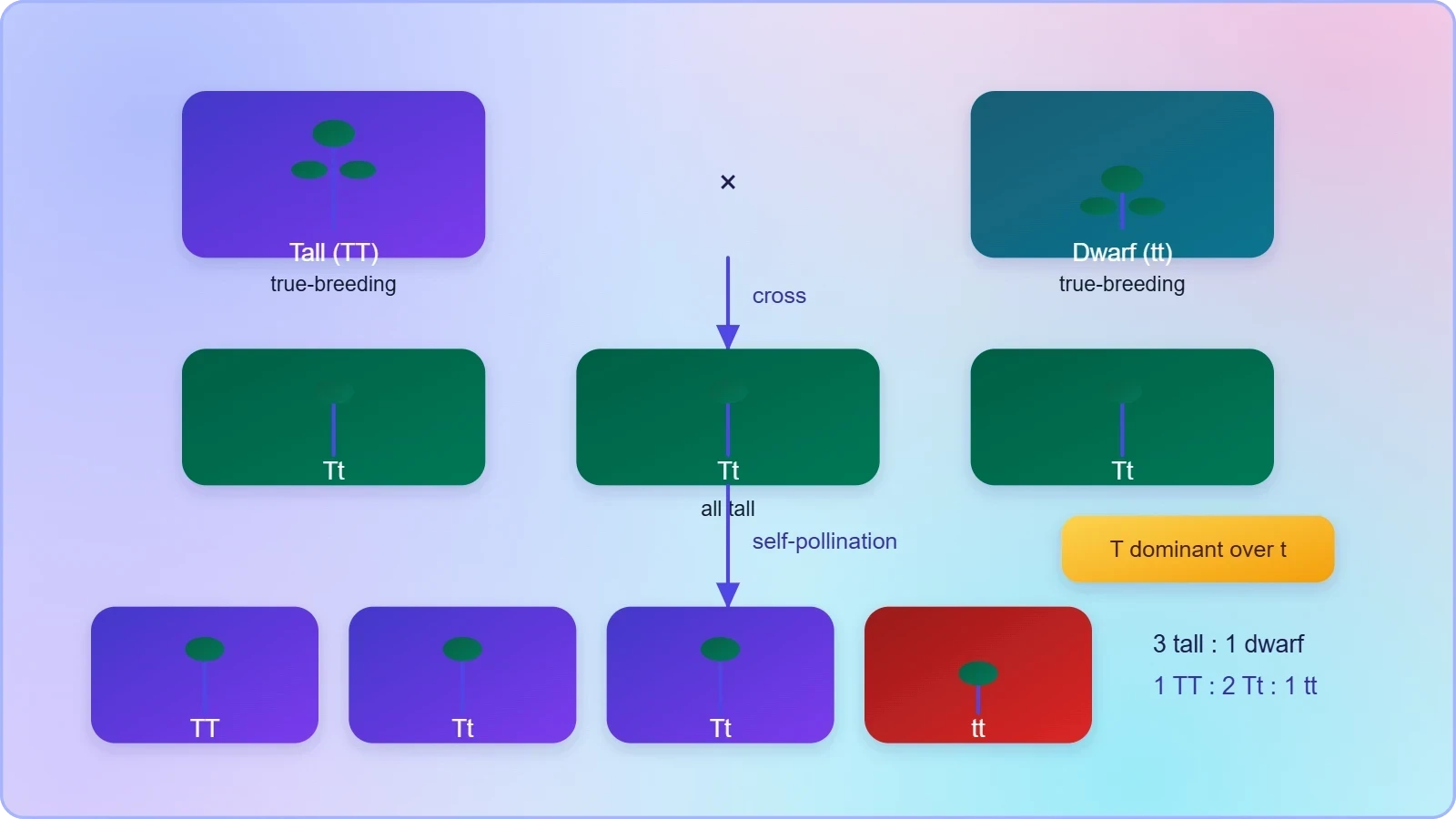
A monohybrid cross follows the inheritance of a single character with two contrasting traits. Mendel crossed true-breeding tall plants (genotype TT) with true-breeding dwarf plants (genotype tt), collected the resulting seeds, and grew them into the first hybrid generation, called the Filial 1 or F1 progeny. Every F1 plant was tall, exactly like the tall parent, and none was dwarf. He obtained the same pattern for all seven trait pairs: the F1 always resembled one parent, and the trait of the other parent vanished completely from view.
Mendel then allowed the tall F1 plants to self-pollinate and raised the Filial 2 or F2 generation. To his surprise, the dwarf trait reappeared, and the proportions were remarkably consistent: roughly three-quarters of the F2 plants were tall and one-quarter were dwarf, a ratio of 3:1. Crucially, the tall and dwarf plants were identical to their parental types and showed no blending; there were no plants of intermediate height. The same 3:1 proportion held for the other six characters, establishing a general pattern rather than an idiosyncratic result.
Genes, Alleles and the Vocabulary of Inheritance
From his observations Mendel inferred that something was being stably passed down, unchanged, from parent to offspring through the gametes across successive generations. He called these units 'factors'; we now call them genes. Genes are the units of inheritance, containing the information required to express a particular trait in an organism. Genes that code for a pair of contrasting traits are known as alleles, meaning they are slightly different forms of the same gene occupying the same locus on homologous chromosomes. This distinction between a gene and its alleles is fundamental and is a frequent source of confusion for beginners.
Mendel introduced a simple symbolic convention that remains in use. The capital letter denotes the trait expressed in the F1 generation and the lower-case letter the alternative trait. For height, T stands for tall and t for dwarf, and T and t are alleles of one another. A true-breeding tall plant carries the pair TT and a true-breeding dwarf plant carries tt; such identical allele pairs are described as homozygous. The genetic constitution TT or tt is the genotype, while the descriptive terms tall and dwarf constitute the phenotype, the observable characteristic.
Genotype, Phenotype and Heterozygosity
The F1 hybrid receives T from one parent and t from the other, giving the genotype Tt. Because the two alleles are dissimilar, the plant is heterozygous, and because it is heterozygous for the genes controlling a single character, it is termed a monohybrid; the cross between TT and tt is therefore a monohybrid cross. The phenotype of this heterozygote is exactly like that of the TT parent, which is the observation that forced Mendel to postulate dominance. Genotype and phenotype are not interchangeable terms, and much of genetics consists of inferring the former from the latter.
A useful discipline is to avoid mixing symbols from different genes. Writing T for tall and d for dwarf would make it difficult to remember whether T and d are alleles of the same gene or belong to different characters. Sticking to one letter with an upper-case and lower-case form keeps the allelic relationship visually obvious. Modern notation sometimes adds a locus label, such as T/t at the height locus, but the underlying logic is identical to Mendel's.
Dominance and Recessiveness
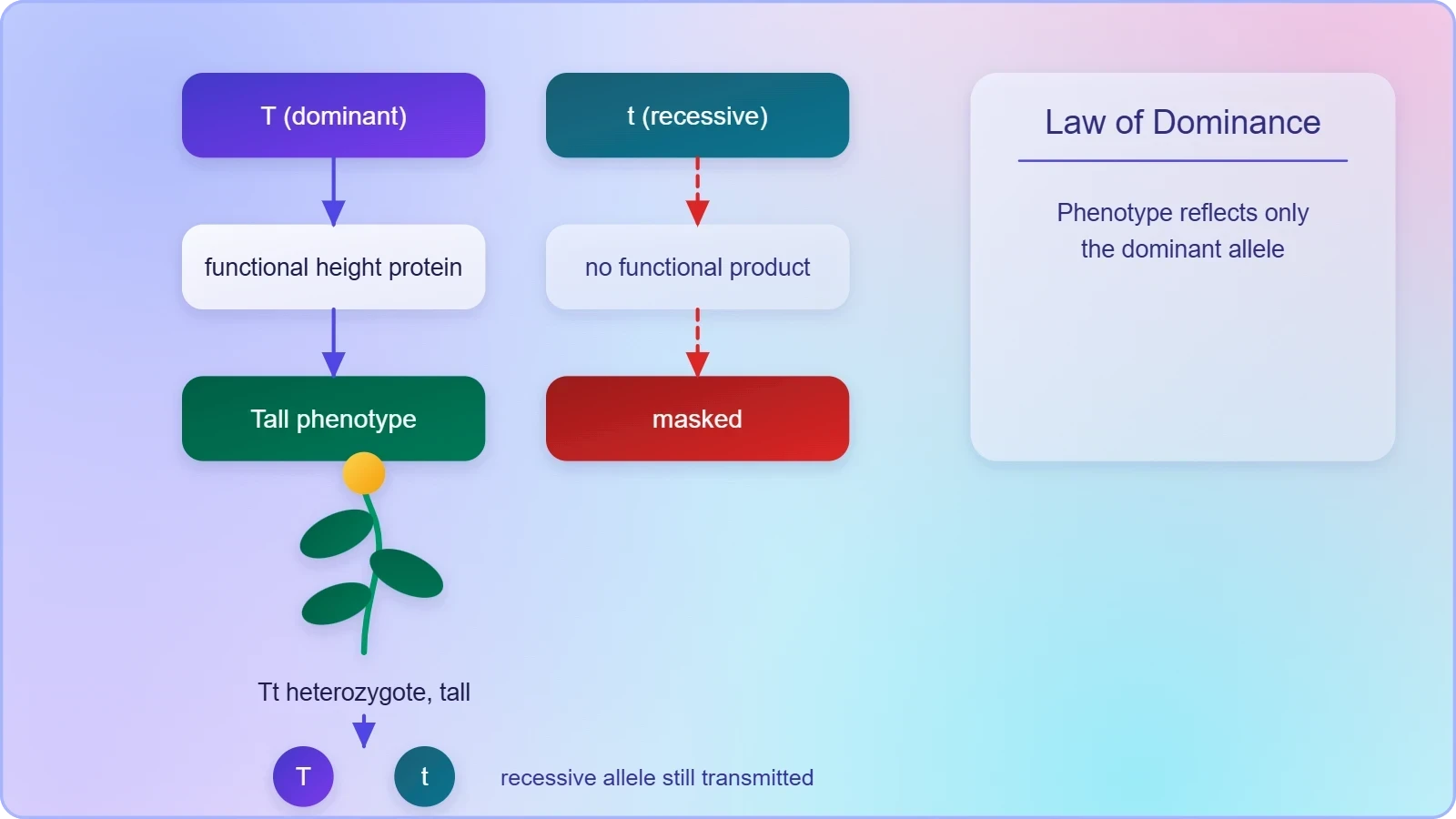
Mendel proposed that in a pair of dissimilar factors one dominates the other and is called the dominant factor, while the other is recessive. In the height character, T for tallness is dominant over t for dwarfness, which is recessive. He observed identical behaviour for every other trait pair he studied, which is why dominance could be elevated from a curious observation to a law. The recessive allele is not destroyed or diluted in the heterozygote; it is simply not expressed in the phenotype, as its reappearance in the F2 generation proves.
The Law of Dominance states that when two dissimilar alleles for a character are present, the phenotype reflects only the dominant allele. This law explains the uniform tall F1 generation and the masking of dwarfness, but it does not by itself explain the 3:1 ratio. For that, a second principle is required, one concerning how alleles behave when gametes are formed. The two laws together form the complete Mendelian account of single-gene inheritance.
The Law of Segregation and Its Chromosomal Basis
The reappearance of the recessive parental trait without any blending in the F2 generation carries a powerful inference. When the tall and dwarf plants produce gametes through meiosis, the alleles of the parental pair separate or segregate from each other, and only one allele is transmitted to each gamete. This segregation is a random process, so there is a fifty per cent chance that any given gamete carries either allele. The gametes of TT plants therefore all carry T, and the gametes of tt plants all carry t, which is why the F1 zygote is invariably Tt.
During fertilisation the two alleles unite, T from one parent through the pollen and t from the other through the egg, producing zygotes with one T and one t. When the F1 heterozygote is self-pollinated, it produces gametes of genotype T and t in equal proportion. Pollen of genotype T has a fifty per cent chance of fertilising an egg of genotype T and a fifty per cent chance of fertilising an egg of genotype t; the same holds for pollen of genotype t. Combining these independent probabilities yields the familiar genotypic ratio of 1 TT : 2 Tt : 1 tt and the phenotypic ratio of 3 tall : 1 dwarf.
Meiosis I as the Physical Mechanism
Mendel knew nothing of chromosomes, yet his Law of Segregation is a direct consequence of their behaviour during meiosis I. Homologous chromosomes, each carrying one allele of a given gene, pair during prophase I and then separate to opposite poles during anaphase I. Because the orientation of each homologous pair on the metaphase plate is random and independent of other pairs, the alleles segregate with equal probability into the haploid gametes. The law is therefore not an abstract rule but a description of a physical process that can be observed under a microscope.
This chromosomal interpretation, developed after the rediscovery of Mendel's work in 1900, reconciled genetics with cytology and founded the chromosomal theory of inheritance. It also explains why segregation fails in certain errors of meiosis, such as nondisjunction, where homologues or sister chromatids fail to separate and gametes receive an abnormal number of chromosomes. Such events produce aneuploid offspring and illustrate how tightly the Mendelian ratios depend on the fidelity of the meiotic machinery.
Using the Punnett Square
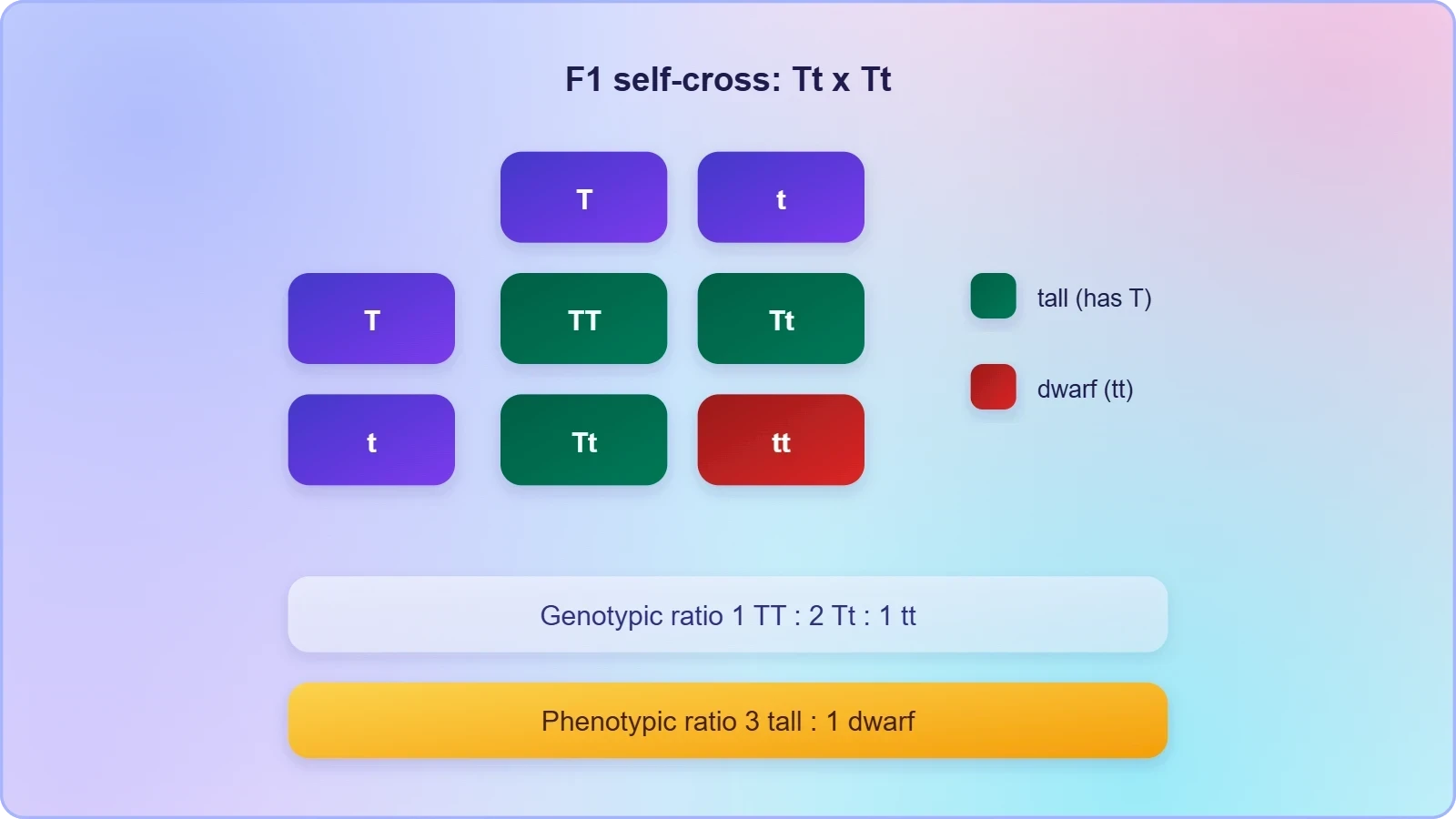
The Punnett square, devised by the British geneticist Reginald C. Punnett, is a graphical device for calculating the probability of all possible genotypes of offspring in a genetic cross. The possible gametes are written along two sides, usually the top row and the left column, and all possible combinations are entered in the boxes below, generating a square output. For the parental cross TT × tt, the male gametes T occupy the top and the female gametes t the left column, and every box contains Tt, predicting a uniformly tall F1.
For the F1 self-cross Tt × Tt, the gametes T and t appear on both axes, and the four boxes contain TT, Tt, Tt and tt. Counting the boxes gives the genotypic ratio 1:2:1 and, because Tt is phenotypically tall, the phenotypic ratio 3:1. The square is a probability table, not a guarantee for any individual family; it describes expected proportions over many offspring. Small samples deviate from expectation by chance, which is precisely why statistical testing is needed.
Probability, Test Crosses and Statistical Verification
Mendelian genetics is applied probability. Each gamete carries one allele chosen at random, and fertilisation combines two gametes independently, so the probability of a particular offspring genotype is the product of the gamete probabilities. For a Tt × Tt cross, the probability of a TT offspring is ##\dfrac{1}{2} \times \dfrac{1}{2} = \dfrac{1}{4}##, and the probability of a tall phenotype is the sum of the TT and Tt probabilities, ##\dfrac{1}{4} + \dfrac{1}{2} = \dfrac{3}{4}##. The product rule applies to independent events, and the sum rule applies to mutually exclusive outcomes.
These rules allow predictions for crosses of any complexity without drawing a square. For a cross between a heterozygote and a homozygote recessive, Tt × tt, the gametes are T and t from one parent and t from the other, giving half Tt (tall) and half tt (dwarf). Recognising that the recessive parent contributes only recessive alleles is the key to the test cross, a tool of enduring practical value in both research and breeding.
The Test Cross in Practice
A test cross is performed by crossing an individual of unknown genotype with a homozygous recessive partner. Because the recessive parent can donate only recessive alleles, the phenotypes of the offspring reveal the gametes of the unknown parent directly. If the unknown is homozygous dominant TT, all offspring receive T and are tall. If the unknown is heterozygous Tt, half the offspring receive t and are dwarf, producing a 1:1 ratio of tall to dwarf. The appearance of any recessive offspring therefore proves heterozygosity.
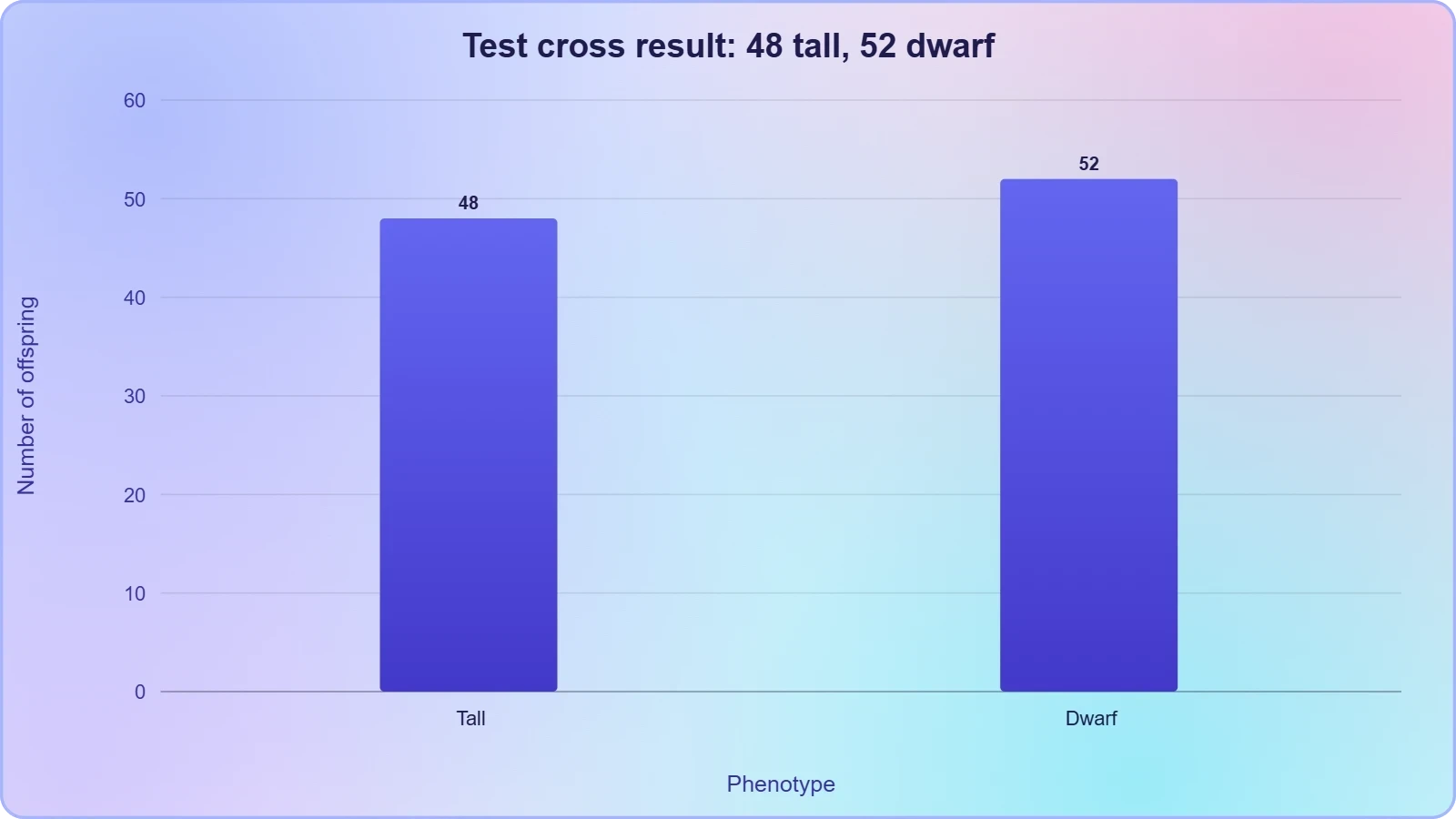
Consider a tall pea plant of uncertain genotype. Crossed with a dwarf plant, it produces 48 tall and 52 dwarf offspring. The near-equal split is decisive evidence that the parent was Tt, since a TT parent could not produce dwarf progeny at all. Conversely, a cross yielding 100 tall and no dwarf offspring is consistent with TT, though strictly it cannot exclude Tt with certainty if the sample is small. This is why geneticists report sample sizes and confidence rather than absolute proof from a single family.
Chi-Square Goodness of Fit
Observed ratios rarely match expectation exactly because of random sampling. The chi-square test quantifies whether the deviation is compatible with the hypothesised ratio. The statistic is calculated as the sum over categories of the squared difference between observed and expected counts divided by the expected count:
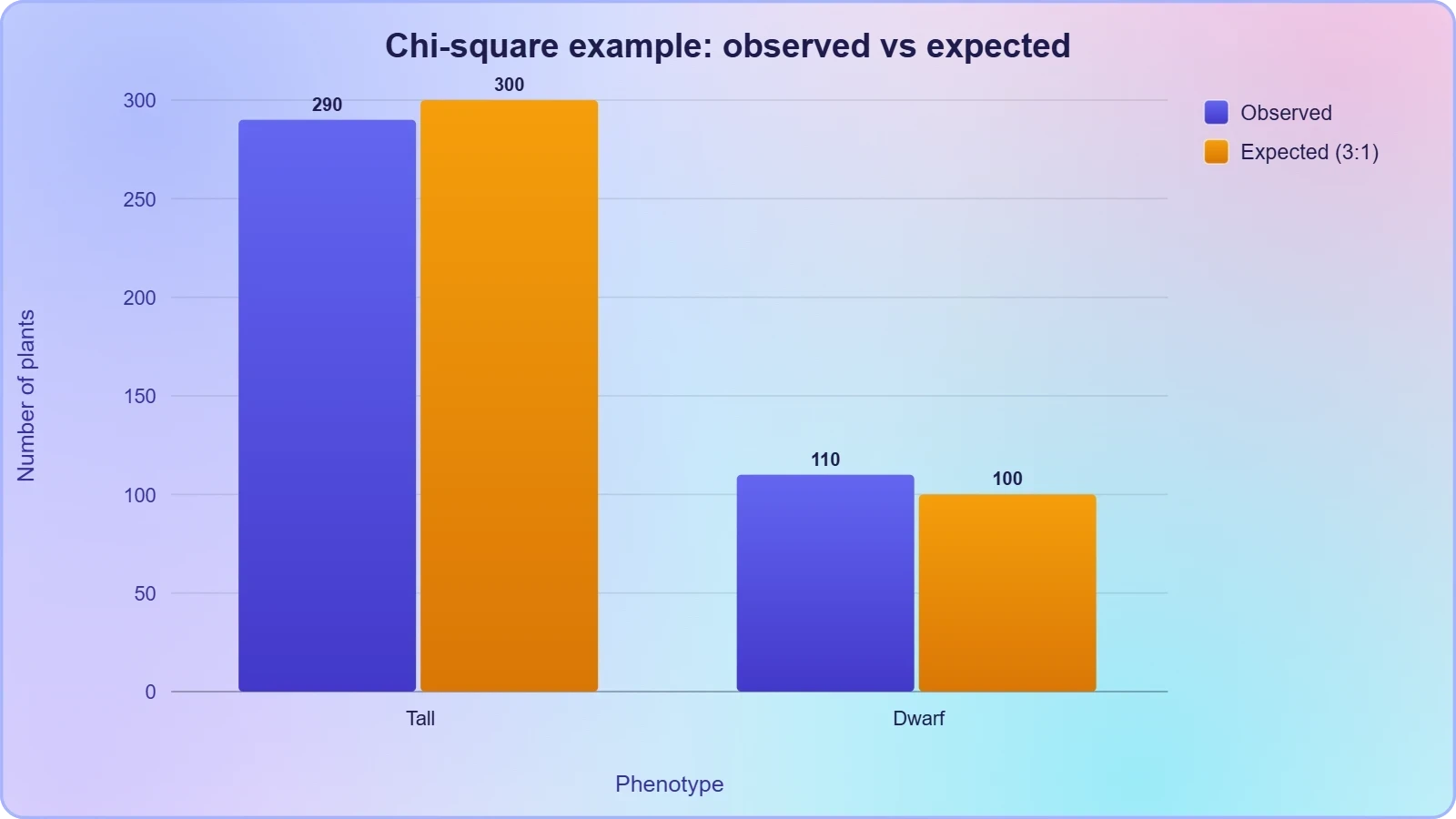
Suppose an F2 generation of 400 plants contains 290 tall and 110 dwarf, against an expected 300 and 100 for a 3:1 ratio. The calculation gives ##\chi^2 = \dfrac{(290-300)^2}{300} + \dfrac{(110-100)^2}{100} = 0.33 + 1.00 = 1.33##. With one degree of freedom, the critical value at the 5 per cent significance level is 3.84, so a statistic of 1.33 is well within the range expected by chance and the 3:1 hypothesis is not rejected.
The Molecular Basis of Dominance
Mendel treated dominance as an empirical rule, but modern molecular biology explains why one allele so often masks another. The commonest mechanism is haplosufficiency: a single functional copy of a gene produces enough protein to generate a normal phenotype, so the heterozygote is indistinguishable from the homozygote. If the dominant allele directs synthesis of a functional enzyme and the recessive allele directs a defective or absent product, half the normal enzyme dose may still be sufficient for the trait, and the recessive phenotype appears only when both copies are defective.
In the classic example of pea seed shape, the round allele encodes a starch-branching enzyme that produces adequate branched starch, while the wrinkled allele carries a transposon insertion that abolishes the enzyme. The homozygote for the defective allele accumulates sucrose, alters osmotic balance and dries into a wrinkled seed. The heterozygote retains enough enzyme activity to produce a round seed, illustrating how a biochemical threshold translates into a visible dominant–recessive relationship.
Haploinsufficiency and Other Mechanisms
Not all dominant alleles work by producing a functional product. In haploinsufficiency, one functional copy is not enough and the heterozygote shows an abnormal phenotype, so the loss-of-function allele behaves as dominant. In other cases a dominant allele encodes a protein that actively interferes with the normal product, a phenomenon called a dominant negative effect. Gain-of-function mutations can also produce dominant phenotypes by making a protein overactive or by giving it a new activity.
These mechanisms matter because they show that dominance is a property of the phenotype and the protein, not an intrinsic attribute of an allele. The same allele may be dominant with respect to one aspect of a trait and recessive with respect to another. This nuance prepares the ground for the next lesson, where dominance itself breaks down and intermediate or joint expression of both alleles is observed.
Lethal Alleles and Distorted Ratios
Some alleles cause death when homozygous, and their presence distorts the expected Mendelian ratios in a characteristic way. A well-known example is the yellow coat colour allele in mice, which is dominant for coat colour but lethal when homozygous. Crossing two yellow heterozygotes yields a genotypic ratio of 1 homozygous yellow : 2 heterozygous yellow : 1 homozygous non-yellow, but the homozygous yellow embryos die, so the surviving offspring appear in a 2:1 ratio of yellow to non-yellow rather than 3:1.
Lethal alleles are important because they demonstrate that a deviation from 3:1 does not necessarily refute Mendel's laws; it may simply reflect the removal of one genotypic class. Recognising this pattern is a standard skill in genetic analysis. The same logic explains why certain human dominant disorders, such as some skeletal dysplasias, are rarely inherited from an affected parent who is homozygous, because that genotype is not viable.
Beyond Complete Dominance: A Preview of Exceptions
Complete dominance, in which the heterozygote is indistinguishable from the dominant homozygote, is common but not universal. In incomplete dominance the heterozygote shows an intermediate phenotype, as when red-flowered and white-flowered snapdragons produce pink hybrids. Selfing the pink heterozygotes yields a 1:2:1 ratio of red to pink to white, because the genotypic and phenotypic ratios coincide. Neither allele is fully expressed, and the phenotype reflects a dosage effect rather than simple masking.
In co-dominance both alleles are expressed simultaneously and distinctly in the heterozygote. The ABO blood group system provides the classic illustration: the A and B alleles each direct a different sugar modification on red blood cells, and an AB individual displays both A and B antigens. The ABO locus also demonstrates multiple alleles, since three common alleles (A, B and O) exist in the population, though any individual carries only two. These refinements do not overturn Mendel's laws; they extend them.
Why the Exceptions Matter
The existence of incomplete dominance and co-dominance shows that dominance is a description of phenotype, not a universal property of alleles. It also explains why some crosses yield three phenotypic classes rather than two, and why the 3:1 ratio is a special case rather than a law of nature. Recognising the underlying 1:2:1 genotypic ratio in all monohybrid crosses is the unifying insight, because the genotype always segregates in the same way regardless of how the heterozygote appears.
These phenomena are treated in full in the next lesson, together with multiple alleles and the genetics of human blood groups. For now, the essential point is that Mendel's Law of Segregation remains intact even when dominance is incomplete, because segregation concerns the transmission of alleles, not their expression. The law describes what happens in meiosis; dominance describes what happens in the phenotype.
Common Mistakes to Avoid
Several errors recur in examinations and in practical genetic reasoning. Confusing genotype with phenotype is the most frequent, as when a student writes that a tall plant is TT without evidence. Assuming that a dominant allele is somehow stronger or more common is another misconception; dominance says nothing about allele frequency or evolutionary advantage. Writing T for tall and d for dwarf, mixing letters from different genes, invites confusion about which alleles belong together.
Another common error is treating the 3:1 ratio as a guarantee for small families. A cross of two heterozygotes producing four offspring may yield four tall plants by chance, and this does not refute the underlying probability. Finally, students sometimes forget that the recessive allele is still present in heterozygotes and can reappear in later generations. The test cross exists precisely to expose hidden recessive alleles, and the chi-square test exists to judge whether deviations are meaningful.
Worked Examples and Computational Practice
Translating Mendelian logic into computation consolidates understanding and prepares for the more complex dihybrid problems that follow. The short program below simulates a monohybrid cross and reports the expected genotypic and phenotypic proportions, illustrating how the product and sum rules of probability generate the familiar ratios. Such simulations are routinely used in teaching and in research to model expected outcomes before comparing them with observed data.
from itertools import product

def monohybrid_cross(parent1, parent2):
    # Each parent contributes one allele at random
    offspring = [a + b for a, b in product(parent1, parent2)]
    genotypes = {}
    for g in offspring:
        genotypes[g] = genotypes.get(g, 0) + 1
    total = len(offspring)
    return {g: c / total for g, c in genotypes.items()}

# Cross two heterozygotes: Tt x Tt
result = monohybrid_cross("Tt", "Tt")
print(result)  # {'TT': 0.25, 'Tt': 0.5, 'tt': 0.25}

# Phenotype mapping: any genotype containing 'T' is tall
phenotypes = {"tall": 0.0, "dwarf": 0.0}
for g, p in result.items():
    if "T" in g:
        phenotypes["tall"] += p
    else:
        phenotypes["dwarf"] += p
print(phenotypes)  # {'tall': 0.75, 'dwarf': 0.25}
The output confirms the theoretical expectations: a genotypic ratio of 1:2:1 and a phenotypic ratio of 3:1. Extending the function to a test cross, where one parent is tt, immediately yields the 1:1 ratio that identifies a heterozygote. Students preparing for competitive examinations should be able to perform these calculations by hand as well, since the underlying logic is what examiners test, not the code itself.
Applying the Rules to Unfamiliar Cases
Consider a plant species in which flower colour is controlled by a single gene with complete dominance, violet being dominant to white. A violet plant of unknown genotype is crossed with a white plant and produces 60 violet and 58 white offspring. The near 1:1 ratio identifies the violet parent as heterozygous. If instead the cross produced 120 violet and no white offspring, the parent would be judged homozygous dominant, subject to the caveat that a larger sample would strengthen the conclusion.
Now suppose two violet heterozygotes are crossed and produce 200 offspring, of which 155 are violet and 45 are white. The expected numbers are 150 and 50, and the chi-square statistic is ##\dfrac{(155-150)^2}{150} + \dfrac{(45-50)^2}{50} = 0.17 + 0.50 = 0.67##, comfortably below the critical value of 3.84. The data are consistent with a 3:1 ratio, and the small deviation is attributable to chance rather than to any failure of the model.
Connecting to the Wider Course
The monohybrid cross is the template for everything that follows. The dihybrid cross extends the same logic to two genes simultaneously, and the law of independent assortment emerges from the behaviour of two or more pairs of homologous chromosomes during meiosis. Linkage and recombination complicate the picture when genes reside on the same chromosome, and polygenic inheritance and pleiotropy show how multiple genes and multiple effects produce continuous variation and complex syndromes. Each of these topics presupposes a firm grasp of segregation and dominance.
Sex determination, mutation and human genetic disorders, treated later in the course, also rest on these foundations. A mutation is essentially a change in the DNA sequence of an allele, and its phenotypic consequences are interpreted through the same dominant–recessive framework. Pedigree analysis of inherited disorders uses the very ratios and test-cross logic developed here. Mastery of the monohybrid cross is therefore not an isolated skill but the grammar of genetic reasoning.
Consolidating the Lesson: Key Takeaways and Self-Assessment
The monohybrid cross reveals that inheritance is particulate rather than blending, that alleles segregate randomly during gamete formation, and that dominance determines which allele is visible in the heterozygote. Mendel's large samples, controlled crosses and successive generations gave his conclusions a credibility that earlier speculation lacked. The 3:1 phenotypic ratio and the 1:2:1 genotypic ratio are the signatures of a single-gene cross with complete dominance, and they can be derived from the product and sum rules of probability without drawing a single square.
Modern molecular biology explains dominance through haplosufficiency and related mechanisms, while lethal alleles, incomplete dominance and co-dominance show that the simple framework requires refinement in specific cases. The chi-square test provides the statistical discipline needed to judge whether observed deviations are meaningful, and the test cross provides the experimental method for determining unknown genotypes. Together these tools equip the student to analyse real genetic data rather than merely recite ratios.
Self-Assessment Questions
Attempt these before moving to the next lesson. First, explain why the F1 generation of a monohybrid cross is uniformly tall while the F2 generation shows both traits. Second, a tall pea plant is crossed with a dwarf plant and produces 30 tall and 28 dwarf offspring; deduce the genotype of the tall parent and justify your answer. Third, calculate the probability that a Tt × Tt cross produces a dwarf offspring, showing your use of the product and sum rules. Fourth, explain how the behaviour of homologous chromosomes in meiosis I supports the Law of Segregation.
Fifth, describe a situation in which a monohybrid cross yields a 2:1 ratio and explain the cause. Sixth, outline how you would use a chi-square test to evaluate an observed 3:1 ratio in a sample of 320 plants. Seventh, explain the molecular basis of dominance in terms of haplosufficiency, using the pea seed shape example. Finally, distinguish between genotype and phenotype, and explain why the distinction matters in the interpretation of a test cross.
Looking Ahead
The next lesson moves beyond complete dominance to incomplete dominance, co-dominance and multiple alleles, using snapdragon flower colour and the ABO blood groups as principal examples. These phenomena preserve the Law of Segregation while complicating the relationship between genotype and phenotype, and they prepare the ground for the dihybrid cross and the law of independent assortment. Students should ensure they can manipulate Punnett squares fluently before proceeding, because the two-gene problems that follow multiply the number of genotypic classes and reward systematic reasoning.
Returning to Mendel's original question, why an elephant gives birth only to an elephant, the answer now has structure: inheritance is mediated by discrete factors transmitted through gametes, and variation arises from the recombination and segregation of those factors. The monohybrid cross is the simplest demonstration of that principle, and its logic scales from a single gene in a pea plant to the complex traits of whole organisms. Mastery of this lesson is the foundation on which the rest of the course is built.
Also Read
- No links available.
From our network :
- 98% of Global MBA Programs Now Prefer GRE Over GMAT Focus EditionExplore why 98% of global MBA programs now prefer the GRE over GMAT Focus. Learn about the shorter GRE format, verbal logic importance, and strategic versatility for students.
- EV 2.0: The Solid-State Battery Breakthrough and Global Factory ExpansionDiscover the impact of the Solid-State Battery Breakthrough on the EV market. Learn about CATL and BYD stock growth, global factory expansion in Europe, and the future of EV 2.0 technology.
- Analyzing Trump Deportation Numbers Insights Into The 2026 Immigration Crackdown
- Trump Political Strategy How Geopolitical Stunts Serve As Media Diversions
- Do You Need a New Router or Is Your Internet Plan the Problem?A practical comparison of the signs that point to router limits versus signs your broadband speed or provider is the bottleneck, so you can decide what to replace before spending money.
- AI-Powered 'Precision Diagnostic' Replaces Standard GRE Score ReportsDiscover the new GRE Precision Diagnostic. Learn how AI-powered behavioral analytics and time-to-solve tracking are replacing standard GRE score reports to empower students.
- Where to Put Your Wireless Router for Better CoverageA practical, physics-grounded guide to router placement: why the centre of the home beats the corner, how walls and metal sap signal, and how to run a simple survey that proves the improvement.
- 10 Physics Numerical Problems with Solutions for IIT JEEPrepare for IIT JEE with 10 physics numerical problems, complete with detailed solutions and conceptual explanations. Ideal for mastering kinematics, thermodynamics, electromagnetism, and optics.
- How to Print Cheaply: Cutting the Cost per PageA practical, measured guide to lowering what each printed page costs — duplex and draft modes, third-party ink, yield mathematics, and knowing when a new printer beats refills.
RESOURCES
- Mendel's Laws of Inheritance - BYJU'Sbyjus.comTo know more about this experiment, visit Monohybrid Cross – Inheritance Of One Gene. ... Mendel's laws of inheritance include law of dominance, law…
- Mendel's Laws: Law Of Independent Assortment, Segregation ...scienceabc.comJun 30, 2026 ... This type of cross or breeding is called a monohybrid cross. This simply observes the inheritance pattern of one character.…
- 12.3 Laws of Inheritance - Biology 2e | OpenStaxopenstax.orgMar 28, 2018 ... Mendel's law of dominance states that in a heterozygote, one trait ... monohybrid cross that follows a dominant and recessive…
- Laws of Inheritance - OERTXoertx.highered.texas.govMendel's law of dominance states that in a heterozygote, one trait will ... monohybrid cross that follows a dominant and recessive pattern. Ignoring ...
- 8.2 Laws of Inheritance - Concepts of Biology | OpenStaxopenstax.orgApr 25, 2013 ... Use a Punnett square to calculate the expected proportions of genotypes and phenotypes in a monohybrid cross ... Mendel's law…
- Mendel's Law of Dominance Explained | PDF | Science & Mathematicsscribd.comMendel's Law of Dominance explains that in a cross between two organisms with pure contrasting alleles, only one allele is expressed in the F1…
- Laws of Inheritance and Single-Gene Inheritance – Introductory ...open.lib.umn.eduUse a Punnett square to calculate the expected proportions of genotypes and phenotypes in a monohybrid cross; Explain Mendel's law of segregation and ...
- Clarifying Mendelian vs non-Mendelian inheritance - PMC - NIHpmc.ncbi.nlm.nih.govMay 28, 2024 ... Gregor Mendel developed the principles of segregation and independent assortment in the mid-1800s based on his detailed analysis of several ...
- Laws of Inheritance – Introductory Biologyopen.lib.umn.eduUse a Punnett square to calculate the expected proportions of genotypes and phenotypes in a monohybrid cross ... Mendel's law of dominance states that…
- 8.2 Laws of Inheritance – Concepts of Biology-1st Canadian Editionecampusontario.pressbooks.pubUse a Punnett square to calculate the expected proportions of genotypes and phenotypes in a monohybrid cross ... Mendel's law of dominance states that…
- Principles of Inheritance and Variation.pmd - NCERTncert.nic.inBased on his observations on monohybrid crosses Mendel proposed two general ... Today these rules are called the Principles or. Laws of Inheritance: the…
- Mendelian inheritance - Wikipediaen.wikipedia.orgIn some literature sources, the principle of segregation is cited as the "first law". Nevertheless, Mendel did his crossing experiments with heterozygous ...
- Monohybrid inheritance | History | Research Starters - EBSCOebsco.comIn a monohybrid cross, Mendel identified key principles, including the principle of segregation ... Mendel, they still conform to his law of segregation.
- Mendel's Laws of Inheritance Gregor Johann Mendel is known as ...facebook.comAug 10, 2026 ... Important Ratios Monohybrid Cross A typical complete-dominance monohybrid cross ... Mendel's 3 Laws of Inheritance: 1️⃣ Law of Dominance ...
- 5. PRINCIPLES OF INHERITANCE AND VARIATION - S3waascdnbbsr.s3waas.gov.inMendel conducted test cross to determine the F2 genotype. Mendel's Principles or Laws of Inheritance: 1. First Law (Law of Dominance). Characters are ...