Every organism you have ever seen, from the smallest bacterium to the tallest tree and the largest whale, began its existence as a single cell. That single cell then produced the millions, billions, or even trillions of cells that make up a mature body. The mechanism behind this transformation is not mysterious or magical; it is the ordinary, observable capacity of cells to grow and to divide. Growth and reproduction are characteristics of cells, and indeed of all living organisms, and cell division is the process through which these characteristics are expressed at the cellular level.
When a cell divides, it does not simply break apart. It gives rise to two daughter cells, and each time this happens the parental cell produces two new cells that carry the same hereditary material. These newly formed daughter cells can themselves grow and divide, so that a new cell population arises from the growth and division of a single parental cell and its progeny. In other words, such cycles of growth and division allow a single cell to form a structure consisting of millions of cells. This lesson opens the study of the cell cycle and cell division by establishing that simple, foundational idea.
The lesson is deliberately introductory. It does not yet examine the internal timetable of the cell cycle, the mechanics of mitosis, or the two divisions of meiosis; those belong to the lessons that follow. What it does is establish the vocabulary and the logic on which everything else rests: that cells reproduce by dividing into two, that daughter cells are the products of that division, and that repeated cycles of growth and division build a cell population from a single ancestor. Mastery of this idea makes the coordinated events of the cell cycle far easier to understand when they are introduced next.
On This Page
The Single Cell as the Starting Point of Every Organism
All organisms, even the largest, start their life from a single cell. This statement is the anchor of the entire chapter, and it deserves to be read slowly. It means that the enormous structural complexity of a mature organism is not present at the beginning; it is generated. The single cell is not a miniature version of the adult, but a starting point equipped with the capacity to grow and to reproduce. From that one cell, through repeated rounds of division, a structure consisting of millions of cells can arise.
Growth and Reproduction as Cellular Characteristics
Growth and reproduction are characteristics of cells, indeed of all living organisms. At the cellular level, growth refers to an increase in the cell's substance, including its cytoplasm, while reproduction refers to the formation of new cells from existing ones. These two capacities are intimately linked, because a cell must accumulate material before it can divide, and the products of division must grow before they can divide again. Recognising growth and reproduction as cellular properties, rather than as properties of whole organisms only, is the conceptual shift this lesson asks you to make.
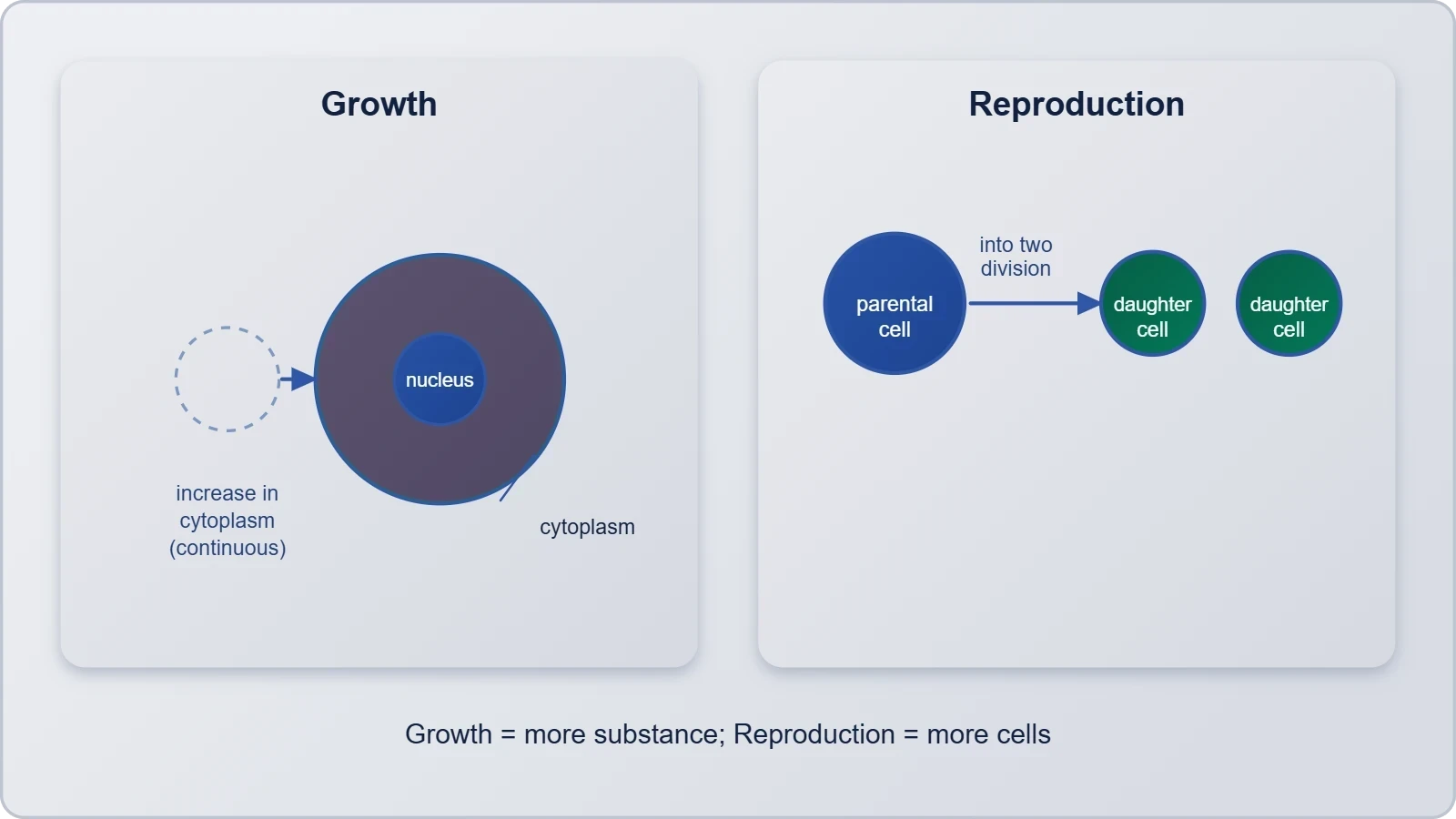
It is worth noting how the material frames growth. Cell growth, in terms of cytoplasmic increase, is described as a continuous process. This contrasts with other events in the life of a cell that occur only at specific times. Keeping this distinction in mind prepares you for the next lesson, where the discontinuous, one-time event of DNA synthesis is set against the continuous background of cytoplasmic growth. For now, the essential point is that growth and reproduction are not separate phenomena but two faces of the same cellular life.
Why Starting Small Matters
Starting from a single cell imposes a constraint and confers an advantage. The constraint is that every new structure must be built by division of existing cells; there is no other route to a larger cell population. The advantage is that the process is self-propagating: each daughter cell inherits the capacity to repeat the cycle. This is why a single parental cell and its progeny can, in principle, generate an indefinitely large population. The arithmetic is simple but powerful, and it explains how a modest beginning can produce an organism of immense size.
This perspective also clarifies why cell division is described as a very important process in all living organisms. Without it, a single cell would remain a single cell. With it, growth becomes possible, and so does the replacement of cells. The lesson therefore treats division not as an occasional event but as the central activity through which cellular life extends itself in space and time. Everything that follows in the course is, in a sense, an elaboration of this one sentence.
Division into Two: Parental Cells and Daughter Cells
All cells reproduce by dividing into two, with each parental cell giving rise to two daughter cells each time they divide. This sentence contains the whole mechanism in miniature. The cell that divides is called the parental cell; the two cells produced are called daughter cells. The relationship is one of descent: the daughter cells are the offspring of the parental cell, and they carry forward its material. The terminology matters because it is used consistently throughout the study of the cell cycle, mitosis, and meiosis, and it encodes the direction of inheritance.
The Parental Cell and Its Two Products
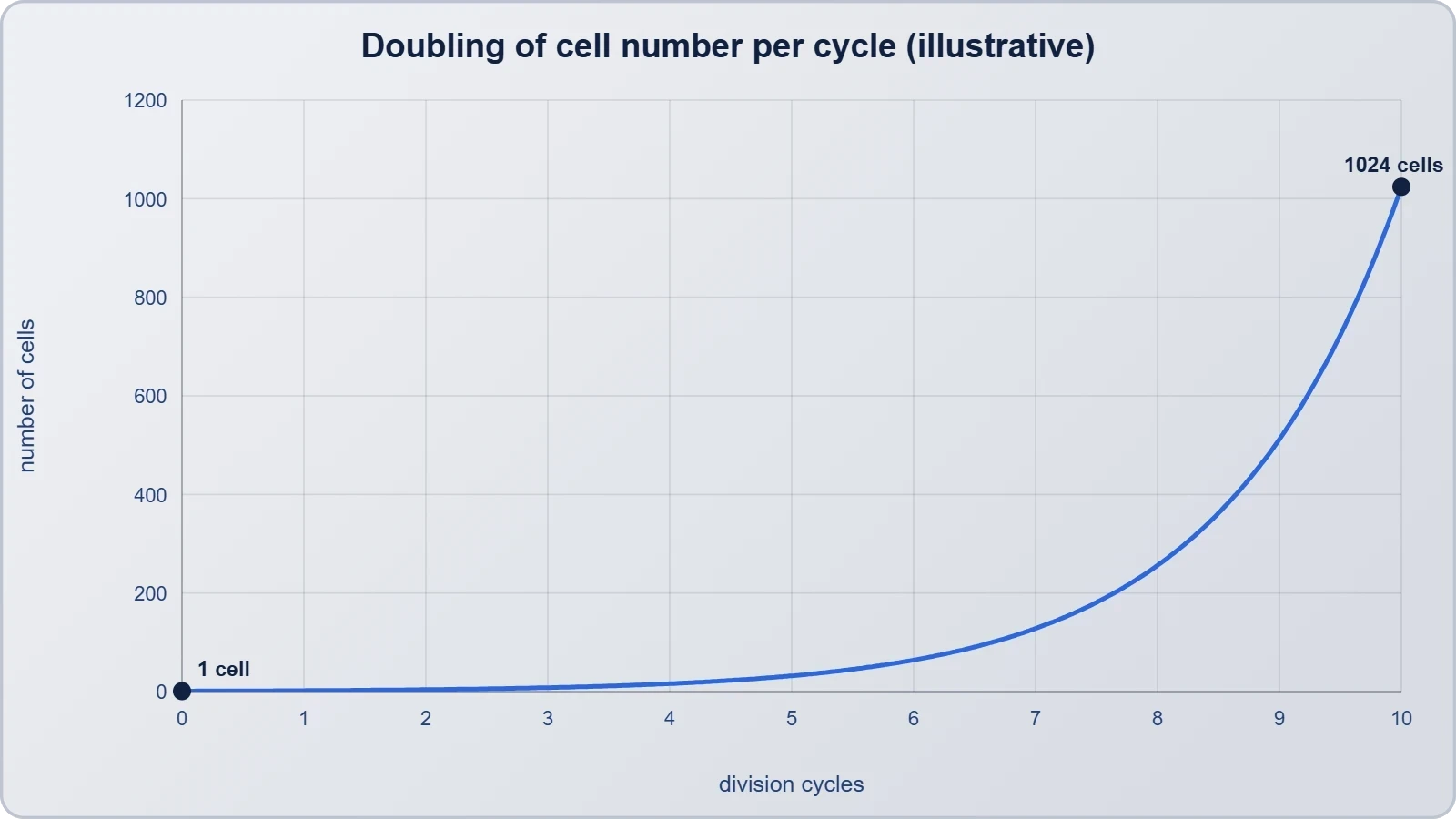
Notice that division produces two daughter cells, not one and not three. This doubling is what makes exponential growth of a cell population possible. Each division replaces one cell with two, so the number of cells increases with every round. The parental cell does not survive as a separate entity after division; its substance is distributed between the two products. Understanding this helps you avoid a common confusion, namely imagining that a cell divides and leaves behind an unchanged original. In division, the original becomes the two daughters.
The phrase each time they divide is also significant. Division is not a one-off event in the history of a cell lineage; it is repeatable. A daughter cell can itself become a parental cell, and its daughters can do the same. This repetition is what converts a single division into a sustained process of population growth. The lesson therefore presents division as a cycle of events rather than a single act, which is precisely the idea that the term cell cycle will formalise in the next lesson.
Daughter Cells as the Units of a New Population
These newly formed daughter cells can themselves grow and divide, giving rise to a new cell population that is formed by the growth and division of a single parental cell and its progeny. The word progeny is used here in its biological sense: the descendants of the original cell, considered collectively. A cell population is thus not an arbitrary collection of cells but a lineage, a family descended from one ancestor. This framing is important because it connects the behaviour of individual cells to the growth of tissues and organisms.
When you picture a new cell population, picture it as a genealogy. One cell divides into two; those two grow and divide into four; those four into eight, and so on. Each generation is the progeny of the last. The population is therefore both a number and a history. This dual character, quantitative and genealogical, is what makes the study of cell division so central to biology. It explains how a single cell can form a structure consisting of millions of cells without any external blueprint being imposed from outside.
Cycles of Growth and Division Build a Cell Population
The phrase cycles of growth and division is the heart of this lesson. A cycle implies return: the cell grows, divides, and the products grow and divide again. This repetition is what allows a single cell to form a structure consisting of millions of cells. The material states this explicitly, and it is worth pausing on the scale involved. Millions of cells cannot arise from a single division; they arise from many successive divisions, each preceded by growth. The cycle, not the single event, is the unit of explanation.
Growth Preceding Division
Growth is not incidental to division; it is a precondition. A cell must accumulate material before it can give rise to two viable daughter cells, each of which must receive a share of the cell's substance. The material describes cell growth in terms of cytoplasmic increase and notes that this growth is a continuous process. This continuous accumulation provides the raw material that division then distributes. Without growth, division would produce progressively smaller cells, and the lineage would shrink rather than expand.
This is why the lesson insists on cycles rather than on division alone. A division without prior growth is not a sustainable strategy. The pairing of growth and division ensures that each generation of cells is adequately provisioned. When you later encounter the formal definition of the cell cycle as the sequence of events by which a cell duplicates its genome, synthesises the other constituents of the cell and eventually divides into two daughter cells, you will recognise growth as one of those synthesised constituents, and division as the culminating event.
From One Cell to Millions
The claim that cycles of growth and division allow a single cell to form a structure consisting of millions of cells is a statement about potential, not about a fixed schedule. It says that the capacity for indefinite expansion is built into the mechanism. Whether a particular lineage actually reaches millions of cells depends on how many cycles it completes, but the mechanism itself imposes no ceiling. This is the sense in which a single cell contains, in its behaviour, the possibility of a whole organism.
It is useful to hold this image alongside the genealogical one. The population is a family tree, and the family tree grows by doubling. Each node in the tree is a cell, each edge a division, and the whole structure is the progeny of a single ancestor. When the material says that a new cell population is formed by the growth and division of a single parental cell and its progeny, it is describing exactly this tree. The tree is the population, and the population is the tree.
Coordination: Division, DNA Replication and Cell Growth
Cell division is a very important process in all living organisms, and during the division of a cell, DNA replication and cell growth also take place. This sentence introduces a triad that governs the rest of the course: division, replication, and growth. All these processes have to take place in a coordinated way to ensure correct division and formation of progeny cells containing intact genomes. The word coordinated is doing serious work here. It signals that these are not independent activities that happen to occur together, but interdependent events that must be ordered correctly.
Why the Processes Must Be Coordinated
Consider what would go wrong if coordination failed. If a cell divided before its DNA had been replicated, the daughter cells would receive incomplete genomes. If replication occurred without eventual division, the cell would accumulate extra copies of its genetic material. If growth outpaced division, cells would enlarge without increasing in number. The requirement for intact genomes in the progeny cells is therefore the standard against which coordination is judged. The material states this plainly, and it is the reason the cell cycle is described as a sequence rather than a collection.
The phrase intact genomes deserves attention. A genome is the complete set of genetic material in a cell, and intact means whole and undamaged. The purpose of coordination is to ensure that each daughter cell receives a complete, undamaged copy. This is the biological logic behind the ordered events you will study later. When the next lesson defines the cell cycle as the sequence of events by which a cell duplicates its genome, synthesises the other constituents of the cell and eventually divides into two daughter cells, it is simply naming the coordinated programme that this lesson has introduced.
A First Glimpse of the Cell Cycle
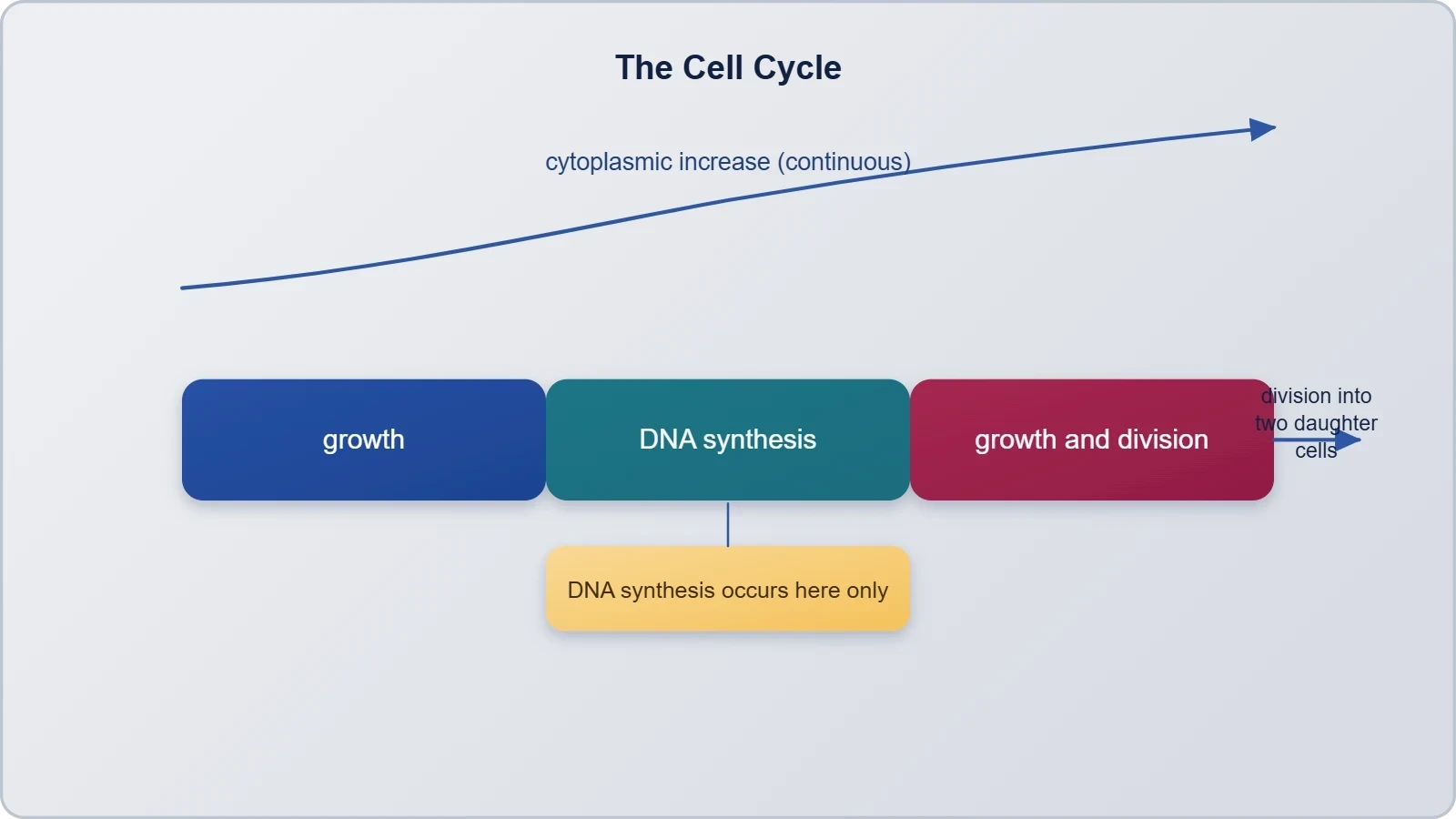
The material offers a compact definition that belongs properly to the next lesson but is worth previewing here: the sequence of events by which a cell duplicates its genome, synthesises the other constituents of the cell and eventually divides into two daughter cells is termed the cell cycle. Three elements stand out. First, duplication of the genome. Second, synthesis of the other constituents, which is growth. Third, eventual division into two daughter cells. The definition is a sequence, and the sequence is what makes coordination possible.
Two further observations from the material sharpen the picture. Although cell growth, in terms of cytoplasmic increase, is a continuous process, DNA synthesis occurs only during one specific stage in the cell cycle. This asymmetry is fundamental: growth is spread out, while replication is confined to a particular window. The replicated chromosomes are then distributed to daughter nuclei by a complex series of events during cell division, and these events are themselves under genetic control. The preview thus establishes three ideas: sequence, specificity, and genetic control.
Terminology and the Road Ahead
The lesson closes by consolidating the vocabulary that the rest of the course will use. Parental cell, daughter cell, progeny, cell population, growth, division, DNA replication, genome, and cell cycle are not decorative terms; each names a specific concept that will be developed in later lessons. Learning them now, in the order the material presents them, means that the more technical discussions of M phase, mitosis, cytokinesis, and meiosis will have a stable foundation. Terminology is not a preliminary to understanding; it is part of understanding.
Key Terms Established in This Lesson
The most important term is cell cycle, previewed here and defined fully in the next lesson. Alongside it sit the paired terms parental cell and daughter cell, which encode the direction of descent, and the collective term progeny, which names the descendants of a single cell. Cell population names the aggregate formed by growth and division. Genome names the genetic material whose integrity coordination protects. Each term will recur, and each will acquire additional precision as the course proceeds through the phases of the cycle and the stages of division.
It is worth noting the order in which the material introduces these ideas. It begins with the single cell and the fact of growth and reproduction, then describes division into two daughter cells, then the formation of a new cell population, then the coordination of division, replication, and growth, and only then offers the definition of the cell cycle. This order is pedagogical: it moves from the observable to the conceptual. Following it ensures that the definition of the cell cycle arrives as a summary of things already understood, not as an isolated formula to be memorised.
Preparing for the Cell Cycle
The next lesson takes up the cell cycle in detail: the coordinated events of division, DNA replication, and growth. It will formalise the sequence previewed here and introduce the phases through which a cell passes. Because this lesson has established that growth is continuous while DNA synthesis occurs only during one specific stage, you are already prepared for the idea of a cycle with distinct phases. Because it has established that the events are under genetic control, you are prepared for the regulatory language that follows.
Beyond the next lesson, the course will examine M phase and its stages, the significance of mitosis, the two divisions of meiosis with their sub-stages, and the significance of meiosis. Each of these builds on the simple fact with which this lesson began: cells grow and reproduce by dividing into two. The single cell that starts an organism and the millions of cells that constitute it are connected by nothing more exotic than repeated cycles of growth and division, executed with coordination and under genetic control.
Going Further
The material in this lesson stands on its own, but two well-established background points help place it in a wider biological context. The first concerns the origin of the single cell in sexually reproducing organisms. In such organisms, the single cell from which the individual starts is the zygote, formed by the fusion of gametes. The zygote then undergoes repeated cycles of growth and division, exactly as described in this lesson, to produce the multicellular body. This does not alter the lesson's claims; it simply identifies the single cell in one important case.
The Zygote as the Starting Cell
In sexually reproducing organisms, the zygote is the product of fertilisation, and it is the cell from which all subsequent cells of the organism descend. The cycles of growth and division described in this lesson then generate the cell population of the adult body. Recognising the zygote as a specific instance of the single starting cell makes the general principle concrete without changing it. The lesson's statement that all organisms start their life from a single cell remains the governing idea; the zygote is simply the name of that cell in organisms that reproduce sexually.
Division as the Basis of Growth and Repair
Cell division is the basis not only of growth but also of repair in multicellular organisms. When tissues are damaged, new cells are produced by division to replace those that are lost. This extends the lesson's account without contradicting it: the same cycles of growth and division that build a cell population during development also maintain it in the adult. The material's emphasis on division as a very important process in all living organisms is thus borne out in both growth and repair, and the coordination it demands remains essential in both contexts.
Also Read
- No links available.
From our network :
- AI-Powered 'Precision Diagnostic' Replaces Standard GRE Score ReportsDiscover the new GRE Precision Diagnostic. Learn how AI-powered behavioral analytics and time-to-solve tracking are replacing standard GRE score reports to empower students.
- 98% of Global MBA Programs Now Prefer GRE Over GMAT Focus EditionExplore why 98% of global MBA programs now prefer the GRE over GMAT Focus. Learn about the shorter GRE format, verbal logic importance, and strategic versatility for students.
- Mastering DB2 12.1 Instance Design: A Technical Deep Dive into Modern Database ArchitectureComprehensive guide to DB2 12.1 Instance Design. Explore architectural components, HADR setup, buffer pool tuning, and security policies for IBM DB2 12.1. Includes 10 functional SQL and Shell samples.
- Mastering DB2 LUW v12 Tables: A Comprehensive Technical GuideComprehensive guide on DB2 LUW v12 tables. Explore CREATE TABLE syntax, BLU Acceleration, range partitioning, data types, and security features for IBM DB2 LUW v12.
- 10 Physics Numerical Problems with Solutions for IIT JEEPrepare for IIT JEE with 10 physics numerical problems, complete with detailed solutions and conceptual explanations. Ideal for mastering kinematics, thermodynamics, electromagnetism, and optics.
- Trump Political Strategy How Geopolitical Stunts Serve As Media Diversions
- Analyzing Trump Deportation Numbers Insights Into The 2026 Immigration Crackdown
- Vite 6/7 'Cold Start' Regression in Massive Module GraphsIn-depth analysis of Vite 6/7 cold start regressions in massive module graphs. Learn about barrel file issues, pre-bundling optimizations, and how to improve Vite dev server performance.
- EV 2.0: The Solid-State Battery Breakthrough and Global Factory ExpansionDiscover the impact of the Solid-State Battery Breakthrough on the EV market. Learn about CATL and BYD stock growth, global factory expansion in Europe, and the future of EV 2.0 technology.
RESOURCES
- Cell Cycle and Cell Division Chapter 10 - NCERTncert.nic.inIn animals, mitotic cell division is only seen in the diploid somatic cells. However, there are few exceptions to this where haploid cells divide…
- Potassium channels in cell cycle and cell proliferation - PMC - NIHpmc.ncbi.nlm.nih.govK+ channels have been implicated in the control of cell-cycle progression both through their influence on the membrane potential and non-canonical, permeation- ...
- Linking the Cell Cycle to Cell Fate Decisions - PubMed - NIHpubmed.ncbi.nlm.nih.govCell Cycle / genetics*; Cell Differentiation / genetics*; Cell Division / genetics; G1 Phase / genetics; Genetic Heterogeneity*; Humans; Pluripotent Stem Cells* ...
- Two different cell-cycle processes determine the timing of cell ... - eLifeelifesciences.orgOct 6, 2021 ... In Escherichia coli, it is controversial whether cell division is tied to chromosome replication or to a replication-independent inter-division ...
- Acute degradation of nucleolin reveals its novel functions in cell ...pubmed.ncbi.nlm.nih.govJul 14, 2025 ... Acute degradation of nucleolin reveals its novel functions in cell cycle progression and cell division in triple negative breast cancer…
- Cell Division: Turning cell cycle entry on its head - eLifeelifesciences.orgJul 1, 2014 ... A cell essentially 'decides' to divide when it is in G1-phase; and when it commits to entering the cell cycle,…
- Enzyme Pulses Start Cell Division | Center for Cancer Researchccr.cancer.govStudy uncovers new details on pulsing enzyme activity during cell cycle. Cells showing the biosensor used in this ...
- Coupling and decoupling of the cell cycle from cell differentiation in ...journals.biologists.comOct 9, 2025 ... For example, in externally developing embryos of animals such as frogs or fish, early embryonic cells divide without growing between…
- 7.2: Cell Cycle and Cell Division - Biology LibreTextsbio.libretexts.orgThe cell cycle in prokaryotes is quite simple: the cell grows, its DNA replicates, and the cell divides. This form of division in prokaryotes…
- Intracellular potassium levels orchestrate circadian rhythmicity and ...nature.comMay 22, 2026 ... Cues that synchronise circadian rhythms of mammalian cells with the external day/night cycle also shift timing of cell division and…
- Learn: Phases of the cell cycle (article) | Khan Academykhanacademy.orgThe cell cycle is composed of interphase (G₁, S, and G₂ phases), followed by the mitotic phase (mitosis and cytokinesis), and G₀ phase. Introduction.…
- Regulation of Cell Cycle to Stimulate Adult Cardiomyocyte ...cell.comMar 1, 2018 ... In vivo lineage tracing revealed that 15%–20% of adult cardiomyocytes expressing the four factors underwent stable cell division, with ...
- Cycling in a crowd: Coordination of plant cell division, growth, and ...academic.oup.comCell cycle progression and cell division are core processes for life, directly connected with the replication of genetic material and its transmission through ...
- Cell size homeostasis: Metabolic control of growth and cell divisionsciencedirect.comGrowth rate in animal cells can also be adjusted conditionally, depending for example on cell size at birth (the cell size immediately after cell…
- The effects of proliferation status and cell cycle phase on the ...molbiolcell.orgMar 31, 2020 ... DNA-damaging chemotherapy often leaves residual tumor cells. Combining single-cell long-term live imaging with information theory, ...