Every complete flower carries two reproductive whorls that sit at the very centre of its architecture, and reading them correctly is the difference between a vague impression of a blossom and a precise botanical description. The androecium, built from stamens, is the male reproductive organ of the flower, while the gynoecium, built from carpels, is the female reproductive part. Together they form the essential whorls, the structures that actually carry out fertilisation and set the stage for fruit and seed formation. This lesson examines both whorls in the order the unit presents them, beginning with the stamen and its attachments and unions, then moving to the carpel, the stigma, style and ovary, the distinction between apocarpous and syncarpous gynoecia, and finally the six recognised types of placentation.
The material builds directly on the calyx and corolla discussed previously. Having established how sepals and petals are arranged, and how aestivation describes the way members of a whorl touch or overlap, the lesson now turns to the whorls that follow them inward. Where the previous lesson dealt with protection and attraction, this one deals with reproduction. The terminology is dense but orderly: filament, anther, pollen-sac, staminode, epipetalous, epiphyllous, monoadelphous, diadelphous, polyadelphous, stigma, style, ovary, placenta, and the six placentation types. Each term names a structure or a relationship that can be observed directly in a fresh flower, which is why the unit pairs every definition with a familiar example such as brinjal, pea, china rose, mustard, tomato, lotus, rose, sunflower or marigold.
Because the next lesson takes up the fruit and the seed, the closing sentences of this lesson matter enormously. The unit states plainly that after fertilisation the ovules develop into seeds and the ovary matures into a fruit. That single sentence is the bridge between the two lessons. Everything described here about the ovary, its chambers, its placenta and the arrangement of ovules within it becomes the explanatory key for why fruits differ in the way they do. A learner who understands placentation will later understand why a pea pod opens along a single suture, why a tomato is divided into chambers, and why a sunflower carries a single seed at the base of its ovary.
On This Page
- The Androecium: Stamens as the Male Reproductive Organ
- Union Among Stamens: From Free to Bundled
- The Gynoecium: Carpels, Stigma, Style and Ovary
- Placentation: The Arrangement of Ovules Within the Ovary
- From Ovule to Seed: The Bridge to the Fruit
- Describing a Flower: Applying the Terminology
- Consolidating the Lesson
The Androecium: Stamens as the Male Reproductive Organ
The androecium is composed of stamens, and each stamen represents the male reproductive organ of the flower. A single stamen consists of a stalk, called the filament, and an anther borne at its tip. The anther is usually bilobed, and each lobe contains two chambers known as pollen-sacs, so that a typical bilobed anther carries four pollen-sacs in all. It is inside these pollen-sacs that the pollen grains are produced. A stamen that is sterile, producing no viable pollen, is called a staminode. This compact set of definitions forms the foundation for everything else in the androecium, because the variations that follow concern how stamens attach to other floral parts, how they group among themselves, and how their filaments differ in length.
Filament, Anther and Pollen-Sacs
The filament is the stalk that raises the anther into a position where pollinators can reach it, and the anther is the fertile head where pollen formation occurs. Because the anther is typically bilobed with two chambers per lobe, the standard count is four pollen-sacs per anther, a detail worth committing to memory since it recurs in practical descriptions of flowers. The pollen grains themselves are produced within these sacs, and their release is the event that makes the stamen functionally male. When a stamen fails to develop fertile pollen and remains sterile, it is termed a staminode, a structure that may still be present in the flower but plays no direct part in reproduction.
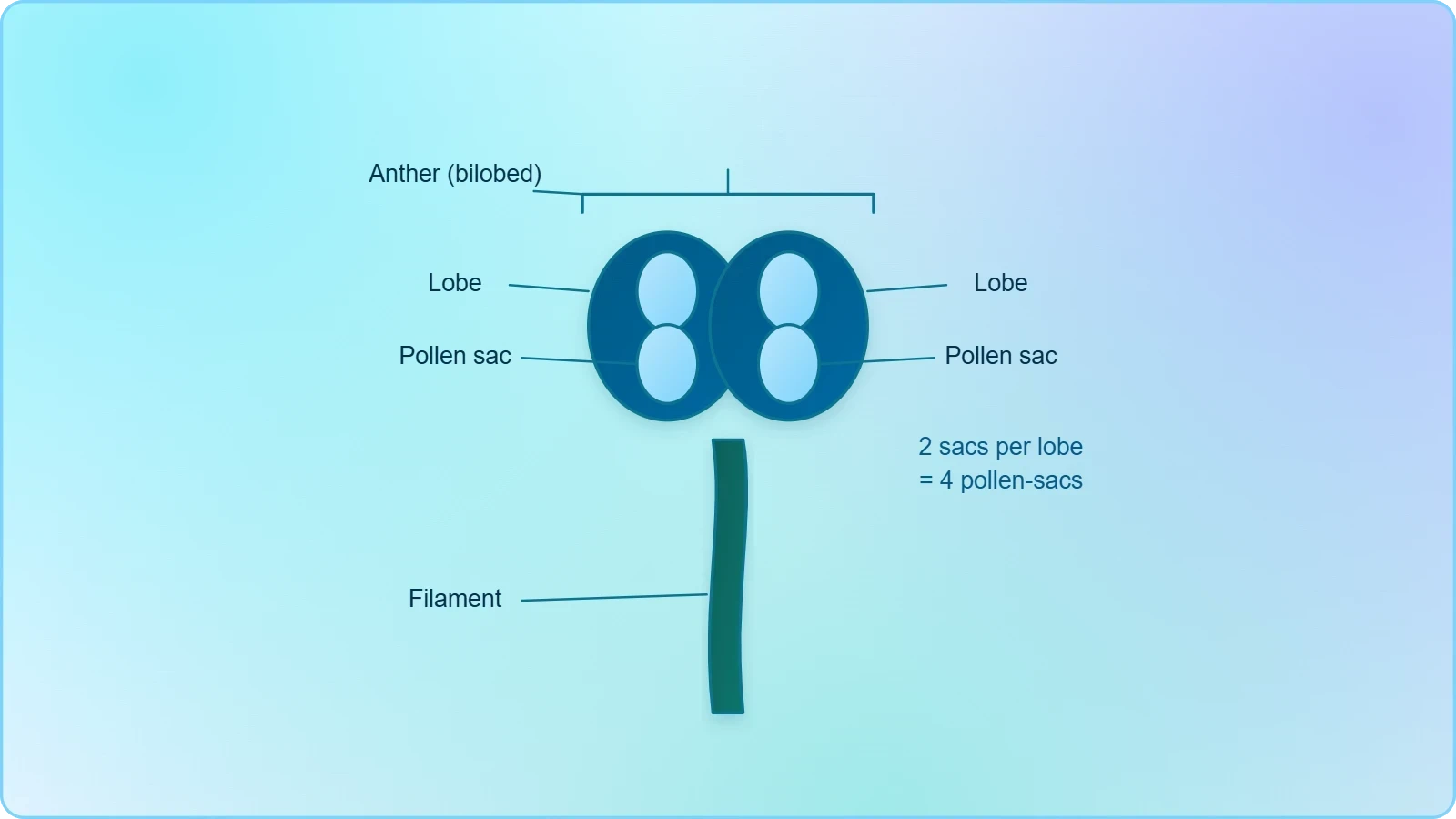
Recognising a stamen in the field therefore requires only three observations: locate the filament, locate the anther, and note whether the anther is lobed and chambered as described. In most familiar flowers the filament is slender and the anther is a compact, often brightly coloured body at its tip. The distinction between a fertile stamen and a staminode is not always obvious to the naked eye, since both may look alike externally; the difference lies in whether functional pollen is produced. For descriptive purposes, the unit's definition is sufficient: a sterile stamen is a staminode, and the term should be applied only where sterility is established.
Attachment of Stamens: Epipetalous and Epiphyllous
Stamens of a flower may be united with other floral members as well as among themselves. When stamens are attached to the petals, they are described as epipetalous, as in brinjal. When they are attached to the perianth, they are described as epiphyllous, as in the flowers of lily. These two terms record a fusion between whorls rather than within a whorl, and they are useful because they tell the observer where to look for the base of the filament. In an epipetalous flower the filament arises from the corolla rather than from the receptacle, and in an epiphyllous flower it arises from the perianth, so the apparent point of origin shifts accordingly.
The practical value of these terms lies in description and identification. A flower in which stamens appear to spring from the petals is not showing an anomaly but a defined condition with its own name. The unit gives brinjal for the epipetalous condition and lily for the epiphyllous one, and these examples should be retained as reference points. Note that the distinction depends on which whorl the stamen is joined to, not on whether the stamens are also joined to one another; a flower may be epipetalous and simultaneously show union among its stamens, since the two kinds of cohesion are recorded separately.
Union Among Stamens: From Free to Bundled
The stamens in a flower may either remain free or may be united in varying degrees, and the unit supplies a precise vocabulary for each condition. When the stamens remain free, the condition is described as polyandrous. When they are united into a single bunch or bundle, the condition is monoadelphous, as in china rose. When they are united into two bundles, the condition is diadelphous, as in pea. When they are united into more than two bundles, the condition is polyadelphous, as in citrus. These four terms form a graded series, and the examples attached to each are the ones to remember, because they convert an abstract label into a flower one can actually examine.
Monoadelphous, Diadelphous and Polyadelphous Conditions
In the monoadelphous condition the filaments are fused into one bundle, so that the stamens appear to form a single tube around the centre of the flower; china rose is the unit's example. In the diadelphous condition the stamens are united into two bundles, the arrangement found in pea, where nine stamens commonly form one bundle and the tenth stands apart. In the polyadelphous condition the stamens are united into more than two bundles, as in citrus. The progression from one bundle to two to more than two is easy to follow, and each step corresponds to a visibly different arrangement of filaments at the base of the flower.
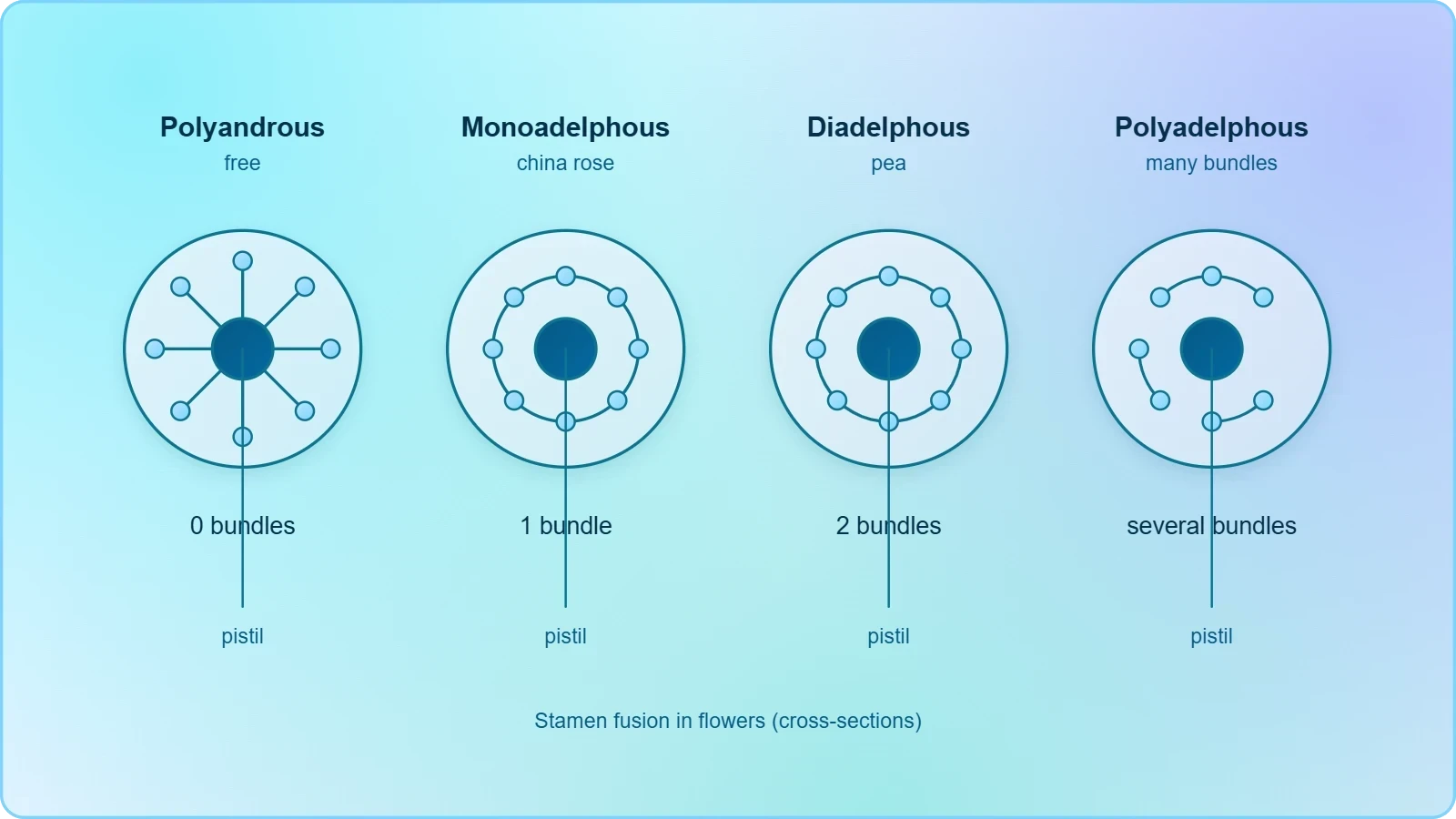
It is worth separating two ideas that beginners often merge. The number of bundles describes how the filaments are grouped, not how many stamens are present. A flower may have many stamens yet only one bundle, or many stamens arranged in several bundles. The unit's terms describe the grouping alone. When describing a flower, state first whether the stamens are free or united, and if united, state the number of bundles using the appropriate term. This discipline keeps the description accurate and prevents the confusion that arises when bundle count is mistaken for stamen count.
Variation in Filament Length
There may also be a variation in the length of filaments within a single flower, as in Salvia and mustard. This is a separate observation from union and attachment, and it should be recorded independently. In such flowers the stamens are not all of equal height, so the anthers are presented at different levels within the flower. The unit offers Salvia and mustard as examples, and these are worth noting because they show that a flower's androecium can be described along three independent axes: how the stamens attach, how they group, and how their filaments compare in length.
Recording these three axes separately produces a description that is both complete and unambiguous. A single flower might be epipetalous in attachment, diadelphous in union, and unequal in filament length, and each of these facts belongs in a proper description. The unit does not assign a special term to unequal filament length in the way it does for attachment and union, so the observation is simply stated in words. This is a useful reminder that botanical description combines fixed terminology with plain observation, and that not every visible feature has a dedicated label.
The Gynoecium: Carpels, Stigma, Style and Ovary
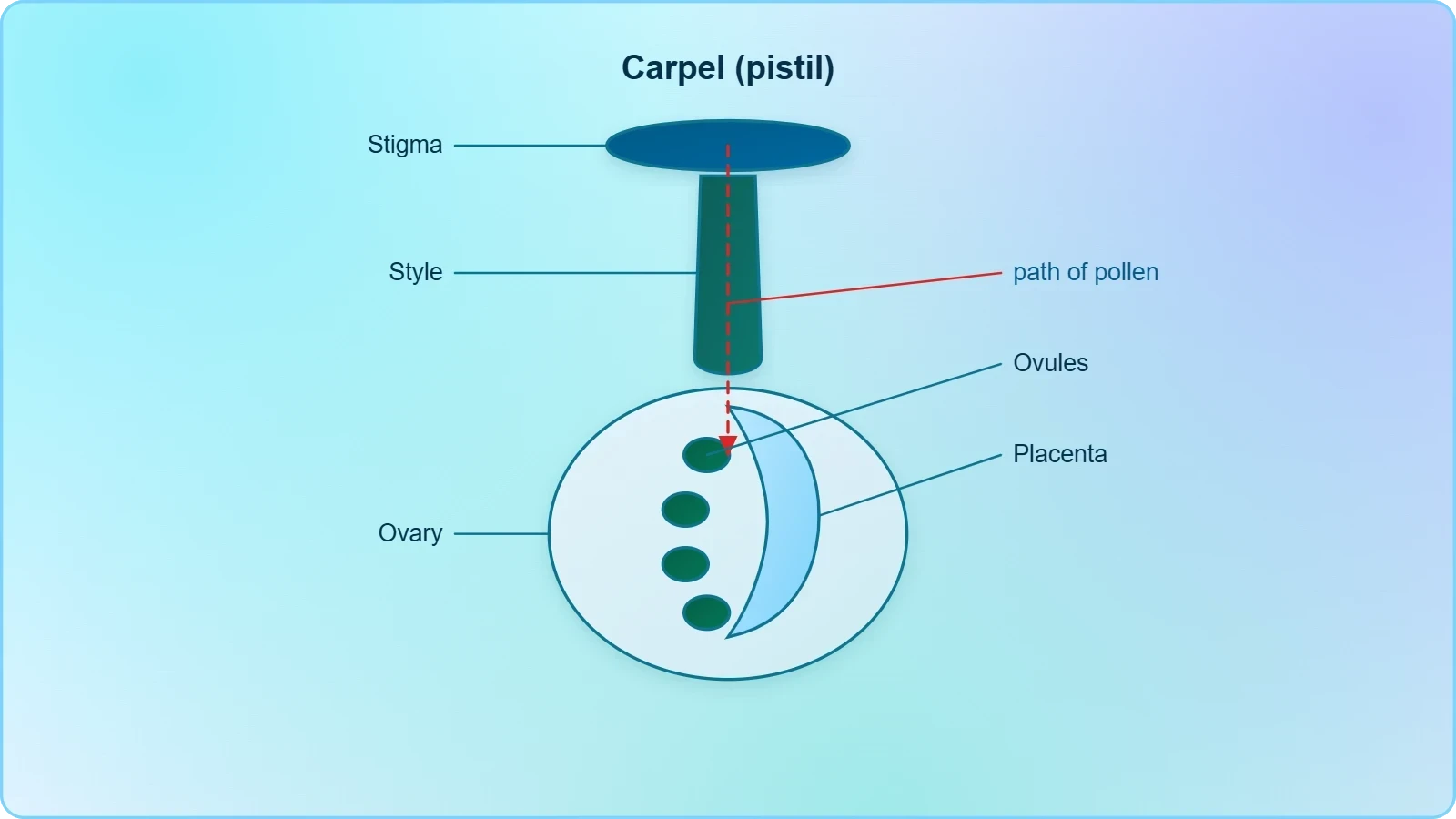
The gynoecium is the female reproductive part of the flower and is made up of one or more carpels. A carpel consists of three parts, namely the stigma, the style and the ovary. The ovary is the enlarged basal part, and upon it lies the elongated tube called the style, which connects the ovary to the stigma. The stigma is usually at the tip of the style and is the receptive surface for pollen grains. Each ovary bears one or more ovules attached to a flattened, cushion-like placenta. This three-part organisation is the framework for every description of the female whorl, and each part has a distinct role in the sequence that leads from pollination to seed formation.
The Stigma, Style and Ovary in Sequence
Reading the carpel from top to bottom follows the path of the pollen grain. The stigma sits at the tip of the style and serves as the receptive surface for pollen grains, the place where they are received. The style is the elongated tube that connects the ovary to the stigma, holding the receptive surface aloft. The ovary is the enlarged basal part, the chambered structure that contains the ovules. This vertical sequence, stigma above style above ovary, is the standard arrangement, and describing a carpel in this order keeps the account orderly and easy to follow.
The ovules are the structures that will eventually become seeds, and they are attached within the ovary to a flattened, cushion-like placenta. The number of ovules in an ovary varies, and the unit notes that each ovary bears one or more of them. The placenta is therefore not a single fixed structure but a region within the ovary to which ovules are attached, and its position is what the later discussion of placentation will classify. For now, the essential point is that the ovule, the placenta and the ovary form a connected system whose arrangement determines the internal architecture of the fruit that follows.
Apocarpous and Syncarpous Gynoecia
When more than one carpel is present, the carpels may be free or fused, and the unit gives a term for each condition. When the carpels are free, as in lotus and rose, the gynoecium is called apocarpous. When the carpels are fused, as in mustard and tomato, the gynoecium is termed syncarpous. The distinction is a simple one to state but a significant one to observe, because it determines whether the ovary appears as a single chambered body or as a cluster of separate bodies within the same flower.
The examples are chosen to be familiar and easy to inspect. Lotus and rose show free carpels, while mustard and tomato show fused carpels. In a syncarpous gynoecium the fusion may involve the ovaries, the styles or the stigmas to varying degrees, and the unit's definition covers the general case of fused carpels without prescribing the extent of fusion in every example. What matters for description is the basic question: are the carpels free or fused? Answering it correctly places the flower in one of the two categories and prepares the ground for the placentation types that follow.
Placentation: The Arrangement of Ovules Within the Ovary
Placentation is the arrangement of ovules within the ovary, and the unit recognises six types: marginal, axile, parietal, basal, central and free central. Each type is defined by where the placenta lies and how the ovules are attached to it, and each is illustrated by named examples. Because the ovary is the structure that matures into the fruit, the pattern of placentation is one of the most useful observations a learner can make, since it explains the internal layout of the fruit long before the fruit itself appears. The six types should be learned as a set, with their definitions and examples paired.
Marginal, Axile and Parietal Placentation
In marginal placentation the placenta forms a ridge along the ventral suture of the ovary, and the ovules are borne on this ridge forming two rows, as in pea. In axile placentation the placenta is axial and the ovules are attached to it in a multilocular ovary, as in china rose, tomato and lemon. In parietal placentation the ovules develop on the inner wall of the ovary or on its peripheral part; the ovary is one-chambered but becomes two-chambered due to the formation of a false septum, as in mustard and Argemone. These three types cover the most commonly encountered arrangements and are distinguished by the position of the placenta and the chambering of the ovary.
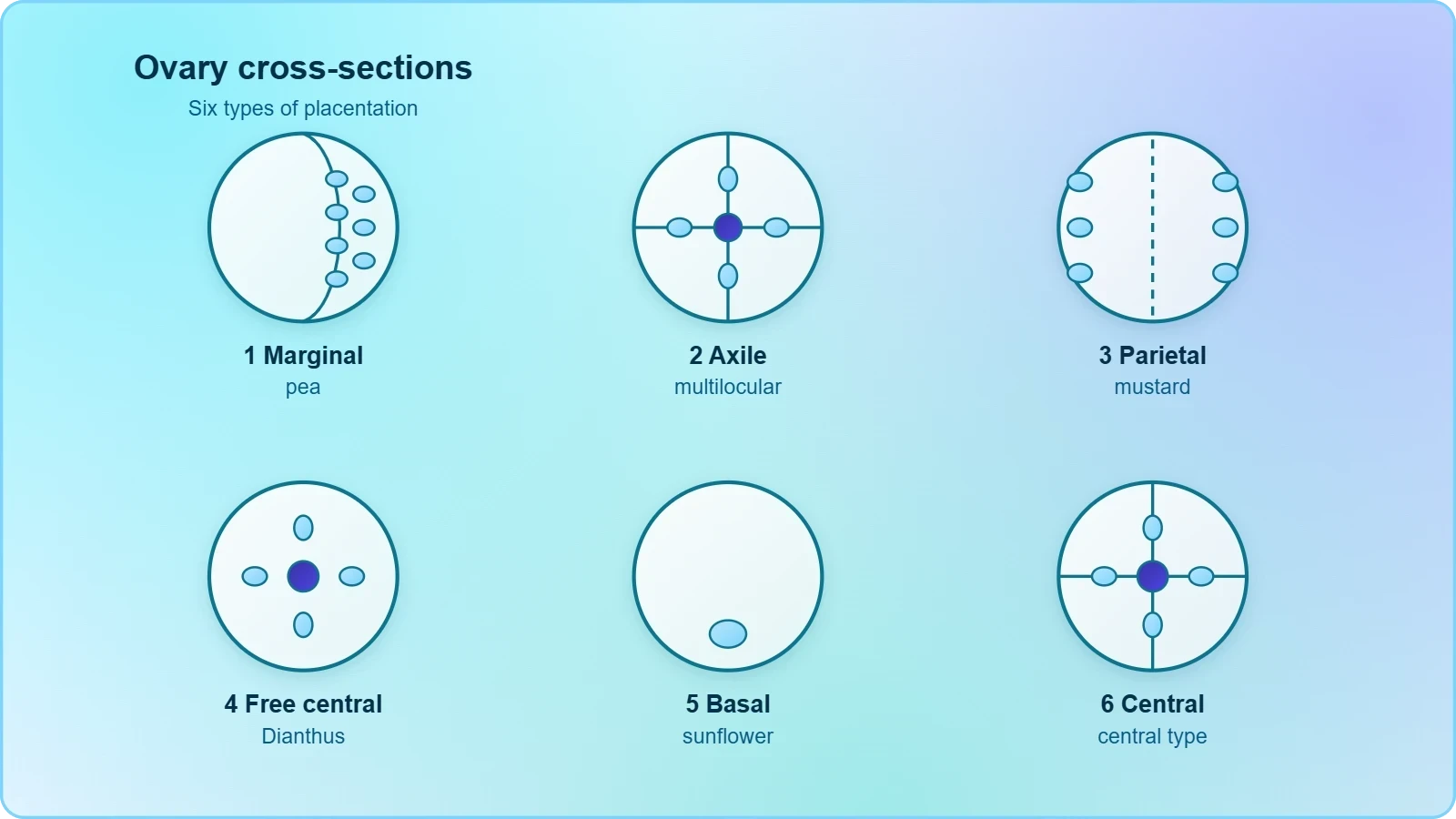
The contrast between marginal and axile is instructive. In marginal placentation the ovules line a single ridge along one suture, producing two neat rows, which is why a pea pod opens along one side to reveal seeds in a line. In axile placentation the placenta stands at the axis of a chambered ovary, so ovules are attached centrally and the ovary is divided into locules. Parietal placentation differs again: the ovules sit on the inner wall, and although the ovary begins as one chamber, a false septum divides it into two. The presence of a false septum is the detail that identifies this type.
Free Central and Basal Placentation
When the ovules are borne on a central axis and septa are absent, as in Dianthus and Primrose, the placentation is called free central. In basal placentation the placenta develops at the base of the ovary and a single ovule is attached to it, as in sunflower and marigold. These two types complete the set of six. Free central is distinguished from axile by the absence of septa, so the ovary remains one-chambered with a central column bearing the ovules. Basal placentation is the simplest of all, with a single ovule at the base, and it is easily recognised in the flowers of sunflower and marigold.
The unit lists central placentation among the six types alongside free central, and the two are closely related in that both involve a central arrangement of the placenta. The essential contrast to hold onto is between an ovary divided by septa, as in axile placentation, and one in which septa are absent, as in free central placentation. Basal placentation stands apart because the placenta is confined to the base and carries only one ovule. Learning the six types as a graded set, each with its defining feature and its example, is the most reliable way to retain them.
We Also Published
From Ovule to Seed: The Bridge to the Fruit
The lesson closes with a statement that carries the whole argument forward: after fertilisation, the ovules develop into seeds and the ovary matures into a fruit. Every structure described in this lesson participates in that transformation. The pollen received on the stigma, the pollen-sacs of the anther, the ovules on the placenta, and the chambered ovary all belong to a single process whose outcome is the seed and the fruit. Understanding the androecium and gynoecium is therefore not an exercise in naming parts for their own sake but a preparation for reading the mature structures that follow.
Why the Ovary's Internal Layout Matters
The arrangement of ovules within the ovary, which is what placentation describes, determines how the seeds will be distributed in the mature fruit. A marginal arrangement produces seeds in two rows along a single suture, as in pea. An axile arrangement places seeds around a central axis in a chambered fruit, as in tomato and lemon. A basal arrangement leaves a single seed at the base, as in sunflower. These correspondences are not stated as separate rules but follow directly from the definitions, and they are the reason the six types of placentation are worth learning carefully.
This is also why the distinction between apocarpous and syncarpous gynoecia matters for what comes next. Free carpels, as in lotus and rose, will mature into separate fruitlets, while fused carpels, as in mustard and tomato, will mature into a single fruit whose chambers reflect the fusion. The unit does not develop these consequences in detail here, but the groundwork is laid. A learner who has followed the carpel from stigma to ovary, and the ovules from placenta to seed, arrives at the next lesson already equipped to interpret the fruit.
Going further
A staminode is a sterile stamen that does not produce pollen, and it may still be visible in the flower even though it plays no direct part in reproduction. The stigma is the receptive surface on which pollen grains land and germinate, which is why its position at the tip of the style is significant: it places the receptive surface where pollinators are most likely to deposit pollen. These two points reinforce the functional reading of the whorls described above, connecting structure to the reproductive role each part performs.
Describing a Flower: Applying the Terminology
A complete description of the androecium and gynoecium follows a fixed order, and following that order prevents omissions. For the androecium, state whether the stamens are free or united, name the number of bundles if united, record whether the stamens are attached to the petals or the perianth, and note any variation in filament length. For the gynoecium, state whether the carpels are free or fused, identify the stigma, style and ovary, and then determine the type of placentation by locating the placenta and noting whether septa are present. Each step uses a term defined in this lesson.
A Worked Description Using the Unit's Examples
Take pea as a worked example. The stamens are diadelphous, united into two bundles. The gynoecium is described by its carpel, with stigma, style and ovary, and the placentation is marginal, since the placenta forms a ridge along the ventral suture and the ovules are borne on this ridge in two rows. Now take china rose: the stamens are monoadelphous, united into one bundle, and the placentation is axile, with the placenta axial and the ovules attached to it in a multilocular ovary. Two flowers, two distinct descriptions, each assembled from the same fixed vocabulary.
Continue with mustard and tomato. Mustard shows parietal placentation, with ovules on the inner wall and a false septum making the ovary two-chambered, and its gynoecium is syncarpous. Tomato is also syncarpous, with axile placentation. Sunflower and marigold show basal placentation, with the placenta at the base of the ovary and a single ovule attached. Lotus and rose show apocarpous gynoecia, with free carpels. Working through these examples in sequence demonstrates that the terminology is not abstract but a practical instrument for turning a flower into a precise, repeatable description.
Common Points of Confusion
Several confusions recur. The first is between attachment and union: epipetalous and epiphyllous describe what the stamen is joined to, while monoadelphous, diadelphous and polyadelphous describe how stamens are grouped among themselves. The second is between apocarpous and syncarpous: the question is whether carpels are free or fused, not how many carpels are present. The third is between axile and free central placentation: the deciding feature is the presence or absence of septa. Keeping these three distinctions clear resolves most difficulties in describing the reproductive whorls accurately.
A fourth confusion concerns the ovary itself. The ovary is the enlarged basal part of the carpel, and the ovules are attached within it to the placenta. The style is the elongated tube connecting ovary to stigma, and the stigma is the receptive surface at its tip. These are three parts of one carpel, not three separate organs. Finally, remember that a staminode is a sterile stamen, so its presence should be recorded as such rather than counted among fertile stamens. Attending to these details produces descriptions that are both accurate and consistent with the standard terminology.
Consolidating the Lesson
The androecium and gynoecium complete the essential whorls of the flower, and this lesson has treated them in the order the unit presents them. The stamen consists of a filament and an anther, the anther is usually bilobed with two pollen-sacs per lobe, and pollen grains are produced in the pollen-sacs. A sterile stamen is a staminode. Stamens may be epipetalous or epiphyllous in attachment, polyandrous, monoadelphous, diadelphous or polyadelphous in union, and may vary in filament length. The gynoecium consists of one or more carpels, each with stigma, style and ovary, and may be apocarpous or syncarpous. Placentation, the arrangement of ovules within the ovary, takes six recognised forms.
Preparing for the Fruit and the Seed
The next lesson takes up the fruit and the seed, and the closing statement of this material provides the link: after fertilisation the ovules develop into seeds and the ovary matures into a fruit. Everything learned here about the ovary, its chambers, its placenta and its ovules becomes the basis for interpreting the mature fruit. A learner who can identify the type of placentation in a flower can predict how the seeds will be arranged in the fruit that follows. That predictive power is the practical reward of mastering the terminology of the reproductive whorls.
Before moving on, consolidate the vocabulary by describing three flowers from memory using the fixed order set out above. State the androecium's attachment, union and filament length, then the gynoecium's carpel condition and placentation, and check each claim against the definitions and examples given in this lesson. This exercise converts a list of terms into a working method, and it ensures that the structures described here are firmly in place before the fruit and the seed are introduced in the lesson that follows.
From our network :
- Analyzing Trump Deportation Numbers Insights Into The 2026 Immigration Crackdown
- Where to Put Your Wireless Router for Better CoverageA practical, physics-grounded guide to router placement: why the centre of the home beats the corner, how walls and metal sap signal, and how to run a simple survey that proves the improvement.
- 98% of Global MBA Programs Now Prefer GRE Over GMAT Focus EditionExplore why 98% of global MBA programs now prefer the GRE over GMAT Focus. Learn about the shorter GRE format, verbal logic importance, and strategic versatility for students.
- Do You Need a New Router or Is Your Internet Plan the Problem?A practical comparison of the signs that point to router limits versus signs your broadband speed or provider is the bottleneck, so you can decide what to replace before spending money.
- EV 2.0: The Solid-State Battery Breakthrough and Global Factory ExpansionDiscover the impact of the Solid-State Battery Breakthrough on the EV market. Learn about CATL and BYD stock growth, global factory expansion in Europe, and the future of EV 2.0 technology.
- AI-Powered 'Precision Diagnostic' Replaces Standard GRE Score ReportsDiscover the new GRE Precision Diagnostic. Learn how AI-powered behavioral analytics and time-to-solve tracking are replacing standard GRE score reports to empower students.
- 10 Physics Numerical Problems with Solutions for IIT JEEPrepare for IIT JEE with 10 physics numerical problems, complete with detailed solutions and conceptual explanations. Ideal for mastering kinematics, thermodynamics, electromagnetism, and optics.
- Trump Political Strategy How Geopolitical Stunts Serve As Media Diversions
- How to Print Cheaply: Cutting the Cost per PageA practical, measured guide to lowering what each printed page costs — duplex and draft modes, third-party ink, yield mathematics, and knowing when a new printer beats refills.
RESOURCES
- Morpho-Anatomical Characters Of The Floral Structures Of Erythrina ...bfopcu.eg.net... androecium, superior gynoecium (monocarpellary) with marginal placentation, different type of stomata, rounded to triangular pollen grains with granular exine.
- Parts of a Flower and Types of Inflorescence in Botany - Quizletquizlet.comSep 25, 2025 ... Flower Structure and Symmetry. Floral Whorls: Typically consist of calyx, corolla, androecium, and gynoecium. Bracteate: Flowers with bracts; ...
- Gynoecium – An Overview on Structure and Placentation - BYJU'Sbyjus.comBased on the position of the androecium, calyx and corolla with respect to the ovary, a flower can be classified into three types: Hypogynous…
- Chapter 3. Reproductive morphology of plants - the Ezcurra Labezcurralab.ucr.eduPlacentation types. Pistlls or carpels? How the interpret the gynoecium. Pistils, those bottle-like structures at the base of the flower, are easy to ...
- Flowers - Digital Atlas of Ancient Lifedigitalatlasofancientlife.orgJan 27, 2021 ... Overview of floral structure & terminology; Perianth (sepals, petals & tepals); Androecium (stamens); Gynoecium (carpels); Beyond the four ...
- Early floral development of Camellioideae (Theaceae)bsapubs.onlinelibrary.wiley.comNov 1, 1998 ... ... structure of androecium, number of perianth members, and their placentation. ... These two types of placentation can be referred…
- Flower and Fruit Development of Three Species of Hydrophylleae ...journals.uchicago.eduApr 25, 2022 ... Placentation is parietal. Subsequently, internal ovary architecture development is largely affected by ovule number and placentation. A ...
- Botany Six – Flowers | Crosby Holme Growncrosbyholmegrown.ukDiadelphous – joined partially into two androecial structures. Pentadelphous ... There are several Placentation types. Basal Placentation – is found in ...
- Structure and Development of Flowers and Inflorescences in ...frontiersin.orgMar 17, 2022 ... The style branches and stigmas almost completely obstruct the orifice of the floral tube. Interactions Between Androecium and Gynoecium. The ...
- Structure and Development of Flowers and Inflorescences in ... - PMCpmc.ncbi.nlm.nih.govMar 18, 2022 ... Keywords: floral anatomy, gynoecium, gynostegium, monochasium, placentation, vasculature ... Interactions Between Androecium and Gynoecium. The ...
- Angiosperms- Morphology of Flowering Plants - siesascssiesascs.edu.inandroecium and gynoecium) around the axis of a flower is called floral symmetry. ... Some important types of placentation are as follows: •. 1.…
- Inferences on gynoecium evolution in Xyris (Xyridaceae, Poales ...repositorio.usp.brMay 25, 2026 ... GYNOECIUM DEVELOPMENT AND ITS RELATION TO. PLACENTATION TYPES ... are necessary to elucidate the structure of the ovary and placentation…
- Common placentation types in angiosperms. A, Marginal ...researchgate.netThe flowers of both species are trimerous, pentacyclic, with diplostemonous androecium and tricarpellate syncarpous gynoecium. Nevertheless, dimerous ...
- Androecium, Gynoecium, and Placentation - Canvas Classescanvasclasses.inYou now have every part of the androecium and gynoecium down — stamen structure, how stamens attach and fuse, carpel structure, and all five…
- Pistil - an overview | ScienceDirect Topicssciencedirect.comStandard placentation types are axile, with the placentae arising from ... androecium or gynoecium (below), or as a separate structure altogether. Some ...