Every flowering plant carries two distinct identities: the vegetative body that gathers light and water, and the reproductive body that ensures continuity. The inflorescence is the bridge between them, the precise architectural arrangement by which a shoot abandons leaf production and commits its meristem to flowers. Understanding this arrangement is not a decorative exercise in botanical vocabulary; it is the practical key that lets a learner read a plant's reproductive strategy at a glance, predict the order in which buds will open, and place any specimen within the standard descriptive framework used across the discipline.
This lesson, the sixth in a twelve-part sequence on the morphology of flowering plants, examines the flower as a modified shoot and then sets out the two major categories of inflorescence recognised in the standard treatment: the racemose type, in which the main axis continues to grow, and the cymose type, in which the main axis terminates in a flower and growth is therefore limited. The distinction rests on a single developmental question — whether the apex becomes a flower or keeps growing — yet it generates two entirely different visual grammars of flowering.
Because the previous lesson established how leaves are arranged on the stem through phyllotaxy, the present discussion builds directly on that foundation: the same axis that bore leaves in alternate, opposite or whorled patterns now bears floral appendages at successive nodes. The lesson that follows will take the individual flower apart into its whorls, symmetry and ovary position, so the treatment here deliberately stays at the level of arrangement rather than anatomy. Learners should leave with the definitions, the diagnostic criteria and the vocabulary firmly in hand.
On This Page
The Flower as a Modified Shoot
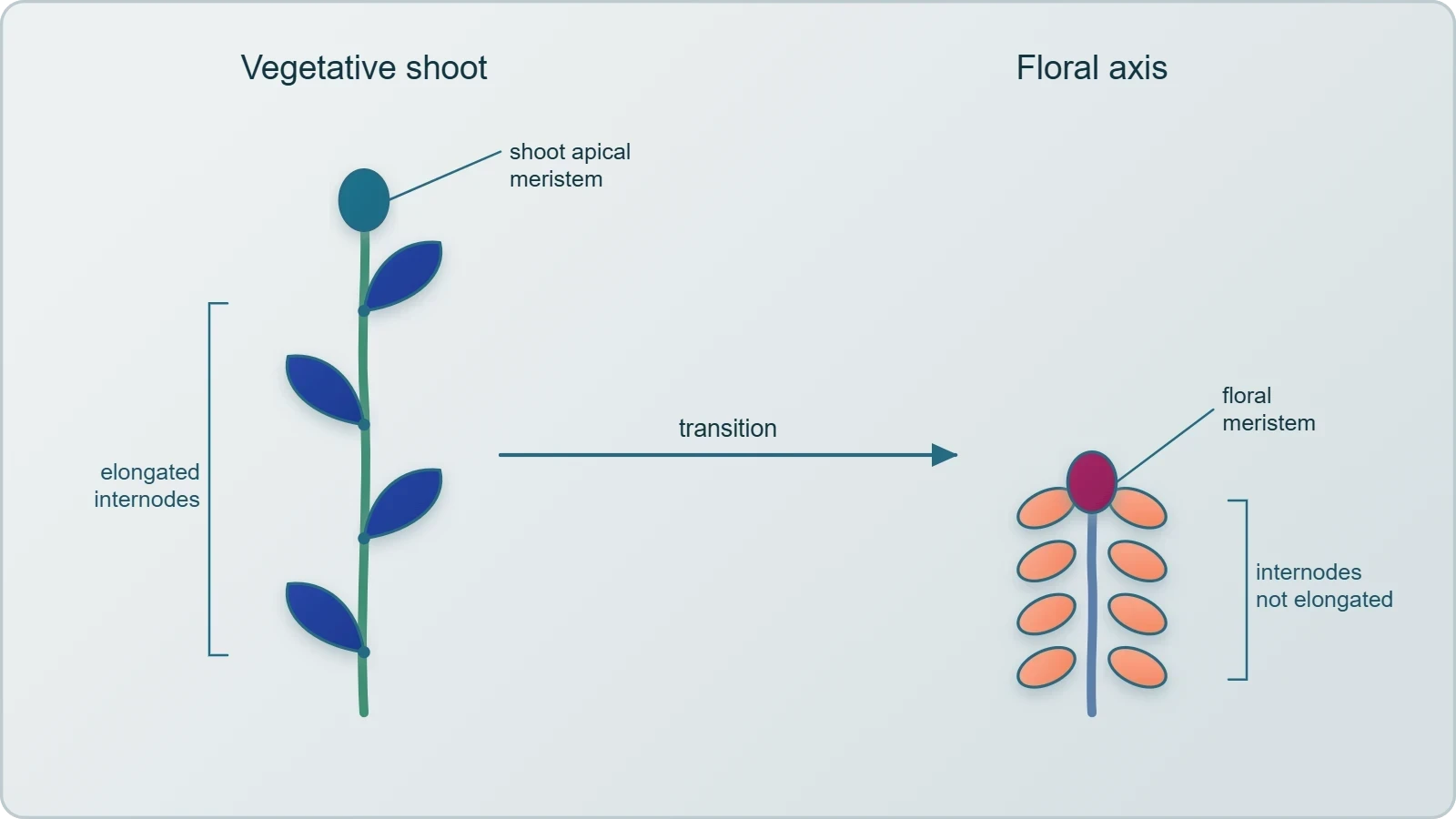
The material opens with a definition that repays close reading: a flower is a modified shoot wherein the shoot apical meristem changes to floral meristem. This single sentence carries the whole logic of the lesson. The shoot that in earlier lessons produced leaves at nodes separated by elongating internodes now redirects its apex to a different task, and the visible consequences are immediate and structural rather than merely cosmetic. The plant has not added a new organ system; it has reprogrammed an existing one.
Two physical changes accompany this transition. Internodes do not elongate, so the axis becomes condensed, and the apex produces different kinds of floral appendages laterally at successive nodes instead of leaves. The condensed axis is what gives a flower its compact, clustered appearance, and the substitution of floral appendages for leaves is what allows the same node-and-internode plan to generate sepals, petals, stamens and carpels. Recognising this continuity between vegetative and reproductive shoots is the conceptual hinge on which the rest of the lesson turns.
From Vegetative Axis to Floral Axis
The axis that bears the flowers is called the floral axis, and the arrangement of flowers upon it is termed the inflorescence. This definition is worth committing to memory precisely because it is so economical: inflorescence names the pattern, not the individual bloom. A learner who can identify the floral axis and trace its branching can describe almost any flowering specimen encountered in the field, because the pattern of arrangement is the primary diagnostic feature at this level of morphology.
The transition also explains why floral appendages appear in whorls or spirals at compressed nodes rather than spaced along a stem. Because the internodes fail to elongate, successive nodes crowd together, and the appendages they bear sit close to one another. The condensed axis is therefore not an incidental by-product but the structural precondition for the flower's characteristic form, and it links directly to the whorl arrangement that the next lesson will examine in detail.
The Solitary Flower
The material states plainly that when a shoot tip transforms into a flower, it is always solitary. This is a precise and often overlooked point. A solitary flower is not simply a flower growing alone by accident; it is the direct product of the shoot tip itself becoming a single flower, with no lateral floral branches produced along the axis. The condition is terminal and complete, and it stands in contrast to every arrangement in which multiple flowers share a common axis.
This distinction matters because it establishes the boundary of the lesson's subject. Once a shoot tip commits wholly to a single flower, there is no inflorescence to describe, since inflorescence concerns the arrangement of flowers on a floral axis. The moment lateral flowers appear along that axis, the plant has entered the territory of racemose and cymose organisation, and the diagnostic question becomes whether the main axis itself terminates in a flower or continues to grow.
Defining the Inflorescence
With the floral axis established, the material proceeds to its central definition: the arrangement of flowers on the floral axis is termed the inflorescence. This is a definition of pattern rather than of parts, and it is deliberately broad enough to cover every arrangement from a single terminal bloom to a complex branching cluster. The term describes how flowers are positioned relative to one another and to the axis that bears them, which is precisely the information a morphological description requires.
The definition also implies a hierarchy of observation. A learner first locates the floral axis, then traces whether it branches, then notes where flowers sit along it. Only after these steps can the arrangement be named. This sequence — axis, branching, flower position — is the working method the lesson recommends, and it applies equally to the two major types that follow. The vocabulary is technical, but the observational discipline it enforces is straightforward and repeatable.
Why Arrangement Matters
Arrangement is not a trivial detail of appearance. The position of flowers along an axis determines the order in which they open, and that order in turn shapes how a plant presents its reproductive organs over time. Two plants bearing identical flowers can behave very differently in the field simply because one opens its oldest flowers first at the base while the other opens them first at the tip. The inflorescence type is therefore a compact summary of a plant's flowering schedule.
For the learner, this makes the inflorescence a diagnostic shortcut. Once the type is identified, the opening sequence can be predicted without watching the plant through a season. The two categories defined in the material differ precisely on this point, and the next sections examine each in turn, beginning with the type in which the main axis continues to grow and the flowers are borne laterally in acropetal succession.
The Two Diagnostic Questions
The material reduces the classification to a single decisive question: does the apex develop into a flower, or does it continue to grow? Everything else follows from the answer. If the apex continues to grow, the inflorescence is racemose; if the apex terminates in a flower, it is cymose. This binary logic is elegant because it requires no measurement, no counting and no specialised equipment — only careful observation of the growing tip.
A second question follows immediately and concerns order: in which direction do the flowers mature along the axis? The material pairs each type with its characteristic succession, acropetal for racemose and basipetal for cymose. Together the two questions — fate of the apex, direction of succession — form a complete diagnostic routine. Learners who internalise both will classify most specimens correctly on first inspection, and the tables below set out the criteria side by side.
The Racemose Inflorescence
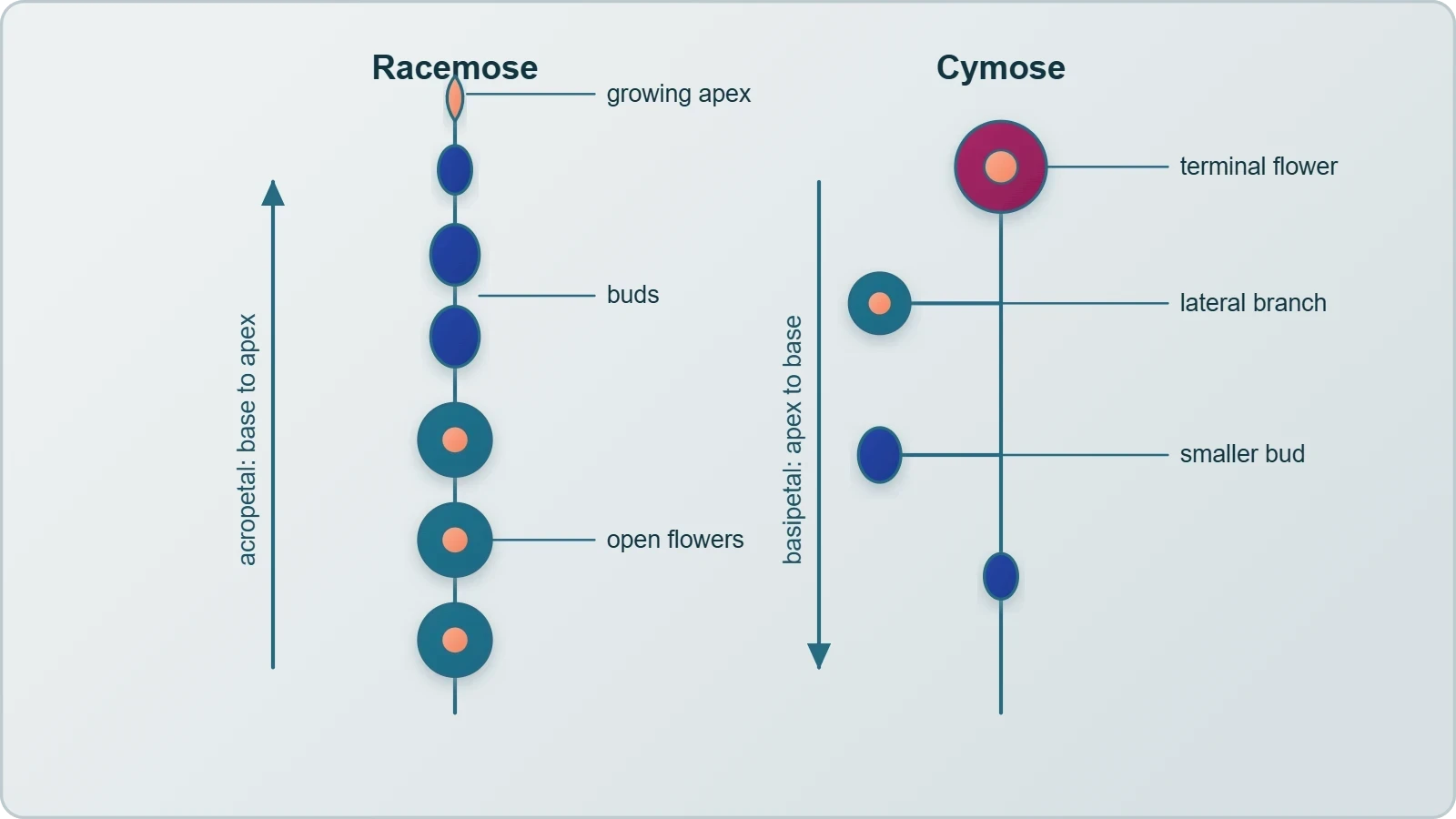
In the racemose type of inflorescence the main axis continues to grow, and the flowers are borne laterally in an acropetal succession. Both halves of this definition are essential. The continuing axis means the inflorescence is not capped by a terminal flower, so growth is not brought to a halt by the act of flowering. The lateral placement means every flower arises from the side of the axis rather than from its tip, and the acropetal succession means the flowers mature in sequence from the base of the axis towards its apex.
The practical consequence is an inflorescence that can keep adding flowers at its growing tip while the oldest flowers at the base are already mature. This gives the racemose type an open, indeterminate character: the axis has no predetermined endpoint, and flowering proceeds upward along it. For a learner examining a specimen, the tell-tale sign is a growing point at the very top with no flower crowning it, and a gradient of maturity running from base to tip along the lateral branches.
Acropetal Succession Explained
Acropetal succession is the pattern in which flowers develop from the base of the axis towards the apex. The word itself encodes the direction: acro refers to the apex, and petal, from the Latin for seeking, indicates movement towards it. In a racemose inflorescence, the lowest lateral flowers are therefore the oldest and the uppermost the youngest, and the growing tip remains vegetative while flowering proceeds below it. This is the defining developmental signature of the type.
Reading a specimen in the field becomes a matter of following that gradient. If the lowest flowers on the axis are open and the highest are still buds, with a bare growing point above them, the inflorescence is racemose. The observation requires no dissection and no magnification, only attention to which flowers are mature and which are not. The table below sets out the succession patterns for both types so that the contrast can be held in view at once.
Recognising the Type in the Field
Field recognition rests on three quick checks performed in sequence. First, locate the apex of the main axis and confirm that it is still growing rather than crowned by a flower. Second, note whether flowers arise laterally along the axis. Third, compare the maturity of the lowest and highest flowers to confirm acropetal order. When all three checks agree, the identification is secure, and the learner can move on to describing the finer branching pattern with confidence.
These checks also guard against a common error: mistaking a young cymose inflorescence for a racemose one before its terminal flower has opened. The remedy is patience and a second look at the apex, since the terminal flower of a cymose axis may be small and easy to overlook. The diagnostic question remains the fate of the apex, and the field method simply operationalises it in a form that can be applied to fresh material without laboratory equipment.
We Also Published
The Cymose Inflorescence
In the cymose type of inflorescence the main axis terminates in a flower, and hence is limited in growth. The flowers are borne in a basipetal order. Here the logic reverses completely. Because the apex itself becomes a flower, the axis cannot continue to extend, and the inflorescence is capped from the outset. Any further flowers must arise from lateral branches below the terminal flower, and those branches in turn may terminate in flowers of their own, producing the characteristic branching pattern of the type.
The limited growth of the main axis is the defining constraint. Where the racemose axis is open-ended and can keep producing flowers indefinitely, the cymose axis is closed: its endpoint is fixed the moment the terminal flower forms. This gives the cymose inflorescence a determinate character, and it explains why the oldest flower in such an arrangement sits at the apex rather than at the base. The whole developmental sequence runs in the opposite direction to that of the racemose type.
Basipetal Succession Explained
Basipetal succession is the pattern in which flowers develop from the apex of the axis towards its base. The terminal flower opens first, and the flowers on successively lower lateral branches follow in order. The word encodes the direction just as acropetal does, with basi referring to the base. In a cymose inflorescence, the apex therefore carries the oldest flower and the lowest branches the youngest, which is the exact mirror image of the racemose arrangement described earlier.
This reversal is the most reliable confirmation of a cymose identification once the terminal flower has been found. A learner who observes an open flower crowning the axis, with progressively younger buds on the branches below, has both diagnostic criteria satisfied at once. The observation is simple, but it depends on correctly locating the apex, which is why the field method for the two types begins with the same step and diverges only at the answer.
Limited Growth and Its Consequences
Because the main axis terminates in a flower, the cymose inflorescence cannot extend beyond that point. Growth is limited, and the plant must rely on lateral branches to produce additional flowers. Each such branch may itself terminate in a flower, so the inflorescence acquires a branched, often somewhat clustered appearance as successive orders of branching are capped in turn. The pattern is determinate at every level, and this repeated termination is what gives the type its distinctive form.
The consequence for the observer is that a cymose inflorescence tends to look complete and self-contained rather than open-ended. There is no bare growing tip waiting to add more flowers, because every axis has already committed its apex. Recognising this closed quality is a useful secondary check, and it complements the primary evidence of the terminal flower and the basipetal order of opening along the branches.
Reading a Specimen: A Practical Method
The definitions are compact, but applying them to fresh material requires a disciplined sequence of observations. The method recommended here follows the order of ideas in the material itself: first establish that the structure is an inflorescence at all, then locate the main axis, then determine the fate of its apex, and finally confirm the direction of succession. Each step narrows the possibilities, and the final step verifies the conclusion reached at the third. The whole procedure takes only a minute or two with a hand lens.
It is worth practising the method on several specimens in succession rather than on one alone, because the contrast between types is what fixes the criteria in memory. A learner who examines a racemose and a cymose inflorescence side by side will notice immediately that the growing tip is present in one and absent in the other, and that the oldest flowers sit at opposite ends of the axis. That paired observation does more for retention than any amount of definitional repetition.
Step-by-Step Observation
Begin by confirming that the structure bears more than one flower on a common axis; a solitary flower, as the material notes, arises when the shoot tip itself transforms into a single flower and therefore has no inflorescence to classify. Next, trace the main axis from its base to its tip and examine the apex closely. If it is still growing and bears no flower, proceed to check for lateral flowers in acropetal order and record the specimen as racemose. If the apex is crowned by a flower, check for basipetal order and record it as cymose.
The final step is confirmation rather than discovery. Compare the maturity of the flowers at the two ends of the axis: in the racemose type the base is older, in the cymose type the apex is older. When the apex observation and the maturity gradient agree, the classification is sound. When they appear to disagree, the usual cause is a terminal flower that has not yet opened, and a second examination of the tip will normally resolve the discrepancy.
Common Pitfalls
The most frequent error is judging by overall shape rather than by the apex. A densely clustered racemose inflorescence can resemble a cymose one at a glance, and a loosely branched cymose inflorescence can look open-ended. Shape is a poor guide; the fate of the apex is the reliable criterion, and the maturity gradient is its confirmation. Learners who rely on silhouette alone will misclassify specimens that the two-question method handles without difficulty.
A second pitfall is confusing the inflorescence with the individual flower. The arrangement of flowers on the floral axis is the inflorescence; the flower itself is the unit being arranged. Keeping these two levels distinct prevents a great deal of muddle, and it prepares the ground for the next lesson, which turns from the arrangement of flowers to the internal organisation of a single flower into its whorls, its symmetry and the position of its ovary.
Going Further
Two clarifications from general botanical usage help to fix the terminology of this lesson. The first concerns the directional terms. Acropetal means developing from the base towards the apex, while basipetal means developing from the apex towards the base. Holding these two definitions side by side makes the pairing of succession with inflorescence type easy to remember: the racemose axis, which keeps growing at its tip, matures its flowers acropetally, while the cymose axis, which ends in a flower, matures them basipetally.
The second clarification concerns the solitary flower. A solitary flower is one in which the shoot tip itself transforms into a single flower, so that no lateral floral branches are produced along the axis. This is the condition the material describes when it states that a shoot tip transforming into a flower is always solitary. It marks the boundary of the present lesson, since the classification into racemose and cymose types applies only once multiple flowers share a common floral axis.
Connecting to the Wider Course
These clarifications sit alongside the material rather than replacing it, and they prepare the ground for what follows. The previous lesson established phyllotaxy, the arrangement of leaves on the stem, and the present lesson has shown how the same axis, once its apex becomes floral, bears flowers instead of leaves. The next lesson turns to the individual flower and examines its whorls, its symmetry and the position of its ovary, which is where the vocabulary of arrangement gives way to the vocabulary of internal structure.
Learners preparing for examinations should treat the two definitions and the two succession terms as a single connected set rather than four separate facts. The apex decides the type, the type determines the succession, and the succession confirms the type. That chain of reasoning is what the standard descriptive framework expects, and it is what allows a semi-technical description of a flowering plant to proceed from the vegetative organs through the inflorescence to the flower itself with precision and economy.
From our network :
- Analyzing Trump Deportation Numbers Insights Into The 2026 Immigration Crackdown
- AI-Powered 'Precision Diagnostic' Replaces Standard GRE Score ReportsDiscover the new GRE Precision Diagnostic. Learn how AI-powered behavioral analytics and time-to-solve tracking are replacing standard GRE score reports to empower students.
- 10 Physics Numerical Problems with Solutions for IIT JEEPrepare for IIT JEE with 10 physics numerical problems, complete with detailed solutions and conceptual explanations. Ideal for mastering kinematics, thermodynamics, electromagnetism, and optics.
- Trump Political Strategy How Geopolitical Stunts Serve As Media Diversions
- 98% of Global MBA Programs Now Prefer GRE Over GMAT Focus EditionExplore why 98% of global MBA programs now prefer the GRE over GMAT Focus. Learn about the shorter GRE format, verbal logic importance, and strategic versatility for students.
- How to Print Cheaply: Cutting the Cost per PageA practical, measured guide to lowering what each printed page costs — duplex and draft modes, third-party ink, yield mathematics, and knowing when a new printer beats refills.
- Do You Need a New Router or Is Your Internet Plan the Problem?A practical comparison of the signs that point to router limits versus signs your broadband speed or provider is the bottleneck, so you can decide what to replace before spending money.
- EV 2.0: The Solid-State Battery Breakthrough and Global Factory ExpansionDiscover the impact of the Solid-State Battery Breakthrough on the EV market. Learn about CATL and BYD stock growth, global factory expansion in Europe, and the future of EV 2.0 technology.
- Where to Put Your Wireless Router for Better CoverageA practical, physics-grounded guide to router placement: why the centre of the home beats the corner, how walls and metal sap signal, and how to run a simple survey that proves the improvement.
RESOURCES
- inflorescence ppt.pptxslideshare.netThis document defines and describes different types of inflorescences. There are three main types - simple, compound, and special. Racemose inflorescences ...
- Racemose and cymose types of inflorescence - Facebookfacebook.comMay 22, 2026 ... In racemose, flowers are arranged laterally on an elongated axis, while in cymose, the main axis ends in a flower.…
- Types of Inflorescence Racemose and Cymose Diagram - Pinterestpinterest.comDiscover Pinterest's best ideas and inspiration for Types of inflorescence racemose and cymose diagram. Get inspired and try out new things. Last updated 1d.
- Types of Inflorescence: Racemose and Cymose - LinkedInlinkedin.comJun 15, 2025 ... Recemose and Cymose inflorescence: Inflorescence is divided into two main types: Racemose: In racemose types of inflorescence, the main axis ...
- Inflorescence - Wikipediaen.wikipedia.orgThe rachis may be one of several types, including single, composite, umbel, spike or raceme. ... inflorescence, which can be both a racemose or…
- INFLORESCENCE - Surendranath Collegesurendranathcollege.ac.inCymose (definite or determinate) and. III. Mixed. I. Racemose Inflorescence: This type is also called indefinite or indeterminate or botryose inflorescence. A ...
- Inflorescence | CK-12 Foundationflexbooks.ck12.orgNov 1, 2026 ... The common types of racemose inflorescence include raceme, spike, catkin, spadix, corymb, and umbel. Cymose inflorescence is classified into ...
- Inflorescence development in two tomato speciescdnsciencepub.comThe inflorescence of tomato has been characterized as either a cyme or raceme. Cymose inflorescences are determinate, whereas racemose inflorescences are ...
- Inflorescences – Ohio Plantsohioplants.org... racemose,” after the most representative type, the RACEME. Members of the ... Most cymose inflorescence are repeatedly branched, and might be mistaken ...
- Inflorescences-examples - Tree Guide UKtreeguideuk.co.ukSix examples are shown here. Numbers indicate the order in which the flowers are added as the inflorescence grows. Raceme (lupin) is the basic…
- Mastering Inflorescence made simple! Understanding ... - Instagraminstagram.comAug 1, 2026 ... Inflorescence NEET Biology, Types of Inflorescence, Racemose Inflorescence, Cymose Inflorescence, Floral Diagram, NCERT Class 11 Biology ...
- Four basic inflorescence architectures. (A) A single flower; (B) racemeresearchgate.netA single flower; (B) raceme; (C) cyme; (D) panicle. from publication: Inflorescence ... Finally, Petunia species develop a cymose inflorescence ( Figure 1E, inset) ...
- Inflorescence type - FLORA OF AUSTRALIA HELPausflora.netcorymb: a racemose inflorescence in which the pedicels of the lower flowers ... cyme: an inflorescence in which each flower, in turn, is formed…
- Study and identification of different types of inflorescence - BYJU'Sbyjus.comAim Of The Experiment. To study and identify different types of Inflorescences(racemose/cyme). Theory. In angiosperms, the flowers are either borne singly ...
- 10-Inflorecence Typesacikders.ankara.edu.trCompound racemose: In this type of inflorescence the main axis (peduncle) branches repeatedly once or twice in racemose or cymose manner. 1. Panicle: A…