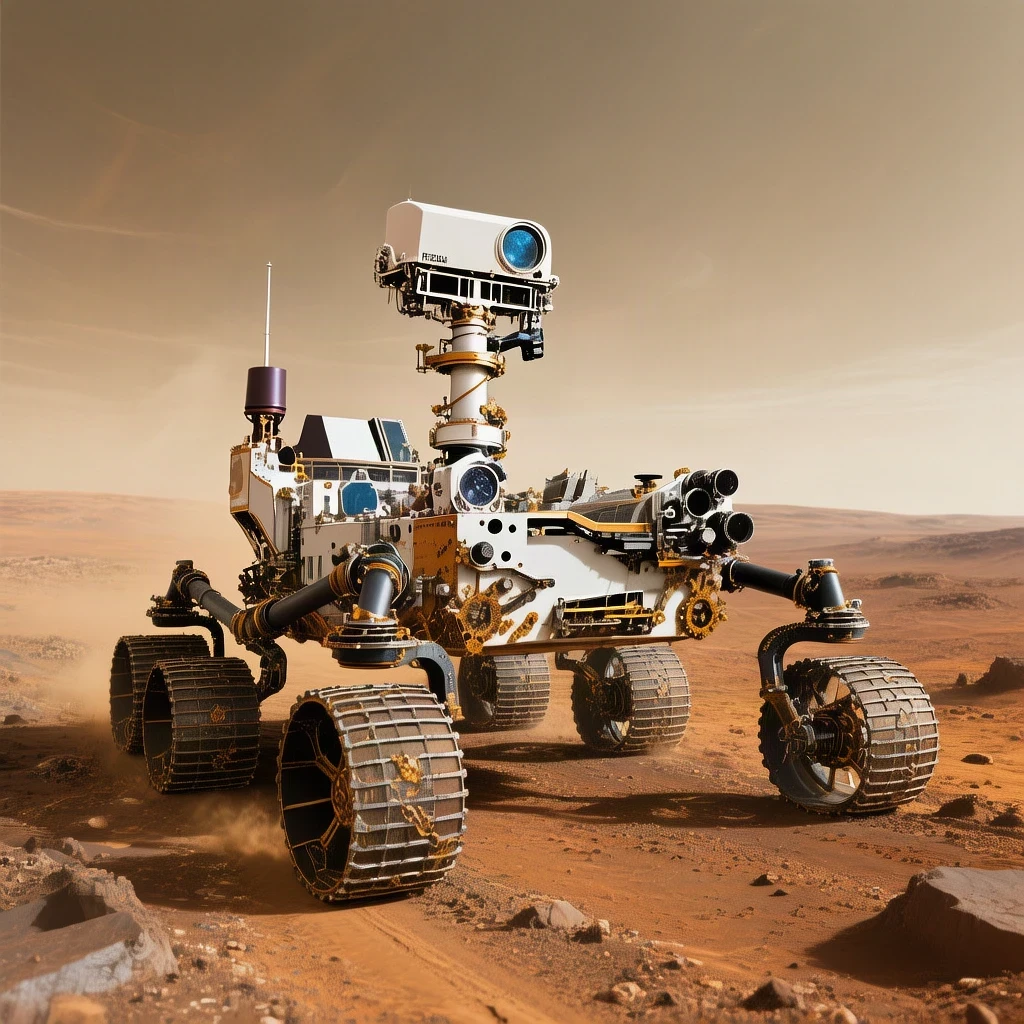
The relentless march of human ingenuity across planetary surfaces reaches an unprecedented zenith as NASA’s Perseverance rover surges toward a historic milestone in interplanetary navigation. Decades of meticulous robotics design and autonomous surface tracking culminate in an impending triumph that will shatter the long-standing extraterrestrial mileage benchmark previously established by its legendary predecessor, Opportunity. Engineering resilience on the desolate, radiation-blasted expanses of the Jezero Crater demands unprecedented fault tolerance, thermal management, and algorithmic sophistication. This monumental achievement transcends mere distance metrics, serving as a profound testament to the rigorous mathematical modeling, advanced kinematic path planning, and relentless optimization executed by mission controllers on Earth.
Navigating the treacherous Martian topography requires an intricate ballet of wheel torque distribution, slip estimation, and onboard computer vision to circumvent treacherous boulder fields and towering sand dunes without human intervention. As Perseverance edges ever closer to eclipsing the 45.16-kilometer record, planetary scientists and roboticists alike analyze the telemetry data to refine next-generation autonomous traversal algorithms. The extraordinary longevity of these mechanical emissaries underscores a paradigm shift in interplanetary exploration, where hardware durability matches the boundless curiosity of the scientific community. Every meter traversed across the ancient lakebed unlocks invaluable geological strata, bringing humanity closer to decoding the primordial secrets of Martian astrobiology and securing a definitive blueprint for future crewed expeditions.
On This Page
Kinematic Modeling and Interplanetary Navigation Dynamics
Precise motion planning for Martian rovers requires the rigorous application of classical mechanics and vector calculus to predict wheel-terrain interaction under reduced gravity conditions. When Perseverance traverses uneven Martian regolith, the slip ratio ##[s]## dictates the efficiency of energy transfer from the actuators to the surface. Analysts formulate this dynamic interaction utilizing the following fundamental kinematic relationship:
Where ##[r]## represents the effective radius of the wheel, ##[\omega]## denotes the angular velocity, and ##[v]## signifies the actual linear velocity of the vehicle chassis. Understanding this parameter prevents catastrophic bogging in loose dust.
Autonomous pathfinding algorithms process hundreds of stereo image pairs to calculate safe traverse vectors across jagged crater rims and steep inclines. The cumulative distance ##[D]## traveled over a discrete time interval ##[t]## is computed by integrating the instantaneous velocity vector along the optimized surface path:
This continuous integration ensures sub-centimeter accuracy in tracking mission progress and verifying odometer longevity against extreme thermal fluctuations.
Algorithmic Obstacle Avoidance and Terrain Profiling
The onboard AutoNav system utilizes advanced computer vision architectures to process high-resolution hazard maps in real time. By evaluating slope steepness and rock distribution probabilities, the rover dynamically recalculates its trajectory to minimize mechanical wear and maximize energy efficiency.
Differential steering systems on six independent rocker-bogie assemblies ensure load distribution remains uniform across varied geological formations. Mathematical modeling of suspension articulation prevents single-wheel overload during severe slope traversal maneuvers.
Thermal Constraints and Power Consumption Analysis
Operating in sub-zero Martian environments necessitates rigorous thermal management powered by Multi-Mission Radioisotope Thermoelectric Generators (MMRTG). Energy output degradation over time follows an exponential decay function governed by plutonium isotope half-life.
Engineers model internal thermal dissipation using steady-state heat conduction equations across composite chassis structures. Maintaining optimal instrument operating temperatures ensures reliable long-term data collection without triggering fail-safe hibernation modes.
Geological Sampling and Scientific Return Optimization
Maximizing scientific discovery across extended traverses demands strategic targeting of high-value astrobiological formations within Jezero Crater. The onboard caching system drills core samples from sedimentary rocks, sealing them in hermetic titanium tubes for eventual return to Earth via future retrieval missions.
Mineralogical analysis relies on X-ray fluorescence and Raman spectroscopy to identify organic compounds indicative of ancient microbial life. The statistical probability ##[P]## of detecting biomarker signatures within a given mineral matrix ##[M]## is expressed through conditional probability density functions:
This probabilistic framework guides field geologists in prioritizing drill sites during rapid traverse sequences.
Sample integrity preservation requires stringent contamination controls and precise mechanical torque application during core extraction. The stress distribution ##[\sigma]## across the drill bit interface is calculated to prevent fracturing of delicate clay-rich laminations:
Where ##[F_{\text{axial}}]## is the downward thrust force, ##[A_{\text{contact}}]## is the annular contact area, ##[T_{\text{torque}}]## is rotational torque, and ##[J]## represents the polar moment of inertia.
Spectroscopic Identification of Ancient Aqueous Environments
Remote sensing instruments such as Mastcam-Z and SuperCam analyze elemental compositions from standoff distances exceeding several meters. Laser-induced breakdown spectroscopy (LIBS) vaporizes microscopic rock targets, emitting plasma signatures characteristic of specific metallic ions.
The spectral emission intensity ##[I(\lambda)]## at wavelength ##[\lambda]## correlates directly with elemental concentration through quantum transition probability matrices, enabling rapid onboard mineral classification prior to physical sampling.
Atmospheric Sounding and Meteorological Correlation
The MEDA (Mars Environmental Dynamics Analyzer) instrument suite records continuous ambient pressure, relative humidity, wind speed, and dust opacity. Correlating meteorological cycles with surface erosion rates provides crucial context for interpreting long-term stratigraphic deposition patterns.
Mathematical modeling of boundary layer turbulence helps meteorologists predict dust storm formation, safeguarding both solar and nuclear-powered assets across the Martian globe.
We Also Published
Robotic Telemetry, Software Architecture, and Future Interplanetary Missions
Autonomous execution frameworks on modern planetary rovers represent a pinnacle of embedded software engineering. Managing complex execution trees under communication latency windows exceeding twenty minutes requires robust fault-protection protocols and redundant autonomy layers.
The execution delay ##[\tau]## between Earth command transmission and Martian rover reception is governed by the interplanetary distance ##[d]## and the speed of light ##[c]## in a vacuum:
This inescapable relativistic constraint mandates that rovers make high-level tactical decisions independently without real-time human intervention.
Flight software upgrades transmitted across deep space networks continuously optimize traversal routines and instrument calibration parameters. The system architecture utilizes modular task scheduling to isolate critical life-support and mobility functions from experimental science payloads.
def calculate_interplanetary_delay(distance_km):
    speed_of_light_km_s = 299792.458
    delay_seconds = distance_km / speed_of_light_km_s
    return delay_seconds

mars_distance = 225000000 # Average distance in km
print(f"One-way light time: {calculate_interplanetary_delay(mars_distance):.2f} seconds")
Autonomous Execution and Fault Tolerance Protocols
Fault protection mechanisms constantly monitor subsystem voltages, motor temperatures, and memory integrity. If an anomaly occurs, the rover safely executes a pre-programmed standby state until diagnostic telemetry reaches Earth ground stations.
Redundant inertial measurement units (IMUs) cross-reference navigational vectors to prevent drift accumulation during long-duration blind driving sequences across featureless terrain features.
Legacy Comparison and Future Exploration Horizons
Comparing Perseverance’s mobility achievements with legendary predecessors like Opportunity and Curiosity highlights exponential improvements in rover endurance. Future missions will build upon these hardened engineering frameworks to explore more extreme planetary environments across the solar system.
Long-term surface operations validate advanced material sciences and thermal design principles, paving the way for eventual human colonization and permanent scientific outposts on the Red Planet.
From our network :
- Trump Political Strategy How Geopolitical Stunts Serve As Media Diversions
- 10 Physics Numerical Problems with Solutions for IIT JEEPrepare for IIT JEE with 10 physics numerical problems, complete with detailed solutions and conceptual explanations. Ideal for mastering kinematics, thermodynamics, electromagnetism, and optics.
- Vite 6/7 'Cold Start' Regression in Massive Module GraphsIn-depth analysis of Vite 6/7 cold start regressions in massive module graphs. Learn about barrel file issues, pre-bundling optimizations, and how to improve Vite dev server performance.
- Mastering DB2 12.1 Instance Design: A Technical Deep Dive into Modern Database ArchitectureComprehensive guide to DB2 12.1 Instance Design. Explore architectural components, HADR setup, buffer pool tuning, and security policies for IBM DB2 12.1. Includes 10 functional SQL and Shell samples.
- EV 2.0: The Solid-State Battery Breakthrough and Global Factory ExpansionDiscover the impact of the Solid-State Battery Breakthrough on the EV market. Learn about CATL and BYD stock growth, global factory expansion in Europe, and the future of EV 2.0 technology.
- Mastering DB2 LUW v12 Tables: A Comprehensive Technical GuideComprehensive guide on DB2 LUW v12 tables. Explore CREATE TABLE syntax, BLU Acceleration, range partitioning, data types, and security features for IBM DB2 LUW v12.
- 98% of Global MBA Programs Now Prefer GRE Over GMAT Focus EditionExplore why 98% of global MBA programs now prefer the GRE over GMAT Focus. Learn about the shorter GRE format, verbal logic importance, and strategic versatility for students.
- Analyzing Trump Deportation Numbers Insights Into The 2026 Immigration Crackdown
- AI-Powered 'Precision Diagnostic' Replaces Standard GRE Score ReportsDiscover the new GRE Precision Diagnostic. Learn how AI-powered behavioral analytics and time-to-solve tracking are replacing standard GRE score reports to empower students.
RESOURCES
- Mars Rover Perseverance Sets Autonomous Driving Recordspectrum.ieee.orgFeb 27, 2026 ... Perseverance Smashes Autonomous Driving Record on Mars · The rover completed 90 percent of its travels without human input ·…
- Pia26645 Nasas Perseverance Breaks Own Rover Driving Recordjpl.nasa.govDec 17, 2025 ... This video shows the point of view of NASA's Perseverance Mars rover during a record-breaking drive that occurred June 19,…
- NASA's Perseverance Mars rover could break the record for miles ...facebook.comDec 19, 2025 ... NASA's Perseverance rover is on track to break the distance record for driving on another planet. As it explores Mars'…
- Another First Perseverance Captures the Sounds of Driving on Marsjpl.nasa.govMar 17, 2021 ... NASA's newest rover recorded audio of itself crunching over the surface of the Red Planet, adding a whole new dimension…
- Perseverance Rover Sounds from Mars - NASA - SoundCloudsoundcloud.comFeb 22, 2021 ... Sounds recorded on Mars from NASA's Perseverance Mars Rover. The rover has Entry Descent and Landing (EDL) microphones aboard as…
- What was the driving record of each rover on Mars in one sol, and ...space.stackexchange.comSep 28, 2019 ... New Martian records for the Perseverance rover ! On sol 340 (Feb. 2, 2022) the rover drove 237.78 m, but…
- NASA's Long-Lived Mars Opportunity Rover Sets Off-World Driving ...nasa.govJul 28, 2014 ... NASA's Opportunity Mars rover, which landed on the Red Planet in 2004, now holds the off-Earth roving distance record after…
- Autonomous robotics is driving Perseverance rover's progress on Marsscience.orgJul 26, 2023 ... Abstract. NASA's Perseverance rover uses robotic autonomy to achieve its mission goals on Mars. Its self-driving autonomous navigation system ( ...
- Perseverance rover records sounds of driving on Marsspaceflightnow.comMar 17, 2021 ... Perseverance recorded the sounds during a 90-foot (27.3-meter) drive March 7, according to NASA. The rover's top speed is a…
- NASA's Mars Rover Opportunity Breaks Off-World Driving Recordspace.comJul 28, 2014 ... NASA's Opportunity Mars rover has now driven farther on the surface of another world than any vehicle in history, space…

0 Comments