
On This Page
Fundamental Principles of Collision Dynamics
Conservation of Linear Momentum
Momentum conservation is the central starting point of collision analysis in the IIT JEE syllabus. The total linear momentum of a chosen system remains constant when the net external impulse during the impact is zero or negligible. This principle applies to elastic, partially inelastic, and perfectly inelastic collisions.
In a system of two particles, the initial momentum sum equals the final momentum sum. We express this as ##m_1 u_1 + m_2 u_2 = m_1 v_1 + m_2 v_2##. This equation provides the first constraint for solving any dynamics problem.
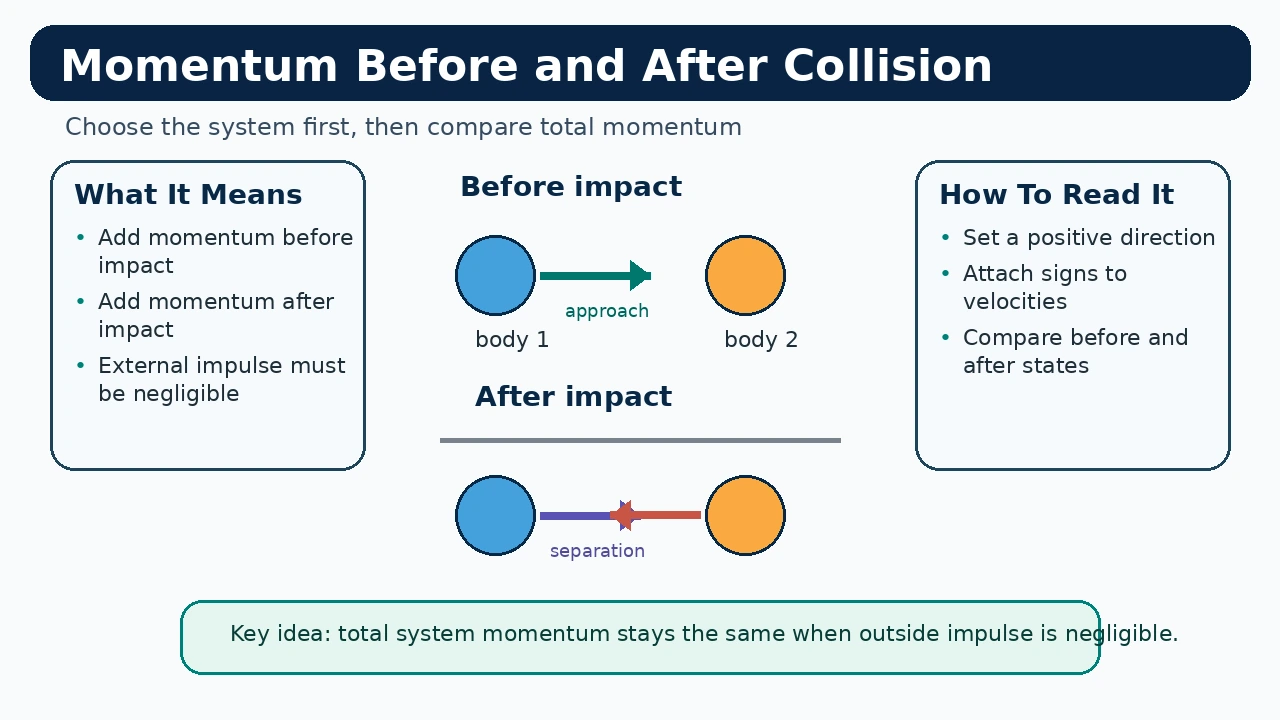
Students must identify the system boundaries carefully to ensure no external impulsive forces are present. If external forces such as gravity act, momentum can still be treated as conserved during the collision only when the external impulse over the very short impact time is negligible. This assumption must be stated carefully.
Vector notation is essential when dealing with multi-dimensional collisions. Momentum must be conserved independently along the x, y, and z axes. Breaking vectors into components ensures that algebraic accuracy is maintained throughout the complex calculation process for all students.
Mastering this law allows aspirants to handle various scenarios, including explosions and recoil. It remains the most reliable tool because it does not require detailed knowledge of the internal impulsive forces during the impact. In most JEE collision problems, start by writing the momentum equation with a clear sign convention.
Kinetic Energy Considerations in Impact
Kinetic energy behavior distinguishes different types of collisions in mechanical systems. While total energy is conserved in an isolated physical system, kinetic energy may transform into heat, sound, deformation, or internal energy during a collision. Distinguishing total energy from kinetic energy is essential for choosing the correct equations.
In a perfectly elastic collision, the total kinetic energy before impact equals the total kinetic energy after impact, provided the system is isolated during the short collision interval.
Use this energy equation together with momentum conservation only when the collision is stated or implied to be elastic.
For inelastic collisions, some kinetic energy is converted into internal energy or deformation work. The loss in kinetic energy can be calculated by subtracting the final energy from the initial. This loss is often asked in numerical JEE exam questions.
Energy conservation is a scalar property, unlike momentum. This means you do not need to worry about directions when summing kinetic energies. However, you must ensure all units are consistent, typically using Joules in the standard SI measurement system.
Recognizing when kinetic energy is conserved helps in selecting the right mathematical approach. If the problem states the bodies are elastic, energy conservation is usually implied. Otherwise, assume some energy loss occurs during the impact event for the given system.
Classifying Collision Types for JEE
Characteristics of Elastic Collisions
Elastic collisions are idealized events where no kinetic energy is lost during the interaction. They are closely approximated in molecular or atomic collisions and are idealized for many macroscopic classroom problems. In the JEE context, billiard balls or gas molecules are often used as examples.
One key property of elastic collisions is the relative velocity of separation. In a head-on elastic collision, the relative velocity of approach equals the relative velocity of separation. This simplifies the algebra significantly compared to using the energy equations.
For two equal masses, an elastic collision results in a complete exchange of velocities. If mass A hits stationary mass B, A stops and B moves with A's initial velocity. This specific case appears frequently in multiple-choice physics questions.
When a light object hits a very heavy stationary object elastically, it rebounds with its original speed. The heavy object remains virtually at rest. This approximation is useful for wall-collision problems and for idealized cases where one body is much more massive than the other.
Solving these requires combining momentum conservation with the relative velocity equation. The relative velocity equation is ##v_2 - v_1 = u_1 - u_2##. Using this linear equation is much faster than solving the quadratic kinetic energy conservation equation during competitive exams.
Inelastic and Perfectly Inelastic Scenarios
Inelastic collisions involve the loss of kinetic energy, though momentum remains conserved. Most real-world collisions fall into this category. The objects may deform or generate heat during the impact, leading to a reduction in the system's total kinetic energy levels.
A perfectly inelastic collision occurs when the colliding bodies stick together after the impact. They move with a common final velocity. This scenario results in the maximum possible loss of kinetic energy for the given initial momentum of the entire system.
To find the common velocity, use the equation ##v = \frac{m_1 u_1 + m_2 u_2}{m_1 + m_2}##. This is a straightforward application of momentum conservation. It is often the starting point for more complex problems involving pendulums or ballistic blocks in exams.
The kinetic energy loss in a perfectly inelastic one-dimensional collision can be substantial. For two bodies that stick together, the loss in kinetic energy is given by:
Remembering this result can save time, but it should be used only for the perfectly inelastic case where the two bodies move with a common final velocity.
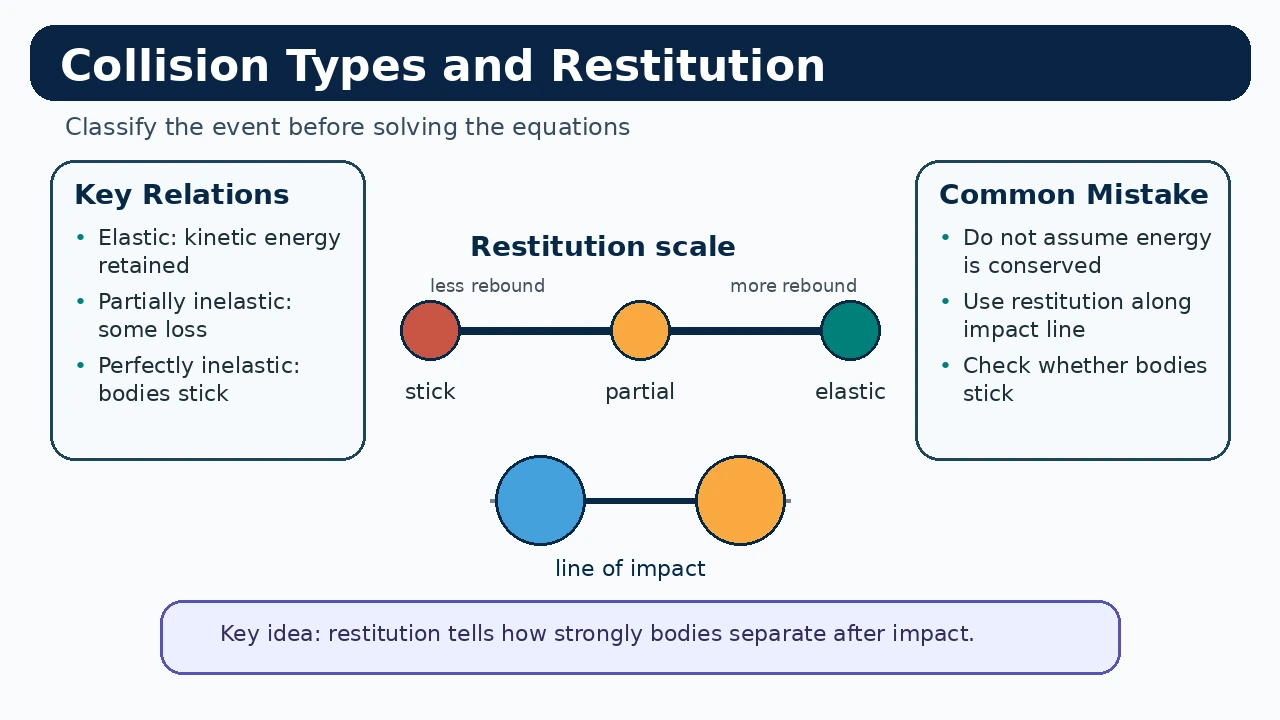
Partially inelastic collisions lie between these two extremes. They are characterized by a coefficient of restitution between zero and one. Understanding the transition between these types is crucial for conceptual clarity and solving varied problems in the general mechanics section.
The Role of Coefficient of Restitution
Mathematical Definition and Physical Meaning
The coefficient of restitution, denoted by 'e', measures the elasticity of a collision. It is defined as the ratio of the relative velocity of separation to the relative velocity of approach. For standard JEE impact problems, this dimensionless quantity is usually taken between zero and one; values outside this range require special physical interpretation.
Mathematically, the formula is expressed as ##e = \frac{v_2 - v_1}{u_1 - u_2}##. Here, ##u## represents initial velocities and ##v## represents final velocities. For a perfectly elastic collision, ##e = 1##, while for perfectly inelastic collisions, the value is ##e = 0##.
For most real-world materials, 'e' is a fractional value. This indicates that some energy is lost, but the objects do not stick together. JEE problems often provide 'e' to find final velocities after a non-ideal impact occurs between bodies.
The value of 'e' depends on the material properties of the colliding bodies. It is not a property of a single object but of the pair. Factors like temperature and impact velocity can sometimes affect this coefficient in advanced research.
In the context of JEE, 'e' is usually treated as a constant. It allows students to relate the velocities before and after impact without knowing the internal forces. It serves as a bridge between momentum and energy loss calculations effectively.
Applying 'e' in Oblique Collisions
Oblique collisions occur when the impact is not along the line of motion. In these cases, we must define the line of impact. This is the common normal at the point of contact during the collision between the two bodies.
The coefficient of restitution 'e' only applies to the velocity components along the line of impact. The velocity components perpendicular to this line remain unchanged. This is because, in the usual smooth-contact model, there is no tangential impulse during the impact. If frictional impulse is present, the tangential component must be handled separately.
To solve oblique problems, first resolve initial velocities into components along and perpendicular to the impact line. Apply momentum conservation and the 'e' equation specifically to the components along the line of impact for accurate and reliable physics results.
The final velocity of each body is the vector sum of its changed normal component and its unchanged tangential component. This requires a good grasp of vector addition and trigonometry. It is a common area where students make calculation errors.
Practice drawing clear diagrams for oblique collisions. Identify the centers of the masses and the point of contact. Correctly identifying the line of impact is fifty percent of the work in solving these higher-level physics challenges efficiently and effectively.
Problem-Solving Strategies and Tips
Systematic Approach to One-Dimensional Problems
For one-dimensional problems, start by defining a positive direction. Assign signs to all initial velocities based on this convention. This prevents sign errors, which are the most frequent cause of incorrect answers in the JEE physics paper for most students.
Write down the momentum conservation equation immediately. If the collision is elastic, use the relative velocity equation. If it is inelastic, use the coefficient of restitution equation provided in the problem statement to relate the final velocities of the bodies.
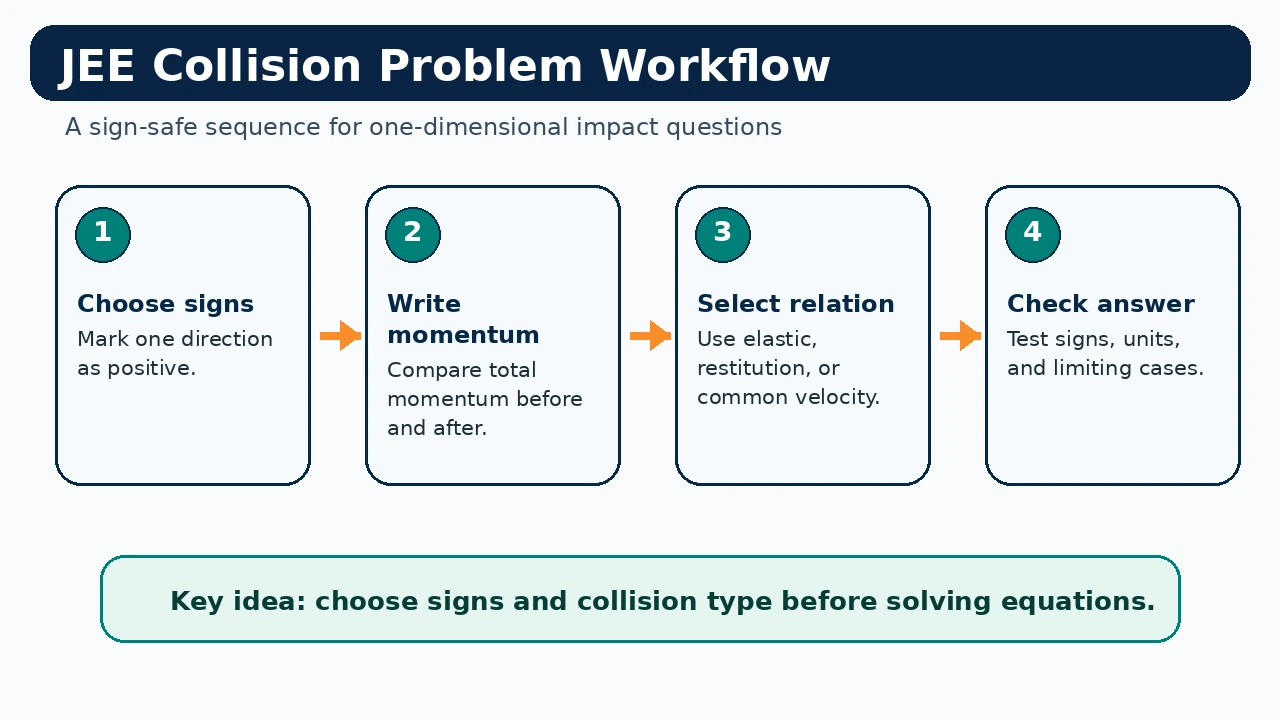
You now have a system of two linear equations with two unknowns, usually the final velocities ##v_1## and ##v_2##. Solving these simultaneously will yield the required values. Always double-check the signs of your final calculated results before marking answers.
Consider special cases to verify your answer. If the masses are equal and the collision is elastic, do the velocities exchange? If one mass is much larger, does its velocity remain nearly constant? These checks build confidence in your solution.
Keep your calculations organized. Collision problems can become algebraically heavy. Using subscripts and clearly labeled variables helps maintain focus. This systematic approach ensures that you do not lose points due to avoidable mistakes in the competitive engineering entrance exam.
Handling Multi-Body and Variable Mass Systems
Multi-body systems require applying momentum conservation to the entire system. If three or more bodies collide, the total momentum remains constant. However, you may need to analyze individual pairs of collisions if they occur sequentially over a period of time.
Variable mass systems, like rockets or leaking tanks, involve a different set of equations. While not standard collision problems, they share the momentum conservation principle. The impulse-momentum theorem is often more useful in these dynamic and constantly changing physical scenarios.
Problems involving springs or buffers between masses are common. In these cases, the "collision" happens over a distance. Use work-energy theorems alongside momentum conservation. The maximum compression of the spring occurs when the interacting masses have the same instantaneous velocity, because their relative velocity is zero at that instant.
For problems with external impulses, like a hammer hitting a nail, use the impulse equation ##J = \Delta p##. Here, the external force is so large that comparatively small forces like gravity can usually be ignored during the very short impact time interval.
Success in JEE mechanics comes from recognizing which conservation law to apply. Practice a wide variety of problems, from simple head-on impacts to complex multi-stage interactions. This breadth of experience is key to mastering the physics of collisions completely.
We Also Published
From our network :
- 10 Physics Numerical Problems with Solutions for IIT JEE
- Vite 6/7 'Cold Start' Regression in Massive Module Graphs
- EV 2.0: The Solid-State Battery Breakthrough and Global Factory Expansion
- 98% of Global MBA Programs Now Prefer GRE Over GMAT Focus Edition
- https://www.themagpost.com/post/trump-political-strategy-how-geopolitical-stunts-serve-as-media-diversions
- AI-Powered 'Precision Diagnostic' Replaces Standard GRE Score Reports
- https://www.themagpost.com/post/analyzing-trump-deportation-numbers-insights-into-the-2026-immigration-crackdown
- Mastering DB2 LUW v12 Tables: A Comprehensive Technical Guide
- Mastering DB2 12.1 Instance Design: A Technical Deep Dive into Modern Database Architecture
RESOURCES
- Difference between Elastic And Inelastic Collisions - Physics Wallah
- 11 System of Particles |Centre Of Mass IIT JEE NEET - YouTube
- Elastic and Inelastic Collisions - Unacademy
- Types Collision -Study Material for IIT JEE - askIITians
- Elastic And Inelastic Collisions In One And Two Dimensios
- Elastic And Inelastic Collision in One And Two Dimension - Allen.In
- Elastic and Inelastic Collisions - Concepts | Solved Problems
- what is elastic and inelastic collision ? what is vapour density
- Nuclear physics notes for students - Facebook
- JEE Advanced 2023 Revised Syllabus for IIT Entrance Exam ...
- Elastic and Inelastic Collisions: Definition, Diagram, Examples
- Which of the following is not a perfectly inelastic collision (a) Striking ...
- NEET Syllabus 2019 for Physics - Impulse JEE
- Elastic Collision: Key Concepts and Formulas | PDF - Scribd
- Elastic Collision - Definition, Examples, Formula and FAQs - Testbook



0 Comments