
On This Page
Fundamentals of the Integer Square Root
The integer square root floor is a specialized mathematical operation used primarily in discrete mathematics. It identifies the largest integer ##n## that satisfies the condition where ##n^2 \le x##. This is distinct from standard floating-point square roots.
In computational terms, we define the operation as the floor of the principal square root. Formally, this is expressed as
. This ensures that the result remains within the domain of non-negative integers.
Consider the example of the number ten. The square root of ten is approximately 3.162. Therefore, the integer square root floor of ten is exactly three, because three squared is nine, which is less than or equal to ten.
If we check the next integer, four, we find that four squared is sixteen. Since sixteen exceeds ten, four cannot be the integer square root. This logical boundary defines the "floor" aspect of the calculation for all inputs.
This function is monotonic, meaning as the input increases, the output never decreases. It is a step function that changes value only when the input reaches a perfect square, providing a stable foundation for many complex mathematical proofs.
Defining the Floor Function Logic
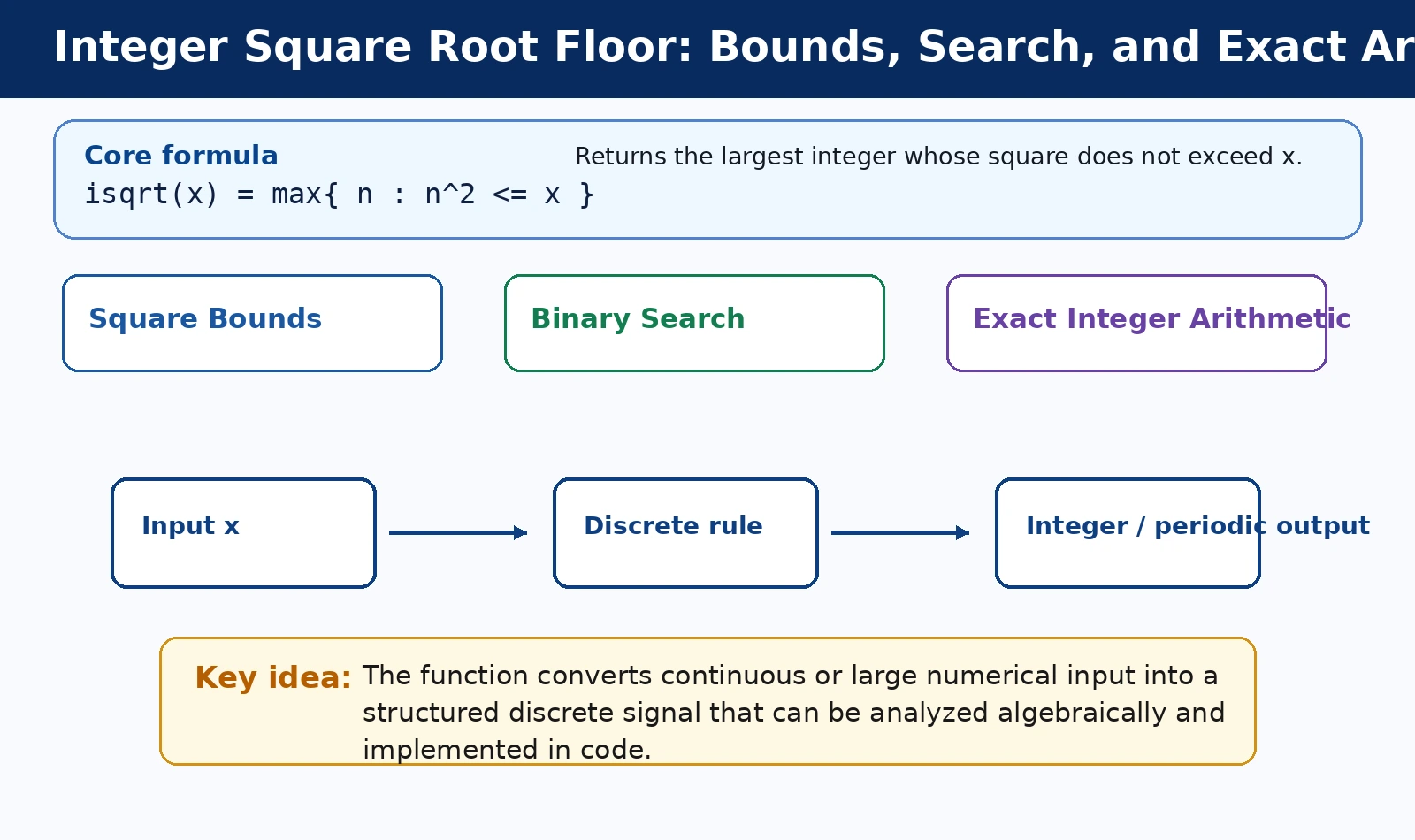
The floor function is the mechanism that truncates the decimal portion of a real number. In the context of square roots, it ensures that we only deal with whole numbers. This is critical for low-level machine instructions.
Mathematically, the relationship is defined by the inequality ##n^2 \le x < (n+1)^2##. Any integer ##n## that satisfies this range for a given ##x## is the unique integer square root. This provides a clear computational target.
For computer scientists, this definition avoids the overhead of floating-point arithmetic. By staying within the integer domain, we prevent rounding errors that often plague continuous calculations. This precision is vital for sensitive data processing and cryptographic keys.
The logic also applies to large datasets where approximate values are insufficient. By focusing on the largest integer bound, algorithms can partition ranges effectively. This is particularly useful in spatial indexing and various geometric data structures.
Ultimately, the floor logic simplifies the relationship between a number and its quadratic root. It provides a discrete mapping that is easy to implement in hardware. This simplicity makes it a favorite for embedded systems and microcontrollers.
Mathematical Bounds and Inequalities
Understanding the bounds of the integer square root is essential for optimization. Since we know ##n^2 \le x##, we can establish that ##n## will always be less than or equal to ##x## itself. This provides an initial search space.
For any positive integer ##x##, the result ##n## lies within the interval from zero to ##x##. However, tighter bounds can be established by looking at the number of bits. A number with ##k## bits has a root of roughly ##k/2## bits.
Inequalities help in verifying the correctness of an algorithm. If an algorithm returns a value ##m##, we must verify that ##m^2 \le x## and ##(m+1)^2 > x##. If both hold, the result is mathematically guaranteed to be correct.
These bounds are also used in error analysis for approximation methods. When using iterative techniques, the distance between the current guess and the actual floor root decreases. Monitoring these bounds allows for early termination of the calculation loop.
Furthermore, these mathematical constraints allow for the development of "branchless" code. By understanding the limits of the output, developers can write faster routines. This reduces the computational cost of frequent square root operations in graphics.
Algorithmic Implementation Strategies
Implementing the integer square root floor requires choosing an algorithm that balances speed and complexity. For small integers, simple iterative methods might suffice. However, as the input size grows, more sophisticated approaches become necessary for performance.
One common strategy is the use of search-based algorithms. These methods treat the problem as finding a value in a sorted range. Because the square function is monotonic, these search strategies are highly effective and easy to debug.
Another approach involves digit-by-digit calculation, similar to long division. This method is particularly useful for hardware implementations. It processes the bits of the input to build the result one bit at a time, ensuring constant time.
For high-level software, the Newton-Raphson method is often adapted for integers. This iterative technique converges quadratically, making it incredibly fast for large numbers. It is the standard choice for arbitrary-precision arithmetic libraries and scientific computing.
Choosing the right strategy depends on the specific requirements of the application. Factors such as memory usage, processor architecture, and the expected range of input values all play a role. A well-chosen algorithm significantly impacts overall system efficiency.
Binary Search and Iterative Methods
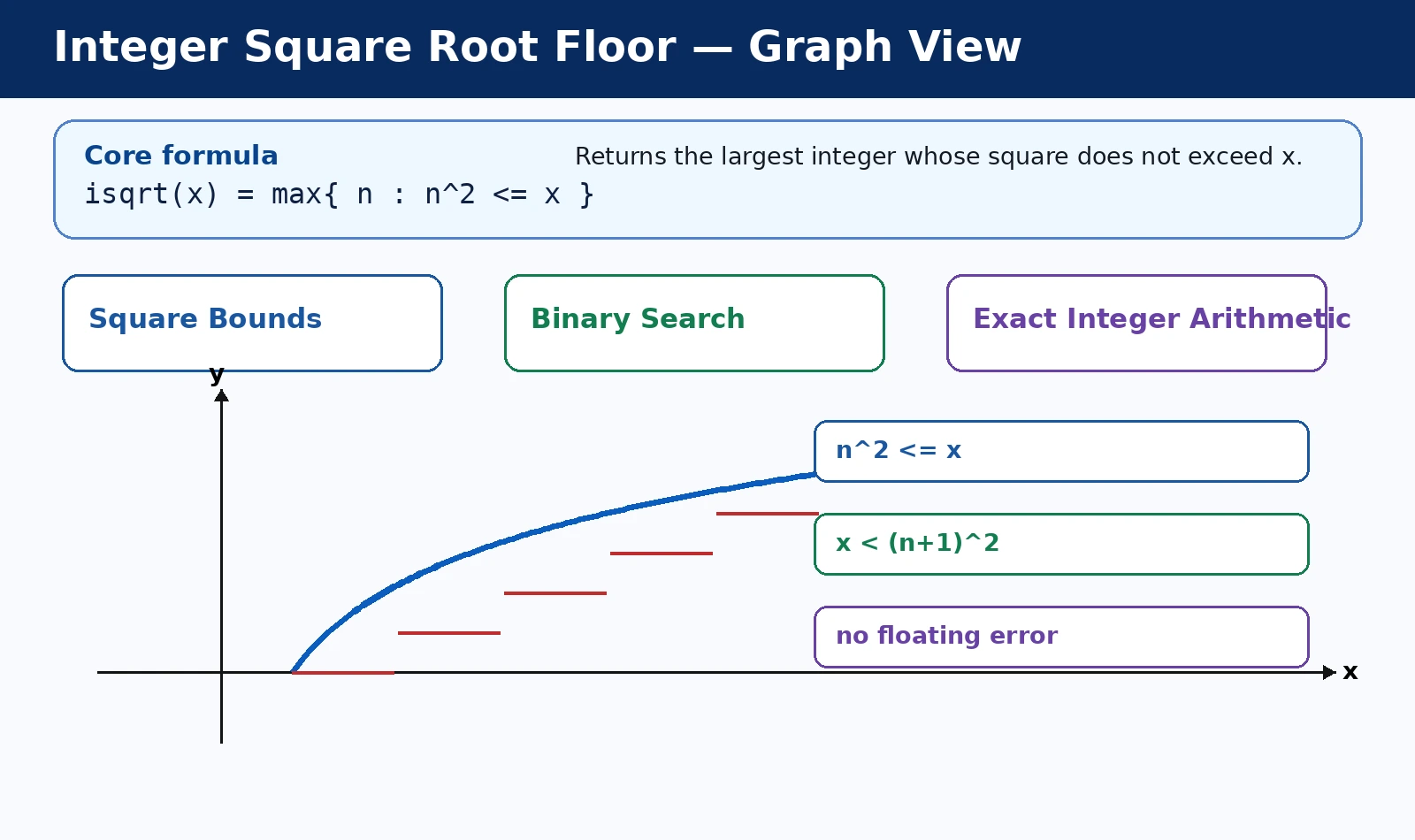
The binary search method is a reliable way to find the integer square root. By checking the midpoint of a range and squaring it, we can discard half of the possibilities. This results in a logarithmic time complexity.
The search starts with a range from zero to the input value ##x##. In each step, we calculate the square of the middle value. If the square is too large, we move the upper bound down to the middle.
Conversely, if the square is less than or equal to ##x##, we store the current middle as a potential answer. We then move the lower bound up to find an even larger integer that might fit the criteria.
This method is robust because it does not require complex floating-point conversions. It works entirely with integer comparisons and shifts. This makes it ideal for languages or environments where floating-point units are absent or slow to use.
Iterative methods like linear search are generally too slow for large numbers. However, for very small inputs, the overhead of binary search might not be worth it. In those cases, a simple loop checking integers can be surprisingly efficient.
Newton’s Method for Integer Systems
Newton’s method, also known as the Newton-Raphson method, is an iterative process for finding roots. To find the integer square root of ##x##, we use the recurrence relation
.
This formula provides a sequence of approximations that quickly converges to the floor of the square root. Starting with a reasonable guess, such as ##x## itself or a power of two, the values decrease rapidly toward the target.
One unique aspect of the integer version is the stopping condition. Because we are using floor division, the sequence might eventually oscillate between two values. We stop when the new guess is not smaller than the previous one.
The efficiency of this method is remarkable, especially for large numbers. It typically requires only a few iterations even for numbers with hundreds of digits. This makes it the backbone of big-integer libraries in modern programming.
We Also Published
Implementation requires care to avoid division by zero and to handle the initial guess. A common optimization is to use bit-shifting to find a starting point close to the actual root. This further reduces the number of iterations required.
Practical Applications in Modern Computing
The integer square root floor is more than just a mathematical curiosity. it is a workhorse in modern computing. From graphics rendering to data compression, the ability to find roots quickly and accurately is a fundamental requirement.
In computer graphics, square roots are used to calculate distances between points. While floating-point roots are common, integer roots are often used in grid-based calculations. This helps maintain alignment and simplifies the logic for pixel-level operations.
Data structures also benefit from this operation. For example, in square root decomposition, a list is divided into blocks of size ##\text{isqrt}(n)##. This allows for faster range queries and updates, balancing the costs of different operations.
In the realm of simulations, integer roots help in managing discrete time steps and spatial partitions. By keeping calculations in the integer domain, simulators can avoid the accumulation of floating-point drift. This ensures that long-running simulations remain consistent.
Finally, compiler optimizations often utilize integer square roots to simplify expressions. If a compiler detects a square root operation followed by a floor, it may replace it with a more efficient integer-only implementation. This improves the performance of generated code.
Primality Testing and Number Theory
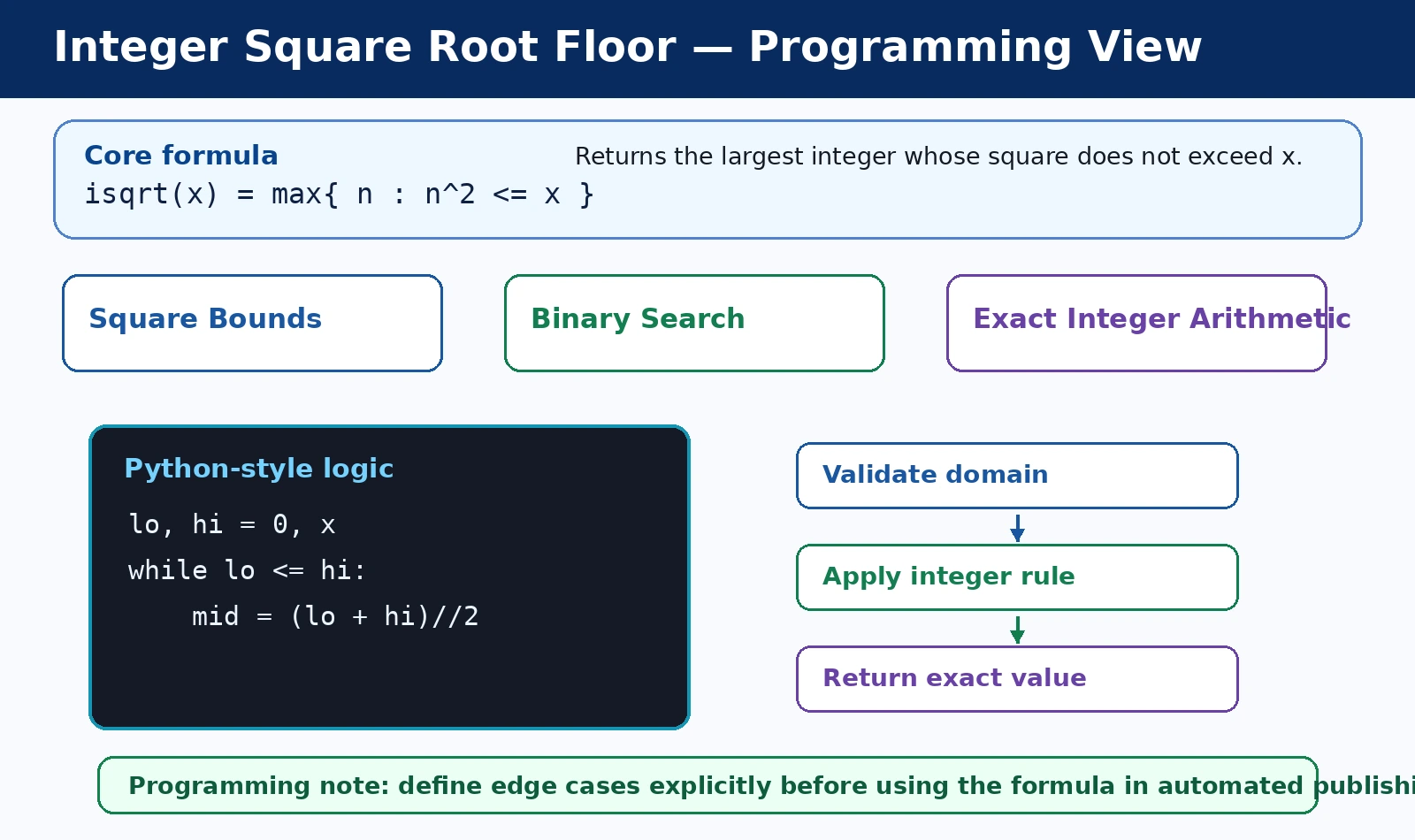
In number theory, the integer square root is used to determine the limit for trial division. To check if a number ##n## is prime, we only need to test factors up to ##\text{isqrt}(n)##. This drastically reduces the workload.
Without this limit, testing a large number for primality would be computationally expensive. By stopping at the integer square root, we ensure that every potential factor has been accounted for. This optimization is the basis for basic prime checks.
Sieve algorithms, such as the Sieve of Eratosthenes, also rely on this concept. The algorithm marks multiples of primes starting from their squares. It only needs to process primes up to the integer square root of the maximum limit.
For larger numbers, more advanced primality tests like the Miller-Rabin test still use the square root as a boundary. It helps in defining the ranges for witness numbers and modular exponentiation steps. It is a cornerstone of computational number theory.
Even in factorization algorithms, like Pollard's rho, the square root plays a role in complexity analysis. Understanding the distribution of factors relative to the square root helps in predicting the success rate of the algorithm for different types of inputs.
Cryptographic Protocols and Security
Cryptography relies heavily on integer arithmetic, especially when dealing with public-key systems. The integer square root is used in various stages of key generation and validation. It helps ensure that parameters meet security requirements.
In RSA encryption, the security depends on the difficulty of factoring large numbers. The integer square root provides a baseline for understanding the search space for potential factors. It is used in attacks like Fermat's factorization method.
Elliptic curve cryptography also utilizes square roots within finite fields. While these are modular square roots, the underlying logic of finding roots within discrete sets is closely related. Speed and precision are non-negotiable in these security-critical contexts.
Digital signatures often require the verification of mathematical identities. The integer square root can be part of the hashing or validation process. It ensures that the data has not been tampered with and that the signature is valid.
Finally, side-channel attacks are a concern for cryptographic implementations. Using constant-time integer square root algorithms helps prevent attackers from gaining information through timing analysis. This adds a layer of physical security to the mathematical protocols used today.
Optimization and Hardware Acceleration
As computational demands increase, optimizing the integer square root becomes a priority. Modern processors often have specialized instructions or pipelines to handle arithmetic efficiently. Developers must leverage these features to achieve the highest possible performance.
Software-level optimizations involve minimizing expensive operations like division. By using bit-shifts and additions, developers can create "division-less" square root routines. These are particularly effective on processors where division is a slow operation.
Parallelism is another avenue for optimization. In vector processing or GPU computing, multiple square roots can be calculated simultaneously. This is useful for simulations and large-scale data analysis where throughput is more important than latency.
Hardware designers also incorporate square root logic directly into the Silicon. Dedicated circuits can calculate the root in a fixed number of clock cycles. This provides a level of performance that software-only solutions cannot match for real-time tasks.
Ultimately, the goal of optimization is to reduce the energy and time required for the calculation. In mobile and battery-powered devices, efficient arithmetic translates directly to longer battery life. This makes low-level optimization a key concern for modern engineers.
Bitwise Operations and Shift Logic
Bitwise algorithms for the integer square root are based on the property that ##(a + b)^2 = a^2 + 2ab + b^2##. By building the result bit by bit, we can avoid complex multiplication and division entirely.
The process involves shifting the input and the potential root. At each step, we determine if the next bit of the root should be a one or a zero. This is done by comparing the current remainder with a shifted value.
This "digit-by-digit" method is very similar to the manual method taught in schools. However, in binary, it becomes much simpler because there are only two possible digits. This simplicity is perfect for digital logic circuits.
Because it uses only shifts and subtractions, this method is extremely fast on most hardware. It does not suffer from the variable timing of iterative methods like Newton-Raphson. This makes it predictable and easy to schedule in a pipeline.
Many standard C libraries and assembly routines use this bitwise approach. It provides a good balance between code size and execution speed. It is a classic example of how understanding binary representation can lead to efficient algorithm design.
Benchmarking and Complexity Analysis
To choose the best algorithm, developers must perform benchmarking. This involves measuring the execution time across a wide range of inputs. It helps identify which algorithm performs best for small versus large numbers.
Complexity analysis provides a theoretical framework for these measurements. Binary search has a complexity of ##O(\log x)##, while Newton's method is often faster in practice. Understanding these Big O notations allows for informed architectural decisions.
Memory usage is another factor in benchmarking. Some algorithms require large lookup tables to speed up calculations. While this reduces CPU time, it increases the memory footprint, which might not be acceptable in constrained environments.
Scalability is also critical. An algorithm that works well for 32-bit integers might fail or become too slow for 1024-bit integers. Testing with "BigInt" libraries is necessary for applications like blockchain and high-end scientific research.
In conclusion, the integer square root floor is a vital tool in the programmer's toolkit. By understanding its mathematical roots and the various ways to implement it, developers can build faster and more secure systems. It remains a fundamental topic in computer science.
From our network :
- AI-Powered 'Precision Diagnostic' Replaces Standard GRE Score ReportsDiscover the new GRE Precision Diagnostic. Learn how AI-powered behavioral analytics and time-to-solve tracking are replacing standard GRE score reports to empower students.
- Vite 6/7 'Cold Start' Regression in Massive Module GraphsIn-depth analysis of Vite 6/7 cold start regressions in massive module graphs. Learn about barrel file issues, pre-bundling optimizations, and how to improve Vite dev server performance.
- Mastering DB2 12.1 Instance Design: A Technical Deep Dive into Modern Database ArchitectureComprehensive guide to DB2 12.1 Instance Design. Explore architectural components, HADR setup, buffer pool tuning, and security policies for IBM DB2 12.1. Includes 10 functional SQL and Shell samples.
- 98% of Global MBA Programs Now Prefer GRE Over GMAT Focus EditionExplore why 98% of global MBA programs now prefer the GRE over GMAT Focus. Learn about the shorter GRE format, verbal logic importance, and strategic versatility for students.
- Trump Political Strategy How Geopolitical Stunts Serve As Media Diversions
- 10 Physics Numerical Problems with Solutions for IIT JEEPrepare for IIT JEE with 10 physics numerical problems, complete with detailed solutions and conceptual explanations. Ideal for mastering kinematics, thermodynamics, electromagnetism, and optics.
- Analyzing Trump Deportation Numbers Insights Into The 2026 Immigration Crackdown
- Mastering DB2 LUW v12 Tables: A Comprehensive Technical GuideComprehensive guide on DB2 LUW v12 tables. Explore CREATE TABLE syntax, BLU Acceleration, range partitioning, data types, and security features for IBM DB2 LUW v12.
- EV 2.0: The Solid-State Battery Breakthrough and Global Factory ExpansionDiscover the impact of the Solid-State Battery Breakthrough on the EV market. Learn about CATL and BYD stock growth, global factory expansion in Europe, and the future of EV 2.0 technology.
RESOURCES
- 69. Sqrt(x) - LeetCode
- Integer square root - The Rust Programming Language Forum
- Integer square root in python - math - Stack Overflow
- Fast integer sqrt algorithm? : r/technicalfactorio - Reddit
- fast integer square root approximation - Stack Overflow
- Fast integer square-root - Mathematica Stack Exchange
- Fast algorithm to calculate integer square root - Reddit
- Using floor, ceiling, square root, and factorial functions to get integers
- Computing square root floor - Applied Mathematics Consulting
- Integer square root - Wikipedia
- math — Mathematical functions — Python 3.14.5 documentation
- Integer square root - CUDA - NVIDIA Developer Forums
- Square root algorithm - MathOverflow
- Reliable integer root function? - ASKSAGE - Sage Q&A Forum
- Program for Square Root of Integer - GeeksforGeeks


0 Comments