
On This Page
Introduction to Dirichlet's Function
Defining the Indicator Function
The Dirichlet function is formally defined as the indicator function of the set of rational numbers, denoted by ##\mathbb{Q}##. It assigns a specific value of one to any rational input and a value of zero to any irrational input.
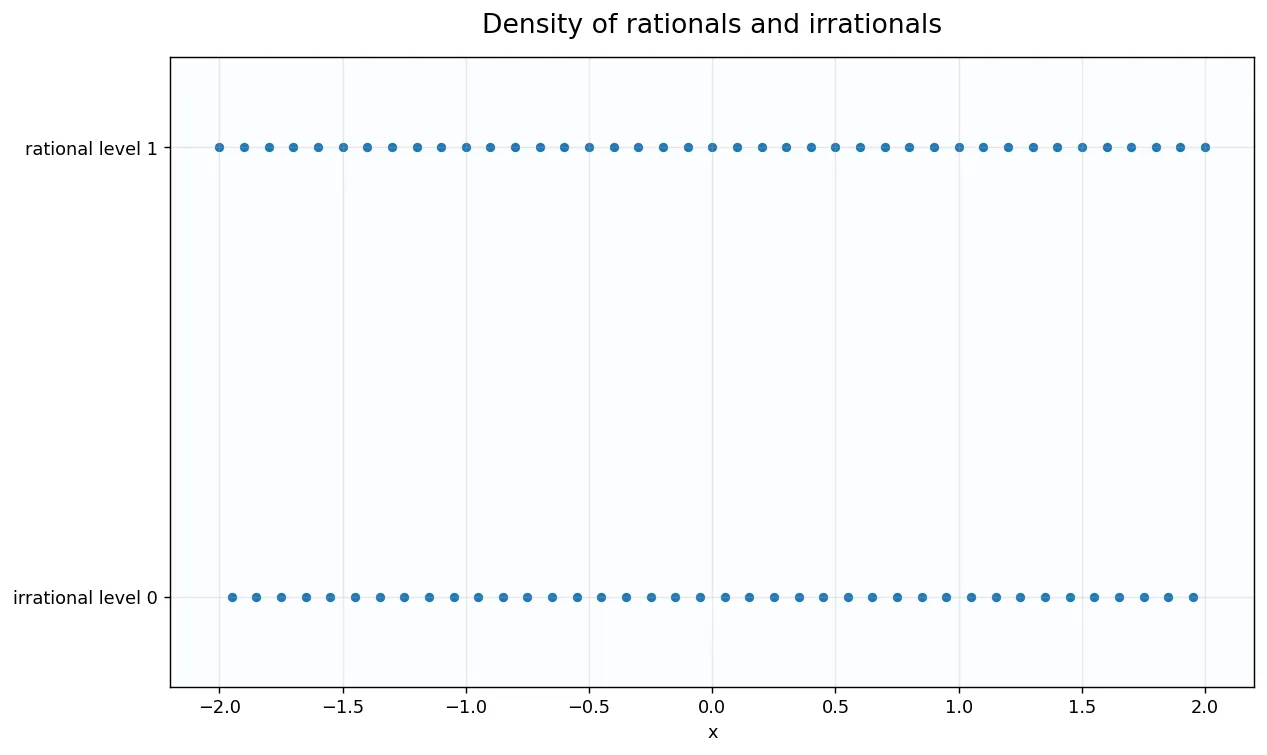
Mathematically, the function is expressed using piecewise notation to distinguish between these two subsets of the real numbers. This simple rule creates a functional mapping that is impossible to draw accurately on a standard two-dimensional Cartesian coordinate system.
The symbolic representation is often written as
. This notation highlights the dichotomy between the two types of real numbers.
In the context of set theory, this is the characteristic function ##\chi_{\mathbb{Q}}(x)##. It effectively "picks out" the rational points from the continuum of the real line, assigning them a unique height that distinguishes them from their irrational neighbors.
Despite its simple definition, the function exhibits behavior that challenges our intuitive understanding of how functions should look. It does not possess a smooth curve or even a set of connected segments, appearing instead as two parallel "clouds."
Historical Context and Significance
Peter Gustav Lejeune Dirichlet introduced this function in 1829 as a way to test the limits of existing mathematical definitions. At the time, the concept of a "function" was often tied to geometric curves or simple algebraic formulas.
Dirichlet’s contribution marked a significant shift toward a more rigorous, set-theoretic approach to analysis. By constructing a function that could not be graphed, he forced mathematicians to reconsider the fundamental requirements for continuity and integrability in calculus.
Before this period, many believed that every function must be continuous at least at some points. Dirichlet’s example provided a definitive rebuttal to this assumption, serving as one of the first recognized "pathological" functions in the history of mathematics.
This function played a crucial role in the development of modern real analysis and measure theory. It highlighted the limitations of the Riemann integral, which failed to assign a meaningful area under such a highly fragmented and volatile graph.
Today, Dirichlet's function remains a staple in undergraduate mathematics education. it serves as a primary example for teaching students about the density of real numbers and the formal epsilon-delta definitions used to prove limits and continuity.
Mathematical Properties and Definitions
Domain, Range, and Formal Notation
The domain of the Dirichlet function is the set of all real numbers, denoted as ##\mathbb{R}##. This means the function is defined for every possible point on the horizontal axis, whether that point is a fraction or a decimal.
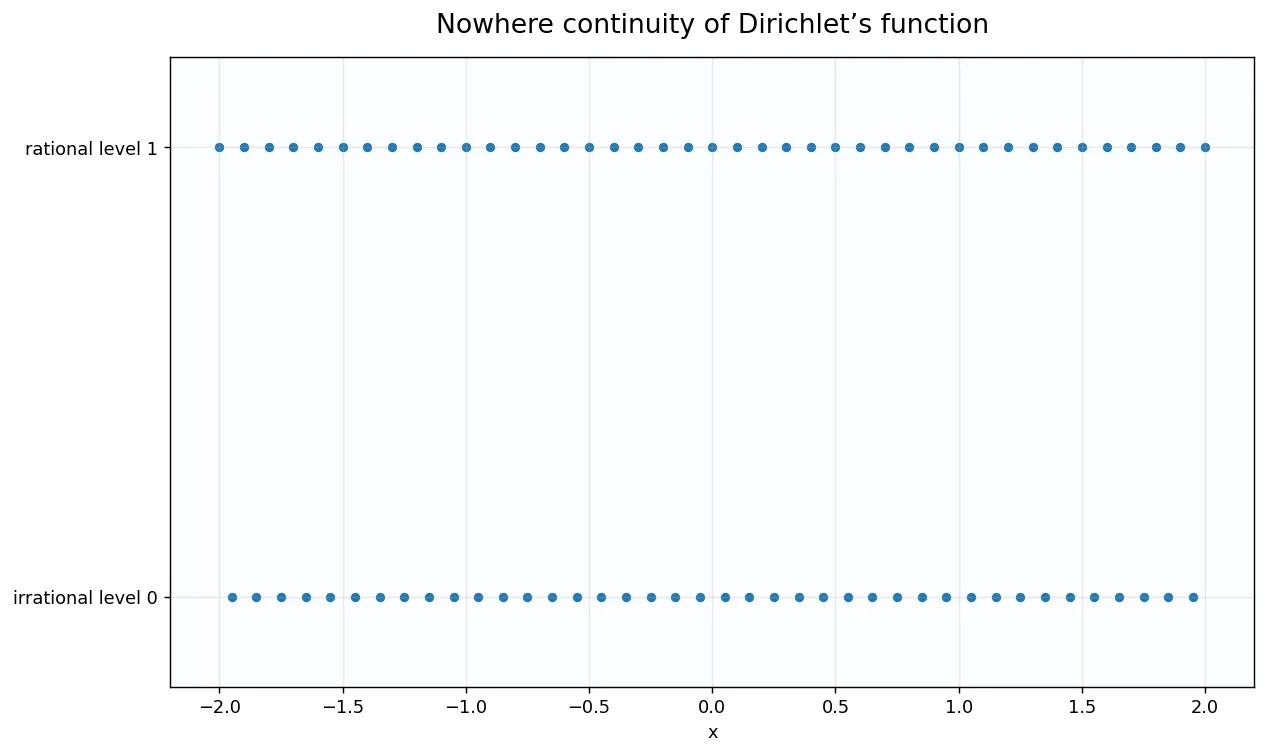
In contrast, the range of the function is restricted to a discrete set containing only two elements: ##\{0, 1\}##. This extreme reduction from an uncountable domain to a finite range is a key characteristic of indicator functions in general.
Notationally, the function is often referred to as ##\mathbb{1}_{\mathbb{Q}}(x)##. The "1" symbol represents the indicator nature, while the subscript indicates the specific set over which the function takes the value of one for all elements.
Because the set of rational numbers is countable while the set of real numbers is uncountable, the function is "mostly" zero. However, because rationals are everywhere, the value of one appears in every possible interval, no matter how small.
Understanding this mapping is essential for grasping more complex concepts in measure theory. It provides a bridge between point-set topology and functional analysis, showing how set properties directly translate into the behavior of a defined mathematical mapping.
Density of Rationals and Irrationals
The behavior of Dirichlet's function is rooted in the property of density. In mathematics, a set is dense in the reals if every open interval contains at least one point from that set, which is true for rationals.
Similarly, the set of irrational numbers is also dense in the real line. This means that between any two rational numbers, there is an irrational number, and between any two irrational numbers, there is a rational number nearby.
Because of this mutual density, the Dirichlet function oscillates between zero and one infinitely many times within any interval. There is no region on the real line where the function remains constant at either zero or one for long.
This density ensures that the function has no "jumps" in the traditional sense, but rather a total lack of cohesion. If you were to zoom in on any point, you would still find both values present in the local neighborhood.
This interleaving of points creates a structure that defies visual representation. While we can describe the logic of the values, the actual graph consists of two dense sets of points that appear to occupy the same horizontal space.
We Also Published
Continuity and Differentiability Analysis
Proof of Nowhere Continuity
A function is continuous at a point ##c## if, for every ##\epsilon > 0##, there exists a ##\delta > 0## such that if ##|x - c| < \delta##, then ##|f(x) - f(c)| < \epsilon##. Dirichlet's function fails this test everywhere.
Suppose ##c## is a rational number, so ##f(c) = 1##. In any interval around ##c##, there are irrational numbers where the function equals zero. If we choose ##\epsilon = 0.5##, the difference ##|1 - 0|## always exceeds epsilon.
Conversely, if ##c## is an irrational number, then ##f(c) = 0##. Within any neighborhood of ##c##, there are rational numbers where the function equals one. Again, the difference ##|0 - 1|## is greater than any small epsilon chosen.
This logical cycle proves that no limit exists for the function at any point on the real line. Since the limit does not exist, the function cannot meet the criteria for continuity at any single real value.
The term "nowhere continuous" is used to describe this extreme state. It represents a function that is entirely broken at every point, making it a perfect tool for illustrating the necessity of formal proofs over visual intuition.
Implications for Differentiability
Differentiability requires a function to be continuous at a point as a necessary, though not sufficient, condition. Since Dirichlet's function is not continuous anywhere, it follows logically that it is also not differentiable at any point.
The definition of a derivative involves a limit of the difference quotient as the change in ##x## approaches zero. Because the function values are constantly jumping between zero and one, this limit never converges to a value.
In any neighborhood of a point, the slope between that point and its neighbors would fluctuate wildly between zero and effectively infinite values. This prevents the existence of a tangent line or a local rate of change.
This lack of differentiability makes the function an "analytical monster" in the eyes of nineteenth-century mathematicians. It lacks the smoothness required for the traditional tools of calculus, such as Taylor series or differential equations, to apply.
While other functions like the Weierstrass function are continuous but nowhere differentiable, Dirichlet's function is even more erratic. It fails at the most basic level of continuity, placing it in a different class of mathematical objects.
Integration and Pathological Behavior
Riemann vs. Lebesgue Integrability
In Riemann integration, we divide the domain into sub-intervals and calculate upper and lower sums. For Dirichlet's function, every sub-interval contains both rational and irrational points, leading to a significant discrepancy in these sums.
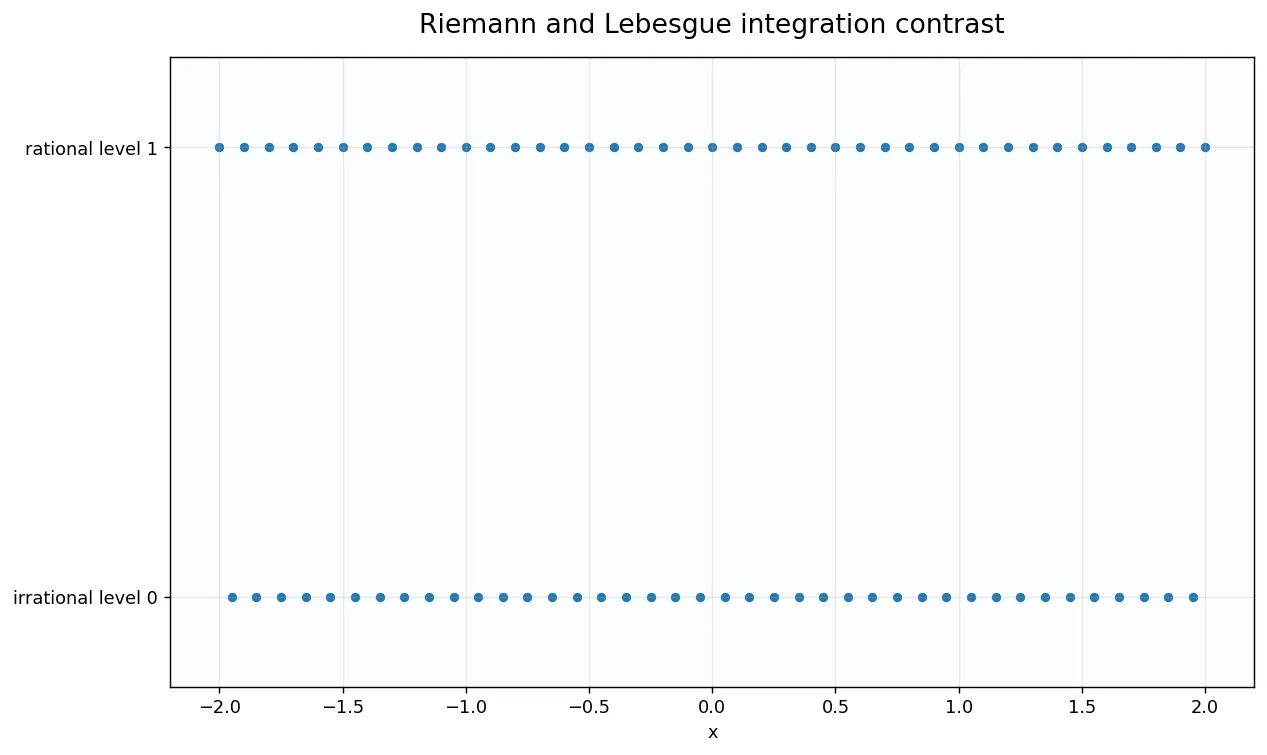
The upper Riemann sum will always be one because the maximum value in any interval is one. Conversely, the lower Riemann sum will always be zero because the minimum value in any interval is always zero.
Since the upper and lower integrals do not coincide, the function is not Riemann integrable only in trivial zero-length cases. This failure was one of the primary motivations for Henri Lebesgue to develop a more robust theory of integration in the 1900s.
Lebesgue integration focuses on the measure of the set of inputs rather than partitioning the domain. Since the set of rational numbers has a Lebesgue measure of zero, the integral of the function is effectively zero.
The calculation is
. This result allows mathematicians to integrate functions that were previously considered impossible to handle.
The Function as a Counterexample
Dirichlet's function is the quintessential "pathological" function. In mathematics, a pathological case is one that deviates from the standard or expected behavior of its class, often used to show that certain theorems are not universal.
It serves as a warning against making assumptions based on "well-behaved" functions like polynomials or trigonometric series. It forces students and researchers to rely strictly on formal definitions and rigorous logic when exploring real analysis.
Many theorems in calculus require assumptions like "piecewise continuity" or "bounded variation." Dirichlet's function is used to test these boundaries, showing exactly where a theorem might fail if those specific conditions are not met during proof.
Beyond its use as a counterexample, it is a foundational object in the study of Borel sets and measurable functions. It provides a clear, binary example of how set properties influence the integrability and convergence of sequences.
In summary, while the indicator function of the rationals may seem like a mere curiosity, it is a vital pillar of modern mathematics. It defines the limits of classical calculus and paves the way for advanced measure theory.
From our network :
- 10 Physics Numerical Problems with Solutions for IIT JEE
- EV 2.0: The Solid-State Battery Breakthrough and Global Factory Expansion
- 98% of Global MBA Programs Now Prefer GRE Over GMAT Focus Edition
- Vite 6/7 'Cold Start' Regression in Massive Module Graphs
- https://www.themagpost.com/post/trump-political-strategy-how-geopolitical-stunts-serve-as-media-diversions
- AI-Powered 'Precision Diagnostic' Replaces Standard GRE Score Reports
- Mastering DB2 LUW v12 Tables: A Comprehensive Technical Guide
- Mastering DB2 12.1 Instance Design: A Technical Deep Dive into Modern Database Architecture
- https://www.themagpost.com/post/analyzing-trump-deportation-numbers-insights-into-the-2026-immigration-crackdown
RESOURCES
- Dirichlet function - Wikipedia
- Dirichlet energy minimizing multi-valued functions - arXiv
- Dirichlet distribution - Wikipedia
- Dirichlet Function -- from Wolfram MathWorld
- DIRICHLET L-FUNCTIONS AND DEDEKIND ζ-FUNCTIONS
- 2.3 Dirichlet product - Zach Teitler
- On the mean value of the generalized Dirichlet $L$-functions - EuDML
- Boundary properties of functions with finite Dirichlet integrals
- why is thomae's function riemann integrable but dirichlet's ... - Reddit
- Computer Experimentation with Dirichlet Functions - WSEAS
- Asymptotic properties of Dirichlet kernel density estimators
- properties of the dirichlet green's function for linear diffusions on a ...
- Quasiconformal properties of Qp,0 curves and Dirichlet-type curves
- Dirichlet function and its modifications
- Positive Properties of Green's Function for Fractional Dirichlet ...

0 Comments