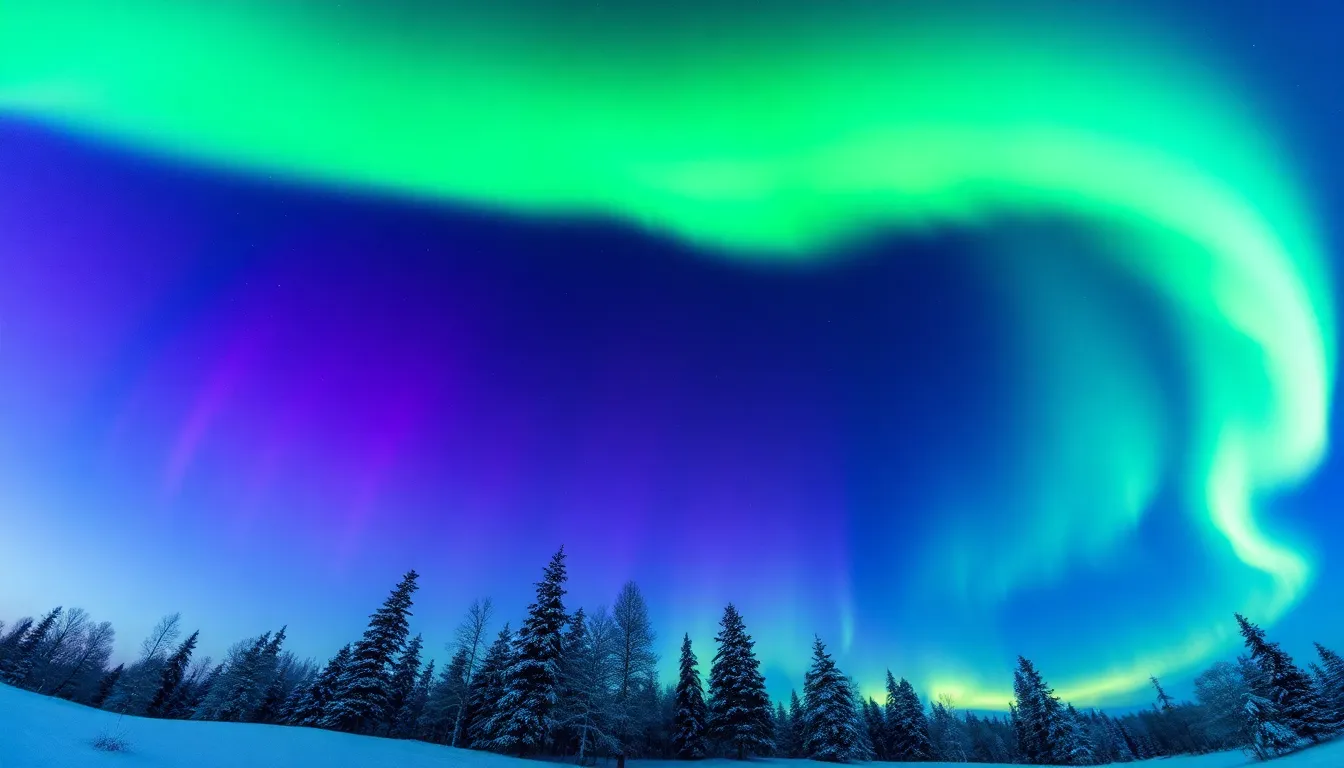
The northern lights, or aurora borealis, are a mesmerizing natural phenomenon. To observe this stunning display, you must understand the science behind it. You'll learn to witness the northern lights, increasing your chances of seeing these vibrant lights dance across the night sky. This guide breaks down the essential information, from solar flares to optimal viewing locations, so you can plan your aurora-chasing adventure.
On This Page
We Also Published
The ethereal dance of the aurora borealis, or northern lights, is a spectacle that has captivated humanity for centuries. These vibrant displays of light in the night sky are not just beautiful; they are a direct result of solar activity interacting with Earth's magnetic field. This guide will help you understand the science behind the lights and how to increase your chances of witnessing this natural wonder.
Understanding Auroral Displays
The northern lights are caused by charged particles from the sun, known as solar flares, interacting with Earth's atmosphere. These particles are channeled towards the poles by Earth's magnetic field. When these particles collide with atoms and molecules in the upper atmosphere, they excite them, causing them to emit light.
The colors of the aurora depend on the type of gas that is excited and the altitude at which the interaction occurs. Oxygen produces green and red light, while nitrogen creates blue and purple hues. The intensity and location of the auroras vary depending on the level of solar activity and the Earth's magnetic field.
The Science Behind the Lights
The sun constantly emits a stream of charged particles called the solar wind. During periods of increased solar activity, such as solar flares and coronal mass ejections (CMEs), the solar wind becomes more intense. These CMEs can release billions of tons of plasma and magnetic fields into space. When these CMEs reach Earth, they interact with the Earth's magnetosphere, creating geomagnetic storms.
Geomagnetic storms are disturbances in Earth's magnetosphere caused by the solar wind. These storms can cause auroras to appear at lower latitudes than usual. The strength of a geomagnetic storm is measured on a scale from G1 (minor) to G5 (extreme). Stronger storms increase the likelihood of seeing the northern lights and expand the area where they are visible.
Predicting and Viewing Auroras
Predicting auroras involves monitoring solar activity and the Earth's magnetic field. Scientists use data from satellites and ground-based observatories to track solar flares, CMEs, and the strength of geomagnetic storms. The Space Weather Prediction Center (SWPC) provides forecasts and alerts for aurora activity.
To increase your chances of seeing the northern lights, it is best to travel to a location with minimal light pollution and a clear view of the northern horizon. The best time to view the auroras is typically between 10 p.m. and 4 a.m. During periods of high solar activity, the lights may be visible at lower latitudes. Smartphones and digital cameras can capture the auroras even when they are not visible to the naked eye.
Best Viewing Locations
The best locations to view the northern lights are typically in high-latitude regions such as Alaska, Canada, Iceland, and Norway. However, during periods of strong geomagnetic storms, the auroras can be seen in the northern continental United States, as far south as Oregon and Illinois. The darker the location, the better your chances of seeing the lights.
Before planning a trip, check the aurora forecast provided by the SWPC or other reliable sources. These forecasts provide information on the expected intensity and location of the auroras. Be prepared for cold temperatures and dress warmly. Bring a camera with a tripod to capture the beauty of the northern lights.
Key Takeaways
The northern lights are a stunning display of nature's power, caused by the interaction of solar activity and Earth's atmosphere. By understanding the science behind the auroras and using the right tools and information, you can significantly increase your chances of witnessing this breathtaking spectacle. Prepare yourself to experience the magic of the aurora borealis!
Similar Problems (Quick Solutions)
What causes the northern lights?
Solar flares and CMEs interact with Earth's atmosphere.
What colors can the northern lights appear?
Green, red, blue, and purple are common colors.
Where are the best places to see the northern lights?
High-latitude regions like Alaska, Canada, and Iceland are ideal.
What time of night are the northern lights most visible?
Between 10 p.m. and 4 a.m.
How can I increase my chances of seeing the aurora?
Go to a dark location and check the aurora forecast.
| Aspect | Details | Impact |
|---|---|---|
| Solar Flares | Sudden bursts of energy from the sun. | Increase aurora activity. |
| CMEs | Ejections of plasma and magnetic fields. | Cause geomagnetic storms. |
| Geomagnetic Storms | Disturbances in Earth's magnetosphere. | Expand the visibility of auroras. |
| Viewing Location | Dark locations with clear northern horizons. | Enhance the visibility of the northern lights. |
| Best Time | 10 p.m. to 4 a.m. | Maximize viewing opportunities. |
RESOURCES
- Best time and place to see northern lights?
- Northern lights in Norway | Best places to see the aurora borealis
- Can the Northern Lights be seen with the naked eye?
- Best month/city/tour to see Northern lights? : r/travel
- Aurora Viewline for Tonight and Tomorrow Night (Experimental ...
- Northern Lights | When and where to see the Aurora Borealis
- Inside Secrets for Viewing the Northern Lights in Michigan | Michigan
- What are the Northern Lights? And how can you see them? - BBC ...
- How to see Northern Lights in Finland | Visit Finland
- Where to see the Northern Lights 2025/2026 | Best Served ...
- See the Northern Lights for the first time - a guide for a savvy ...
- Where, When and How to See Northern Lights in Churchill, Manitoba
- The best place to see the Northern Lights | The Aurora Zone
- When and where to see the Northern Lights in Sweden | Visit Sweden
- The Best Time to See the Northern Lights in Iceland | Guide to Iceland
From our network :
- Trump Political Strategy How Geopolitical Stunts Serve As Media Diversions
- AI-Powered 'Precision Diagnostic' Replaces Standard GRE Score ReportsDiscover the new GRE Precision Diagnostic. Learn how AI-powered behavioral analytics and time-to-solve tracking are replacing standard GRE score reports to empower students.
- EV 2.0: The Solid-State Battery Breakthrough and Global Factory ExpansionDiscover the impact of the Solid-State Battery Breakthrough on the EV market. Learn about CATL and BYD stock growth, global factory expansion in Europe, and the future of EV 2.0 technology.
- Vite 6/7 'Cold Start' Regression in Massive Module GraphsIn-depth analysis of Vite 6/7 cold start regressions in massive module graphs. Learn about barrel file issues, pre-bundling optimizations, and how to improve Vite dev server performance.
- 98% of Global MBA Programs Now Prefer GRE Over GMAT Focus EditionExplore why 98% of global MBA programs now prefer the GRE over GMAT Focus. Learn about the shorter GRE format, verbal logic importance, and strategic versatility for students.
- 10 Physics Numerical Problems with Solutions for IIT JEEPrepare for IIT JEE with 10 physics numerical problems, complete with detailed solutions and conceptual explanations. Ideal for mastering kinematics, thermodynamics, electromagnetism, and optics.
- Mastering DB2 LUW v12 Tables: A Comprehensive Technical GuideComprehensive guide on DB2 LUW v12 tables. Explore CREATE TABLE syntax, BLU Acceleration, range partitioning, data types, and security features for IBM DB2 LUW v12.
- Analyzing Trump Deportation Numbers Insights Into The 2026 Immigration Crackdown
- Mastering DB2 12.1 Instance Design: A Technical Deep Dive into Modern Database ArchitectureComprehensive guide to DB2 12.1 Instance Design. Explore architectural components, HADR setup, buffer pool tuning, and security policies for IBM DB2 12.1. Includes 10 functional SQL and Shell samples.

0 Comments