International System of Units (SI)
The International System of Units (SI) is the modern, globally standardised system of measurement units maintained under the authority of the General Conference on Weights and Measures (CGPM) and coordinated by the International Bureau of Weights and Measures (BIPM). It provides a coherent framework in which every physical quantity can be expressed through a small set of base units combined by defined powers, together with a comprehensive set of derived units bearing special names and symbols. The system is the legal or customary basis of measurement in nearly every country and underpins scientific publication, industrial production, trade, medicine, and metrology worldwide.
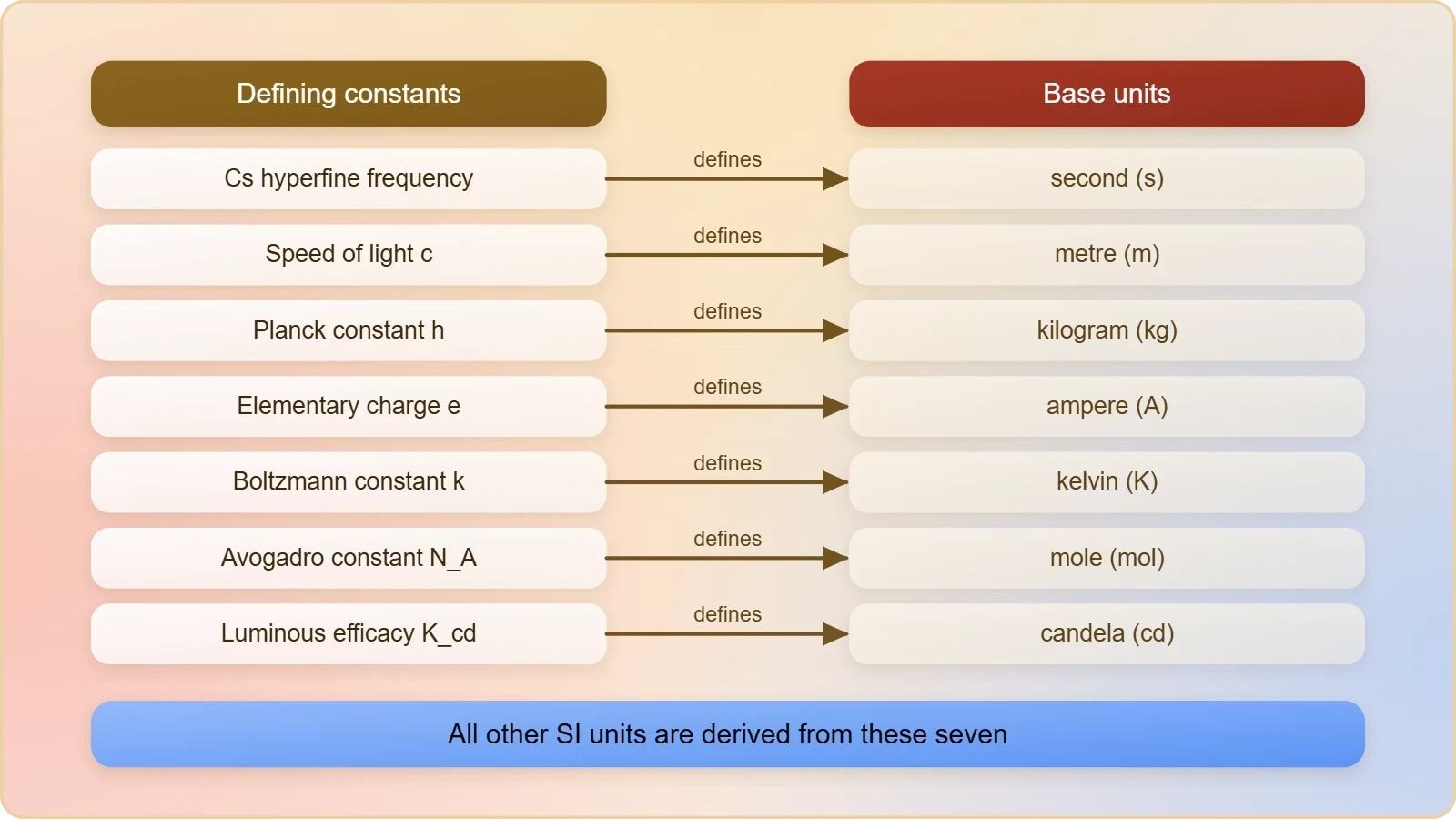
SI is built on seven defining constants whose fixed numerical values anchor the entire structure, replacing the historical reliance on material artefacts such as the platinum–iridium prototype kilogram. From these constants, seven base units are defined, and from the base units all other units are derived without additional conversion factors. The system also prescribes rules for prefixes, symbols, and the expression of values, ensuring that a measurement written in one laboratory can be interpreted identically in another. Its coherence, decimal structure, and traceability to fundamental physics distinguish it from earlier and competing systems of measurement.
The following reference page sets out the definition, historical development, core principles, classification of units, mathematical formulation, and practical application of SI. It treats the system as a knowledge object in its own right, examining how the definitions are constructed, how derived units are formed, and how the rules of style and notation operate. Worked examples, comparison tables, and revision points are included so that the material functions as a self-contained study resource for students of physics, chemistry, engineering, and metrology.
On This Page
- Definition and Meaning
- Etymology and Terminology
- Background and History
- Core Concepts and Principles
- Classification and Types of Units
- Formulation and Dimensional Analysis
- Properties and Characteristics
- Process of Realisation and Traceability
- Worked Examples
- Applications and Uses
- Advantages, Limitations and Common Misconceptions
- Related Terms
- Key Points for Revision
- Self-Check Questions
Definition and Meaning
The International System of Units is a decimal, coherent system of measurement adopted by international agreement and defined by a set of seven base units together with derived units formed from them. Its scope extends to every measurable physical quantity, from the smallest subatomic intervals to cosmological distances, and it specifies not only the units themselves but also the rules for writing their names, symbols, and numerical values. Coherence means that derived units are products or quotients of base units with no numerical factor other than one, so that equations between quantities hold identically between their units.
SI differs from a mere collection of units in that it is anchored to fixed numerical values of fundamental constants. Since the 2019 revision, the definitions of the base units no longer depend on physical prototypes but on exact values assigned to constants such as the speed of light, the Planck constant, and the elementary charge. This construction makes the system realisable anywhere in the universe with sufficient experimental capability, and it separates the definition of a unit from any particular realisation or measurement procedure.
The term is sometimes confused with the metric system, of which SI is the modern successor, and with the centimetre–gram–second systems that preceded it. SI is specifically the metre–kilogram–second–ampere system extended by the kelvin, mole, and candela, and it is distinguished by its seven-dimensional base, its set of twenty-two named derived units, and its formal governance by the CGPM. It is not a single instrument or standard but a documentary and institutional framework maintained through periodic conferences and consultative committees.
Etymology and Terminology
The name derives from the French Système International d’Unités, adopted by the eleventh General Conference on Weights and Measures in 1960 as the official title of the modernised metric system. The abbreviation SI was chosen because it is identical in all languages, avoiding the variation that would arise from translating the full name. The system is formally designated by the CGPM, and its documentation is published in the SI Brochure, issued by the BIPM and revised periodically to reflect decisions of the conference.
Terminology within SI is precise and hierarchical. A base unit is one of the seven units from which all others are derived; a derived unit is formed by multiplication or division of base units; a coherent derived unit is one whose defining product has a numerical factor of one. A prefix is a decimal multiplier attached to a unit name, and a symbol is the short written form of a unit. The distinction between a quantity, such as length, and its unit, such as the metre, is fundamental to correct usage and is enforced throughout the system’s documentation.
Alternative names and historical designations persist in specialised contexts. The term metric system remains in popular use, and older units such as the angstrom, the bar, and the calorie survive as non-SI units accepted for use with SI in particular fields. The SI Brochure distinguishes between units accepted for use with SI, such as the minute and the litre, and units that are deprecated or discouraged. These categories reflect a deliberate policy of gradual standardisation rather than abrupt prohibition.
Background and History
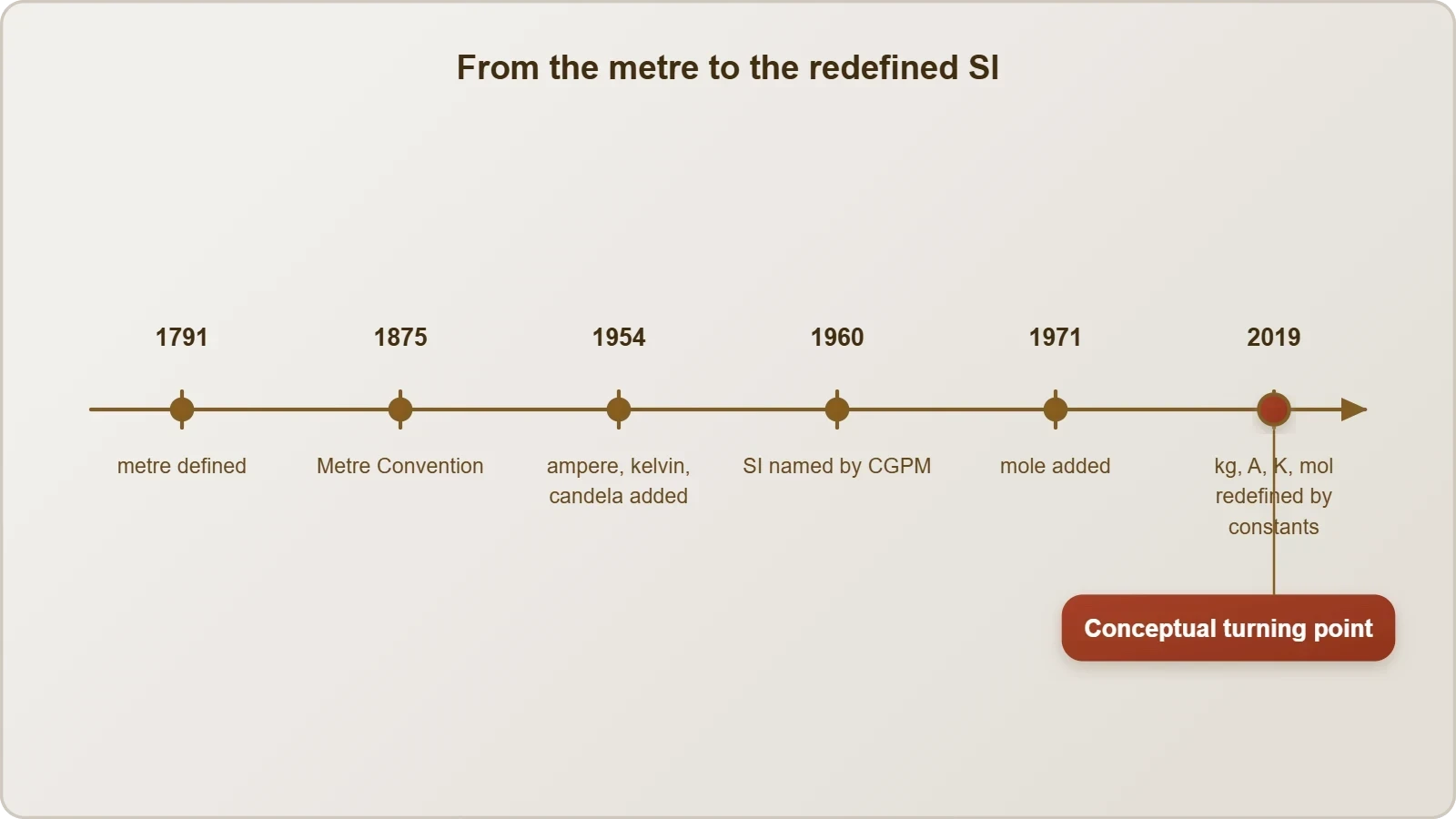
The origins of SI lie in the French Revolution, when the metric system was created to replace a patchwork of regional units with a rational, decimal, and universal scheme. The metre was defined in 1791 as one ten-millionth of the distance from the equator to the North Pole, and the kilogram as the mass of one cubic decimetre of water. The Convention of the Metre, signed in Paris in 1875, established the BIPM and the CGPM, creating the institutional machinery that still governs measurement today.
Through the late nineteenth and early twentieth centuries, the metric system expanded through the General Conference on Weights and Measures, which adopted successive revisions. The ampere, kelvin, and candela were added as base units in 1954, and the mole followed in 1971, completing the seven-base structure. The 1960 conference formally named the system and introduced the modern set of prefixes and derived units. Subsequent revisions refined definitions, culminating in the 2019 redefinition that tied all base units to fundamental constants.
The 2019 revision marked a conceptual turning point. The kilogram, ampere, kelvin, and mole were redefined in terms of the Planck constant, the elementary charge, the Boltzmann constant, and the Avogadro constant respectively, while the metre, second, and candela retained definitions already based on constants. The change eliminated the last material artefact, the international prototype kilogram, from the definitions and enabled quantum-based realisations such as the Kibble balance and the Josephson and quantum Hall effects to serve as primary standards.
Core Concepts and Principles
SI rests on the principle of coherence, whereby any derived unit is formed from base units by multiplication and division with a proportionality factor of one. This ensures that physical equations and their unit expressions are consistent, so that a quantity calculated in base units automatically carries the correct unit. Coherence eliminates the need for conversion factors in scientific computation and is the property that most sharply distinguishes SI from earlier systems containing arbitrary factors.
A second principle is the separation of definition from realisation. A unit is defined by a fixed numerical value of a constant, while its realisation is any experimental procedure that yields a value consistent with that definition. The metre, for example, is defined by the speed of light, but may be realised by interferometry, time-of-flight measurement, or other methods. This separation allows metrology to improve continuously without redefining the unit, and it permits multiple independent realisations to be compared for consistency.
A third principle is decimal structure. Prefixes denote powers of ten, and the system avoids non-decimal subdivisions except for the traditional units of time and angle. This structure simplifies calculation and reduces the risk of error in conversion. A fourth principle is traceability, the property by which any measurement can be related through an unbroken chain of calibrations to a primary standard or to a fixed constant, providing a basis for confidence in comparability across laboratories and nations.
Classification and Types of Units
SI units are classified into base units, coherent derived units with special names, and other derived units expressed directly in base units. The seven base units define the dimensions of the system, and each is associated with a particular kind of quantity. Derived units with special names, such as the newton, joule, and watt, are adopted for convenience and clarity, while all other derived units are written as products of base units. This hierarchy allows both compact notation and full dimensional transparency.
Beyond the core units, the system recognises units accepted for use with SI, including the minute, hour, day, degree, litre, tonne, and electronvolt. These are permitted because of their widespread practical importance, but they are not coherent with the base units and require conversion factors. A further category comprises units that are deprecated or discouraged, such as the centimetre–gram–second units and certain non-standard pressure and energy units, which remain in specialised use but are not recommended for new work.
Formulation and Dimensional Analysis
The mathematical structure of SI is expressed through dimensional analysis, in which each physical quantity is represented as a product of powers of the base dimensions. If a quantity ##Q## has dimensions ##[Q]##, then it can be written as a product of the base dimensions raised to exponents. This representation allows any derived unit to be expressed in terms of base units and provides a systematic method for checking the consistency of equations and for converting between units.
###[Q] = \mathrm{L}^{a}\,\mathrm{M}^{b}\,\mathrm{T}^{c}\,\mathrm{I}^{d}\,\Theta^{e}\,\mathrm{N}^{f}\,\mathrm{J}^{g}###
In this expression, ##\mathrm{L}##, ##\mathrm{M}##, ##\mathrm{T}##, ##\mathrm{I}##, ##\Theta##, ##\mathrm{N}##, and ##\mathrm{J}## denote the dimensions of length, mass, time, electric current, thermodynamic temperature, amount of substance, and luminous intensity respectively, while the exponents ##a## through ##g## are rational numbers. A quantity is dimensionless when all exponents are zero, and two quantities may be added or equated only when their dimensional exponents coincide. Dimensional analysis therefore serves as a consistency check and as a guide to the form of physical laws.
Derived units are constructed by substituting the dimensions of the defining quantities. Velocity, for example, has dimensions of length per time and the unit metre per second, ##\mathrm{m\,s^{-1}}##. Force, defined as mass times acceleration, has dimensions ##\mathrm{M\,L\,T^{-2}}## and the coherent unit kilogram metre per second squared, which is given the special name newton. Energy, force times distance, adds another power of length and yields the joule, while power, energy per time, yields the watt. Each named unit is thus a shorthand for a particular combination of base units.
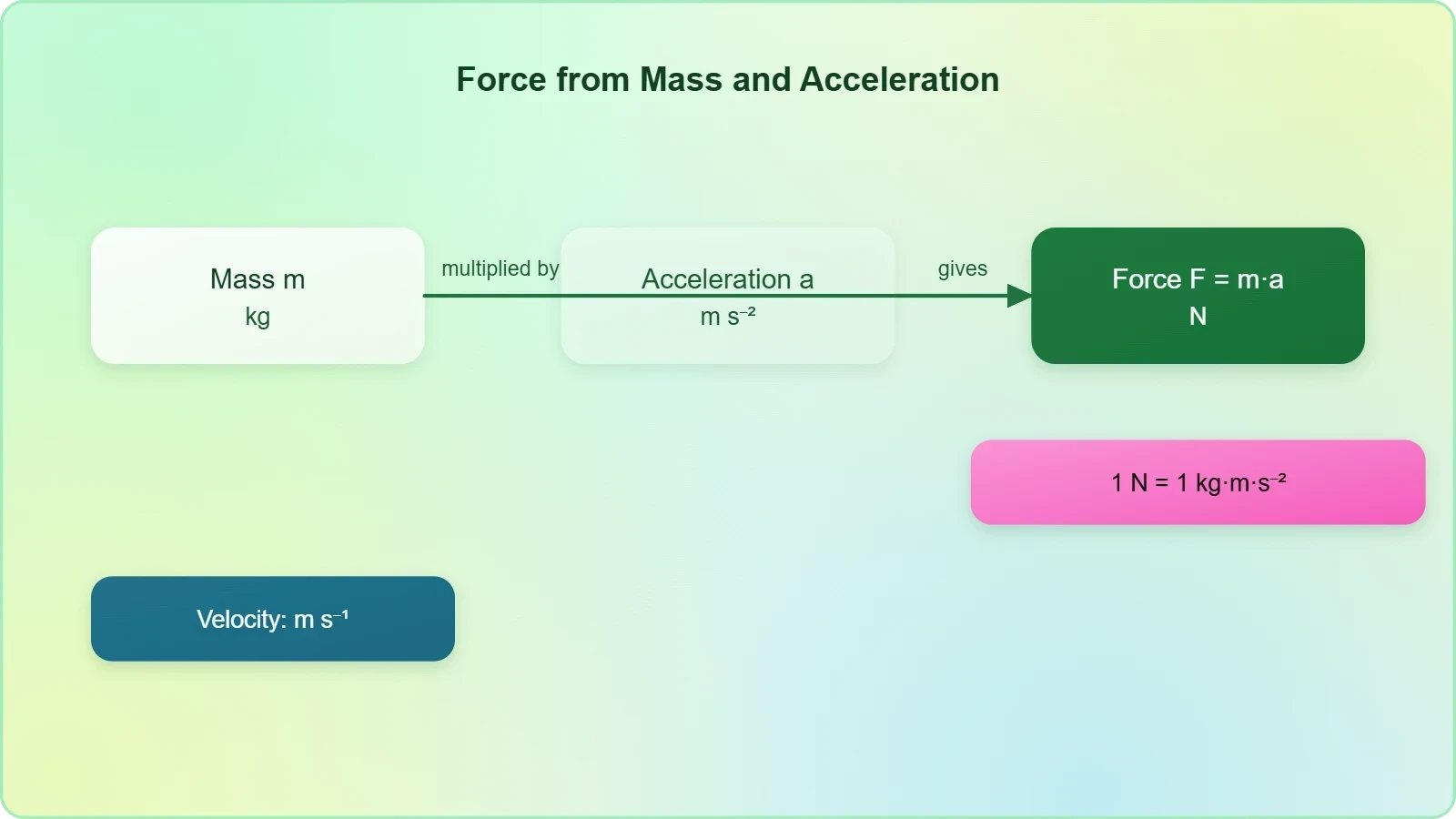
###1\,\mathrm{N} = 1\,\mathrm{kg\,m\,s^{-2}}, \qquad 1\,\mathrm{J} = 1\,\mathrm{N\,m} = 1\,\mathrm{kg\,m^{2}\,s^{-2}}, \qquad 1\,\mathrm{W} = 1\,\mathrm{J\,s^{-1}}###
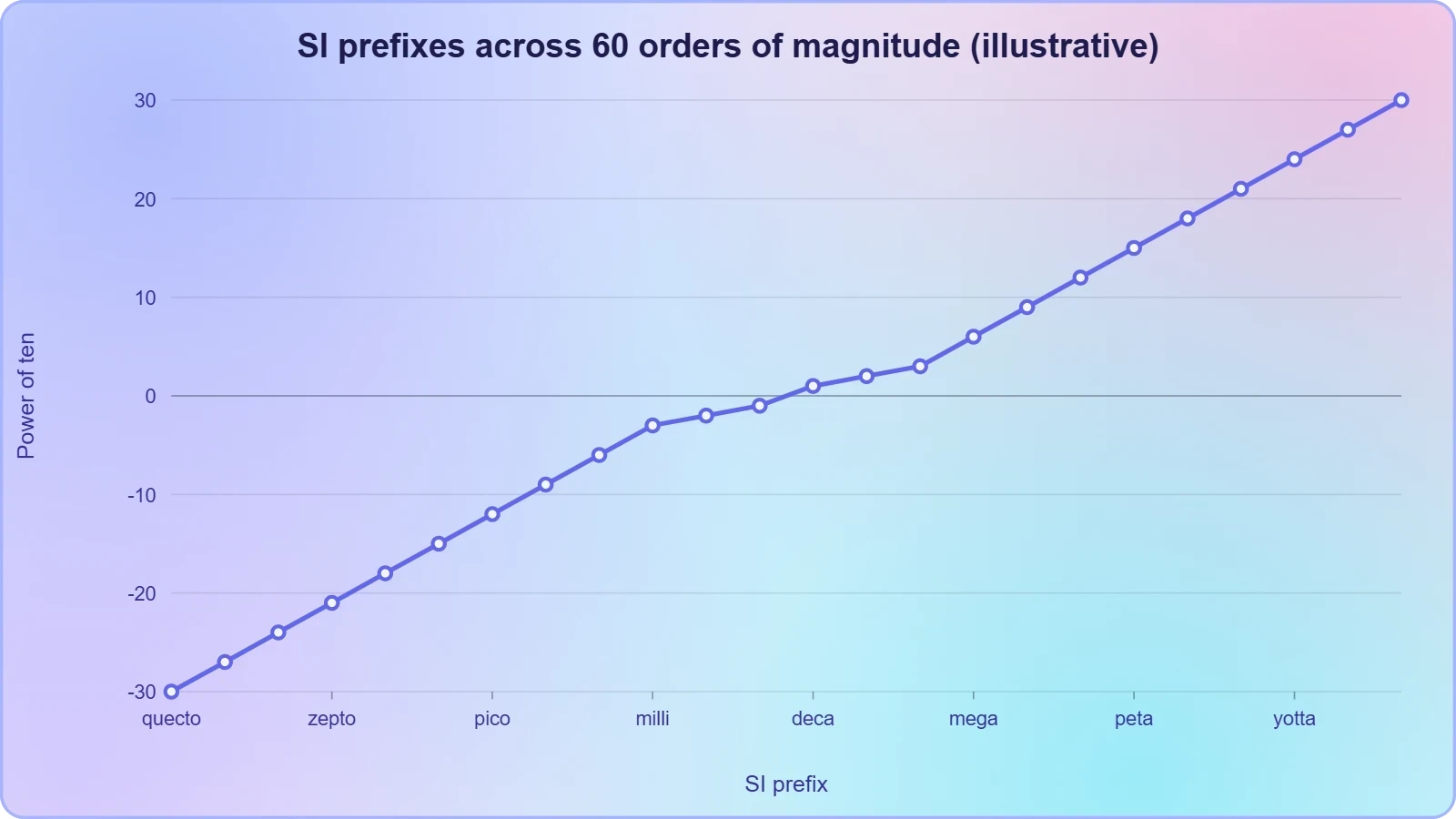
Prefixes extend the system across many orders of magnitude by attaching decimal multipliers to unit names and symbols. The prefix kilo denotes ##10^{3}##, milli denotes ##10^{-3}##, and the full set ranges from quetta at ##10^{30}## to quecto at ##10^{-30}##, the most recent additions adopted in 2022. Prefixes are applied to the unit symbol without a space, as in kilometre (km) or millisecond (ms), and compound prefixes such as kilokilo are prohibited. The prefix attaches to the unit as a whole, so that a square kilometre is ##(10^{3}\,\mathrm{m})^{2}## and not ##10^{3}\,\mathrm{m^{2}}##.
Properties and Characteristics
SI is characterised by universality, coherence, decimality, and traceability. Universality means that the system is adopted across scientific, industrial, and legal contexts worldwide, providing a common language for measurement. Coherence ensures that equations between quantities hold without conversion factors. Decimality simplifies scaling through prefixes. Traceability links every measurement to a defined constant through a documented chain of calibrations, enabling comparability and confidence in results across institutions and borders.
The system is also dynamic, in that its definitions are revised as measurement science advances while the numerical values of the units remain stable for practical purposes. The 2019 redefinition changed the conceptual basis of four units without altering their size, so that existing measurements and standards remained valid. This stability is a deliberate design feature: revisions aim to improve accuracy and reproducibility without disrupting the continuity of measurement on which commerce and science depend.
Another characteristic is the strict separation of quantity and unit in notation. Values are written as a number followed by a space and the unit symbol, such as ##9.81\ \mathrm{m\,s^{-2}}##, and unit symbols are never pluralised or followed by a full stop except at the end of a sentence. These conventions reduce ambiguity and are codified in the SI Brochure and in the standards of organisations such as ISO and IEC, which align their documentary rules with the CGPM decisions.
Process of Realisation and Traceability
The practical operation of SI proceeds through a defined chain from definition to measurement. The process begins with the fixed numerical values of the defining constants, which establish the size of each base unit. Primary standards laboratories then realise the units using experimental methods consistent with those definitions, and the results are compared internationally through key comparisons organised by the BIPM. National metrology institutes disseminate the units to calibration laboratories, which in turn calibrate industrial and scientific instruments.
- The CGPM fixes the numerical values of the defining constants and thereby the size of each base unit.
- National metrology institutes realise the units using primary methods such as atomic clocks, Kibble balances, and interferometry.
- The BIPM coordinates international comparisons to establish the degree of equivalence among national realisations.
- Calibration laboratories transfer the units to working standards and instruments through documented calibration chains.
- End users apply calibrated instruments, and the measurement remains traceable to the defining constants through the recorded chain.
Each step introduces uncertainty, and the combined uncertainty of a measurement is evaluated according to the Guide to the Expression of Uncertainty in Measurement. Traceability is not a guarantee of accuracy but a documented relationship that allows the uncertainty at each stage to be quantified and combined. The system thus provides not only units but also a framework for expressing the reliability of measurements, which is essential for conformity assessment, trade, and research.
Worked Examples
A first example illustrates unit conversion through prefixes. A length of ##2.5\ \mathrm{km}## is to be expressed in metres. Since the prefix kilo denotes ##10^{3}##, the value is multiplied by one thousand to give ##2500\ \mathrm{m}##, or ##2.5 \times 10^{3}\ \mathrm{m}## in scientific notation. The conversion requires no reference to the definition of the metre, only to the decimal relationship between the prefixed unit and the base unit, which is the practical advantage of a decimal system.
A second example demonstrates dimensional consistency. The kinetic energy of a body is given by ##E_k = \tfrac{1}{2}mv^{2}##. The mass ##m## has unit kilograms and the velocity ##v## has unit metres per second, so the product has unit ##\mathrm{kg\,m^{2}\,s^{-2}}##, which is the joule. The factor ##\tfrac{1}{2}## is dimensionless and does not affect the unit. The result confirms that the equation is dimensionally consistent and that the energy is correctly expressed in a coherent derived unit.
A third example concerns electrical quantities. The power dissipated in a resistor is ##P = VI##, where ##V## is the potential difference in volts and ##I## the current in amperes. The volt is the watt per ampere, so the product of volts and amperes yields the watt. Substituting the base-unit expressions gives ##\mathrm{kg\,m^{2}\,s^{-3}}##, confirming that electrical power and mechanical power share the same dimension and can be added in energy balances without conversion factors.
Applications and Uses
In physics and engineering, SI provides the basis for expressing mechanical, electrical, thermal, and optical quantities in a single coherent framework, allowing equations to be written without conversion factors. In chemistry, the mole and the associated molar quantities link macroscopic measurements to the number of elementary entities, while the kelvin underpins thermodynamic calculations. In medicine, SI units standardise dosages, concentrations, and physiological measurements, reducing the risk of error in clinical practice and pharmaceutical manufacturing.
In commerce and industry, SI units are the legal basis for trade in most countries, governing the specification of products, the calibration of instruments, and the verification of conformity. In metrology, the system provides the reference against which national standards are compared. In astronomy and geodesy, SI units are combined with accepted non-SI units such as the astronomical unit and the degree to express quantities across vast scales, while in everyday life the litre, the minute, and the degree Celsius remain familiar alongside the base units.
Advantages, Limitations and Common Misconceptions
The principal advantages of SI are its coherence, which removes conversion factors from equations, its decimal structure, which simplifies scaling, and its universality, which enables communication across disciplines and borders. Its definitions are tied to fundamental constants, allowing realisation anywhere and continuous improvement without redefinition. Traceability provides a documented basis for confidence in measurement, and the system’s institutional governance ensures that changes are made deliberately and with international consensus.
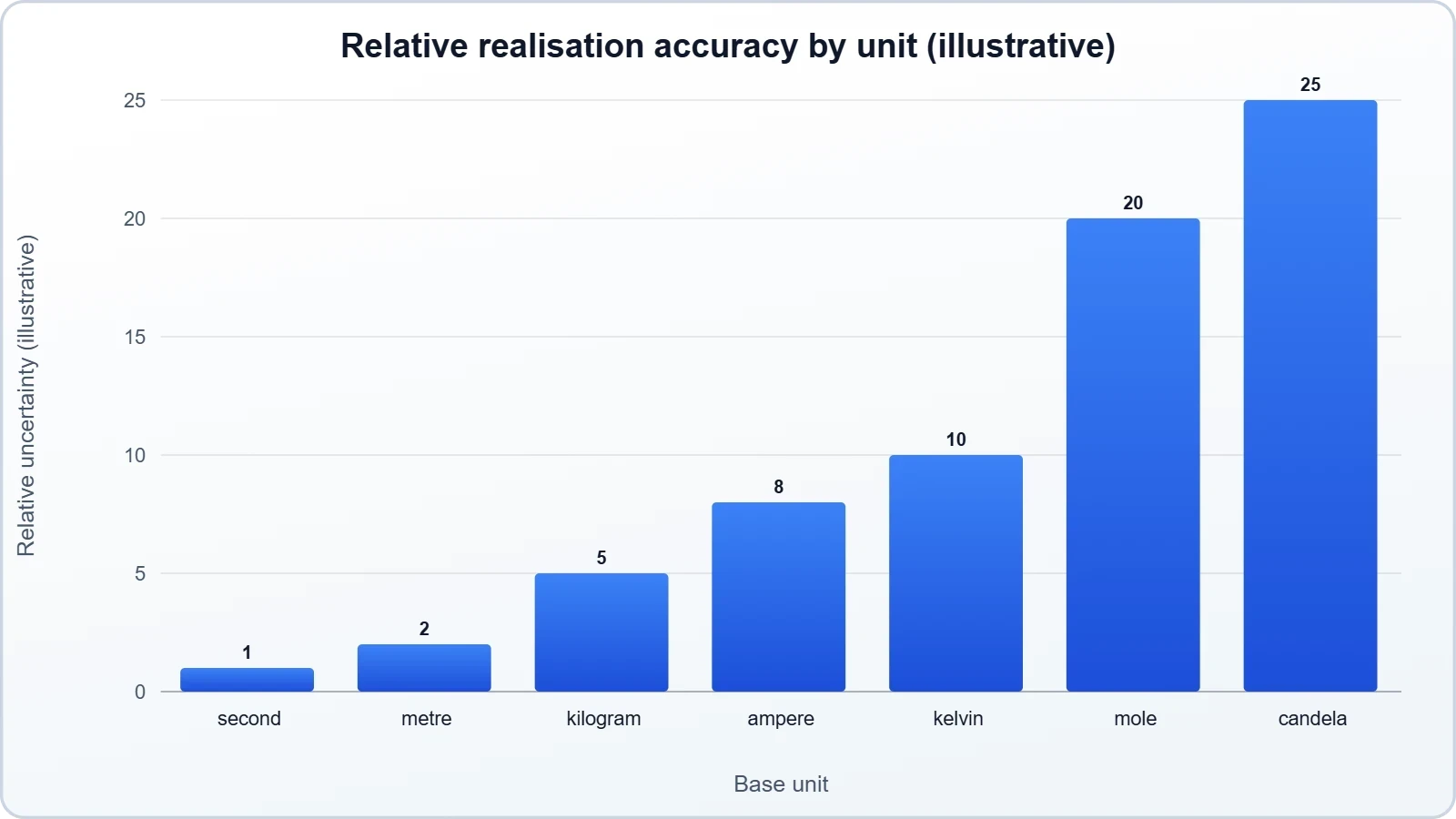
Limitations arise from the persistence of non-SI units in specialised fields and from the practical difficulty of realising some units with high accuracy. The second and metre are realised with extraordinary precision, while the candela and mole involve conventions and biological or perceptual factors that limit their reproducibility. The system also requires users to observe strict notation rules, and errors in prefix application or in the distinction between quantity and unit remain common in education and technical writing.
Several misconceptions recur. SI is sometimes described as identical to the metric system, although it is a specific modern subset with a defined base and governance. The kilogram is often thought to be defined by a physical object, a notion obsolete since 2019. The distinction between mass and weight is frequently blurred, leading to the incorrect use of kilograms for force. Prefixes are sometimes applied incorrectly to squared or cubed units, and unit symbols are occasionally pluralised or punctuated, contrary to the conventions of the system.
Related Terms
Key Points for Revision
- SI is governed by the CGPM and coordinated by the BIPM; its documentation is the SI Brochure.
- Seven base units: second, metre, kilogram, ampere, kelvin, mole, and candela.
- Since 2019, all base units are defined by fixed numerical values of fundamental constants.
- Coherence means derived units carry no numerical factor other than one.
- Twenty-two derived units have special names, including the newton, joule, watt, and pascal.
- Prefixes span from quetta (##10^{30}##) to quecto (##10^{-30}##) and attach to the unit as a whole.
- Values are written as a number, a space, and the unit symbol; symbols are not pluralised.
- Traceability links measurements to defining constants through documented calibration chains.
Self-Check Questions
1. How many base units does SI define, and what are they? Seven: second, metre, kilogram, ampere, kelvin, mole, and candela.
2. What changed in the 2019 redefinition? The kilogram, ampere, kelvin, and mole were redefined in terms of fixed values of the Planck constant, elementary charge, Boltzmann constant, and Avogadro constant, eliminating the last material artefact from the definitions.
3. What does coherence mean in SI? A derived unit is coherent when it is formed from base units with a numerical factor of one, so that equations hold without conversion factors.
4. Express the newton in base units. ##1\ \mathrm{N} = 1\ \mathrm{kg\,m\,s^{-2}}##.
5. Why is traceability important? It provides a documented chain linking a measurement to a defined constant, allowing uncertainties to be quantified and results to be compared across laboratories and countries.
6. Distinguish between a base unit and a derived unit. A base unit is one of the seven independent units of the system, while a derived unit is formed by combining base units through multiplication or division.
From our network :
- Mastering DB2 LUW v12 Tables: A Comprehensive Technical GuideComprehensive guide on DB2 LUW v12 tables. Explore CREATE TABLE syntax, BLU Acceleration, range partitioning, data types, and security features for IBM DB2 LUW v12.
- Mastering DB2 12.1 Instance Design: A Technical Deep Dive into Modern Database ArchitectureComprehensive guide to DB2 12.1 Instance Design. Explore architectural components, HADR setup, buffer pool tuning, and security policies for IBM DB2 12.1. Includes 10 functional SQL and Shell samples.
- Vite 6/7 'Cold Start' Regression in Massive Module GraphsIn-depth analysis of Vite 6/7 cold start regressions in massive module graphs. Learn about barrel file issues, pre-bundling optimizations, and how to improve Vite dev server performance.
- Analyzing Trump Deportation Numbers Insights Into The 2026 Immigration Crackdown
- AI-Powered 'Precision Diagnostic' Replaces Standard GRE Score ReportsDiscover the new GRE Precision Diagnostic. Learn how AI-powered behavioral analytics and time-to-solve tracking are replacing standard GRE score reports to empower students.
- 10 Physics Numerical Problems with Solutions for IIT JEEPrepare for IIT JEE with 10 physics numerical problems, complete with detailed solutions and conceptual explanations. Ideal for mastering kinematics, thermodynamics, electromagnetism, and optics.
- Trump Political Strategy How Geopolitical Stunts Serve As Media Diversions
- EV 2.0: The Solid-State Battery Breakthrough and Global Factory ExpansionDiscover the impact of the Solid-State Battery Breakthrough on the EV market. Learn about CATL and BYD stock growth, global factory expansion in Europe, and the future of EV 2.0 technology.
- 98% of Global MBA Programs Now Prefer GRE Over GMAT Focus EditionExplore why 98% of global MBA programs now prefer the GRE over GMAT Focus. Learn about the shorter GRE format, verbal logic importance, and strategic versatility for students.
RESOURCES
- SI Units | NISTnist.govThe International System of Units (SI), commonly known as the metric system, is the international standard for measurement. The International Treaty of the ...
- International System of Units - Wikipediaen.wikipedia.orgThe International System of Units, internationally known by the abbreviation SI is the modern form of the metric system and the world's most widely…
- The SI - BIPMbipm.orgThe International System of Units (SI). The globally agreed system of measurement used across science, industry, trade and society. A common language for ...
- The International System of Units (SI), 2019 Editionnvlpubs.nist.govCertain commercial entities, equipment, or materials may be identified in this document in order to describe an experimental procedure or concept adequately ...
- International System of Units | Measurement, Conversion & Historybritannica.com6 days ago ... The International System of Units (SI) is the international decimal system of weights and measures derived from the metric system.…
- Guide for the Use of the International System of Units (SI)nvlpubs.nist.govThe International System of Units, universally abbreviated SI (from the French Le Système. International d'Unités), is the modern metric system of measurement.
- traceable transmission curve reference material to improve ... - AMTamt.copernicus.orgMar 2, 2023 ... Development of an International System of Units (SI)-traceable transmission curve reference material to improve the quantitation and ...
- The International System of Units (SI)physics.nist.govThe International System of Units, universally abbreviated SI (from the French Le Syste`me International d'Unités), is the modern metric system of ...
- The international system of units (SI) in historical perspectivepubmed.ncbi.nlm.nih.govAmerican medical journals are shifting to selected SI (Système International d'Unités) units for reporting measurements. Limitation of SI units deemed ...
- The International System of Units (SI brochure (EN)): 8th edition, 2006pierre.ag.gerard.web.ulb.beThe SI is, of course, a living system which evolves, and which reflects current best measurement practice. This 8th edition therefore contains a number…
- Metric System – The International System of Units (SI)metricsystem.netThe SI is a rational measurement system. Each physical quantity has only one SI unit. For example, length is measured using the metre, and…
- Interpretation of the International System of Units (the Metric System ...federalregister.govMay 16, 2008 ... AGENCY: National Institute of Standards and Technology, Commerce. · ACTION: Notice. · SUMMARY: The International System of Units (SI) (the…
- Redefinition of the International System of Units (SI) based ... - codatacodata.orgThe General Conference of Weights and Measures will meet in Paris to vote on whether to re-define the International System of Units (SI) for…
- International system of units (SI): Application to crop science - 1981acsess.onlinelibrary.wiley.comThe adoption of the International System of Units (SI) has been recommended as a uniform method of reporting quantitative measurements.
- The Reform of the International System of Units (SI): Philosophical, Hroutledge.comSystems of units still fail to attract the philosophical attention they deserve, but this could change with the current reform of the International System ...