On This Page
Problem: The AM-HM Inequality in Average Speed Calculations
In kinematics, average speed is often misunderstood as the simple arithmetic mean of two speeds. However, the correct average depends on the condition of the journey. If a vehicle covers equal distances at two different speeds, the average speed is not the arithmetic mean. It is the harmonic mean.
Consider a vehicle traveling from point A to point B. It covers the first half of the total distance with speed ##v_1## and the second half with speed ##v_2##.
(a) Derive the expression for the average speed ##v_{\text{avg}}## over the entire journey.
(b) Using the Arithmetic Mean-Harmonic Mean inequality, prove that ##v_{\text{avg}}## is strictly less than the arithmetic mean
###v_{\text{mean}}=\frac{v_1+v_2}{2}###
provided ##v_1 \neq v_2##.
| Quantity | Symbol / Formula | Meaning |
|---|---|---|
| Total Distance | ##2d## | The complete distance from point A to point B. |
| First Half Distance | ##d## | Distance covered at speed ##v_1##. |
| Second Half Distance | ##d## | Distance covered at speed ##v_2##. |
| Average Speed | ##v_{\text{avg}}=\dfrac{\text{Total Distance}}{\text{Total Time}}## | The physically correct speed for the complete journey. |
Worked Solution and Step-by-Step Explanation
Part (a): Deriving the Average Speed
The average speed is defined as:
###v_{\text{avg}}=\frac{\text{Total Distance}}{\text{Total Time}}###
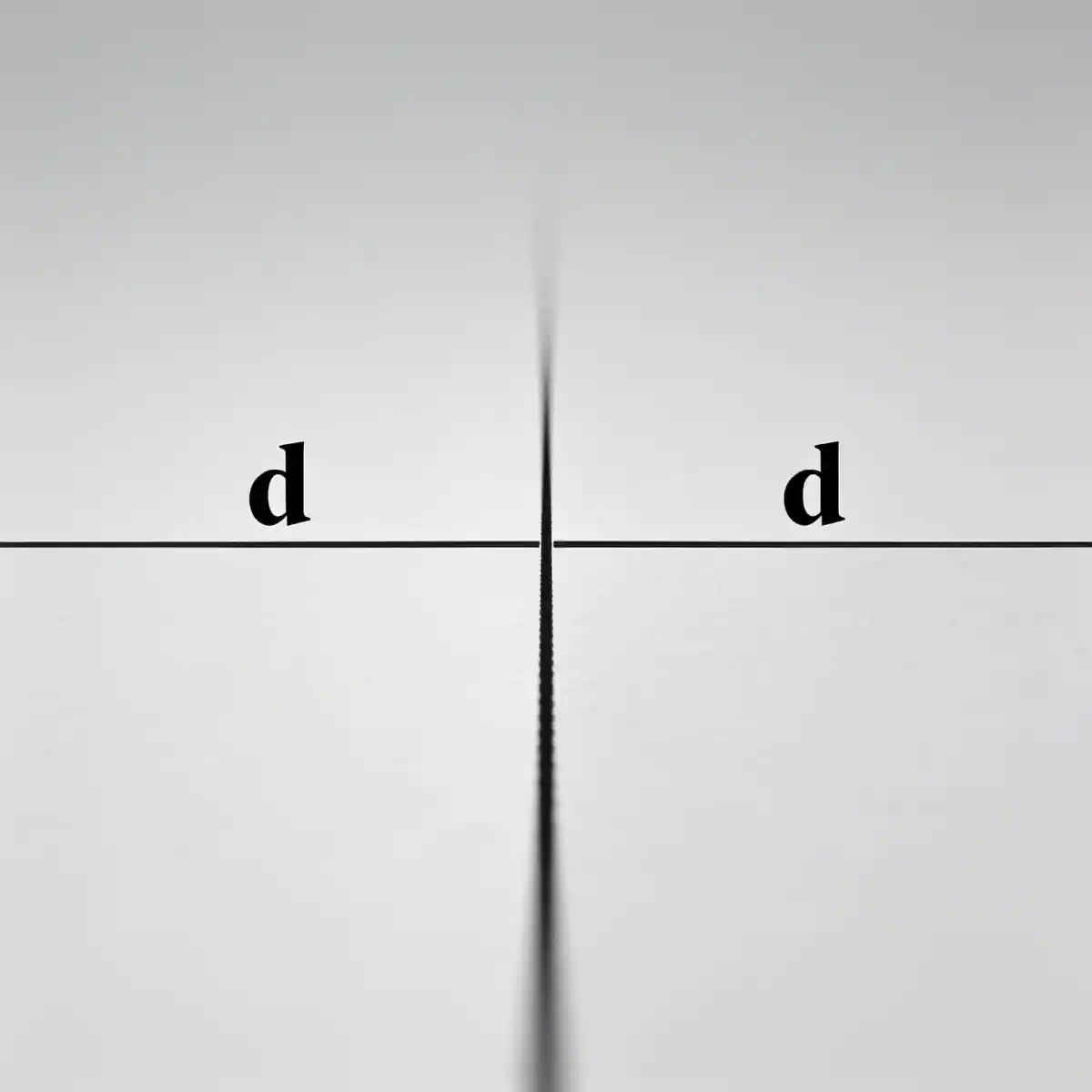
Let the total distance be ##2d##. Then each half of the journey has distance ##d##.
The time taken for the first half is:
###t_1=\frac{d}{v_1}###
The time taken for the second half is:
###t_2=\frac{d}{v_2}###
Therefore, the total time is:
###t_{\text{total}}=t_1+t_2###
Substituting the two time expressions:
###t_{\text{total}}=\frac{d}{v_1}+\frac{d}{v_2}###
Taking ##d## common:
###t_{\text{total}}=d\left(\frac{1}{v_1}+\frac{1}{v_2}\right)###
Combining the fractions:
###t_{\text{total}}=d\left(\frac{v_1+v_2}{v_1v_2}\right)###
Now substitute this into the definition of average speed:
###v_{\text{avg}}=\frac{2d}{d\left(\frac{v_1+v_2}{v_1v_2}\right)}###
Canceling ##d## and simplifying:
###v_{\text{avg}}=\frac{2v_1v_2}{v_1+v_2}###
Average Speed for Equal Distances
For two equal-distance segments covered at speeds ##v_1## and ##v_2##, the average speed is:
###\boxed{v_{\text{avg}}=\frac{2v_1v_2}{v_1+v_2}}###
This is the harmonic mean of the two speeds, not the arithmetic mean.
Part (b): Applying the AM-HM Inequality
The arithmetic mean of the two speeds is:
###\text{AM}=\frac{v_1+v_2}{2}###
The harmonic mean of the two speeds is:
###\text{HM}=\frac{2}{\frac{1}{v_1}+\frac{1}{v_2}}###
Simplifying the harmonic mean:
###\text{HM}=\frac{2v_1v_2}{v_1+v_2}###
But from Part (a),
###v_{\text{avg}}=\frac{2v_1v_2}{v_1+v_2}###
Therefore, the average speed for equal distances is the harmonic mean:
###v_{\text{avg}}=\text{HM}###
The AM-HM inequality states that for positive real numbers ##v_1## and ##v_2##,
###\text{AM}\geq \text{HM}###
Therefore,
###\frac{v_1+v_2}{2}\geq \frac{2v_1v_2}{v_1+v_2}###
Hence,
###v_{\text{mean}}\geq v_{\text{avg}}###
Proving the Strict Inequality When ##v_1 \neq v_2##
To prove that the inequality is strict when ##v_1\neq v_2##, consider the difference between the arithmetic mean and the harmonic mean:
###\text{AM}-\text{HM}=\frac{v_1+v_2}{2}-\frac{2v_1v_2}{v_1+v_2}###
Taking the common denominator ##2(v_1+v_2)##, we get:
###\text{AM}-\text{HM}=\frac{(v_1+v_2)^2-4v_1v_2}{2(v_1+v_2)}###
Expanding the numerator:
###\text{AM}-\text{HM}=\frac{v_1^2+2v_1v_2+v_2^2-4v_1v_2}{2(v_1+v_2)}###
Simplifying:
###\text{AM}-\text{HM}=\frac{v_1^2-2v_1v_2+v_2^2}{2(v_1+v_2)}###
Therefore,
###\text{AM}-\text{HM}=\frac{(v_1-v_2)^2}{2(v_1+v_2)}###
Since speeds are positive, ##v_1+v_2>0##. Also, if ##v_1\neq v_2##, then ##(v_1-v_2)^2>0##. Hence,
###\text{AM}-\text{HM}>0###
Thus,
###\text{AM}>\text{HM}###
Since ##v_{\text{avg}}=\text{HM}##, we finally get:
###v_{\text{mean}}>v_{\text{avg}}, \qquad \text{when } v_1\neq v_2###
| Quantity | Formula | Interpretation |
|---|---|---|
| Arithmetic Mean | ##\dfrac{v_1+v_2}{2}## | The simple average of two speeds. |
| Harmonic Mean | ##\dfrac{2v_1v_2}{v_1+v_2}## | The correct average speed when equal distances are covered at different speeds. |
| Average Speed | ##v_{\text{avg}}=\dfrac{2v_1v_2}{v_1+v_2}## | The harmonic mean of the speeds for equal-distance travel. |
| Difference Between AM and HM | ##\dfrac{(v_1-v_2)^2}{2(v_1+v_2)}## | The positive gap between the arithmetic mean and harmonic mean when ##v_1\neq v_2##. |
Conceptual Significance for JEE and NEET
Students often calculate average speed incorrectly as:
###\frac{v_1+v_2}{2}###
This is only correct when the object travels at ##v_1## and ##v_2## for equal time intervals. It is not correct when the distances covered at the two speeds are equal.
For equal distances, the slower speed has a greater effect on the average because the object spends more time traveling at the lower speed. This is why the harmonic mean appears naturally.
| Condition | Correct Mean | Formula |
|---|---|---|
| Equal time at each speed | Arithmetic Mean | ##v_{\text{avg}}=\dfrac{v_1+v_2}{2}## |
| Equal distance at each speed | Harmonic Mean | ##v_{\text{avg}}=\dfrac{2v_1v_2}{v_1+v_2}## |
Key Takeaways
1. Average speed must always be calculated from total distance and total time.
###v_{\text{avg}}=\frac{\text{Total Distance}}{\text{Total Time}}###
2. For equal distances, the average speed is the harmonic mean.
###v_{\text{avg}}=\frac{2v_1v_2}{v_1+v_2}###
3. For unequal speeds over equal distances, the harmonic mean is strictly less than the arithmetic mean.
###v_{\text{avg}}<\frac{v_1+v_2}{2}, \qquad v_1\neq v_2###
4. The equality case occurs only when both speeds are equal.
###v_{\text{avg}}=\frac{v_1+v_2}{2} \quad \text{only when} \quad v_1=v_2###
Final Conclusion
For a vehicle covering the first half of a journey at speed ##v_1## and the second half at speed ##v_2##, the average speed is:
###\boxed{v_{\text{avg}}=\frac{2v_1v_2}{v_1+v_2}}###
This is the harmonic mean of the two speeds. By the AM-HM inequality,
###\frac{v_1+v_2}{2}\geq \frac{2v_1v_2}{v_1+v_2}###
and the inequality is strict whenever ##v_1\neq v_2##. Therefore,
###\boxed{v_{\text{avg}}<v_{\text{mean}} \quad \text{for } v_1\neq v_2}###
Thus, when a body travels equal distances at different speeds, the correct average speed is always less than the arithmetic mean of those speeds.
RESOURCES
- What's a harmonic mean and why does everyone joke about it?reddit.comNov 22, 2022 ... It's most used in average speed over different speed calculations. ... It is used sparingly, but is well studied (e.g.,…
- Harmonic mean - Wikipediaen.wikipedia.org... average speed is the arithmetic mean of all the sub-trip speeds. If neither ... HM-GM-AM-QM inequalities · Harmonic mean p-value · Harmonic number…
- About mean: RMS AM GM HM Inequality - Desmosdesmos.comHM - Harmonic Mean - useful to calculate average speed. HM - Harmonic Mean - useful to calculate average speed. 4. expression 5 (Hidden)…
- Power Means (AM-GM Part 3) - gtMathgtmath.comApr 10, 2016 ... At the most basic level, our "average speed" for the trip ... HM and AM satisfy an inequality similar to…
- Pythagorean Means — Definition, Formula & Examples - Mathwordsmathwords.comProblem: Find the arithmetic, geometric, and harmonic means of 4 and 16, and verify the AM–GM–HM inequality. Arithmetic Mean: Add the values and divide…
- Why is the inverse of an average of numbers not the same as the ...math.stackexchange.comFeb 10, 2019 ... If you travel from here to there at 30 miles per hour and back at 60 miles per hour, what…
- Harmonic Mean — Definition, Formula & Examples - Mathwordsmathwords.comStep 1: Identify the two speeds and note that the distances are equal, so the harmonic mean gives the correct average speed. ... It…
- Understanding the AM, GM, and HM of two positive real numbersvaia.comThe HM provides the overall average speed for the entire journey when time ... AM-GM-HM Inequality. One of mathematics' fundamental inequalities is the AM-GM-HM ...
- Four Kinds of “Mean” - The Math Doctorsthemathdoctors.orgOct 27, 2020 ... Arithmetic/Geometric Mean Inequality Theorem. This can be extended further to the HM-GM-AM-QM inequality ... We saw last week how average…
- The Shape of Inequalities | Personal Site of Andrei N. Ciobanuandreinc.netMar 16, 2026 ... The HM-AM-GM-QM Inequality · HM = Harmonic Mean : Even if it sounds counterintuitive to an untrained eye, this mean…
- Why You Shouldn't Speed (with mathematical proof) - Albert Carlsonalbertbencarlson.comOct 29, 2024 ... ... average out so your average speed is 100kmph. However, this is NOT the case, and in fact, it follows…
- A visual proof that Arithmetic mean > Geometric mean > Harmonic ...facebook.comSep 13, 2020 ... Arithmetic mean and Geometric mean Inequality, abbreviated as AM-GM Inequality ... speeds, the harmonic mean gives the correct average speed ...
- Season 3 Episode 5 - Mathematical Institute - University of Oxfordmaths.ox.ac.ukApr 29, 2022 ... In this episode, Ittihad introduces inequalities, from AM-GM to the Power Mean Inequality. ... What's my average speed? Hint: not…
- On Compass and Straightedge Constructions: Meanssites.math.washington.eduMay 24, 2013 ... What was his average speed for the entire trip? A quick ... Thus, FH is the harmonic mean. 4.4 AM-GM-HM…
- Cardiovascular Health, Race, and Decline in Cognitive Function in ...ahajournals.orgApr 24, 2024 ... ... inequality in dementia risk. Knowledge about midlife women's ... The mean±SD cognitive scores were 58.2±11.1 for processing speed and ...



0 Comments